Year: 2021

09 Feb 2021

Aurora strikes deal with Toyota, Denso to develop, test self-driving Sienna minivans

Aurora has reached a deal with Toyota and auto-parts supplier Denso to develop and test vehicles equipped with the self-driving startup’s technology, beginning with a fleet of Toyota Sienna minivans.

Engineering teams from Aurora and Toyota will work together to design and build the self-driving Sienna minivans with an aim to start testing a fleet by the end of 2021, the companies said Tuesday.

The announcement follows Aurora’s acquisition of Uber Advanced Technologies Group, which spun out from Uber in 2019 after the unit raised $1 billion in funding from Toyota, Denso and SoftBank’s Vision Fund. The acquisition, which closed January 20, was a complex deal in which Uber handed over its equity in ATG and invested $400 million into Aurora. Uber now holds a 26% stake in the combined company. Toyota also has a minority stake in Aurora as a result of the acquisition.

The partnership announced Tuesday is similar — at least in part — to an agreement reached in 2018 between Toyota and Uber to bring an on-demand autonomous ride-hailing service to market. Under that deal, which included a $500 million investment by Toyota, the companies agreed to integrate Uber ATG’s self-driving technology into the Sienna minivans for use in Uber’s ride-hailing network. The vehicles later could be owned and operated by third-party fleet managers, Toyota and Uber ATG said at the time.

Aurora co-founder and chief product officer Sterling Anderson emphasized that this is a new partnership and not just an extension of Toyota’s agreement with Uber ATG.

Toyota and Aurora declined to disclose details such as the size of the team or whether there were financial incentives tied to the deal, making it difficult to determine the scope of the collaboration.

However, Aurora describes this as a long-term strategic deal and laid out an ambitious vision for a partnership that extends far beyond testing. Aurora said that the joint development work in 2021 will lay the groundwork for the mass production and launch of these vehicles with Toyota on ride-hailing networks, including Uber’s. Aurora said it will also explore mass production of autonomous driving components with Denso and the creation of a services platform with Toyota that could manage financing, insurance and maintenance of the self-driving vehicles.

Anderson noted that the development of these commercial downstream services such as fleet management has become increasingly important for the company following its agreement with trucking firm PACCAR and now Toyota.

“We need a vehicle, we need a driver and we need support services,” Anderson said in a recent interview. “One of the areas that we’re exploring with Toyota as part of this, is the scaled deployment of Toyota-built vehicles, powered by the Aurora driver, supported by a combination of Aurora’s support services as well as Toyota’s network. This is one of the areas where Toyota’s scale becomes so significant to us.”

The path from testing to commercialization is a long one, riddled with potential speed bumps, including technical and regulatory challenges, competing with rivals over skilled workers and raising enough capital. Achieving these doesn’t always equate to success as operating an autonomous ride-hailing network has its own set of hurdles. The upshot: Aurora’s partnership with Toyota is no guarantee.

Still, locking in a partnership with a large automaker is still important for Aurora.

“Toyota has an unparalleled legacy, engineering expertise, leadership, and ability to deliver high-quality, affordable, and reliable vehicles,” Aurora co-founder and CEO Chris Urmson wrote in a blog post Tuesday. “They’re also the preferred vehicle brand for transporting riders on ride-hailing networks, so we’re excited and honored to work with them to unlock driverless mobility services with the Aurora Driver.”

Urmson added that Aurora’s development work on highway driving to support its first commercial product, a driverless truck, “will also be critical for safely moving people, as a significant fraction of ride-share bookings today require the ability to drive over 50 mph.”

09 Feb 2021

Spotify confirms it’s (finally) testing a lyrics feature in the U.S.

Spotify this morning confirmed it’s testing a new, synced lyrics feature in the U.S. market, following a report from Engadget. Though the streaming music service today offers live lyrics in a number of markets — 27, in fact, including its recent launch in South Korea — it has not offered lyrics in the U.S. for many years. Instead, Spotify here runs the “Behind the Lyrics” feature provided in partnership with Genius, which offers a combination of lyrics and trivia about the song being played.

Reached for comment, Spotify said the new Lyrics feature rolled out as a test for some users in the U.S. starting today.

“We can confirm we’re currently testing our lyrics feature to a select number of users in the U.S.,” a spokesperson told TechCrunch. “At Spotify, we routinely conduct a number of tests in an effort to improve our user experience. Some of those tests end up paving the way for our broader user experience and others serve only as an important learning.”

The company declined to share additional details about its plans, but did note that its U.S. partner on the new Lyrics feature is Musixmatch — a service that already powers Spotify’s lyrics feature in various non-U.S. markets.

This is not the first time Spotify has run a lyrics feature in the U.S., to be clear. The streaming service had originally worked with Musixmatch from 2011 through 2016, before ending that relationship to instead partner with Genius. But despite ongoing user demand for lyrics’ return, Spotify never brought the feature back to the U.S.

In more recent years, however, Spotify rekindled its relationship with Musixmatch. Last year, it announced the launch of real-time lyrics in, then, 26 worldwide markets across Southeast Asia, India and Latin America. This had been the first time lyrics were offered in 22 of these 26 markets, as only Thailand, Vietnam, Indonesia and Mexico had some form of prior lyrics support via other providers.

Spotify’s ongoing lack of support for lyrics in the U.S. has given its streaming music competitors an advantage. Amazon Music, for example, allowed users to view lyrics as songs played and tied the feature to its Alexa voice platform, so consumers could ask Alexa to search for songs by lyrics. Meanwhile, the updated version of Apple Music that rolled out with iOS 12 in 2018 included a way to search by lyrics, instead of just artist, album or song title. It later added live, synced lyrics with the launch of iOS 13. Siri can also respond to commands that involve lyrics.

Musixmatch additionally confirmed it has partnered with Spotify on the new U.S. test.

“Musixmatch is keeping growing at a fast pace thanks to our continued investment we’ve made [over] a decade. We’re focused now on bringing more data to continue enriching the audio experience globally,” Musixmatch CEO and founder Max Ciocciola told TechCrunch.

Because the lyrics feature is only a test, you may not see it yourself in the Spotify app, due to its limited availability. Spotify has not said if or when the test may be expanded.

09 Feb 2021

Mighty Buildings nabs $40M Series B to 3D print your next house

Once upon a time, the idea of 3D-printed homes felt like a thing of the future.

But as housing gets less and less affordable — especially in ultra-expensive markets such as the Bay Area — companies are getting creative in their quest to build more affordable homes using technology.

One of those companies, Oakland-based Mighty Buildings, just raised $40 million in Series B funding for its quest to create homes that it says are “beautiful, sustainable and affordable” using 3D printing, robotics and automation. It claims to be able to 3D print structures “two times as quickly with 95% less labor hours and 10-times less waste” than conventional construction. For example, it says it can 3D print a 350-square-foot studio apartment in just 24 hours.

The four-year-old startup’s efforts caught the eye of Khosla Ventures, which co-led the financing along with Zeno Ventures. 

Ryno Blignaut, an operating partner at Khosla, believes that Mighty Buildings — which launched out of stealth last August — has the potential to cut both the cost and carbon footprint of home construction “by 50% or more.”

The company takes a hybrid approach to home construction, combining 3D printing and prefab (meaning built offsite) building, according to co-founder and COO Alexey Dubov. It has invented a proprietary thermoset composite material called Light Stone Material (LSM) as part of its effort to reduce the home construction industry’s reliance on concrete and steel. 

The material can be 3D printed and hardens almost immediately, according to the company, while also maintaining cohesion between layers to create a monolithic structure. Mighty Buildings can then 3D print elements like overhangs or ceilings without the need for additional supporting formwork. That way, it’s able to fully print a structure and not just the walls. 

Robotic arms can post-process the composite, which combined with the company’s ability to automate the pouring of insulation and the 3D printing gives Mighty Buildings the ability to automate up to 80% of the construction process, the company claims.

Khosla was drawn to the Mighty Buildings’ innovative approach.

“We believe in dematerializing buildings and non-linearly reducing the amount of cement and steel used, thereby reducing the cost of construction in order to increase affordable access to housing together with improved sustainability,” Blignaut wrote via email.

Mighty Building’s use of 3D printing, advanced manufacturing techniques, modern robotics and “new lighter and stronger materials” gives it an edge, he added.

Since its launch, the company has produced and installed a number of accessory dwelling units (ADUs) and is now taking orders for Mighty Houses — its newest product line that will range from 864 to 1,440 square feet at an estimated cost of $304,000 to $420,500. (Similarly sized houses in some parts of the Bay Area can sell for upwards of $1 million).

The units are created with a 3D-printed exterior panelized shell while certain elements — such as bathrooms for example — are prefabricated in the company’s 79,000-square-foot production facility in Oakland. 

For now, the company is only building in California, but Dubov says it’s open to exploring other markets as its factory can be replicated.

Also, Mighty Buildings plans this year to market its Mighty Kit System and a new fiber-reinforced material for multi-story projects as part of a planned B2B platform for developers. In fact, the company already has secured contracts with developers for its single family housing product line. It also plans to use the new capital in part to scale its production capacity with increased automation.

Ultimately, Mighty Building’s vision is to provide production-as-a-service, with builders and architects designing their own structures and then developers using Mighty Factories to produce them at scale.

Mighty Buildings is not the only startup doing 3D-printed homes. Last August, Austin-based ICON raised $35 million in Series A funding. The company also aims to reinvent building affordable homes with the use of 3D printers, robotics and advanced materials. The biggest difference between the two companies, according to Dubov, is that ICON does primarily onsite construction while Mighty Buildings prefabricates in a factory.

More than a dozen other investors also participated in Mighty Building’s latest round, including returning backers Bold Capital Partners, Core Innovation Capital and Foundamental and new investors including ArcTern Ventures, Abies Ventures, Modern Venture Partners, MicroVentures, One Way Ventures, Polyvalent Capital and others. Mighty Buildings was also included in Y Combinator’s Top companies list, all of which have valuations over $150 million (although the company declined to reveal its current valuation). 

For its part, Khosla’s Blignaut believes that buildings are “a big part of our urban landscape and a large consumer of resources.”

“Construction and building account for more carbon emissions in the U.S. than transportation or industry,” he said. Other portfolio companies addressing such challenges include Ori Living, Vicarious, Katerra and Arevo.

09 Feb 2021

Mexican online grocer Jüsto raises $65M in General Atlantic-led Series A

Jüsto, an online supermarket based in Mexico City, announced Tuesday it has raised $65 million in Series A round led by General Atlantic.

The amount is sizable for a Series A in general, but supersized for a LatAm startup. In fact, according to Pitchbook data cited by General Atlantic, the round represents the largest Series A raised in Latin America in the past decade.

Existing backers also participated in the round including Foundation Capital and Mountain Nazca.

Ricardo Weder, former president of Cabify (a large ride-sharing company operating in Latin America, Spain, and Portugal) founded Jüsto in 2019 with a mission to “disrupt the Latin American grocery industry.” It claims to be the first supermarket in Mexico with no physical store. Customers can buy their groceries directly from the website or via the app and Jüsto delivers the order to the customer’s location of choice.

The concept is clearly resonating with consumers as Jüsto saw impressive growth in 2020 with a 16-fold increase in revenue. 

Jüsto prides itself on working directly with fresh produce suppliers so that it can offer “the freshest” fruits, vegetables, meats and fish in the market. It also offers a variety of products such as pantry staples, personal hygiene and beauty, home and cleaning, drinks and pet-related items.

The startup only sells items from local suppliers, with whom it prides itself on developing fair trade agreements. (“Jüsto” means fair in Spanish) It also uses artificial intelligence to forecast demand and to try and reduce food waste at its micro-fulfillment centers. The company’s approach results in “competitive prices, lower transaction costs, and improved convenience to consumers by eliminating intermediaries in the supply chain,” according to the company.

Looking ahead, Jüsto plans to use its new capital on expanding across Mexico and Latin America as a whole, enhancing its last-mile logistics infrastructure and marketing initiatives.

Luis Cervantes, managing director and head of Mexico City for General Atlantic, believes Mexico is at an inflection point in its transition to a digital economy.

“We see Jüsto as leading the way in the high-growth online grocery space with its technology-centric, mission-driven approach,” he said in a written statement. “Under Ricardo’s leadership, we believe Jüsto is positioned for significant expansion as it disrupts and transforms the legacy grocery value chain.”

 Jüsto marks General Atlantic’s fifth investment in Mexico since 2014. Since then, General Atlantic has invested nearly USD $1 billion in what it describes as “high-growth” Mexican companies. 

The financing brings Jüsto’s total raised to over $100 million. Other investors include FEMSA Ventures, S7V, Elevar Equity, Bimbo Ventures, Quiet Capital, Sweet Capital, H2O Capital  and SV LatAm Capital, among others.

09 Feb 2021

What should banking look like for modern couples?

Zeta co-founder Aditi Shekar has spent the past three years tracking the ways couples share and manage their finances, from each card swipe to every split bill. Her effort led to tens of thousands of couples signing up for a free budgeting app experiment. Today, those learnings have been formed into a venture-backed startup.

Zeta is a new fintech platform that helps couples join their finances. Zeta isn’t creating the concept of joint accounts; it’s simply trying to rebuild them for the modern family. Currently, joint accounts lack transparency or the option to add multiple users that come from different relationships in your life. Many standard joint accounts just give every user entire access to other users’ finances, versus tiered ways to spend.

Shekar, who started the company after experiencing the stress of dividing and dealing with money in her own relationship, says the goal of Zeta is to take the “cognitive load” of dealing with money off of people in a relationship.

Off that vision, Shekar and her co-founder Kevin Hopkins have raised $1.5 million in a round co-led by Deciens Capital and Precursor with participation from executives from Chime, Square, PayPal, Venmo, Google, Facebook and Weight Watchers. Shekar says that 57% of its cap table is women or people of color.

“In some ways, we see ourselves as part of a replacement for Venmo,” Shekar said. “We saw couples Venmoing back and forth to each other sometimes six times a day…we want to take over your money chores.” While Zeta is entering the market as a tool for couples, Shekar sees the startup’s moonshot as being the go-to operational account for any modern household.

A tool like Zeta is trying to give already existent transactions — begging for a rent check, splitting the grocery bill, going halfsies on dinner, giving allowance — an easier way to be completed.

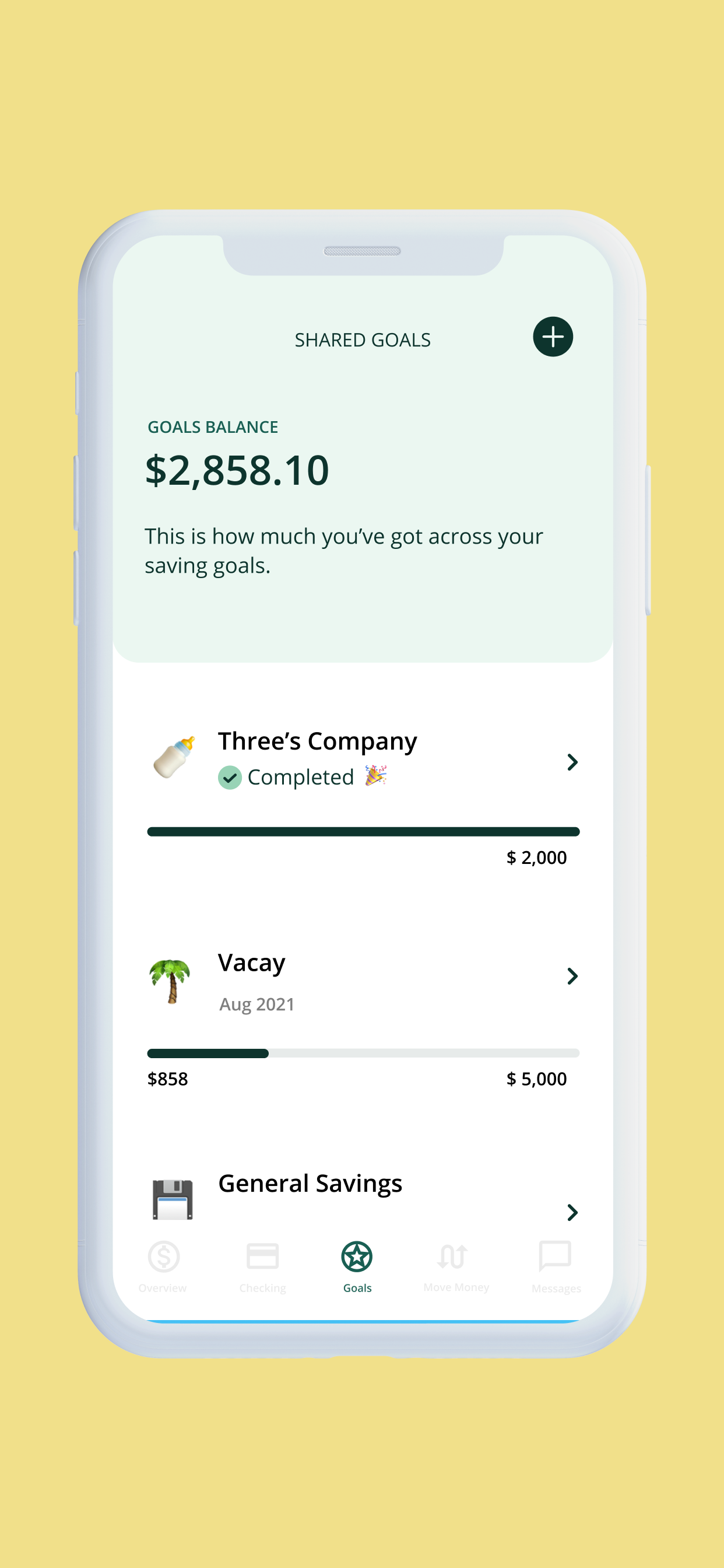
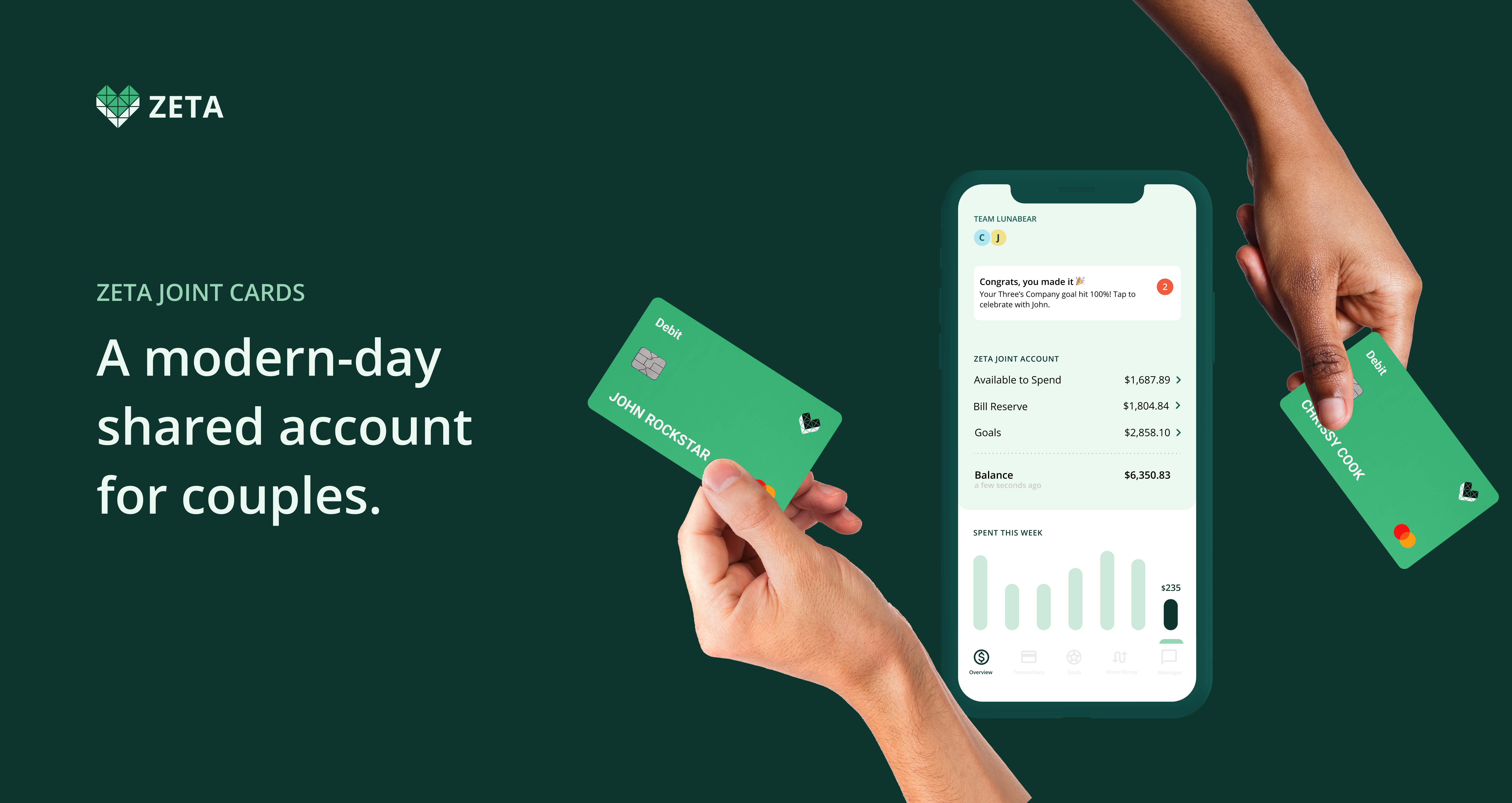
In reality, the startup works as a First Republic or Chase replacement, providing a digital layer of banking services that can integrate with pre-existing bank accounts. Couples who download Zeta will each get a Zeta joint card and a joint account to layer atop their finances. The joint card will serve as the way that couples can spend from the same account.

So far, users use their Zeta account in two main ways: have it take over standing bills such as rent or mortgage, or have it serve as a savings account for mutual goals, such as a post-COVID trip or big shared purchase like a car or home. Users can direct-deposit as much money as they want from their main bank accounts into Zeta, and then use the Zeta debit card to swipe couple money instead of individual money.

“There are a lot of fintechs that will go after the direct deposit,” Shekar said. “But we really thought about Zeta as the layer on top of existing accounts so you don’t have to move everything over.”

Similar to Chime, Zeta makes money from interchange fees, the cost it takes for a merchant to process your payment, on card transactions. A portion of the interchange fee is paid to Zeta, and a portion goes to your bank.

“If you and your partner wanted to share rent and pay bills together we’d be the natural place to plug into,” she said.

“Frankly, institutions have treated people as single-player games,” Shekar said. “Fintech is way more social than we realize.”

The success of Zeta hinges on the idea that people want to share their finances in an ongoing and meaningful way, and that the world of finance is ready to shift from individualism to collectivism earlier and louder. It sounds daunting, but we already know that social finance is big, as shown by apps like Venmo and Splitwise, and phenomena like the GameStop saga from just a few weeks ago.

Other startups have taken notice too, entering the world of multiplayer fintech, a term that categorizes socially focused and consumer-friendly financial services. Braid, a group-financing platform, is trying to make transactions work for various entities, from shared households to side hustles to creative projects.

Braid founder Amanda Payton breaks down the concept of multi-player, social finance into two phases: if 1.0 was Venmo, then 2.0 will “enable sharing money at the account and transaction level,” she says.

“I think about it this way: The current set of mainstream financial products supports my money and your money. Social finance 2.0 will be all about our money,” Peyton said.

“Banks have historically prioritized growing their own customer base. They haven’t invested a lot in products that promote sharing money, regardless of where your primary checking account lives…Zelle is a noticeable exception here,” she said. “And it’s not hard to see why, there’s little tangible benefit for them to do so.”

Zeta differentiates from Braid in that it is solely focused on couples and families, which lets it do things like pay bills and save money to plan for the financial future. Shekar says that it plans to support families in broader ways over time, such as being part of taxes or prenuptial agreements. That said, Zeta currently only supports two people per account, while Braid already has the capability to add multiple parties to its joint account.

The biggest hurdle for Zeta is if people trust each other enough to get into operational accounts with each other to do it. Individualism isn’t just a lazy reaction to lack of tooling out there; for many people, keeping your money to yourself is a preference. Of course, the flip-side of shared finances is dealing with the repercussions of ending that relationship if life gets in the way.

Image Credits: Zeta

“Break-up was the first feature we ever built,” Shekar said. Right now, there are no clear ways that Zeta can define what happens to the money in the shared account if people break up (no, there’s no clause that requires you to split money down the middle).

The startup is thinking about adding a feature during on-boarding that asks users what they prefer happens “in the event of a closure.”

“The psychology you need to have to open an account together is that you really trust your partner,” she said. “If you don’t trust your partner you might not be ready for this.”

Image Credits: Zeta

09 Feb 2021

Mount Sinai study finds Apple Watch can predict COVID-19 diagnosis up to a week before testing

A new study from Mount Sinai researchers published in the peer-reviewed Journal of Medical Internet Research found that wearable hardware, and specifically the Apple Watch, can effectively predict a positive COVID-19 diagnosis up to a week before current PCR-based nasal swab tests.

The investigation dubbed the ‘Warrior Watch Study,‘ used a dedicated Apple Watch and iPhone app and included participants from Mount Sinai staff. It required participants to use the app for health data monitoring and collection, and also asked that they fill out a day survey to provide direct feedback about their potential COVID-19 symptoms, and other factor including stress.

During the course of the study, the research team enlisted “several hundred health care workers” to participate, and collected data over several months, between April and September. The primary biometric signal that the study’s authors were watching was heart rate variability (HRV), which is a key indicator of strain on a person’s nervous system. This information was combined with information around reported symptoms associated with COVID-19, including fever, aches, dry cough, gastrointestinal issues, loss of taste and smell, among others.

The Warrior Watch Study was not only able to predict infections up to a week before tests provided confirmed diagnoses, but also revealed that participants’ HRV patterns normalized fairly quickly after their diagnosis, returning to normal roughly one to two weeks following their positive tests.

As to what the study could lead to in terms of actual interventions, the study’s authors note that it can help anticipate outcomes and isolate individuals from others who are at risk. Most importantly, it provides a means for doing so remotely, allowing caregivers to anticipate or detect a COVID-19 case without even doing a physical exam or a administering a nasal swab test, which can help take precautionary measures in high-risk situations when cases are suspected, possibly preventing any spread before someone is highly contagious.

The study is ongoing, and will expand to examine what else wearables like the Apple Watch and their onboard sensors can tell us about other impacts of COVID-19 on the health of care workers, including what factors like sleep and physical activity can have in association with the disease.

09 Feb 2021

PSA: Most aggregate VC trend data is garbage

“Seed rounds are up!” “Seed rounds are higher valued than ever!” “There were 10% less VCs investing in seed rounds last year!” !!!!!!!!1

We’ve all seen these stories, and we’re fine connoisseurs of them here at TechCrunch, for sure. Trend data about VC investing are always enticing to startup founders and investors, since they affect so much of the strategy and planning of building a company. If seed rounds are becoming more elusive, maybe skip on that last hire, extend the runway, and try to gain some revenues. If Series A is the new bottleneck, well, invest more in product and growth so you don’t slam into the capital wall. If money is raining down from the sky, double the team, double growth marketing spend, and go blitzscale.

It’s key market intelligence, and important. Which is why it is so frustrating that the aggregate data on VC rounds is so, goddamn bad.

Here’s a friendly reminder: there are no comprehensive datasets on VC rounds, at least in the United States) And the data quality has only gotten worse over time, particularly at the seed stage.

It’s a theme I have been harping on for years now. SEC Form D filings, which form the backbone of most trend data of VC investment rounds, have been disappearing for years now.

As I described in my analysis from way back in 2018, the biggest reason is also one that isn’t very visible: a transformation in the culture among lawyers from a culture of “always file” to a culture of avoiding filings if at all possible.

That cultural change has been driven by founders and investors who want to keep their startups stealthy and their competitors in the dark about where their finances are. Plus, founders can avoid the spectacle of salespeople beating down their door when they find out the startup has cash in the coffers.

When I talked to lawyers about how to delay filing a Form D, all gave the standard perfunctory response about the necessity of filing — until we went off-the-record. Then, lawyers opened up about how much they skirt around SEC securities regulations. As one lawyer essentially put it, there’s what the law says is required, and then what the SEC ever bothers to enforce. No one in Silicon Valley has ever been charged with a crime related to skipping out on a Form D filing, or even paid a fine that anyone seems to have any memory of.

One lawyer at the time described to me a prototypical conversation he has with founders. He doesn’t tell them not to file their Form Ds. Instead, he says that almost none of their peer founders will file securities paperwork, and thus, if they do follow the law, they would be at a competitive disadvantage. Unsurprisingly, the vast majority of founders follow the directed course.

While it might seem like the law is the law, what’s far more important than what is written in the law or SEC regulations is how the law is interpreted, which is really about the sociology of attorneys. Years ago, I was talking to a securities attorney about company valuations. He was describing to me how East Coast-based securities lawyers at the time would blanche at some of the valuation tricks that West Coast / Silicon Valley lawyers would use with startups. You can follow the law closely, and you can follow the law loosely — and neither group is altogether breaking the law.

A change in legal culture driven by founders is one aspect of the dilemma facing VC investment trend surveyors. Another, particularly at the seed stage, is the complexity of rounds today.

As my colleague Alex Wilhelm wrote this morning in The Exchange newsletter, alternative investment models are having a large effect on aggregate VC data. Rolling rounds, convertible notes, SaaS securitization products, crowdfunding, and other mechanisms have massively transformed the seed-stage investing world from the ol’ write-a-check-and-buy-equity approach. While some of these forms of investment trigger filings requirements, many of these models are so new that lawyers have been willing to skip filings given the paucity of case law associated with the regulations.

Finally, you can generally avoid a Form D by filing in the relevant state jurisdictions of the company and its investors. As much as securities law may seem federal (we talk about the SEC a heck of a lot more than the California Department of Financial Protection & Innovation), the reality is that much of securities law is still practiced at the state level. What that means is that startups can use state filings in lieu of federal filings, and those are essentially invisible since literally no one besides me and a few other journalists in the world read state securities filings.

Take for instance a cool company I covered a little while back called Hebbia, which is reinventing search on the desktop. They raised a $1.1 million pre-seed round led by Floodgate with a lot of other great investors. Now, go to the SEC search page and look for the Form D. Nothing. But if you go to the California DFPI, you will find three filings submitted on September 21, 2020 for a $1.2 million total round. There’s your filing.

Even late-stage companies can mostly go without any Form D filings. Take DoorDash, for instance, which just had a monster IPO last year. If you search through the SEC database for “DoorDash Inc,” you will find nary a Form D filing for any of the company’s 11 venture rounds that Crunchbase identifies. The first filings with the SEC are for its originally confidential Draft Registration Statement to go IPO in early 2020. Now, if you head over to California’s database again, you will find filings going back to 2016, which I presume is the five-year limit for the site’s search function.

Using state filings is not wrong, illegal, or unethical — it’s just the standard way to do business today. But few industry datasets go beyond federal Form D filings to take into account every state’s database for securities filings. There are 50 states, and many of them (looking at you Florida) are all but impenetrable to researchers and investigators.

So if the legal culture around filings has changed, more rounds are using alternative investment models, and startups aren’t filing federally, what are analysts supposed to do?

Well, they try to compensate for this sparsity by augmenting the dataset they have with publicly reported information from sites like TechCrunch, Twitter conversations, self-reported data from startups, surveys of lawyers and accountants and more to attempt to statistically estimate how many rounds were actually conducted given the limited information they have on hand. For example, if lawyers report a 15% uptick in rounds, we can guesstimate roughly how many rounds took place in a given year.

At least, that’s the idea. Unfortunately, there really is no way to measure the inaccuracy of this approach, since there is no administrative dataset to compare our estimations to.

What percentage of rounds go undisclosed? It’s impossible to count something we can’t count, but my guess covering the industry is something on the order of 50-60% of seed rounds, a third of Series A/B rounds, and a declining percentage the later a company goes (at a certain point, Form Ds solve a lot of problems for companies when it comes to securities paperwork and mitigating legal risk).

Even the government doesn’t have data better than us. Take a story from last week in the Wall Street Journal about how the Department of Justice is investigating startups that took money from Chinese investors. The DoJ isn’t taking advantage of some secret database to identify all the investors that are hidden from the general public. They don’t know themselves! From the article:

Startup investments are exempt from many of the disclosures required from public companies. Last year, Cfius launched a new confidential tip line to help surface deals. In some cases, companies have alerted Cfius to a rival’s connections with foreign investors, said startup executives and lawyers.

Contact Us


Got a tip? Contact us securely using SecureDrop. Find out more here.

(That last bit is just so juicy – a good reminder that we have a Secure Drop if you want to similarly slam a rival).

Ultimately, VC investment trend data is interesting and key market intelligence, and it might be — at a very high level — directionally right. There are just huge constraints on the ability of market researchers and data companies to comprehensively analyze the market in an accurate way. Everyone tries their best, but the reality is that if startups don’t have to disclose their investor data, there’s literally no other source for the information.


09 Feb 2021

The rise of the activist developer

The last few months have put technology and its role in society, especially in the United States, in the spotlight.

We need a serious conversation on the equitable and ethical use of tech, what can be done to combat the spread of misinformation and more. As we work to solve these problems, however, I hope this dialogue doesn’t overshadow one silver lining of the past year: The rise of the developer activists who are using tech for good.

They stepped up like never before to tackle numerous global issues, demonstrating they not only love solving incredibly hard problems, but can do it well and at scale.

We need a serious conversation on the equitable and ethical use of tech, what can be done to combat the spread of misinformation and more.

The responsibility lies with all of us to empower this community to unleash their entrepreneurial growth mindset and ensure more people have the opportunity to create a sustainable future for all. I’m calling on my colleagues, our industry, our governments and more to join me in supporting a new wave of developer-led activism and renew efforts to collectively close the skills gap that exists today.

From the COVID-19 pandemic, to climate change, to racial injustice, developers are playing a crucial role in creating new technologies to help people navigate today’s volatile world. Many of these developers are working on social problems on their own time, using open-source software that they can share globally. This work is helping to save lives and going forward, will help millions more.

The international research community acted early to share data and genetic sequences with one another in open-source projects that helped advance our early understanding of coronavirus and how to mobilize efforts to stop it. The ability for researchers to track genetic codes around the world in near real-time is crucial to our response.

St. Jude Children’s Research Hospital was able to digitize its contract signature process in just 10 days during this critical time. A team of four developers hailing from Taiwan, Brazil, Mongolia and India helped farmers navigate climate change by using weather data to make more informed crop management decisions.

From the civil rights and anti-war movements of the 1950s and 1960s through the recent rallies supporting the Black Lives Matter movement, people have used passion and protests to shape the conversations that lead to a better future. Now, this rich history of people-powered action has an important new set of tools: The data, software and tech know-how that’s needed to mount a coordinated global and local response to our greatest challenges.

Today’s software developers are akin to civil engineers in the 1940s and 1950s who designed bridges and roads, creating an infrastructure that paved the path for enormous widespread progress.

The open-source code community already collaborates and shares, producing innovations that belong to everyone, focusing on progress over perfection. If a hurricane is about to create havoc in your community, don’t just fill sandbags, hit your keyboard and use open-source technologies to not only help your community, but to scale solutions to help others. DroneAID, for example, is an open-source tool that uses visual recognition to detect and count SOS icons on the ground from drones flying overhead, and then automatically plots emergency needs on a map for first responders.

A recent GitHub study shows that open-source project creation is up 25% since April of last year. Developers are signing on to contribute to open-source communities and virtual hackathons during their downtime, using their skills to create a more sustainable world.

In 2018, I helped found Call for Code with IBM, David Clark Cause and United Nations Human Rights to empower the global developer community, and a big part of our mission was to create the infrastructure needed to shepherd big ideas into real-world deployments. For our part, IBM provides the 24-million-person developer community access to the same technology being used by our enterprise clients, including our open hybrid cloud platform, AI, blockchain and quantum computing.

One winner, Prometeo, with a team including a firefighter, nurse and developers, created a system that uses artificial intelligence and the Internet of Things to safeguard firefighters as they battle blazes and has been tested in multiple regions in Spain. We’ve seen developers help teachers share virtual information for homeschooling; measure the carbon footprint impact of consumer purchases; update small businesses with COVID-19 policies; help farmers navigate climate change; and improve the way businesses manage lines amid the pandemic.

This past year, Devpost partnered with the World Health Organization (WHO) and challenged developers to create COVID-19 mitigation solutions in categories including health, vulnerable populations and education. The Ford Foundation and Mozilla led a fellowship program to connect technologists, activists, journalists and scientists, and strengthen organizations working at the convergence of technology and social justice. The U.S. Digital Response (USDR) connected pro-bono technologists to work with government and organizations responding to crisis.

The most complex global and societal issues can be broken down into smaller solvable tech challenges. But to solve our most complex problems, we need the brains of every country, every class, every gender. The skills-gap crisis is a global phenomenon, making it critical that we equip the next generation of problem solvers with the training and resources they need to turn great ideas into impactful solutions.

This year, we can expect to see a newly energized community of developers working across the boundaries of companies, states and countries to take on some of the world’s biggest problems.

But they can’t do it alone. These developer activists need our support, encouragement and help pinpointing the most crucial problems to address, and they need the tools to bring solutions to every corner of the world.

The true power of technology lies with those who want to change the world for good. To ensure anyone who wants to create change has the tools, resources and skillsets to do so, we must renew our focus on closing the skills gap and addressing deep inequalities in our society.

Our future depends on getting this right.

09 Feb 2021

Biden’s commitment to diversity sets the tone for business leaders

I have a confession to make: my company fell short of its DEI goal in 2020.

Heading into the year, our goal was to build a workforce that’s 44% women and 14% Underrepresented People (URP). We made some strides, but currently those figures are 43% and 13%, respectively.

Here’s why these goals are important to me: I immigrated to America at 17 with my mother and brother from Nicaragua. I was promised a land where anything is possible with some know-how and hard work. Yet, growing up, I can’t recall ever seeing a business leader, an elected official, or even a school principal who looked like me. There was never a Black Marc Benioff or a Latino Steve Jobs in the press to make that kind of accomplishment feel possible.

Things have changed at the very highest levels, beginning with the election of President Obama in 2008, which can’t be understated for its impact on people of color. Now, as a new administration takes power, President Biden is doing something well overdue in building a cabinet that “represents the diversity of our nation.”

His team is highlighted by influential voices from the Black and Latinx communities, including Ambassador to the United Nations nominee Linda Thomas-Greenfield and Department of Homeland Security Secretary nominee Alejandro Mayorkas.

I thought back to how a 17-year-old me would have felt seeing a former refugee steering the future of our country and how differently my worldview might have developed. I became more motivated to double down on our commitment. After all, if the public sector is able to make this commitment, then surely it should be possible for businesses to do the same.

Every business should have a DEI game plan in 2021. Here’s ours:

Skip the board and tap employees for ideas

While the board room is becoming a more diverse place, ultimately, this isn’t where progress is made. Rather, progress is made when employees feel empowered to combine their skills with their passions.

This is exactly what happened in our company this year.

Watching the outsized impact that the coronavirus pandemic has had on Black-owned businesses, several employees came to us with an idea: they wanted to find a way to use our products to help Black-owned businesses outlast the shutdowns. They started by working with William Murrell, owner of BlackBoston.com to understand his needs–and how we could help him connect with website visitors. By working with William’s network, we became more aware of the barriers that deter Black-owned businesses from adopting technology and created a repeatable process to bridge the gap.

These decisions, and the resulting initiative weren’t made in a boardroom–where so much time is spent determining the path to profitability–but rather among employees that wanted to improve their community and saw a way how.

To make these efforts more commonplace, we’ve hired a diversity-focused recruiter to make sure our teams better reflect our communities. We’ve also created processes like Balanced Hiring, to help underrepresented groups get to the interview stage and reduce bias in the hiring decision. On the other side of the coin, we also aim to learn from our leavers–so we understand areas for improvement and can help them thrive beyond our company.

Don’t let remote work hinder expression and belonging

Right now, people are not working normal hours; they are juggling childcare, remote work and more; for leaders, understanding and relating to that trauma is an essential. To date, we announced that we moved our fiscal year-end to January. This way, our sales and go-to-market teams could spend the holidays recharging with family, rather than scrambling to hit year-end goals.

Moreover, we are empowering and expanding the role of our employee-led Employee Resource Groups (ERG) to create safe spaces for expression among peers. Belonging is essential in any business, and as founders who have often found themselves a token in a boardroom, we know the value in having an outlet for employees to express themselves and encourage the sharing of learnings from individual successes, and mishaps.

These steps alone will not directly improve diversity, but they will go a long way toward building trust.

Don’t stop at race or gender: embrace diverse perspectives

The final consideration we are making is acknowledging that diversity is not solely inclusive of outward appearance. Rather, diversity of thought and background are critical factors to how teams collaborate to reach a unified goal.

After all, building a culture where differences aren’t acknowledged only seeks to push minorities further to the outskirts of organizational structure. Part of our focus on DEI will encourage diversity of thought as much as it does ethnic diversity–and hold ourselves accountable to employees that will speak up when it matters.

2020 was a year of trauma, and one where every person was alike in sharing the same fears and anxieties. Thankfully, we have a light at the end of the tunnel with two promising vaccines, and an incoming administration that knows the value in encouraging equal representation across gender and ethnic borders.

Regardless of these positive developments, our focus toward empowering diverse communities must remain steadfast. After all, the systemic issue of low representation of URPs in tech will not be ended because of these efforts alone, but through sustained attention toward addressing the issue and learning each day. We might have missed our mark in 2020, but now we will take the President’s lead and build equity within our offices in 2021, wherever they might be.

I encourage all business owners to make this same commitment.

09 Feb 2021

Are SAFEs obscuring today’s seed volume?

Just over a year ago in our coverage of the 2019 venture capital market,  we noted that “United States-demarcated angel and seed deals dipped in 2019.” Our reporting concerning the Q1 2020 venture capital market had a similar tone, noting that “domestic seed rounds, in slow decline since peaks in 2017, have sharply fallen since Q3 2019.”

The same theme continued in the second quarter. Widening our lens to global seed data, own we wrote that “global seed and angel deals […] were down from 4,256 rounds in Q2 2019 worth $3.7 billion to 1,791 rounds worth just $2.3 billion in Q2 2020.”


The Exchange explores startups, markets and money. Read it every morning on Extra Crunch, or get The Exchange newsletter every Saturday.


Of course, the second quarter of 2020 was the middle of the storm when it came to the temporary decline in venture capital confidence. So, what about Q3? One source noted, as we wrote at the time, that the “percentage of U.S. VC deals that were for rounds of $5 million or less was the lowest since at least 2010.” Another data source showed a slight rebound in domestic seed rounds, but it was a rare positive data point.

Then came Q4 2020 data and a full-year look at the market. We wrote that in “the U.S., seed deal count was high in 2020, around 5,227,” per that day’s data source.

Weird, right?

The Exchange leans on PitchBook, CB Insights, the NVCA, Silicon Valley Bank and Crunchbase along with other more focused data sources for its raw inputs. I’m not citing individual sources in the above (you can find them at the links) to avoid appearing to be cross with any particular entity; that’s not my goal.

Instead, I’m curious how we can have so many different seed data signals in the same year. This is a question I’ve had for some time, as whenever I’d report that seed deal volume in any particular part of the world was looking light — Europe, for example — investors would tell me, in polite tones or with sheer incredulity, that the seed data in question did not match their lived realities.

Investors were seeing a hot seed market, while data often showed a flat-to-down seed market. So, what’s going on?

SAFEs could be to blame

Thanks to angel investor and Twitter bon vivant Trace Cohen, I think we have a good idea of what’s to blame for discrepant data and reality when it comes to seed and earlier dealmaking. Per Cohen, could SAFEs be to blame?

SAFEs, or Simple Agreements for Future Equity, are a method of raising capital that is quick and cheap. Y Combinator invented them back in 2013, and they’ve become rather popular amongst seed deals over time.