
Year: 2021

29 Jan 2021

Stock trading app Trade Republic expands to France

German startup Trade Republic is rolling out its app and service in France this week. This is a significant expansion move as Trade Republic has only been available in Germany and Austria so far.

Trade Republic lets you buy and sell shares or exchange-traded funds (ETFs) from your phone with low, transparent fees. The company charges €1 ($1.21) in fees per order, whether you’re buying a single share worth €100 or allocating €10,000 of your savings on an ETF. The company promises that it doesn’t add any commission on top of that €1.

The startup lets you buy European shares as well as stock in Asian or American companies. Overall, there are 7,500 shares and ETFs available in the app. While the service is relatively new, Trade Republic has been working on its infrastructure for several years.

Behind the scenes, the company has partnered with Solarisbank, a German banking-as-a-service platform regulated by German authorities. It means that your deposits are covered up to €100,000 ($121,000) in case of bankruptcy. When you’re submitting an order, Trade Republic works with LS Exchange and HSBC Transaction Services to handle those shares.

Trade Republic wants to position itself differently from Robinhood. The company thinks there are currently two options when it comes to trading.

You can open a trading account with your bank or a legacy broker, but they’ll charge a lot of money. Or you can use a mobile-first broker, but they’ll push you toward risky assets and day-trading. And we’ve seen this week with the GameStop saga that the second option can lead to some backlash.

Trade Republic is promoting a third way — low fees and low risk. The company wants to promote savings plans for instance. Those plans let you buy shares progressively, which should protect users against volatility.

The company raised a €62 million funding round ($75.22 million at today’s rate) last year. The Series B round was co-led by Accel and Founders Fund.

As for French users, don’t forget that you have to declare that you have a foreign bank account when you file your taxes. Foreign brokers also don’t necessarily send information to tax authorities to pre-fill your tax reports. But if you’re fine with that, Trade Republic is most likely cheaper than your bank.

29 Jan 2021

Huawei’s struggles hurt overall smartphone shipments in China, but rivals like Apple found new opportunities

The impact of United States government sanctions on Huawei is continuing to hurt the company and dampen overall smartphone shipments in China, where it is largest smartphone vendor, according to a new report by Canalys. But Huawei’s decline also opens new opportunities for its main rivals, including Apple.

Canalys says Apple’s performance in China during the fourth-quarter of 2020 was its best in years, thanks to the iPhone 11 and 12. Its full-year shipments returned to its 2018 levels, and it reached its highest quarterly shipments in China since the end of 2015, when the iPhone 6s was launched.

Overall, smartphone shipments in China fell 11% to about 330 million units in 2020, with market recovery hindered by Huawei’s inability to ship new units. Even though demand in China for Huawei devices remains high, the company has struggled to cope with sanctions imposed by the U.S. government under the Trump administration that banned it from doing business with American companies and drastically curtailed its ability to procure new chips.

In May 2020, Huawei rotating chairman Guo Ping said even though the firm can design some semiconductor components, like integrated circuits, it is “incapable of doing a lot of other things.”

This left Huawei unable to meet demand for its devices, but gives its main rivals new opportunities, wrote Canalys vice president of mobility Nicole Peng. “Oppo, Vivo and Xiaomi are fighting to win over Huawei’s offline channel partners across the country, including small rural ones, backed by huge investments in store expansion and marketing support. These commitments brought immediate results, and market share improved within mere months.”

Apple benefited from Huawei’s decline because the company’s Mate series is the iPhone’s main rival in the high-end category, and only 4 million Mate units were shipped in the fourth quarter. “However, Apple has not relaxed its market promotions for iPhone 12,” wrote Canalys research analyst Amber Liu. “Aggressive online promotions across ecommerce players, coupled with widely available trade-in plans and interest-free installments with major banks, drove Apple to its stellar performance.”

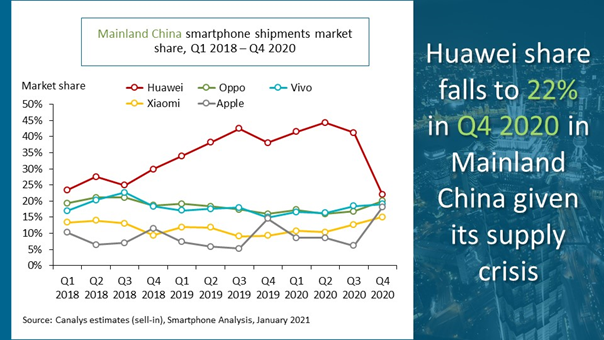
During the fourth-quarter of 2020, smartphone shipments in mainland China fell 4% year-over-year to a total of 84 million units. Even though it held onto its number one position in terms of shipments, Huawei’s total market share plummeted to 22% from 41% a year earlier, and it shipped just 18.8 million smartphones, including units from budget brand Honor, which it agreed to sell in November.

Canalys' graph showing shipments by the top five smartphone vendors in China

Canalys’ graph showing shipments by the top five smartphone vendors in China

Huawei’s main competitors, on the other hand, all increased their shipments at the end of 2020. Oppo took second place, shipping 17.2 million smartphones, a 23% increase year-over-year. Oppo’s closest competitor Vivo increased its quarterly shipment to 15.7 million units. Apple shipped more than 15.3 million units, putting its market share at 18%, up from 15% a year ago. Xiaomi rounded out the top five vendors, shipping 12.2 million units, a 52% year-over-year increase.

Huawei’s decision to sell Honor means the brand may rapidly gain market share in 2021, since it already has brand recognition, wrote Peng. 5G is also expected to help smartphone shipments in China, especially for premium models.

29 Jan 2021

Hong Kong startup ICW eyes supply chain diversification demand amid trade war

For American importers, finding suppliers these days can be challenging not only due to COVID-19 travel restrictions. The U.S. government’s entity list designations, human rights-related sanctions, among other trade blacklists targeting Chinese firms have also rattled U.S. supply chains.

One young company called International Compliance Workshop, or ICW, is determined to make sourcing easier for companies around the world as it completed a fresh round of funding. The Hong Kong-based startup has just raised $5.75 million as part of its Series A round, boosting its total funding to around $10 million, co-founder and CEO Garry Lam told TechCrunch.

ICW works like a matchmaker for suppliers and buyers, but unlike existing options like Alibaba’s B2B platform or international trade shows, ICW also vets suppliers over compliance, product quality, and accreditation. It gathers all that information into its growing database of over 40,000 suppliers — 80% of which are currently in China — and recommends them to customers based on individual needs.

Founded in 2016, ICW’s current client base includes some of the world’s largest retailers, including Ralph Lauren, Prenatal Retail Group, Blokker, Kmart, and a major American pharmacy chain that declined to be named.

ICW’s latest funding round was led by Infinity Ventures Partners with participation from Integrated Capital and existing investors MindWorks Capital and the Hong Kong government’s $2 billion Innovation and Technology Venture Fund.

Supply chain shift

In line with the ongoing shift of sourcing outside China, in part due to the U.S.-China trade war and China’s growing labor costs, ICW has seen more customers diversifying their supply chains. But the transition has limitations in the short run.

“It’s still very difficult to find suppliers of certain product categories, for example, Bluetooth devices and power banks, in other countries,” observed Lam. “But for garment and textile, the transition already began to happen a decade ago.”

In Southeast Asia, which has been replacing a great deal of Chinese manufacturing activity, each country has its slight specialization. Whereas Vietnam abounds with wooden furniture suppliers, Thailand is known for plastic goods and Malaysia is a good source for medical supplies, said Lam.

When it comes to trickier compliance burdens, such as human rights sanctions, ICW relies on third-party certification institutes to screen and verify suppliers.

“There is a [type of] qualification standard that verifies whether a supplier has fulfilled its corporate social responsibility… like whether the factory fulfills the labor law, the minimum labor rights, or the payroll, everything,” Lam explained.

ICW plans to use the fresh proceeds to further develop its products, including its compliance management system, product testing platform, and B2B sourcing site.

28 Jan 2021

Why calendar invites are worth $3B

Hello and welcome back to Equity, TechCrunch’s venture capital-focused podcast, where we unpack the numbers behind the headlines.

Natasha and Danny and Alex and Grace hopped online for our weekly show, sans Gamestop news (which you can find here) to talk about all the other busy news happening in startup world right now.

Here’s a taste of what we got into:

  •  Qualtrics IPO pricing, and the future of major acquisition pricing schemes. This company’s path to the public markets has been a long-time coming, so we had plenty to say.
  •  How Atlanta’s Calendly turned a scheduling nightmare into a $3 billion company. This story was not only neat, but also operated as a sort of palate cleanser for the team.
  •  Rhino‘s interesting insurtech play, and how it is pre-IPO pretty damn early. Revenue questions, the power of insurtech, and public markets impacting startups? This story had it all!
  •  Alex talks about how Fast is raising fast money ($102 million to be exact). Even more, the Fast story fits into a broader narrative of online checkout startups raising a zillion dollars in recent weeks.
  •  A boom in food delivery and restaurant startups, and why Danny is bearish on a plastic-free play. Natasha is in favor. Alex gets a company’s model mixed up with Spoon Rocket.
  •  Natasha explains how Clubhouse isn’t the first company to raise millions off of millions of users with no known near-term monetization plan. Her piece on ClassDojo illustrates how a quiet edtech giant finally turned its 51 million users into a profitable base. There’s also a new edtech investor survey for you to check out (Discount code: EQUITY).
  • TCV’s record fund, and a female-focused angel fund coming out of Africa.

As always, it was a ton to get through because there is just so much going on. More Monday morning, until then stay cool!

Equity drops every Monday at 7:00 a.m. PST and Thursday afternoon as fast as we can get it out, so subscribe to us on Apple PodcastsOvercastSpotify and all the casts

28 Jan 2021

Daily Crunch: Robinhood restricts GameStop trading

The GameStop stock saga continues, Apple releases more details about its privacy changes and Qualtrics goes public. This is your Daily Crunch for January 28, 2021.

The big story: Robinhood restricts GameStop trading

Robinhood has responded to an upsurge in retail investors buying shares in companies like GameStop, AMC and Blockbuster by restricting trading on “certain securities” to “position closing only,” meaning that users can no longer buy more of the companies’ stocks. (It says it will allow “limited buys” tomorrow.)

This comes after the current buying spree — targeting stocks shorted by institutional investors and spurred by the WallStreetBets forum on Reddit — took Robinhood and Reddit to the top of the app charts.

Now, Robinhood is being hit with numerous 1-star reviews, and the move also attracted criticism from politicians on both sides of the aisle, with Rep. Alexandria Ocasio-Cortez describing it as “unacceptable” and Senator Ted Cruz tweeting, “Fully agree.”

The tech giants

Apple’s App Tracking Transparency feature will be enabled by default and arrive in ‘early spring’ on iOS — The plan is to launch these changes in early spring, with a version of the feature coming in the next iOS 14 beta release.

Qualtrics prices IPO at $30 per share, above its upgraded target range — The company sold 50.4 million shares in the process.

Twitter is already working on integrating newsletters on its site, following its Revue acquisition — It appears “Newsletters” will soon be the newest addition to Twitter’s sidebar navigation.

Startups, funding and venture capital

Workday acquires employee feedback platform Peakon for $700M — Peakon says companies have used its platform’s weekly surveys to ask more than 153 million questions since inception six years ago.

Fintech darling Nubank raises blockbuster $400M Series G at $25B valuation — The fintech company now has 34 million customers.

Flowhaven raises $16M to evolve brand licensing management beyond emails and spreadsheets — The media licensing business is a massive market, but much of the work involved is still handled manually through emails and spreadsheets.

Advice and analysis from Extra Crunch

Thirteen investors say lifelong learning is taking edtech mainstream — As learners become more multi-layered and nuanced, so have the edtech companies that back them.

Talent and capital are shifting cybersecurity investors’ focus away from Silicon Valley — Solving the cybersecurity problem will take more time and resources than we are currently allocating.

Mind the gap: E-commerce marketers should revise their TAM and SAM estimates — 2021 is going to be another glorious year for e-commerce.

(Extra Crunch is our membership program, which helps founders and startup teams get ahead. You can sign up here.)

Everything else

Smartphone sales slowed decline in Q4, with a big assist from Apple — The past year was, of course, a major blow to an industry already suffering a slide.

GM pledges to be carbon neutral by 2040 with zero tailpipe emission vehicles by 2035 — It’s a big step for a company whose products are responsible for a large percentage of global greenhouse gas emissions.

UCLA is building a digital archive of mass incarceration with a new $3.6M grant — The “Archiving the Age of Mass incarceration” effort is being led by Kelly Lytle Hernandez, director of the university’s Bunche Center for African American Studies.

The Daily Crunch is TechCrunch’s roundup of our biggest and most important stories. If you’d like to get this delivered to your inbox every day at around 3pm Pacific, you can subscribe here.

28 Jan 2021

SoftBank earmarks $100 million for Miami-based startups

Miami, an emerging startup hub, has a new check-writer in town: SoftBank. The Japanese multinational conglomerate announced plans today to invest $100 million, drawn from across its funds, into Miami-based startups. Notably, SoftBank’s $5 billion Latin America fund is headquartered in Miami, as well.

The initiative is led by SoftBank CEO Marcelo Claure. The fund will back companies who are in Miami or plan to move there.

A SoftBank check is somewhat of a Silicon Valley rite-of-passage, so the firm’s involvement in the scene will likely signal to others that the growth of Miami is something to be taken seriously. The tax-free haven is attracting swathes of investors and founders from around the country looking to join the growing scene. Relocators include Keith Rabois of Founders Fund, David Blumberg of Blumberg Capital, Chris Dixon of Andreessen Horowitz and David Sacks of Craft Ventures.

Miami Mayor Francis Suarez, who has been on a Twitter tear asking techies to move to Miami, has spearheaded much of the efforts to turn the city into a startup epicenter.

Ruben Harris, founder of Career Karma, has been working with Suarez since 2018 to help people break into tech.

“Now that Softbank has made this move, we will see more funds follow their example and this is a huge win for diversity not just from a race perspective, but also from a socioeconomic perspective, and from a gender perspective,” Harris said, who is thinking about moving to the city. Career Karma is currently working with VC funds to get old laptops into its Reskill America program, to help train an emerging workforce in Miami.

Monica Black, who is behind Function, a non-profit connecting Miami’s best entrepreneurs, hopes that SoftBank’s entrance “will not only increase the amount of capital going to local startups and help them grow to the Series A stage and beyond, but also attract other institutional VCs as co-investors.” Historically, she said, it’s been tough for local startups to raise capital from Silicon Valley or New York funds. The exception to this was Papa, which raised $18 million in September to connect older adults with virtual companions from Slow Ventures and Canaan.

Nico Berardi, the founder of Miami-based fund ANIMO Ventures, connected the new SoftBank initiative to the recent announcement by San Francisco’s Founders Fund to open an office in Miami.

“Both are symbolic and I think symbols matter,” Berardi said. “[They] are planting a flag here and saying look this is a viable scene.” Of his 16 portfolio companies, Berardi says only one startup is based in Miami. With more and more investors moving to the city, Berardi is optimistic that it can magnetize more talent to move, too.

“I’m hopeful that this can attract tens or hundreds of founders to build their next thing in Miami,” he said.

28 Jan 2021

After soaring above $23B, Qualtrics’ founder and CEO reflect on a stellar debut

Amidst all of the the sturm und drang of l’affaire GameStop, Qualtrics went public today.

After pricing its stock above its raised IPO range, the company received a warm welcome from public investors. After starting its trading life worth $41.85, Qualtrics closed the day worth $45.50, up some 51.67%.

Qualtrics did everything that it said it was going to.

The software company’s debut comes after a lengthy path to the public markets; Qualtrics sold to SAP on the eve of its first run at a public listing back in 2018. Now, SAP has completed spinning the company out, though the software giant remains the Utah unicorn’s largest shareholder.

That Qualtrics’ IPO might perform well was presaged in its pricing run, having prices far above its initial valuation estimates; there was evidence of strong demand even before its shares started to trade.

But did Qualtrics misprice, given its strong first-day performance? TechCrunch spoke with Qualtrics CEO Zig Serafin, and its founder and current executive chairman Ryan Smith about its public offering, hoping to learn a bit about what is next for the company.

Pricing, plans

Having spoken to myriad folks on IPO days, I’ve learned the best way to kick off is to ask about emotions. Most CEOs and other execs are tied up in what they can (and cannot) say. And they are well-trained by communications experts regarding what to repeat and emphasize. You can sometimes loosen them up a little, however, by asking them how they feel.

In response to that question, Serafin described a feeling of gratitude and Smith brought up the long game. Qualtrics, he said, had been told that it couldn’t bootstrap, that it couldn’t build in Utah, that SAP had overpaid, that SAP had messed up and so forth.

28 Jan 2021

The somewhat boring reason it appears that Robinhood yanked trading on some securities

After enduring a day’s worth of taking a beating across social media, government, and the various app stores of the mobile world, Robinhood took to its own blog and CEO’s Twitter account to explain why it had halted trading of some stocks earlier today.

That Robinhood had restricted trading in a number of securities was bombshell news after the consumer trading platform had become synonymous with not only a rise in retail investing, but also a risky wager by some individual investors to push shares of heavily-shorted companies, including GameStop, AMC and others higher. Speculation that Robinhood was limiting the trading ability of those users at the behest of, pick your poison, Citadel, the US government, hedge funds, Janet Yellen, or others, ran rampant.

But none of it was true – at least according to Robinhood’s telling. In its post, Robinhood wrote that (emphasis TechCrunch):

[a]mid this week’s extraordinary circumstances in the market, we made a tough decision today to temporarily limit buying for certain securities. As a brokerage firm, we have many financial requirements, including SEC net capital obligations and clearinghouse deposits. Some of these requirements fluctuate based on volatility in the markets and can be substantial in the current environment. These requirements exist to protect investors and the markets and we take our responsibilities to comply with them seriously, including through the measures we have taken today.

That reads like Robinhood ran low on capital and had to make some hard decisions, quickly. The securities its users wanted to trade likely generated the highest capital obligations given how volatile they proved and how long it takes for trades to settle, so Robinhood had to shut off some trades to stay on the right side of its capital needs. (Not great, not terrible?)

Reporting from Bloomberg indicates that Robinhood “tapped at least several hundred million dollars” from credit lines today makes sense in this context. As does the unicorn’s decision to allow for some trading of the afore-limited securities in the near future (“starting tomorrow, we plan to allow limited buys of these securities,” the company wrote); now reloaded with more capital, Robinhood can afford to let its users get back, somewhat, to business.

Of course Robinhood could have been more clear about all of this earlier in the day. Instead, unfairly or not, it became the face of theoretical corruption and other nefarious forces. (Here’s a tip, if your theory sounds like it could fit inside the Qanon orbit, try again?)

Nothing is settled. Congress has its hackles up. Other trading platforms had to suspend trading in GameStop and other stocks for a spell as well. Social media is pissed. Some Robinhood users were forced to liquidate positions. And somehow GameStop closed the day worth more than $196 per share. And after-hours it is up $72.40, or 37.40% to $266 per share.

Who knows what comes next. But grains of salt, please, as we continue this bizarre adventure.

28 Jan 2021

The somewhat boring reason it appears that Robinhood yanked trading on some securities

After enduring a day’s worth of taking a beating across social media, government, and the various app stores of the mobile world, Robinhood took to its own blog and CEO’s Twitter account to explain why it had halted trading of some stocks earlier today.

That Robinhood had restricted trading in a number of securities was bombshell news after the consumer trading platform had become synonymous with not only a rise in retail investing, but also a risky wager by some individual investors to push shares of heavily-shorted companies, including GameStop, AMC and others higher. Speculation that Robinhood was limiting the trading ability of those users at the behest of, pick your poison, Citadel, the US government, hedge funds, Janet Yellen, or others, ran rampant.

But none of it was true – at least according to Robinhood’s telling. In its post, Robinhood wrote that (emphasis TechCrunch):

[a]mid this week’s extraordinary circumstances in the market, we made a tough decision today to temporarily limit buying for certain securities. As a brokerage firm, we have many financial requirements, including SEC net capital obligations and clearinghouse deposits. Some of these requirements fluctuate based on volatility in the markets and can be substantial in the current environment. These requirements exist to protect investors and the markets and we take our responsibilities to comply with them seriously, including through the measures we have taken today.

That reads like Robinhood ran low on capital and had to make some hard decisions, quickly. The securities its users wanted to trade likely generated the highest capital obligations given how volatile they proved and how long it takes for trades to settle, so Robinhood had to shut off some trades to stay on the right side of its capital needs. (Not great, not terrible?)

Reporting from Bloomberg indicates that Robinhood “tapped at least several hundred million dollars” from credit lines today makes sense in this context. As does the unicorn’s decision to allow for some trading of the afore-limited securities in the near future (“starting tomorrow, we plan to allow limited buys of these securities,” the company wrote); now reloaded with more capital, Robinhood can afford to let its users get back, somewhat, to business.

Of course Robinhood could have been more clear about all of this earlier in the day. Instead, unfairly or not, it became the face of theoretical corruption and other nefarious forces. (Here’s a tip, if your theory sounds like it could fit inside the Qanon orbit, try again?)

Nothing is settled. Congress has its hackles up. Other trading platforms had to suspend trading in GameStop and other stocks for a spell as well. Social media is pissed. Some Robinhood users were forced to liquidate positions. And somehow GameStop closed the day worth more than $196 per share. And after-hours it is up $72.40, or 37.40% to $266 per share.

Who knows what comes next. But grains of salt, please, as we continue this bizarre adventure.

28 Jan 2021

Lawmakers announce hearings on GameStop and online trading platforms

The GameStop short squeeze saga caught the attention of Congress Thursday morning and that buzz is already panning out into hearings on the topic.

Rep. Maxine Waters (D-CA), chairwoman of the House Committee on Financial Services, announced plans for an investigation into the situation, pointing to a history of “predatory conduct” from hedge funds.

Waters didn’t call out Robinhood or any other trading services by name, but did note that a future hearing would focus on the systemic financial impact of short selling, “gamification” and online trading platforms. The hearing date is not yet set.

“Addressing that predatory and manipulative conduct is the responsibility of lawmakers and securities regulators who are charged with protecting investors and ensuring that our capital markets are fair, orderly, and efficient,” Waters said.


In the Senate, incoming Senate Banking Chairman Sherrod Brown announced his own plans for a hearing on the “current state of the stock market” in light of recent events. “People on Wall Street only care about the rules when they’re the ones getting hurt,” Brown said.

Earlier on Thursday, Democratic Reps. Rep. Rashida Tlaib, Alexandria Ocasio-Cortez and Ro Khanna all condemned the startup Robinhood for halting some trades in the midst of the Reddit retail investor-led volatility. Morgan Stanley-owned E-Trade followed suit.

Texas Republican Senator Ted Cruz echoed Democrats’ concerns over Robinhood’s actions, signaling that even in the midst of pandemic relief negotiations and an impeachment trial that lawmakers on both sides of the aisle still have an appetite for dragging tech in for questioning.

And apparently it’s not just Congress. New York Attorney General Letitia James also issued a short statement Thursday noting that her office is “aware of concerns raised regarding activity on the Robinhood app” and would be reviewing the situation.