Year: 2021

27 Jan 2021

Following acquisition, Episerver rebrands as Optimizely

After acquiring Optimizely last fall, content management company Episerver is adopting the Optimizely name for the entire organization.

CEO Alex Atzberger told me that the company will be rolling out new branding in the next coming months, as well as renaming its entire product suite to reflect the Optimizely brand.

“We believe it’s no longer just about personalizing the experience or driving recommendations,” Atzberger said. “The brand and word Optimizely really signifies optimal performance. Companies today of any size, any scale [need to be] much more sophisticated in terms of how they digitally connect with their customers. It’s a never-ending story.”

At the same time, he emphasized that Episerver is making the change from “a position of strength,” with the combined company seeing double-digit revenue growth last year and going live with more than 250 new customers.

Asked whether adopting the Optimizely name was always part of the post-acquisition plan, Atzberger replied, “When we acquired Optimizely, we knew that we would be acquiring not just a great product, not just a great customer base, but also acquiring a very well-known brand. We had not yet decided on [rebranding], but it was certainly something that, for me, was part of the consideration.”

In addition to announcing the new company name, Episerver/Optimizely is also announcing a new platform that it’s calling Optimization-as-a-Service, which integrates aspects of Optimizely and Episerver products to offer web targeting, testing and recommendations. As Atzberger put it, this new platform allows customers to determine “who to show something to, what content to show and how to actually show this content.”

27 Jan 2021

Renewable investment wave continues as solar lending company Loanpal raises $800 million

Days after the billionaire investor Chamath Palihapitiya announced his involvement in the $1.3 billion acquisition of the solar and home improvement lending business Sunlight Financial, a collection of investors announced a nearly $1 billion cash infusion into Loanpal, another renewable energy and home improvement lender.

The $800 million commitment to Loanpal arrives alongside a flurry of climate commitments from some of the world’s largest investors.

Yesterday, Blackrock chief Larry Fink, released the $9 trillion investment manager’s annual letter calling for more stringent accounting and reporting of climate data, and Bank of America joined 60 other companies in committing to a new reporting standard for climate and sustainability endorsed by the International Business Council and the World Economic Forum. Fink endorses a separate reporting scheme called the Task Force on Climate Related Financial Disclosures that has the backing of some of the biggest financial investors in the world.

These new standards will drive more investment dollars into businesses that are reducing the greenhouse gas emissions that contribute to global climate change. And lending programs incentivizing the switch to more energy efficient appliances and renewable installations are probably the lowest of low hanging fruit for the financial services industry.

That’s one reason why investors like NEA, the WestCap Group, Brookfield Asset Management, and the giant private equity energy investment fund Riverstone Holdings are backing Loanpal.

The deal, which was a secondary transaction to give strategic investors a stake in the business actually wrapped up last year. As a result Scott Sandell, the managing general partner at NEA and a longtime investor in pr and Laurence Tosi, Managing Partner of WestCap Group, have joined the company’s board of directors.

“We invited a number of players into the company,” said Loanpal’s founder, chairman and chief executive Hayes Barnard. The former chief revenue officer for SolarCity before its acquisition by Tesla, Barnard has a long history with solar energy development. At Loanpal he also had the balance sheet to take his pick among would-be investors. “We’re a multi-billion dollar company,” said Barnard.

Loanpal founder chairman and chief executive, Hayes Barnard. Image Credit: Loanpal

“This was us inviting strategic investors into the company and being thoughtful about where they could help and how they could help,” Barnard said.

Loanpal is profitable, has zero debt and throws off monthly dividends to its financial backers. “Today we finance $400 million a month for roughly 15,000 solar systems that are combined with battery systems,” says Barnard. In all, the company has arranged $5.9 billion in consumer finance loans since its launch in 2018. Loanpal also counts around 85% of the top solar firms as vendors and has a staff of around 12,000 sales professionals.

Those numbers allowed the company to bring in board members like Tosi, the former chief financial officer of the multi-billion dollar financial services firm, Blackstone. “He really understands how to bring in capital markets at scale,” said Barnard. 

If anything, the attention from Blackrock, Blackstone, Riverstone and all the financial services firms without references to stones or rocks in their name shows that this is a problem of capital at scale. Decarbonizing the global economy is a $10 trillion business, according to the World Economic Forum (or, for the retail investment crowd, the equivalent of roughly 66.7 billion Gamestops at yesterday’s share price).

The near term market that we’re going to penetrate now is sustainable home solutions that’s a $100 billion market,” Barnard said. 

A significant chunk of that $10 trillion is going to come from the development and integration of new consumer facing appliances and hardware to reduce the consumption of energy. “We believe the battery storage market, the smart thermostat market and the solar market are all intertwined and combined,” said Barnard. “Overall the most important thing is that this is just technology that is better. It was going to scale regardless of who was in the White House. These pieces of technology are better, they save homeowners money.. It’s kind of an IQ test if homeowners want to do it.”

27 Jan 2021

Lynk, a “knowledge-as-a-service” platform with more than 840,000 experts, raises $24 million

Lynk co-founder and chief executive officer Peggy Choi

Lynk co-founder and chief executive officer Peggy Choi

Lynk, a “knowledge-as-a-service” platform that connects clients with over 840,000 experts in a wide range of fields, announced today it has raised $24 million led by Brewer Lane Ventures and MassMutual Ventures, with participation from Alibaba Entrepreneurs Fund. The company uses machine learning algorithms to match users, who include investment firms, Fortune 100 companies and government entities, with experts on its platform, helping connect them with people they would probably not find at traditional consultancies or by searching online.

“At the core of it, the search is a people search based on what you know, and not just where you work, to put it very simply,” co-founder and chief executive officer Peggy Choi told TechCrunch.

Founded in 2015, Lynk has now raised a total of $30 million. It has more than 200 employees across offices in eight cities: Hong Kong, New York City, Singapore, London, Mumbai, Shanghai, Hyderabad, Toronto and Manila. Its funding will be used for product launches and to expand in North America and China, where its seen demand grow over the past twelve months.

Lynk’s flagship product, Lynk Answers, is currently used by about 200 enterprise clients when their employees need to do research for projects including geographical expansion, product-market fit and due diligence, with many relying on the platform for on-the-ground research in areas they can’t travel to because of the pandemic. For example, investors talk with advisors on Lynk to understand new technology or the dynamics in a sector. Over the past few years, companies have used Lynk to help them react quickly to geopolitical changes, including events that affected their supply chain. Some sought supply chain experts when shipments got stuck in customs or they wanted to diversify their manufacturing by setting up factories in Southeast Asia.

Before Lynk, Choi worked in finance, including at Silver Lake in London and TPG in San Francisco. As an investor, “every day you have to do a lot of conversations with executives and different kinds of experts to learn about new industries or companies really quickly. Through that experience, I realized that talking to the right person makes a huge difference,” she said.

In contrast, Choi found herself at a loss when her parents wanted to launch an art gallery. “They had all these day-to-day business questions and sometimes they asked me because they thought I would know how to address it. But I don’t know either, I’m not the right person for them, so I had to find the right people,” she said. “When I saw that contrast, I thought, what about using data to organize people in a way based on what they know?”

Lynk, which monetizes by charging enterprise clients a subscription fee, fills the gap between traditional consultancies and consumer-oriented Q&A platforms like Quora or China’s Zhihu. The platform also includes SaaS features that provide an alternative to email chains, like collaboration tools and auto-transcription for expert interviews so they can be organized, searched and referenced by a team.

Lynk’s experts, who the platform calls “Knowledge Partners,” include C-suite executives, independent consultants, lawyers, engineers, financial analysts and scientists, among others. The company finds them through several channels, including digital marketing, a referral program for current Knowledge Partners and partnerships with groups, associations and institutions. Lynk vets experts before they are added to the platform, where they set their own rates.

When users have a question, Lynk’s search engine shows them a list of experts based on criteria like domain expertise and geography. Then they ask potential experts a couple of questions to see if they are the right match. Lynk uses data from those conversations, on an anonymized basis, to refine its search technology and make matching more accurate. Once users pick experts, they work with them in different ways. Most of the time they do a question-and-answer session. Sometimes that turns into speaker and workshop engagements or longer-term projects.

Choi said building an inclusive roster of experts is a priority for Lynk. The company’s team and board are divided equally between women and men and represent more than 20 nationalities. It wants to build a diverse database through initiatives like outreach programs and campaigns like Lynk Elite Expert Women to recruit people, including those who haven’t done consulting before.

“When we were running the [Lynk Elite Expert Women] campaign, we realized that a lot of people find it a very new way of being valued,” said Choi. “Especially if they’ve spent their entire life doing something, they also want to know what people want to know about their area.”


27 Jan 2021

Literati raises $40M for its book club platform

Literati has raised a $40 million Series B to pursue an unusual startup opportunity — namely, book clubs.

Founder and CEO Jessica Ewing (a former product manager at Google) explained that the Austin-based company started out with book clubs for kids, before launching its Luminary brand for adult book clubs last year. And the Luminary clubs live up to the name — they’re curated by notable figures such as activist and Nobel laureate Malala Yousafzai, NBA star Stephen Curry, entrepreneur and philanthropist Sir Richard Branson, journalist Susan Orlean and the Joseph Campbell Foudnation.

When you sign up for a Literati book club, you receive a print edition of each month’s selection with a note from the curator. You also get access to the Literati app, where you can discuss the book with other readers, and where curators host author conversations. For example, Curry is leading a book club focused on nonfiction about people who “transcend expectations” (he invested in Literati as well), while Yousafzai chooses books by women “with bold ideas from around the world.”

Ewing told me that she’s trying to build the first “new, innovative bookseller” since Amazon launched 25 years ago. And she’s doing that by focusing on curation.

“There’s too much choice, too many lists, it’s completely overwhelming for most people,” she said. And she argued that it helps to enlist celebrities and other big names to do the curation: “Books are aspirational. No one aspires to play more video games, people aspire to read more … People want their books to be recommended by someone a little bit smarter than they are.”

Stephen Curry book club

Image Credits: Literati

Ewing’s hope for Literati is to create “the next great literary social network,” bridging the gap between celebrity-driven lists like Oprah’s Book Club and Reese’s Book Club and what she described as “the wine-and-cheese, super intimate model.”

I would love to see in-person meetups once we’re out of the COVID environment,” she added. “But I also think there’s everything in between. We’re enabling threaded discussions [in the app] right now, and it’s cool to have asynchronous conversations about the books.”

And on the children’s book side, Literati is also working building personalization tools designed to recommend the best books for each child.

“To me, this is one of the most exciting applications: How do we make this generation of kids love reading by pairing them with the right books?” Ewing said.

Literati previously raised $12 million in funding from Shasta Ventures and others, according to Crunchbase. The new round was led by Aydin Senkut of Felicis Ventures, with participation from Dick Costolo and Adam Bain of 01 Advisors, Founders Fund, General Catalyst, Shasta, Silverton Partners, Springdale Ventures and — as previously mentioned — Stephen Curry.

“I wanted to start my own book club with Literati, because their mission to better the world through reading naturally aligns with my values as an entrepreneur and father,” Curry said in a statement. “I was a fan before I was an investor, and am so proud to be a part of a company that works to better the lives of others, one book at a time.”

27 Jan 2021

LottieFiles, a platform for the animation format, lands $9 million Series A led by M12, Microsoft’s venture fund

LottieFiles, a platform for JSON-based Lottie animations, has raised a Series A of $9 million. The round was led by M12, Microsoft’s venture capital arm, with participation from returning investor 500 Startups.

Based in San Francisco and Kuala Lumpur, LottieFiles was founded in 2018. The platform includes Lottie creation, editing and testing tools, and a marketplace for animations. It now claims about one million users from 65,000 companies, including Airbnb, Google, TikTok, Disney and Netflix, and 300% year-over-year growth. The new funding brings its total raised to about $10 million.

Smaller than GIF or PNG graphics, Lottie animations also have the advantage of being scalable and interactive. It was introduced as an open-source library by Airbnb engineers six years ago and quickly became popular with app developers because Lottie files can be used across platforms without additional coding and edited after shipping.

An illustration from animation startup LottieFiles

An illustration from animation startup LottieFiles

LottieFiles co-founder and chief executive officer Kshitij Minglani told TechCrunch the startup originally started as a community for designers and developers, before adding tools, integrations and other resources. It launched its marketplace during the COVID-19 lockdown, with 70% of earnings going directly to creators, and also has a list of animators who are available for hire.

LottieFiles’ core platform and tools are currently pre-revenue, with plans to monetize later this year. “It’s not often a revolutionary format comes about and disrupts an entire industry, saving tons of precious design and development hours,” said Minglani. “We didn’t want to stunt the adoption of Lottie by monetizing early on.”

The new funding will be used on LottieFiles’ product roadmap, expanding its infrastructure and increasing its global user base.

27 Jan 2021

Starship Technologies raises $17M to roll out more delivery bots

A year ago, Starship Technologies had a couple hundred autonomous bots delivering burritos and pizzas to  students on college campuses and residents in a few neighborhoods.

The company — with $17 million of new capital in its coffers — has expanded its fleet five-fold since COVID-19 swept through the European and North American markets that it operates in. While COVID-19 delivered pain and chaos, including to Starship Technologies, the company has also experienced an uptick in demand as restaurants switched to a takeout and delivery-only model. Starship now has 1,000 autonomous delivery bots in its fleet.

Starship Technologies said last year it planned to expand to 100 universities by late summer 2021. That’s a leap from the 15 campuses it operates at today. Still, the company is expanding in just about every measurable way, including locations, volume of trips, fleet size and workforce, which now number 400 people. The company said it is bringing new college campuses on every month and has a robust pipeline that will come online as classes resume.

The company’s recent $17 million raise, which was announced Tuesday, included investors TDK Ventures and Goodyear Ventures. The new investment brings Starship’s total funding to $102 million. Starship decline to share its valuation. The company also announced it has expanded to UCLA and Bridgewater State University in Massachusetts.

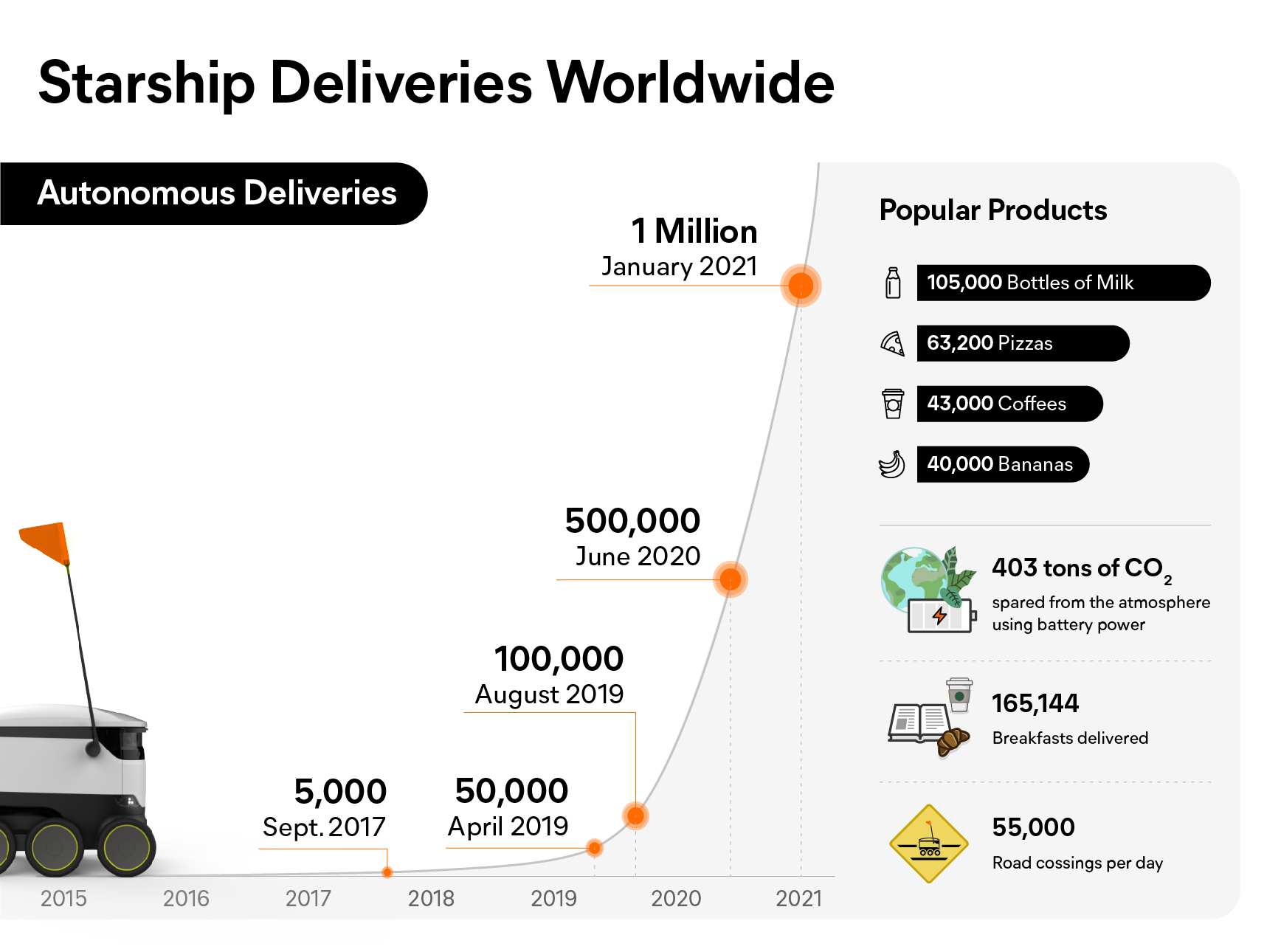
Starship infographic1_Jan2021

Image Credits: Starship Technologies

Starship Technologies, which was launched in 2014 by Skype co-founders Ahti Heinla and Janus Friis, has grown from an enterprise that completed 5,000 deliveries in 2017 to 1 million by January of this year. It’s also expanded beyond college campuses and communities like Milton Keyes, UK to more towns, including a 5,000-household area in Northhampton, UK and the California cities of Mountain View and Modesto.

27 Jan 2021

Classiq raises $10.5M Series A round for its quantum software development platform

Classiq, a Tel Aviv-based startup that aims to make it easier for computer scientists and developers to create quantum algorithms and applications, today announced that it has raised a $10.5 million Series A round led by Team8 Capital and Wing Capital. Entrée Capital, crowdfunding platform OurCrowd and Sumitomo Corporation (through IN Venture) also participated in this round, which follows the company’s recent $4 million seed round led by Entrée Capital.

The idea behind Classiq, which currently has just under a dozen members on its team, is that developing quantum algorithms remains a major challenge.

“Today, quantum software development is almost an impossible task,” said Nir Minerbi, CEO and Co-founder of Classiq. “The programming is at the gate level, with almost no abstraction at all. And on the other hand, for many enterprises, that’s exactly what they want to do: come up with game-changing quantum algorithms. So we built the next layer of the quantum software stack, which is the layer of a computer-aided design, automation, synthesis. […] So you can design the quantum algorithm without being aware of the details and the gate level details are automated.”

Image Credits: Classiq

With Microsoft’s Q#, IBM’s Qiskit and their competitors, developers already have access to quantum-specific languages and frameworks. And as Amir Naveh, Classiq’s VP of R&D told me, just like with those tools, developers will define their algorithms as code — in Classiq’s case a variant of Python. With those other languages, though, you will write sequences of gates on the cubits to define your quantum circuit.

“What you’re writing down isn’t gates on cubits, its concepts, its constructs, its constraints — it’s always constraints on what you want the circuit to achieve,” Naveh explained. “And then the circuit is synthesized from the constraints. So in terms of the visual interface, it would look the same [as using other frameworks], but in terms of what’s going through your head, it’s a whole different level of abstraction, you’re describing the circuit at a much higher level.”

This, he said, gives Classiq’s users the ability to more easily describe what they are trying to do. For now, though, that also means that the platform’s users tend to be quantum teams and scientists and developers who are quantum experts and understand how to develop quantum circuits at a very deep level. The team argues, though, that as the technology gets better, developers will need to have less and less of an understanding of how the actual qubits behave.

As Minerbi stressed, the tool is agnostic to the hardware that will eventually run these algorithms. Classiq’s mission, after all, is to provide an additional abstraction layer on top of the hardware. At the same time, though, developers can optimize their algorithms for specific quantum computing hardware as well.

Classiq CTO Dr. Yehuda Naveh also noted that the company is already working with a number of larger companies. These include banks that have used its platform for portfolio optimization, for example, and a semiconductor firm that was looking into a material science problem related to chip manufacturing, an area that is a bit of a sweet spot for quantum computing — at least in its current state.

The team plans to use the new funding to expand its existing team, mostly on the engineering side. A lot of the work the company is doing, after all, is still in R&D. Finding the right software engineers with a background in physics — or quantum information experts who can program — will be of paramount importance for the company. Minerbi believes that is possible, though, and the plan is to soon expand the team to about 25 people.

“We are thrilled to be working with Classiq, assisting the team in achieving their goals of advancing the quantum computing industry,” said Sarit Firon, Managing Partner at Team8 Capital. “As the quantum era takes off, they have managed to solve the missing piece in the quantum computing puzzle, which will enable game-changing quantum algorithms. We look forward to seeing the industry grow, and witnessing how Classiq continues to mark its place as a leader in the industry.”

27 Jan 2021

TCV closes record $4B fund to invest in e-commerce, fintech, edtech, travel and more

The pandemic has spelled economic setbacks for many people and industries, but the capital swirling about the technology world continues to roar along. In the latest development, TCV — the storied venture capital firm behind the likes of Airbnb, Spotify, Peloton and Facebook — has closed a record $4 billion for its latest fund.

This is not only the company’s biggest fund to date, but it also speaks to just how fast the tech industry is accelerating in terms of capital and how much of it tech is attracting. In 25 years of operations (a milestone it passed in 2020) TCV invested $14 billion across hundreds of startups. This latest $4 billion fund raised in a matter of months represents nearly 30% of that figure.

(It’s also more than the company originally targeted, which was $3.25 billion.)

Parter John Doran told TechCrunch the plan will be to use the money to continue backing existing portfolio companies, as well as make new bets, both in areas that have shown to be very strong winners in the last year — e-commerce, education, and tools to enable working in the cloud, for example — but also investments in areas that may not be doing as well right now, but TCV will believes will return, like travel.

“We have to take a long term view,” he said in an interview. “It’s about great founders and CEOs, and where those in areas like travel, you’ll still see the startups get funded at up rounds. Besides, who will be better positioned to grow and take advantage of a world that’s now more digital? That is a huge opportunity in the long term.”

As with other big capital events, the closing of a VC fund may not be intrinsically interesting news in itself, but it’s a significant bellwether that points to the level of confidence, interest and activity in the early stages of the funding process. That, in turn, has a direct knock-on effect for startups, and subsequently the technology industry at large.

In the case of TCV XI, as it is known, it’s a sign of strength in the market — it is $1 billion more than its previous fund, closed before the pandemic in 2019 — but also an endorsement of some of the less traditional processes and practices that have become the norm in many of our lives.

Notably, the raising (and closing) of the fund was done entirely virtually over the last year, Julia Roux, the company’s head of investor relations, told TechCrunch, from a mix of returning and new LPs. Going virtual is also, in many cases, the route that TCV (and other VCs) have taken in closing deals over the last year too, which looks like it may now be here to stay.

TCV has been very active in the past year, not just with private startup investments but seeing one of its most successful startups go public. Airbnb boldly went for an IPO in December, in the wake of a year that saw its business providing accommodation and other services to travellers come to a grinding halt.

The IPO was an example of the kind of more long-term investing that the firm is keen on doing (and very much has the funds to do now) despite current market conditions. Doran pointed out that TCV remains a “big believers in the Airbnb story,” investing in more shares in the company in the IPO.

Other big investments this year have included a lot of activity in commerce and fintech — including Mollie (raised $106 million), Spryker ($130 million), Revolut ($500 million), Klarna ($650 million), Nubank ($400 million) and Mambu ($135 million) — and Strava ($110 million). (Note how many of those rounds were outside the U.S.: almost all of them. The company says it has some $4 billion under management outside the U.S. now.)

Recent exits include AxiomSL, Genesys, Cradlepoint, and Silver Peak.

“We are humbled by the ongoing support of new and returning investors, which enabled us to raise a record sized fund,” said Jay Hoag, a founding general partner at TCV, in a statement. “Just as importantly, we are honored by all the great entrepreneurs we’ve worked with over the past 25 years, as their vision and relentless execution has been our foundation. We look forward to backing entrepreneurs with our new fund that we believe will become the next generation of iconic companies, in this incredibly fertile technology industry.”

27 Jan 2021

Playvox scores $25M Series A and acquires Australian startup Agyle Time

It’s not every day you see a Latin American startup funded by a U.S. venture capital firm based in the midwest. Playvox, a Colombian startup that wants to bring a positive twist to customer service monitoring announced a $25 million Series A from Five Elms Capital, a Kansas City, MO VC firm. It has now raised $34 million.

While it was at it, Playvox also announced something else unusual for an early stage company: an acquisition. The startup bought an Australian company called Agyle Time, a workforce monitoring SaaS tool. The acquisition brings together two companies with similar missions to provide a more complete customer service solution.

Playvox founder and CEO Oscar Giraldo founded the company in 2012 and has been quietly building it into an international business with brand name customers like Dropbox, Electronic Arts and Wish. The company’s Workforce Optimization platform works as a layer on top of customer service center management tools like Zendesk and Salesforce Service Cloud, allowing management to monitor digital channels and give customer service agents feedback to help them do their jobs better.

“When you call a contact center or a company, you may hear that ‘this call may be recorded for quality and training purposes’. So Playvox is a technology that works on the backend of [the customer service system] to manage the workforce that is responsible for providing a great customer experience,” Giraldo explained. It does this, but instead of for calls, it focuses on chat and email interactions.

Giraldo got the idea for the business nine years ago when he was working as a software engineer in Argentina and toured some customer service centers, where he observed a lot of disgruntled and unhappy employees. He wanted to start a company that would help give feedback to these employees in a more constructive and positive way.

“Instead of the traditional approach of customer service QA that was punishing the agents [for mistakes], what we do is we use that data to train them with a learning management system that is integrated in the platform, and have coaching tools that allow our customers to provide timely feedback to the agent so they can change their behavior for the better,” he said.

The Agyle Time acquisition enables the company to expand beyond this feedback system into customer service workforce scheduling and position them to compete in the enterprise market with a more complete toolset. “What we see is that combining the quality management agent optimization tools that Playvox has built with Agyle Time’s workforce management will allow us to be a unique vendor in the marketplace,” Giraldo said.

As for Five Elms, it’s a firm that invests between $4 and $40 million in companies that have between $2 and $20 million in revenue. They like SaaS companies in atypical places with portfolio companies in Fayetteville, AK, Columbus, OH and Brisbane Australia. Playvox fits nicely in that group.

“Playvox continues to deliver extraordinary products, add renowned brands to its customer base, and attract exceptional executives because of its company values and culture,” Ryan Mandl, managing director at Five Elms Capital said in a statement.

27 Jan 2021

Datastax acquires Kesque as it gets into data streaming

Datastax, the company best known for commercializing the open-source Apache Cassandra database, is moving beyond databases. As the company announced today, it has acquired Kesque, a cloud messaging service.

The Kesque team built its service on top of the Apache Pulsar messaging and streaming project. Datastax has now taken that team’s knowledge in this area and, combined with its own expertise, is launching its own Pulsar-based streaming platform by the name of Datastax Luna Streaming, which is now generally available.

This move comes right as Datastax is also now, for the first time, announcing that it is cash-flow positive and profitable, as the company’s chief product officer, Ed Anuff, told me. “We are at over $150 million in [annual recurring revenue]. We are cash-flow positive and we are profitable,” he told me. This marks the first time the company is publically announcing this data. In addition, the company also today revealed that about 20 percent of its annual contract value is now for DataStax Astra, its managed multi-cloud Cassandra service and that the number of self-service Asta subscribers has more than doubled from Q3 to Q4.

The launch of Luna Streaming now gives the 10-year-old company a new area to expand into — and one that has some obvious adjacencies with its existing product portfolio.

“We looked at how a lot of developers are building on top of Cassandra,” Anuff, who joined Datastax after leaving Google Cloud last year, said. “What they’re doing is, they’re addressing what people call ‘data-in-motion’ use cases. They have huge amounts of data that are coming in, huge amounts of data that are going out — and they’re typically looking at doing something with streaming in conjunction with that. As we’ve gone in and asked, “What’s next for Datastax?,’ streaming is going to be a big part of that.”

Given Datastax’s open-source roots, it’s no surprise the team decided to build its service on another open-source project and acquire an open-source company to help it do so. Anuff noted that while there has been a lot of hype around streaming and Apache Kafka, a cloud-native solution like Pulsar seemed like the better solution for the company. Pulsar was originally developed at Yahoo! (which, full disclosure, belongs to the same Verizon Media Group family as TechCrunch) and even before acquiring Kesque, Datastax already used Pulsar to build its Astra platform. Other Pulsar users include Yahoo, Tencent, Nutanix and Splunk.

“What we saw was that when you go and look at doing streaming in a scale-out way, that Kafka isn’t the only approach. We looked at it, and we liked the Pulsar architecture, we like what’s going on, we like the community — and remember, we’re a company that grew up in the Apache open-source community — we said, ‘okay, we think that it’s got all the right underpinnings, let’s go and get involved in that,” Anuff said. And in the process of doing so, the team came across Kesque founder Chris Bartholomew and eventually decided to acquire his company.

The new Luna Streaming offering will be what Datastax calls a “subscription to success with Apache Pulsar.’ It will include a free, production-ready distribution of Pulsar and an optional, SLA-backed subscription tier with enterprise support.

Unsurprisingly, Datastax also plans to remain active in the Pulsar community. The team is already making code contributions, but Anuff also stressed that Datastax is helping out with scalability testing. “This is one of the things that we learned in our participation in the Apache Cassandra project,” Anuff said. “A lot of what these projects need is folks coming in doing testing, helping with deployments, supporting users. Our goal is to be a great participant in the community.”