Year: 2021

26 Jan 2021

Facebook’s secret settlement on Cambridge Analytica gags UK data watchdog

Remember the app audit Facebook founder Mark Zuckerberg promised to carry out a little under three years ago at the height of the Cambridge Analytica scandal? Actually the tech giant is very keen that you don’t.

The UK’s information commissioner just told a parliamentary subcommittee on online harms and disinformation that a secret arrangement between her office and Facebook prevents her from publicly answering whether or not Facebook contacted the ICO about completing a much-trumpeted ‘app audit’.

“I think I could answer that question with you and the committee in private,” information commissioner Elizabeth Denham told questioner, Kevin Brennan, MP.

Pressed on responding, then and there, on the question of whether Facebook ever notified the regulator about completing the app audit — with Brennan pointing out “after all it was a commitment Mark Zuckerberg gave in the public domain before a US Senate committee” — Denham referred directly to a private arrangement with Facebook which she suggested prevented her from discussing such details in public.

“It’s part of an agreement that we struck with Facebook,” she told the committee. “In terms of our litigation against Facebook. So there is an agreement that’s not in the public domain and that’s why I would prefer to discuss this in private.”

In October 2019 Facebook settled with the UK’s data protection watchdog — agreeing to pay in full a £500,000 penalty announced by the ICO in 2018 in relation to the Cambridge Analytica breach but which Facebook had been appealing.

When it settled with the ICO Facebook did not admit liability. It had earlier secured a win, from a first-tier legal tribunal that had held June that “procedural fairness and allegations of bias” against the regulator should be considered as part of its appeal, so its litigation against Facebook had got off to a bad start — likely providing the impetus for the ICO to settle with Facebook’s private army of in-house lawyers.

In a statement at the time, covering the bare bones of the settlement, the ICO said Denham considered the agreement “best serves the interests of all UK data subjects who are Facebook users”.

There was no mention of any ‘gagging clauses’ in that disclosure. But the regulator did note that the terms of the agreement gave Facebook permission to “retain documents disclosed by the ICO during the appeal for other purposes, including furthering its own investigation into issues around Cambridge Analytica”.

So — at a stroke — Facebook gained control of a whole lot of strategically important information.

The settlement looks to have been extremely convenient for Facebook. Not only was it fantastically cheap (Facebook paid $5BN to settle with the FTC in the wake of the Cambridge Analytica scandal just a short while later); and not only did it provide Facebook with a trove of ICO-obtained data to do its own digging into Cambridge Analytica safely out of the public eye; but it also ensured the UK regulator would be restricted in what it could say publicly.

To the point where the information commissioner has refused to say anything about Facebook’s post-Cambridge Analytica app audit in public.

The ICO had seized a massive trove of data from the disgraced and now defunct company that became such a sketchy thorn in Facebook’s side, after raidingCambridge Analytica’s UK offices in early 2018. How much of that data ended up with Facebook via the ICO settlement is unclear.

Interestingly, the ICO also never produced a final report on its Cambridge Analytica investigation.

Instead it sent a letter to the DCMS committee last year — in which it set out a number of conclusions, confirming its view that the umbrella of companies of which CA was a part had been aggregating datasets from commercial sources to try to “make predictions on personal data for political alliance purposes”, as it put it; also confirming the improperly obtained Facebook data had been incorporated into a pre-existing database containing “voter file, demographic and consumer data for US individuals”.

The ICO also said then that its investigation did not find evidence of the Facebook data that had been sold to Cambridge Analytica had been used for political campaigning associated with the UK’s Brexit Referendum. But there was no overarching report setting out not only conclusions but detailing the underlying workings via which the regulator got there. So, again from Facebook’s perspective, a pretty convenient outcome.

Asked today by the DCMS committee why the regulator had not produced the expected final report on Cambridge Analytica, Denham pointed to a number of other reports it put out over the course of the multi-year probe, such as audits of UK political parties and an investigation into credit reporting agencies.

“The letter was extensive,” she also argued. “My office produced three reports on the investigation into the misuse of data in political campaigning. So we had a policy report and we had two enforcement reports. So we had looked at the entire ecosystem of data sharing and campaigning… and the strands of that investigation are reported out sufficiently, in my view, in all of our work.”

“Taken together the letter, which was our final line on the report, with the policy and the enforcement actions, prosecutions, fines, stop processing orders, we had done a lot of work in this space — and what’s important here is that we have really pulled back the curtain on the use of data in democracy which has been taken up by… many organizations and parliamentarians around the world,” she added.

Denham also confirmed to the committee that the ICO has retained data related to the Cambridge Analytica investigation — which could be of potential use to other investigations still ongoing around the world. But she denied that her office had been asked by the US Senate Intelligence Committee to provide information to its inquiries — seemingly contradicting an earlier report by that US committee which suggested it had been unable to obtain the sought for information. (We’ve contacted the committee to ask about this.)

Denham did say data was shared with the FTC, SEC and with states attorneys general, though.

We’ve also reached out to Facebook about its private arrangement with the ICO, and to ask again about the status of its post-Cambridge Analytica ‘app audit’. (And will update this report with any response.)

The company has produced periodic updates about the audit’s progress, saying in May 2018 that around 200 apps had been suspended as a result of the internal probe, for example.

Then in August 2019 Facebook also claimed to the DCMS committee that the app audit was “ongoing”.

In its original audit pledge — in March 2018 — Zuckerberg promised a root and branch investigation into any other ‘sketchy’ apps operating on Facebook’s platform, responding in a ‘crisis’ length Facebook post to the revelations that a third party had illicitly obtained data on millions of users with the aim of building psychographic profiles for voter targeting. It later turned out that an app developer, operating freely on Facebook’s platform under existing developer policies, had sold user data to Cambridge Analytica.

“We will investigate all apps that had access to large amounts of information before we changed our platform to dramatically reduce data access in 2014, and we will conduct a full audit of any app with suspicious activity,” Zuckerberg wrote at the time. “We will ban any developer from our platform that does not agree to a thorough audit. And if we find developers that misused personally identifiable information, we will ban them and tell everyone affected by those apps. That includes people whose data [Aleksandr] Kogan misused here as well.”

It’s notable that the Facebook founder did not promise to transparently and publicly report audit findings.

This is of course what ‘self regulation’ looks like. Invisible final ‘audit’ reports.

An ‘audit’ that’s entirely controlled by an entity deeply implicated in core elements of what’s being scrutinized obviously isn’t worth the paper it’s (not) written on. But, in Facebook’s case, this opened-but-never-closed ‘app audit’ appears to have served its crisis PR purpose.

26 Jan 2021

Voice recognition features return to TiVo through a partnership with Atlanta-based Pindrop

TiVo devices are getting new voice recognition capabilities thanks to a partnership with the Atlanta-based startup Pindrop, which is now offering its voice recognition and personalization technologies for consumer devices.

The new voice recognition capabilities replace TiVo’s discontinued use of the Alexa voice recognition service, which happened with little fanfare last year.

TiVo made a big push with its Alexa integration a little over two years ago, but the switch to Pindrop’s services shows that there’s a robust market for voice-enabled services and providers are moving from different markets to compete on Amazon and Google’s home turf.

Through the integration with Pindrop’s services, TiVo homeowners will now be able to search for shows and control their devices using their voice. But Pindrop’s tech, which was developed initially as an anti-fraud technology for financial services firms and big business customers, goes beyond basic voice recognition.

Pindrop’s tech can tell the difference between different speakers, setting up opportunities for the personalization of programming with each user being able to call up their individual account for Netflix, Amazon or other services with simple voice commands.

“Beyond just understanding what was said, we want to understand the context of the situation to drive intelligent system behavior in the moment,” said Jon Heim, Senior Director of Product & Conversation Services at TiVo. “The ability to distinguish between different members of a household based on their voice is an example of this contextual awareness, enabling us to provide an unprecedented level of personalization through an experience tailored to that specific person.”

It’s cool.

When different users say the “What should I watch?” prompt, TiVo devices can now pull up personalized content they are most likely to want to watch. If another member of the household says the same command, the device will display different results.

The technology requires user opt-in, and while Pindrop’s tech can differentiate between speakers, the identity of the speaker is anonymized. 

It’s a service that Pindrop has already rolled out to eight of the ten largest banks in the U.S., according to Pindrop co-founder and chief executive Vijay Balasubramanian. And the foray into consumer devices through the TiVo partnership is just the beginning.

The company has also integrated with SEI Robotics devices, the white label manufacturer of Android devices.

Pindrop has plenty of cash in the bank to finance its push into the world of consumer devices. The company’s profitable and is looking at an annual run rate just shy of $100 million, according to Balasubramanian.

For its next trick, the company intends to roll out its voice recognition service in cars and other networked consumer devices, according to Balasubramanian.

“[We’re] working with OEMS for auto… they’re in the proof of concept phase,” he said. 

26 Jan 2021

Stacker raises $1.7M to help nocoders build apps from spreadsheets

Stacker, a company that helps non-developers create software from spreadsheets, announced that it has raised $1.7 million in a seed round.

Stacker fits inside the growing no-code, and low-code niche that TechCrunch has explored at length over the last year. But its approach to the topic is worth examining, as is its new funding round.

According to Stacker CEO Michael Skelly, the idea for his company came from his time at an asset management company where he had helped build internal apps using Salesforce’s platform. Later on in his career, he found the process more difficult without as assistive service, and noticed that teams in need of engineering time — even for more modest changes to how something worked — were stuck waiting in a long line for developer attention.

Thinking back to his former experience building tools on Salesforce’s platform, he decided to build something that would help non-technical end-users at companies build their own apps, as they know best what they need.

By now this concept should be familiar to anyone who has spent time in the no-code space; allowing non-technical teams to build their own app is a somewhat normal effort. But Stacker is betting that people already know how to get data into a spreadsheet, and that they don’t want to build an app from zero.

So, users of Google Sheets and the popular Airtable, can use Stacker to build apps from their spreadsheets. In Skelly’s view, lots of people already use spreadsheets as a way to make software of a sort; spreadsheets are a workaround, in his perspective, used by non-developers to get as far as they can towards building their own solution. So, turn those into real apps, let the end-users tinker with them, and presto, non-technical teams are off on their own.

Stacker’s method also solves the issue of expecting users to start from scratch, adding buttons to a blank screen, as the service will make users an initial app from their selected Google Sheet, or Airtable.

If that seems like a narrow use case, it isn’t. Skelly was clear during an interview with TechCrunch that he is not trying to help non-developers build the next mega-product. Instead, he wants to help teams build neat internal apps. And that market is proving out so far, with Stacker racking up 500 customers so far. TechCrunch noted that the company had 250 in August of 2020, when the startup took part in Y Combinator’s demo day. Today the company has reached $1 million in annual recurring revenue (ARR), it said. You can infer growth rates from the three data points.

Initialized Capital led the startup’s round, with participation from Y Combinator, Pioneer Fund and Makerpad. The capital was closed in September of 2020, but announced today as Stacker wanted to skip the holiday dead zone. That makes the round about as temporally laggy as most seed deals.

What’s next for Stacker’s distributed team of 12? Skelly told TechCrunch that some folks are using Stacker not just for customer portals or other simple uses, but to create daily-use apps. So the startup wants to invest in making that better, and bring the ability to link even more data sources — think SaaS apps, and the like — in time to allow for what we reckon is more rich app use-cases.

Finally, to whom does Stacker sell? On the customer front, it said that most of its customers are SMBs. That makes sense, as larger companies have more internal development resources. But to whom might Stacker sell? At the end of our call, TechCrunch jokingly enjoined the company not to exit early to Airtable. The CEO said that he tells people that in five years that his company will buy Airtable. That was a good answer.

26 Jan 2021

Run:AI raises $30M Series B for its AI compute platform

Run:AI, a Tel Aviv-based company that helps businesses orchestrate and optimize their AI compute infrastructure, today announced that it has raised a $30 million Series B round. The new round was led by Insight Partners, with participation from existing investors TLV Partners and S Capital. This brings the company’s total funding to date to $43 million.

At the core of Run:AI’s platform is the ability to effectively virtualize and orchestrate AI workloads on top of its Kubernetes-based scheduler. Traditionally, it was always hard to virtualize GPUs, so even as demand for training AI models has increased, a lot of the physical GPUs often set idle for long periods because it was hard to dynamically allocate them between projects.

Image Credits: Run.AI

The promise behind Run:AI’s platform is that it allows its users to abstract away all of the AI infrastructure and pool all of their GPU resources — no matter whether in the cloud or on-premises. This also makes it easier for businesses to share these resources between users and teams. In the process, IT teams also get better insights into how their compute resources are being used.

“Every enterprise is either already rearchitecting themselves to be built around learning systems powered by AI, or they should be,” said Lonne Jaffe, managing director at Insight Partners and now a board member at Run:AI.” Just as virtualization and then container technology transformed CPU-based workloads over the last decades, Run:AI is bringing orchestration and virtualization technology to AI chipsets such as GPUs, dramatically accelerating both AI training and inference. The system also future-proofs deep learning workloads, allowing them to inherit the power of the latest hardware with less rework. In Run:AI, we’ve found disruptive technology, an experienced team and a SaaS-based market strategy that will help enterprises deploy the AI they’ll need to stay competitive.”

Run:AI says that it is currently working with customers in a wide variety of industries, including automotive, finance, defense, manufacturing and healthcare. These customers, the company says, are seeing their GPU utilization increase from 25 to 75% on average.

“The new funds enable Run:AI to grow the company in two important areas: first, to triple the size of our development team this year,” the company’s CEO Omri Geller told me. “We have an aggressive roadmap for building out the truly innovative parts of our product vision — particularly around virtualizing AI workloads — a bigger team will help speed up development in this area. Second, a round this size enables us to quickly expand sales and marketing to additional industries and markets.”

26 Jan 2021

Bloomreach raises $150M on $900M valuation and acquires Exponea

Bloomreach, an API company that helps eCommerce customers with search and web site creation, announced a $150 million investment today from Sixth Street Growth. Today’s funding values the company at $900 million.

At the same time, the company announced it has acquired Exponea, a startup that gives Bloomreach a marketing automation component it had been missing. The two companies did not reveal the acquisition price, but along with the pure functionality, the company gains 200 additional employees, which is significant, considering Bloomreach had 300 prior to the acquisition. It also gains 250 net new customers, giving it a total of 750.

“Historically, we have had two major pillars of the business — the search part of it and the content part,” Bloomreach CEO and co-Founder Raj De Datta told TechCrunch. The content management component lets customers build websites, while the search powers the search box, navigation and merchandising. He points out that all of it is powered by an underlying data analysis engine that matches data to people and people to products.

Exponea will give the company more of a complete platform of services, allowing marketers to target and personalize their marketing messages across multiple channels. De Datta says the two companies had similar missions and made a good fit. “We have a common vision and common sort of product direction. […] Both companies are data-driven optimization technologies[…] and both are entrepreneurial product-driven companies,” he said.

It also helped that they had been partnering together for six months prior to the sale, which has now closed. Exponea was founded in 2016 in Slovakia and has raised over $57 million, according to Pitchbook data. The plan is to leave Exponea as a stand-alone product, while finding ways to integrate it more smoothly with the other components in the Bloomreach platform. They expect the integration parts to happen over the next year.

While De Datta did not want to share specific revenue figures, he did say that the company had a record second half as business was pushed online due to the pandemic. Michael McGinn, partner at Sixth Street and co-head at investor Sixth Street Growth doesn’t see the demand for eCommerce abating, even post-COVID, and that will drive a need for more customized online shopping experiences.

“Technology serving more bespoke customer experiences is a rapidly expanding market and we are pleased to join Bloomreach in its leadership of the digital commerce experience and marketing sector,” McGinn said in a statement.

De Datta says the money was used in part to buy Exponea, but he also plans to invest more in engineering to continue building the product line. The ultimate goal is an IPO, but as you would expect, he wasn’t ready to commit to any timeline just yet.

“I wouldn’t say we have a timeline, but our goal is that the company over the course of 2021 should make investments towards that, so that it’s an option for us.”

26 Jan 2021

10 VCs say interactivity, regulation and independent creators will reshape digital media in 2021

The digital media industry will give us plenty to talk about this year.

When we last surveyed venture capitalists about their media investments, the big topic was the impact that the pandemic would have on the industry, and on the prospects for new startups.

Obviously, the pandemic hasn’t gone away, but when asked to predict the biggest storylines for 2021, VCs pointed to themes as varied as new distribution models, new kinds of interactivity, new tools for creators, the return of advertising business models and even the role of media in a democratic society.

“We are headed toward a content universe where consumers’ power of choice grows to new heights — what premium content to consume and pay for, and how to consume it,” Javelin’s Alex Gurevich wrote. “The consumers will have the final choice! Not traditional media and content distribution companies.”

For this new survey, we heard from 10 VCs — nine who invest in media startups, plus a tenth who’s seeing plenty of media pitches and was happy to share her thoughts. We asked them about the likelihood of further industry consolidation, whether we’ll see more digital media companies take the SPAC route and of course, what they’re looking for in their next investment.

Here’s who we surveyed:

Read their full responses below.

What do you think will be the biggest trend or story in digital media in 2021?

Daniel Gulati: Defining media’s role in a democratic society. What accountability exists when an individual company’s pursuit of scale leads to the spread of disinformation? When a platform’s terms of service appears to collide with constitutional rights, who makes the call and what happens? To what extent should governments support the viability of local media organizations in the face of global competition and a rapidly changing digital landscape?

These are high stakes issues that will be front and center through the year.

Alex Gurevich: The continued disruption of content distribution models, whether that’s the debundling of cable via the plethora of SVOD services, or the way new content is released (i.e., on-demand at home versus movie theaters). We are headed toward a content universe where consumers’ power of choice grows to new heights — what premium content to consume and pay for, and how to consume it. The consumers will have the final choice! Not traditional media and content distribution companies. The pandemic has greatly accelerated this trend.

Matthew Hartman: The two largest social networks, Twitter and Facebook, removed the account of a sitting president and a set of related, follower accounts. This has fundamentally reset the media stack. This will accelerate action the government had already planned to take, including to reshape Section 230. The ripples will be felt throughout media, affecting how news is distributed through social media, what startups can use bigger platforms to grow, what the exit options are for small talent acquisitions and the fragmentation already occurring.

Second, the rise of synthetic media. Algorithmically enhanced or created media is a shift we identified at Betaworks in 2018 and in 2021 it will only increase in scale and scope. Yes, this affects deep fake detection (with companies like Sensity.AI leading the way) and other nefarious uses — but it will also start to fundamentally reshape the way media is created, from the cost of animation to the cost of writing stories, to editing and creating CGI.

Third, game streaming will continue to grow, with audiences that are starting to blow away those of regular TV. An enormous number of people tuned in last year to watch Alexandria Ocasio-Cortez play Among Us on Twitch with popular streamers (she hit 435,000 concurrent viewers at one point). And that wasn’t even close to the biggest event ever on Twitch, David Martinez, aka TheGrefg, hit 2.4 million concurrent viewers for the unveiling of his new Fortnite skin. Game publishers have finally started to understand the power of streamers not just to launch a new game, but to revive old ones, with games that groups of streamers can play together (like Among Us or Rust) soaring in popularity this past year.

Jerry Lu: The emergence of interactive media platforms outside of just gaming.

Because of their isolation due to COVID, people are yearning for social interaction and we’re seeing greater engagement across platforms like Twitch and Zoom, which make interactive communications possible. Previous iterations of media platforms were top-down broadcast, whereby companies produced content they thought consumers would like. Over the past five years, we’ve started to see a greater shift toward the long tail, whereby content comes straight from the consumer.

Gaming and esports were at the forefront of this shift from passive content viewing to interactive entertainment experiences. I believe that 2021 will be the year when we see platforms beginning to embrace interactivity as a form of audience participation, blurring the line between viewer and active participant. I’m excited at the prospect of seeing this form of interactive content consumption applied to other sectors, like education, childcare and commerce, to name a few.

Jana Messerschmidt: We will see a proliferation of products that enable content creators to build businesses outside of traditional media companies. These creators will leverage their existing brand, following and social media engagement to become entrepreneurs, building revenue streams across multiple different products.

There are a plethora of new tools for creators: for writers (Substack, Medium), personalized video shoutouts from creators (Cameo*, PearPop), new audio platforms (Clubhouse, LockerRoom) or all-in-one tools for creators that include merch, subscriptions, tipping and more (FourthWall). Now is the time for creators to be rewarded by their fans for their content creation.

Historically, the big social platforms (Facebook, Instagram, Snap*, Twitter, TikTok) have failed to create meaningful paths for their creators to monetize. They make money from advertisers and thus their resources are focused on those advertising customer demands.

  • denotes Lightspeed portfolio company

Michael Palank: If 2020 was the year every major media company either announced or grew their direct-to-consumer video/audio/gaming offering, 2021 will be the year where those offerings optimize and differentiate or die. We expect the hunger for original content to continue, but we feel the type of content will continue to diversify from both a story and IP perspective and a format perspective. It is not unthinkable that a major media company like Apple, Amazon or Disney looks to acquire Clubhouse in 2021.

As the lines between video games and filmed entertainment continue to blur we can also envision new companies popping up to take advantage of this trend. I also feel these content platforms will need to differentiate by way of better discovery and personalization.

I fully expect every major media company from Disney to Apple to Amazon to Microsoft will be looking for new and innovative ways to separate themselves from the rest of the pack in 2021.

Marlon Nichols: I think that the continued creation of streaming platforms from content creators/owners (e.g., Disney+, HBO Max, etc.) will force downward subscription pricing adjustments across the board and streaming platforms will need to revisit advertising as a revenue stream. That said, we know that watching ads on a paid platform won’t fly with consumers so I believe we’ll see contextually relevant product placement become the accepted form of brand/content collaboration going forward. I led MaC’s investment into Ryff because of this thesis.

Pär-Jörgen Pärson: Institutions and legislators will have a big effect on social media platforms. I think there will be pushes on antitrust behavior, and social networks will have to behave like media — meaning that they also need to take responsibility for the content that’s on their platform, not only from a user agreement standpoint like today but from an editorial standpoint. I think we’ll see many more editors-in-chief in this industry, as editorial becomes more and more important in our polarized world. This has the potential to change the social media platform landscape quite dramatically, and I’m not entirely sure yet on the long-term impact commercially.

M.G. Siegler: It’s sort of boring, but I wouldn’t be shocked if we see a swing back toward advertising-based models. I think there are two parts to this: First, if and when the pandemic recedes, I think a lot of traditional big advertising players like travel, will come roaring back. Second, it feels like there’s been a move away from advertising to paid subscriptions for a while now and I think these things are cyclical.

To be clear, I think both will continue to exist, I just think that after years of underindexing on paid subs, now we’re perhaps on the verge of overindexing on it … Obviously, advertising never went away, I just think it may be due for a bit of a renaissance (though I say that hoping the powers that be make those ads a better user experience — I think that’s the only way there’s not another backlash against them).

Laurel Touby: The biggest trend in digital media will be companies that don’t call themselves media companies, but that clearly draw from the business model playbook of media companies. For example: Companies that monetize their communities by giving sponsors and advertisers access to their audiences; or technology startups that sell wearable products and upsell their customers with access to premium high-value content.

Hans Tung: Contextual social networks: Video and livestreaming with the likes of TikTok and with other players like Instagram and Snap will continue to drive creativity and engagement. Clubhouse is now garnering a lot of attention as audio captures the attention of a new generation. This also creates new opportunities for established audio players like YY or Ximalaya. At the same time, apps like Clubhouse are an evolution of Snap or Twitter where influencers of all sorts gather to build a new following on new platforms.

However, one of the most interesting things we’re seeing is the emergence of contextual social networks that are focused on solving real-life problems. We see a lot more companies taking the best of audio and video experiences and experimenting with the next iteration of apps like Headspace and Calm, to solve societal issues, personal issues such as how to deal with anxiety, etc. These social networks may not scale as quickly or grab headlines like Clubhouse but they’re designed to bring people together to solve problems. We are also seeing professionalized networks such as Valence or Chief use these audio/video networks to address issues for a particular gender or underrepresented group, or apps that create virtual networking for communities.

Digital media delivered with differentiated experiences: Peloton may not immediately jump to mind as a digital-media company but they are one of the best at producing a high-value experience using extremely high-quality content that goes far beyond simple fitness or even the need for hardware. Increasingly more categories will become “Netflix-ized” where content is king and the experience is delivered through your smartphone.

As with Peloton, the experience is further enhanced with social interaction, such as leader boards, access to the best instructors, etc., which in turn expands the reach of the content. It’s a powerful loop that is driven by quality content, and the components feed off each other to make it more accessible. If you then couple it with Affirm to make it more affordable, you’ve got a flywheel on steroids. This pattern will emerge in other categories.

Consumerization of enterprise communication: Another aspect of media is communication, which we are seeing evolve in the enterprise space. It started with Slack a few years ago and Zoom more recently. Now with companies like Yak or the emergence of various conference apps, we see a higher usage frequency between companies, companies and their customers, and within the enterprise itself.

How much time are you spending looking at media startups right now?

26 Jan 2021

LA-based Sidecar Health’s low-cost, cash-pay health insurance service is now valued at $1 billion

Meet Sidecar Health, the newest member of the tech industry’s billion dollar healthcare startup club.

The valuation comes thanks to $125 million in new funding that the company will use to expand its new model for health insurance. Sidecar Health’s insurance plans give consumers the ability to pay directly for care — often at steep discounts to the prices that patients would be charged through traditional insurance plans.

A typical Sidecar Health plan costs $240 per-member, per-month and its flexibility has made it a popular choice for the nation’s 20 million to 30 million uninsured individuals, according to chief executive officer Patrick Quigley.

The core of Sidecar’s plan is an ability to offer its policy holders the ability to pay directly for their medical care — and shop around to find the best provider using pricing information that the company provides through its mobile app.

Sidecar’s app provides real-time, geo-located information on the costs of any number of medical procedures, consultations, or drugs — and allows its users to shop at the places that offer them the best deal — in some cases the company will even pay money back if a price-savvy healthcare shopper finds a better deal.

If this all sounds kind of dystopian and nightmarish — well, welcome to the world of American healthcare!

In an ideal world, low-cost medical care would be a right, not a privilege and a baseline level of healthcare access would be available to everyone — including an ability to pay a set price for drugs, consultations and treatment. But if you live in America, bargain hunting for care may be the best bet to curb skyrocketing healthcare costs — at least for now.

While Sidecar pitches its service for everyone, the average age of the company’s current patient population is 33 years-old, Quigley said.  “It’s typically people that earn more than $45,000 a year and less than $75,000,” said Quigley of the company’s demographics.

The way it works is that Sidecar issues its insured members what’s basically a debit card that they use to pay for care, prescriptions, and consultations directly. The money comes from Sidecar’s claims accounts and is paid directly to doctors. By avoiding the middleman (traditional insurance companies), Sidecar can reduce overhead for care providers who like to get paid directly and will offer discounts in exchange for receiving cash in hand.

“It is 40% cheaper than the traditional commercial insurance companies would pay,” said Quigley.

Sidecar covers around 170,000 medical conditions and procedures, according to Quigley — including things from horse therapy (it’s a thing) for anxiety relief to heart transplants and chemotherapy, Quigley said.

Sidecar is currently available in 16 states and hopes to expand to most of the country on the back of its latest round of funding.

And while the company is working with uninsured patient populations now, it’s hoping to also expand its footprint with government-backed healthcare plans and into employer-sponsored health insurance as well.

It’s still early days for the service, which has only been around through two open enrollment periods for would-be plan members to sign up. And while the company doesn’t disclose its membership figures, Quigley said it would end the year above 30,000 members.

“It’s still super early,” Quigley said. 

Despite the stage of the business, investors are convinced that the business model has an opportunity to transform health insurance in the US. 

“The extraordinary level of transparency Sidecar Health brings to the marketplace has the  potential to fundamentally change how millions of Americans shop for healthcare,” said Molly  Bonakdarpour, a partner at the Drive Capital, which provided early backing for the company. “We think Sidecar Health’s team of consumer,  technology and healthcare veterans is well positioned to capitalize on the large healthcare  insurtech opportunity.” 

For the latest round, Drive Capital was joined by new investors including BOND, Tiger Global and Menlo Ventures, according to a statement.

Sidecar Health will use the investment to expand its geographic footprint, grow its team and  invest in new insurance products that build on its success in the uninsured market. The first of  these will be an ACA or “Obamacare” offering for 2022, followed by a product for the self funded employer market. 

“We believe we can take $1 trillion in waste out of the U.S. healthcare system,” Quigley said. 

26 Jan 2021

Span, the smart fusebox replacement founded by an ex-Tesla engineer, gets an Alexa upgrade

Automating and controlling devices and energy usage in homes has potentially become a bit easier thanks to an integration between Span, the startup making a digital fusebox replacement, and  Amazon’s voice recognition interface, Alexa.

The integration also comes with a $20 million new cash infusion from Amazon’s Alexa Fund and the massive insurance company Munich Re Ventures’ HSB Fund.

Through the Alexa integration, homeowners using Span’s electrical panels can turn on or off any circuit or appliance in their home, monitor which appliances are using power, and determine which electrical source is generating the most power for a home.

Questions like “Alexa, ask Span what is consuming the most power right now?” will get a response. The Alexa integration opens up new opportunities for home owners to integrate their devices and appliances, because of the connection to the home’s wiring, according to Span chief executive, Arch Rao.

Rao sees the Alexa integration as a way for Span to become the home automation hub that tech companies have been promising for a long time. “There are far too many devices in the hoe today… with too many apps,” Rao said. “The advantage we have is, once installed, we’re persistent in the home and connected to everything electric in the home for the next 30 to 40 years.”

In addition to monitoring energy usage and output, Alexa commands could turn off the power for any device or switch that a homeowner has programmed into the system.

“The most material way to state it is, our panel is providing a virtual interface to the home in the build environment,” said Rao. “We’re building a very capable edge device… it becomes sort of a true aggregation point and nerve center to give you real-time visibility and control.”

Going forward, Rao envisions Span integrating with other devices like water sensors, fire alarm sensors, and other equipment to provide other types of controls that could be useful for insurers like Munich Re.

With the $20 million that the company raised, Rao intends to significantly increase sales and marketing efforts working through partners like Munich Re and Amazon to get Span’s devices into as many homes as possible.

The company has significant tailwinds thanks to home automation and energy efficiency upgrade efforts that are now wending their way through Washington, but could mean subsidies for the deployment of technology’s like Span’s electric panels.


Rao also intends to boost headcount at Span. The company currently has 35 employees and Rao would like to see that number double to roughly 70 by the end of the year.

Span’s growth is part of a broad movement in home technologies toward increasingly sustainable options. In many cases that’s the penetration of electrical appliances in things like water heaters and stove tops, but also the integration of electric vehicle charging stations, home energy storage units, and other devices that push energy generation and management to the edge of electricity grids.

“It’s cutting that pipe that’s bringing natural gas to the home and bringing all electric everything… as consumers are continuing to cut the cord on fossils, your existing home system is not efficient. That’s one ecosystem of products where we are starting to see partnership opportunities,” Rao said. “When it comes to applications like monitoring the health of your appliances… and services to the home. Having the data that we provide will be unprecedented.”

26 Jan 2021

EdgeQ reveals more details behind its next-gen 5G/AI chip

5G is the current revolution in wireless technology, and every chip company old and new is trying to burrow their way into this ultra-competitive — but extremely lucrative — market. One of the most interesting new players in the space is EdgeQ, a startup with a strong technical pedigree via Qualcomm that we covered last year after it raised a nearly $40 million Series A.

The company has been quite stealthy about its technology as it works on its design (its website as I write this literally says “Welcome to WordPress. This is your first post. Edit or delete it, then start writing!”), but today, the company revealed more details for the first time (and presumably also updated its website).

The most interesting facet of its system-on-a-chip (SoC) design is that it is based on RISC-V. Unlike processor architectures like x86 and Arm, RISC-V is open-source, and one of the first open architectures to reach any sort of enduring popularity and ecosystem. That’s led to a bunch of new companies building on top of it, including now EdgeQ and also SiFive, which we covered late last year.

Vinay Ravuri, EdgeQ’s founder and CEO, explained that the use of RISC-V allows EdgeQ to offer chips with the flexibility of reprogrammable processors known as FPGAs while also offering a more cohesive and integrated product with better power savings. In his view, that’s been one of the big challenges in the wireless communications market to date with the rollout of 5G.

“When you are in a closed system, it compacts nicely, and everything matches,” he said, pointing to market leaders like Huawei and Ericsson whose vertically-integrated base stations are widely deployed throughout the world. The problem is that customers feel stifled by having all of their equipment come from one, irreplaceable vendor. Meanwhile, with a purely open system based on standards like OpenRAN, “you get a clunky solution” that’s cobbled together from off-the-shelf parts. That leads to increased power consumption since the components in these boxes were never faithfully designed to be used together.

Ravuri says that EdgeQ stands in the middle between open and closed, offering an extensible system that is also integrated and may save, in some instances, up to 50% of the power demand for a wireless base station. The key is combining machine learning into wireless communications through a better SoC and having all the parts work seamlessly together. “The uniqueness of the communications chips is in the algorithms,” he said. “You are not selling sand, you are not connecting gates and saying this is a processor. You are connecting gates and here is an algorithm for the physical layer of communications.”

EdgeQ founder and CEO Vinay Ravuri. Photo via EdgeQ.

Adil Kidwai, who is VP and head of product at EdgeQ, said that “Under the hood, it is hardware instructions that are controlled by software … It’s a ‘soft’ modem with very low power consumption.” Since EdgeQ is based on RISC-V, the existing toolchain available in that ecosystem also applies to the company’s product, allowing engineers to use compilers and debuggers that have been built for RISC-V. Ravuri noted that EdgeQ has added about 50 to 100 of its own vector extensions to the base RISC-V implementation to optimize performance.

With the product’s design more firmly established, he said that the company is looking to sample its system with customers in the first half of this year. “Once we sample, there is a productization cycle that customers take,” he said, and he intends to be starting revenue growth by 2022. The EdgeQ base station is compatible according to the company with OpenRAN option 7.x and option 6.

The company also noted for the first time today that Paul Jacobs, the former CEO of Qualcomm, and Matt Grob, the company’s former CTO, have both joined EdgeQ’s advisory board in an official capacity. The two met Ravuri back when he was at Qualcomm and have been in touch throughout EdgeQ’s development.

26 Jan 2021

Opal raises $4.3 million for its ‘digital well-being’ assistant for iPhone

Many people want to develop better screen-time habits, but don’t have a good set of tools to do so. A new startup, Opal, aims to help. The company, now backed by $4.3 million in seed funding, has developed a digital well-being assistant for iOS that allows you to block distracting websites and apps, set schedules around app usage, lock down apps for stricter and more focused quiet periods, and more.

The service works by way of a VPN system that limits your access to apps and sites. But unlike some VPNs on the market, Opal is committed to not collecting any personal data on its users or their private browsing data. Instead, its business model is based on paid subscriptions, not selling user data, it says.

Timed with its public debut, Opal also today announced its initial financing in a round led by Nicolas Wittenborn at Adjacent, a mobile-focused VC fund. Other investors included Harry Stebbings, Steve Schlafman, Alex Zubillaga, Kevin Carter, Thibaud Elziere, Jean-Charles Samuelian-Werve, Alban Denoyel, Isai, Secocha Ventures, Speedinvest, and others.

Image Credits: Opal, founder Kenneth Schlenker

The idea for Opal comes from Paris-based Kenneth Schlenker, a longtime technologist who previously founded and sold an art marketplace startup ArtList and later led mobility company Bird’s expansion in France.

Schlenker, who grew up in a small, quiet village in the Alps, says he got into technology at a young age.

“I sort of got obsessed, like many of us, by the potential of technology and its amazing power of attraction — making connections, learning new things, all sorts of incredible opportunities,” he explains. “But I’ve then spent the last 10 years and more trying to seek a balance between this need for connection and this need for disconnection.”

In more recent years, Schlenker came to realize that others were having the same problem, including those outside the tech industry. That drove him to build Opal, with the goal of helping people better achieve balance in their lives so they could reconnect with loved ones, spend time in nature or just generally go offline to focus on other areas of their lives.

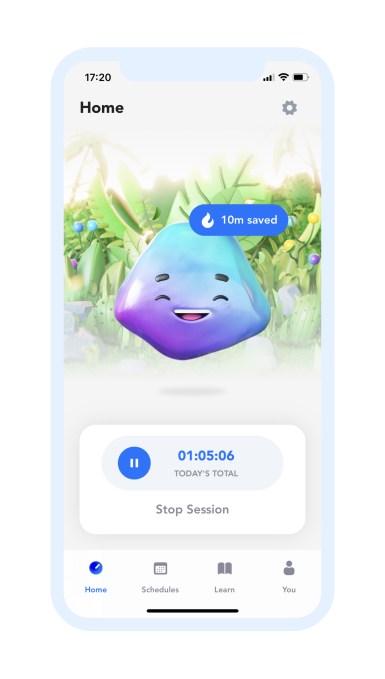
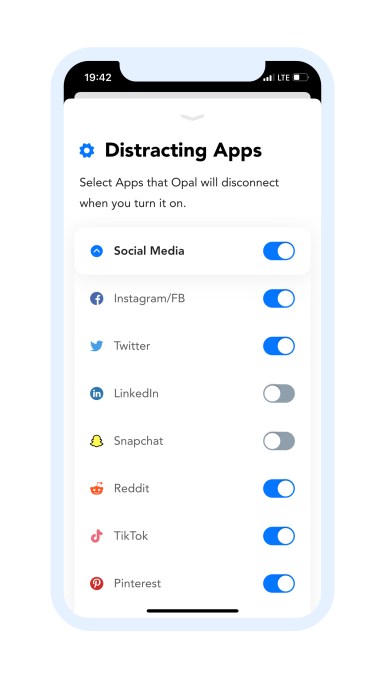
At a basic level, Opal’s VPN allows users to block themselves from using dozens of distracting apps and sites for certain periods of time, including social media, news, productivity apps and more.

Social media, in particular, has been a huge problem in recent years, Schlenker says.

“In particular, Instagram, Facebook and Twitter — social media is where you feel like you’re learning something, and you feel like you’re connecting with people. So it’s good. But on the other hand, it’s very hard to stay intentional,” he explains. “It’s okay to pick up your phone and go to Instagram, but when you ‘wake up’ 30 minutes later, you usually feel really bad. You feel like, ‘where’s the time gone?’, ‘what did I just do?,’ ” he says.

Opal addresses this problem through a handful of features.

Image Credits: Opal

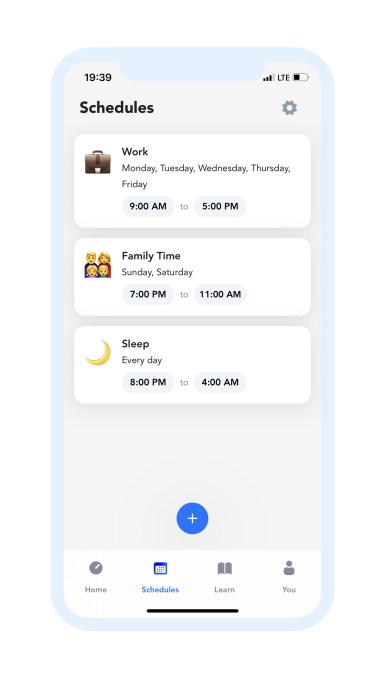
The free service allows you to block distracting websites and apps and take breaks throughout the day. By upgrading to the paid membership, Opal users can schedule time off from apps to establish recurring downtimes — whether that’s for family dinners or working hours, or anything else. They also can use a more extreme version of this feature called Focus Mode, which locks you out of apps in a way that’s not cancelable.

While the company is using a VPN to make this system work, it’s being transparent and straightforward about its data collection practices.

“There is zero private browsing data that leaves your phone,” Schlenker insists. “Anything you do on your phone outside of Opal’s app stays local on your phone and is never stored on any of our servers or any other servers. That’s very important to us,” he says.

From inside Opal’s app, the company claims it only collects usability and crash information — not browsing data. And the usability data is completely anonymized for another layer of privacy. Opal also doesn’t require an email to begin using the app. It only asks for one if you choose to pay.

Image Credits: Opal


These core principles are also documented on Opal’s privacy page, and are why Schlenker believes his app won’t face the challenges that other screen-time apps on the App Store have experienced in the past.

As you may recall, Apple cracked down on the screen time app industry a couple of years ago — a move Apple said was focused on protecting user privacy, but has also been raised as a possible example of anticompetitive behavior. Many of the apps at the time had been using techniques Apple claimed put consumers’ privacy and security at risk, as they gave third-parties elevated access to users’ devices. This was particularly concerning because many of the impacted apps were marketed as parental control services — meaning the end users were often children.

Opal, meanwhile, is targeting adults, and perhaps teenagers, who want to develop better screen-time habits. It is not selling this as a parental control system, however.

Image Credits: Opal

At launch, Opal can block over 100 apps and sites across several categories, including Facebook, Instagram, Snapchat, TikTok, Reddit, Pinterest, YouTube, Netflix, Twitch, Gmail, Outlook, Slack, Robinhood, WhatsApp, WeChat and others, including those in the news, adult and gambling categories.

Users can choose to block the apps for short breaks — 5, 10 or 60 minutes — throughout the day. You can also set an intention and set a timer before using an app, to help you avoid the issue of losing track of time. And you can set focus timers or scheduled times to automatically shut off app usage.

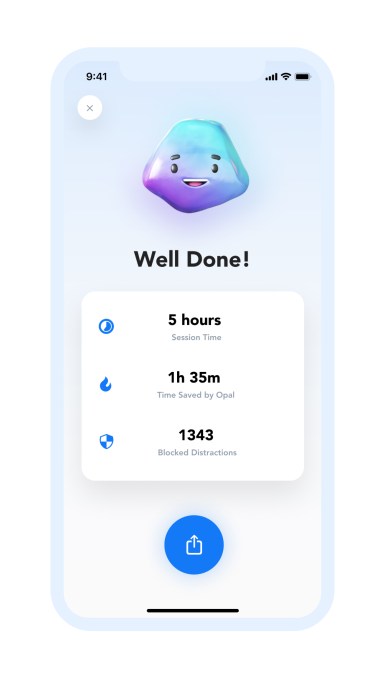
You can track your progress by viewing the “time saved” and you can share your successes across social media. In time, Schlenker plans to add more of a scoring mechanism to Opal that will help you stay accountable to your original goals.

Image Credits: Opal

Though work on the app only began in 2020, Opal began attracting attention as it publicized its plans on Twitter and ran its private beta, which grew from hundreds to thousands of users this year, saving its users an average of two hours per day.

Though Schlenker had connections with many of the angel investors who have since backed Opal, he says the interest from institutional and larger investors was all inbound.

“It was not our intention to raise so much, so early,” Schlenker notes.

The funds will be used to help Opal grow its team, particularly engineering, design as well as product. The company will also soon launch a version of Opal for Chrome and later, Android, and will experiment with more social features around sharing and hosting group sessions.

The app is currently a free download on the App Store with an optional $59.99/year subscription plan.