Year: 2021

19 Jan 2021

Netflix’s ‘Shuffle Play’ feature will roll out to all users worldwide this year

Netflix is always in search of a better way to instantly connect users to something to watch, instead of having them waste time unsuccessfully scrolling through all the available programming options. Now, the company says a recent test focused on solving this problem, Shuffle Play, has proven popular enough to roll out to all users worldwide.

In the streamer’s Q4 2020 earnings, announced today, Netflix noted the product development only briefly. It referred broadly to a test of a new feature that “gives members the ability to choose to instantly watch a title chosen just for them versus browse.” It also noted the feature would reach all users worldwide sometime in the first half of 2021.

Netflix confirmed to TechCrunch the test in question is Shuffle Play, which we first covered back in August 2020. However, the company tells us the actual name of the feature is something that’s still being tested.

Shuffle Play puts a big button right on the Netflix home screen, beneath your profile icon. When clicked, Netflix randomly plays content its personalization algorithms think you’ll like. This could include a movie you’re currently watching, something you’ve saved to your watch list, or a title that’s similar to something you’ve already watched, for example.

A variation has also been spotted in the TV app’s sidebar navigation. More recently, we’ve found this sidebar option relabeled as “Shuffle Play,” instead of “Play Something” as before.

In addition, as you start scrolling down through the Netflix home screen on the TV, you’ll eventually come across a screen that explains what the option is for and points to the new button with a red arrow.

“Not sure what to watch?,” this page asks, before explaining how Shuffle Play works.
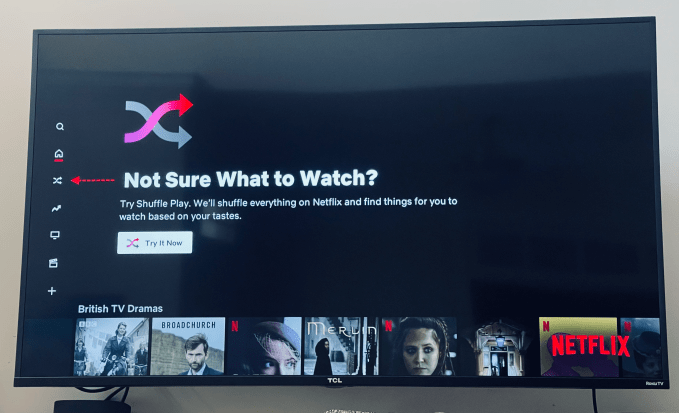
Image Credits: TechCrunch

The button has already appeared on some users’ Netflix app for TV devices, due to the ongoing tests.

In its letter to shareholders, Netflix said the user response to Shuffle Play has been positive — which is funny because the original responses to the feature on social media were decidedly mixed. However, the company doesn’t make its decisions based on what a handful of tweets once said, but rather in how Netflix members actually used the product, of course.

Netflix also tells us the feature is still being tested only on TV devices, not other platforms like web or mobile. It declined to say how many users or what percentage had been opted into the test to date.

Shuffle Play is the latest in a long series of tests where Netflix has tried to make it easier to find something to watch right away.

In 2019, for example, Netflix tried out a shuffle mode that let you click on a popular show to start playing a random episode. This may have worked well when users wanted to play a random episode of their default pick, like the “The Office” or “Friends,” but Netflix has lost both.

It has also promoted its shows on the login screen and as screensavers, and notoriously autoplayed previews until last year, when it finally caved in to user demand for a way to turn this off.

Overall, the goal is to make the Netflix experience closer to that of traditional TV, where you could switch the set on and content just started playing.

Netflix says Shuffle Play will roll out globally in the first half of 2021, but didn’t share more specifics.

19 Jan 2021

A first look at Qualtrics’ IPO pricing

Earlier today, Qualtrics dropped a new S-1 filing, this time detailing its proposed IPO pricing. That means we can now get a good look at how much the company may be worth when it goes public later this month.

The debut has been one TechCrunch has been looking forward to since the company announced that it would be spun out from its erstwhile corporate parent, SAP. In 2019, the Germany-based enterprise giant SAP snatched up Qualtrics for $8 billion just before it was to go public.

Qualtrics is either worth less than we would have guessed, or its first IPO range feels light.

That figure provides a good marker for how well SAP has done with the deal and how much value Qualtrics has generated in the intervening years. Keep in mind, however, that the value of software companies has risen greatly in the last few years, so the numbers we’ll see below benefit from a market-wide repricing of recurring revenue.

Qualtrics estimates that it may be worth $22 to $26 per share when it goes public. Is that a lot? Let’s find out.

Qualtrics’ first IPO range

First, scale. Qualtrics is selling just under 50 million shares in its public offering. As you can math out, at more than $20 per share, the company is looking to raise north of $1 billion.

After going public, Qualtrics anticipates having 510,170,610 shares outstanding, inclusive of its 7.4 million underwriter option. Using that simple share count, Qualtrics would be worth $11.2 billion to $13.3 billion.

19 Jan 2021

A first look at Qualtrics’ IPO pricing

Earlier today, Qualtrics dropped a new S-1 filing, this time detailing its proposed IPO pricing. That means we can now get a good look at how much the company may be worth when it goes public later this month.

The debut has been one TechCrunch has been looking forward to since the company announced that it would be spun out from its erstwhile corporate parent, SAP. In 2019, the Germany-based enterprise giant SAP snatched up Qualtrics for $8 billion just before it was to go public.

Qualtrics is either worth less than we would have guessed, or its first IPO range feels light.

That figure provides a good marker for how well SAP has done with the deal and how much value Qualtrics has generated in the intervening years. Keep in mind, however, that the value of software companies has risen greatly in the last few years, so the numbers we’ll see below benefit from a market-wide repricing of recurring revenue.

Qualtrics estimates that it may be worth $22 to $26 per share when it goes public. Is that a lot? Let’s find out.

Qualtrics’ first IPO range

First, scale. Qualtrics is selling just under 50 million shares in its public offering. As you can math out, at more than $20 per share, the company is looking to raise north of $1 billion.

After going public, Qualtrics anticipates having 510,170,610 shares outstanding, inclusive of its 7.4 million underwriter option. Using that simple share count, Qualtrics would be worth $11.2 billion to $13.3 billion.

19 Jan 2021

Netflix shares soar as it passes 200M paying subscribers

Netflix capped off a year of impressive streaming growth by adding 8.5 million net new paying subscribers during the fourth quarter.

That means the streaming giant now has a total of 204 million paying subscribers worldwide — net growth of 37 million new subscribers for the full year, up from 28 million net additions in 2019.

The company also reported that it brought in $6.64 billion in revenue and earnings per share of $1.19 during Q4, compared to analyst predictions of $6.63 billon in revenue and EPS of $1.39.

In response to the earnings report, Netflix shares were up 12.4% in after-hours trading (as of 4:43pm Eastern).

Looking ahead, Netflix projected that it will add 6.0 million new subscribers in the first quarter of 2021 — the same as its old forecast for Q4, and less than half the 15.8 million subscribers that Netflix added in Q1 2020 (right as lockdowns were beginning in the United States).

The company’s investor letter also highlights a number of hit titles from the quarter, projecting that 72 million households will “choose to watch” (watch at least two minutes of) “The Midnight Sky” in its first 28 days of release, while 68 million households chose to watch “Holidate.” It also said the most recent season of “The Crown” was its most popular yet, with more than 100 million households choosing to watch the show “since its initial launch.”

“In addition to titles with big viewership, we also aspire to have hits that become part of the cultural zeitgeist,” Netflix said. “In 2020 alone, we had ​’Tiger King,​’ ‘​Bridgerton​’ and ​’The Queen’s Gambit​.’ … In fact, Netflix series accounted for nine out of the 10 most searched shows globally in 2020, while our films represented two of the top 10.”

The company acknowledged growing competition from new(-ish) streaming services like Disney+, Peacock and HBO Max, but its user numbers still put it far ahead of any streaming competition — Disney+, for example, had 86.8 million subscribers as of early December (Disney’s service launched a little over a year ago and is still rolling out globally).

“Our strategy is simple: if we can continue to improve Netflix every day to better delight our members, we can be their first choice for streaming entertainment,” Netflix said. “This past year is a testament to this approach. Disney+ had a massive first year (87 million paid subscribers!) and we recorded the biggest year of paid membership growth in our history.”

eMarketer analyst Eric Haggstrom made a similar point in a statement:

Netflix ended 2020 on a high note, adding over 36 million subscribers and passing 200 million subscribers. Despite increasing competition from Disney and others, Netflix had its strongest year yet and will look to grow further in 2021, with a strong content release slate already planned. So far, Netflix has been a clear winner of the streaming wars.

19 Jan 2021

How and when to build marketing teams at deep tech companies

Deep tech startups develop cutting-edge innovations with the power to truly revolutionize society. The founding team members at these companies often come from deeply technical backgrounds, which powers rapid product progress but can create bottlenecks on the go-to-market side.

In this post, I outline the answers to four key questions around marketing at early-stage deep tech companies that are post-revenue:

  • What marketing teams at deep tech companies do.
  • When to hire the marketing team.
  • Whether the marketing team needs industry experience.
  • How to source and evaluate talent for the marketing team.

From this post, deep tech startups can formulate their marketing hiring strategy and attract and cultivate top talent to drive their go-to-market plan. Without business execution, even the most groundbreaking innovations do not achieve their intended impact.

What do marketing teams at deep tech companies do?

To set the context, I share below the typical projects of deep tech marketing teams, which look different from marketing in other industries given the greater product focus and complexity, regulatory oversight and longer time to market.

Go-to-market

Marketers leverage the strength of the IP to establish collaborations with large companies, such as pharma companies and institutions, such as the government, universities or hospitals. To this end, marketers develop creative ways to gather lists of, and information on, key contacts at these potential partners. They also build sales collateral, such as demo videos, pitch decks and one-pagers, to more effectively reach and build long-term relationships with these prospects.

More broadly, marketers also develop the go-to-market strategy beyond partnerships. To this end, marketers conduct in-depth market research on business models, monetization strategies and reimbursement channels.

Communications

Marketers create original content to establish the company as a thought leader, build the company’s brand credibility through social media and apply for awards and honors to validate the potential of the company’s solution.

Forecasting

Marketers work with finance and product teams to formulate projections as the company moves into the clinical phase.

When should deep tech companies hire marketers?

The CEO and other members of the founding team take on marketing work in the formation stage to better understand and empathize with the needs, capabilities and opportunities in the department before bringing someone on full time.

Once the product shows signs of repeatable revenue, a marketing lead is needed. Specifically, this is ahead of a large Series A round, after a small Series A round or when a commercial partner has expressed interest in larger, long-term contracts. Instead of the typical chief marketing officer or chief revenue officer title, deep tech startups call this person a chief commercial officer or chief partnerships officer.

For additional support in the formation stage, companies bring on MBA interns and work with their investors. Prior to the Series A, platform teams at deep tech venture-capital funds are hands-on in helping with marketing through actually doing marketing projects for their portfolio companies, ideating on long-term marketing strategy with the founders through regular feedback sessions and connecting founders with vetted marketing contractors or agencies.

For companies that require FDA approval, commercial advisors, consultants and board members fully take on the partnership strategy work (which represents the bulk of the marketing needs) prior to the Series A round. Similarly, external consultants, such as marketing agencies, can take over major projects like launch strategy. External consultants can then join the team should their performance be strong.

For drug-development companies, the marketing leader is most crucial when the company enters the clinical phase and prepares for trials, regardless of funding stage.

Do marketing hires need industry experience?

Of course, it is ideal to hire someone with experience selling into the space and someone who is comfortable with the complex supply chains and long sales cycles. However, if the choice is between someone with functional expertise but no industry expertise and someone with industry experience but limited or no functional expertise, it is better to hire the former candidate and leverage the rest of the team for domain expertise. Deep tech is a niche area, so the other team members can support the marketer in developing industry expertise.

19 Jan 2021

Bolt Mobility launching into 48 new markets after snapping up Last Mile’s assets

Bolt Mobility, the Miami-based micromobility startup co-founded by Olympic gold medalist Usain Bolt, is expanding to 48 new markets after acquiring the assets of Last Mile Holdings.

Bolt Mobility’s rise and Last Mile’s demise captures the uncertainty that plagued micromobility companies in the past year as the COVID-19 pandemic upended business models that were, in some cases, already on shaky ground.

Bolt Mobility and Last Mile were both negatively affected by the COVID-19 pandemic. Bolt Mobility, for instance, had to shut down in several markets in early 2020 due to the pandemic. The company rebounded after it tweaked its business model and began to partner with local operators, added GM’s former VP global design Ed Welburn as an adviser and came out with a new scooter equipped with dual brakes, 10-inch wheels, LED lights, swappable batteries with 25 miles of range and NanoSeptic surfaces on its handlebars and brake levers designed to rid these common contact points of germs and bacteria.

Last Mile Holdings didn’t fare as well.

If Last Mile Holdings doesn’t sound familiar, the brands it once owned might. Last Mile was a holding company that owned the OjO Electric scooters and Gotcha Mobility, which had a portfolio of electric trikes, scooters and bikes. The company acquired Gotcha in a $12 million cash and stock deal that closed in March 2020.

As Bolt Mobility grew, with its customer base hitting 300,000 users in 2020, Last Mile hit headwinds. Last Mile Holdings, which traded on the Toronto Stock Exchange under MILE, ended up selling its U.S. assets in an auction. Bolt Mobility acquired substantially all of the assets of the company for a credit bid of $3 million, according to a filing at the end of the year.

Those assets include 8,500 new devices, including e-scooters, e-bikes, pedal bikes and sit-down cruisers and licenses to operate in 48 new markets, the majority of which (more than 30) are exclusive contracts, according to Bolt CEO Ignacio Tzouma. The 48 new markets include 18 university campuses.

“The acquisition represents a significant expansion for Bolt on all fronts,” Tzoumas said, adding that the company brought on former Gotcha Chief Operating Officer Matt Tolan, who will now serve as Bolt’s chief commercial officer, as well as about 20 team members who were formerly a part of Gotcha’s tech and operations teams.

Riders in Bolt’s new markets will continue to be able to access and use the e-scooters, e-bikes and pedal bikes through the Gotcha Mobility and Ojo Electric iOS and Android mobile apps. Bolt is working with cities and universities to transition these markets to Bolt’s platform. The acquisition adds e-bikes to the Bolt platform for the first time. Although, the company was already developing its own line of e-bikes that it plans to launch later this year.

Gotcha Powered By Bolt

Image Credits: Bolt Mobility

Bolt credits its new business model for helping it survive and even thrive in 2020. Instead of continuing to handle the complex and expensive task of fleet management and operations, Bolt decided to partner with local companies. These partners operate Bolt’s fleets on the ground in each individual market. This customizable approach allowed for a business partnership model in select markets where Bolt leased scooters to delivery workers, restaurants and other small businesses, the company said. 

By July, Bolt and its partners were operating in five new or re-launched markets. Bolt also has a backlog of agreements with partners for an additional 20 markets that the acquisition is primed to fulfill, according to the company. 

Tzoumas said Bolt was able to execute the deal without taking on any additional debt, and “under terms that will allow us to continue devoting our resources to expanding and improving our services in all of the markets where we operate.” The acquisition was funded in part by Fuel Venture Capital, an existing Bolt investor.  Bolt is also backed by Sofreh Capital and The Yucaipa Companies.

“We founded Bolt because we believe in micromobility as a movement that can transform the way people live and move within their communities,” Usain Bolt said in a statement. “This expansion proves that anything is possible for micromobility when you support it with talented people, innovative technology, and the incredible work ethic of the Bolt team.”

19 Jan 2021

SpaceX bought two oil rigs to convert into offshore launch pads for Starship

SpaceX’s next spacecraft is in development in Texas, and CEO Elon Musk previously revealed that the company was planning to build floating spaceports for Starship  operations, after a job ad was posted looking for someone to oversee their development. Now, SpaceX has purchased two oil rigs to convert for this purpose, as first reported by spaceflight.com’s Michael Baylor, and confirmed by CNBC.

The rigs have been named Deimos and Phoibos by SpaceX, which are the names of the two Moons of Mars (and the names of the gods of both dread and fear in Greek mythology before that). The rigs were originally designed for off shore deepwater drilling, up to a maximum depth of 8,500 feet. They’re currently located in Brownsville, a port city on the Gulf of Mexico near SpaceX’s Starship development site in Brownsville, Texas.

These vessels measure 240-feet by 255-feet, and will in theory be repurposed to support launching of Starship (and perhaps return landing, given their reusable design). Thus far, SpaceX has been launching and landing its Starship prototypes on land at its Boca Chica site, though it’s only done lower altitude flights so far. The company also operates two drone ships, which are 300-feet long by around 170-feet wide, as autonomous floating landing pads for its current Falcon 9 rocket boosters.

SpaceX also posted another ad seeking a resort development manager to turn its south Texas facility into a “21st century spaceport,” specifically looking for someone with resort expertise. Meanwhile, Musk confirmed that he has moved to Texas last December, following a number of public suggestions that he would do so owing in part to California’s taxation and regulatory environment.

Musk’s other company SpaceX also selected Austin as the site of its next gigafactory in the U.S., intended for assembly of its Cybertruck, Model Y and Tesla Semi, as well as Model 3 cars destined for customers on the east coast. SpaceX has maintained engine test facilities in McGreger, Texas, and set up Boca Chica as one of two Starship development sites alongside Florida, before making the south Texas location the sole focus for that spacecraft’s construction and testing after consolidating its efforts.

19 Jan 2021

Uppbeat launches a freemium music platform aimed at YouTubers

A new music platform, Uppbeat, aims to make it easier for YouTubers and other content creators to find quality free music to use in their videos. The system, which is designed to navigate the complexities of copyright claims while also fairly compensating artists, offers an alternative to existing free music platforms, including YouTube’s own Audio Library and Creative Commons’ legal music for videos, for example.

The idea for the startup comes from Lewis Foster and Matt Russell, the U.K.-based co-founders of another music-licensing company, Music Vine, which has been operating for about six years.

Last year, the co-founders realized there was a growing opportunity to address the creator space with a slightly different product.

“We were realizing, more and more, was that the creator space — YouTubers, streamers, podcasters — has become enormous, but there wasn’t a music platform that was doing a nice job for those type of users,” explains Foster. “So we sat down and thought about what the perfect music resource would look like for creators. That led to deciding to build Uppbeat,” he says.

They began developing the Uppbeat website in September 2020 and launched it to the public on Monday.

On the creators’ side, Uppbeat’s key focus is on eliminating headaches over copyright claims, particularly on YouTube.

Currently, if a YouTuber gets a copyright claim over music in their video, it can cause them to lose income. Though YouTube has worked to address this problem over the years with new features and changes to its Content ID match system, it’s still an issue.

“If a YouTuber gets a copyright claim, [YouTube] can de-monetize their video. And if they go through YouTube’s dispute system, it can take as long as 30 days for it to get resolved. It’s a pretty big frustration for YouTubers,” Foster says.

Uppbeat’s music will instead almost instantly clear the claims.

Image Credits: Uppbeat

Similar to Spotify, the Uppbeat website leverages a freemium model, To get started, creators can sign up for a free account that provides with access to about 50% of the site’s roughly 1,000-track music catalog and 10 downloads per month. The paid plan offers full catalog access and no download limit.

Free users simply add a credit to their YouTube video description to clear copyright claims, while paid users are added to an approved list, eliminating this extra step.

Because the tracks have to fingerprinted to fight off unlicensed usage, a copyright claim will still occur. But instead of taking days or weeks to resolve, it will be cleared within about five minutes, the company says. The Uppbeat system clears the claim by checking the video description for the necessary credit and by checking the claim against its list of paid users. This is all automated, too, which helps to speed things up.

Image Credits: Uppbeat

Meanwhile, on the artists’ side, Uppbeat will pays as their music is used — even by the free users.

The revenue from the premium subscriptions, and soon, advertising, is divided between the artists on a monthly basis, in proportion to the number of downloads the artist receives.

“What that means from the artists’ perspective is, on average, they’re going to make the same amount from tracks on the premium side as they do on the free side,” says Lewis. “It means, even for free usage, they will get paid,” he adds.

The site will also monetize through audio ads that play as you browse the tracks and listen to the music. (However, these are just promoting the paid plan for the time being.)

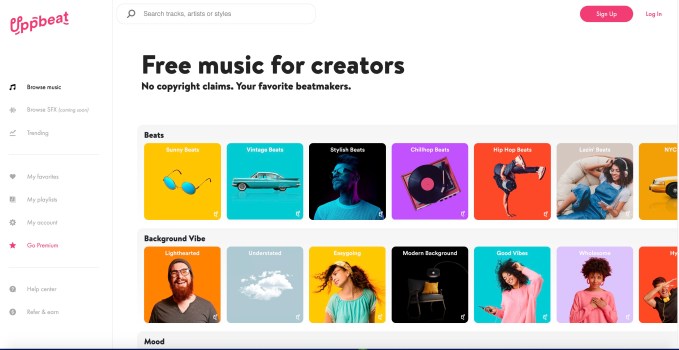
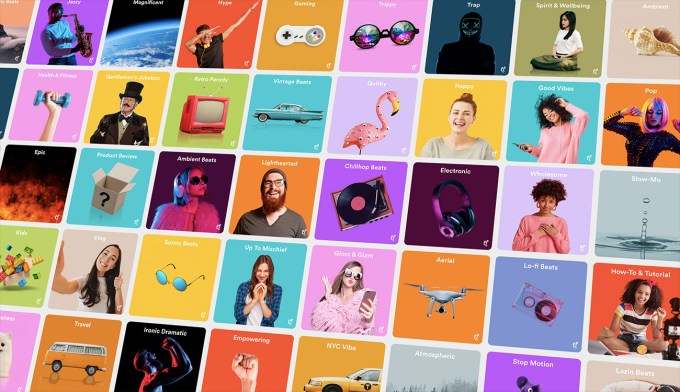
Browsing Uppbeat’s catalog is easy, too. The music is organized by genre, theme and style in colorful rows that aim to introduce all the different types of music and beats a YouTuber may need. For example, there’s music customized for use the background and other tracks that cater to different moods, like inspiring, calm, happy, dramatic, and more. A catalog of SFX (sound effects) is expected to be added in a few months, too.

Uppbeat believes its existing music industry connections with producers, composers and songwriters via Music Vine will help them to source higher-quality tracks than other free music services.

At present, the startup is self-funded through revenues from Music Vine, but Foster says they’ve had some VC interest. For now, though, the founders are looking to keep the ownership in-house, for the most part.

However, Uppbeat is experimenting with both a referral program and a profit-sharing scheme. The latter will allow YouTubers who bring Uppbeat new customers, then take the full revenue from those customers for two years’ time.

“We’re taking a massive sacrifice,” Foster admits. “But from from our perspective, the faster we can get Uppbeat out there and well-known in the YouTuber space, then we’re happy to share that [revenue]. We think it’s a cool idea to share that within the YouTuber community, rather than [take] a big private investment,” he notes.

The startup is also considering making shares in the company available to some larger YouTubers, Foster adds.

Today, Uppbeat is a team of 8 employees and 12 freelancers, based in Leeds, U.K.


19 Jan 2021

Ad-supported EV charging network developer Volta raises $125 million

Volta, the developer of a network of electric vehicle charging stations that monetize using advertising, has raised $125 million in new funding in a process managed by Goldman Sachs.

Volta builds and operates a network of electric vehicle charging stations that are sited in parking lots around grocery stores, pharmacy chains, banks and hospitals.

The company has placed its charging stations, with their 55-inch digital displays in locations at 200 cities across 23 states, according to a statement.

The charge is free for vehicle owners and is supported by the retailers and consumer goods companies that want to reach the EV audience.

With the new financing, Volta has now raised over $200 million in funding and intends to use its cash to begin expanding internationally.

Companies who have placed Volta’s chargers on their sites include Albertsons Companies, Giant Food, Regency Centers, Wegmans and TopGolf. Brands advertising on the company’s screens include GM, Hulu, Nestlé, Polestar, Porsche and Unilever.

“Since our initial investment in Volta in 2018, excitement and interest in electrification — and specifically solving for public charging solutions — has continued to gain momentum,” said John Tough, Managing Partner at Energize Ventures, a major and existing investor in this round. “Our conviction in this team has similarly grown, and we believe Volta is poised to lead this market as the most capital-efficient and highly utilized EV charging network in the country.”


19 Jan 2021

Ad-supported EV charging network developer Volta raises $125 million

Volta, the developer of a network of electric vehicle charging stations that monetize using advertising, has raised $125 million in new funding in a process managed by Goldman Sachs.

Volta builds and operates a network of electric vehicle charging stations that are sited in parking lots around grocery stores, pharmacy chains, banks and hospitals.

The company has placed its charging stations, with their 55-inch digital displays in locations at 200 cities across 23 states, according to a statement.

The charge is free for vehicle owners and is supported by the retailers and consumer goods companies that want to reach the EV audience.

With the new financing, Volta has now raised over $200 million in funding and intends to use its cash to begin expanding internationally.

Companies who have placed Volta’s chargers on their sites include Albertsons Companies, Giant Food, Regency Centers, Wegmans and TopGolf. Brands advertising on the company’s screens include GM, Hulu, Nestlé, Polestar, Porsche and Unilever.

“Since our initial investment in Volta in 2018, excitement and interest in electrification — and specifically solving for public charging solutions — has continued to gain momentum,” said John Tough, Managing Partner at Energize Ventures, a major and existing investor in this round. “Our conviction in this team has similarly grown, and we believe Volta is poised to lead this market as the most capital-efficient and highly utilized EV charging network in the country.”