Year: 2021

19 Jan 2021

In 2020, VCs invested $428M into US-based startups every day

Despite a pandemic that sparked a global recession, 2020 was still a record year for venture capital investments into American startups.

According to data shared by PitchBook and the National Venture Capital Association, investors poured $156.2 billion into domestic startups last year, or around $428 million for each day of the year. The huge sum of money, however, was itself dwarfed by the amount of liquidity that American startups generated, some $290.1 billion.


The Exchange explores startups, markets and money. Read it every morning on Extra Crunch, or get The Exchange newsletter every Saturday.


The exit-value figure was a record as well, as were the 321 rounds worth $100 million — nearly one for each day of the year.

But while the U.S. venture capital market in 2020 was hot, it was not newly so. In 2018 and 2019, VCs invested around $140 billion into domestic startups, making last year’s $156 billion result a record, but not a shocking departure from previous years.

A first read of the data indicates that the U.S. venture capital market is still getting larger in scale and later-stage in focus. But inside those well-worn trends are a host of notable movements that both underscore what we observed last year in real time, and teach us something new about today’s venture capital market.

So far, 2021’s startup financing and exit market appears to be the mirror of what we saw in late 2020. So we’d best understand the past so we can forecast what we’ll see in Q1 of 2021.

To avoid getting too lost in the data, we’ll proceed by stage, pulling out key facts for each step of the startup lifecycle. Feel free to scroll to the one that makes the most sense for where your company is, or fund invests today.

Seed

In the U.S., seed deal count was high in 2020, around 5,227 per PitchBook’s estimates. Those rounds were worth just over $10 billion, making it the third year in a row in which American seed-stage startups managed around $10 billion in capital against around 5,000 rounds.

Boring, yeah? Not really. Inside those numbers are the whole year’s ups-and-downs: the fact that the seed data is so close to 2018 and 2019 levels is almost silly.

The real surprise from seed, per PitchBook’s report, is that these valuations actually fell on a year-over-year basis in 2020. This, despite the fact that seed deal sizes rose.

Considering these two trends at once, it appears likely that, on average, VC ownership as a percentage of seed-stage companies rose in 2020.

Frankly I was just surprised to see a form of startup valuation decrease after expanding for nearly a decade.

19 Jan 2021

In 2020, VCs invested $428M into US-based startups every day

Despite a pandemic that sparked a global recession, 2020 was still a record year for venture capital investments into American startups.

According to data shared by PitchBook and the National Venture Capital Association, investors poured $156.2 billion into domestic startups last year, or around $428 million for each day of the year. The huge sum of money, however, was itself dwarfed by the amount of liquidity that American startups generated, some $290.1 billion.


The Exchange explores startups, markets and money. Read it every morning on Extra Crunch, or get The Exchange newsletter every Saturday.


The exit-value figure was a record as well, as were the 321 rounds worth $100 million — nearly one for each day of the year.

But while the U.S. venture capital market in 2020 was hot, it was not newly so. In 2018 and 2019, VCs invested around $140 billion into domestic startups, making last year’s $156 billion result a record, but not a shocking departure from previous years.

A first read of the data indicates that the U.S. venture capital market is still getting larger in scale and later-stage in focus. But inside those well-worn trends are a host of notable movements that both underscore what we observed last year in real time, and teach us something new about today’s venture capital market.

So far, 2021’s startup financing and exit market appears to be the mirror of what we saw in late 2020. So we’d best understand the past so we can forecast what we’ll see in Q1 of 2021.

To avoid getting too lost in the data, we’ll proceed by stage, pulling out key facts for each step of the startup lifecycle. Feel free to scroll to the one that makes the most sense for where your company is, or fund invests today.

Seed

In the U.S., seed deal count was high in 2020, around 5,227 per PitchBook’s estimates. Those rounds were worth just over $10 billion, making it the third year in a row in which American seed-stage startups managed around $10 billion in capital against around 5,000 rounds.

Boring, yeah? Not really. Inside those numbers are the whole year’s ups-and-downs: the fact that the seed data is so close to 2018 and 2019 levels is almost silly.

The real surprise from seed, per PitchBook’s report, is that these valuations actually fell on a year-over-year basis in 2020. This, despite the fact that seed deal sizes rose.

Considering these two trends at once, it appears likely that, on average, VC ownership as a percentage of seed-stage companies rose in 2020.

Frankly I was just surprised to see a form of startup valuation decrease after expanding for nearly a decade.

19 Jan 2021

Citrix is acquiring Wrike from Vista for $2.25B

Citrix announced today that it plans to acquire Wrike, a SaaS project management platform, from Vista Equity Partners for $2.25 billion. Vista bought the company just two years ago.

Citrix, which is best known for its digital workspaces, sees this as a good match, especially at a time where employees have been forced to work from home because of the pandemic. By combining the two companies, it produces a powerful combination, one that didn’t escape Citrix CEO and president David Henshall

“Together, Citrix and Wrike will deliver the solutions needed to power a cloud-delivered digital workspace experience that enables teams to securely access the resources and tools they need to collaborate and get work done in the most efficient and effective way possible across any channel, device or location,” Henshall said in a statement.

Andrew Filev, founder and CEO at Wrike, who has managed the company through these multiple changes and remains at the helm, believes his company has landed in a good spot with the Citrix purchase.

“First, as part of the Citrix family we will be able to scale our product and accelerate our roadmap to deliver capabilities that will help our customers get more from their Wrike investment. We have always listened to our customers and have built our product based on their feedback — now we will be able to do more of that, faster.,” Filev wrote in a company blog post announcing the deal, stating a typical argument from CEOs of acquired companies.

The startup reports $140 million ARR, growing at 30% annually, so that comes out to approximately 16x its present-day revenue, which is the price companies are generally paying for acquisitions these days. However, as Wrike expects to reach $180 million to $190 million in ARR this year, the company’s sale price could look like a bargain in a few years’ time if the projections come to pass.

The price was not revealed in the 2018 sale, but it surely feels like a big win for Vista. Consider that Wrike has previously raised just $26 million.

19 Jan 2021

WeChat advances e-commerce goals with $250B in transactions

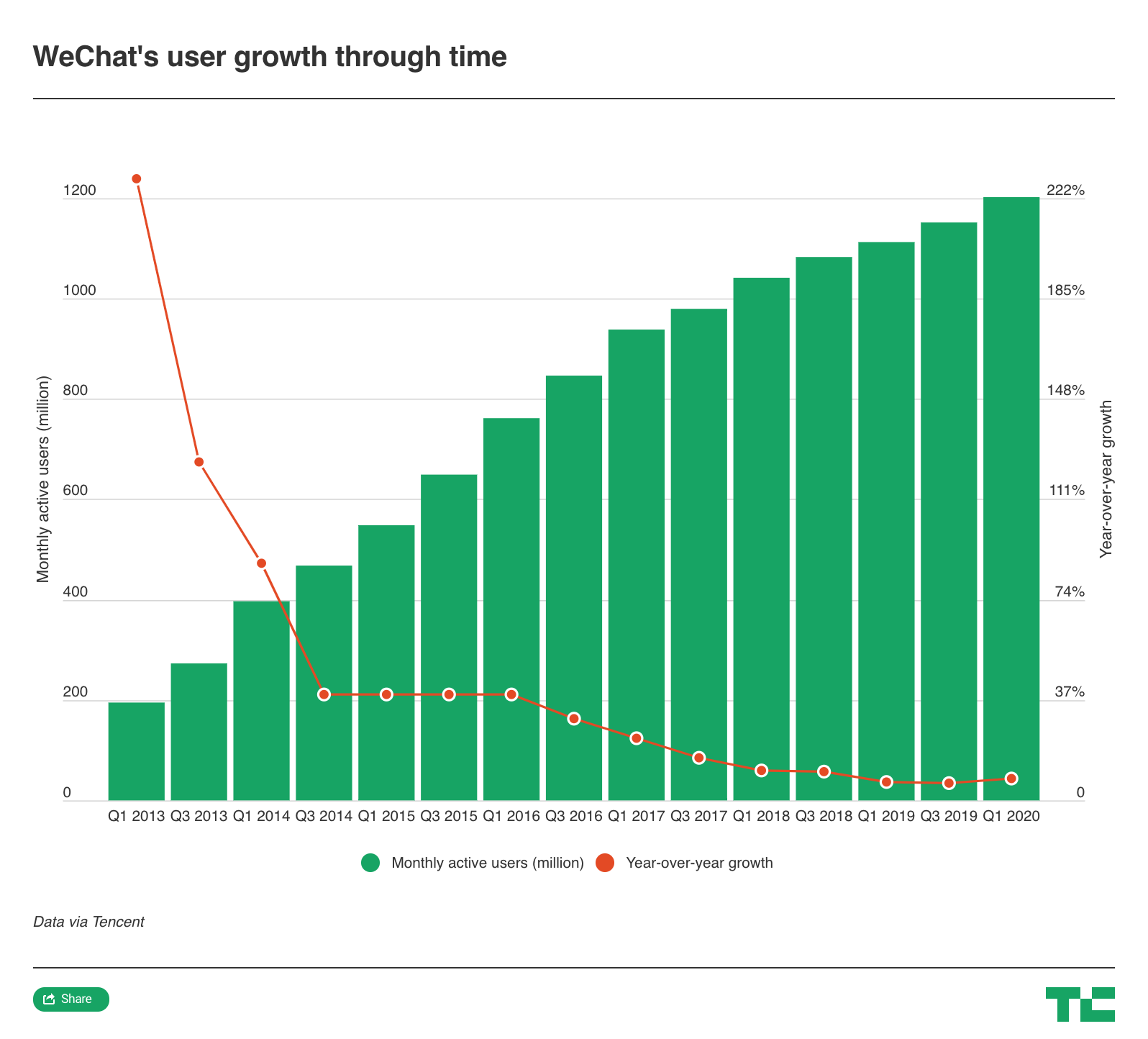
WeChat continues to advance its shopping ambitions as the social networking app turns 10 years old. The Chinese messenger facilitated 1.6 trillion yuan (close to $250 billion) in annual transactions through its “mini programs,” third-party services that run on the super app that allow users to buy clothes, order food, hail taxis and more.

That is double the value of transactions on WeChat’s mini programs in 2019, the networking giant announced at its annual conference for business partners and ecosystem developers, which normally takes place in its home city of Guangzhou in southern China but was moved online this year due to the pandemic.

To compare, e-commerce upstart Pinduoduo, Alibaba’s archrival, saw total transactions of $214.7 billion in the third quarter.

WeChat introduced mini programs in early 2017 in a move some saw as a challenge to Apple’s App Store and has over time shaped the messenger into an online infrastructure that keeps people’s life running. It hasn’t recently disclosed how many third-party lite apps it houses, but by 2018 the number reached one million, half the size of the App Store at the time.

From Tencent’s strategic perspective, the growth in mini program-based transactions helps further the company’s goal to strengthen its fintech business, which counts digital payments as a major revenue driver.

A big proportion of WeChat’s mini programs are games, which the app said exceeded 500 million monthly users thanks to a boost in female and middle-aged users, as well as players residing in China’s Tier 3 cities, WeChat said.

The virtual conference also unveiled a set of other milestones from China’s biggest messaging app, which surpassed 1.2 billion monthly active users last year.

Among its monthly users, 500 million have tried the WeChat Search function. The Chinese internet is carved into several walled gardens controlled by titans like Tencent, Alibaba and ByteDance, which often block competitors from their services. When users search on WeChat, they are in effect retrieving information published on the messenger as well as Tencent’s allies like Sogou, Pinduoduo and Zhihu, rather than the open web.

WeChat said 240 million people have used its “payments score.” When the feature debuted back in 2019, there was speculation that it signaled WeChat’s entry into consumer credit finance and participation in the government’s social credit system. WeChat reiterated at this year’s event that the WeChat score does neither of that.

Like Ant’s Sesame Score, the rating system works more like a royalty program, “designed to build trust between merchants and users.” For instance, people who reach a certain score can waive deposits or delay payments when using merchant services on WeChat. The score, WeChat said, helped users save more than $30 billion in deposits a year.

WeChat’s enterprise version has surpassed 130 million active users. Its biggest rival, Dingtalk, operated by Alibaba, reached 155 million daily active users last March.

The one-day event concluded with the much-anticipated appearance of Allen Zhang, WeChat’s creator. Zhang went to great lengths to talk about WeChat’s nascent short-video feature, which is somewhat similar to Snap’s Stories. He didn’t disclose the number of users on short videos because “the PR team doesn’t allow” him to, but said that “if we set a goal for ourselves, we will have to achieve it.”

Zhang also announced the WeChat team is weighing up an input tool for users. It’d be a tiny project given Tencent’s colossal size, but the project reflects Zhang’s belief in “privacy protection,” despite public skepticism about how WeChat handles user data.

“If we analyze users’ chat history, we can bring great advertising revenue to the company. But we don’t do that, so WeChat cares a lot about user privacy,” asserted Zhang.

“But why do you still get ads [related to] what you have just said on WeChat? There are many other channels that process your information, not just WeChat. From there, our technical team said, ‘Why don’t we create an input tool ourselves?'”

19 Jan 2021

Equity Tuesday: Everyone’s raising money, and Wrike exits yet again

Hello and welcome back to Equity, TechCrunch’s venture capital-focused podcast where we unpack the numbers behind the headlines.

This is Equity Monday Tuesday, our weekly kickoff that tracks the latest private market news, talks about the coming week, digs into some recent funding rounds and mulls over a larger theme or narrative from the private markets. You can follow the show on Twitter here and myself here — and make sure to check out last week’s two episodes, covering all the news sans ecommerce, and then all the ecommerce news.

We’re here on a Tuesday due to an American holiday, but that short break did not mean that the world’s news volume slowed down in the slightest. Here’s the rundown:

And that’s that for today, we are back in short order on Thursday afternoon!

Equity drops every Monday at 7:00 a.m. PST and Thursday afternoon as fast as we can get it out, so subscribe to us on Apple PodcastsOvercastSpotify and all the casts.
19 Jan 2021

Fintech startup Vise brings on Andrew Fong (formerly Dropbox) as CTO

Vise, a fintech firm that focuses on helping financial advisors rather than automating them out of existence, has today announced that its bringing on Andrew Fong as its Chief Technology Officer.

Fong hails from Dropbox, where he served as VP of Infrastructure Engineering. He actually started out as a Site Reliability Engineer at Dropbox back in 2012 climbing the ranks to Engineering Director, and then Senior Director of Engineering – Head of Infrastructure before becoming to vice president.

Before Dropbox, Fong was an engineer at YouTube and Aol.

Vise brought on Fong to scale up its technical team following its most recent fundraise, a $45 million in Series B led by Sequoia Capital. In total, Vise has raised $63 million since launching on the TC Disrupt stage in 2019.

You can check out the video of their demo here.

Vise uses AI to support financial advisors in their relationships with clients, giving them the ability to justify and explain (with data) the reason for making this or that investment, as well as the ability to customize a portfolio quickly.

Top of mind for Fong is scaling up the engineering department from 20 people to 75 by the end of the year, and Fong explained that diversity, equity and inclusion must be front and center in that endeavor.

“Vise is in the early stages of building out its engineering organization,” Fong told TechCrunch. “It’s imperative that we weave in DEI as a first principle to our recruiting at this stage and ensure we are maturing our processes with DEI in mind.”

At Dropbox, Fong started out as a team leader building a team of 40 and by the time he left, led a team of more than 250 people. He explained that he learned a lot during that 8+ year period, and made a lot of mistakes, and was eager to see how that knowledge could be reapplied at a different firm.

“What would it be like to do this again with the knowledge I have now?” asked Fong. “What things would I do differently? How would I improve upon it? How can I actually take that knowledge and leverage it in a way that helps others in the industry or my peers at Vise? Can I provide a perspective that they don’t necessarily have today?”

Fong was first connected with Vise while he was still at Dropbox. He spoke to Vise cofounder Runik Mehrotra on an explanatory call, and remembers feeling like no matter where his path took him, he wanted to stay connected to Mehrotra and Vise.

“This is somebody that just has something about him,” he said of Mehrotra. “There’s just like an ‘it’ factor that made me feel like I wanted to work with him.”

Fong says that recruiting during COVID, with extremely limited face-to-face contact, is one of the biggest challenges ahead for both himself and Vise in general.

19 Jan 2021

Senator: ‘More transparency is needed’ by exam proctoring tech firms

Three of the leading exam proctoring companies are facing calls to be more transparent, amid continued claims of bias and fault by students forced to take remote exams because of the ongoing pandemic.

Exam proctoring tech lets students take remotely invigilated tests from home. Students are told to install their university’s choice of proctoring software, which allows the exam monitor deep access to the student’s computer, including their webcams and microphones, to monitor their activity to spot potential cheating.

But companies like Proctorio, ExamSoft, and ProctorU have faced a barrage of criticism from students who say that their proctoring technology is fraught with problems, including issues of bias — all of which could impact their test results.

Chief among the complaints are that their proctoring software cannot recognize faces with darker skin tones or religious headgear, and discriminates against students with disabilities and those in lower-income areas who may not have the internet speeds to meet the standards of the test-taking tech.

Several U.S. Democratic senators sent Proctorio, ExamSoft, and ProctorU letters in December calling on the companies to explain their technology and policies better. In their responses seen by TechCrunch, the companies rejected claims of discrimination and all said that it’s up to the teachers to decide whether a student has cheated, not the companies themselves.

But lawmakers say that the companies are not transparent enough, and worry teachers could be making decisions about a student’s conduct based on little more than what the technology tells them.

“Proctorio, ExamSoft, and ProctorU claim they don’t have problems with bias, yet alarming reports from students tell a different story,” Sen. Richard Blumenthal (D-CT) told TechCrunch. “These responses from the companies are only the first step in learning more about how they operate, but much more transparency is needed into the systems that have the power to accuse students of cheating. I will work on every fix necessary to ensure students are protected.”

Students across the U.S. have already called on their schools to stop using proctoring software citing privacy and security risks.

We sent the companies several questions. ProctorU’s chief executive Scott McFarland declined to comment citing the holiday weekend. Proctorio and ExamSoft did not respond.

19 Jan 2021

StackPulse announces $28M investment to help developers manage outages

When a system outage happens, chaos can ensue as the team tries to figure out what’s happening and how to fix it. StackPulse, a new startup that wants to help developers manage these crisis situations more efficiently, emerged from stealth today with a $28 million investment.

The round actually breaks down to a previously unannounced $8 million seed investment and a new $20 million Series A. GGV led the A round, while Bessemer Venture Partners led the seed and also participated in the A. Glenn Solomon at GGV and Amit Karp at Bessemer will join the StackPulse board.

Nobody is immune to these outages. We’ve seen incidents from companies as varied as Amazon and Slack in recent months. The biggest companies like Google, Facebook and Amazon employ site reliability engineers and build customized platforms to help remediate these kinds of situations. StackPulse hopes to put this kind of capability within reach of companies, whose only defense is the on-call developers.

Company co-founder and CEO Ofer Smadari says that in the midst of a crisis with signals coming at you from Slack and PagerDuty and other sources, it’s hard to figure out what’s happening. StackPulse is designed to help sort out the details to get you back to equilibrium as quickly as possible.

First off, it helps identify the severity of the incident. Is it a false alarm or something that requires your team’s immediate attention or something that can be put off for a later maintenance cycle. If there is something going wrong that needs to be fixed right now, StackPulse can not only identify the source of the problem, but also help fix it automatically, Smadari explained.

After the incident has been resolved, it can also help with a post mortem to figure out what exactly went wrong by pulling in all of the alert communications and incident data into the platform.

As the company emerges from stealth, it has some early customers and 35 employees based in Portland, Oregon and Tel Aviv. Smadari says that he hopes to have 100 employees by the end of this year. As he builds the organization, he is thinking about how to build a diverse team for a diverse customer base. He believes that people with diverse backgrounds build a better product. He adds that diversity is a top level goal for the company, which already has an HR leader in place to help.

Glenn Solomon from GGV, who will be joining the company board, saw a strong founding team solving a big problem for companies and wanted to invest. “When they described the vision for the product they wanted to build, it made sense to us,” he said.

Customers are impatient with down time and Solomon sees developers on the front line trying to solve these issues. “Performance is more important than ever. When there is downtime, it’s damaging to companies,” he said. He believes StackPulse can help.

19 Jan 2021

UK’s WhiteHat rebrands as Multiverse, raises $44M to build tech apprenticeships in the US

University education is getting more expensive, and at the moment it feels a bit like a petrie dish for infections, but the long-term trends continue to show a dramatic growth in the number of people worldwide getting degrees beyond high school, with one big reason for this being that a college degree generally provides better economic security.

Today, a startup that is exploring a different route for those interested in technology — specifically by way of apprenticeships to bring in and train younger people on the job — is announcing a significant round of growth funding to see if it can provide a credible, scalable alternative to that model.

Multiverse, a UK startup that works with organizations to develop technology-based apprenticeships, and then helps source promising, diverse candidates to fill those roles, has raised $44 million, funding that it will be using to spearhead a move into the US market.

The Series B is being led by General Catalyst (which has been especially active this week with UK startups: it also led a large round yesterday for Bloom & Wild), with GV (formerly known as Google Ventures), Audacious Ventures, Latitude and SemperVirens also participating. Index Ventures and Lightspeed Venture Partners, who first invested in the company in its $16 million Series A in 2020, also participated. Valuation is not being disclosed.

The company was originally co-founded as WhiteHat and is officially rebranding today. Co-founder Euan Blair (who happens to be the son of the former UK prime minister Tony Blair and his accomplished barrister wife Cherie Booth Blair) said the name change was because the original name was a reference to how the startup sought to “hack the system for good.”

However, he added, “The scale has become bigger and more evolved.” The new name is to convey that — as in gaming, which is probably the arena where you might have heard this term before — “anything is possible.”

There are “multiple universes” one can inhabit as a post-18 young adult, Blair continued, and while it’s been assumed that to get into tech, the obvious route was college or university, the bet that Multiverse is making here is that apprenticeships can easily, and widely, become another. “We want to build an outstanding alternative to university and college,” he said.

This is especially important when thinking of how to target more marginalized groups and how this ties up with how tech companies are looking to be more diverse in the future. Blair said that currently over half of the people making their way through Multiverse are people of color, and 57% are women, and the plan is to build tools to make that an even firmer part of its mission. 

The startup sees itself as part-tech company and part-education enterprise. It works with tech companies to open up opportunities for people who have not had any higher education or any training, where fresh high school graduates can come in, learn the ropes of a job while getting paid, and then continue on working their way up the ladder with that knowledge base in place.

This is not just a social enterprise: there is actual money in this area. Blair prices that it charges the companies it works with range by qualification “but are broadly around the $15,000 mark.” (The individuals applying don’t pay anything, and they will eventually also be paid by the companies providing the apprenticeships.)

On the educational front, Multiverse doesn’t just connect people as a recruiter might: it has a team in place to build out what the “curriculum” might be for a particular apprenticeship, and how to deliver and train people with the requisite skills alongside the practice experience of working, and more.

That latter role, of course, has taken on a more poignant dimension in the last year: concepts like remote training and virtual mentorship have very much come into their own at a time when offices are largely standing empty to help reduce the spread of Covid-19.

Regardless of what happens in the year ahead — fingers crossed that vaccinations and other efforts will help us collectively move past where we are right now — many believe that the infrastructure that has been put into place to keep working virtually will continue to be used, which bodes well for a company like Multiverse that is building a business around that, both with technology it creates itself and will bring in from third parties and partners.

Indeed, the ecosystem of companies building tools to deliver educational content, provide training and work collaboratively has really boomed in the pandemic, giving companies like Multiverse a large library of options for how to bring people into new work situations. (Google, which is now an investor in Multiverse, is very much one of the makers of such education tools.)

Apprenticeships are an interesting area for a startup to tackle. Traditionally, it’s a term that would have been associated mainly with skilled labor positions, rather than “knowledge workers.”

But you can argue that with the bigger swing that the globe has seen away from industrial and towards knowledge economies, there is an argument to be made for building more enterprises and opportunities for an ever wider pool of users, rather than expecting everyone to be shoehorned into the models of the last 50 years. (The latter would essentially imply that college is possibly the only way up.)

You might also be fair to claim that Blair’s connections helped him secure funding and open doors with would-be customers, and that might well be the case, but ultimately the startup will live or die by how well it executes on its premise, whether it finds a good way to connect more people, engage them in opportunities, and keep them on board.

This is what really attracted the investors, said Joel Cutler, managing director and co-founder of General Catalyst.

“Euan has a genuine belief that this is important, and when you talk to him, you get a  feeling of manifest destiny,” Cutler said in an interview. In response to the question of family connections, he said that this was precisely the kind of issue that the technology industry should be tackling to fight.

“Of all the industries to break the mold of where you went to school, it should be the tech world that will do that, since it is far more of a meritocracy than others. This is the perfect place to start to break that mold,” he said. “Education will be super valuable but apprenticeships will also be important.” He noted that another company that General Catalyst invests in, Guild Education, is addressing similar opportunities, or rather the gaps in current opportunities, for older people.


19 Jan 2021

Microsoft invests in Cruise in new $2 billion round

Cruise has raised $2 billion in a new equity round that has pushed its valuation up to $30 billion and delivered Microsoft as an investor and partner.

GM, Honda and other institutional investors have also put more capital into Cruise as the autonomous vehicle company inches closer to commercializing its technology.

While Microsoft’s capital is important, the partnership might provide equal and longer term value for Cruise. Under the long-term strategic partnership, Cruise will leverage Azure, Microsoft’s cloud and edge computing platform, to commercialize its autonomous vehicle solutions at scale.

Any autonomous vehicle company aiming to commercialize — meaning bring their tech to the public at scale — needs a robust cloud computing platform. Operating fleets of self-driving vehicles that will shuttle people and even packages generates a massive amount of data, making cloud services one of the bigger costs for an AV company.

Cruise’s partnership with Microsoft aims to provide benefits for both companies. Cruise will be able to lock in lower prices for cloud services and Microsoft will be able to test the some of its bleeding edge systems that can handle workloads needed to bring machine learning and robotics — like autonomous vehicles — to life and at scale.

“Advances in digital technology are redefining every aspect of our work and life, including how we move people and goods,” Microsoft CEO Satya Nadella said in a statement. “As Cruise and GM’s preferred cloud, we will apply the power of Azure to help them scale and make autonomous transportation mainstream.”

The partnership extends to GM as well, according to Tuesday’s announcement. Microsoft will be GM’s preferred public cloud provider to help the automaker accelerate several of it digitization initiatives as well as streamline operations across digital supply chains.

The partnership will not only allow Cruise to accelerate the commercialization of its all-electric, self-driving vehicles, it help “GM realize even more benefits from cloud computing as we launch 30 new electric vehicles globally by 2025 and create new businesses and services to drive growth, GM Chairman and CEO Mary Barra said.