Year: 2021

19 Jan 2021

Health insurance startup Alan launches free medical app Alan Baby

French startup Alan is generating 100% of its revenue from health insurance products — and that isn’t going to change. But the company wants to start a conversation with a bigger use base. Alan is going to launch multiple mobile apps that let you learn more about health topics, contact a doctor and chat with the community.

“We are proud to announce today that we’re launching free medical apps for everyone,” co-founder and CEO Jean-Charles Samuelian-Werve said in a virtual press conference. “We’re going to develop services for specific groups of people who are facing specific issues or questions.”

And the company is starting with Alan Baby. As you can guess from the name, Alan Baby helps you stay on top of your baby’s health. The company has chosen to focus on that segment as your baby’s health can be a great source of mental stress.

When you first open the app, you get a feed of articles on specific topics, from sleep to nutrition and child development. You can get relevant articles by entering the birthdate of your child as you often don’t have the same questions at day one and day 100.

While parents usually have 10 pediatrician appointments in the first year, you may have a burning question that cannot wait that long. From Alan Baby, you can start a text discussion with a doctor. The company says users should expect an answer within 24 hours.

Alan had already hired doctors for a similar messaging feature for its users who are covered under the health insurance products. The company is opening up that feature to more users beyond its paid customers.

Finally, people who install Alan Baby can interact with each other in the community section. It works a bit like an online forum on health topics, except that it’s mobile-first and Alan wants to moderate it with some help from its doctors.

“Thanks to what we’re setting up for parents, we will be able to extend it to other topics soon,” Samuelian-Werve said. He names fertility, mental health or diabetes as potential topics for other free apps.

While the apps are going to be free, the company expects to attract new clients for its health insurance thanks to those new apps. Essentially, Alan is broadening the top of its sales funnel with free apps.

Alan Baby is rolling out progressively in France. There’s a waitlist and the iOS app is available to pre-order (for free) in the App Store.

An update on the health insurance products

Back in October, Samuelian-Werve told me that 100,000 were covered through Alan. A few months later, 139,000 people are covered through one Alan insurance product or another. Overall, 8,300 companies have chosen the company as their health insurance provider. Basically, Alan’s user base has more than doubled in 2020.

In France, employees are covered by both the national healthcare system and private insurance companies. So Alan convinces other companies to use its product for its employees. The company has obtained its own health insurance license, which means that it can customize its health insurance products completely depending on the segment and client.

The company is also operating in Spain and Belgium. But it’s been a slow start with 300 members in Spain and 500 members in Belgium. Alan is going to focus on those two markets before launching new countries in the future.

19 Jan 2021

TikTok’s Chinese version Douyin launches an e-wallet

Tencent’s WeChat Pay and Alibaba’s affiliate Alipay have long dominated digital payments in China, but they have always faced new challengers. The latest entrant in online payments is Douyin, TikTok’s Chinese version.

The short video app recently added “Douyin Pay” to its list of existing payment options, which have included Alipay and WeChat Pay.

“The set-up of Douyin Pay (Douyin Zhifu) is to supplement the existing major payment options, and to ultimately enhance user experience on Douyin,” a Douyin spokesperson said.

Payment is a natural step for Douyin, which has a growing e-commerce business. Users can be directed to a product link while watching a video of an influencer reviewing, say, a lipstick. Instead of the ubiquitous WeChat Pay and Alipay, they may opt for Douyin Pay one day, if the incentives are great enough.

Other internet giants, such as e-commerce giant JD.com and food delivery service Meituan, have also tried luring people to use their own payment methods, though the market duopoly is hard to break. All in all, Alipay and WeChat Pay handle about 90% of China’s electronic payments.

Like other internet firms, Douyin parent ByteDance snapped up a coveted payments license by acquiring a third-party payments firm. Last September, a company controlled by ByteDance founder Zhang Yiming bought out a payments solution provider called Wuhan Hezhong Yibao Technology Co. The license, in turn, allows Douyin, Toutiao and other ByteDance services to offer payment features.

Users can, for instance, receive a cash-filled electronic red packet from a Douyin campaign and deposit that cash to their bank accounts.

Douyin Pay

The rollout of Douyin Pay seems well-timed with the upcoming Chinese New Year holiday, a time when families and friends gift each other red packets. Over the past decade, WeChat has been popularizing electronic versions of these auspicious money-filled envelopes, which helped WeChat Pay take off in the early days.

Douyin inked a deal with Chinese state broadcaster CCTV to be its red envelope technology provider for the Spring Festival Gala, traditionally a major advertising event of the year, according to Chinese business news provider LatePost. Alibaba’s young rival Pinduoduo had a similar deal last year in an attempt to grow its own payments users.

19 Jan 2021

Skyqraft raises $2.2M seed for its powerline issue detection system

Skyqraft, the Swedish startup using AI and drones for electricity powerline inspection, has raised $2.2 million in seed funding, capital it will use to further develop its technology and expand its operations in Europe and in the U.S.

Leading the seed round is Subvenio Invest, with participation from pre-seed backer Antler, Next Human Ventures, and unnamed angel investors.

Founded in March 2019 and launched that September, Skyqraft provides what it calls “smart” infrastructure inspections for powerlines. It uses drones, combined with AI, to gather images and detect risk automatically.

This is in contrast to the status quo, where power-lines are typically inspected by teams of people and helicopters, which is time consuming and potentially dangerous. The idea behind Skyqraft is to enable safer powerline inspections in a more cost-efficient and environmentally sustainable way.

“Power-line inspections most importantly are not environmentally friendly, very costly and unsafe with the use of helicopters and people,” Skyqraft co-founder and CMO Sakina Turabali told TechCrunch when Skyqraft announced its pre-seed funding. “We provide smart infrastructure inspections using unmanned airplanes by gathering images and 360 videos and feeding that data into a machine learning system that automatically detects any risk to the power-lines.”

Skyqraft says the system can process high volumes of image data and is able to detect equipment issues “rapidly and with high accuracy”. By using Skyqraft, the Swedish company claims utility companies can shorten a 25km powerline inspection from two days to “three minutes”.

Image Credits: Skyqraft

That proposition appears to already be resonating with customers, which include the three largest utility companies in Sweden jointly representing 85% of the Swedish market. Additionally, Skyqraft says it is also negotiating a series of larger scale pilots in the U.S. in 2021 with the global utility company Iberdrola.

19 Jan 2021

LeoCare raises $18.1 million for its insurance products designed to fit in a mobile app

French startup LeoCare has raised a €15 million funding round. Felix Capital, Ventech and Daphni are participating in today’s funding round. The company is selling a portfolio of insurance products with a focus on the signup process and user experience. You can control your insurance products from a mobile app.

Chances are you already pay for multiple insurance products. But when is the last time you checked your coverage and adjusted your contract? When people sign up to a new insurance product, they tend to set it and forget it.

That’s why insurance companies don’t invest a ton of money on mobile apps, control panels and user-facing features. LeoCare believes there’s room for a player that does the opposite.

LeoCare can insure your home, your car, your motorbike and your smartphone. You can sign up from the company’s website or install a mobile app. The company has tried to optimize the onboarding process with easy-to-understand questions and an indicator that tells you if you’re going to pay a bit more or a lot more if you choose one option or another.

When you sign up, you get your insurance contract right away. This way, you can send it to a landlord a few minutes later. But LeoCare also helps you manage your contract later down the road. For instance, many LeoCare customers chose to lower their car insurance premiums during lockdown. You can also add another driver for a couple of weeks.

Behind the scenes, LeoCare acts as a managing general agent. The startup partners with several insurance companies and sells its insurance products under its own brand. The company currently charges €1 million in premiums per month and has 20,000 customers.

63% of contracts cover a car, 26% of contracts cover a home, 7% of contracts are for motorcyclists and 4% of contracts focus on smartphones. And LeoCare is growing rapidly with a current month-over-month growth rate of 38%.

Up next, the company wants to launch new features, such as a bot that lets you check the status of your case. LeoCare is also working on a feature that lets you receive a notification when you’re driving and there are usually a lot of road accidents in the area.

Finally, the startup wants to launch a marketplace of professionals. This could be helpful if you’re looking for a plumber for instance. And it could represent a new revenue stream for the startup.

LeoCare plans to grow its insurance portfolio sevenfold by the end of 2021. The team will also grow from 35 to 80 people.

19 Jan 2021

Prosus Ventures leads $30 million investment in Indian agritech startup DeHaat

Once overlooked, agritech startups are beginning to have a moment in India.

On Tuesday, DeHaat, an online platform that offers full-stack agricultural services to farmers, said it has raised $30 million in a new financing round as the Indian firm looks to maintain its accelerated growth despite the pandemic.

Prosus Ventures, formerly known as Naspers Ventures, led Patna and Gurgaon-based startup’s Series C financing round. RTP Global and existing investors Sequoia Capital India, FMO, Omnivore and AgFunder also participated in it, bringing the startup’s to-date raise to over $46 million. (Dexter Capital was the advisor for this funding round.)

One of the biggest challenges farmers in India face is securing agri-input items such as seeds and fertilizers and then finding buyers after producing the yields.

DeHaat, which is Hindi for village, is solving this by bringing brands, institutional financers and buyers to one platform, which is accessible through a helpline and an app in local languages.

Only about a third of the yields Indian farmers produce reaches the big markets, according to industry estimates. It’s traditionally proven immensely difficult for farmers to find buyers for their produce.

Once the season is over, DeHaat helps farmers sell their yields to bulk buyers such as business-to-business marketplace Udaan, Reliance Fresh, and food delivery firm Zomato.

The 10-year-old startup has also developed a database of crop tests and uses artificial intelligence to provide farmers with free-of-cost personalized advisory on what they should sow in a season. DeHaat also helps farmers secure working capital through partnership with hundreds of institutional firms.

We wrote about DeHaat last year, when it had raised a $12 million financing round. The past nine months has been the story of its accelerated growth despite the coronavirus pandemic, which prompted lockdowns across the nation for several months.

The startup, which today has presence in eastern part of India — states such as Bihar, Uttar Pradesh, Jharkhand, Odisha and West Bengal — serves close to 400,000 farmers, up from about 210,000 in April last year, Shashank Kumar, co-founder and chief executive of the startup, told TechCrunch in an interview.

How the startup is tackling these challenges is equally impressive. It works with nearly 1,400 micro-entrepreneurs, up from about 400 last year, in rural areas who distribute over 4,000 types of agri-input goods to farmers from their regional hubs and then bring back the output to the same hub. “They are the ones responsible for last-mile delivery and aggregation,” he said.

DeHaat has grown on every front, including the revenue it clocks, which is up 3X to 3.5X since last year, he said.

“At the end of March, our daily volume out was around 200 metric tonne. Now it’s over 600 metric tonne. Everyday we aggregate this much from farmers and supply to FMCG players and modern retails. Similarly on the agri-input side — seed, fertilizers, and pesticide — we are processing close to 10,000 orders everyday, compared to about 2,600 in March of last year,” he said.

“Prosus Ventures invests in industries around the world where innovation can significantly address big societal needs,” said Ashutosh Sharma, Head of India Investments at Prosus Ventures, in a statement.

“DeHaat is catering to a massive market in India with the agriculture sector worth more than $350 billion to the country’s economy and consisting of an estimated 140 million+ farmers. Through its end-to-end agricultural services offerings, DeHaat will have a major societal impact in India, improving the earning potential for Indian farmers and overall yield for the sector while also enabling microentrepreneurs all over the country, including in rural areas where there is often less income opportunity,” he added.

The startup plans to deploy the fresh capital to expand to more states in India including Rajasthan, Madhya Pradesh, and Maharashtra and eventually serve 10 million farmers.

And another area where it intends to focus is hiring top tech talent. The startup has doubled its workforce since the past year, with many high-profile hires from major firms. The startup, which recently made its second acquisition, is also open to exploring more M&A opportunities, said DeHaat’s Kumar.

Once ignored, scores of agritech startups have cropped up in India in recent years — and many old startups are beginning to receive large-sized checks from investors.

Further reading: Omnivore and Accel recently co-authored a report on India’s agritech landscape.

19 Jan 2021

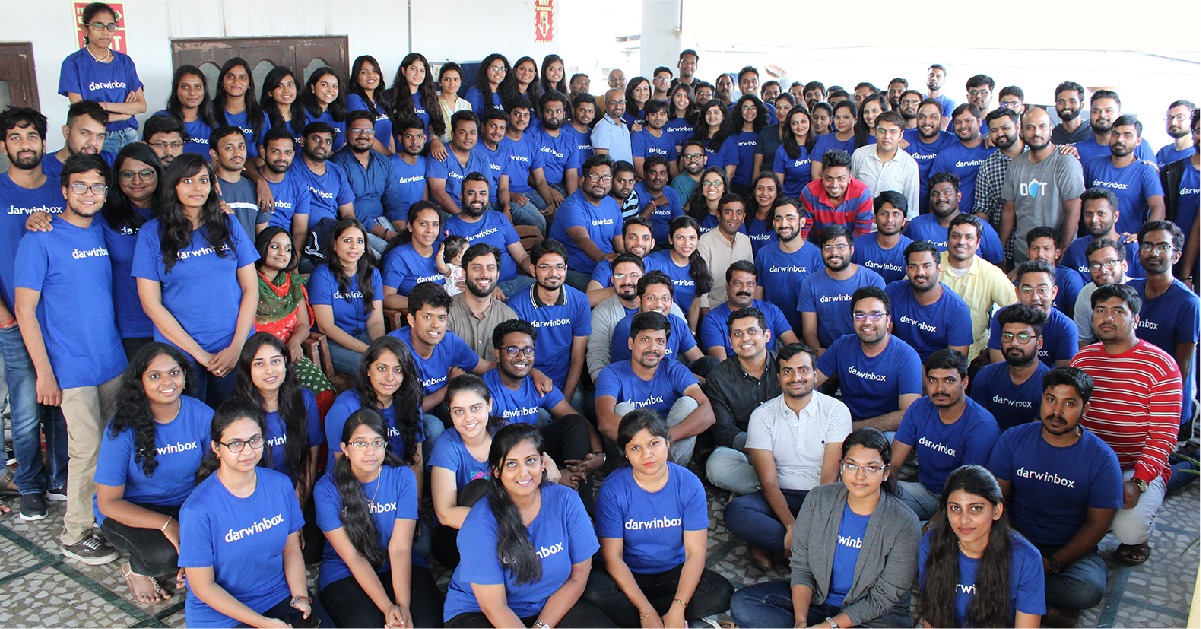
Salesforce leads $15M investment round in Indian HR tech platform Darwinbox

Darwinbox, which operates a cloud-based human resource management platform, has raised $15 million in a new financing round as the Indian startup looks to expand beyond the country and Southeast Asian markets.

The new round, a Series C, for the Hyderabad-based startup was led by Salesforce Ventures, the venture arm of the American software giant. This is Salesforce Ventures’ one of rare investments in India. Existing investors including Lightspeed India and Sequoia Capital India also participated in the round, which brings the five-year old startup’s total raise to date to $35 million.

Over 500 firms including — Tokopedia, Indorama, JG Summit Group, Zilingo, Zalora, Fave, Adani, Mahindra, Kotak, TVS, NSE, Ujjivan Small Finance Bank, Dr.Reddy’s, Nivea, Puma, Swiggy, Bigbasket — use Darwinbox’s HR platform to provide more than a million employees of theirs with a range of features including insurance and early salary as loans in 60 nations, up from about 200 firms across 50 nations in 2019, said Chaitanya Peddi, co-founder of Darwinbo, in an interview with TechCrunch.

Peddi said the startup has always looked up to Salesforce, and investment from the enterprise giant is “nothing sort of a child receiving validation from their father,” he said.

The fundraise caps the most successful year for the startup that started with uncertainty as the coronavirus spread across Asian nations. The startup took a hit as its customers scrambled to navigate through the global pandemic, but the last two quarters have been its best to date, said Peddi. Overall, the startup’s revenue has ballooned by 300% since September 2019, when it last raised money, he said.

Image Credits: Darwinbox

Darwinbox’s platform is built to take care of the entire “hiring to retiring” cycle needs for employees. It handles onboarding of new hires, keeps a tap on their performance, monitors attrition rate, and provides an ongoing feedback loop.

It also provides its customers with a social network for their employees to remain connected with one another and an AI assistant to apply for a leave or set up meetings with quick voice commands from their phones.

Peddi said the startup will deploy the fresh capital to expand to several more countries, especially in the Middle East, and broaden its offerings.

“India is home to one of the world’s youngest population, and by 2050, it is expected to account for over 18% of the global working age population,” said Arundhati Bhattacharya, Chairperson and CEO, Salesforce India, in a statement. “This makes technology platforms like Darwinbox, that focuses on workforces, incredibly important. I’m proud that Salesforce is supporting Darwinbox on their journey as they continue to grow and innovate in this space.”

More to follow…

18 Jan 2021

Singapore-based Volopay raises $2.1 million seed round to build a “financial control center” for businesses

Volopay, a Singapore-based startup building a “financial control center” for businesses, announced today it has raised $2.1 million in seed funding. The round was led by Tinder co-founder Justin Mateen, and included participation from Soma Capital, CP Ventures, Y Combinator, VentureSouq, the founders of Razorpay and other angel investors.

The funding will be used on hiring, product development, strategic partnerships and Volopay’s international expansion. It plans to launch operations in Australia later this month. The company currently has about 100 clients, including Smart Karma, Dathena, Medline, Sensorflow and Beam.

Launched in 2019 by Rajith Shaiji and Rajesh Raikwar, Volopay took part in Y Combinator’s accelerator program last year. It was created after chief executive officer Shaji, who worked for several fintech companies before launching Volopay, became frustrated by the process of reconciling business expenses, especially with accounting departments located in different countries. Shaiji and Raikwar also saw that many companies, especially startups and SMEs, struggled to track different kinds of spending, including subscriptions and vendor payments.

Most of Volopay’s clients are in the tech sector and have about 15 to 150 employees. Volopay’s platform integrates multi-currency corporate cards (issued by VISA Corporate), domestic and international bank transfers, automated payments and expense and accounting software, allowing companies to save money on foreign exchange fees and reconcile expenses more quickly.

In order to speed up its development, Volopay integrated Airwallex’s APIs. Its corporate cards offer up to 2% cashback on software subscriptions, hosting and international travel, which Volopay says are the three top expense categories for tech companies, and it in November 2020, it launched a credit facility for corporate cards to help give SMEs more liquidity during the COVID-19 pandemic.

Compared to traditional credit products, like credit cards and working capital loans, Shaji said Volopay’s credit facility, which is also issued by VISA Corporate, has a more competitive fixed-free pricing structure that depends on the level of credit used. This means companies know how much they owe in advance, which in turn helps them manage their cashflows more easily. The average credit line provided by Volopay is about $30,000.

Since TechCrunch last covered Volopay in July 2020, it has grown 70% month on month in terms of total funds flowing through its platform, Shaji said. It also launched two new features: a bill pay feature that allows clients to transfer money domestically and internationally with low foreign exchange rates and transaction fees, and the credit facility. The bill pay feature now contributes about 40% to Volopay’s total payment volume, while the credit product makes up 30% of its card spending.

Shaji told TechCrunch that Volopay decided to expand into Australia because because not only is it a much larger market than Singapore, but “SMEs in Australia are very comfortable using paid digital software to streamline internal operations and scale their businesses.” He added that there is currently no other provider in Australia that offers both expense management and credit to SMEs like Volopay.

18 Jan 2021

Gillmor Gang: Twitter+

The best thing about 2020 is we survived it. No need to say what the worst thing is, it’s hands down our collective stupidity in the choices we’ve made. That reality has forced us to refactor what we do moving forward.

If we had correctly understood the massive changes ahead, we would not be wondering when we will return to the old, new, or any normal. The normal is what got us here. Unlimited air travel, freedom to do whatever we wanted without regard to the impact it would have on anybody else. Nationalism. What the hell is that all about? Keeping us in, everybody else out.

Take Twitter for one. When it first emerged, it felt like a pipe dream realized. For me, it still feels that way. Good people like it, so do bad people. Bad as in they use the global network to inflict damage on their political enemies. Does that mean the phone is a bad thing, too? Or cars, or popcorn butter? What about dramas? They’re sad, reward winners and losers? Do I wish Hollywood was only allowed to make romcoms? Well, yes I do.

But only if it doesn’t abridge my rights, my freedom to pursue happiness. So when I see Twitter turn into a cesspool, I look for someone to blame. Let’s start with the bad guys. But what if they have a point about something? Their motives may be suspect, or just plain evil. What am I doing reading them anyway. It’s not like I chose them to follow. Well, apparently I did, by listening to people who retweet what these folks spew.

Retweets are another one of these things I love about Twitter. Let’s say I follow someone whose perspective I admire, and they in turn retweet others who they admire. A social cloud forms with interesting characteristics. Implicitly, the pattern of retweets, @mentions, and likes can be plugged into readers or aggregators to reflect trends, emerging news, business analytics, and social dynamics of power, ethics, humor, and stature.

So it’s not like a follow of the bad actors, but it is like I follow their relative position in the stream of those I follow. I can and do rationalize this monitoring of other than the chosen social group as a necessary early warning system for trouble ahead. These signals can be used prophylactically to measure how our message is carrying, but a typical impact is to pigeonhole our views as fodder for those who wish us ill.

Net net, this countervailing energy reduces the sense of fun I have with the global network. If I had to choose no Twitter over this problem, I still choose Twitter. In the early days of social media, I had a front row seat in observing how these little signals could have a surprising impact on the concerns of the day, on the projection of ideas around the network to and with others who together built support, and sometimes, business through the collective group mind.

Has this been lost in the partisan nature of our daily political noise? Of course, just try saying anything about anything and watch the nasty trolls rev up their schtick. Not fun. Also not effective, because the pushback creates a new rhythm of Pee Wee Herman yeah-but-what-am-I dynamics. What to do? How about a @botmention that argues with tagged trolls but silently removes the noise from the feeds of those who @like the @bot tag.

Implementing this semi-public stream is already doable inside a private network, with the “cost” of joining the agreement to provide access to an internal view that makes the stream less noisy and more responsive. We’ve been experimenting with just such a private/public backchannel to support production of the Gillmor Gang, but I’m not here to promote that. More usefully, the network functions efficiently in concert with Twitter.

The events of 2020, and the years leading up to the election and pandemic breakout, make clear that the kind of social media spread we have seen has consequences we should have countered but in fact exacerbated. Yet even in the volatile wind down of the election are some signs of a rebound from playing the chaos card. Whatever you think of Twitter’s history of or lack of backbone development, Jack Dorsey’s red line in the sand was a much needed call to arms against Trump’s bullying.

Even if the actual technology was limited in effect, the application of any pushback at all was a signal of what the world might look like if the election went the other way. The first amplification of that subtle shift came from social media’s biggest customer, mainstream media: pointed pushback in White House press conferences, silent movie montages of Republican senators refusing to answer shouted hallway questions, networks cutting away from events when the falsehood level reached fake mass.

Mitch McConnell’s move to tie additional stimulus help to Trump’s attempt to punish Twitter by repealing Section 230 protection proved effective in running out the clock. It also moved the ball from Trump’s control to the hard numbers of January 20. The Georgia runoff on January 5, followed the next day by the attempt to challenge the electoral college Biden win and the storming of the Capitol, changed everything. Twitter became Trump’s last super power. Note: this edition of the Gang was recorded minutes before Twitter permanently suspended the @realDonaldTrump account.

Well, there is Zoom too. Its swappable background feature lets the ex-resident broadcast to the faithful as though nothing has changed. That’s why he came back from vacation early, to pre-pardon his production staff and hire a shadow cabinet. Secretary of Streaming, Chief Acting Legal Officer, Secretary of Horror Stephen Miller, Secretary of Bacteria Giuliani.

Zoom lets you do this behind a subscription paywall, but now Trump+ is competing against Disney+, Netflix, Apple+, and the bundles designed to lock-in the market until the vaccines take root. Or how about an ACA+ bundle that gives you pre-existing coverage, the latest iPhone, and any three + networks on a rotating basis to encourage competition for stream retention.

from the Gillmor Gang Newsletter

__________________

The Gillmor Gang — Frank Radice, Michael Markman, Keith Teare, Denis Pombriant, Brent Leary and Steve Gillmor. Recorded live Friday, January 8, 2021.

Produced and directed by Tina Chase Gillmor @tinagillmor

@fradice, @mickeleh, @denispombriant, @kteare, @brentleary, @stevegillmor, @gillmorgang

Subscribe to the Gillmor Gang Newsletter and join the backchannel here on Telegram.

The Gillmor Gang on Facebook … and here’s our sister show G3 on Facebook.

18 Jan 2021

Cryptocat author gets insanely fast backing to build p2p tech for social media

The idea for Capsule started with a tweet about reinventing social media.

A day later cryptography researcher, Nadim Kobeissi — best known for authoring the open source e2e encrypted desktop chat app Cryptocat (now discontinued) — had pulled in a pre-seed investment of $100,000 for his lightweight mesh-networked microservices concept, with support coming from angel investor and former Coinbase CTO Balaji Srinivasan, William J. Pulte and Wamda Capital.

The nascent startup has a post-money valuation on paper of $10M, according to Kobeissi, who is working on the prototype — hoping to launch an MVP of Capsule in March (as a web app), after which he intends to raise a seed round (targeting $1M-$1.5M) to build out a team and start developing mobile apps.

For now there’s nothing to see beyond Capsule’s landing page and a pitch deck (which he shared with TechCrunch for review). But Kobeissi says he was startled by the level of interest in the concept.

“I posted that tweet and the expectation that I had was that basically 60 people max would retweet it and then maybe I’ll set up a Kickstarter,” he tells us. Instead the tweet “just completely exploded” and he found himself raising $100k “in a single day” — with $50k paid in there and then.

“I’m not a startup guy. I’ve been running a business based on consulting and based on academic R&D services,” he continues. “But by the end of the day — last Sunday, eight days ago — I was running a Delaware corporation valued at $10M with $100k in pre-seed funding, which is insane. Completely insane.”

Capsule is just the latest contender for retooling Internet power structures by building infrastructure that radically decentralizes social platforms to make speech more resilient to corporate censorship and control.

The list of decentralized/p2p/federated protocols and standards already out there is very long — even while usage remains low. Extant examples include ActivityPub, Diaspora, Mastodon, p2p Matrix, Scuttlebutt, Solid and Urbit, to name a few.

Interest in the space has been rekindled in recent weeks after mainstream platforms like Facebook and Twitter took decisions to shut down US president Donald Trump’s access to their megaphones — a demonstration of private power that other political leaders have described as problematic

Kobeissi also takes that view, while adding the caveat that he’s not “personally” concerned about Trump’s deplatforming. But he says he is concerned about giant private corporations having unilateral power to shape Internet speech — whether takedown decisions are being made by Twitter’s trust & safety lead or Amazon Web Services (which recently yanked the plug on right-wing social network Parler for failing to moderate violent views).

He also points to a lawsuit that’s been filed in US court seeking damages and injunctive relief from Apple for allowing Telegram, a messaging platform with 500M+ users, to be made available through its iOS App Store — “despite Apple’s knowledge that Telegram is being used to intimidate, threaten, and coerce members of the public” — raising concerns about “the odds of these efforts catching on”.

“That is kind of terrifying,” he suggests.

Capsule would seek to route around the risk of mass deplatforming via “easy to deploy” p2p microservices — starting with a forthcoming web app.

“When you deploy Capsule right now — I have a prototype that does almost nothing running — it’s basically one binary. And you get that binary and you deploy it and you run it, and that’s it. It sets up a server, it contacts Let’s Encrypt, it gets you a certificate, it uses SQLite for the database, which is a server-less database, all of the assets for the web server are within the binary,” he says, walking through the “really nice technical idea” which snagged $100k in pre-seed backing insanely fast.

“There are no other files — and then once you have it running, in that folder when you set up your capsule server, it’s just the Capsule program and a Capsule database which is a file. And that’s it. And that is so self-contained that it’s embeddable everywhere, that’s migratable — and it’s really quite impossible to get this level of simplicity and elegance so quickly unless you go this route. Then, for the mesh federation thing, we’re just doing HTTPS calls and then having decentralized caching of the databases and so on.”

Among the Twitter back-and-forth about how (or whether) Kobeissi’s concept differs to various other decentralized protocols, someone posted a link to this XKCD cartoon — which lampoons the techie quest to resolve competing standards by proposing a tech that covers all use-cases (yet is of course doomed to increase complexity by +1). So given how many protocols already offer self-hosted/p2p social media services it seems fair to ask what’s different here — and, indeed, why build another open decentralized standard?

Kobeissi argues that existing options for decentralizing social media are either: A) not fully p2p (Mastodon is “self-hosted but not decentralized”, per a competitive analysis on Capsule’s pitch deck, ergo its servers are “vulnerable to Parler-style AWS takedowns”); or B) not focused enough on the specific use-case of social media (some other decentralized protocols like Matrix aim to support many more features/apps than social media and therefore can’t be as lightweight is the argument); or C) simply aren’t easy enough to use to be more than a niche geeky option.

He talks about Capsule having the same level of focus on social media as Signal does on private messaging, for example — albeit intending it to support both short-form ‘tweet’ style public posts and long-form Medium-style postings. But he’s vocal about not wanting any ‘bloat’.

He also invokes Apple’s ‘design for usability’ philosophy. Albeit, it’s a lot easier to say you want to design something that ‘just works’ vs actually pulling off effortless mainstream accessibility. But that’s the bar Kobeissi is setting himself here.

“I always imagine Glenn Greenwald when I think of my user,” he says on the usability point, referring to the outspoken journalist and Intercept co-founder who recently left to launch his own newsletter-based offering on Substack. “He’s the person I see setting this up. Basically the way that this would work is he’d be able to set this up or get someone to set it up really easily — I think Capsule is going to offer automated deployments as also a way to make revenue, by the way, i.e. for a bit extra we deploy the server for you and then you’re self-hosting but we also make a margin off of that — but it’s going to be open source, you can set it up yourself as well and that’s perfectly okay. It’s not going to be hindered at all in that sense.

“In the case of Capsule, each content creator has their own website — has their own address, like Capsule.Greenwald.com — and then people go there and their first discovers of the mesh is through people that they’re interested in hearing from.”

Individual Capsules would be decentralized from the risk of platform-level censorship since they’d be beyond the reach of takedowns by a single centralizing entity. Although they would still be being hosted on the web — and therefore could be subject to a takedown by their own web host. That means illegal speech on Capsule could still be removed. However there wouldn’t be a universal host that could be hit up with the risk of a whole platform being taken down at a sweep — as Parler just was by AWS.

“For every takedown it is entirely between that Capsule user and their hosting provider,” says Kobeissi. “Capsule users are going to have different hosting providers that they’re able to choose and then every time that there is a takedown it is going to be a decision that is made by a different entity. And with a different — perhaps — judgement, so there isn’t this centralized focus where only Amazon Web Services decides who gets to speak or only Twitter decides.”

And while the business of web hosting at platform giant level involves just a handful of cloud hosting giants able to offer the required scalability, he argues that that censorship-prone market concentration goes away once you’re dealing with scores of descentralized social media instances.   

“We have the big hosting providers — like AWS, Azure, Google Cloud — but aside from that we have a lot of tiny hosting providers or small businesses… Sure if you’re running a big business you do get to focus on these big providers because they allow you to have these insane servers that are very powerful and deployable very easily but if you’re running a Capsule instance, as a matter of fact, the server resource requirements of running a Capsule instance are generally speaking quite small. In most instances tiny.”

Content would also be harder to scrub from Capsule because the mesh infrastructure would mean posts get mirrored across the network by the poster’s own followers (assuming they have any). So, for example, reposts wouldn’t just vanish the moment the original poster’s account was taken down by their hosting provider.

Separate takedown requests would likely be needed to scrub each reposted instance, adding a lot more friction to the business of content moderation vs the unilateral takedowns that platform giants can rain down now. The aim is to “spare the rest of the community from the danger of being silenced”, as Kobeissi puts it.

Trump’s deplatforming does seem to have triggered a major penny dropping moment for some that allowing a handful of corporate giants to own and operate centalized mass communication machines isn’t exactly healthy for democratic societies as this unilateral control of infrastructure gives them the power to limit speech. (As, indeed, their content-sorting algorithms determine reach and set the agenda of much public debate.)

Current social media infrastructure also provides a few mainstream chokepoints for governments to lean on — amplifying the risk of state censorship.

With concerns growing over the implications of platform power on data flows — and judging by how quickly Kobeissi’s tweet turned heads — we could be on the cusp of an investor-funded scramble to retool Internet infrastructure to redefine where power (and data) lies.

It’s certainly interesting to note that Twitter recently reupped its own decentralized social media open standard push, Bluesky, for example. It obviously wouldn’t want to be left behind any such shift.

“It seems to really have blown up,” Kobeissi adds, returning to his week-old Capsule concept. “I thought when I tweeted that I was maybe the only person who cared. I guess I live in France so I’m not really in tune with what’s going on in the US a lot — but a lot of people care.”

“I am not like a cypherpunk-style person these days, I’m not for full anonymity or full unaccountability online by any stretch,” he adds. “And if this is abused then sincerely it might even be the case that we would encourage — have a guidelines page — for hosting providers like on how to deal with instances of someone hosting an abusive Capsule instance. We do want that accountability to exist. We are not like a full on, crazy town ‘free speech’ wild west thing. We just think that that accountability has to be organic and decentralized — just as originally intended with the Internet.”


18 Jan 2021

The Station: CES trends and Uber plots another spinoff

The Station is a weekly newsletter dedicated to all things transportation. Sign up here — just click The Station — to receive it every weekend in your inbox.

Hi friends and new readers, welcome back to The Station, a newsletter dedicated to all the present and future ways people and packages move from Point A to Point B.

Before I launch into the news of the week, let’s take care of some housekeeping. First, you might have noticed that The Station landed in your email inbox on Sunday, not Saturday.

I have received some feedback that suggests the newsletter is typically read on Sundays. Do you have an alternate view? Please reach out with your opinion on this matter.

When would you like to see The Station? And what do you like and dislike about the newsletter?

One last item: I am now transportation editor at TechCrunch. The title change comes with more responsibility and a mission. I’ll be bringing on more freelancers to expand our “future of transportation” coverage. Mark Harris, an investigative reporter who has already delivered some wonderful articles for us, will be a more regular fixture here. Harris has a knack for rooting out news tucked inside legal documents and filings such as his Tesla tariffs article in 2019 and insights into the passenger capability of Elon Musk’s Las Vegas Loop project.

I hope to add more faces to the transportation bureau in the weeks and months to come.

Email me at kirsten.korosec@techcrunch.com to share thoughts, criticisms, offer up opinions or tips. You can also send a direct message to me at Twitter — @kirstenkorosec.

CES roundup

Mercedes-EQ. MBUX Hyperscreen

Mercedes-EQ. MBUX Hyperscreen

Maybe it was the virtual format, but autonomous vehicle technology didn’t play a starring role at CES this year as it has in the past.

Instead, several other themes emerged at CES, mostly around infotainment and advanced driver assistance systems. And continuing a trend in 2020, there were several gigantic screens, including the Mercedes Hyperscreen that is pictured below.

Pioneer, Harman and Panasonic all revealed future products aimed at bringing more audio and visual technology into the vehicle. Harman, for instance, unveiled three new “experience concepts,” that can turn the infotainment system in a vehicle into a concert hall, recording studio or gaming center.

Panasonic also announced a partnership with UK startup Envisics to jointly develop and commercialize a new generation of head-up displays for cars, trucks and SUVs. Head-up displays, or HUDs, seemed to be everywhere this show. The technology isn’t new. But recent advances are pushing the capabilities of these systems, which are integrated in the dash of a vehicle and project images onto the windshield to aid drivers with navigation and provide other alerts.

Envisics Navigation

Image Credits: Envisics

GM had perhaps the biggest presence at the virtual 2021 CES, at least within the transportation sector. The automaker chose the tech trade show to announce a new business unit called BrightDrop that will focus on electric vans and other products and services for the commercial market. But that wasn’t all.

GM used the opportunity to tease its upcoming Chevrolet Bolt EUV — a vehicle that will have GM’s hands-free highway driving assist technology known as Super Cruise — as well as the Cadillac Celestiq dashboard and even a new logo. The intent of this bouquet of announcements was clear: GM wants the world — and shareholders — to know it’s serious about electrification and connected car tech.

GM’s numerous announcements were hard to miss — there was even an eVTOL. Conversely, Mobileye’s announcements flew a bit under the radar, but are arguably as notable. 

GM showed off two concepts at CES 2021: an autonomous shuttle and a personal eVTOL.

Mobileye outlined plans to expand its autonomous vehicles testing to more cities, which was expected and is in line with the company’s previously stated plans.

What stood out to me was a talk that Mobileye president and CEO Amnon Shashua gave which outlined the company’s vision and progress.

The recap: Mobileye is taking a three-pronged strategy to developing and deploying automated vehicle technology that combines a full self-driving stack — that includes redundant sensing subsystems based on camera, radar and lidar technology— with its REM mapping system and a rules-based Responsibility-Sensitive Safety (RSS) driving policy.

Mobileye’s REM mapping system essentially crowdsources data by tapping into nearly 1 million vehicles equipped with its tech to build high-definition maps that can be used to support in ADAS and autonomous driving systems. Shashua said Mobileye’s technology can now map the world automatically with nearly 8 million kilometers tracked daily and nearly 1 billion kilometers completed to date.

The company provided more details at CES about a new lidar System on Chip product that is under development and will come to market in 2025. The lidar, which will use Intel’s specialized silicon photonics fab, is notable because Mobileye is known for its camera-based technology. To be clear, Mobileye is not backing away from that camera-first approach. Shashua explained Mobileye believes the best technological and business approach is to develop a camera-first system and use the lidar and radar as add-ons for redundancy.

In short: Mobileye has the money and existing network to commercialize automated vehicle technology and bring it to the masses.

Below is sampling of our transportation-related CES coverage:

Mercedes unveils Hyperscreen, a 56-inch screen for its flagship EQS electric vehicle

GM targets delivery with new EV business unit BrightDrop

Mobileye is bringing its autonomous vehicle test fleets to at least four more cities in 2021

Sony reveal more details on its secretive Vision S sedan

Holographic startup Envisics partners with Panasonic to fast track in-car AR tech

Startups look beyond lidar for autonomous vehicle perception

BMW previews its next-generation iDrive infotainment system

Sono Motor plans to license the tech that powers it solar electric car

Air taxi startup Archer partners with FCA

Another Uber spinoff is in the works

POSTMATES OUSTER 1

Postmates’ Serve robot is equipped with cameras as well as lidar from Ouster.

Remember when I predicted that autonomous delivery would gain momentum in 2021? It seems that sometimes I am right!

Postmates X, the robotics division of the on-demand delivery startup that Uber acquired last year for $2.65 billion, is seeking investors in its bid to become a separate company called Serve Robotics.

You might recall Serve, the yellow and black-emblazoned autonomous sidewalk delivery bot that was developed and piloted by Postmates X. This robot, which recently partnered with Pink Dot Stores for deliveries in West Hollywood, will likely be the centerpiece of the new startup.

I learned of a few important details of this plan, which is not yet settled. Uber will maintain a stake in this new startup. Uber’s stake was initially low, but has since popped to about 25%, according to sources familiar with the deal.

The company would be run by Ali Kashani, who heads up Postmates X and leads the Serve program. Anthony Armenta would lead the startup’s software efforts and Aaron Leiba would be in charge of hardware — keeping the same positions they hold at Postmates X.

I’ll fill y’all in with more details as I learn them.