Year: 2021

14 Jan 2021

Trump circumvents Twitter ban to decry ‘unprecedented assault on free speech’

Following a comprehensive ban from Twitter and a number of other online services following last week’s assault on the Capitol by his followers, President Trump managed to put out a tweet in the form of a video address touching on the “calamity at the Capitol”… and, of course, his deplatforming.

In the video, Trump instructs his followers to shun violence, calling it un-American. “No true supporter of mine could ever endorse political violence,” he said, days after calling rioters “great patriots” and telling them “we love you, you’re very special” as they despoiled the House and Senate.

He pivoted after a few minutes to the topic that, after his historic second impeachment, is almost certainly foremost on his mind: being banned from his chief instrument of governance, Twitter.

“I also want to say a few words about the unprecedented assault on free speech we have seen in recent days,” he said, although the bans and other actions are all due to documented breaches of the platforms’ rules. “The efforts to censor, cancel and blacklist our fellow citizens are wrong, and they are dangerous. What is needed now is for us to listen to one another, not to silence one another.”

After having his @realdonaldtrump handle suspended by Twitter, Trump attempted to sockpuppet a few other prominent accounts of allies, but was swiftly shut down. What everyone assumed must be plans to join Parler were scuttled along with the social network itself, which has warned it may be permanently taken offline after Amazon and other internet infrastructure companies refused to host it.

In case you’re wondering how Trump was able to slip this one past Twitter’s pretty decisive ban to begin with, we were curious too.

Twitter tells TechCrunch:

This Tweet is not in violation of the Twitter Rules. As we previously made clear, other official administration accounts, including @WhiteHouse, are permitted to Tweet as long as they do not demonstrably engage in ban evasion or share content that otherwise violates the Twitter Rules.

In other words, while Trump the person was banned, Trump the head of the Executive branch may still have some right, in the remaining week he holds the office, to utilize Twitter as a way of communicating matters of importance to the American people.

This gives a somewhat unfortunate impression of a power move, as Twitter has put itself in the position of determining what is a worthwhile transmission and what is a rabble-rousing incitement to violence. I’ve asked the company to clarify how it is determined whether what Trump does on this account is considered ban evasion.

Meanwhile, almost simultaneous with Trump’s surprise tweet, Twitter founder Jack Dorsey unloaded 13 tweets worth of thoughts about the situation:

I believe this was the right decision for Twitter. We faced an extraordinary and untenable circumstance, forcing us to focus all of our actions on public safety. Offline harm as a result of online speech is demonstrably real, and what drives our policy and enforcement above all.

That said, having to ban an account has real and significant ramifications. While there are clear and obvious exceptions, I feel a ban is a failure of ours ultimately to promote healthy conversation. And a time for us to reflect on our operations and the environment around us.

Jack neither reaches any real conclusions nor illuminates any new plans, but it’s clear he is thinking real hard about this. As he notes, however, it’ll take a lot of work to establish the “one humanity working together” he envisions as a sort of stretch goal for Twitter and the internet in general.
14 Jan 2021

Trump circumvents Twitter ban to decry ‘unprecedented assault on free speech’

Following a comprehensive ban from Twitter and a number of other online services following last week’s assault on the Capitol by his followers, President Trump managed to put out a tweet in the form of a video address touching on the “calamity at the Capitol”… and, of course, his deplatforming.

In the video, Trump instructs his followers to shun violence, calling it un-American. “No true supporter of mine could ever endorse political violence,” he said, days after calling rioters “great patriots” and telling them “we love you, you’re very special” as they despoiled the House and Senate.

He pivoted after a few minutes to the topic that, after his historic second impeachment, is almost certainly foremost on his mind: being banned from his chief instrument of governance, Twitter.

“I also want to say a few words about the unprecedented assault on free speech we have seen in recent days,” he said, although the bans and other actions are all due to documented breaches of the platforms’ rules. “The efforts to censor, cancel and blacklist our fellow citizens are wrong, and they are dangerous. What is needed now is for us to listen to one another, not to silence one another.”

After having his @realdonaldtrump handle suspended by Twitter, Trump attempted to sockpuppet a few other prominent accounts of allies, but was swiftly shut down. What everyone assumed must be plans to join Parler were scuttled along with the social network itself, which has warned it may be permanently taken offline after Amazon and other internet infrastructure companies refused to host it.

In case you’re wondering how Trump was able to slip this one past Twitter’s pretty decisive ban to begin with, we were curious too.

Twitter tells TechCrunch:

This Tweet is not in violation of the Twitter Rules. As we previously made clear, other official administration accounts, including @WhiteHouse, are permitted to Tweet as long as they do not demonstrably engage in ban evasion or share content that otherwise violates the Twitter Rules.

In other words, while Trump the person was banned, Trump the head of the Executive branch may still have some right, in the remaining week he holds the office, to utilize Twitter as a way of communicating matters of importance to the American people.

This gives a somewhat unfortunate impression of a power move, as Twitter has put itself in the position of determining what is a worthwhile transmission and what is a rabble-rousing incitement to violence. I’ve asked the company to clarify how it is determined whether what Trump does on this account is considered ban evasion.

Meanwhile, almost simultaneous with Trump’s surprise tweet, Twitter founder Jack Dorsey unloaded 13 tweets worth of thoughts about the situation:

I believe this was the right decision for Twitter. We faced an extraordinary and untenable circumstance, forcing us to focus all of our actions on public safety. Offline harm as a result of online speech is demonstrably real, and what drives our policy and enforcement above all.

That said, having to ban an account has real and significant ramifications. While there are clear and obvious exceptions, I feel a ban is a failure of ours ultimately to promote healthy conversation. And a time for us to reflect on our operations and the environment around us.

Jack neither reaches any real conclusions nor illuminates any new plans, but it’s clear he is thinking real hard about this. As he notes, however, it’ll take a lot of work to establish the “one humanity working together” he envisions as a sort of stretch goal for Twitter and the internet in general.

14 Jan 2021

Feds asks Tesla to recall 158,000 vehicles over failing touchscreen displays

U.S. safety regulators have asked Tesla to recall 158,000 vehicles over media control unit failures that cause the touchscreen displays to stop working, following a months-long investigation by the National Highway Traffic Safety Administration.

The Office of Defects Investigation unit of the agency determined that the failure of the media control unit is a safety issue since functions like the backup camera and defogging and defrosting setting controls stop working as well as audible chimes, which are used when the turn signal indicator is activated and to alert drivers while the vehicle’s Autopilot advanced driver assistance system is engaged. Reports of the MCUs suddenly failing have been a topic for years in Tesla forums.

The failure is caused when the memory storage in a flash drive used in the used in these vehicles reaches capacity, investigators concluded. The only solution is to replace the physical piece of hardware. Vehicles affected include Model S sedans built between 2012 and 2018 as well as Model X SUVs in 2016 through 2018.

Tesla did not respond to a request for comment. However, the company did provide information to NHTSA, which is contained in the report. Tesla confirmed to NHTSA that all units will inevitably fail given the memory device’s finite storage capacity. Tesla provided its own statistical model showing the number of projected weekly MCU repairs from 2020 to 2028. The automaker estimated that replacement rates for MCU failures will peak in early 2022 and gradually decline until (near) full part turnover has been accomplished in 2028, according to the report.

These vehicles are equipped with an NVIDIA Tegra 3 processor with an integrated 8GB eMMC NAND flash memory device. Part of this 8GB storage capacity is used each time the vehicle is started. The eMMC NAND cell hardware fails when the storage capacity is reached, resulting in failure of the MCU, the agency said.

The eMMC NAND flash device’s lifespan based upon the number of program/erase cycles, after which the MCU fails due to memory wear-out. Investigators determined that the expected usage life rating for the 8GB eMMC NAND flash memory device is about 3,000 Program-Erase cycles, after which the eMMC NAND flash memory device would become fully consumed and no longer be operational. At a daily cycle usage rate of 1.4 per block, accumulation of 3,000 P/E cycles would take only 5 to 6 years, the agency said.

The agency has officially requested that Tesla initiate a recall to notify all owners, purchasers, and dealers of the subject vehicles of this safety defect and provide a remedy.

14 Jan 2021

Tokyo-based SODA, which runs Japan’s largest sneaker resell platform, lands $22 million led by SoftBank Ventures Asia

Tokyo-based SODA, which runs sneaker reselling platform SNKRDUNK, has raised a $22 million Series B led by SoftBank Ventures Asia. Investors also included basepartners, Colopl Next, THE GUILD and other strategic partners. Part of the funding will be used to expand into other Asian countries. Most of SNKRDUNK’s transactions are within Japan now, but it plans to become a cross-border marketplace.

Along SODA’s $3 million Series A last year, this brings the startup’s total funding so far to $25 million.

While the COVID-19 pandemic was initially expected to put a damper on the sneaker resell market, C2C marketplaces have actually seen their business increase. For example, StockX, one of the biggest sneaker resell platforms in the world (which hit a valuation of $2.8 billion after its recent Series E), said May and June 2020 were its biggest months for sales ever.

SNKRDUNK’s sales also grew last year, and in December 2020, it recorded a 3,000% year-over-year increase in monthly gross merchandise value. Chief executive officer Yuta Uchiyama told TechCrunch this was because demand for sneakers remained high, while more people also started buying things online.

Launched in 2018, SNKRDUNK now has 2.5 million monthly users, which it says makes it the largest C2C sneaker marketplace in Japan. The Series B will allow it to speed up the pace of its international expansion, add more categories and expand its authentication facilities.

Like StockX and GOAT, SNKRDUNK’s user fees cover authentication holds before sneakers are sent to buyers. The company partners with FAKE BUSTERS, an authentication service based in Japan, to check sneakers before they are sent to buyers.

In addition to its marketplace, SNKRDUNK also runs a sneaker news site and an online community.

SODA plans to work with other companies in SoftBank Venture Asia’s portfolio that develop AI-based tech to help automate its operations, including logistics, payment, customer service and counterfeit inspection.

13 Jan 2021

Pace launches out of private beta with a plan to scale virtual group therapy

One in five people have a mental health illness. Pace, a new startup founded by Pinterest and Affirm executives, wants to pay attention to the other four in that statistic.

“Nobody is perfectly mentally healthy all the time,” said Jack Chou, Pace co-founder. “It’s a non-existent idea, everyone is sort of swimming in between being clinically mentally unhealthy and perfectly mentally happy.”

While diagnosable mental health conditions might get an individual medication or therapy, those that live in a grey space might still need resources to stay afloat. After Chou experienced the detrimental effects of burnout while working for Pinterest and Affirm, and co-founder Cat Lee, formerly of Pinterest and Maveron, experienced a personal travesty, the former colleagues realized there needed to be a way to help people who didn’t fit squarely into one bucket.

So Pace, which launched out of private beta today, wants to address this fallacy by creating small-group training classes for people interested in taking care of their emotional and mental health. It is launching with $1.9 million in seed funding. Investors include Nellie and Max Levchin, Jeff Weiner, Emilie Choi, Ben Silbermann, Box Group, and SV Angel.

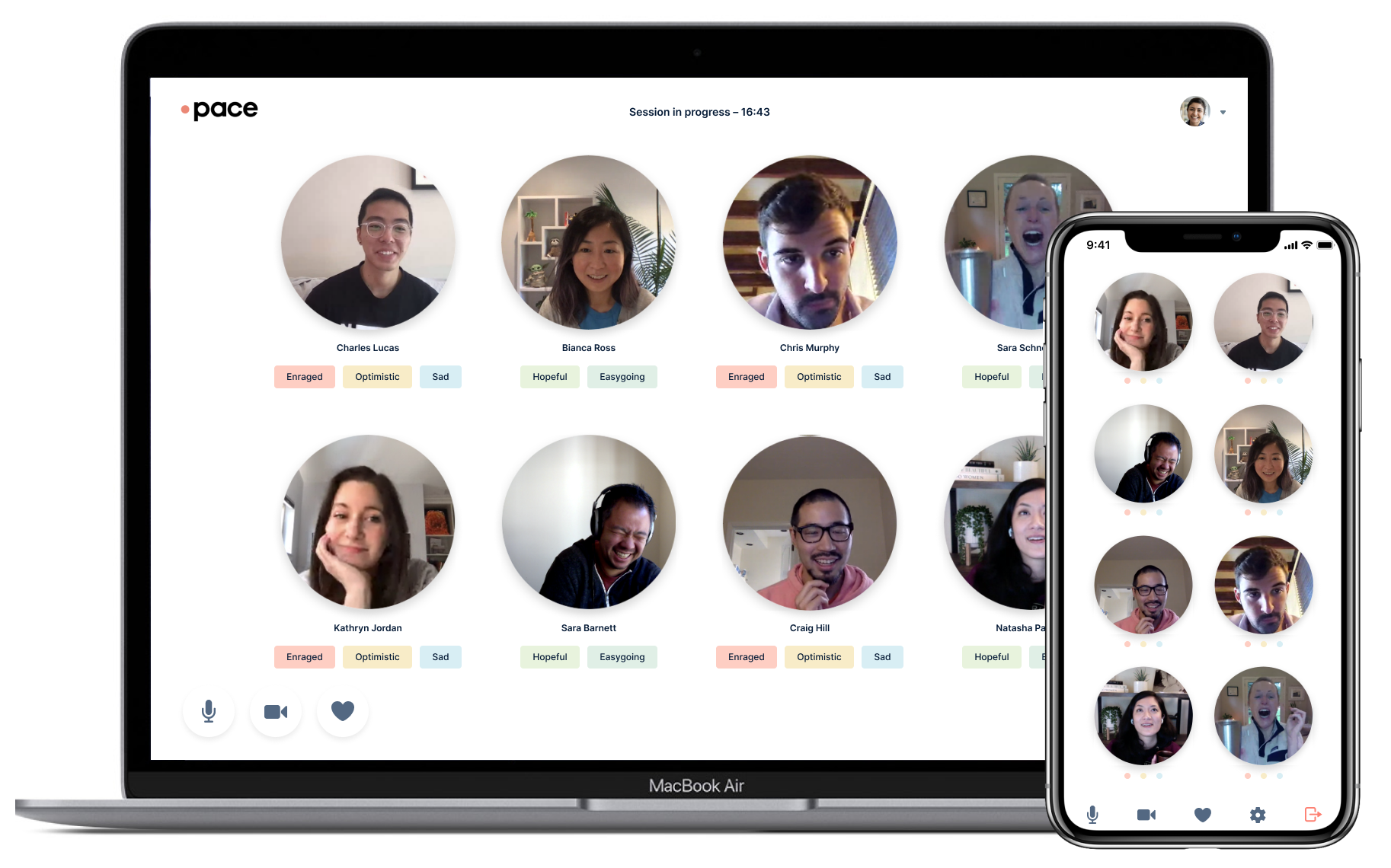
The core of the product is a 90-minute live video group session once a week, delivered through Pace’s platform. The video component integrates with Twilio and Agora (and interestingly, not Zoom, because its SDK lacks personalization options). Users can attend the sessions on Web, iOS or Android.

Image Credits: Pace

Pace forms cohorts of eight to 10 people around shared interest or identities, such as a founder group or parent group. Then, Pace interviews a new user for 15 to 30 minutes to learn about what they hope to get out of the experience.

Once a group is formed, they meet weekly with a facilitator at the helm. While it’s not trying to be a therapy replacement, the startup is looking for facilitators who are licensed in mental health practice. To help them do this, Pace secured two founding members who are psychologists: Dr. Kerry Makin-Byrd and Dr. Vivian Oberling.

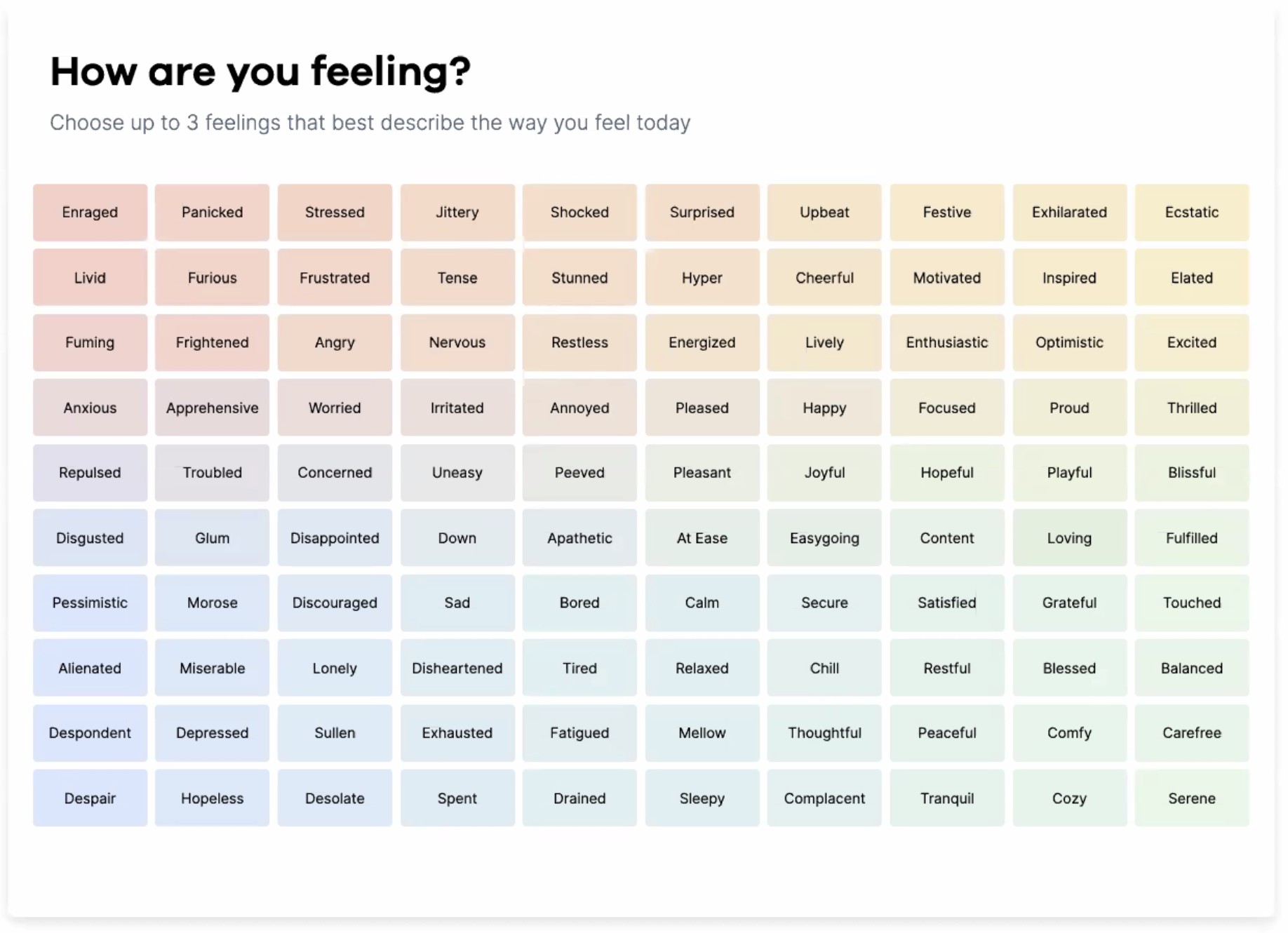
When users sign on, they are prompted to pick three words that describe themselves from dozens of options. Those words show up under their video as they talk, and help skip some small talk in the beginning of the sessions.

The group talks about a variety of topics, from how to manage stress to how to adapt to a remote world. There is no formal curriculum, but each class has a takeaway for participants to leave with.

Pace doesn’t follow any specific curriculum during the meetings, but instead uses the time for people to talk through their feelings. Facilitators are licensed mental health clinicians, with the majority of the leaders being part-time or freelancers. It plans to introduce asynchronous ways for group members to chat and stay in touch beyond the weekly class, as well as spend time building out a product that feels beyond a Zoom call.

Mental health software startups are on a tear right now. Last month, Lyra Health raised $175 million at a $2.25 billion valuation to connect employees to therapists and mental health services. Another telehealth provider, Talkspace, announced today that it was going public through a SPAC. There’s also Calm, last valued at $2 billion, and Headspace, its biggest competitor in the mindfulness app space.

Pace’s focus is more similar to the latter than the former: It’s avoiding the telehealth label and positioning itself more as supplementary to formal health services.

“Our hope is that as [therapists] have individual patients who they’d like to incorporate some group work, or need a next thing, that we’re here for that too,” says Chou.

One of Pace’s closest competitors is Coa, which launched with $3 million in seed funding in October 2020. The startup is similarly using small-group fitness culture and applying it to mental health. It mixes lecture-style teaching with breakout sessions to breed conversation.

Pace wouldn’t expand on how it differentiates from Coa beyond alluding to upcoming product features and community investments. Coa charges $25 for drop-in classes (sticking to that fitness class theme) while Pace charges $45 per week for the same group to meet for months at a time. While Coa has licensed therapists, Pace has licensed mental health clinicians.

Coa co-founders Alexa Meyer and Dr. Emily Anhalt say their service is unique from Pace in a curriculum perspective.

“Although all of Coa’s classes are facilitated by licensed therapists, Coa’s classes are different from group therapy,” Meyer said. Coa uses Anhalt’s research around mental happiness to create programming. Both companies are still pre-launch, but Coa says it has 6,000 people on its waitlist.

For both startups, the hurdles ahead are common for any startup: customer acquisition, effectiveness in tracking outcomes and scaling an innately emotional and personalized experience. As Homebrew’s Hunter Walk pointed out in a recent blog post, vulnerable populations being exposed to venture-level risk is a difficult phenomenon. Startups fail often, and in this case, that could mean leaving without once-critical support people who are depending on group therapy.

Going forward, the real winner in the mental health fitness space will come down to a thoughtful curriculum and a user experience that brings out vulnerability in people even over a virtual setting. Regardless, innovation pouring into the sector couldn’t come at a better time.

13 Jan 2021

Robotic exoskeletons promise increased mobility and job assistance

The last several years have seen a substantial increase of ability for robotic exoskeleton technology. Completely understandable. For one thing, it’s that rare technology you encounter that really feels like it’s going to change lives for the better the first time you see it. I’ve had a number of demos with companies that frankly took my breath away — watching someone walk across the room for the first time in years while their spouse stands by you crying will do that.

For another thing, there are two distinct use cases for this tech. The first is the aforementioned mobility — whether it’s full paralysis or simply helping people with walking impairments move a bit more easily. The second is work. Exoskeletons have great potential to ease the burden of lifting heavy objects or standing for extended periods. For this reason, many companies like Esko Bionics have created two distinct divisions to serve both sides.

So it’s a big, potential market — albeit one that’s still going to take a number of years to mature. For that reason, we’re really only talking rough projections here. I do think there’s still space for some smaller companies to carve out a meaningful business in the category.

I also won’t be surprised when more big companies get involved in the category. It’s a good way to put your stamp on the robotics category. Samsung’s GEMS is certainly the biggest-name product in the category this week at CES — even if it didn’t warrant a ton of stage time. It debuted at the event two years ago and we were able to try it out. For now, the news centered around hardware improvements like battery and the beginning of clinical trials – a necessary part of bringing this sort of healthcare or healthcare-adjacent product to market.

As with most of Samsung’s robotics announced at the show this week, the jury is very much still out with regards to how seriously the company is taking the product. Last year it made a brief appearance at CES as part of an “immersive workout experience.”

Image Credits: Archelis

Some smaller companies have shown off compelling entries. Japan-based Archelis Inc. is top of mind, showcasing the ArchelisFX, whose name derives from the Japanese word for “walkable chair.” The device is designed for a number of different scenarios, including back pain and those who have recently undergone surgery. The company says it will be available to rent or buy for around $5,000.

On the whole, the exoskeletons on display at this year’s virtual CES tend largely toward the mobility side of the equation. Notably absent was Sarcos Robotics, which announced a partnership with Delta Airlines at last year’s event. In September, the company built on that interest to raise a $40 million round.

13 Jan 2021

Daily Crunch: Airbnb cancels all DC bookings during inauguration week

Airbnb takes a big step to avoid violence at the inauguration, Intel gets a new CEO and Affirm goes public. This is your Daily Crunch for January 13, 2021.

The big story: Airbnb cancels all DC bookings during inauguration week

Airbnb said today that “in response to various local, state and federal officials asking people not to travel to Washington, D.C.” it will be canceling all reservations in the area for next week, which is the week of President-elect Joe Biden’s inauguration. This will apply to all reservations on Airbnb-owned HotelTonight as well.

The company had already said that it would ban anyone who was involved in last week’s riot in the U.S. Capitol, but it’s now taking a much more aggressive step to avoid housing anyone who might have violent plans during the inauguration.

They also said guests will be given a full refund, while hosts will still receive full compensation for these reservations.

The tech giants

Pat Gelsinger stepping down as VMware CEO to replace Bob Swan at Intel — Gelsinger would be replacing Intel’s interim CEO Bob Swan on February 15.

Affirm doubles after starting to trade despite strong IPO pricing — Affirm’s explosive debut comes on the heels of similarly strong results from DoorDash, C3.ai and Airbnb.

Apple announces new projects related to its $100 million pledge for racial equity and justice — For starters, the company will contribute $25 million to the Propel Center, an innovation and learning hub for Historically Black Colleges and Universities.

Startups, funding and venture capital

Rapyd raises $300M on a $2.5B valuation to boost its fintech-as-a-service API — Rapyd’s customer base now includes about 5,000 businesses.

Flo gets FTC slap for sharing user data when it promised privacy — The FTC has reached a settlement with Flo, a period and fertility tracking app with 100 million+ users.

E-commerce optimization startup Tradeswell raises $15.5M — The key goal is to allow e-commerce businesses to improve their net margins.

Advice and analysis from Extra Crunch

Venture capitalists react to Visa-Plaid deal meltdown — The leading sentiment seems to be, “Congratulations, you’re no longer selling your company for billions of dollars!”

Will startup valuations change given rising antitrust concerns? — Even a few smoke signals is enough to start raising concerns.

Dear Sophie: What’s the new minimum salary required for H-1B visa applicants? — The latest edition of “Dear Sophie,” the advice column that answers immigration-related questions about working at technology companies.

Everything else

These robo-fish autonomously form schools and work as search parties — Researchers at Harvard’s Wyss Institute for Biologically Inspired Engineering have created a set of fish-shaped underwater robots that can autonomously navigate and find each other.

Survey: Help shape the future of TechCrunch — We’re always looking to make TechCrunch better, and part of that is regularly gathering feedback from the people who matter most: You!

The Daily Crunch is TechCrunch’s roundup of our biggest and most important stories. If you’d like to get this delivered to your inbox every day at around 3pm Pacific, you can subscribe here.

13 Jan 2021

UK on-demand supermarket Weezy raises $20M Series A led by NYC’s Left Lane Capital

Weezy — an on-demand supermarket that delivers groceries in fast times such as 15 minutes — has raised $20 million in a Series A funding led by New York-based venture capital fund Left Lane Capital. Also participating were UK-based fund DN Capital, earlier investors Heartcore Capital and angel investors, notably Chris Muhr, the Groupon founder.

Although the company hasn’t made mention of a later US launch, the presence of US investors would tend to suggest that. Weezy is reminiscent of Kozmo, the on-demand groceries business from the dotcom boom of the late ’90s. However, it differs from Postmates in that it doesn’t do pickups.

The cash injection will be used to expand its grocery delivery service across London and the broader UK, and open two fulfillment centers across London. Some 40 more UK sites are planned by the end of 2021 and it plans to add 50 new employees in the next 4 months.

Launched in July 2020, Weezy uses its own delivery people on pedal cycles or electric mopeds to deliver goods in less than 15 minutes on average. As well as working with wholesalers, it also sources groceries from independent bakers, butchers and markets.

It has pushed at an open door during the pandemic. In Q2 2020 half a million new shoppers joined the grocery delivery sector, which is now worth £14.3bn in the UK, according to research.

Kristof Van Beveren, Co-founder and CEO of Weezy, said in a statement: “People are no longer happy to wait around for deliveries, and there is strong demand for a more efficient service.”

Weezy’s co-founders are Kristof Van Beveren and Alec Dent. Van Beveren is formerly from the consumer goods world at Procter & Gamble and McKinsey & Company, while Dent headed up operations at UK startup Drover and business development at BlaBlaCar.

Harley Miller, managing partner, Left Lane Capital, commented: “Weezy’s founding team have the right balance of drive, experience and temperament to lead in e-commerce innovation
and convenience within the UK grocery market and beyond.”

Nenad Marovac, founder and managing partner, DN Capital, said: “Even before the pandemic, interest in online grocery shopping was on the rise. The first time I ordered from Weezy, my delivery arrived in seven minutes and I was hooked.”

13 Jan 2021

Zocdoc founder returns with Shadow, an app that finds lost dogs

Every year, around 10 million pets go missing in the U.S., and millions of those end up in shelters where they aren’t always reunited with their owners, due to their lack of identification or a microchip. A new mobile app, Shadow, aims to tackle this problem by leveraging a combination of a volunteer network and A.I. technology to help dog owners, in particular.

The startup is working in partnership with animal shelters and rescue organizations around the U.S. to pull in photos of the dogs they’re currently housing, then supplements this with photos pulled from social media platforms, like Twitter and Facebook.

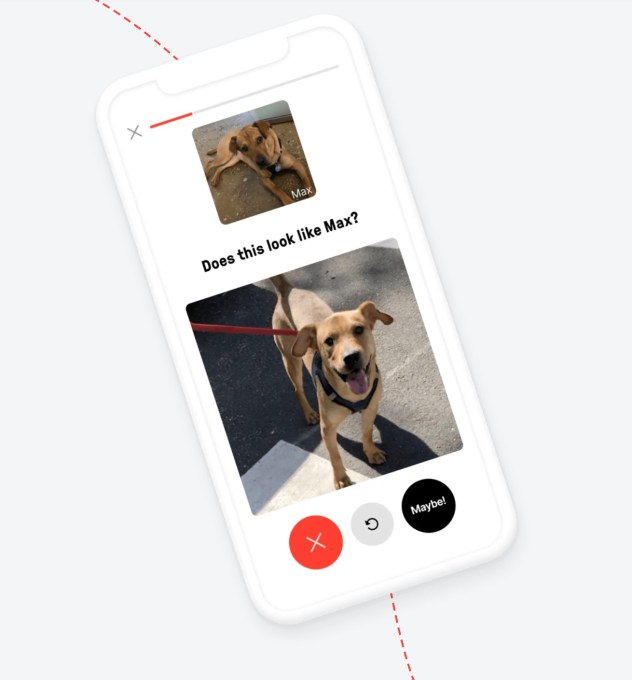
It then uses A.I. technology to match the photograph of the missing dogs to possible matches from nearby shelters or the web.

Image Credits: Shadow

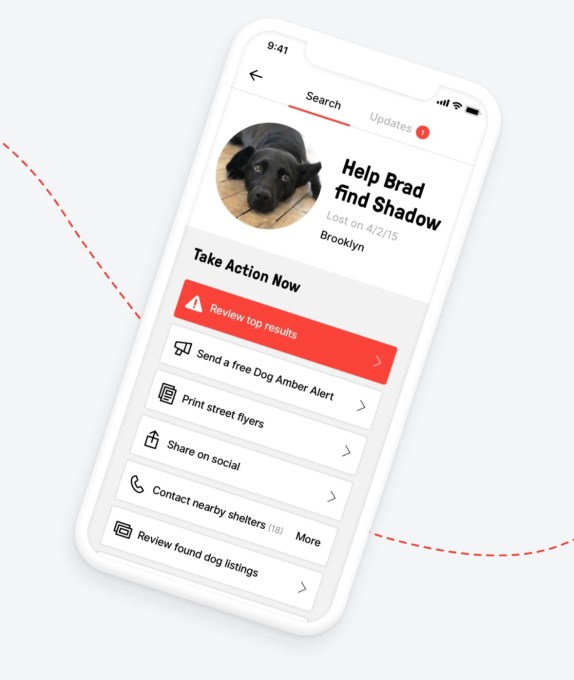
If there’s not a match found, Shadow will then programmatically set a search radius based on where and when the dog went missing, and suggest other actions that the dog’s owner can take as the next steps.

This includes viewing all the photographs from the shelters directly, in the case that the technology matching process missed a possible match, as well as working with other Shadow users to help crowdsource activities like hanging “Lost Dog” flyers around a neighborhood, for example, among other things.

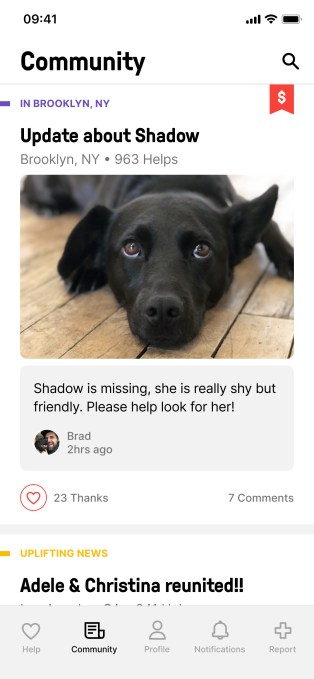
The app also relies on a network of volunteers who help by also reviewing shelter photographs and broadcasting missing posters to social media sites they use to increase the chances of the dog being found. Dog owners can even advertise a reward in the app to encourage people to help search.

Today, Shadow has grown its volunteer user base to over 30,000. And it’s partnered with the ASPCA, Animal Care Centers of New York and L.A., the Dallas shelter system, and others.

Image Credits: Shadow

While Shadow is free to use, it makes money through a virtual tipping mechanism when it makes a successful match and the dog is found. It also offers users the ability to buy an Instagram ad in-app for $10. Here, Shadow provides the visual assets and manages the ad-buying process and placement process on owners’ behalf.

The startup, founded by former Zocdoc founder Cyrus Massoumi, has been in a sort of public stealth mode for a few years as it grew beyond its hometown of New York. It’s now offering dog-finding services in 76 counties across 20 U.S. states.

We should note that Massoumi’s exit from Zocdoc was complicated. He sued his co-founders and CFO for orchestrating a plot to oust him from the company during a Nov. 2015 board meeting, claiming fraud. The lawsuit detailed the internal strife inside Zocdoc at the time. A New York Supreme Court judge recently determined this lawsuit, which is ongoing, needs to be filed in Delaware, instead of New York. So a ruling is yet to be determined.

Ahead of this, Zocdoc had been accused by Business Insider of having developed a stressful,  “bro culture,” in which young, male employees would make inappropriate remarks about the women who worked there. This was ahead of the larger rise of the Me Too movement, which has since impacted how businesses address these issues in the workplace.

Massoumi disputes the claims were exactly as described by the article. The company had 300 salespeople at the time, and while he agrees some people may have acted inappropriately, he also believes company’s response to those actions was handled properly.

“The allegations were fully investigated at Zocdoc and found to be without merit,” he told TechCrunch, adding that Zocdoc was repeatedly recognized as a “best place to work” while he was CEO.

Shadow today claims a different makeup. It has a team twelve people, and two-thirds of its product and engineering team are women. Some Zocdoc investors have also returned to back Massoumi again.

The startup is funded by Founders Fund, Humbition (Massoumi and Indiegogo founder Slava Rubin’s fund), Lux Capital, firstminute Capital, and other angels, including a prior Zocdoc

Despite the complicated Zocdoc history, the work Shadow is doing is solving a problem many people do care about. Millions of pet owners lose their pets to euthanization as they end up at shelters that cannot keep animals indefinitely due to lack of space. Meanwhile, the current system of having lost pet messages distributed across social media can mean many of those posts aren’t seen — especially in larger metros where there are numerous “lost pet” groups.

Image Credits: Shadow


As Shadow began its work in 2018, it was local to the New York area. Its first year, it reunited 600 dogs. The next year, it reunited 2,000 dogs. The third year, it reunited 5,000 dogs. Today, it’s nearing 10,000 dogs reunited with owners.

More than half of those were since the pandemic began, which saw many new pet owners and increased time spent outdoors with those pets, when dogs can sometimes get loose.

Massoumi says he was inspired to found Shadow after a friend lost his own dog, the namesake Shadow. It took the friend over a month to find the dog after both following false leads and being connected with people who tried to help him.

“I’m thinking to myself, this is something that happens 100 million times a year, globally…and for people who love pets, this is a lost family member,” Massoumi explains. “It seemed to me to be a similar problem that I’d already been solving in healthcare, where there’s fragmentation — people want to see the doctor and the doctor wants to see the patient, but there’s just not a central way to make it work,” he says.

More broadly, he wants to see technology being put to good use to solve problems that people actually care about.

“I think there needs to be more technology that injects the humanity back in what everyone does. I think that it’s very core that’s what we’re doing,” he says.

Shadow’s app is a free download on iOS and Android.

13 Jan 2021

Zocdoc founder returns with Shadow, an app that finds lost dogs

Every year, around 10 million pets go missing in the U.S., and millions of those end up in shelters where they aren’t always reunited with their owners, due to their lack of identification or a microchip. A new mobile app, Shadow, aims to tackle this problem by leveraging a combination of a volunteer network and A.I. technology to help dog owners, in particular.

The startup is working in partnership with animal shelters and rescue organizations around the U.S. to pull in photos of the dogs they’re currently housing, then supplements this with photos pulled from social media platforms, like Twitter and Facebook.

It then uses A.I. technology to match the photograph of the missing dogs to possible matches from nearby shelters or the web.

Image Credits: Shadow

If there’s not a match found, Shadow will then programmatically set a search radius based on where and when the dog went missing, and suggest other actions that the dog’s owner can take as the next steps.

This includes viewing all the photographs from the shelters directly, in the case that the technology matching process missed a possible match, as well as working with other Shadow users to help crowdsource activities like hanging “Lost Dog” flyers around a neighborhood, for example, among other things.

The app also relies on a network of volunteers who help by also reviewing shelter photographs and broadcasting missing posters to social media sites they use to increase the chances of the dog being found. Dog owners can even advertise a reward in the app to encourage people to help search.

Today, Shadow has grown its volunteer user base to over 30,000. And it’s partnered with the ASPCA, Animal Care Centers of New York and L.A., the Dallas shelter system, and others.

Image Credits: Shadow

While Shadow is free to use, it makes money through a virtual tipping mechanism when it makes a successful match and the dog is found. It also offers users the ability to buy an Instagram ad in-app for $10. Here, Shadow provides the visual assets and manages the ad-buying process and placement process on owners’ behalf.

The startup, founded by former Zocdoc founder Cyrus Massoumi, has been in a sort of public stealth mode for a few years as it grew beyond its hometown of New York. It’s now offering dog-finding services in 76 counties across 20 U.S. states.

We should note that Massoumi’s exit from Zocdoc was complicated. He sued his co-founders and CFO for orchestrating a plot to oust him from the company during a Nov. 2015 board meeting, claiming fraud. The lawsuit detailed the internal strife inside Zocdoc at the time. A New York Supreme Court judge recently determined this lawsuit, which is ongoing, needs to be filed in Delaware, instead of New York. So a ruling is yet to be determined.

Ahead of this, Zocdoc had been accused by Business Insider of having developed a stressful,  “bro culture,” in which young, male employees would make inappropriate remarks about the women who worked there. This was ahead of the larger rise of the Me Too movement, which has since impacted how businesses address these issues in the workplace.

Massoumi disputes the claims were exactly as described by the article. The company had 300 salespeople at the time, and while he agrees some people may have acted inappropriately, he also believes company’s response to those actions was handled properly.

“The allegations were fully investigated at Zocdoc and found to be without merit,” he told TechCrunch, adding that Zocdoc was repeatedly recognized as a “best place to work” while he was CEO.

Shadow today claims a different makeup. It has a team twelve people, and two-thirds of its product and engineering team are women. Some Zocdoc investors have also returned to back Massoumi again.

The startup is funded by Founders Fund, Humbition (Massoumi and Indiegogo founder Slava Rubin’s fund), Lux Capital, firstminute Capital, and other angels, including a prior Zocdoc

Despite the complicated Zocdoc history, the work Shadow is doing is solving a problem many people do care about. Millions of pet owners lose their pets to euthanization as they end up at shelters that cannot keep animals indefinitely due to lack of space. Meanwhile, the current system of having lost pet messages distributed across social media can mean many of those posts aren’t seen — especially in larger metros where there are numerous “lost pet” groups.

Image Credits: Shadow


As Shadow began its work in 2018, it was local to the New York area. Its first year, it reunited 600 dogs. The next year, it reunited 2,000 dogs. The third year, it reunited 5,000 dogs. Today, it’s nearing 10,000 dogs reunited with owners.

More than half of those were since the pandemic began, which saw many new pet owners and increased time spent outdoors with those pets, when dogs can sometimes get loose.

Massoumi says he was inspired to found Shadow after a friend lost his own dog, the namesake Shadow. It took the friend over a month to find the dog after both following false leads and being connected with people who tried to help him.

“I’m thinking to myself, this is something that happens 100 million times a year, globally…and for people who love pets, this is a lost family member,” Massoumi explains. “It seemed to me to be a similar problem that I’d already been solving in healthcare, where there’s fragmentation — people want to see the doctor and the doctor wants to see the patient, but there’s just not a central way to make it work,” he says.

More broadly, he wants to see technology being put to good use to solve problems that people actually care about.

“I think there needs to be more technology that injects the humanity back in what everyone does. I think that it’s very core that’s what we’re doing,” he says.

Shadow’s app is a free download on iOS and Android.