Year: 2021

13 Jan 2021

Telegram blocks ‘dozens’ of channels threatening violence

With many social networks suddenly reevaluating their policies in light of political violence in the U.S., the popular messaging app Telegram is implementing a crackdown of its own.

Telegram confirmed to TechCrunch that it has removed “dozens” of public channels over the course of the last 24 hours after those accounts, some of which have thousands of followers. “Our Terms of Service expressly forbid public calls to violence,” Telegram spokesperson Mike Ravdonikas told TechCrunch.

Asked if those takedowns relate to last week’s violent siege of the U.S. Capitol, Ravdonikas said that Telegram is “monitoring the current situation closely.”

The company confirmed that a number of accounts TechCrunch had previously observed promoting white supremacy, Nazi iconography and other forms of far-right extremism were part of the new enforcement action, which is still expanding. Some of the blocked channels were still viewable on Telegram’s web client Wednesday.

One of those groups bemoaned Telegram’s bans Tuesday in a post displaying a Nazi flag and the warning “you can’t kill an idea.” Prior to being taken down Wednesday, that channel boasted more than 10,000 followers.

Many extremist channels began publicizing backup accounts Tuesday, pointing subscribers to dozens of other groups where they could continue to gather. Other sympathetic channels chronicled the bans in real-time, posting screenshots documenting violations of Telegram’s terms of service.

Telegram’s new batch of takedowns appears to be connected to an effort by self-described anti-fascist and activist Gwen Snyder, who marshaled Twitter users in a “mass-reporting campaign” following last week’s violent invasion of the U.S. Capitol.

“For years, we’ve been tracking these Nazi Terrorgram channels and reporting horrendous, explicit calls to racist violence and insurrection, and Telegram did nothing,” Snyder told TechCrunch. “It worked, and Telegram is finally dismantling the network of Nazi channels that have spent months and years overtly attempting to incite just the sort of terror we saw in DC.”

With Telegram channels blaming Snyder for the takedowns, her home address has widely circulated on the app in an ongoing doxing campaign. On one channel calling for her death, an image depicts Snyder’s face with a bloody hole in its forehead. Another image includes an address, screenshots of her Twitter posts and the text “You know what to do.”

Snyder says she heard pounding on her door Tuesday night. “My address is all over those channels with people saying I should be shot and raped for this, and they only have to convince one person.”

With President Trump suspended from most major social media platforms and restrictions tightening on pro-Trump conspiracies like QAnon and the Stop the Steal movement, the president’s followers have fled in droves to platforms that remain willing to incubate extremism.

Prominent among those is Parler, a social network hailed by many pro-Trump figures as a politically friendly alternative to mainstream social media. But with Parler offline after Amazon suspended the account’s web hosting services and Apple and Google booted it from their respective app stores, a number of users flocked to more private options where violent extremism continues to flourish, including Telegram.

This story is developing…
13 Jan 2021

Foxconn, Geely team up to build electric, autonomous and shared vehicles for automakers

The electric, autonomous vehicles of the future might be manufactured by Apple’s main supplier Foxconn and Chinese automaker Zhejiang Geely Holding Group.

The two companies have agreed to form a joint venture focused on contract manufacturing for automakers, with a specific focus on electrification, connectivity and autonomous driving technology as well as vehicles designed for sharing. Each party will hold an equal 50% stake in new joint venture. The board of directors will consist of five members with Foxconn appointing three including the Chairman and Geely Holding appointing two, according to a statement issued by the two companies.

The agreement follows moves by both companies to take larger roles in contract manufacturing for automakers. Earlier this week, Geely said it would help China’s search giant Baidu set up a company to produce electric vehicles. Baidu will provide smart driving technologies while Geely will be in charge of car design and manufacturing. Meanwhile, Foxconn has announced plans to help troubled Chinese electric car startup Byton build its M-Byte SUV.

Geely Holding Group CEO Daniel Donghui Li said that the global automotive industry is undergoing profound changes. Geely must “actively embrace change build alliances, and synergize resources to create greater value for our users,” he said, adding that Foxconn’s expertise will offer important insight for the transformation and evolution of the automotive industry.

The joint venture will provide consulting services on whole vehicles, parts, intelligent drive systems and other automotive ecosystem platforms to automakers as well as ride-sharing companies. Geely will bring its experience in the automotive fields of design, engineering, R&D, intelligent manufacturing, supply chain management and quality control while Foxconn will bring its manufacturing and Information and Communication Technology (ICT) know-how.

The aim, the companies said, is to help automakers accelerate their transition to new innovative and efficient manufacturing processes and business models based on connected, autonomous, shared, and electrified technologies (referred to in the industry as CASE).

Dozens of new companies aiming to become the next Tesla or trying to commercialize autonomous vehicles have popped up in recent years, giving this Foxconn-Geely enterprise a long list of potential customers. One of the primary roadblocks to making vehicles at volume is the billions of dollars required to build and tool a factory. That need for capital has prompted a number of EV startups to become publicly traded companies by merging with a special purpose acquisition company. Canoo, Fisker, Lordstown Motors and Nikola Corp. are a few that have merged with a SPAC, otherwise known as a blank-check company.

Foxconn Technology Group chairman Young-way Liu called the alliance a milestone in cooperation between the automotive and information and communication technology (ICT) industries.

“With Foxconn’s globally leading R&D technologies, intelligent manufacturing, and hardware-software integration capabilities, the two parties form a highly complementary partnership which allows us to better serve and meet the diverse needs of different customers, and offer the most advanced, fastest, cost-effective full value-chain vehicle production service platform,” Young-way Liu said, adding that the partnership will result in tremendous change in the development of the automotive industry. 

13 Jan 2021

Foxconn, Geely team up to build electric, autonomous and shared vehicles for automakers

The electric, autonomous vehicles of the future might be manufactured by Apple’s main supplier Foxconn and Chinese automaker Zhejiang Geely Holding Group.

The two companies have agreed to form a joint venture focused on contract manufacturing for automakers, with a specific focus on electrification, connectivity and autonomous driving technology as well as vehicles designed for sharing. Each party will hold an equal 50% stake in new joint venture. The board of directors will consist of five members with Foxconn appointing three including the Chairman and Geely Holding appointing two, according to a statement issued by the two companies.

The agreement follows moves by both companies to take larger roles in contract manufacturing for automakers. Earlier this week, Geely said it would help China’s search giant Baidu set up a company to produce electric vehicles. Baidu will provide smart driving technologies while Geely will be in charge of car design and manufacturing. Meanwhile, Foxconn has announced plans to help troubled Chinese electric car startup Byton build its M-Byte SUV.

Geely Holding Group CEO Daniel Donghui Li said that the global automotive industry is undergoing profound changes. Geely must “actively embrace change build alliances, and synergize resources to create greater value for our users,” he said, adding that Foxconn’s expertise will offer important insight for the transformation and evolution of the automotive industry.

The joint venture will provide consulting services on whole vehicles, parts, intelligent drive systems and other automotive ecosystem platforms to automakers as well as ride-sharing companies. Geely will bring its experience in the automotive fields of design, engineering, R&D, intelligent manufacturing, supply chain management and quality control while Foxconn will bring its manufacturing and Information and Communication Technology (ICT) know-how.

The aim, the companies said, is to help automakers accelerate their transition to new innovative and efficient manufacturing processes and business models based on connected, autonomous, shared, and electrified technologies (referred to in the industry as CASE).

Dozens of new companies aiming to become the next Tesla or trying to commercialize autonomous vehicles have popped up in recent years, giving this Foxconn-Geely enterprise a long list of potential customers. One of the primary roadblocks to making vehicles at volume is the billions of dollars required to build and tool a factory. That need for capital has prompted a number of EV startups to become publicly traded companies by merging with a special purpose acquisition company. Canoo, Fisker, Lordstown Motors and Nikola Corp. are a few that have merged with a SPAC, otherwise known as a blank-check company.

Foxconn Technology Group chairman Young-way Liu called the alliance a milestone in cooperation between the automotive and information and communication technology (ICT) industries.

“With Foxconn’s globally leading R&D technologies, intelligent manufacturing, and hardware-software integration capabilities, the two parties form a highly complementary partnership which allows us to better serve and meet the diverse needs of different customers, and offer the most advanced, fastest, cost-effective full value-chain vehicle production service platform,” Young-way Liu said, adding that the partnership will result in tremendous change in the development of the automotive industry. 

13 Jan 2021

Survey: Help shape the future of TechCrunch

We’re always looking to make TechCrunch better, and part of that is regularly gathering feedback from the people that matter most – our readers. We’ve compiled a short survey, and we’d appreciate it if you could take a few minutes to respond. 

The survey can be found here.

We look forward to hearing your product ideas and suggestions.

13 Jan 2021

Survey: Help shape the future of TechCrunch

We’re always looking to make TechCrunch better, and part of that is regularly gathering feedback from the people that matter most – our readers. We’ve compiled a short survey, and we’d appreciate it if you could take a few minutes to respond. 

The survey can be found here.

We look forward to hearing your product ideas and suggestions.

13 Jan 2021

An argument against cloud-based applications

In the last decade we’ve seen massive changes in how we consume and interact with our world. The Yellow Pages is a concept that has to be meticulously explained with an impertinent scoff at our own age. We live within our smartphones, within our apps.

While we thrive with the information of the world at our fingertips, we casually throw away any semblance of privacy in exchange for the convenience of this world.

This line we straddle has been drawn with recklessness and calculation by big tech companies over the years as we’ve come to terms with what app manufacturers, large technology companies, and app stores demand of us.

Our private data into the cloud

According to Symantec, 89% of our Android apps and 39% of our iOS apps require access to private information. This risky use sends our data to cloud servers, to both amplify the performance of the application (think about the data needed for fitness apps) and store data for advertising demographics.

While large data companies would argue that data is not held for long, or not used in a nefarious manner, when we use the apps on our phones, we create an undeniable data trail. Companies generally keep data on the move, and servers around the world are constantly keeping data flowing, further away from its source.

Once we accept the terms and conditions we rarely read, our private data is no longer such. It is in the cloud, a term which has eluded concrete understanding throughout the years.

A distinction between cloud-based apps and cloud computing must be addressed. Cloud computing at an enterprise level, while argued against ad nauseam over the years, is generally considered to be a secure and cost-effective option for many businesses.

Even back in 2010, Microsoft said 70% of its team was working on things that were cloud-based or cloud-inspired, and the company projected that number would rise to 90% within a year. That was before we started relying on the cloud to store our most personal, private data.

Cloudy with a chance of confusion

To add complexity to this issue, there are literally apps to protect your privacy from other apps on your smart phone. Tearing more meat off the privacy bone, these apps themselves require a level of access that would generally raise eyebrows if it were any other category of app.

Consider the scenario where you use a key to encrypt data, but then you need to encrypt that key to make it safe. Ultimately, you end up with the most important keys not being encrypted. There is no win-win here. There is only finding a middle ground of contentment in which your apps find as much purchase in your private data as your doctor finds in your medical history.

The cloud is not tangible, nor is it something we as givers of the data can access. Each company has its own cloud servers, each one collecting similar data. But we have to consider why we give up this data. What are we getting in return? We are given access to applications that perhaps make our lives easier or better, but essentially are a service. It’s this service end of the transaction that must be altered.

App developers have to find a method of service delivery that does not require storage of personal data. There are two sides to this. The first is creating algorithms that can function on a local basis, rather than centralized and mixed with other data sets. The second is a shift in the general attitude of the industry, one in which free services are provided for the cost of your personal data (which ultimately is used to foster marketing opportunities).

Of course, asking this of any big data company that thrives on its data collection and marketing process is untenable. So the change has to come from new companies, willing to risk offering cloud privacy while still providing a service worth paying for. Because it wouldn’t be free. It cannot be free, as free is what got us into this situation in the first place.

Clearing the clouds of future privacy

What we can do right now is at least take a stance of personal vigilance. While there is some personal data that we cannot stem the flow of onto cloud servers around the world, we can at least limit the use of frivolous apps that collect too much data. For instance, games should never need access to our contacts, to our camera and so on. Everything within our phone is connected, it’s why Facebook seems to know everything about us, down to what’s in our bank account.

This sharing takes place on our phone and at the cloud level, and is something we need to consider when accepting the terms on a new app. When we sign into apps with our social accounts, we are just assisting the further collection of our data.

The cloud isn’t some omnipotent enemy here, but it is the excuse and tool that allows the mass collection of our personal data.

The future is likely one in which devices and apps finally become self-sufficient and localized, enabling users to maintain control of their data. The way we access apps and data in the cloud will change as well, as we’ll demand a functional process that forces a methodology change in service provisions. The cloud will be relegated to public data storage, leaving our private data on our devices where it belongs. We have to collectively push for this change, lest we lose whatever semblance of privacy in our data we have left.

13 Jan 2021

An argument against cloud-based applications

In the last decade we’ve seen massive changes in how we consume and interact with our world. The Yellow Pages is a concept that has to be meticulously explained with an impertinent scoff at our own age. We live within our smartphones, within our apps.

While we thrive with the information of the world at our fingertips, we casually throw away any semblance of privacy in exchange for the convenience of this world.

This line we straddle has been drawn with recklessness and calculation by big tech companies over the years as we’ve come to terms with what app manufacturers, large technology companies, and app stores demand of us.

Our private data into the cloud

According to Symantec, 89% of our Android apps and 39% of our iOS apps require access to private information. This risky use sends our data to cloud servers, to both amplify the performance of the application (think about the data needed for fitness apps) and store data for advertising demographics.

While large data companies would argue that data is not held for long, or not used in a nefarious manner, when we use the apps on our phones, we create an undeniable data trail. Companies generally keep data on the move, and servers around the world are constantly keeping data flowing, further away from its source.

Once we accept the terms and conditions we rarely read, our private data is no longer such. It is in the cloud, a term which has eluded concrete understanding throughout the years.

A distinction between cloud-based apps and cloud computing must be addressed. Cloud computing at an enterprise level, while argued against ad nauseam over the years, is generally considered to be a secure and cost-effective option for many businesses.

Even back in 2010, Microsoft said 70% of its team was working on things that were cloud-based or cloud-inspired, and the company projected that number would rise to 90% within a year. That was before we started relying on the cloud to store our most personal, private data.

Cloudy with a chance of confusion

To add complexity to this issue, there are literally apps to protect your privacy from other apps on your smart phone. Tearing more meat off the privacy bone, these apps themselves require a level of access that would generally raise eyebrows if it were any other category of app.

Consider the scenario where you use a key to encrypt data, but then you need to encrypt that key to make it safe. Ultimately, you end up with the most important keys not being encrypted. There is no win-win here. There is only finding a middle ground of contentment in which your apps find as much purchase in your private data as your doctor finds in your medical history.

The cloud is not tangible, nor is it something we as givers of the data can access. Each company has its own cloud servers, each one collecting similar data. But we have to consider why we give up this data. What are we getting in return? We are given access to applications that perhaps make our lives easier or better, but essentially are a service. It’s this service end of the transaction that must be altered.

App developers have to find a method of service delivery that does not require storage of personal data. There are two sides to this. The first is creating algorithms that can function on a local basis, rather than centralized and mixed with other data sets. The second is a shift in the general attitude of the industry, one in which free services are provided for the cost of your personal data (which ultimately is used to foster marketing opportunities).

Of course, asking this of any big data company that thrives on its data collection and marketing process is untenable. So the change has to come from new companies, willing to risk offering cloud privacy while still providing a service worth paying for. Because it wouldn’t be free. It cannot be free, as free is what got us into this situation in the first place.

Clearing the clouds of future privacy

What we can do right now is at least take a stance of personal vigilance. While there is some personal data that we cannot stem the flow of onto cloud servers around the world, we can at least limit the use of frivolous apps that collect too much data. For instance, games should never need access to our contacts, to our camera and so on. Everything within our phone is connected, it’s why Facebook seems to know everything about us, down to what’s in our bank account.

This sharing takes place on our phone and at the cloud level, and is something we need to consider when accepting the terms on a new app. When we sign into apps with our social accounts, we are just assisting the further collection of our data.

The cloud isn’t some omnipotent enemy here, but it is the excuse and tool that allows the mass collection of our personal data.

The future is likely one in which devices and apps finally become self-sufficient and localized, enabling users to maintain control of their data. The way we access apps and data in the cloud will change as well, as we’ll demand a functional process that forces a methodology change in service provisions. The cloud will be relegated to public data storage, leaving our private data on our devices where it belongs. We have to collectively push for this change, lest we lose whatever semblance of privacy in our data we have left.

13 Jan 2021

These robo-fish autonomously form schools and work as search parties

Researchers at Harvard’s Wyss Institute for Biologically Inspired Engineering have created a set of fish-shaped underwater robots that can autonomously navigate and find each other, cooperating to perform tasks or just placidly school together.

Just as aerial drones are proving themselves useful in industry after industry, underwater drones could revolutionize ecology, shipping, and other areas where a persistent underwater presence is desirable but difficult.

The last few years have seen interesting new autonomous underwater vehicles, or AUVs, but the most common type is pretty much a torpedo — efficient for cruising open water, but not for working one’s way through the nooks and crannies of a coral reef or marina.

For that purpose, it seems practical to see what Nature herself has seen fit to create, and the Wyss Institute has made a specialty of doing so and creating robots and machinery in imitation of the natural world.

In this case Florian Berlinger, Melvin Gauci, and Radhika Nagpa, all co-authors on a new paper published in Science Robotics, decided to imitate not just the shape of a fish, but the way it interacts with its fellows as well.

Having been inspired by the sight of schooling fish during scuba diving, Nagpa has pursued the question: “How do we create artificial agents that can demonstrate this kind of collective coherence where a whole collective seems as if it’s a single agent?”

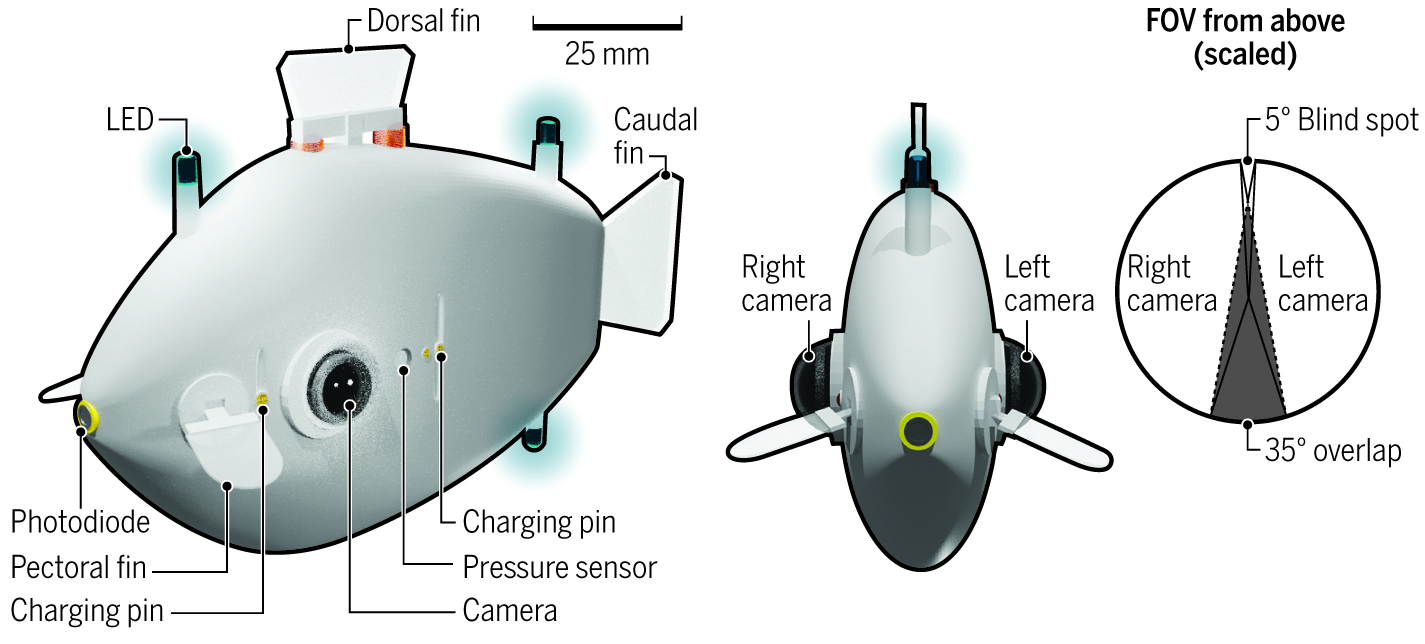
Diagram of a fish-shaped robot

Image Credits: Berlinger et al., Science Robotics

Their answer, Blueswarm, is a collection of small “Bluebots” 3D-printed in the shape of fish, with fins instead of propellers and cameras for eyes. Although neither you nor I is likely to mistake these for actual fish, they’re far less scary of an object for a normal fish to see than a six-foot metal tube with a propeller spinning loudly in the back. The Bluebots also imitate nature’s innovation of bioluminescence, lighting up with LEDs the way some fish and insects do to signal others. The LED pulses change and adjust depending on each bot’s position and knowledge of its neighbors.

Using the simple senses of cameras and a photosensor at the very front, elementary swimming motions, and the LEDs, Blueswarm automatically organizes itself into group swimming behaviors, establishing a simple “milling” pattern that accommodates new bots when they’re dropped in from any angle.

Images showing how "bluebots" swarm intelligently and find each other.

Image Credits: Berlinger et al, Science Robotics

The robots can also work together on simple tasks, like searching for something. If the group is given the task of finding a red LED in the tank they’re in, they can each look independently, but when one of them finds it, it alters its own LED flashing to alert and summon the others.

It’s not hard to imagine uses for this tech. These robots could get closer to reefs and other natural features safely without alarming the sea life, monitoring their health or looking for specific objects their camera-eyes could detect. Or they could meander around underneath docks and ships inspecting hulls more efficiently than a single craft can. Perhaps they might even be useful in search and rescue.

The research also advances our understanding of how and why animals swarm together in the first place.

With this research, we cannot only build more advanced robot collectives, but also learn about collective intelligence in nature. Fish must follow even simpler behavior patterns when swimming in schools than our robots do. This simplicity is so beautiful yet hard to discover,” said Berlinger. “Other researchers have reached out to me already to use my Bluebots as fish surrogates for biological studies on fish swimming and schooling. The fact that they welcome Bluebot among their laboratory fish makes me very happy.”

13 Jan 2021

These robo-fish autonomously form schools and work as search parties

Researchers at Harvard’s Wyss Institute for Biologically Inspired Engineering have created a set of fish-shaped underwater robots that can autonomously navigate and find each other, cooperating to perform tasks or just placidly school together.

Just as aerial drones are proving themselves useful in industry after industry, underwater drones could revolutionize ecology, shipping, and other areas where a persistent underwater presence is desirable but difficult.

The last few years have seen interesting new autonomous underwater vehicles, or AUVs, but the most common type is pretty much a torpedo — efficient for cruising open water, but not for working one’s way through the nooks and crannies of a coral reef or marina.

For that purpose, it seems practical to see what Nature herself has seen fit to create, and the Wyss Institute has made a specialty of doing so and creating robots and machinery in imitation of the natural world.

In this case Florian Berlinger, Melvin Gauci, and Radhika Nagpa, all co-authors on a new paper published in Science Robotics, decided to imitate not just the shape of a fish, but the way it interacts with its fellows as well.

Having been inspired by the sight of schooling fish during scuba diving, Nagpa has pursued the question: “How do we create artificial agents that can demonstrate this kind of collective coherence where a whole collective seems as if it’s a single agent?”

Diagram of a fish-shaped robot

Image Credits: Berlinger et al., Science Robotics

Their answer, Blueswarm, is a collection of small “Bluebots” 3D-printed in the shape of fish, with fins instead of propellers and cameras for eyes. Although neither you nor I is likely to mistake these for actual fish, they’re far less scary of an object for a normal fish to see than a six-foot metal tube with a propeller spinning loudly in the back. The Bluebots also imitate nature’s innovation of bioluminescence, lighting up with LEDs the way some fish and insects do to signal others. The LED pulses change and adjust depending on each bot’s position and knowledge of its neighbors.

Using the simple senses of cameras and a photosensor at the very front, elementary swimming motions, and the LEDs, Blueswarm automatically organizes itself into group swimming behaviors, establishing a simple “milling” pattern that accommodates new bots when they’re dropped in from any angle.

Images showing how "bluebots" swarm intelligently and find each other.

Image Credits: Berlinger et al, Science Robotics

The robots can also work together on simple tasks, like searching for something. If the group is given the task of finding a red LED in the tank they’re in, they can each look independently, but when one of them finds it, it alters its own LED flashing to alert and summon the others.

It’s not hard to imagine uses for this tech. These robots could get closer to reefs and other natural features safely without alarming the sea life, monitoring their health or looking for specific objects their camera-eyes could detect. Or they could meander around underneath docks and ships inspecting hulls more efficiently than a single craft can. Perhaps they might even be useful in search and rescue.

The research also advances our understanding of how and why animals swarm together in the first place.

With this research, we cannot only build more advanced robot collectives, but also learn about collective intelligence in nature. Fish must follow even simpler behavior patterns when swimming in schools than our robots do. This simplicity is so beautiful yet hard to discover,” said Berlinger. “Other researchers have reached out to me already to use my Bluebots as fish surrogates for biological studies on fish swimming and schooling. The fact that they welcome Bluebot among their laboratory fish makes me very happy.”

13 Jan 2021

Venture capitalists react to Visa-Plaid deal meltdown

Congratulations, you’re no longer selling your company for billions of dollars!

As strange as it sounds, that’s the leading perspective from venture capitalists concerning Plaid, now that its much-touted sale to Visa has fallen apart.

The $5.3 billion deal would have seen banking API startup Plaid join consumer payments and credit giant Visa. But the American government took a dim view of the deal, and according to Axios reporting, Plaid felt like it could be worth more money in time.

The TechCrunch team has collected views from venture capitalists, analysts and Anshu Sharma, CEO of another API-powered startup and a former VC to get a better view on the perspectives in the market concerning the blockbuster breakup.

From the venture capital side of things, most takes we received were bullish regarding Plaid’s chances now that it’s no longer being taken over by Visa. Amy Cheetham, for example, of Costanoa Ventures, said that the result is “good for the company, ultimately.” She added that Plaid may now see better “talent acquisition,” faster product decisions and a better eventual valuation.

“There is so much left for them to build in fintech infrastructure,” Cheetham said in an email, adding that she sees “Stripe-like scale potential” in Plaid. Stripe is reportedly raising capital at a valuation that could reach $100 billion.

Cheetham is not alone in her bullish perspective. Nico Berandi of Animo Ventures wrote to TechCrunch to say that he “still wishes” that his firm had been “around back then to have invested” in Plaid, adding a smiley face at the end of his missive.