Year: 2021

13 Jan 2021

Pat Gelsinger stepping down as VMware CEO to replace Bob Swan at Intel

In a move that could have wide ramifications across the tech landscape, Intel announced that VMware CEO Pat Gelsinger would be replacing interim CEO Bob Swann at Intel on February 15th. The question is why would he leave his job to run a struggling chip giant.

The bottom line is he has a long history with Intel, working with some of the biggest names in chip industry lore before he joined VMware in 2009. It has to be a thrill for him to go back to his roots and try to jump start the company.

“I was 18 years old when I joined Intel, fresh out of the Lincoln Technical Institute. Over the next 30 years of my tenure at Intel, I had the honor to be mentored at the feet of Grove, Noyce and Moore,” Gelsinger wrote in a blog post announcing his new position.

Certainly Intel recognized that the history and that Gelsinger’s deep executive experience should help as the company attempts to compete in an increasingly aggressive chip industry landscape. “Pat is a proven technology leader with a distinguished track record of innovation, talent development, and a deep knowledge of Intel. He will continue a values-based cultural leadership approach with a hyper focus on operational execution,” Omar Ishrak, independent chairman of the Intel board said in a statement.

But Gelsinger is walking into a bit of a mess. As my colleague Danny Crichton wrote in his year-end review of the chip industry last month, Intel is far behind its competitors, and it’s going to be tough to play catch-up:

Intel has made numerous strategic blunders in the past two decades, most notably completely missing out on the smartphone revolution and also the custom silicon market that has come to prominence in recent years. It’s also just generally fallen behind in chip fabrication, an area it once dominated and is now behind Taiwan-based TSMC, Crichton wrote.

Patrick Moorhead, founder and principal analyst at Moor Insights & Strategy agrees with this assertion, saying that Swan was dealt a bad hand, walking in to clean up a mess that has years long timelines. While Gelsinger faces similar issues, Moorhead thinks he can refocus the company. “I am not foreseeing any major strategic changes with Gelsinger, but I do expect him to focus on the company’s engineering culture and get it back to an execution culture” Moorhead told me.

The announcement comes against the backdrop of massive chip industry consolidation last year with over $100 billion changing hands in four deals with NVidia nabbing ARM for $40 billion, the $35 billion AMD-Xilink deal, Analog snagging Maxim for $21 billion and Marvell grabbing Inphi for a mere $10 billion, not to mention Intel dumping its memory unit to SK Hynix for $9 billion.

As for VMware, it has to find a new CEO now. As Moorhead says, the obvious choice will be current COO Sanjay Poonen. Holger Mueller, an analyst at Constellation Research says it will be up to Michael Dell who to hand the reins to, but he believes Gelsinger was stuck at Dell and would not get a broader role, so he left.

“VMware has a deep bench, but it will be up to Michael Dell to get a CEO who can innovate on the software side and keep the unique DNA of VMware inside the Dell portfolio going strong, Dell needs the deeper profits of this business for its turnaround,” he said.

The stock market seems to like the move for Intel with the company stock up 7.26%, but not so much for VMware, whose stock was down close to the same amount at 7.72% as went to publication.

13 Jan 2021

Pat Gelsinger stepping down as VMware CEO to replace Bob Swan at Intel

In a move that could have wide ramifications across the tech landscape, Intel announced that VMware CEO Pat Gelsinger would be replacing interim CEO Bob Swann at Intel on February 15th. The question is why would he leave his job to run a struggling chip giant.

The bottom line is he has a long history with Intel, working with some of the biggest names in chip industry lore before he joined VMware in 2009. It has to be a thrill for him to go back to his roots and try to jump start the company.

“I was 18 years old when I joined Intel, fresh out of the Lincoln Technical Institute. Over the next 30 years of my tenure at Intel, I had the honor to be mentored at the feet of Grove, Noyce and Moore,” Gelsinger wrote in a blog post announcing his new position.

Certainly Intel recognized that the history and that Gelsinger’s deep executive experience should help as the company attempts to compete in an increasingly aggressive chip industry landscape. “Pat is a proven technology leader with a distinguished track record of innovation, talent development, and a deep knowledge of Intel. He will continue a values-based cultural leadership approach with a hyper focus on operational execution,” Omar Ishrak, independent chairman of the Intel board said in a statement.

But Gelsinger is walking into a bit of a mess. As my colleague Danny Crichton wrote in his year-end review of the chip industry last month, Intel is far behind its competitors, and it’s going to be tough to play catch-up:

Intel has made numerous strategic blunders in the past two decades, most notably completely missing out on the smartphone revolution and also the custom silicon market that has come to prominence in recent years. It’s also just generally fallen behind in chip fabrication, an area it once dominated and is now behind Taiwan-based TSMC, Crichton wrote.

Patrick Moorhead, founder and principal analyst at Moor Insights & Strategy agrees with this assertion, saying that Swan was dealt a bad hand, walking in to clean up a mess that has years long timelines. While Gelsinger faces similar issues, Moorhead thinks he can refocus the company. “I am not foreseeing any major strategic changes with Gelsinger, but I do expect him to focus on the company’s engineering culture and get it back to an execution culture” Moorhead told me.

The announcement comes against the backdrop of massive chip industry consolidation last year with over $100 billion changing hands in four deals with NVidia nabbing ARM for $40 billion, the $35 billion AMD-Xilink deal, Analog snagging Maxim for $21 billion and Marvell grabbing Inphi for a mere $10 billion, not to mention Intel dumping its memory unit to SK Hynix for $9 billion.

As for VMware, it has to find a new CEO now. As Moorhead says, the obvious choice will be current COO Sanjay Poonen. Holger Mueller, an analyst at Constellation Research says it will be up to Michael Dell who to hand the reins to, but he believes Gelsinger was stuck at Dell and would not get a broader role, so he left.

“VMware has a deep bench, but it will be up to Michael Dell to get a CEO who can innovate on the software side and keep the unique DNA of VMware inside the Dell portfolio going strong, Dell needs the deeper profits of this business for its turnaround,” he said.

The stock market seems to like the move for Intel with the company stock up 7.26%, but not so much for VMware, whose stock was down close to the same amount at 7.72% as went to publication.

13 Jan 2021

Affirm doubles after starting to trade despite strong IPO pricing

Today shares of Affirm, a buy-now-pay-later unicorn, started trading above $90 per share, far above its $49 per-share IPO price, a figure that was already miles above the company’s early expectations.

The pop comes after Affirm raised its pricing range earlier this week, to $41 to $44 per share, up from an initial range of $33 to $38 per share. To see the company double from its raised price implies strong demand for its shares, a thin float, or both.

Affirm’s explosive debut comes on the heels of similarly-strong results from DoorDash, C3.ai, and Airbnb. Those companies’ debuts were so strong that Roblox delayed its IPO, later swapping a traditional IPO for a direct listing to get around the pricing issue.

Today’s IPO shows that the same dynamics that were at play in those IPOs have persisted into 2021. More public debuts are expected in Q1, including Coinbase, another well-known unicorn. Other names like Robinhood, Bumble, and others are in the wings.

Affirm’s first-day performance will certainly raise eyebrows from regular critics of the traditional IPO process. But the company did raise more money than it perhaps anticipated, and is having a raucous first-day’s trading, so it’s hard to fret too much for the company. If its share price is still as high in a month as it is today, perhaps it was as underpriced as some will claim.

Fintech

Affirm’s pricing brings a green splash to a busy week for fintech giants. Yesterday, Visa’s $5.3 billion acquisition of Plaid failed to go through due to regulatory concerns. While the fallen deal could have a chilling effect on fintech startups, Plaid told TechCrunch that it saw 60% customer growth in 2020, bringing it to more than 4,000 clients. Plaid’s next step, per many in the VC and tech community, will be even bigger than its once-planned $5.3 billion dollar exit.

Some tweets here to give you a sense of the momentum around fintech right now:

Affirm’s pop and Plaid’s forward-looking attitude show that the exit market for fintech feels both optimistic and energetic.

13 Jan 2021

Affirm doubles after starting to trade despite strong IPO pricing

Today shares of Affirm, a buy-now-pay-later unicorn, started trading above $90 per share, far above its $49 per-share IPO price, a figure that was already miles above the company’s early expectations.

The pop comes after Affirm raised its pricing range earlier this week, to $41 to $44 per share, up from an initial range of $33 to $38 per share. To see the company double from its raised price implies strong demand for its shares, a thin float, or both.

Affirm’s explosive debut comes on the heels of similarly-strong results from DoorDash, C3.ai, and Airbnb. Those companies’ debuts were so strong that Roblox delayed its IPO, later swapping a traditional IPO for a direct listing to get around the pricing issue.

Today’s IPO shows that the same dynamics that were at play in those IPOs have persisted into 2021. More public debuts are expected in Q1, including Coinbase, another well-known unicorn. Other names like Robinhood, Bumble, and others are in the wings.

Affirm’s first-day performance will certainly raise eyebrows from regular critics of the traditional IPO process. But the company did raise more money than it perhaps anticipated, and is having a raucous first-day’s trading, so it’s hard to fret too much for the company. If its share price is still as high in a month as it is today, perhaps it was as underpriced as some will claim.

Fintech

Affirm’s pricing brings a green splash to a busy week for fintech giants. Yesterday, Visa’s $5.3 billion acquisition of Plaid failed to go through due to regulatory concerns. While the fallen deal could have a chilling effect on fintech startups, Plaid told TechCrunch that it saw 60% customer growth in 2020, bringing it to more than 4,000 clients. Plaid’s next step, per many in the VC and tech community, will be even bigger than its once-planned $5.3 billion dollar exit.

Some tweets here to give you a sense of the momentum around fintech right now:

Affirm’s pop and Plaid’s forward-looking attitude show that the exit market for fintech feels both optimistic and energetic.

13 Jan 2021

Flo gets FTC slap for sharing user data when it promised privacy

The FTC has reached a settlement with Flo, a period- and fertility tracking app with 100M+ users, over allegations it shared users’ health data with third party app analytics and marketing services like Facebook despite promising to keep users’ sensitive health data private.

Flo must obtain an independent review of its privacy practices and obtain app users’ consent before sharing their health information, under the terms of the proposed settlement.

The action follows a 2019 reports in the Wall Street Journal which conducted an analysis of a number of apps’ data sharing activity.

It found the fertility tracking app had informed Facebook of in-app activity — such as when a user was having their period or had informed it of an intention to get pregnant despite. It did not find any way for Flo users to prevent their health information from being sent to Facebook.

In the announcement of a proposed settlement today, the FTC said press coverage of Flo sharing users data with third party app analytics and marketing firms including Facebook and Google had led to hundreds of complaints.

The app only stopped leaking users’ health data following the negative press coverage, it added.

Under the FTC settlement terms, Flo is prohibited from misrepresenting the purposes for which it (or entities to whom it discloses data) collect, maintain, use, or disclose the data; how much consumers can control these data uses; its compliance with any privacy, security, or compliance program; and how it collects, maintains, uses, discloses, deletes, or protects users’ personal information. 

Flo must also notify affected users about the disclosure of their personal information and instruct any third party that received users’ health information to destroy that data.

The app maker has been contacted for comment.

No financial penalty is being levied but the FTC’s proposed settlement is noteworthy as it’s the first time the US regulator has ordered notice of a privacy action.

“Apps that collect, use, and share sensitive health information can provide valuable services but consumers need to be able to trust these apps. We are looking closely at whether developers of health apps are keeping their promises and handling sensitive health information responsibly,” said Andrew Smith, director of the FTC’s Bureau of Consumer Protection, in a statement.

While the settlement received unanimous backing from five commissioners, two — Rohit Chopra and Rebecca Kelly Slaughter — have issued a joint dissent statement in which they highlight the lack of a finding of a breach of a US’ health breach notification rule which they argue should have applied in this case.

“In our view, the FTC should have charged Flo with violating the Health Breach Notification Rule. Under the rule, Flo was obligated to notify its users after it allegedly shared their health information with Facebook, Google, and others without their authorization. Flo did not do so, making the company liable under the rule,” they write.

“The Health Breach Notification Rule was first issued more than a decade ago, but the explosion in connected health apps make its requirements more important than ever. While we would prefer to see substantive limits on firms’ ability to collect and monetize our personal information, the rule at least ensures that services like Flo need to come clean when they experience privacy or security breaches. Over time, this may induce firms to take greater care in collecting and monetizing our most sensitive information,” they add.

Flo is by no means the only period tracking app to have attracted attention for leaking user data in recent years.

A report last year by the Norwegian Consumer Council found fertility/period tracker apps Clue and MyDays unexpectedly sharing data with adtech giants Facebook and Google, for example.

That report also found similarly non-transparent data leaking going on across a range of apps, including dating, religious, make-up and kids apps — suggesting widespread breaches of regional data processing laws which require that for consent to be valid users must be properly informed and given a genuine free choice. Although app makers have so far faced little enforcement for analytics/marketing-related data leaking in the region.

In the US regulatory action around apps hinges on misleading claims — whether about privacy (in Flo’s case) or in relation to the purposes of data processing, as in a separate settlement the FTC put out earlier this week related to cloud storage app Ever.

13 Jan 2021

Flo gets FTC slap for sharing user data when it promised privacy

The FTC has reached a settlement with Flo, a period- and fertility tracking app with 100M+ users, over allegations it shared users’ health data with third party app analytics and marketing services like Facebook despite promising to keep users’ sensitive health data private.

Flo must obtain an independent review of its privacy practices and obtain app users’ consent before sharing their health information, under the terms of the proposed settlement.

The action follows a 2019 reports in the Wall Street Journal which conducted an analysis of a number of apps’ data sharing activity.

It found the fertility tracking app had informed Facebook of in-app activity — such as when a user was having their period or had informed it of an intention to get pregnant despite. It did not find any way for Flo users to prevent their health information from being sent to Facebook.

In the announcement of a proposed settlement today, the FTC said press coverage of Flo sharing users data with third party app analytics and marketing firms including Facebook and Google had led to hundreds of complaints.

The app only stopped leaking users’ health data following the negative press coverage, it added.

Under the FTC settlement terms, Flo is prohibited from misrepresenting the purposes for which it (or entities to whom it discloses data) collect, maintain, use, or disclose the data; how much consumers can control these data uses; its compliance with any privacy, security, or compliance program; and how it collects, maintains, uses, discloses, deletes, or protects users’ personal information. 

Flo must also notify affected users about the disclosure of their personal information and instruct any third party that received users’ health information to destroy that data.

The app maker has been contacted for comment.

No financial penalty is being levied but the FTC’s proposed settlement is noteworthy as it’s the first time the US regulator has ordered notice of a privacy action.

“Apps that collect, use, and share sensitive health information can provide valuable services but consumers need to be able to trust these apps. We are looking closely at whether developers of health apps are keeping their promises and handling sensitive health information responsibly,” said Andrew Smith, director of the FTC’s Bureau of Consumer Protection, in a statement.

While the settlement received unanimous backing from five commissioners, two — Rohit Chopra and Rebecca Kelly Slaughter — have issued a joint dissent statement in which they highlight the lack of a finding of a breach of a US’ health breach notification rule which they argue should have applied in this case.

“In our view, the FTC should have charged Flo with violating the Health Breach Notification Rule. Under the rule, Flo was obligated to notify its users after it allegedly shared their health information with Facebook, Google, and others without their authorization. Flo did not do so, making the company liable under the rule,” they write.

“The Health Breach Notification Rule was first issued more than a decade ago, but the explosion in connected health apps make its requirements more important than ever. While we would prefer to see substantive limits on firms’ ability to collect and monetize our personal information, the rule at least ensures that services like Flo need to come clean when they experience privacy or security breaches. Over time, this may induce firms to take greater care in collecting and monetizing our most sensitive information,” they add.

Flo is by no means the only period tracking app to have attracted attention for leaking user data in recent years.

A report last year by the Norwegian Consumer Council found fertility/period tracker apps Clue and MyDays unexpectedly sharing data with adtech giants Facebook and Google, for example.

That report also found similarly non-transparent data leaking going on across a range of apps, including dating, religious, make-up and kids apps — suggesting widespread breaches of regional data processing laws which require that for consent to be valid users must be properly informed and given a genuine free choice. Although app makers have so far faced little enforcement for analytics/marketing-related data leaking in the region.

In the US regulatory action around apps hinges on misleading claims — whether about privacy (in Flo’s case) or in relation to the purposes of data processing, as in a separate settlement the FTC put out earlier this week related to cloud storage app Ever.

13 Jan 2021

Facial recognition reveals political party in troubling new research

Researchers have created a machine learning system that they claim can determine a person’s political party, with reasonable accuracy, based only on their face. The study, from a group that also showed that sexual preference can seemingly be inferred this way, candidly addresses and carefully avoids the pitfalls of “modern phrenology,” leading to the uncomfortable conclusion that our appearance may express more personal information that we think.

The study, which appeared this week in the Nature journal Scientific Reports, was conducted by Stanford University’s Michal Kosinski. Kosinski made headlines in 2017 with work that found that a person’s sexual preference could be predicted from facial data.

The study drew criticism not so much for its methods but for the very idea that something that’s notionally non-physical could be detected this way. But Kosinski’s work, as he explained then and afterwards, was done specifically to challenge those assumptions and was as surprising and disturbing to him as it was to others. The idea was not to build a kind of AI gaydar — quite the opposite, in fact. As the team wrote at the time, it was necessary to publish in order to warn others that such a thing may be built by people whose interests went beyond the academic:

We were really disturbed by these results and spent much time considering whether they should be made public at all. We did not want to enable the very risks that we are warning against. The ability to control when and to whom to reveal one’s sexual orientation is crucial not only for one’s well-being, but also for one’s safety.

We felt that there is an urgent need to make policymakers and LGBTQ communities aware of the risks that they are facing. We did not create a privacy-invading tool, but rather showed that basic and widely used methods pose serious privacy threats.

Similar warnings may be sounded here, for while political affiliation at least in the U.S. (and at least at present) is not as sensitive or personal an element as sexual preference, it is still sensitive and personal. A week hardly passes without reading of some political or religious “dissident” or another being arrested or killed. If oppressive regimes could obtain what passes for probable cause by saying “the algorithm flagged you as a possible extremist,” instead of for example intercepting messages, it makes this sort of practice that much easier and more scalable.

The algorithm itself is not some hyper-advanced technology. Kosinski’s paper describes a fairly ordinary process of feeding a machine learning system images of more than a million faces, collected from dating sites in the U.S., Canada, and the U.K., as well as American Facebook users. The people whose faces were used identified as politically conservative or liberal as part of the site’s questionnaire.

The algorithm was based on open-source facial recognition software, and after basic processing to crop to just the face (that way no background items creep in as factors), the faces are reduced to 2,048 scores representing various features — as with other face recognition algorithms these aren’t necessary intuitive thinks like “eyebrow color” and “nose type” but more computer-native concepts.

Chart showing how faces are cropped and reduced to neural network representations.

Image Credits: Michael Kosinski / Nature Scientific Reports

The system was given political affiliation data sourced from the people themselves, and with this it diligently began to study the differences between the facial stats of people identifying as conservatives and those identifying as liberal. Because it turns out, there are differences.

Of course it’s not as simple as “conservatives have bushier eyebrows” or “liberals frown more.” Nor does it come down to demographics, which would make things too easy and simple. After all, if political party identification correlates with both age and skin color, that makes for a simple prediction algorithm right there. But although the software mechanisms used by Kosinski are quite standard, he was careful to cover his bases in order that this study, like the last one, can’t be dismissed as pseudoscience.

The most obvious way of addressing this is by having the system make guesses as to the political party of people of the same age, gender, and ethnicity. The test involved being presented with two faces, one of each party, and guessing which was which. Obviously chance accuracy is 50 percent. Humans aren’t very good at this task, performing only slightly above chance, about 55 percent accurate.

The algorithm managed to reach as high as 71 percent accurate when predicting political party between two like individuals, and 73 percent when presented with two individuals of any age, ethnicity, or gender (but still guaranteed to be one conservative, one liberal).
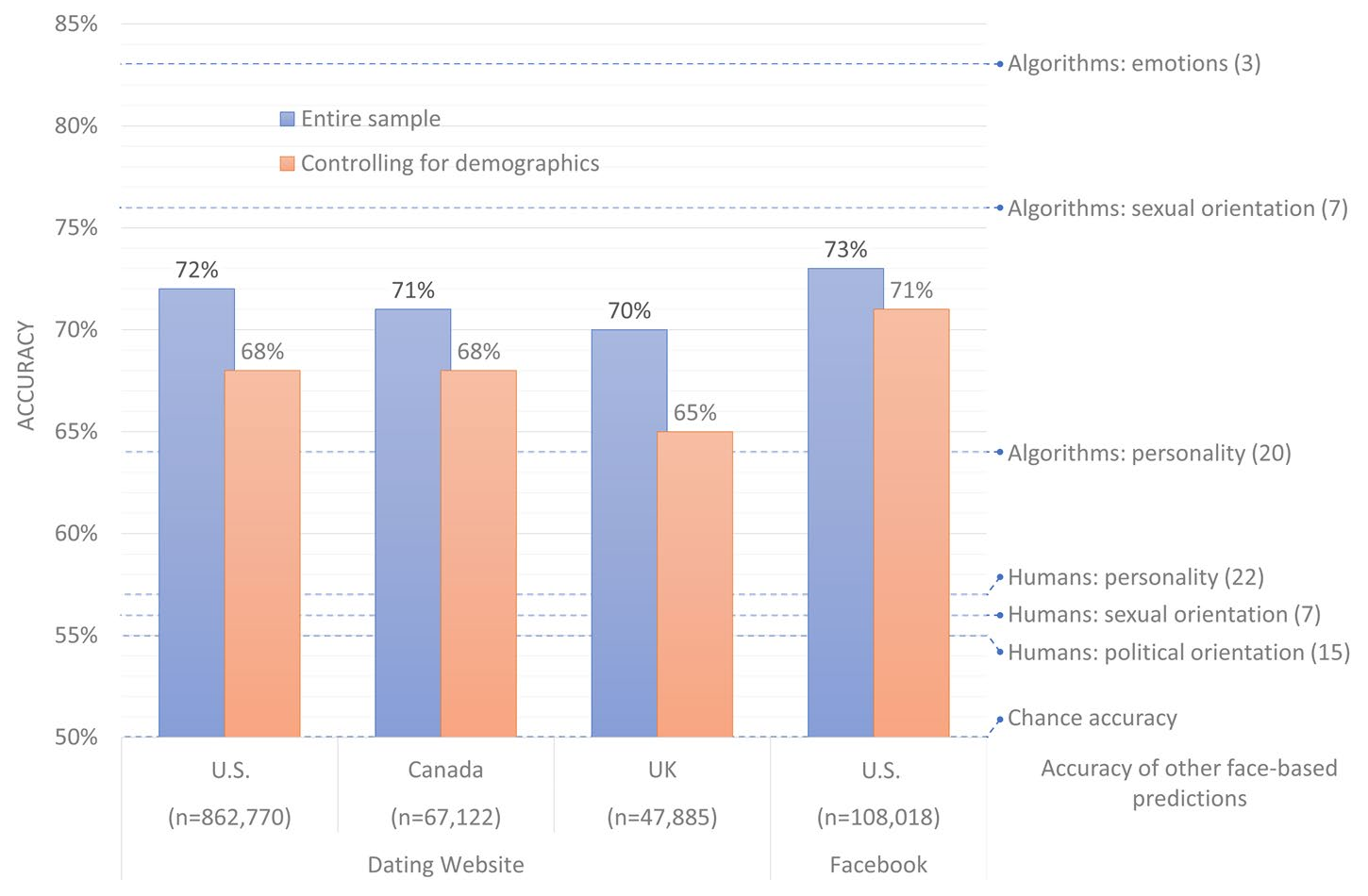
Image Credits: Michael Kosinski / Nature Scientific Reports

Getting three out of four may not seem like a triumph for modern AI, but considering people can barely do better than a coin flip, there seems to be something worth considering here. Kosinski has been careful to cover other bases as well; this doesn’t appear to be a statistical anomaly or exaggeration of an isolated result.

The idea that your political party may be written on your face is an unnerving one, for while one’s political leanings are far from the most private of info, it’s also something that is very reasonably thought of as being intangible. People may choose to express their political beliefs with a hat, pin, or t-shirt, but one generally considers one’s face to be nonpartisan.

If you’re wondering which facial features in particular are revealing, unfortunately the system is unable to report that. In a sort of para-study, Kosinski isolated a couple dozen facial features (facial hair, directness of gaze, various emotions) and tested whether those were good predictors of politics, but none led to more than a small increase in accuracy over chance or human expertise.

“Head orientation and emotional expression stood out: Liberals tended to face the camera more directly, were more likely to express surprise, and less likely to express disgust,” Kosinski wrote in author’s notes for the paper. But what they added left more than 10 percentage points of accuracy not accounted for: “That indicates that the facial recognition algorithm found many other features revealing political orientation.”

The knee-jerk defense of “this can’t be true – phrenology was snake oil” doesn’t hold much water here. It’s scary to think it’s true, but it doesn’t help us to deny what could be a very important truth, since it could be used against people very easily.

As with the sexual orientation research, the point here is not to create a perfect detector for this information, but to show that it can be done in order that people begin to consider the dangers that creates. If for example an oppressive theocratic regime wanted to crack down on either non-straight people or those with a certain political leaning, this sort of technology gives them a plausible technological method to do so “objectively.” And what’s more, it can be done with very little work or contact with the target, unlike digging through their social media history or analyzing their purchases (also very revealing).

We have already heard of China deploying facial recognition software to find members of the embattled Uyghur religious minority. And in our own country this sort of AI is trusted by authorities as well — it’s not hard to imagine police using the “latest technology” to, for instance, classify faces at a protest, saying “these 10 were determined by the system as being the most liberal,” or what have you.

The idea that a couple researchers using open-source software and a medium-sized database of faces (for a government, this is trivial to assemble in the unlikely possibility they do not have one already) could do so anywhere in the world, for any purpose, is chilling.

“Don’t shoot the messenger,” said Kosinski. “In my work, I am warning against widely used facial recognition algorithms. Worryingly, those AI physiognomists are now being used to judge people’s intimate traits – scholars, policymakers, and citizens should take notice.”


13 Jan 2021

Facial recognition reveals political party in troubling new research

Researchers have created a machine learning system that they claim can determine a person’s political party, with reasonable accuracy, based only on their face. The study, from a group that also showed that sexual preference can seemingly be inferred this way, candidly addresses and carefully avoids the pitfalls of “modern phrenology,” leading to the uncomfortable conclusion that our appearance may express more personal information that we think.

The study, which appeared this week in the Nature journal Scientific Reports, was conducted by Stanford University’s Michal Kosinski. Kosinski made headlines in 2017 with work that found that a person’s sexual preference could be predicted from facial data.

The study drew criticism not so much for its methods but for the very idea that something that’s notionally non-physical could be detected this way. But Kosinski’s work, as he explained then and afterwards, was done specifically to challenge those assumptions and was as surprising and disturbing to him as it was to others. The idea was not to build a kind of AI gaydar — quite the opposite, in fact. As the team wrote at the time, it was necessary to publish in order to warn others that such a thing may be built by people whose interests went beyond the academic:

We were really disturbed by these results and spent much time considering whether they should be made public at all. We did not want to enable the very risks that we are warning against. The ability to control when and to whom to reveal one’s sexual orientation is crucial not only for one’s well-being, but also for one’s safety.

We felt that there is an urgent need to make policymakers and LGBTQ communities aware of the risks that they are facing. We did not create a privacy-invading tool, but rather showed that basic and widely used methods pose serious privacy threats.

Similar warnings may be sounded here, for while political affiliation at least in the U.S. (and at least at present) is not as sensitive or personal an element as sexual preference, it is still sensitive and personal. A week hardly passes without reading of some political or religious “dissident” or another being arrested or killed. If oppressive regimes could obtain what passes for probable cause by saying “the algorithm flagged you as a possible extremist,” instead of for example intercepting messages, it makes this sort of practice that much easier and more scalable.

The algorithm itself is not some hyper-advanced technology. Kosinski’s paper describes a fairly ordinary process of feeding a machine learning system images of more than a million faces, collected from dating sites in the U.S., Canada, and the U.K., as well as American Facebook users. The people whose faces were used identified as politically conservative or liberal as part of the site’s questionnaire.

The algorithm was based on open-source facial recognition software, and after basic processing to crop to just the face (that way no background items creep in as factors), the faces are reduced to 2,048 scores representing various features — as with other face recognition algorithms these aren’t necessary intuitive thinks like “eyebrow color” and “nose type” but more computer-native concepts.

Chart showing how faces are cropped and reduced to neural network representations.

Image Credits: Michael Kosinski / Nature Scientific Reports

The system was given political affiliation data sourced from the people themselves, and with this it diligently began to study the differences between the facial stats of people identifying as conservatives and those identifying as liberal. Because it turns out, there are differences.

Of course it’s not as simple as “conservatives have bushier eyebrows” or “liberals frown more.” Nor does it come down to demographics, which would make things too easy and simple. After all, if political party identification correlates with both age and skin color, that makes for a simple prediction algorithm right there. But although the software mechanisms used by Kosinski are quite standard, he was careful to cover his bases in order that this study, like the last one, can’t be dismissed as pseudoscience.

The most obvious way of addressing this is by having the system make guesses as to the political party of people of the same age, gender, and ethnicity. The test involved being presented with two faces, one of each party, and guessing which was which. Obviously chance accuracy is 50 percent. Humans aren’t very good at this task, performing only slightly above chance, about 55 percent accurate.

The algorithm managed to reach as high as 71 percent accurate when predicting political party between two like individuals, and 73 percent when presented with two individuals of any age, ethnicity, or gender (but still guaranteed to be one conservative, one liberal).

Image Credits: Michael Kosinski / Nature Scientific Reports

Getting three out of four may not seem like a triumph for modern AI, but considering people can barely do better than a coin flip, there seems to be something worth considering here. Kosinski has been careful to cover other bases as well; this doesn’t appear to be a statistical anomaly or exaggeration of an isolated result.

The idea that your political party may be written on your face is an unnerving one, for while one’s political leanings are far from the most private of info, it’s also something that is very reasonably thought of as being intangible. People may choose to express their political beliefs with a hat, pin, or t-shirt, but one generally considers one’s face to be nonpartisan.

If you’re wondering which facial features in particular are revealing, unfortunately the system is unable to report that. In a sort of para-study, Kosinski isolated a couple dozen facial features (facial hair, directness of gaze, various emotions) and tested whether those were good predictors of politics, but none led to more than a small increase in accuracy over chance or human expertise.

“Head orientation and emotional expression stood out: Liberals tended to face the camera more directly, were more likely to express surprise, and less likely to express disgust,” Kosinski wrote in author’s notes for the paper. But what they added left more than 10 percentage points of accuracy not accounted for: “That indicates that the facial recognition algorithm found many other features revealing political orientation.”

The knee-jerk defense of “this can’t be true – phrenology was snake oil” doesn’t hold much water here. It’s scary to think it’s true, but it doesn’t help us to deny what could be a very important truth, since it could be used against people very easily.

As with the sexual orientation research, the point here is not to create a perfect detector for this information, but to show that it can be done in order that people begin to consider the dangers that creates. If for example an oppressive theocratic regime wanted to crack down on either non-straight people or those with a certain political leaning, this sort of technology gives them a plausible technological method to do so “objectively.” And what’s more, it can be done with very little work or contact with the target, unlike digging through their social media history or analyzing their purchases (also very revealing).

We have already heard of China deploying facial recognition software to find members of the embattled Uyghur religious minority. And in our own country this sort of AI is trusted by authorities as well — it’s not hard to imagine police using the “latest technology” to, for instance, classify faces at a protest, saying “these 10 were determined by the system as being the most liberal,” or what have you.

The idea that a couple researchers using open-source software and a medium-sized database of faces (for a government, this is trivial to assemble in the unlikely possibility they do not have one already) could do so anywhere in the world, for any purpose, is chilling.

“Don’t shoot the messenger,” said Kosinski. “In my work, I am warning against widely used facial recognition algorithms. Worryingly, those AI physiognomists are now being used to judge people’s intimate traits – scholars, policymakers, and citizens should take notice.”

13 Jan 2021

Airbnb cancels all bookings for DC during Inauguration week

Airbnb won’t be hosting anyone in Washington DC during the week of the Presidential Inauguration, the company said in a statement.

Brian Chesky took to Twitter to confirm the company’s move on Wednesday even as lawmakers in the nation’s Capitol were moving ahead with a historic vote to impeach President Donald Trump for a second time.

The move to make the blanket ban and effectively shutter Airbnb’s in and around DC ahead of the Inauguration came after the company had committed to review guest bookings in an attempt to ensure that no one associated with last week’s riot at the Capitol used the service to return during the lead up to the Inauguration.

“Today, in response to various local, state and federal officials asking people not to travel to Washington, D.C., we are announcing that Airbnb will cancel reservations in the Washington, D.C. metro area during the Inauguration week,” the company said in a statement. “Additionally, we will prevent any new reservations in the Washington, D.C. area from being booked during that time by blocking such reservations.”

Guests whose reservations had been canceled are receiving a full refund, and the company said it would reimburse hosts for the money they would have earned from the canceled reservations. The company said that HotelTonight reservations also will be canceled.

“Airbnb’s work continues to be informed by inputs from our local host community as well as Washington, D.C. officials, Metro Police and Members of Congress throughout this week. In particular, Mayor Bowser, Governor Hogan and Governor Northam have been clear that visitors should not travel to the D.C. Metro area for the Inauguration,” the company said. “Additionally, we are aware of reports emerging yesterday afternoon regarding armed militias and known hate groups that are attempting to travel and disrupt the Inauguration.”

Airbnb has also been assisting the law enforcement in their investigations into what happened at the Capitol last week.

“As we’ve learned through media or law enforcement sources the names of individuals confirmed to have been responsible for the violent criminal activity at the United States Capitol on January 6, we’ve investigated whether the named individuals have an account on Airbnb,” the company said. “Through this work, we have identified numerous individuals who are either associated with known hate groups or otherwise involved in the criminal activity at the Capitol Building, and they have been banned from Airbnb’s platform.”

13 Jan 2021

E-commerce optimization startup Tradeswell raises $15.5M

After launching in October, Tradeswell is announcing today that it has raised $15.5 million in Series A funding.

Co-founder and CEO Paul Palmieri previously led digital ad company Millennial Media (now owned by TechCrunch’s parent company Verizon Media), and he said the e-commerce market today is similar to the online ad market when he was leading Millennial — ready for more optimization and automation.

Tradeswell focuses on six components of e-commerce businesses — marketing, retail, inventory, logistics, forecasting, lifetime value and financials — with the key goal of allowing those businesses to improve their net margins, rather than simply driving more clicks or purchases. The platform can fully automate some processes, such as buying online ads.

To illustrate what it can accomplish, Tradeswell pointed to the work it did with a personal care brand on Amazon Prime Day, with total sales doubling versus the previous Prime Day and profits increasing 67%.

The startup has now raised a total of $18.8 million. The Series A was led by SignalFire, which also led Tradeswell’s seed round, while Construct Capital, Allen & Company and The Emerson Group also participated.

“With the explosion of ecommerce over the past year, Tradeswell is perfectly positioned to help brands manage the complexity of online sales across an ever-increasing number of platforms and marketplaces,” said SignalFire founder and CEO Chris Farmer in a statement. “Paul and his team bring together a unique blend of experience in data, marketing and logistics to address the challenges of today and a rapidly evolving market in the years ahead with a central command center to optimize profitable growth.”

Palmieri said the new funding will allow Tradeswell to continue investing in the product, which will also mean building more integrations so that more types of data become “more liquid,” which in turn means that the platform can “make much more real-time decisions.”

When Tradeswell launched publicly last fall, it already had 100 customers, and Palmieri told me that number has subsequently grown past 150. Nor does he expect the consumer shift in e-commerce to disappear once the pandemic ends.

“Some of it probably goes back to the way it was, some of it stays online,” he said. “I do think it’s important to point out there’s something in the middle — that something is this notion of high convenience, that is semi-brick-and-mortar with [elements of e-commerce], whether that’s mobile ordering or something like an Instacart.”

Naturally, he sees Tradeswell as the key platform to help businesses navigate that shift.