Year: 2021

13 Jan 2021

E-commerce optimization startup Tradeswell raises $15.5M

After launching in October, Tradeswell is announcing today that it has raised $15.5 million in Series A funding.

Co-founder and CEO Paul Palmieri previously led digital ad company Millennial Media (now owned by TechCrunch’s parent company Verizon Media), and he said the e-commerce market today is similar to the online ad market when he was leading Millennial — ready for more optimization and automation.

Tradeswell focuses on six components of e-commerce businesses — marketing, retail, inventory, logistics, forecasting, lifetime value and financials — with the key goal of allowing those businesses to improve their net margins, rather than simply driving more clicks or purchases. The platform can fully automate some processes, such as buying online ads.

To illustrate what it can accomplish, Tradeswell pointed to the work it did with a personal care brand on Amazon Prime Day, with total sales doubling versus the previous Prime Day and profits increasing 67%.

The startup has now raised a total of $18.8 million. The Series A was led by SignalFire, which also led Tradeswell’s seed round, while Construct Capital, Allen & Company and The Emerson Group also participated.

“With the explosion of ecommerce over the past year, Tradeswell is perfectly positioned to help brands manage the complexity of online sales across an ever-increasing number of platforms and marketplaces,” said SignalFire founder and CEO Chris Farmer in a statement. “Paul and his team bring together a unique blend of experience in data, marketing and logistics to address the challenges of today and a rapidly evolving market in the years ahead with a central command center to optimize profitable growth.”

Palmieri said the new funding will allow Tradeswell to continue investing in the product, which will also mean building more integrations so that more types of data become “more liquid,” which in turn means that the platform can “make much more real-time decisions.”

When Tradeswell launched publicly last fall, it already had 100 customers, and Palmieri told me that number has subsequently grown past 150. Nor does he expect the consumer shift in e-commerce to disappear once the pandemic ends.

“Some of it probably goes back to the way it was, some of it stays online,” he said. “I do think it’s important to point out there’s something in the middle — that something is this notion of high convenience, that is semi-brick-and-mortar with [elements of e-commerce], whether that’s mobile ordering or something like an Instacart.”

Naturally, he sees Tradeswell as the key platform to help businesses navigate that shift.

 

13 Jan 2021

GoPro makes stopping and starting simpler with motion, power, QR triggers

GoPro may have started out at the intersection of capability and affordability in the action cam space, but since then it has increasingly leaned towards use by professionals or deployment by businesses. The latest features, announced at CES, underline that priority, making the cameras simpler and more automated for rentals and hands-free operation.

If you’ve got a Hero 7, 8, or 9 Black, or Max, you should be able to download the latest GoPro Labs firmware, which adds the following convenient features.

Motion and USB power triggers: Set the camera to start and stop recording either when power flows to it (in a dash cam situation, for instance) or when in motion (for a bike or ski helmet perhaps). Motion detection is also improved and now works in all video modes.

The cameras can already perform various tasks upon scanning QR codes, but here’s a new one: you can use a QR code to tell a device to connect to a specific wi-fi network and start streaming. It’s faster than using the app for when you need a quick deployment.

An obvious one for tourism is the “one button mode,” which as you might expect limits the controls to starting and stopping video capture. Great both for the less tech-savvy on vacation who can’t handle more than one button’s worth of controls, and also for rental joints tired of their cameras coming back with weird custom settings after an overly tech-savvy customer tweaks them.

There are a few other improvements, which you can check out at the press release.

13 Jan 2021

GoPro makes stopping and starting simpler with motion, power, QR triggers

GoPro may have started out at the intersection of capability and affordability in the action cam space, but since then it has increasingly leaned towards use by professionals or deployment by businesses. The latest features, announced at CES, underline that priority, making the cameras simpler and more automated for rentals and hands-free operation.

If you’ve got a Hero 7, 8, or 9 Black, or Max, you should be able to download the latest GoPro Labs firmware, which adds the following convenient features.

Motion and USB power triggers: Set the camera to start and stop recording either when power flows to it (in a dash cam situation, for instance) or when in motion (for a bike or ski helmet perhaps). Motion detection is also improved and now works in all video modes.

The cameras can already perform various tasks upon scanning QR codes, but here’s a new one: you can use a QR code to tell a device to connect to a specific wi-fi network and start streaming. It’s faster than using the app for when you need a quick deployment.

An obvious one for tourism is the “one button mode,” which as you might expect limits the controls to starting and stopping video capture. Great both for the less tech-savvy on vacation who can’t handle more than one button’s worth of controls, and also for rental joints tired of their cameras coming back with weird custom settings after an overly tech-savvy customer tweaks them.

There are a few other improvements, which you can check out at the press release.

13 Jan 2021

Drata raises $3.2M for its compliance audit platform

Drata, a startup that helps businesses get their SOC 2 compliance, today announced that it has raised a $3.2 million seed round led by Cowboy Ventures and that it is coming out of stealth. Other investors include Leaders Fund, SV Angel and a group of angel investors.

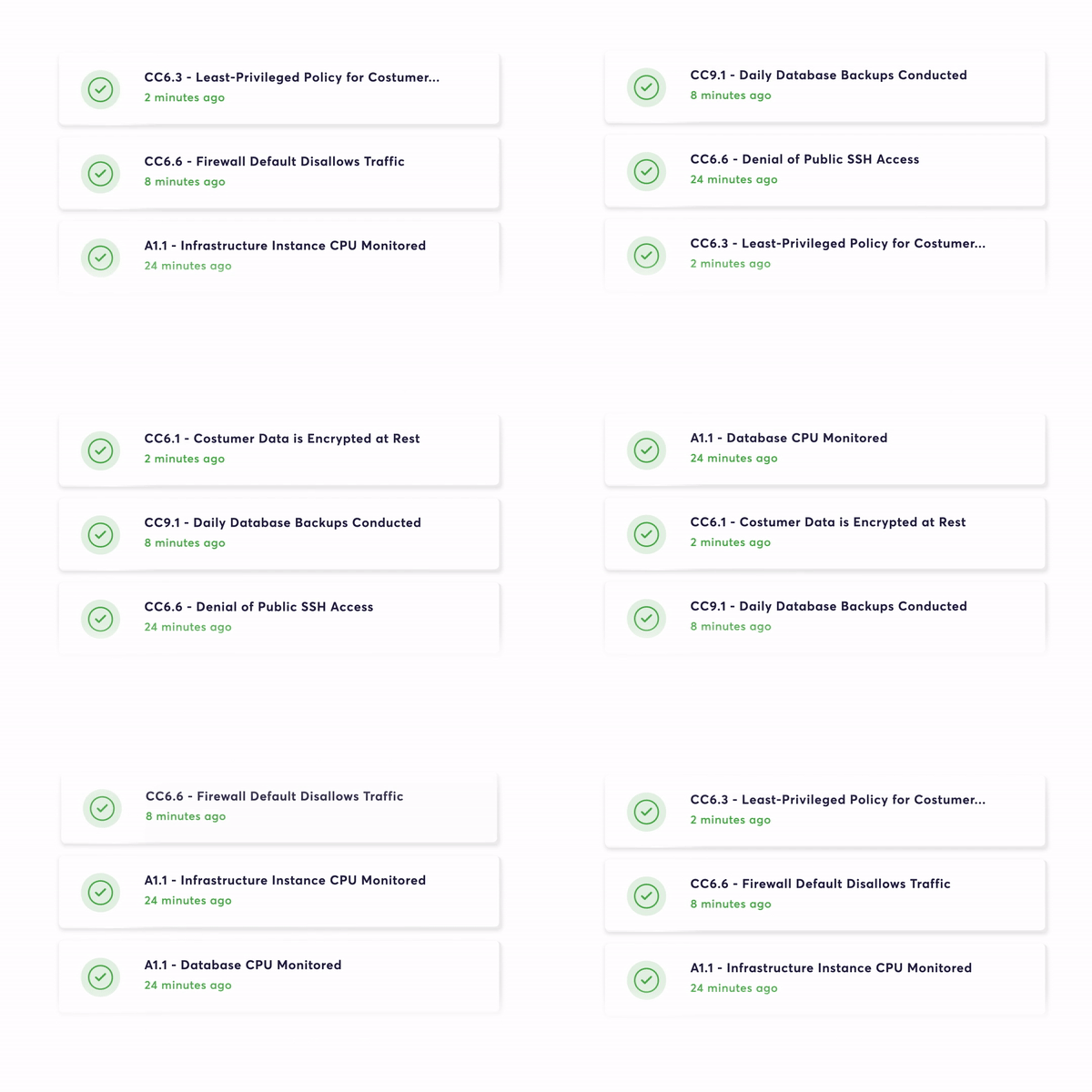
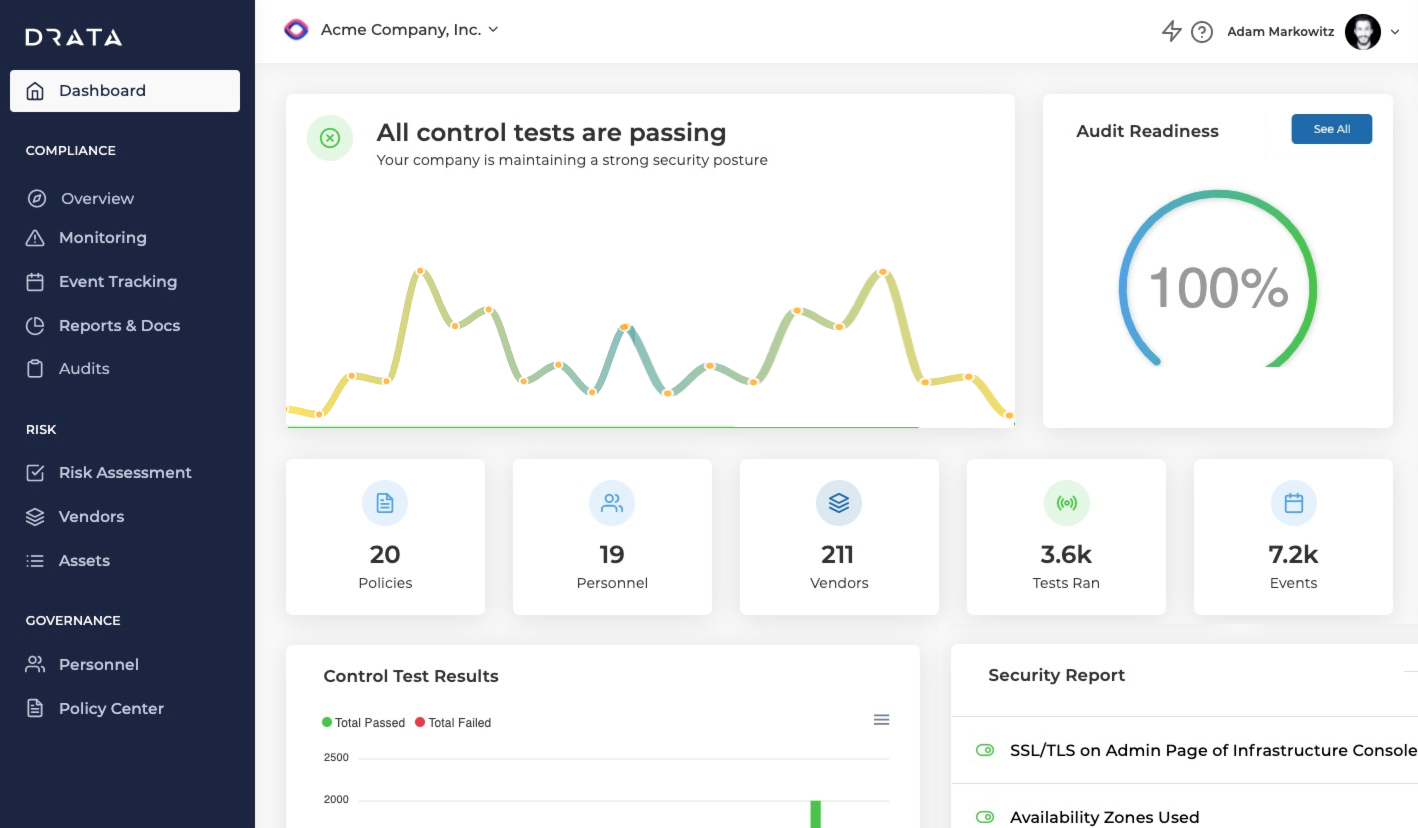
Like similar services, Drata helps businesses automate a lot of the evidence collection as they prepare for a SOC 2 audit. The focus of the service is obviously on running tests against the SOC 2 framework to help businesses prepare for their audit (and to prepare the right materials for the auditor). To do so, it features integrations with a lot of standard online business tools and cloud services to regularly pull in data. One nifty feature is that it also lets you step through all of the various sections of the SOC 2 criteria to check your current readiness for an audit.

At the end of the day, tools like Drata are meant to get you through an audit, but at the same time, the idea here is also to give you a better idea of your own security posture. For that, Drata offers continuous control monitoring, as well as tools to track if your employees have turned on all the right controls on their work computers, for example. Since companies have to regularly renew their certification, too, Drata can help them to continuously collect all of the data for their renewal, something that previously often involved boring — and quickly forgotten — manual tasks like taking screenshots of various settings every month or so.

Image Credits: Drata

Drata co-founder and CEO Adam Markowitz worked on the space shuttle engines after graduating from college and then launched his own startup, Portfolium, after that program ended. Portfolium, which helped students showcase their work in the form of — you guessed it — a portfolio, eventually sold to Infrastructure in 2019, where Markowitz stayed on until he launched Drata last June, together with a group of former Portfolium founders and engineers. Besides Markowitz, the co-founders include CTO Daniel Marashlian and CRO Troy Markowitz. It was the team’s experience seeing companies go through the audit process, which has traditionally been a drawn-out and manual process, that led them to look at building their own solution.

The company already managed to sign up a number of customers ahead of its official launch. These include Spot by NetAppAccel RoboticsAbnormal SecurityChameleon and Vareto. As Markowitz told me, even though Drata already had customers who were using the service to prepare for their audits, the team wanted to remain in stealth mode until it had used its own tool to go through its own audit. With that out of the way, and Drata receiving its SOC 2 certification, it’s now ready to come out of stealth.

As the number of companies that need to go through these kinds of audits increases, it’s maybe no surprise that we’re also seeing a growing number of companies that aim to automate much of this process. With that, unsurprisingly, the number of VC investments in this space also continues to increase. In recent months, Secureframe and Strike Graph announced their own funding rounds, for example.

Image Credits: Drata

13 Jan 2021

Openbase scores $3.6M seed to help developers find open source components

Openbase founder Lior Grossman started his company the way that many founders do — to solve a problem he was having. In this case, it was finding the right open source components to build his software. He decided to build something to solve the problem, and Openbase was born.

Today, the company announced a $3.65 million seed round led by Zeev Ventures with participation from Y Combinator and 20 individual tech industry investors. Openbase was a member of the YC 2020 cohort.

Grossman says that being part of YC helped him meet investors, especially on Demo Day when hundreds of investors listened in. “I would say that being part of YC definitely gave us a higher profile, and exposed us to some investors that I didn’t know before. It definitely opened doors for us,” he said.

As developers build modern software, they often use open source components to help build the application, and Openbase helps them find the best one for their purposes. “Openbase basically helps developers choose from among millions of open source packages,” Grossman told me.

The database includes 1.5 million JavaScript packages today with support for additional languages including Python and Go in beta. The way it works is that users search for a package based on their requirements and get a set of results. From there, they can compare components and judge them based on user reviews and other detailed insights.

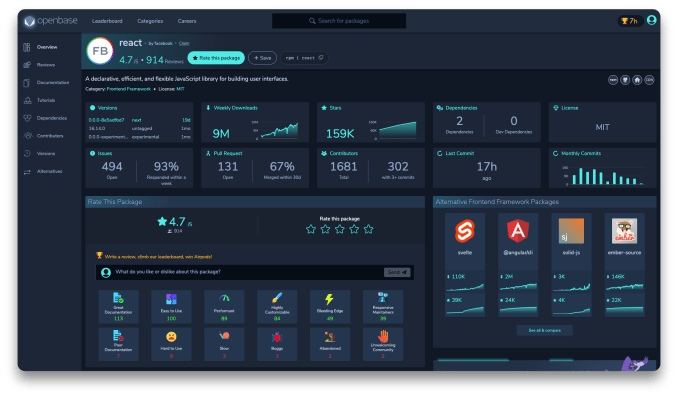
Openbase data screen gives detailed insights on the chosen package including popularity and similar packages.

Image Credits: Openbase

Grossman found that his idea began resonating with developers shortly after he launched in 2019. In fact, he reports that he went from zero to half a million users in the first year without any marketing beyond word of mouth. That’s when he decided to apply to Y Combinator and got into the Summer 2020 class.

The database is free for developers and that has helped build the user base so quickly. Eventually he hopes to monetize by allowing certain companies to promote their packages on the system. He says that these will be clearly marked and that the plan is to have only one promoted package per category. What’s more, they will retain all their user reviews and other associated data, regardless of whether it’s being promoted or not.

Grossman started the company on his own, but has added 5 employees with plans to hire more people this year to keep growing the startup. As an immigrant founder, he is sensitive to diversity and sees building a diverse company as a key goal. “I built this company as an immigrant myself […] and I want to build an inclusive culture with people from different backgrounds because I think that will produce the best environment to foster innovation,” he explained.

So far the company has been fully remote, but the plan is to open an office post-pandemic. He says he sees a highly flexible approach to work though with people spending some days in the office and some at home. “I think for our culture this hybrid approach will work. Whenever we expand further I obviously imagine having more offices and not only our office in San Francisco.”

13 Jan 2021

Openbase scores $3.6M seed to help developers find open source components

Openbase founder Lior Grossman started his company the way that many founders do — to solve a problem he was having. In this case, it was finding the right open source components to build his software. He decided to build something to solve the problem, and Openbase was born.

Today, the company announced a $3.65 million seed round led by Zeev Ventures with participation from Y Combinator and 20 individual tech industry investors. Openbase was a member of the YC 2020 cohort.

Grossman says that being part of YC helped him meet investors, especially on Demo Day when hundreds of investors listened in. “I would say that being part of YC definitely gave us a higher profile, and exposed us to some investors that I didn’t know before. It definitely opened doors for us,” he said.

As developers build modern software, they often use open source components to help build the application, and Openbase helps them find the best one for their purposes. “Openbase basically helps developers choose from among millions of open source packages,” Grossman told me.

The database includes 1.5 million JavaScript packages today with support for additional languages including Python and Go in beta. The way it works is that users search for a package based on their requirements and get a set of results. From there, they can compare components and judge them based on user reviews and other detailed insights.

Openbase data screen gives detailed insights on the chosen package including popularity and similar packages.

Image Credits: Openbase

Grossman found that his idea began resonating with developers shortly after he launched in 2019. In fact, he reports that he went from zero to half a million users in the first year without any marketing beyond word of mouth. That’s when he decided to apply to Y Combinator and got into the Summer 2020 class.

The database is free for developers and that has helped build the user base so quickly. Eventually he hopes to monetize by allowing certain companies to promote their packages on the system. He says that these will be clearly marked and that the plan is to have only one promoted package per category. What’s more, they will retain all their user reviews and other associated data, regardless of whether it’s being promoted or not.

Grossman started the company on his own, but has added 5 employees with plans to hire more people this year to keep growing the startup. As an immigrant founder, he is sensitive to diversity and sees building a diverse company as a key goal. “I built this company as an immigrant myself […] and I want to build an inclusive culture with people from different backgrounds because I think that will produce the best environment to foster innovation,” he explained.

So far the company has been fully remote, but the plan is to open an office post-pandemic. He says he sees a highly flexible approach to work though with people spending some days in the office and some at home. “I think for our culture this hybrid approach will work. Whenever we expand further I obviously imagine having more offices and not only our office in San Francisco.”

13 Jan 2021

Will startup valuations change given rising antitrust concerns?

The United States has, over the past few decades, been extremely lenient on antitrust enforcement, rarely blocking deals, even with overseas competitors. Yet, there have been inklings that things are changing. Yesterday, we learned that Visa and Plaid called off their combination after the Department of Justice sued to block it in early November. We also learned a week ago that shaving startup Billie would end its proposed acquisition by consumer product goods giant P&G after the Federal Trade Commission sued to block it in December.

Many, many, many other deals of course get through the gauntlet of regulations, but even a few smoke signals is enough to start raising concerns. That new calculus is even before we start to look at the morass of reforms being proposed around antitrust in Washington DC these days, nearly all of which — on a bipartisan basis — would create stricter controls for antitrust, particularly in critical technology industries and information services.

So, what’s the valuation prognosis for startups these days given that one of the most important exit options available is increasingly looking fraught?

13 Jan 2021

Iziwork raises $43 million for its temporary work platform

French startup Iziwork has raised a $43 million funding round. Cathay Innovation and Bpifrance’s Large Venture fund are participating in this funding round. The company has been building a platform focused on improving temporary employment.

While it’s a relatively large funding round, the startup is quite young. It was founded in September 2018 and it has raised $68 million overall.

Iziwork manages a marketplace of temporary work. 2,000 companies are using the platform in France and Italy. 800,000 candidates have used the app to access job opportunities. You can consider it as a tech-enabled version of the good old employment agency.

Candidates can onboard directly from the mobile app. You then get personalized recommendations based on your profile. 95% of assignments are filled in less than 4 hours. And of course, all your documents are managed from the app.

Iziwork tries to add some benefits to compensate the fact that temporary workers often jump from one company to another. For instance, you get a time savings account, you can request a down payment on your pay every week, etc.

The startup has realized that it can’t open offices in every big and intermediate city. That’s why third-party companies can join the Iziwork network. As a partner, you find new clients and new job opportunities. You can then leverage Iziwork’s app, service and pool of candidates.

This is an interesting strategy as it greatly increases supply on the Iziwork marketplace. Partners get a revenue sharing deal with Iziwork.

With today’s funding round, the company plans to expand to new countries and improve its tech product. There are still some growth opportunities in its existing markets as well.

Jobandtalent, another company in this space, has attracted some headlines as it has raised $108 million last week. Founded in 2009 and based in Madrid, it has generated €500 million in revenue last year.

But, let’s be honest, the temporary work market is huge. Adecco, Randstad and other legacy players still represent a bigger threat for this recent wave of temp staffing startups. Let’s see how it plays out in the coming years.

13 Jan 2021

Human.ai nabs $3.2M seed to build personal intelligence platform

The last we heard from Luther.ai, the startup was participating in the TechCrunch Disrupt Battlefield in September. The company got a lot of attention from that appearance, which culminated in a $3.2 million seed round it announced today. While they were at it, the founders decided to change the company name to Human.ai, which they believe better reflects their mission.

Differential VC led the round joined by Village Global VC, Good Friends VC, Beni VC and Keshif Ventures. David Magerman from Differential will join the startup’s Board.

The investors were attracted to Human.ai’s personalized kind of artificial intelligence, and co-founder and CEO Suman Kanuganti says that the Battlefield appearance led directly to investor interest, which quickly resulted in a deal four weeks later.

“I think overall the messaging of what we delivered at TechCrunch Disrupt regarding an individual personal AI that is secured by blockchain to retain and recall [information] really set the stage for what the company is all about, both from a user standpoint as well as from an investor standpoint,” Kanuganti told me.

As for the name change, he reported that there was some confusion in the market that Luther was an AI assistant like Alexa or a chatbot, and the founders wanted the name to better reflect the personalized nature of the product.

“We are creating AI for the individual and there is so much emphasis on the authenticity and the voice and the thoughts of an individual, and how we also use blockchain to secure ownership of the data. So most of the principle lies in creating this AI for an individual human. So we thought, let’s call it Human.ai,” he explained.

As Kanuganti described it in September, the tool allows individuals to search for nuggets of information from past events using a variety of AI technologies:

“It’s made possible through a convergence of neuroscience, NLP and blockchain to deliver seamless in-the-moment recall. GPT-3 is built on the memories of the public internet, while Luther is built on the memories of your private self.”

The company is still in the process of refining the product and finding its audience, but reports that so far they have found interest from creative people such as writers, professionals such as therapists, high tech workers interested in AI, students looking to track school work and seniors looking for a way to track their memories for memoir purposes. All of these groups have the common theme of having to find nuggets of information from a ton of signals and that’s where Human.ai’s strength lies.

The company’s diverse founding team includes two women, CTO Sharon Zhang and designer Kristie Kaiser, along with Kanuganti, who is himself an immigrant. The founders want to continue building a diverse organization as they add employees. “I think in general we just want to attract a diverse kind of talent, especially because we are also Human.ai and we believe that everyone should have the same opportunity,” Zhang told me.

The company currently has 7 full time employees and a dozen consultants, but with the new funding is looking to hire engineers and AI talent and a head of marketing to push the notion of consumer AI. While the company is remote today and has employees around the world, it will look to build a headquarters at some point post-COVID where some percentage of the employees can work in the same space together.

13 Jan 2021

Human.ai nabs $3.2M seed to build personal intelligence platform

The last we heard from Luther.ai, the startup was participating in the TechCrunch Disrupt Battlefield in September. The company got a lot of attention from that appearance, which culminated in a $3.2 million seed round it announced today. While they were at it, the founders decided to change the company name to Human.ai, which they believe better reflects their mission.

Differential VC led the round joined by Village Global VC, Good Friends VC, Beni VC and Keshif Ventures. David Magerman from Differential will join the startup’s Board.

The investors were attracted to Human.ai’s personalized kind of artificial intelligence, and co-founder and CEO Suman Kanuganti says that the Battlefield appearance led directly to investor interest, which quickly resulted in a deal four weeks later.

“I think overall the messaging of what we delivered at TechCrunch Disrupt regarding an individual personal AI that is secured by blockchain to retain and recall [information] really set the stage for what the company is all about, both from a user standpoint as well as from an investor standpoint,” Kanuganti told me.

As for the name change, he reported that there was some confusion in the market that Luther was an AI assistant like Alexa or a chatbot, and the founders wanted the name to better reflect the personalized nature of the product.

“We are creating AI for the individual and there is so much emphasis on the authenticity and the voice and the thoughts of an individual, and how we also use blockchain to secure ownership of the data. So most of the principle lies in creating this AI for an individual human. So we thought, let’s call it Human.ai,” he explained.

As Kanuganti described it in September, the tool allows individuals to search for nuggets of information from past events using a variety of AI technologies:

“It’s made possible through a convergence of neuroscience, NLP and blockchain to deliver seamless in-the-moment recall. GPT-3 is built on the memories of the public internet, while Luther is built on the memories of your private self.”

The company is still in the process of refining the product and finding its audience, but reports that so far they have found interest from creative people such as writers, professionals such as therapists, high tech workers interested in AI, students looking to track school work and seniors looking for a way to track their memories for memoir purposes. All of these groups have the common theme of having to find nuggets of information from a ton of signals and that’s where Human.ai’s strength lies.

The company’s diverse founding team includes two women, CTO Sharon Zhang and designer Kristie Kaiser, along with Kanuganti, who is himself an immigrant. The founders want to continue building a diverse organization as they add employees. “I think in general we just want to attract a diverse kind of talent, especially because we are also Human.ai and we believe that everyone should have the same opportunity,” Zhang told me.

The company currently has 7 full time employees and a dozen consultants, but with the new funding is looking to hire engineers and AI talent and a head of marketing to push the notion of consumer AI. While the company is remote today and has employees around the world, it will look to build a headquarters at some point post-COVID where some percentage of the employees can work in the same space together.