Year: 2021

13 Jan 2021

Two-year-old NUVIA sells to Qualcomm for $1.4 billion

You know what’s great? Becoming a unicorn in two years. You know what’s even better? Exiting at unicorn status in two years.

This morning, Qualcomm announced that it was buying high-performance computing startup NUVIA for $1.4 billion, minus some coverage of working capital and debt.

The startup, which we extensively profiled on its launch after raising $53 million in a Series A in late 2019 and again a few months ago when it raised $240 million in its Series B from Mithril, was the brainchild of a number of star Apple chip engineers who had worked on the computing giant’s A series of chips that powered the company’s iPhones and iPads.

Much like how Apple’s new M series of chips for its laptop computers (so far) have dazzled with an almost revolutionary mix of energy efficiency and performance, NUVIA’s founders were hoping to use their experience in managing the power envelope while eking out high performance and bring that to the data center. Given the sheer scale of power required by data centers to function, which is only going up with the demand for AI applications in the cloud, the hope was that NUVIA could have its cake and eat it too: offering high performance while cutting power and saving costs for cloud computing.

According to Qualcomm’s press release, NUVIA’s technology will be incorporated across the company’s line of chips, with its leadership centered around its 5G-focused Snapdragon chip. The company’s founders and employees are expected to join, and the deal must be approved by U.S. regulators.

NUVIA was one of the most compelling companies of the new crop of next-generation silicon startups, but it was also mired in a legal battle between one of its founders and famed former Apple engineer Gerald Williams III and his former employer. Apple filed a civil lawsuit against Williams in 2019 (California Superior Court of Santa Clara, 19-cv-352866), arguing that he attempted to recruit his former colleagues to join NUVIA in breach of his contractual obligations with Apple. Williams fought back through his own motions, and the two have been legal discovery ever since, with the latest updates happening just last month with Apple and Williams demanding each other hand over certain documents as the case has proceeded.

We don’t know how the timing of that lawsuit played into the company’s quick exit, or whether Qualcomm’s significantly deeper relationship with Apple as a supplier might help the parties reach a quicker settlement. We’ve reached out to a NUVIA spokesperson for comment.

While that lawsuit was a cloud over the company, the end result is a unicorn exit at $1.4 billion on just shy of $300 million of venture capital fundraised in roughly two years. Mithril is probably not terribly thrilled given the quick turnaround, but earlier investors like Capricorn Investment Group, Dell Technologies Capital (DTC), Mayfield, and WRVI Capital are probably doing a bit better on the multiples on invested capital front. And of course, the founders likely came out well ahead as well.

13 Jan 2021

Gainful raises $7.5M for personalized sports nutrition

Gainful, a startup offering personalized subscriptions to protein powders and hydration products, is announcing that it has raised $7.5 million in Series A funding.

COO Eric Wu, who founded the company with CTO Jahaan Ansari, told me that Gainful began with his own experience experimenting different protein powders and eventually the combination that worked best for his goals and dietary needs.

“In my personal experience, trying to find a protein powder can be a very overwhelming experience,” Wu told me. “There are a million ingredients, and you just want somebody to talk to who can cut through all that noise.”

So when when you first sign up for Gainful, you take a quiz about things like your height, weight, exercise patterns, fitness goals and how often you plan to consume the protein product. The company will then recommend a powder for you, as well as providing ongoing access to a registered dietitian who can answer any additional questions.

Wu said that behind the scenes, Gainful developed “hundreds and hundreds of different [protein] blends,” then worked with its science advisory board (which includes nutrition experts who have worked with the Golden State Warriors and Sacramento Kings) to “hone in on a set number of blends.” When asked for more details about how many products the company is actually selling, Wu said it’s “more than handful” and they’re “constantly being iterated on.”

Gainful hydration

Image Credits: Gainful

All Gainful products are made without artificial colors, flavors or sweeteners, and they’re gluten-free and soy-free as well. With the new electrolyte drink mixes (which I’ve tried and enjoyed), the startup is moving beyond protein, and Wu said it will continue to add new products and new flavors. At the same time, you still need a subscription to the protein powder (pricing starts at $39) to get access to additional products.

To explain this relatively high commitment approach, Wu said, “We really believe that we’ve created a system of products that all have complementary benefits and work really synergistically. If you’re hydrating properly, you can work harder during your exercise, and your personalized protein powder is working harder for you. All of these are offered … not as a magic bullet, not as a lose-weight-fast solution, but as a way of being healthy. It’s not supposed to be a flash in the pan.”

The Series A round was co-led by BrandProject and Courtside Ventures, with participation from AF Ventures, Round13 Capital, Barrel Ventures and the founder of Polaris Sports.

Gainful was part of Y Combinator’s winter 2018 batch. It also had a leadership transition early last year, with Wu shifting from CEO to COO (where he said he could focus more on product development), while Dean Kelly joined as chief executive.

Wu added that the company has seen significant growth during the pandemic, due to the general shift towards e-commerce, as well as “people reflecting on what it means to lead a full, healthy, happy life in a time when it was really difficult.”

13 Jan 2021

Gainful raises $7.5M for personalized sports nutrition

Gainful, a startup offering personalized subscriptions to protein powders and hydration products, is announcing that it has raised $7.5 million in Series A funding.

COO Eric Wu, who founded the company with CTO Jahaan Ansari, told me that Gainful began with his own experience experimenting different protein powders and eventually the combination that worked best for his goals and dietary needs.

“In my personal experience, trying to find a protein powder can be a very overwhelming experience,” Wu told me. “There are a million ingredients, and you just want somebody to talk to who can cut through all that noise.”

So when when you first sign up for Gainful, you take a quiz about things like your height, weight, exercise patterns, fitness goals and how often you plan to consume the protein product. The company will then recommend a powder for you, as well as providing ongoing access to a registered dietitian who can answer any additional questions.

Wu said that behind the scenes, Gainful developed “hundreds and hundreds of different [protein] blends,” then worked with its science advisory board (which includes nutrition experts who have worked with the Golden State Warriors and Sacramento Kings) to “hone in on a set number of blends.” When asked for more details about how many products the company is actually selling, Wu said it’s “more than handful” and they’re “constantly being iterated on.”

Gainful hydration

Image Credits: Gainful

All Gainful products are made without artificial colors, flavors or sweeteners, and they’re gluten-free and soy-free as well. With the new electrolyte drink mixes (which I’ve tried and enjoyed), the startup is moving beyond protein, and Wu said it will continue to add new products and new flavors. At the same time, you still need a subscription to the protein powder (pricing starts at $39) to get access to additional products.

To explain this relatively high commitment approach, Wu said, “We really believe that we’ve created a system of products that all have complementary benefits and work really synergistically. If you’re hydrating properly, you can work harder during your exercise, and your personalized protein powder is working harder for you. All of these are offered … not as a magic bullet, not as a lose-weight-fast solution, but as a way of being healthy. It’s not supposed to be a flash in the pan.”

The Series A round was co-led by BrandProject and Courtside Ventures, with participation from AF Ventures, Round13 Capital, Barrel Ventures and the founder of Polaris Sports.

Gainful was part of Y Combinator’s winter 2018 batch. It also had a leadership transition early last year, with Wu shifting from CEO to COO (where he said he could focus more on product development), while Dean Kelly joined as chief executive.

Wu added that the company has seen significant growth during the pandemic, due to the general shift towards e-commerce, as well as “people reflecting on what it means to lead a full, healthy, happy life in a time when it was really difficult.”

13 Jan 2021

Dell’s 40-inch curved monitor is perfect for a home office command center

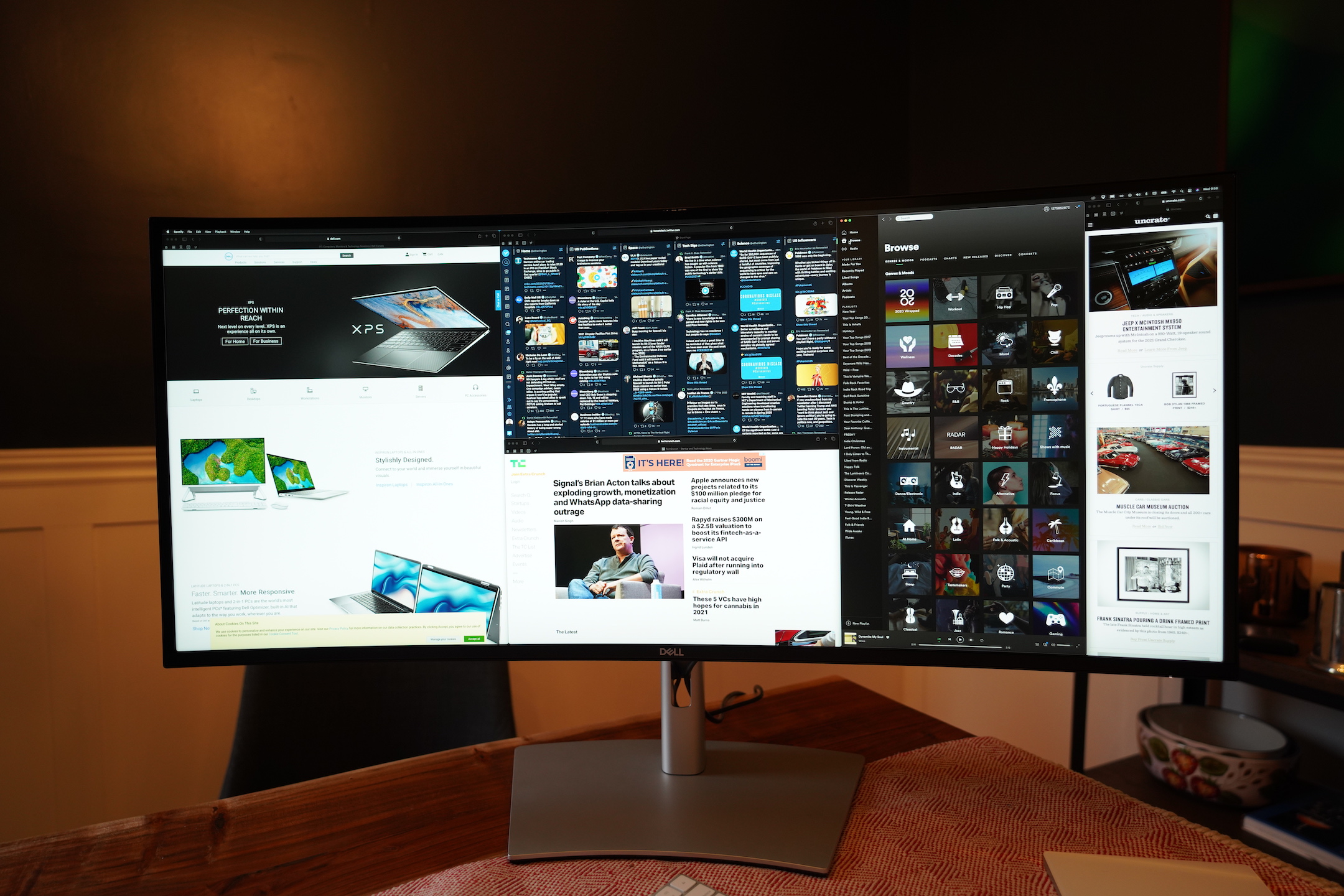
Dell’s kicking off 2021 with a new addition to its monitor lineup that aims to hit a variety of sweet spots. The Dell UltraSharp 40 Curved WUHD monitor offers 39.7″ of screen real estate, with a 5120 x 2160 resolution that matches the pixel density of 4K resolution on a 32-inch conventional widescreen display. It comes equipped with Thunderbolt 3 for display and data connectivity, as well as 90W of charging for compatible computers, and a 10Gbps Ethernet connection for networking. In short, Dell’s latest (which is available beginning January 28) looks to be a true ‘one display to rule them all’ contender, particularly for those searching for a way to optimize their home offices.

The basics

Dell’s UltraSharp 40 has a 60Hz, 39.7″ diagonal display in 21:9 aspect ratio with WUHD resolution (not quite true 5K, but exceptional for a curved monitor this size). It offers 100% sRGB and 98% P3 color reproduction, and comes with a stand that has height adjustability, tilt and swivel, and that features a hidden cable channel for cable management. Built-in speakers provide 9W each of sound reproduction so you don’t need to worry about adding externals.

Image Credits: Darrell Etherington

In terms of wired connections, it offers Thunderbolt 3, RJ45 Ethernet, and USB 10Gps ports (three on the rear, and one in front) as well as one USB-C port for easy access on the front. There’s also 3.5mm audio line out (though it’s worth noting that this doesn’t work with headphones), and two HDMI ports plus one DisplayPort for more traditional display connectivity if you’re not going the Thunderbolt route. Finally, a standard security lock slot allows you to anchor the display in any shared environment.

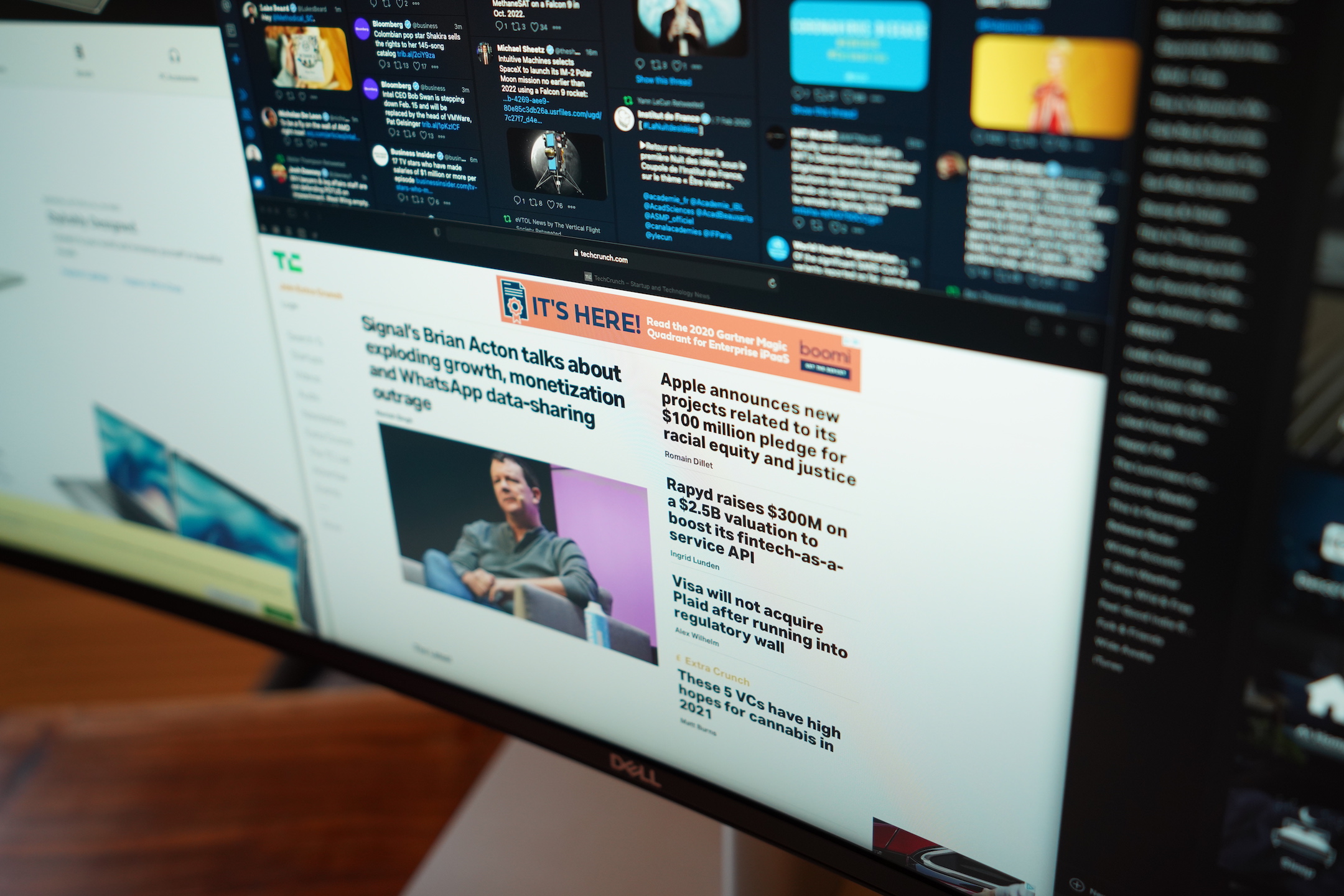
The display itself is bright, clear and viewable at a wide range of angles, with a more matte finish that provides excellent viewing in a wide range of lighting conditions. A joystick control button provides easy navigation and operation of the built-in on-screen menu and integrated features, including picture-in-picture.

Design and features

First and foremost, the Dell UltraSharp 40 delivered excellent visual quality. Especially for a display this size, in a curved form factor, at this resolution, it’s going to be something that satisfies everyone from telecommuters mostly handling meetings and spreadsheets, to photographers and video professionals looking for image quality that is highly color-accurate and provides crystal clear detail.

The WUHD resolution means that you can run the display in a range of different configurations, depending on how much screen real estate you want or need. For instance, I’ve been using it at the 5160 x 2160 res, and it provides ample workspace for arranging multiple windows side-by-side, and tiled vertically. I typically use three displays at once in my day job (there’s a lot of tab and browser windows involved) and the Dell UltraSharp 40 makes it so that I can comfortably work with just a single monitor instead. It’ll work with Apple’s HiDPI modes on its modern Macs for clear and crisp visuals with larger on-screen elements, too, however, if you don’t need all that room.

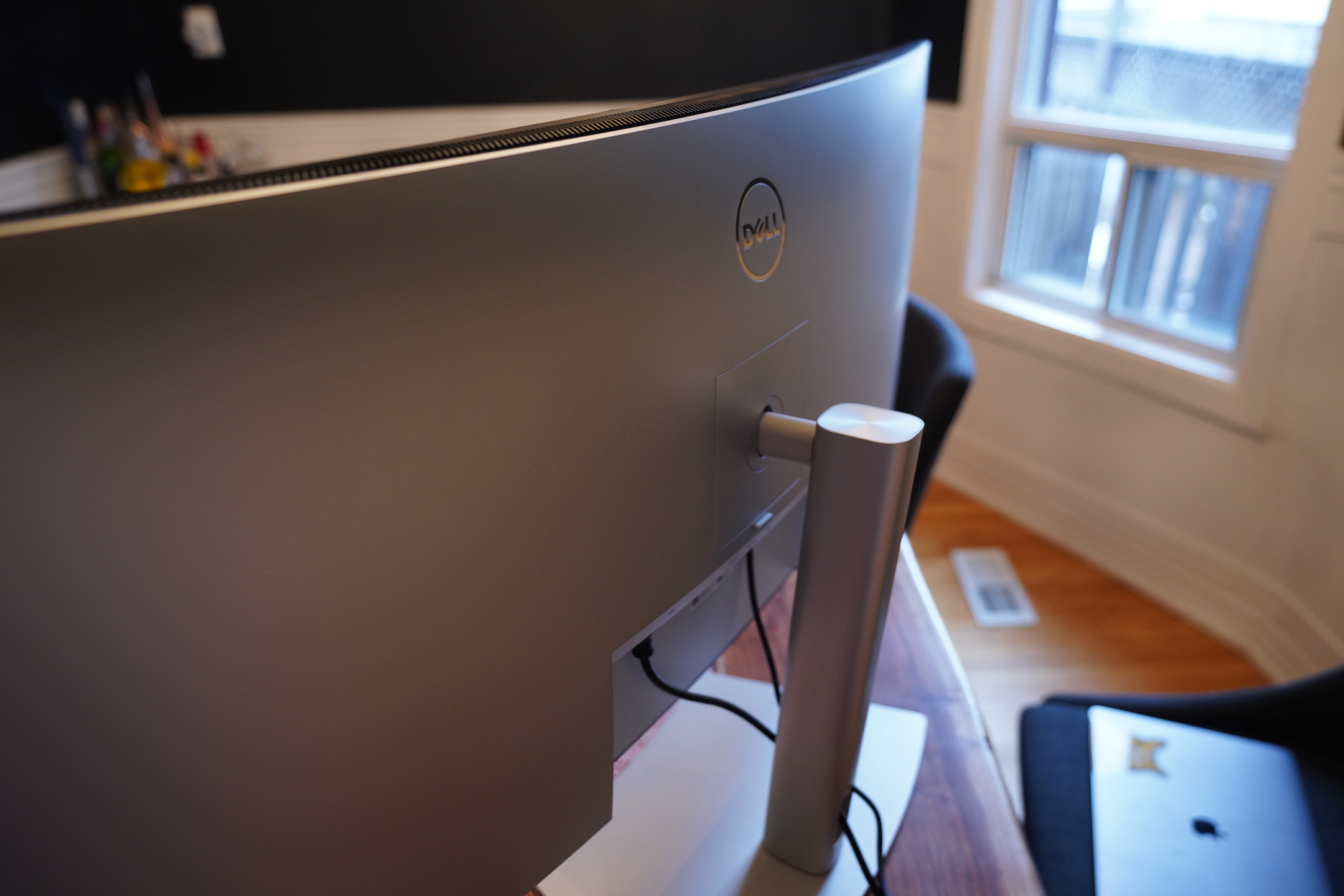
Dell’s integrated stand is simple and effective, providing a range of maneuverability options that allow for significant travel in height adjustment. You won’t get a portrait mode full swivel in this display – but that’s not surprising given how long it is on its longest edge, compared to the vertical. You do get tilt if you need it, and the ability to angle back and forwards depending on how you have it positioned. The end result is a display that’s very large, but easy enough to adjust for your comfortable use.

Image Credits: Darrell Etherington

The display comes calibrated out of the box, but also includes plenty of options for adjusting things like contrast and brightness using the built-in menus. This also including a very useful multi-device display setup, including both picture-in-picture features for multiple sources, and a picture-by-picture mode that splits the display into two equal side-by-side sections for multiple inputs. Another useful feature for working with the display with multiple computers: keyboards and mice connected via the monitor will automatically detect and switch between controlling both connected PCs.

Besides the display size and resolution, the other thing that makes the UltraSharp 40 a fantastic option for a home workstation is its range of ports and added bonuses like built-in speakers. The speakers aren’t going to win any audiophile awards, but they’re better than the ones that come built into your laptop and they obviate the need for additional equipment if you’re looking to spare your desk surface space. With any modern Thunderbolt-equipped Mac, the Dell UltraSharp 40 really is a one-cable wonder that offers very little in the way of compromises.

Bottom line

Image Credits: Darrell Etherington

With the Dell UltraSharp 40, the company continues its tradition of delivering extremely high-quality display products at a reasonable price. The $2,100 price tag may seem steep, but for what you’re getting it’s a very fair price point, and Dell’s displays also have very high reliability that means an investment in their monitors is likely to keep you satisfied for many years to come (two of my home office displays are some of Dell’s very first 4K monitors, which have served me reliably for over half a decade).

Because of its wide aspect ratio and curve, this display really does replace two smaller 4K screens for most uses, and so the cost framed that way actually makes even more sense. In short, Dell’s UltraSharp 40 is a home office beast, which fills a sweet spot for a wide range of remote professionals.

13 Jan 2021

Dell’s 40-inch curved monitor is perfect for a home office command center

Dell’s kicking off 2021 with a new addition to its monitor lineup that aims to hit a variety of sweet spots. The Dell UltraSharp 40 Curved WUHD monitor offers 39.7″ of screen real estate, with a 5120 x 2160 resolution that matches the pixel density of 4K resolution on a 32-inch conventional widescreen display. It comes equipped with Thunderbolt 3 for display and data connectivity, as well as 90W of charging for compatible computers, and a 10Gbps Ethernet connection for networking. In short, Dell’s latest (which is available beginning January 28) looks to be a true ‘one display to rule them all’ contender, particularly for those searching for a way to optimize their home offices.

The basics

Dell’s UltraSharp 40 has a 60Hz, 39.7″ diagonal display in 21:9 aspect ratio with WUHD resolution (not quite true 5K, but exceptional for a curved monitor this size). It offers 100% sRGB and 98% P3 color reproduction, and comes with a stand that has height adjustability, tilt and swivel, and that features a hidden cable channel for cable management. Built-in speakers provide 9W each of sound reproduction so you don’t need to worry about adding externals.

Image Credits: Darrell Etherington

In terms of wired connections, it offers Thunderbolt 3, RJ45 Ethernet, and USB 10Gps ports (three on the rear, and one in front) as well as one USB-C port for easy access on the front. There’s also 3.5mm audio line out (though it’s worth noting that this doesn’t work with headphones), and two HDMI ports plus one DisplayPort for more traditional display connectivity if you’re not going the Thunderbolt route. Finally, a standard security lock slot allows you to anchor the display in any shared environment.

The display itself is bright, clear and viewable at a wide range of angles, with a more matte finish that provides excellent viewing in a wide range of lighting conditions. A joystick control button provides easy navigation and operation of the built-in on-screen menu and integrated features, including picture-in-picture.

Design and features

First and foremost, the Dell UltraSharp 40 delivered excellent visual quality. Especially for a display this size, in a curved form factor, at this resolution, it’s going to be something that satisfies everyone from telecommuters mostly handling meetings and spreadsheets, to photographers and video professionals looking for image quality that is highly color-accurate and provides crystal clear detail.

The WUHD resolution means that you can run the display in a range of different configurations, depending on how much screen real estate you want or need. For instance, I’ve been using it at the 5160 x 2160 res, and it provides ample workspace for arranging multiple windows side-by-side, and tiled vertically. I typically use three displays at once in my day job (there’s a lot of tab and browser windows involved) and the Dell UltraSharp 40 makes it so that I can comfortably work with just a single monitor instead. It’ll work with Apple’s HiDPI modes on its modern Macs for clear and crisp visuals with larger on-screen elements, too, however, if you don’t need all that room.

Dell’s integrated stand is simple and effective, providing a range of maneuverability options that allow for significant travel in height adjustment. You won’t get a portrait mode full swivel in this display – but that’s not surprising given how long it is on its longest edge, compared to the vertical. You do get tilt if you need it, and the ability to angle back and forwards depending on how you have it positioned. The end result is a display that’s very large, but easy enough to adjust for your comfortable use.

Image Credits: Darrell Etherington

The display comes calibrated out of the box, but also includes plenty of options for adjusting things like contrast and brightness using the built-in menus. This also including a very useful multi-device display setup, including both picture-in-picture features for multiple sources, and a picture-by-picture mode that splits the display into two equal side-by-side sections for multiple inputs. Another useful feature for working with the display with multiple computers: keyboards and mice connected via the monitor will automatically detect and switch between controlling both connected PCs.

Besides the display size and resolution, the other thing that makes the UltraSharp 40 a fantastic option for a home workstation is its range of ports and added bonuses like built-in speakers. The speakers aren’t going to win any audiophile awards, but they’re better than the ones that come built into your laptop and they obviate the need for additional equipment if you’re looking to spare your desk surface space. With any modern Thunderbolt-equipped Mac, the Dell UltraSharp 40 really is a one-cable wonder that offers very little in the way of compromises.

Bottom line

Image Credits: Darrell Etherington

With the Dell UltraSharp 40, the company continues its tradition of delivering extremely high-quality display products at a reasonable price. The $2,100 price tag may seem steep, but for what you’re getting it’s a very fair price point, and Dell’s displays also have very high reliability that means an investment in their monitors is likely to keep you satisfied for many years to come (two of my home office displays are some of Dell’s very first 4K monitors, which have served me reliably for over half a decade).

Because of its wide aspect ratio and curve, this display really does replace two smaller 4K screens for most uses, and so the cost framed that way actually makes even more sense. In short, Dell’s UltraSharp 40 is a home office beast, which fills a sweet spot for a wide range of remote professionals.

13 Jan 2021

Netflix releases latest diversity numbers

Netflix has released its first-ever diversity and inclusion report. Though, it’s not the first time Netflix has shared this type of data. Netflix has shared representation numbers since 2013, but the company had not put a bow on it until now.

Worldwide, women make up 47.1% of Netflix’s workforce. Since 2017, representation of white and Asian employees has been on a slow decline, while representation of Hispanic or Latinx, Black, mixed race and folks from native populations has been on the rise. In the U.S., Netflix is 8.1% Hispanic or Latinx, 8% Black, and 5.1% of its employees are mixed race, while 1.3% of employees are either Native American, Native Alaskan, Native Hawaiian, Pacific Islander, and/or from the Middle East or North Africa.


Netflix’s representation of people of color at the leadership level is not perfect but it’s certainly better than that of its counterparts in the tech industry. The company’s leadership team is 15.7% Asian, 9.5% Black, 4.9% Hispanic and 4.1% of Netflix’s higher-ups are mixed race.

Netflix has not laid out any concrete goals, but says it’s generally wanting to increase representation by hiring more inclusively and building out its recruiting networks, its VP of inclusion and diversity, Vernā Myers, said in the report. Additionally, Netflix says it wants to focus more on increasing inclusion and representation of folks outside of the U.S., as well as find a way to measure what the company called “inclusion health.”

13 Jan 2021

Stacklet raises $18M for its cloud governance platform

Stacklet, a startup that is commercializing the Cloud Custodian open-source cloud governance project, today announced that it has raised an $18 million Series A funding round. The round was led by Addition, with participation from Foundation Capital and new individual investor Liam Randall, who is joining the company as VP of business development. Addition and Foundation Capital also invested in Stacklet’s seed round, which the company announced last August. This new round brings the company’s total funding to $22 million.

Stacklet helps enterprises manage their data governance stance across different clouds, accounts, policies and regions, with a focus on security, cost optimization and regulatory compliance. The service offers its users a set of pre-defined policy packs that encode best practices for access to cloud resources, though users can obviously also specify their own rules. In addition, Stacklet offers a number of analytics functions around policy health and resource auditing, as well as a real-time inventory and change management logs for a company’s cloud assets.

The company was co-founded by Travis Stanfield (CEO) and Kapil Thangavelu (CTO). Both bring a lot of industry expertise to the table. Stanfield spent time as an engineer at Microsoft and leading DealerTrack Technologies, while Thangavelu worked at Canonical and most recently in Amazon’s AWSOpen team. Thangavelu is also one of the co-creators of the Cloud Custodian project, which was first incubated at Capital One, where the two co-founders met during their time there, and is now a sandbox project under the Cloud Native Computing Foundation’s umbrella.

“When I joined Capital One, they had made the executive decision to go all-in on cloud and close their data centers,” Thangavelu told me. “I got to join on the ground floor of that movement and Custodian was born as a side project, looking at some of the governance and security needs that large regulated enterprises have as they move into the cloud.”

As companies have sped up their move to the cloud during the pandemic, the need for products like Stacklets has also increased. The company isn’t naming most of its customers, but one of them is FICO, among a number of other larger enterprises. Stacklet isn’t purely focused on the enterprise, though. “Once the cloud infrastructure becomes — for a particular organization — large enough that it’s not knowable in a single person’s head, we can deliver value for you at that time and certainly, whether it’s through the open source or through Stacklet, we will have a story there.” The Cloud Custodian open-source project is already seeing serious use among large enterprises, though, and Stacklet obviously benefits from that as well.

“In just 8 months, Travis and Kapil have gone from an idea to a functioning team with 15 employees, signed early Fortune 2000 design partners and are well on their way to building the Stacklet commercial platform,” Foundation Capital’s Sid Trivedi said. “They’ve done all this while sheltered in place at home during a once-in-a-lifetime global pandemic. This is the type of velocity that investors look for from an early-stage company.”

Looking ahead, the team plans to use the new funding to continue to developed the product, which should be generally available later this year, expand both its engineering and its go-to-market teams and continue to grow the open-source community around Cloud Custodian.

13 Jan 2021

Stacklet raises $18M for its cloud governance platform

Stacklet, a startup that is commercializing the Cloud Custodian open-source cloud governance project, today announced that it has raised an $18 million Series A funding round. The round was led by Addition, with participation from Foundation Capital and new individual investor Liam Randall, who is joining the company as VP of business development. Addition and Foundation Capital also invested in Stacklet’s seed round, which the company announced last August. This new round brings the company’s total funding to $22 million.

Stacklet helps enterprises manage their data governance stance across different clouds, accounts, policies and regions, with a focus on security, cost optimization and regulatory compliance. The service offers its users a set of pre-defined policy packs that encode best practices for access to cloud resources, though users can obviously also specify their own rules. In addition, Stacklet offers a number of analytics functions around policy health and resource auditing, as well as a real-time inventory and change management logs for a company’s cloud assets.

The company was co-founded by Travis Stanfield (CEO) and Kapil Thangavelu (CTO). Both bring a lot of industry expertise to the table. Stanfield spent time as an engineer at Microsoft and leading DealerTrack Technologies, while Thangavelu worked at Canonical and most recently in Amazon’s AWSOpen team. Thangavelu is also one of the co-creators of the Cloud Custodian project, which was first incubated at Capital One, where the two co-founders met during their time there, and is now a sandbox project under the Cloud Native Computing Foundation’s umbrella.

“When I joined Capital One, they had made the executive decision to go all-in on cloud and close their data centers,” Thangavelu told me. “I got to join on the ground floor of that movement and Custodian was born as a side project, looking at some of the governance and security needs that large regulated enterprises have as they move into the cloud.”

As companies have sped up their move to the cloud during the pandemic, the need for products like Stacklets has also increased. The company isn’t naming most of its customers, but one of them is FICO, among a number of other larger enterprises. Stacklet isn’t purely focused on the enterprise, though. “Once the cloud infrastructure becomes — for a particular organization — large enough that it’s not knowable in a single person’s head, we can deliver value for you at that time and certainly, whether it’s through the open source or through Stacklet, we will have a story there.” The Cloud Custodian open-source project is already seeing serious use among large enterprises, though, and Stacklet obviously benefits from that as well.

“In just 8 months, Travis and Kapil have gone from an idea to a functioning team with 15 employees, signed early Fortune 2000 design partners and are well on their way to building the Stacklet commercial platform,” Foundation Capital’s Sid Trivedi said. “They’ve done all this while sheltered in place at home during a once-in-a-lifetime global pandemic. This is the type of velocity that investors look for from an early-stage company.”

Looking ahead, the team plans to use the new funding to continue to developed the product, which should be generally available later this year, expand both its engineering and its go-to-market teams and continue to grow the open-source community around Cloud Custodian.

13 Jan 2021

Facebook’s EU-US data transfers face their final countdown

Ireland’s Data Protection Commission (DPC) has agreed to swiftly finalize a long-standing complaint against Facebook’s international data transfers which could force the tech giant to suspend data flows from the European Union to the US within in a matter of months.

The complaint, which was filed in 2013 by privacy campaigner Max Schrems, relates to the clash between EU privacy rights and US government intelligent agencies’ access to Facebook users’ data under surveillance programs that were revealed in high resolution detail by NSA whistleblower Edward Snowden.

The DPC has made the commitment to a swift resolution of Schrems’ complaint now in order to settle a judicial review of its processes which noyb, his privacy campaign group, filed last year in response to its decision to pause his complaint and opt to open a new case procedure.

Under the terms of the settlement Schrems will also be heard in the DPC’s “own volition” procedure, as well as getting access to all submissions made by Facebook — assuming the Irish courts allow that investigation to go ahead, noyb said today.

And while noyb acknowledged may be further pause, as/if the DPC waits on a High Court judgement of Facebook’s own Judicial Review of its processes before revisiting the original complaint, Schrems suggests his 7.5 year old complaint could be headed for a final decision within a matter of months.

“The courts in Ireland would be reluctant to give a deadline and the DPC played that card and said they can’t provide a timeline… So we got the maximum that’s possible under Irish law. Which is ‘swift’,” he told TechCrunch, describing this as “frustrating but the maximum possible”.

Asked for his estimate of when a final decision will at last close out the complaint, he suggested it could be as soon as this summer — but said that more “realistically” it would be fall.

Schrems has been a vocal critic of how the DPC has handled his complaint — and more widely of the slow pace of enforcement of the bloc’s data protection rules vs fast-moving tech giants — with Ireland’s regulator choosing to raise wider concerns about the legality of mechanisms for transferring data from the EU to the US, rather than ordering Facebook to suspend data flows as Schrems had asked in the complaint.

The saga has already had major ramifications, leading to a landmark ruling by Europe’s top court last summer when the CJEU struck down a flagship EU-US data transfer arrangement after it found the US does not provide the same high standards of protection for personal data as the EU does.

The CJEU also made it clear that EU data protection regulators have a duty to step in and suspend transfers to third countries when data is at risk — putting the ball squarely back in Ireland’s court.

Reached for comment on the latest development the DPC told us it would have a response later today. So we’ll update this report when we have it.

The DPC, which is Facebook’s lead data regulator in the EU under the bloc’s General Data Protection Regulation (GDPR), already sent the tech giant a preliminary order to suspend data transfers back in September — following the landmark ruling by the CJEU.

However Facebook immediately filed a legal challenge — couching the DPC’s order as premature, despite the complaint itself being more than seven years old.

noyb said today that it’s expecting Facebook to continue to try to use the Irish courts to delay enforcement of EU law. And the tech giant admitted last year that it’s using the courts to ‘send a signal’ to lawmakers to come up with a political resolution for an issue that affects scores of businesses which also transfer data between the EU and the US, as well as to buy time for a new US administration to be in a position to grapple with the issue.

But the clock is now ticking on how much longer Zuckerberg can play this game of regulatory whack-a-mole. And a final reckoning for Facebook’s EU data flows could come within half a year.

This sets a fairly tight deadline for any negotiations between EU and US lawmakers over a replacement for the defunct Privacy Shield.

European commissioners said last fall that no replacement will be possible without reform of US surveillance law. And whether such radical retooling of US law could come as soon as the summer or even fall seems doubtful — unless there’s a major effort among US tech companies to lobby their own lawmakers to make the necessary changes.

In court documents it filed last year linked to its challenge of the DPC’s preliminary order, Facebook suggested it might have to close service in Europe if EU law is enforced against its data transfers.

However its PR chief, Nick Clegg, swiftly denied it would ever pull service — instead urging EU lawmakers to look favorably on its data-dependent business model by claiming that “personalized advertising” is vital to the EU’s post-COVID-19 economic recovery.

The consensus among the bloc’s digital lawmakers, however, is that tech giants need more regulation, not less.

Separately today, an opinion by an influential advisor to the CJEU could have implications for how swiftly GDPR is enforced in Europe in the future if the court aligns with Advocate General Bobek’s opinion — as he appears to be taking aim at bottlenecks that have formed in key jurisdictions like Ireland as a result of the GDPR’s one-stop-shop mechanism.

So while Bobek confirms the general competence of a lead regulator to investigate in cross-border cases, he also writes that “the lead data protection authority cannot be deemed as the sole enforcer of the GDPR in cross-border situations and must, in compliance with the relevant rules and time limits provided for by the GDPR, closely cooperate with the other data protection authorities concerned, the input of which is crucial in this area”.

He also sets out specific conditions where national DPAs could bring their own proceedings, in his view, including for the purpose of adopting “urgent measures” or to intervene “following the lead data protection authority having decided not to handle a case”.

Responding to the AG’s opinion, the DPC’s deputy commissioner, Graham Doyle, told us: “We, along with our colleague EU DPAs, note the opinion of the Advocate General and await the final judgment of the Court in terms of its interpretation of any relevant One Stop Shop rules.”

Asked for a view on the AG’s remarks, Jef Ausloos, a postdoc researcher in data privacy at the University of Amsterdam, said the opinion conveys “a clear recognition that ACTUAL protection and enforcement might be crippled by the [one-stop-shop] mechanism”.

However he suggested any new openings for DPAs to bypass a lead regulator which could flow from the opinion aren’t likely to shake things up in the short term. “I think the door is open for some changes/bypassing DPC. BUT, only in the long run,” he said. 

13 Jan 2021

Webflow raises $140M, pushing its valuation to $2.1 billion

This morning Webflow, a software company that helps businesses build no-code websites, announced that it has raised a $140 million Series B. The round, led by returning investors Accel and Silversmith, comes after the startup raised $72 million in an August, 2019 Series A.

The new funding values Webflow at more than $2.1 billion it said in a blog post that TechCrunch viewed before publication. Capital G, an Alphabet venture capital group, joined the Series B as well, with its investor Laela Sturdy joining the startup’s board.

Webflows offers a software that helps customers build websites without the need to write code; the company also offers hosting, and content-related capabilities.

Webflow’s product fits into a category of companies arguing that building software for the Internet should get easier over time, not harder. TechCrunch explored the no-code, low-code space 2020, including asking investors bullish on its market about their views concerning its future.

Webflow CEO Vlad Magdalin described the round as “opportunistic” for the company, telling TechCrunch that his company was not low on cash when the deal came together. Indeed, Magdalin said that his company ended 2020 cash-flow positive.

So why raise more money, let alone such a huge round? The CEO described the funds as “courage capital,” funds that will allow it to make investments into its business that may not have short-term revenue impacts. Magdalin said that the money may be spent on its enterprise products, support team, platform, and recruiting.

In an email, Accel investor, and Webflow board member Arun Mathew echoed the CEO’s comments, adding that the company doubled its customer base in 2020.

That Webflow managed to break into the realm of startup profitability is less surprising when we recall that the no-code software company bootstrapped for more than a half-decade before taking external funds; it’s done this before.

Raising capital has other impacts on a business than the ability to raise spend. New capital, a higher valuation, and noise about a business can bolster recruiting efforts, and assuage customers concerned that the startup in question could either evaporate due to a lack of cash, or wind up bought, and either stripped by a private-equity firm, or subsumed by a tech giant.

Big companies don’t want to tie themselves to a product that could disappear. Webflow, now valued at $2.1 billion after its Series B closed, may have allayed those concerns for the time being.

Asked how 2020 went for the company, Magdalin said that its business doubled, which he described as an acceleration of its previous results.

It’s not clear from our vantage point if the company is in the eight, or nine-figure revenue range, so it’s hard to vet how strong a roughly 100% growth rate is for Webflow; that it appears to have bested its 2019 growth rate in 2020 is encouraging for its future IPO prospects.

The company could see strong growth in 2021. Webflow’s CEO told TechCrunch that his company’s move up-market is starting to bear fruit. After noting that average contract values, or ACV, for its larger accounts were several orders of magnitude bigger than its sales agreements with SMBs, Magdalin said that its enterprise customers only account for around 5% of its present-day business today.

However, the CEO said that his firm had only begun to target the enterprise cohort last year, and expects to grow its larger-account business by a factor of ten this year.

And the company has big product plans, including building out its service to support richer and more powerful website creation. In the CEO’s view, websites are merely part of the software world, and he expects no-code tooling to take on more and more complex software tasks over time.

That could expand the broader no-code market, in our view, perhaps creating more space for startups to build services that allow for non-developers to depend less on engineering teams over time.

Mathew shares Magdalin’s bullish view on the no-code market, saying in an email that “the market is moving very quickly to being bullish on no-code tooling,” adding that we are “still very early in the adoption curve.”

Given that take, it’s not hard to see why Accel would want to double-down on Webflow. Accel has a history of making large-dollar bets into companies that bootstrapped to scale, including Webflow and Qualtrics. In the Qualtrics example, Accel led its Series A, B, and C, rounds worth a combined total of $400 million.

To see Accel lead another round for Webflow, then, is in-keeping with prior investing patterns from the firm.

Capital G’s Sturdy, Webflow’s new board member, told TechCrunch in an email that her firm has been “bullish on the massive potential of no code for years,” leading it to hunt for “the most promising companies utilizing no code to transform sectors and democratize access to key tools.” Let’s see what it can do with another huge check and some time.