
Year: 2021

13 Jan 2021

Loop launches out of stealth to make auto insurance more equitable

Car auto-insurance from legacy providers has structural bias built into it. It uses metrics such as credit score, income, marital status and education to figure out insurance rates, which eventually disproportionately hurts low-income individuals through high rates and low protection.

Loop, co-founded by John Henry and Carey Anne Nadeau, hopes to launch an alternative model that is equitable for all communities.

“Structural bias is baked into financial services and institutions that perpetuate and reinforce [it],” said Nadeau, who has worked at Brookings Institute and studied at MIT around topics of mobility. “We can’t just focus on banking, [and] insurance is sort of the overlooked ugly stepchild in the world view of financial services.”

How to rewrite the rules

Loop is a managing general agent (MGA) business so it can act as a broker and a vendor in the insurance space. It markets, acquires and services customers, instead of serving simply as a vendor built atop an existing insurance provider. The startup, also a B corp, is prioritizing profit alongside the environment and social dynamics.

The startup is trying to rewrite the rules of auto insurance by using two key metrics to track, create and charge insurance rates: state of roads and driver behavior. Loop bases rates off of usage, while a legacy provider might base rates off of demographics.

Loop is a mobile-only product that vertically integrates with insurance carriers.

Once a user downloads an app, Loop will find a quote for the user based on their location. The secret sauce is Loop’s tech: Using a database of over 100 million car crashes in 27 states, Loop creates a quote for a user based on their location. Henry, who co-founded Harlem Capital, describes Loop’s data is “almost a God-level understanding of crashes that have occurred on each, individual road.”

The startup also uses data around traffic volume, roadway infrastructure and weather data to set rates. The artificial intelligence capabilities could allow Loop to, say, steer a driver off of a road that has high-risk for crashes. Or it could simply reward them for clearing the road without a bumper scratch.
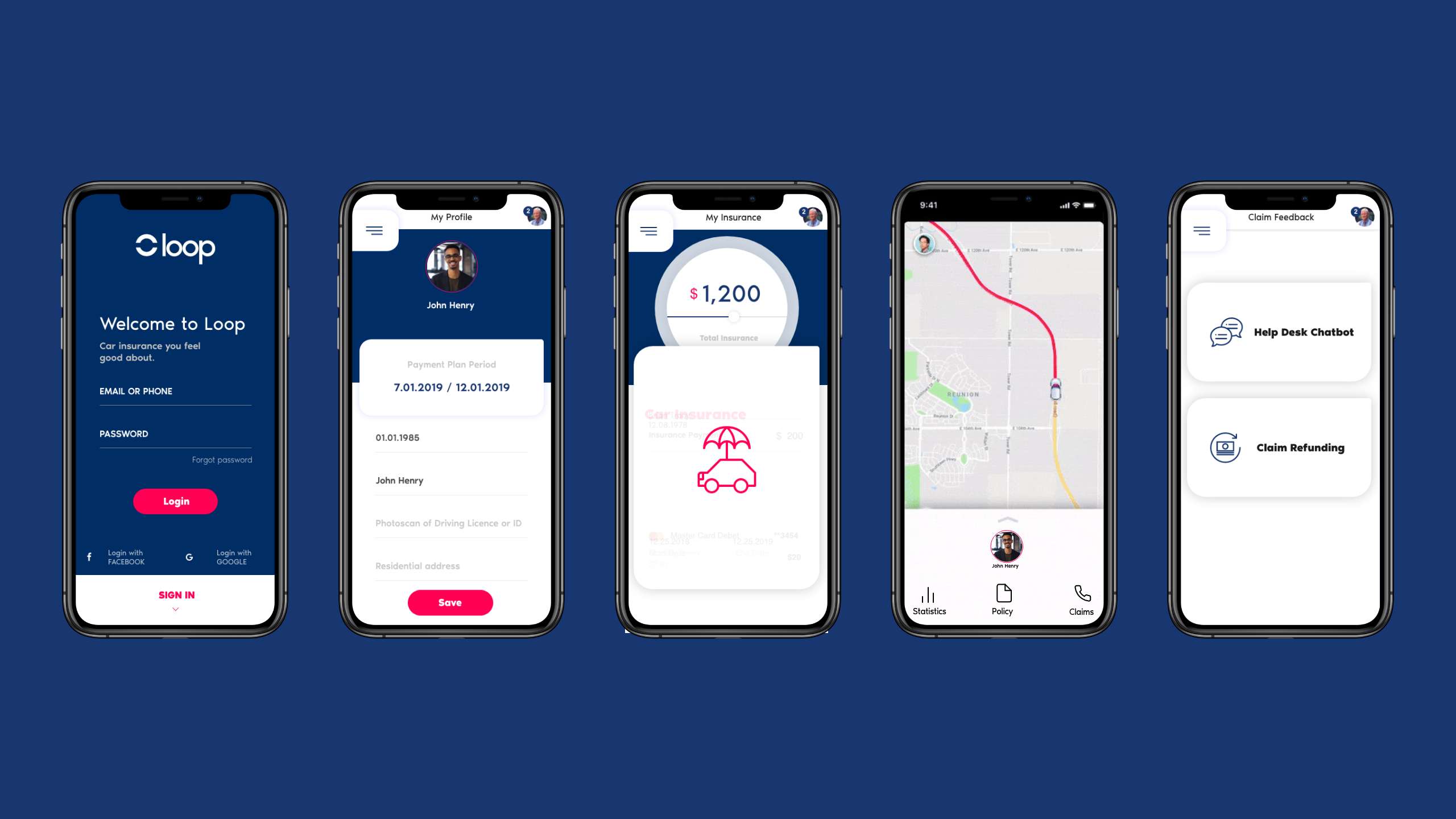
Image Credits: Loop

The other part of its business is based on telematics technology, which allows Loop to understand how and where a driver is going at all times. While legacy carriers might use lack of accidents to incentivize lower rates, Loop is using data to both set the rate and lower it.

Exchanging data for more flexibility could raise some eyebrows, but the co-founders think their customer-base, largely millennials and Gen Z, are comfortable with the model as it promises fairer prices. Loop makes a gross commission on every policy it sells.

Loop also pointed to Ohio-based Root Insurance as an example of how consumers are growing more comfortable with sharing location data. The car insurance startup went public in what many saw as a successful IPO for a midwestern high-growth tech company. Root similarly uses metrics like driver performance and history with telematics technology.

“They use telematics but they still are largely using legacy insurance models,” says Henry. “We’re kind of replacing that with our own AI based approach.”

Root might be the most obvious competitor, but usage-based pricing has been a rising dynamic in insurance for over a decade through various forms. Flexible insurtech has been on a tear recently, with MetroMile’s SPAC, Lemonade’s IPO and, on the early-stage front, Marshmallow, a U.K. based auto insurance startup last valued at $130 million.

The co-founders are confident that their technology is differentiated enough to survive the hot competition.

A racial reckoning and a tweet

The idea for the startup began in July 2020, when George Floyd, a Black man, was murdered by police. Protests erupted across the world, rallying for change and solutions to address systemic racism. VC firms rushed to support Black founders, and Henry saw a gap in solutions committed to change.

Henry tweeted in reaction:
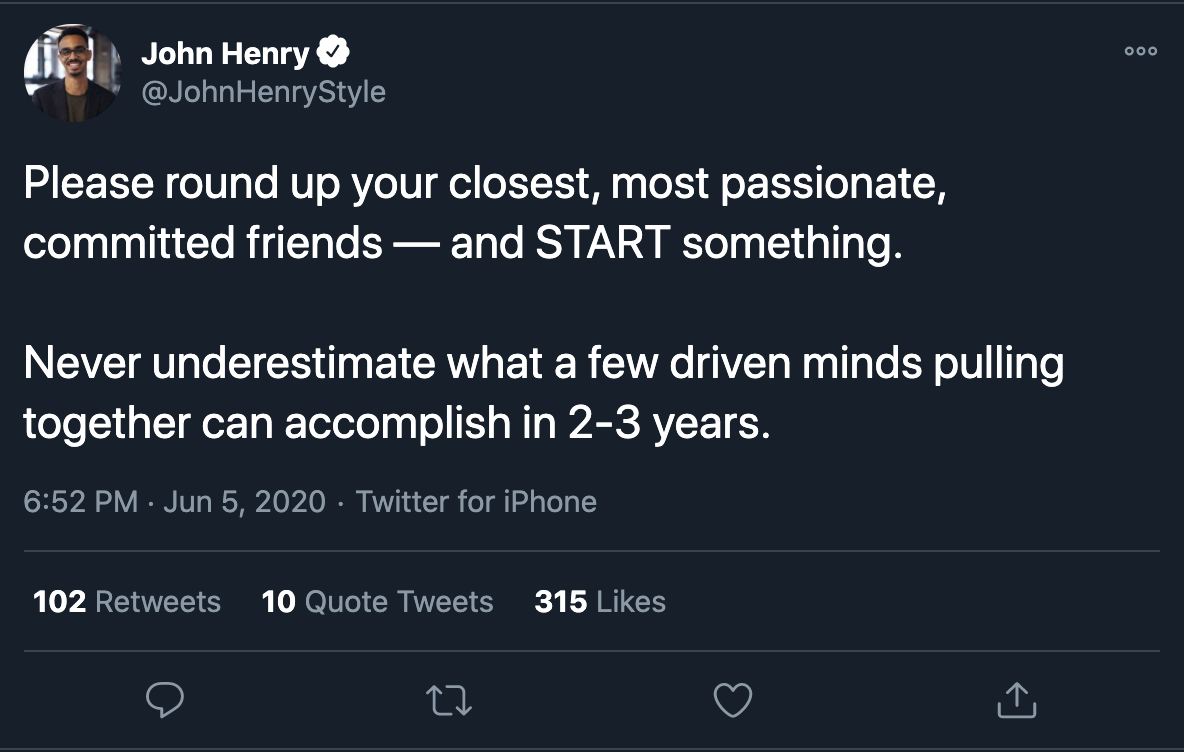
“It occurred to me that the change that we’re looking for was not gonna just bring itself about,” Henry said. “It takes intentional tackling of systemic issues.” He knew Nadeau had focused on transportation and mobility, and the duo eventually decided that they would “swing big.”

Carey Anne Nadeau and John Henry, the co-founders of Loop. Image Credits: Loop

While the co-founders admit the goal is ambitious, they have secured investors that think Loop could be a big business one day. The startup tells TechCrunch that it has raised a $3.25 million seed round led by Freestyle VC, with participation from Blue Fog Capital, Fontinalis Capital Partners, Concrete Rose, Uprising Ventures and Backstage Capital. Participating angel investors include Kristen Dickey, Steve Schlafman, Songe LaRon, Craig J. Lewis, Gerard Adams and Joshua Dorkin.

The money will be used for hiring and developing its data science infrastructure. It’s not live in the market yet, but is launching in Ohio, Illinois, Pennsylvania and New York (pending regulatory approval, of course).

The team met up with 77 investors, 25% of which were female investors, to get the funding needed to start Loop.

“It was more difficult than we thought,” said Henry. “We knew from the jump that we wanted to raise a larger seed round to signal to the market that we were looking to grow big.”

Loop eventually closed the goal round and valuation. As for the tipping point that got investors to back a company disrupting a $256 million industry with around $3 million in seed financing?

Mission, Henry says.

“I literally have goosebumps right now because the mission will open doors that profit cannot,” he said.

13 Jan 2021

Rho, a startup bank aimed at high-growth businesses, raises $15M Series A led by M13 Ventures

Rho Technologies, the NYC-based fintech behind Rho Business Banking, has raised a $15 million Series A round led by M13 Ventures with participation from Torch Capital, and Inspired Capital. The company will use the proceeds to further expand their commercial banking platform aimed at high-growth businesses, starting with today’s launch of Rho AP. The platform is oriented towards companies that need more autonomy in business banking and will map quite well to the current distributed nature of work, post-pandemic.

After raising capital and launching in December 2020, the platform now claims to be handling over $2 billion per year in annualized transaction volume for its clients. Rho AP expands on the core banking platform, by enabling companies to run full accounts payable lifecycles right within Rho, meaning invoices are uploaded, approved, coded, and paid – all within Rho. Companies no longer need another payables solution in addition to their bank account.

Rho’s platform approach consists of a single solution that encompasses both collaborative finance software and commercial-grade banking. It was founded by former Point72 and Deutsche Bank alum Everett Cook (CEO) and British-Canadian serial entrepreneur Alex Wheldon. Banking services are provided by Evolve Bank and Trust, member FDIC.

In a statement, Cook said: “At Rho, we are dedicated to empowering the teams that run today’s growing companies. We’ve developed the modern commercial banking platform built around the way companies operate today: distributed, team-oriented, transparent and built for scale. Rho AP is the next step on our mission to help teams work better together with money.”

Latif Peracha, General Partner at M13 and board member at Rho said: “We knew Rho had product-market fit when we discovered that several of our portfolio companies which span different sectors and sizes chose Rho for their banking needs. We believe there is an opportunity to build a powerful brand in business banking that treats the enterprise – and specifically, the CFO – as a consumer, and Rho has done that with a fully integrated product that makes managing a business much easier.”

Wheldon said: “Having built and scaled multiple businesses, I’d always found that commercial banking was a major point of friction. Rho is empowering the whole organization to work better together by removing the silos and bottlenecks associated with finance.”

13 Jan 2021

Rho, a startup bank aimed at high-growth businesses, raises $15M Series A led by M13 Ventures

Rho Technologies, the NYC-based fintech behind Rho Business Banking, has raised a $15 million Series A round led by M13 Ventures with participation from Torch Capital, and Inspired Capital. The company will use the proceeds to further expand their commercial banking platform aimed at high-growth businesses, starting with today’s launch of Rho AP. The platform is oriented towards companies that need more autonomy in business banking and will map quite well to the current distributed nature of work, post-pandemic.

After raising capital and launching in December 2020, the platform now claims to be handling over $2 billion per year in annualized transaction volume for its clients. Rho AP expands on the core banking platform, by enabling companies to run full accounts payable lifecycles right within Rho, meaning invoices are uploaded, approved, coded, and paid – all within Rho. Companies no longer need another payables solution in addition to their bank account.

Rho’s platform approach consists of a single solution that encompasses both collaborative finance software and commercial-grade banking. It was founded by former Point72 and Deutsche Bank alum Everett Cook (CEO) and British-Canadian serial entrepreneur Alex Wheldon. Banking services are provided by Evolve Bank and Trust, member FDIC.

In a statement, Cook said: “At Rho, we are dedicated to empowering the teams that run today’s growing companies. We’ve developed the modern commercial banking platform built around the way companies operate today: distributed, team-oriented, transparent and built for scale. Rho AP is the next step on our mission to help teams work better together with money.”

Latif Peracha, General Partner at M13 and board member at Rho said: “We knew Rho had product-market fit when we discovered that several of our portfolio companies which span different sectors and sizes chose Rho for their banking needs. We believe there is an opportunity to build a powerful brand in business banking that treats the enterprise – and specifically, the CFO – as a consumer, and Rho has done that with a fully integrated product that makes managing a business much easier.”

Wheldon said: “Having built and scaled multiple businesses, I’d always found that commercial banking was a major point of friction. Rho is empowering the whole organization to work better together by removing the silos and bottlenecks associated with finance.”

13 Jan 2021

Bryte raises $24m, pivots from selling $8k AI-powered mattresses to licensing its tech

Bryte today announced $24M in Series A funding led by ARCHina Capital. This comes as the company moves away from selling its $8,000 mattress direct to consumers and instead is working with partners who would utilize Bryte’s technology in their mattresses.

Bryte says several deals are in the works.

According to the company, this pivot has always been part of the plan. They feel that through licensing, they can better accomplish the company’s goal of improving people’s sleep experience. Bryte doesn’t want to become another direct to consumer brand, but rather the underlying technology in some of the best mattresses.

The company’s original product is still available to consumers. Called the Restorative Bed, the mattress has built-in sensors and 100 computer-controlled pneumatic coils that work with the platform as it learns the owners’ sleeping patterns and adjusts to best suit them — for both sleepers. Bryte says its technology enables better sleep patterns by adjusting the mattress through monitoring temperature, pressure points, and room environment.

The user selects several starting points for the mattress system. The system uses micro-adjustments to fine-tune the system to the sleeper. Each night’s sleep provides the mattress with more data points, which it uses to continually adjust the settings. The company says the greatest gains happen within 2-4 weeks and tend to reach an optimal level within 90 days.

With this funding round, the company is adding serious cash to its mission.

ARCHina Capital lead the $24M Series A funding round, with ARCHina’s Co-Founder Amy Huang joining Bryte’s board. The round also included investors John Warnock, co-founder of Adobe, and Dave Mooring, former President of Rambus.

13 Jan 2021

Bryte raises $24m, pivots from selling $8k AI-powered mattresses to licensing its tech

Bryte today announced $24M in Series A funding led by ARCHina Capital. This comes as the company moves away from selling its $8,000 mattress direct to consumers and instead is working with partners who would utilize Bryte’s technology in their mattresses.

Bryte says several deals are in the works.

According to the company, this pivot has always been part of the plan. They feel that through licensing, they can better accomplish the company’s goal of improving people’s sleep experience. Bryte doesn’t want to become another direct to consumer brand, but rather the underlying technology in some of the best mattresses.

The company’s original product is still available to consumers. Called the Restorative Bed, the mattress has built-in sensors and 100 computer-controlled pneumatic coils that work with the platform as it learns the owners’ sleeping patterns and adjusts to best suit them — for both sleepers. Bryte says its technology enables better sleep patterns by adjusting the mattress through monitoring temperature, pressure points, and room environment.

The user selects several starting points for the mattress system. The system uses micro-adjustments to fine-tune the system to the sleeper. Each night’s sleep provides the mattress with more data points, which it uses to continually adjust the settings. The company says the greatest gains happen within 2-4 weeks and tend to reach an optimal level within 90 days.

With this funding round, the company is adding serious cash to its mission.

ARCHina Capital lead the $24M Series A funding round, with ARCHina’s Co-Founder Amy Huang joining Bryte’s board. The round also included investors John Warnock, co-founder of Adobe, and Dave Mooring, former President of Rambus.

13 Jan 2021

Apple announces new projects related to its $100 million pledge for racial equity and justice

Last June, Apple committed $100 million to a Racial Equity and Justice Initiative (REJI). Lisa Jackson, Apple’s vice president of environment, policy and social initiatives, is leading the initiative. Today, Apple is sharing some of its work as part of the initiative.

“We’re launching REJI’s latest initiatives with partners across a broad range of industries and backgrounds — from students to teachers, developers to entrepreneurs, and community organizers to justice advocates — working together to empower communities that have borne the brunt of racism and discrimination for far too long. We are honored to help bring this vision to bear, and to match our words and actions to the values of equity and inclusion we have always prized at Apple,” Apple CEO Tim Cook said in a statement.

The company will contribute $25 million to the Propel Center, an innovation and leaning hub for Historically Black Colleges and Universities. It is going to be both a virtual platform and a physical campus in the Atlanta University Center. Apple is sharing some early renderings of the new building (see above and below).

Students will be able to follow different educational tracks focused on artificial intelligence, agricultural technologies, social justice, entertainment, app development, augmented reality, design and create arts and entrepreneurship. This isn’t just a monetary investment for Apple as employees will help develop curricula and provide mentorship as well. There will be internship opportunities for students.

In Downtown Detroit, the company will also open an Apple Developer Academy focused on young Black entrepreneurs. This is a collaborative effort with Michigan State University. It’ll be open to all learners across Detroit and teach valuable skills for entrepreneurs, creators and coders.

There will be two programs. A 30-day introductory program will help you learn more about app economy careers. And if you’re willing to dive deeper, there’s an intensive 10- to 12-month program. Apple is trying to reach 1,000 students per year with these two programs.

The third effort is focused on investment opportunities for Black and Brown entrepreneurs. Apple will invest $10 million with Harlem Capital, a VC firm based in New York. There will be more collaboration between Harlem Capital and Apple down the road.

Apple is also investing $25 million in Siebert Williams Shank’s Clear Vision Impact Fund. Finally, Apple is making a contribution to The King Center.

As you can see, Apple’s Racial Equity and Justice Initiative is an on-going effort that requires evaluating new opportunities constantly. The company isn’t just trying to give money to everyone. It is evaluating each opportunity individually to find the best collaboration.

Image Credits: Apple

13 Jan 2021

Rapyd raises $300M on a $2.5B valuation to boost its fintech-as-a-service API

A wave of organizations — propelled by global Covid-19 pandemic circumstances — are moving their commercial and financial interactions online, and today one of the big players helping to enable that shift is announcing a significant round of growth funding to expand the tools and services that provides to them.

Rapyd, which provides an API-based “fintech-as-a-service” platform covering payments, banking services, fraud protection and more, has raised $300 million, funding that CEO and co-founder Arik Shtilman said in an interview will be used to expand its team, build out more technology (next up: expanded fraud ID services and a wider marketplace), and to make selected acquisitions.

Rapyd’s customer base now numbers about 5,000 businesses, which includes marketplaces (labor marketplaces, and marketplaces for goods), e-commerce businesses, other kinds of lenders, and any business that might want to incorporate transactions or new financial services into their wider offerings. Shtilman said that at the moment, Rapyd is seeing its strongest growth yet, onboarding about 500 new customers each week.

The funding is coming at a $2.5 billion post-money valuation, Shtilman confirmed. (For some context on that, Rapyd was last valued at $1.2 billion in December 2019.)

The round is a Series D and is being led by prolific growth-round VC Coatue, with Spark Capital, Avid Ventures, FJ Labs, and Latitude (all new backers) and General Catalyst, Oak FT, Tiger Global, Target Global, Durable Capital, Tal Capital, and Entrée Capital (all previous backers) also participating. Other past investors, notably, include another major player in the world of API-based financial services, Stripe.

As with other companies in categories that have seen a huge surge of demand in the last year, financial services — and in particular those providing services to be able to carry out transactions online via the internet or phone — have proven to be some of the most mandatory and most used. (And no wonder, since bills still need paying, food and other items still need to be purchased, loans very much still need to be made, and so on.)

Notably, this was what many call and “opportunistic” raise, made not to keep the lights on or to extend runway, but because they money was being offered at good terms, and there were smart places where it could be put to use to grow the business.

“We didn’t plan to raise money when we raised this round, but when the pandemic came in our business started to boom,” Shtilman said. “We were approached by existing investors to scale beyond our original business plans after we completed our 2021 growth plans in three months in 2020. So we thought the timing was probably right for world domination.”

Shtilman was partly (only partly) joking — he has a sort of deadpan delivery that I can’t quite capture here — but it’s a far cry from the startup’s early days, when “no one wanted to invest because everyone thought it would be too hard to execute. Even our early investors advised us to focus on a smaller concept. But we thought building globally doesn’t work to start small it’s against the idea. Over the last several years the need to explain and what we do almost vanished.”

The challenge (and opportunity) that Rapyd identified back in 2017 when it first opened for business is that the global commerce and financial markets are very highly fragmented: consumers and businesses in individual markets have their own preferred payment methods and demands, regulations differ, and the key companies involved vary from country to country.

Meanwhile, APIs have long been a great instrument for integration and connection: using a few lines of code — and presuming your own services are built on code too — you can knit together services, and bring in commoditized functionality that would take ages to build from the ground up, cutting down the effort and work needed, to focus on making your core business more unique.

While companies like Stripe, Twilio and many others had identified the opportunity of leveraging APIs to scale out a world of functionality to a wider set of would-be customers, what Rapyd really identified and built out was the idea of loading not just one, two, or three services, but hundreds (even thousands) of features into that proposition. The idea is smart and, as Shtilman noted, very much in keeping with the economies of scale that exist in e-commerce and fintech: individual transactions are at the end of the day very incremental, so services that bring many together can finally start to conceive of interesting returns.

That, of course, is not just something Rapyd has identified and run with. That is to say, the company has a number of competitors now in the market. Just last week, Germany-based Mambu, which also provides an API-based suite of services (7,000 at last count) under the idea of “banking as a service” raised $135 million at a valuation of over $2 billion. Stripe, a backer of Rapyd, also has continued to expand and add in a number of services well beyond payments. Thought Machine also raised a big round last year; Temenos and Italy’s Edera are also strong players here. And the field has so much opportunity that it’s even attracting a lot of newer entrants: witness Unit, another interesting player that came out of stealth in the U.S. in December with an interesting list of backers of its own.

“To build infrastructure doesn’t matter whether you are small mom and pop or something bigger, you need many things, and if you want to sell in more the one jurisdiction you need a lot of those services,” Shtilman noted about the need for scale and breadth in a fintech platform proposition. He’s also very sanguine about competition. “They have emerged like mushrooms after the rain. But if you don’t have competition it means you don’t have a business so this is good. It means there is a lot of demand. But for now we are the market leader. We think we will become the AWS of this space.”

That’s where investors like Coatue are also landing for now.

“The payment landscape varies dramatically across countries. A company doing business globally might need to accept hundreds of local payment methods. Rapyd’s API, which abstracts away this complexity, is currently powering what we think are many of the world’s most exciting companies,” said Kris Fredrickson, Managing Partner at Coatue, in a statement. “We are honored to partner with Arik and team for the next phase of the Rapyd journey.”

13 Jan 2021

YouTube puts a temporary freeze on uploads to Trump’s channel

YouTube has been the slowest of the big social media platforms to react to the threat of letting president Trump continue to use its platform as a megaphone to whip up insurrection in the wake of the attack on the US capital last week. But it’s now applied a temporary upload ban.

In a short Twitter thread today, the Google-owned service said it had removed new content uploaded to Trump’s YouTube channel “in light of concerns about the ongoing potential violence”.

It also said it’s applied a first strike — triggering a temporary upload ban for at least seven days.

At the time of writing the verified Donald J Trump YouTube channel has some 2.78M subscribers.

“Given the ongoing concerns about violence, we will also be indefinitely disabling comments on President Trump’s channel, as we’ve done to other channels where there are safety concerns found in the comments section,” YouTube adds.

We reached out to YouTube with questions about the content that was removed and how it will determine whether to extend the ban on Trump’s ability to post to its platform beyond seven days.

A spokeswoman confirmed content that was uploaded to the channel on January 12 had been taken down for violating its policies on inciting violence, with the platform saying it perceiving an increased risk of violence in light of recent events and due to earlier remarks by Trump.

She did not confirm the specific content of the video that triggered the takedown and strike.

According to YouTube, platform is applying its standard ‘three strikes’ policy — whereby, within a 90 day period, if a channel receives three strikes it gets permanently suspended. Under this policy a first strike earns around a week’s suspension, a second strike earns around two weeks and a third strike triggers a termination of the channel.

At the time of writing, Trump’s official YouTube channel has a series of recent uploads — including five clips from a speech he gave at the Mexican border wall, where he lauded “successful” completion of the pledge during the 2016 election campaign to ‘build the wall’.

In one of these videos, entitled “President Trump addresses the events of last week”, Trump characterizes supporters who attacked the US capital as a “mob” — and claims his administration “believes in the rule of law, not in violence or rioting” — before segueing into a series of rambling comments about the pandemic and vaccine development.

The clip ends with an entreaty by Trump for “our nation to heal”, for “peace and for calm”, and for respect for law enforcement — with the president claiming people who work in law enforcement form the backbone of the “MAGA agenda”.

An earlier clip of Trump speaking to reporters before he left for the tour of the border wall is also still viewable on the channel.

In it the president attacks the process to impeach him a second time as “a continuation of the greatest witch-hunt in the history of politics”. Here Trump name-checks Nancy Pelosi and Chuck Schumer — in what sounds like a veiled but targeted threat.

“[For them] to continue on this path, I think it’s causing tremendous danger to our country and it’s causing tremendous anger,” he says, before tossing a final caveat at reporters that “I want no violence”. (But, well, if you have to add such a disclaimer what does that say about the sentiments you know you’re whipping up?)

While YouTube has opted for a temporary freeze on Trump’s megaphone, Twitter banned the president for good last week after one too many violations of its civic integrity policy.

Facebook has also imposed what it describes as an “indefinite” suspension — leaving open the possibility that it could in future restore Trump’s ability to use its tools to raise hell.

Up to now, YouTube has managed to avoid being the primary target of ire for those criticizing social media platforms for providing Trump with a carve out from their rules of conduct and a mainstream platform to abuse, bully, lie and (most recently) whip up insurrection.

However the temporary freeze on his account comes after civil rights groups had threatened to organize an advertiser boycott of its platform.

Per Reuters, the Stop Hate for Profit (SHP) campaign — which previously led a major advertisers boycott of Facebook last summer — had demanded that YouTube take down Trump’s verified channel.

“If YouTube does not agree with us and join the other platforms in banning Trump, we’re going to go to the advertisers,” one of SHP’s organizers, Jim Steyer, told the news agency.

In its official comments about the enforcement action against president Trump, YouTube makes no mention of any concern about ramifications from its own advertisers. Though, in recent years, it has faced some earlier boycotts from advertisers over hateful and offensive content.

In background remarks to reporters, YouTube also claims it consistently enforces its policies, regardless of who owns the channel — and says it makes no exceptions for public figures. However the platform has been known to reverse a three strike termination — recently reinstating the channel of UK broadcaster TalkRadio, for example, after it received a third strike related to coronavirus misinformation.

In that case the channel’s reinstatement was reported to have followed an intervention by TalkRadio’s owner News Corp’s chairman, Rupert Murdoch. UK ministers had also defended the channel’s right to debate the merits of government policy.

In Trump’s case there are a dwindling number of (GOP) politicians willing to ride to his defense in light of the shocking events in Washington last week and continued violent threats being made online by his supporters.

However concern about the massive market power of tech platforms — meaning they are in a position to be able to take unilateral action and shut down the US president’s ability to broadcast to millions of people — is far more widespread.

Earlier this week Germany’s chancellor, Angela Merkel, called Twitter’s ban on Trump “problematic”, while lawmakers elsewhere in Europe have said it must lead to regulatory consequences for big tech.

So whatever his wider legacy, Trump certainly looks set to have a lasting policy impact on the tech giants he is now busy railing at for putting him on mute.

13 Jan 2021

TikTok update will change privacy settings and defaults for users under 18

TikTok announced today it’s making changes to its app to make the experience safer for younger users. The company will now set the accounts for users ages 13 to 15 to private by default, as well as tighten other controls for all users under 18, in terms of how they can interact with other users and TikTok content itself. TikTok is also announcing a partnership with nonprofit Common Sense Networks, an education and advocacy group that helps parents and educators navigate today’s media landscape, including children’s use of technology.

The partnership will see Common Sense Networks working with TikTok to provide additional guidance on the appropriateness of its content for users under 13.

The social video app in 2019 had been fined $5.7 million by the Federal Trade Commission (FTC) for violating U.S. children’s privacy laws. The FTC had begun looking into the app back when it was known as Musical.ly. The earlier version, prior to its acquisition by ByteDance, had collected personal information for children under 13 without parents’ consent.

As a result of that ruling, TikTok created a new, legally compliant experience for younger users in the U.S. with age-appropriate content and no ability to publish videos.

Now, TikTok will restrict the experience for other minors using the app who are over 13, too.

For children ages 13 to 15, accounts will be set to private by default and TikTok will turn the setting “Suggest your account to others” to Off. This will allow users’ videos to only be seen by those they approve as a follower and limits their account from being recommended to others elsewhere in the app.

Commenting controls are also being locked down for these users.

They’ll now be able to choose between “Friends” or “No One” in terms of who can comment on their videos, and the “Everyone” option will be removed. The Dueting and Stitching features will also be removed, which limits how these younger users can engage with other TikTok users and their content. They won’t be able to make their videos downloadable either.

For those ages 16 to 17, the default setting for Duet and Stitch will be set to “Friends,” and they’ll only be able to download videos created by users 16 and over as a result of the lockdowns for younger users. Downloads for their own videos will also be set to Off by default, but they can enable this, if they choose.

TiTok had already restricted younger users’ accounts before today in various ways, including not only through the under-13 age gated experience, but also by restricting direct messaging and hosting live streams to accounts 16 and over, and restricting virtual gifts to users over 18. Parents additionally have had the option to control their child’s experience through the Family Pairing feature, which offers parental controls and screen time limits, among other things.

Of course, any of these restrictions can be worked around for those who lie about their age upon sign-up. But it’s still fairly unusual for a large social network to do more than look the other way when it knows that minors are on its app.

In TikTok’s case, however, it has a large underage user base — some estimates had said that 41% of TikTok is between ages 16 and 24. But in the U.S., TikTok has attracted a particularly large teenage userbase. The company said in 2020 that 60% of its 26.5 million monthly active users in the U.S. were between 16 and 24. Even some of TikTok’s biggest stars, like Charli D’Amelio, are still just teenagers.

The attention to minor safety and parental controls gathered TikTok praise from notable youth safety experts, which the company also shared.

Today, TikTok is touting praise it’s received from the National PTA, ConnectSafely, NCMEC, Family Online Safety Institute, and WeProtect Global Alliance. The groups believe the changes will help teens be able to use the app more safely, responsibility, and without the further risk of exploitation.

“We couldn’t be more pleased about partnering with TikTok to develop better content experiences for users under the age of 13,” added Eric Berger, CEO of Common Sense Networks, in reference to his organization’s partnership with the social video platfrom. “At Common Sense Networks, we see this engagement as an opportunity to double down on our commitment to elevate the quality of children’s digital media so that age-appropriate content is the rule in our industry and not the exception,” he said.

The changes will roll out starting today.


13 Jan 2021

Amazon launches mobile-only Prime Video subscription in India

Amazon is doubling down on one of the biggest strengths of Prime Video streaming service: Aggressive pricing.

The e-commerce giant on Wednesday announced Prime Video Mobile Edition, an even more affordable tier of the on-demand video streaming service — now also bundling additional perks.

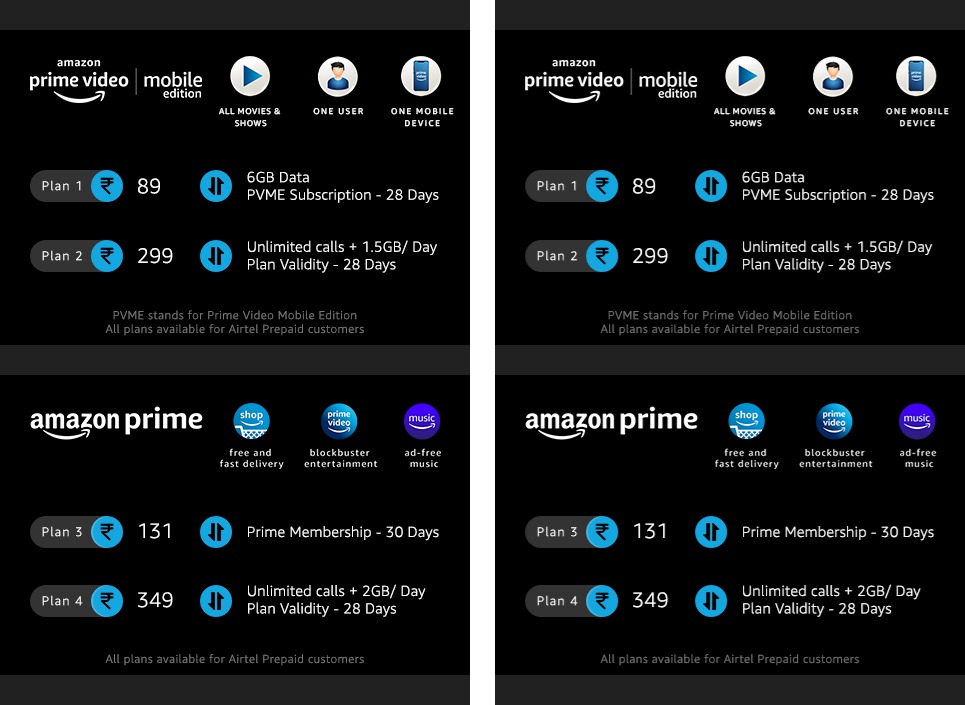
The Prime Video Mobile Edition, for which Amazon has partnered with Indian telecom network Airtel, will feature 28-day mobile-only, standard definition (SD) access to customers in India for Rs 89 ($1.22). This tier will also include 6GB of mobile data for the period to the customers.

There are several more pricing options available.

The service is currently only available in India. Its launch comes years after Netflix made available a similar plan in India.

“India is one of our fastest growing territories in the world with very high engagement rates. Buoyed by this response, we want to double-down by offering our much-loved entertainment content to an even larger base of Indian customers. Given high mobile broadband penetration in the country, the mobile phone has become one of the most widely used streaming devices,” said Jay Marine, Vice President, Amazon Prime Video Worldwide, in a statement.

More to follow…