Year: 2021

13 Jan 2021

Winnoz’s vacuum-assisted Haiim makes finger prick blood draws more efficient

Winnoz’s Haiim is designed to make collecting blood from fingertips easier, increasing the volume drawn so it can be used for more types of tests. The New Taipei City, Taiwan-based company’s vacuum-assisted device can collect up to 150 to 500 microliters of blood from a finger prick, depending on the person, in about two minutes.

Winnoz is currently presenting Haiim and eGGi, its molecular detection device that supports isothermal DNA/RNA amplification methods, at CES’ Taiwan Tech Arena pavilion, with the goal of finding new partners and investors.

Haiim was inspired by founder and chief executive officer Joses Hsiung’s childhood memories of watching his mother go into clinics for regular blood testing. Since his mother’s veins were hard to see, it often took multiple punctures for phlebotomists to draw enough blood. Eventually, her veins collapsed. Hsiung began working on the device to maximize the amount of blood that can be taken from finger pricks.

While finger blood draws are typically used for tests that require less than 10 microliters of blood, like glucose monitoring or cholesterol panel, Haiim can draw enough for ones that need a larger volume, potentially helping patients avoid venipuncture blood draws.

The device consists of two parts, the main unit and single-use cartridges that stores the blood until it is tested. Since many clinics and hospitals are understaffed, it is designed so personnel can start using it with less training than traditional blood collection methods. Haiim was approved by the Taiwan Food and Drug Administration in 2019 and is intended for use by health care organizations, clinics and hospitals.

13 Jan 2021

Business trip platform TravelPerk buys YC-backed rival NexTravel

Barcelona-based TravelPerk has scooped up US-based rival NexTravel as the pandemic drives consolidation in one of the sector’s hardest hit by COVID-19.

It’s not disclosing how much it’s shelling out for NexTravel, which has some 700 customers globally and has processed around 300,000 trips since being founded back in 2013, but says the deal is its largest acquisition to date — with the aim of beefing up its business in the US. (Also today it’s announcing a partnership with Southwest Airlines that plugs a key gap in its US offering.)

The US has always been a top five market for TravelPerk, per CEO and co-founder, Avi Meir, but after the NexTravel acquisition it becomes its largest market.

“US customers, US know-how, [US-based] team,” he said, listing the drivers for the acquisition. “They’ve built an amazing product. It’s a Y Combinator company who started 2-3 years before us and they focused only or mostly on the US market so they have an expertise that is very complementary to what we’re doing.”

Meir confirmed NexTravel’s founders and team are joining TravelPerk as part of the deal. Existing customers include the likes of Yelp, Stripe and Harry’s.

“They’re a great company. I really think we have great execution and we got into the crisis with a much better cash position and COVID-19 is creating opportunities that didn’t exist before,” he added. “We had friendly competition and just the context of the situation was we were in a better position to acquire them vs them acquiring us.”

The plan is to migrate users of the US product onto TravelPerk’s platform over time but Meir said the NexTravel team will continue to support the product for the foreseeable future while it works on understanding and plugging any functionality gaps with the aim of ensuring a smooth, eventual transition for NexTravel customers in the future.

The acquisition is only TravelPerk’s second after it picked up risk management startup Albatross last summer — underlining how the coronavirus crisis is retooling priorities for businesses in the travel sector.

Or at least those that have enough funding to see them through the revenue crunch. And Meir confirmed TravelPerk has its eye on more acquisition targets.

“We are in the process of talking with a few more [potential acquisitions],” he said, adding: “In a moment of crisis consolidation typically happens so I think it’s fair to expect more of this.”

While a couple of years ahead of TravelPerk in starting up a business travel booking business, NexTravel has raised considerably less over its run — pulling in circa $4.5M in funding, according to Crunchbase.

The younger Spain-based startup, meanwhile, grew faster and has raised orders of magnitude more (~$134M to date) — including a $60M top-up to its Series C in 2019 when it was reporting 2,000 customers globally.

“We just happen to be in Europe,” Meir told TechCrunch, discussing how his European startup is in a position to buy a US rival (when the reverse is all too often the case in tech) — and pointing to knowledge of how to localize as a key advantage. “We were never targeting the Spanish market exclusively or not even the European market.

“To win in business travel, one of the paradoxes is you have to build a very localized product… So we never saw ourselves as a European business we just recognize that we have to really localize deeply in order to be successful anywhere. But we have to do it across the world. So this acquisition is just another step in localizing for the US.”

“[The acquisition] will obviously drive a lot of product development, of commercial investments, of partnerships,” he added. “In a way we’re doing it knowing that it will force us to do more of the US — so it’s kind of a self-fulfilling prophesy — but it’s a $300BN business travel market so we should better make some moves around it.”

With the pandemic continuing to ravage much of the globe — including both the US and Europe — there’s likely to be considerably fewer billions of dollars on business travel value up for grabbed for a sizeable chunk of 2021. And Meir confirmed that TravelPerk isn’t expecting to see a revival in the market before the second half of this year.

Nonetheless, he remains bullish that once vaccinations are rolled out to the most vulnerable groups in society business travellers will be on the move once again — predicting that Zoom fatigue and the boom in remote working will rekindle demand for face-to-face human contact.

“My best guess right now is everything converges to around the second half of this year — around May-June maybe — where seasonality should hopefully hit. Meaning we’ll see the same decline in hospitalizations and deaths as we saw last year. That’s my hope,” he predicted. “On top of that we have the vaccines… Within the next 4-5 months there is reason to expect that we’ll see [vaccine rollouts] accelerating and then everything converges. We just need the at risk population to be safe for the world to be open again.”

“It doesn’t mean we’ll be completely done with corona but it won’t be as deadly as it is now so we’ll be able to open up more and remove restrictions and see travel coming back again,” he added.

Pressed on whether businesses might not have adjusted to a new, ‘more digital’ normal after 1.5 years of living with COVID-19 — having come to rely on a suite of videoconferencing and virtual meeting tools — Meir quashes the idea of a smaller business travel market replacing the pre-pandemic industry, predicting a “roaring ’20s” revival for business travel instead, fuelled by “Zoom fatigue” and networking FOMO once social distancing restrictions can be lifted.

“If you still own any Zoom shares you should sell them!” he quipped, speaking via Zoom call (obviously). “This is going down from now. Everybody is tired of this. The Zoom fatigue is real. It creates a lot of mental health concerns, social isolation… Maslow’s Pyramid of Needs is still here, and it’s even stronger than ever, I think, because we realize how bad it is when we don’t meet people in real life. When everything has to be through this weird, proxy to human connection. The virus doesn’t change human nature. We still need to meet each other face to face.”

“The first sales person who’s going to lose a sale because the competition went and took the customer to dinner and they wanted to do it via Zoom, they’re on a plane the next day. So competition will solve it — even if we put aside human nature,” he added. “I think we all recognize even more how much we need human connection.”

So even if some some “transactional meetings” do move permanently to Zoom, as Meir conceded “maybe” happens, he said they’re not the primary driver for the bulk of business travel anyway.

Furthermore, the pandemic will create new demand for business travel because of the boom in remote working creating ongoing need for distributed colleagues to travel to meet each other face to face, with Meir arguing that more flexible working is certainly here to stay.

“My team, like many other teams, used to be all in Barcelona in the same building — and now we allow them to work from anywhere in the world. Because why not? Many companies will stick to that I think,” he said. “We have recognized that people like it, the employees like it and it’s cheaper, because you don’t have to have as much office real estate — and people are more productive and they’re happier and they have a better balance between their personal and work life.

“So this requires a new type of travel because… you have to bring [your team] together for a week of work together. So I think the small decline in business travel due to this one hour transactional call that you can move to Zoom will be compensated even more — increased by — this new way of working that requires a new type of business travel.”

While TravelPerk was fortunate enough to go into the pandemic well-capitalized, having topped up its Series C in 2019, investor interest in travel startups undoubtedly went on holiday for a considerable chunk of last year. But, again, Meir suggests, an uptick on that front.

“We don’t need to raise any time soon — we have enough cash. The expectation is for the business to go back to growing year on year sometime in Q3, Q4 of this year,” he told us. “Having said that, what’s interesting — and I don’t know if I’m the only one — is we went from [being a fast-growing company] and you get a lot of inbound from investors and then COVID-19 hit and my inbox was empty for a while.

“It was pretty sad, pretty pathetic. And then the last few weeks — since the beginning of the school year — September/October, my inbox is not empty anymore. So there is some movement in the market. There’s a lot of money looking for a home — for good investments. And I think even in an industry which is suffering obviously, the good companies can raise at good terms right now. So I’m not looking to raise but I’m always open to the opportunity.”

13 Jan 2021

App stores saw record 218 billion downloads in 2020, consumer spend of $143 billion

Mobile adoption continued to grow in 2020, in part due to the market forces of the COVID-19 pandemic. According to App Annie’s annual “State of Mobile” industry report, mobile app downloads grew by 7% year-over-year to a record 218 billion in 2020. Meanwhile, consumer spending grew by 20% to also hit a new milestone of $143 billion, led by markets that included China, the United States, Japan, South Korea and the United Kingdom.

Consumers also spent 3.5 trillion minutes using apps on Android devices alone, the report found.
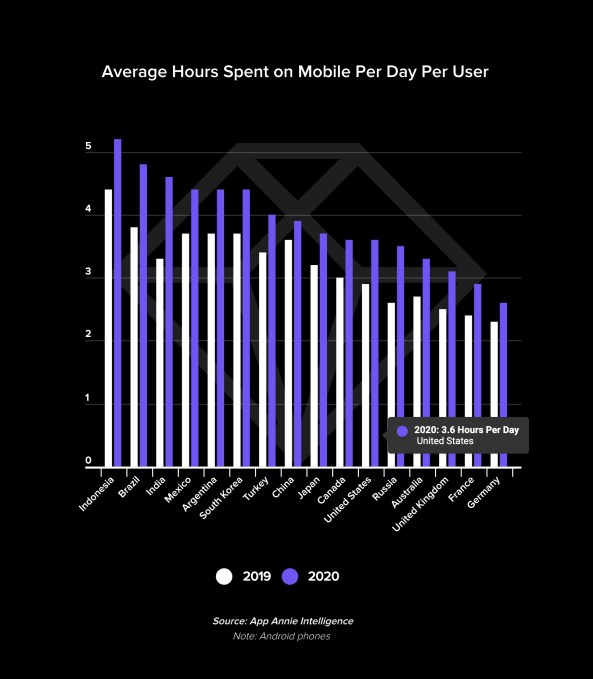
In another shift, app usage in the U.S. surged ahead of the time spent watching live TV. Currently, the average American watches 3.7 hours of live TV per day, but now spends four hours on their mobile device.

The increase in time spent is a trend that’s not unique to the U.S., but can be seen across several other countries, including both developing mobile markets like Indonesia, Brazil and India, as well as places like China, Japan, South Korea, the U.K., Germany, France and others.

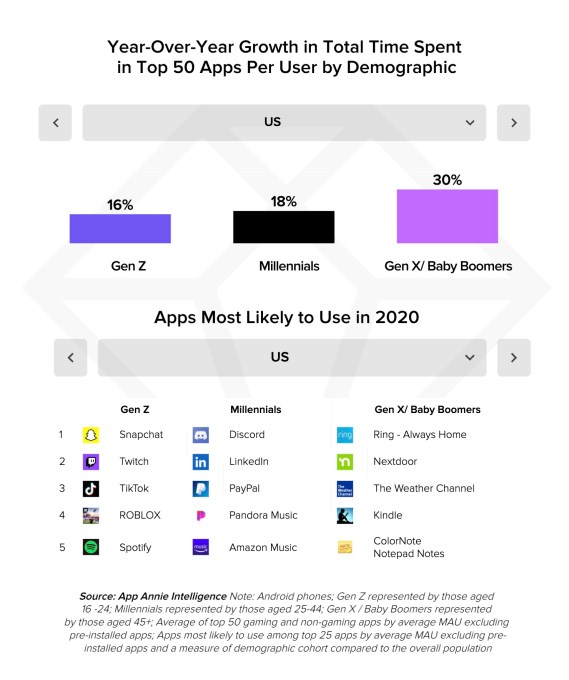
The trend isn’t isolated to any one demographic, either, but is seen across age groups. In the U.S., for example, Gen Z, millennials and Gen X/Baby Boomers spent 16%, 18% and 30% more time in their most-used apps year-over-year, respectively. However, what those favorite apps looked like was very different.

For Gen Z in the U.S., top apps on Android phones included Snapchat, Twitch, TikTok, Roblox and Spotify.

Millennials favored Discord, LinkedIn, PayPal, Pandora and Amazon Music.

And Gen X/Baby Boomers used Ring, Nextdoor, The Weather Channel, Kindle and ColorNote Notepad Notes.
The pandemic didn’t necessarily change how consumers were using apps in 2020, but rather accelerated mobile adoption by two to three years’ time, the report found.

Investors were also eager to fuel mobile businesses as a result, pouring $73 billion in capital into mobile companies — a figure that’s up 27% year-over-year. According to Crunchbase data, 26% of total global funding dollars in 2020 went to businesses that included a mobile solution.
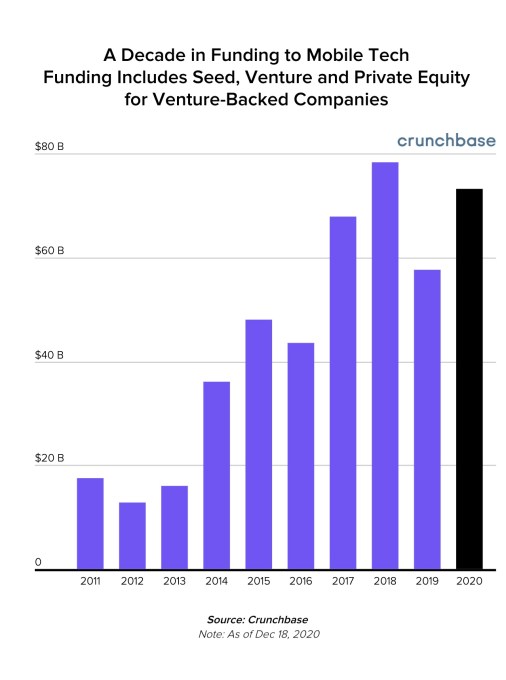
From 2016 to 2020, global funding to mobile technology companies more than doubled compared with the previous five years, and was led by financial services, transportation, commerce and shopping.

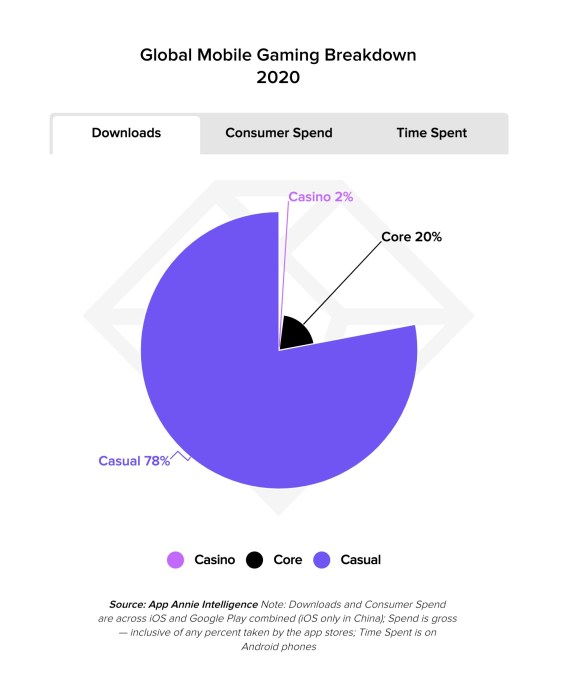
Mobile gaming adoption also continued to grow in 2020. Casual games dominated the market in terms of downloads (78%), but Core games accounted for 66% of games’ consumer spend and 55% of the time spent.

With many stuck inside due to COVID-19 lockdowns and quarantines, mobile games that offered social interaction boomed. Among Us, for example, became a breakout game in several markets in 2020, including the U.S.
Other app categories saw sizable increases over the past year, as well.

Time spent in Finance apps in 2020 was up 45% worldwide, outside of China, and participation in the stock market grew 55% on mobile, thanks to apps like Robinhood in the U.S. and others worldwide, that democratized investing and trading.

TikTok had a big year, too.
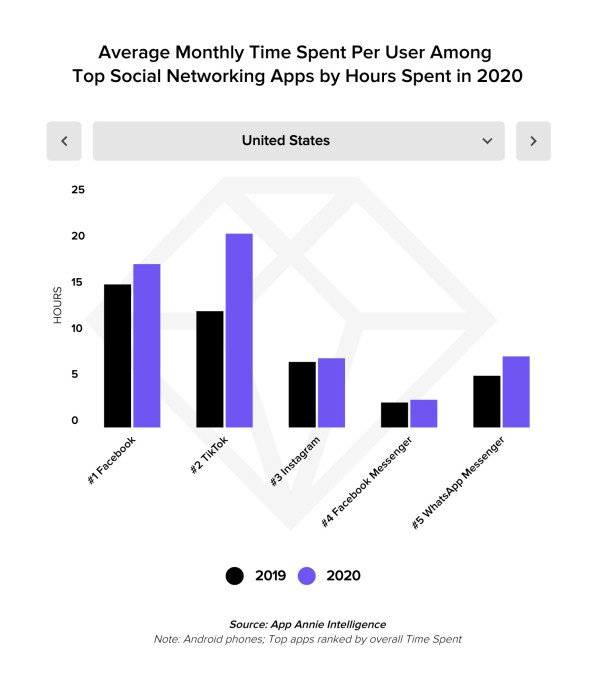
The app saw incredible 325% year-over-year growth, despite a ban in India, and ranked in the top five apps by time spent. The average monthly time spent per user also grew faster than nearly every other app analyzed, including 65% in the U.S. and 80% in the U.K., surpassing Facebook. TikTok is now on track to hit 1.2 billion active users in 2021, App Annie forecasts.

Other video services boomed in 2020, thanks to a combination of new market entrants and a lot of time spent at home. Consumers spent 40% more hours streaming on mobile devices, with time spent in streaming apps peaking in the second quarter in the west as the pandemic forced people inside.
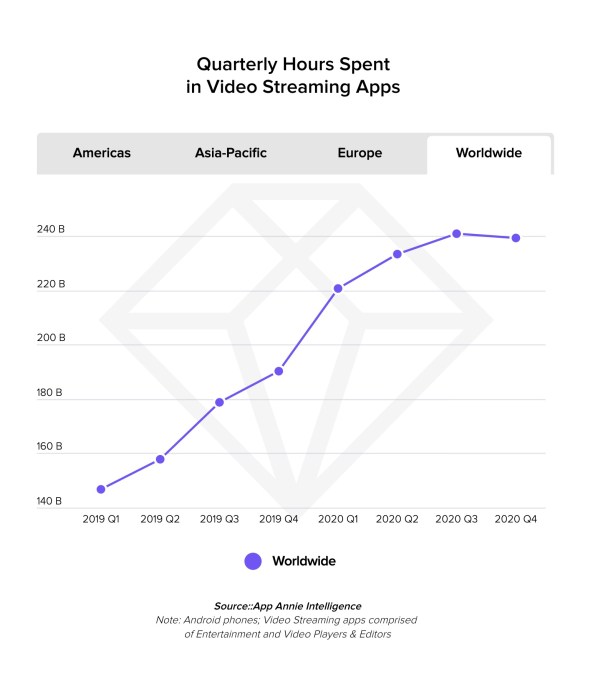
YouTube benefitted from this trend, as it became the No. 1 streaming app by time spent among all markets analyzed except China. The time spent in YouTube is up to 6x that of the next closet app at 38 hours per month.

Of course, another big story for 2020 was the rise of e-commerce amid the pandemic. This made the past year the biggest ever for mobile shopping, with an over 30% increase in time spent in Shopping apps, as measured on Android phones outside of China.
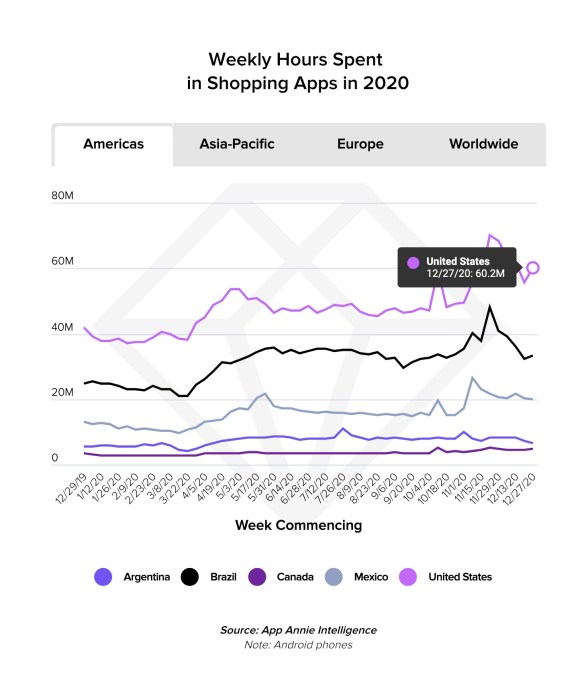
Mobile commerce, however, looked less traditional in 2020.

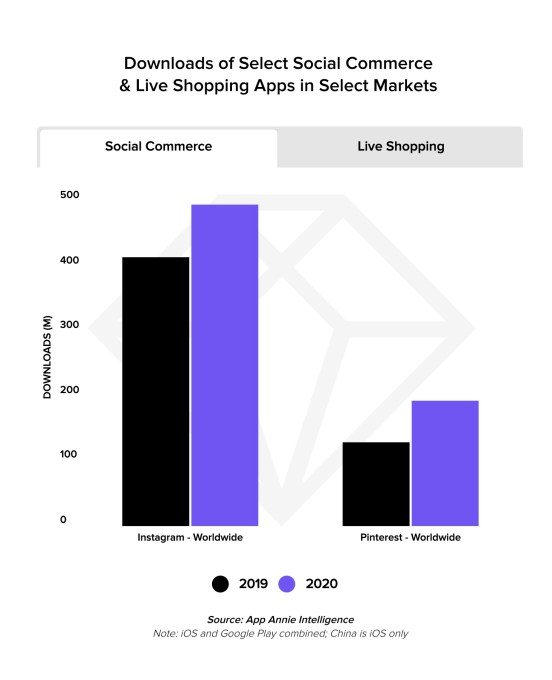
Social shopping was a big trend, with global downloads of Pinterest and Instagram growing 50% and 20% year-over-year, respectively.
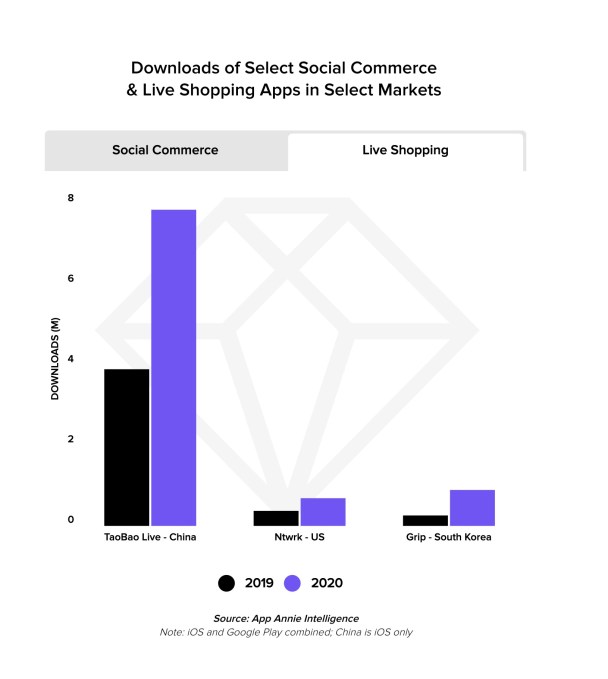
Livestreaming shopping grew, too, led by China. Downloads of live shopping TaoBao Live in China, Grip in South Korea and NTWRK in the U.S. grew 100%, 245% and 85%, respectively. NTWRK doubled in size last year, and now others are entering the space as well — including TikTok, to some extent.
The pandemic also prompted increased usage of mobile ordering apps. In the U.S., Argentina, the U.K., Indonesia and Russia, the app grew by 60%, 65%, 70%, 80% and 105%, respectively, in Q4.

Business apps, like Zoom and Google Meet among others, grew 275% in Q4, for example, as remote work and sometimes school, continued.

The analysis additionally included lists of the top apps by downloads, spending and monthly active users (MAUs).
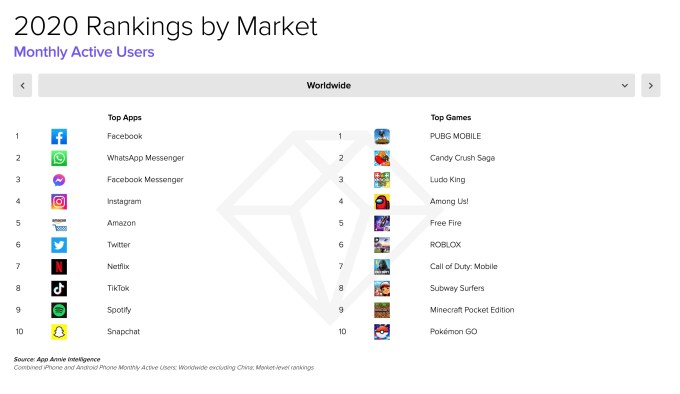
Although TikTok had been topping year-end charts, Facebook continued to beat it in terms of MAUs. Facebook-owned apps controlled the top charts by MAUs, with Facebook at No. 1 followed by WhatsApp, Messenger and Instagram.
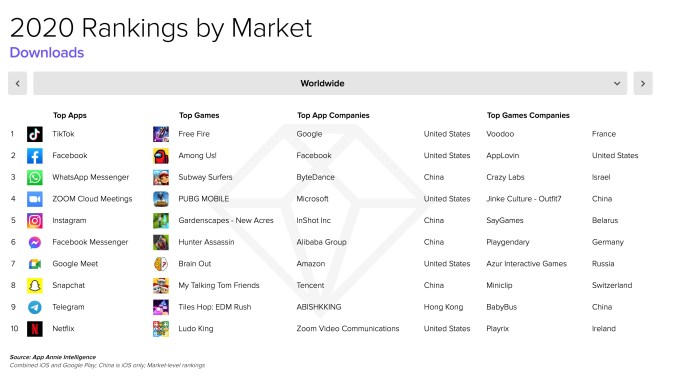
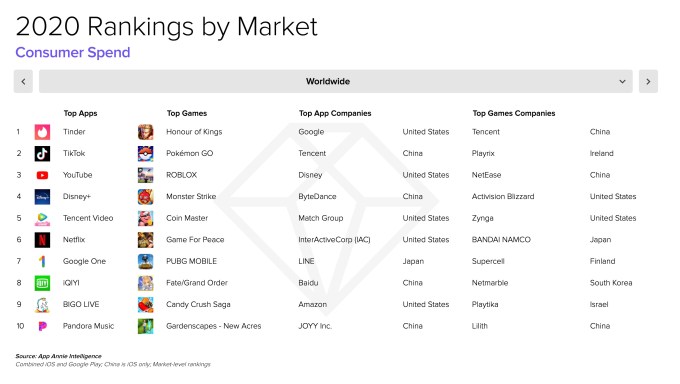
TikTok, however, had more downloads than Facebook and ranked No. 2 by consumer spending, behind Tinder.

The full report is available only as an online interactive experience this year, not a download. The report largely uses data from both the iOS App Store and Google Play, except where otherwise noted.


13 Jan 2021

Amazon makes education push in India with JEE preparation app

Amazon on Wednesday launched Amazon Academy, a service that will aim to help students in India prepare for entry into the nation’s prestigious engineering college. The e-commerce giant is the latest entrant to this market, where scores of startups and institutes have launched digital offering to serve students.

The e-commerce giant said Amazon Academy will help students with in-depth knowledge and practice routines required for the Joint Entrance Examinations (JEE) through curated learning material, live lectures and comprehensive assessments in Math, Physics and Chemistry.

Amazon began testing Amazon Academy, previously known as JEE Ready, in India in mid-2019. Amazon Academy, available to download from Google Play Store and App Store, is free and will remain so for the “next few months,” the company said.

“Amazon Academy aims to bring high quality, affordable education to all, starting with those preparing for engineering entrance examinations. Our mission is to help students achieve their outcomes while also empowering educators and content partners reach millions of students. Our primary focus has been on content quality, deep learning analytics and student experience. This launch will help engineering aspirants prepare better and achieve the winning edge in JEE,” said Amol Gurwara, Director, Education at Amazon India, in a statement.

More to follow…

13 Jan 2021

Chinese facial recognition unicorn Megvii prepares China IPO

Megvii, one of China’s largest facial recognition startups, is gearing up for an initial public offering in Shanghai. The company is working with CITIC Securities to prepare for its planned listing, according to an announcement posted by the China Securities Regulatory Commission on Tuesday.

The move came more than a year after Megvii, known for its computer vision platform Face++, filed to go public in Hong Kong in August 2019. At the time, Reuters reported that the company could raise between $500 million and $1 billion. However, the firm’s IPO application in Hong Kong has lapsed for undisclosed reasons and its focus is now on Shanghai’s STAR board, a person with knowledge of the matter told TechCrunch.

In 2019, China established the STAR board to attract high-growth, unprofitable Chinese tech startups after losing them to the U.S. for years. In the meantime, a domestic flotation is increasingly appealing to Chinese tech firms, especially those that count on government contracts and are caught in the U.S.-China tech competition.

Megvii and its rivals SenseTime, Yitu, and CloudWalk are collectively recognized as the “Four AI Dragons” of China for their market dominance and fundings from highflying investors. Megvii’s technology can be found powering smart city infrastructure across China as well as many smartphones and mobile apps. Alibaba, Ant Group and the Bank of China are among the group of investors who have pumped about $1.4 billion into the ten-year-old company since its inception.

The AI Dragons are less celebrated outside their home market. Last year, Megvii, Yitu and SenseTime were added to the U.S. Entity List for their alleged roles in enabling mass surveillance of the Muslim minority groups in western China. CloudWalk was subsequently added to the blacklist in 2020 and cut off from its U.S. suppliers.

According to the notice posted by China’s securities authority, Megvii plans to issue Chinese depositary receipts (CDRs), which are similar to American depositary receipts and allow domestic investors to hold overseas shares. That suggests the Beijing-based AI unicorn has not ruled out listing outside mainland China.

Currently seeking guidance in the pre-application stage, Megvii’s planned listing still needs approval from Chinese regulators.

13 Jan 2021

Molotov starts its international expansion with seven African countries

French startup Molotov provides an OTT TV streaming service in France with live TV, premium channels, a cloud DVR and on-demand content. While the service has managed to attract 13 million users in France, it has yet to expand to other countries.

Molotov is starting its international expansion this year with a dozen countries on the roadmap. First, the service will be available in seven African countries, starting with Ivory Coast where it’s already live, Senegal in January, Cameroon in February, Burkina Faso in March, Tunisia in April, Guinea and Democratic Republic of Congo after that.

“When it comes to features, the service is more or less the same but content is different,” co-founder and CEO Jean-David Blanc told me. Molotov is betting on local partnerships to launch its service in new countries.

In today’s case, Molotov is partnering with Digital Virgo, a mobile payments company available in 40 countries. Digital Virgo is handling the relationships with local content owners. Molotov is taking care of operations and the tech stack.

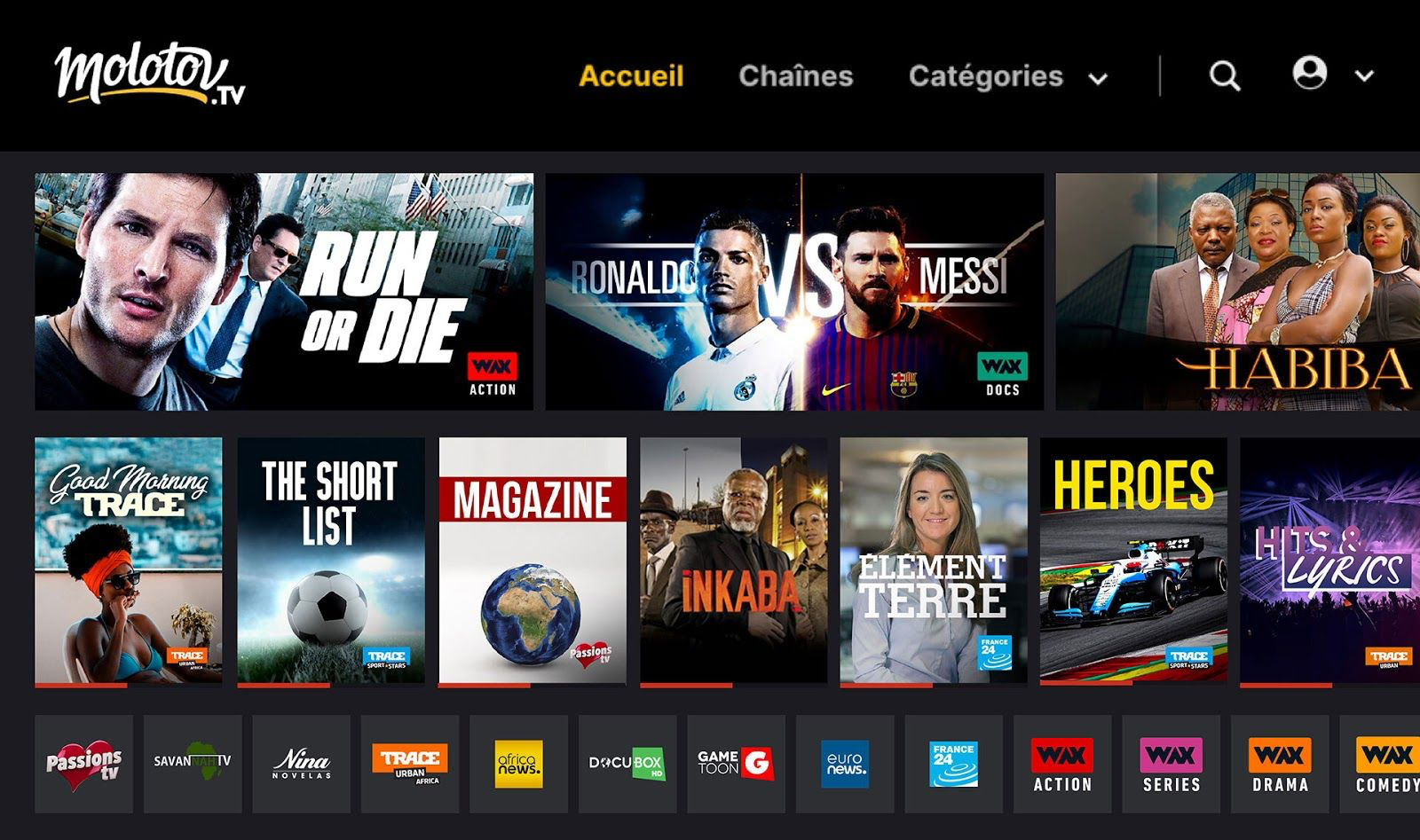
There will be 15 channels at launch, such as Nina TV, Passions TV, Trace Urban, Trace Africa, Trace Urban Africa, Savannah TV, Gametoon, Africanews, Euronews, France24, Trace Sport Stars and DocuBox. Molotov will also grant access to its ad-supported on-demand streaming service Mango.

Image Credits: Molotov

In order to support its international expansion plans, the startup had to rework its infrastructure so that it’s more robust — it relies more on cloud hosting and it is partnering with more CDN companies. For instance, the service should work better if you don’t have as much bandwidth as before.

And this is just a start as Molotov is already talking with different B2B partners in Asia, South America and Europe. “Our strategy is that we lean on local players to launch Molotov in new countries,” Blanc said. So you can expect more news on the international front with new countries and new partners.

13 Jan 2021

Glassdoor: Best tech companies to work for in 2021

Glassdoor just released its annual ranking of the best companies to work for in 2021. We broke out the top 10 tech companies from the list of large businesses (1,000+ employees) as well as from the small to medium-sized business list.

For the large business list, the rankings are based on employee feedback from companies with more than 1,000 employees. Through Glassdoor, employees rate companies based on things like their CEO, career opportunities, compensation and benefits, culture and values, and work-life balance. To be considered for the large list, each employer needed at least 75 ratings across each of the workplace attributes. For the SMB list, companies needed at least 75 ratings to be considered.

Without further ado, here are the top 10 tech companies to work for in the U.S., according to Glassdoor. In parentheses, you’ll find each company’s overall ranking on the list of the 100 best companies along with the average employee rating.

Best tech companies to work for in 2021

  1. NVIDIA (#2, 4.5)
  2. HubSpot (#4, 4.5)
  3. Google  (#6, 4.5)
  4. Microsoft (#9, 4.5)
  5. Facebook (#11, 4.4)
  6. LinkedIn (#13,4.4)
  7. DocuSign (#15, 4.4)
  8. KnowBe4 (#16, 4.4)
  9. Salesforce (#17, 4.4)
  10.  RingCentral (#18, 4.4)

Now, here are the top 10 tech startups to work for in 2021, according to Glassdoor’s list of small- to medium-sized businesses.

Best tech startups to work for in 2021

  1. Ike (#3, 4.9)
  2. Harness  (#6, 4.9)
  3. Lendio (#8, 4.9)
  4. Jobot (#9, 4.9)
  5. Lower (#10, 4.9)
  6. Orchard (#16, 4.8)
  7. SimplrFlex (#17, 4.8)
  8. Flockjay (#21, 4.8)
  9. Wonolo (#24, 4.8)
  10.  Thrasio (#27, 4.8)

*We excluded Asana from this list, which ranked at #14, since it’s a public company. We also excluded Ping Identity from this list due to the fact that it has nearly 1,000 employees and is arguably beyond the startup phase of operations.

13 Jan 2021

Yo-Kai Express introduces Takumi, a smart home cooking appliance

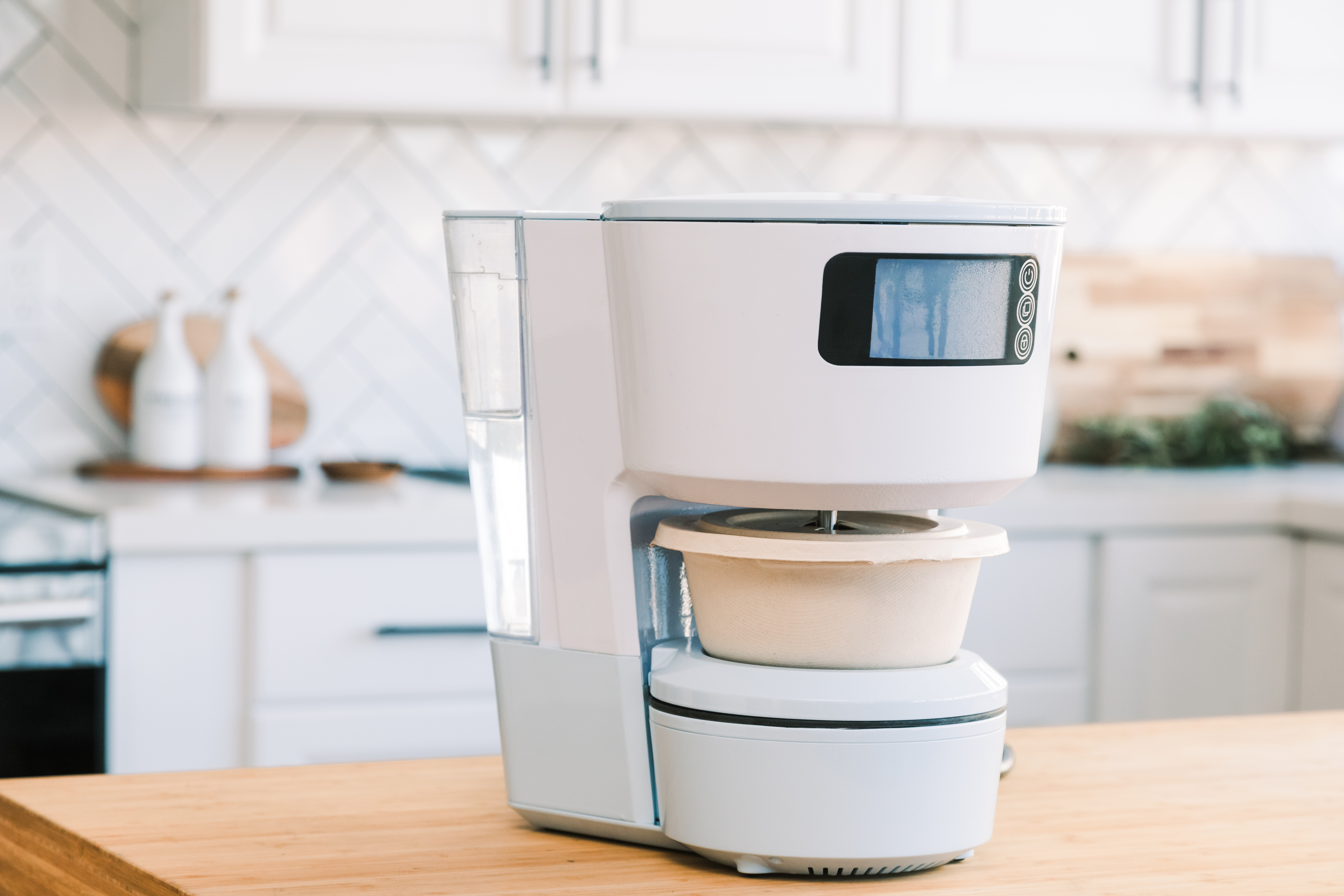
Yo-Kai Express is known for autonomous restaurant technology for venues like office campuses, malls and hotels. As people continue staying home because of the COVID-19 pandemic, the company is introducing a smart home cooking appliance with multiple functions. Called Takumi, it includes a coffee maker, high induction cooktop and a steamer for sanitizing utensils and baby bottles. Takumi is connected by RFID to an app with preprogrammed recipes, which also sends alert when its water container is running low.

The company is currently presenting Takumi at CES’ Taiwan Tech Arena.

Yo-Kai Express' smart home cooking appliance Takumi

Yo-Kai Express’ smart home cooking appliance Takumi

If you live in the Bay Area, you might have seen Yo-Kai Express’s Octo-Chef, a vending machine that serves hot noodle dishes (ramen, udon and pho), in venues like the San Francisco International Airport, the Metreon mall in San Francisco and corporate campuses. But the company is adapting as people stay home. In April, it launched a home meal kit delivery service that is now available in all states.

Created for people who want a home-cooked meal but are short on time (and space), the Takumi’s pre-programmed recipes have cooking times of just two to eight minutes. Yo-Kai Express is known for noodle dishes, but the Takumi’s menu will also include rice bowls, dim sum, dumplings and pasta.

13 Jan 2021

Numbers Protocol’s blockchain camera Capture App safeguards the integrity of photos

The spread of misinformation and fake news online has a dangerous impact on public well-being. Misinformation is difficult to fight, and 73% of Americans surveyed by Pew Research ahead of the presidential election expressed little or no confidence in the ability of major tech companies to keep their platforms from being misused. The open-source Starling Framework for Data Integrity was launched to protect the veracity of online content using blockchain technology, creating “birth certificates” for photos and videos and tracking any changes made to them. Numbers Protocol, a Taipei, Taiwan-based startup, founded by Startling Framework collaborators, is now commercializing its tech to make it more widely available.

Numbers is currently presenting its blockchain camera, Capture App, during CES at the Taiwan Tech Arena pavilion. The app is available for download in the App Store and Google Play.

While journalism, especially citizen journalism, is an obvious use case for Capture App, it can also be used by people who want to prove that they created images that are being shared online. Numbers will add more features to the app, including a video camera.

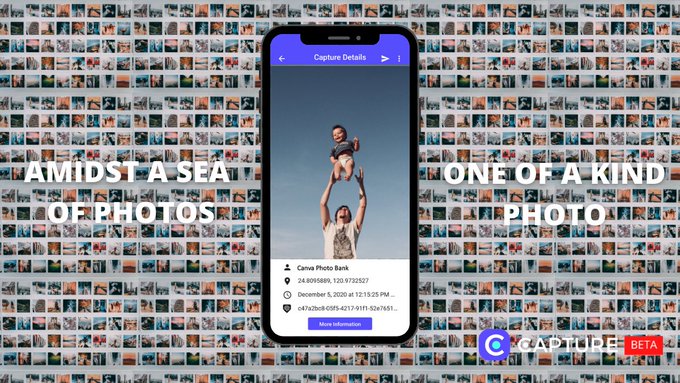
A screenshot of blockchain camera app Capture App by Taiwan startup Numbers Protocol

A screenshot of blockchain camera app Capture App by Taiwan startup Numbers Protocol

All photos taken by the Capture App have their metadata certified and sealed on the blockchain (users can adjust privacy settings if they, for example, don’t want to share their precise location). Then any changes to the photo, including ones made with editing software, are traced and recorded.

Numbers plans to add a video function to the app and create a channel where people can publish certified content, with the goal of changing the information industry, co-founder Tammy Yang told TechCrunch.

Before launching Numbers, Yang worked with the Starling Framework, an initiative by Stanford University and the USC Shoah Foundation. The Shoah Foundation’s work includes preserving testimonies from survivors of genocide and mass violence and the Starling Framework’s technology was created to help them safeguard photos and videos. The Starling Framework was also used by Reuters journalists to capture, verify and store photos taken during the U.S. presidential primaries in March. (The Starling Framework’s other collaborators include Filechain, Hala Systems and Protocol Labs).

The Starling Framework worked with the Shoah Foundation and Reuters to integrate its technology into their workflows, since many photojournalists use digital SLRs and programs like Adobe Photoshop. Capture App was created to allow wider access to the same technology.

Fake news and misinformation has created more public awareness of the need to preserve photo integrity, said Yang. While there are other companies that use blockchain tech to protect data and content, Numbers focuses on certifying photos at their point of origin, and then continuing to record any alterations.

“We focus very much on the camera itself, so at the time the photo is taken, the integrity is already preserved,” said Yang. “If content is captured on a camera app and then copied to a content platform, it’s already very difficult to verify its origin. If I take a photo from Facebook and register it on the blockchain, it means nothing. It’s very different if I take a photo with Capture App and immediately create a registration on the blockchain.”

13 Jan 2021

Nobi’s smart lamp alerts caregivers when a fall is detected

As expected, this year’s (virtual) CES has brought with it a new flood of smart home gadgets. The technology has been a major presence over the last several CES events, and with a world stuck at home for the foreseeable future, a lot of this tech has become all the more appealing.

Nobi stands out from the pack, not so much because of any flashy features, but rather a kind of practicality it brings to the table. Created by a Belgian startup of the same name, the ceiling-mounted smart light features motion sensors and infrared detection.

When the user sits up, the top light illuminates. If they stand up to walk, it illuminates the ground. More interestingly, it can detect irregular motions in the user, as well as falls. If the user does the latter, the on-board speaker will ask, “did you fall.”

If the answer is “no,” nothing happens. If the answer is anything else, it will send a notification to a caregiver, which may include a photo, depending on the specific settings. The lamp is currently undergoing a testing period and will be available for sale by year’s end. Users can buy them outright, or rent them, along with a subscription.