Year: 2021

11 Jan 2021

Inadequate federal privacy regulations leave US startups lagging behind Europe

“A new law to follow” seems unlikely to have featured on many business wishlists this holiday season, particularly if that law concerned data privacy. Digital privacy management is an area that takes considerable resources to whip into shape, and most SMBs just aren’t equipped for it.

But for 2021, I believe startups in the United States should be demanding that legislators deliver a federal privacy law. Yes, they should demand to be regulated.

For every day that goes by without agreed-upon federal standards for data, these companies lose competitive edge to the rest of the world. Soon there may be no coming back.

For every day that goes by without agreed-upon federal standards for data, these companies lose competitive edge to the rest of the world.

Businesses should not view privacy and trust infrastructure requirements as burdensome. They should view them as keys that can unlock the full power of the data they possess. They should stop thinking about privacy as compliance and begin thinking of it as a harmonization of the customer relationship. The rewards flowing to each party from such harmonization are bountiful. The U.S. federal government is in a unique position to help realize those rewards.

To understand what I mean, cast your eyes to Europe, where it’s become clear that the GDPR was nowhere near the final destination of EU data policy. Indeed it was just the launchpad. Europe’s data regime can frustrate (endless cookie banners anyone?), but it has set an agreed-upon standard of protection for citizens and elevated their trust in internet infrastructure.

For example, a Deloitte survey found that 44% of consumers felt that organizations cared more about their privacy after GDPR came into force. With a baseline standard established — seatbelts in every car — Europe is now squarely focused on raising the speed limit.

EU lawmakers recently unveiled plans for “A Europe fit for the Digital Age.” in the words of Internal Market Commissioner Thierry Breton, it’s a plan to make Europe “the most data-empowered continent in the world.”

Here are some pillars of the plan. While reading, imagine that you are a U.S.-based health tech startup. Imagine the disadvantage you would face against a similar, European-based company, if these initiatives came to fruition:

  • A regulatory framework covering data governance, access and reuse between businesses, between businesses and government, and within administrations to create incentives for data sharing.
  • A push to make public-sector data more widely available by opening up “high-value datasets” to enable their reuse to foster innovation.
  • Support for cloud infrastructure, platforms and systems to support the data reuse goals, with investments in European high-impact projects on European data spaces and trustworthy, energy-efficient cloud infrastructures.
  • Sector-specific actions to build European data spaces that focus on specific areas such as industrial manufacturing, the Green New Deal, mobility or health.

There are so many ways governments can help businesses maximize their data leverage in ways that improve society. But the American public currently has no appetite for that. They don’t trust the internet.

They want to see Mark Zuckerberg and Jeff Bezos sweating it out under Senate Committee questioning. Until we trust our leaders to protect basic online rights, widespread data empowerment initiatives will not be politically viable.

In Europe, the equation is totally different. GDPR was the foundation of a European data strategy, not the capstone.

While the EU powers forward, America’s ability to enact federal privacy reform is stymied by two quintessentially American privacy sticking points:

  • Can I personally sue a business that violates my privacy rights?
  • Can individual states build additional privacy protections on top of a federal law, or will it act as a nationwide “ceiling”?

These are important questions that must be answered as a function of our country’s unique cultural and political history. But currently they’re the roadblocks that stall American industry while the EU, seatbelts secure, begins speeding down the data autobahn.

If you want a visceral example of how this gap is already impacting American businesses, look no further than the fallout of the ECJ’s Schrems II decision in the middle of last summer. Europe’s highest court invalidated a key agreement used to transfer EU data back to the U.S., essentially because there’s no federal law to ensure EU citizens’ data would be protected once it lands in America.

The legal wrangling continues, but the impact of this decision was so considerable that Facebook legitimately threatened to quit operating Europe if the Schrems II ruling was enforced.

While issues generated for smaller businesses don’t grab as many headlines, rest assured that on the front lines of this issue, I’ve seen many SMB’s data operations thrown into total chaos. In other words, the geopolitical battle for a data-driven business edge is already well underway. We are losing.

To sum it up, the United States increasingly finds itself in a position that’s unprecedented since the dawn of the internet era: laggard. American tech companies still innovate at a fantastic rate, but America’s inability to marshal private sector practices to reflect evolving public sentiment threatens to become a yoke around the economy’s neck.

The catastrophic response to the COVID-19 pandemic fell far short of other nations’ efforts. Our handling of data privacy protection costs far less in human terms, but it grows astronomically more expensive in dollar terms with every passing day.

The technology exists to treat users respectfully in a cost-effective manner. The public will is there.

The business will is there. The legislative capability is there.

That’s why I believe America’s startup community should demand federal lawmakers follow the recent example of Europe, India, New Zealand, Brazil, South Africa and Canada. They need to introduce federally guaranteed modern data privacy protections as soon as possible.

11 Jan 2021

Revolut applies for UK banking license

It’s hard to believe that fintech startup Revolut doesn’t have a proper banking license in its home country. But this is about to change as the company has applied for a banking license in the U.K. Up next, the Prudential Regulation Authority (PRA) and the Financial Conduct Authority (FCA) are going to look at the application.

Revolut already has a banking license in the European Union. The Bank of Lithuania has granted a license and the company is taking advantage of European passporting rules to operate in other European countries.

It is slowly starting to offer its own banking products in Europe. Revolut is testing a credit offer in two European markets.

Revolut dubs itself as a financial super app. After you create an account, you get an e-wallet and a debit card. You can send and receive money, hold money in your account and use your card for in-store and online purchases.

Over the past few years, Revolut has greatly expanded beyond that simple premise. You can buy cryptocurrencies, stocks and commodities. You can set money aside in a vault. You can get travel and mobile phone insurance products.

Some of these features have been developed in house. Other features have required partnerships with other fintech companies. While you can do a lot of things with your Revolut account, it’s still not technically a bank in the U.K.

It has been great when it comes to growth, but it can be limiting when it comes to revenue opportunities and product offering. If Revolut gets a banking license, the company will be able to offer full-service current accounts with overdrafts and loans in the U.K. Revolut could also offer credit cards.

Customers will also be protected under the Financial Services Compensation Scheme (FSCS). If Revolut becomes a bank and disappears, customers are protected up to £85,000 per person.

Revolut currently has 13 million customers and a valuation of $5.5 billion. While the company doesn’t break down its user base based on markets, the U.K. represents one of the most important markets for the company.

11 Jan 2021

Hulu discounts its on-demand service to $1.99 per month for students

Looking to gain traction with a younger user base, Hulu this morning announced it’s dropping the price of its on-demand streaming service to $1.99 per month for students over 18 who are attending a U.S. college or university. This represents an over 65% discount off Hulu’s ad-supported subscription, which typically sells for $5.99 per month, the company says.

The students will gain access to the same version of Hulu’s streaming service, which includes its library of thousands on-demand movies and TV, including Hulu Originals. They’ll also be able to use the recently launched Watch Party feature that allows users to co-watch with friends and family in different locations as well as use group chat in a sidebar as the content plays.

Over the past few years, Hulu has offered a variety of deals and discounts aimed at growing its user base. In fall 2017, for example, it partnered with Spotify on a combo deal, also aimed at students. It later expanded this deal to include Showtime and then opened it to a broader audience. In 2019, Hulu also again dropped the standard price for its streaming service while raising the cost of its Live TV add-on and rolled out an even more discounted Spotify-Hulu combo.

These promotions help to boost Hulu’s subscriber base to its entry-level service in the hopes that users will later choose to upgrade to Hulu’s more expensive plans. For students, in particular, the goal is to capture the market while users are young and paying for subscriptions possibly for the first time. When the students graduate, Hulu believes they’ll continue to still see the value in its service and convert to fully-paid customers.

This new student deal arrives a couple of months after Hulu once again raised the price of its Hulu with Live TV plan – this time to help fund the addition of 14 new ViacomCBS channels. As Hulu’s Live TV service becomes to look more like traditional pay TV in terms of its pricing, it becomes even more important to attract users to Hulu’s on-demand plan as the first step toward later upsells.

Hulu says the new student deal is “evergreen” and begins to roll out today.

11 Jan 2021

Samsung’s upcycling program is designed to give new life to old tech

In the world of annual refresh cycles, there’s always been a big question mark around what to do with all of the old tech we too readily abandon. There are a number of options for disposing and recycling these objects that often contain rare earth and sometimes harmful material. The concept of upcycling has also become an increasingly popular option – offering a new lease on life for old technology. After all, your three-year-old smartphone may not be the latest and greatest, but that doesn’t mean it’s necessarily worthless.

During this morning’s CES kickoff press conference, Samsung outlined its new Galaxy Upcycling at Home program. For now, we got some pretty broad strokes about the program – and we’ll likely get more information at this Friday’s Galaxy Unpacked event. Here’s what the company had to say, “The new program reimagines the lifecycle of an older Galaxy phone and offers consumers options on how they might be able to repurpose their device to create a variety of convenient IoT tools.”

Examples from the presser include a baby monitor, pet care sensor for turning on lights remotely and a more abstract “digitally safe home” using Samsung Knox. It will be interesting to see what else the company’s got in store in that front – and certainly there’s something to be said for keeping old tech relevant even after its planned obsolescence.

The other piece of the puzzle is one of the more fun initiatives the company has introduced in recent years, with boxes that can be converted into house hold objects. The company announced this morning that all of its QLED, UHD TV and audio projects will feature the packaging.

Per Samsung,

As part of an ongoing commitment to eco-consciousness, Samsung is creating products and solutions with sustainability at the core. For example, Samsung’s new Solar Cell Remote Control—made in part with recycled plastic—can be charged via solar or indoor lighting, reducing battery waste.

11 Jan 2021

Parler is officially offline after AWS suspension

True to its word, Amazon Web Services (AWS) suspended services to Parler, the right-wing-focused social network that proved a welcoming home for pro-Trump users whose calls for violence at the nation’s Capitol and beyond. The service suspension went into effect overnight after a 24-hour warning from AWS, which means that if you now go to Parler’s web address you’re greeted with a message saying the requested domain can’t be reached.

Parler’s community had been surging after the permanent suspension of Trump’s official accounts from Twitter and Facebook last week, which also saw a number of accounts tweeting similar invective and encouragement of violence aligned with Trump’s sentiments removed from those platforms. Apple and Google then removed Parler from their respective app stores for violations of their own terms of service, and AWS follows suit with its own suspension notice.

The company has suggested that it will rebuild its own infrastructure from scratch in order to contend with the various suspensions, but meanwhile other alternative social media sites that continue to exist, and that have typically catered to a more right-wing audience, like Gab, are seeing the benefits of Parler’s deplatforming. Gab has previously seen its hosting revoked, and been removed from Google Play for issues around hate speech dissemination.

11 Jan 2021

Orange spins out Orange Ventures with $430 million allocation

Telecom company Orange is making some changes to its venture capital arm. Orange Ventures is becoming a separate legal entity and Orange itself is allocating $430 million (€350 million).

With this new corporate structure, Orange could attract third-party investors in its fund. Other telecom companies have made some headlines with their venture funds in the past, such as SoftBank’s Vision Fund and Reliance Jio.

Separating Orange Ventures from Orange is also going to boost confidence when it comes to confidentiality and conflicts of interest between a startup and the telecom company. There’s a more visible firewall between Orange and Orange Ventures.

But if you want to partner with Orange, there are some opportunities on the table — the company says those synergies are “flexible and optional”.

Orange Ventures focuses on investments in companies that operate more or less in the same space as Orange. It includes many verticals, such as connectivity, cybersecurity, fintech and e-health. Previous investments include Monzo, Luko, Raisin, YouVerify and WeaveWorks.

Orange Ventures currently has offices in Paris and Dakar and tends to invest in startups from seed stage up to Series A or B. The firm says it can invest as much as €20 million in a single round. It is screening startups in Europe, Africa, the Middle East and the U.S. There are around 20 people working for Orange Ventures.

11 Jan 2021

Get live feedback on your pitch deck from big-name VCs on Extra Crunch Live

Your startup’s pitch deck could be the difference between getting funded or getting ignored. It’s often the first point of contact between a company and venture investors, but it’s also a bit of a black box.

How do these investors consume this content? Are they speed-flipping through the slides or taking their time? Do they prefer more information on the team or context on the industry? More numbers or more words? How many slides is the right number of slides?

There are too many questions to count, and often very few answers. But we’re popping the lid off of that black box with the Pitch Deck Teardown. We’ve done Pitch Deck Teardowns at events like Disrupt and Early Stage 2020, and this year we’re cranking it up a notch.

As a part of Extra Crunch Live, our weekly event series that connects investors and founders, we’ll be offering EC members the chance to get live feedback on their pitch decks from our guests. You heard that right. Every single week, VCs and big-name tech founders will look through pitch decks from the Extra Crunch community and offer their two cents.

That’s where you come in. We’re asking EC members to submit their pitch decks right here!

Only EC members will have the chance to get their pitch deck looked at, so please use the same email attached to your Extra Crunch account when you submit.

Last week, we shared what you can expect from Extra Crunch Live in 2021. Here’s a refresher:

  • Series A – Learn how others have fundraised! We’ll have a segment dedicated to hearing from founder/investor duos who walk us through the Series A pitch deck that led to investment. 
  • Pitch Deck Teardowns – Extra Crunch members will have the opportunity to submit their pitch deck and get feedback from our guests, which will include VCs and founders (EC members can submit their pitch decks right here!). 
  • Live Pitch-offs – Audience members can raise their hand to practice their elevator pitch in front of the audience and get real-time feedback from VCs.
  • Networking!! – The Extra Crunch membership is a community. ECL will be an opportunity to meet your fellow audience members, even in a virtual environment. Who knows? Maybe you’ll meet your next co-founder or investor! 
  • Consistency – ECL will always be at 12pm PT/3pm ET on Wednesdays. When it comes to your calendar, set it and forget it. 

We’re super excited about ECL in 2021 and can’t wait to get started. More on upcoming speakers very soon!

11 Jan 2021

Recycling startup Redwood Materials is now accepting your old smartphones

Redwood Materials, the recycling startup founded by former Tesla CTO JB Straubel, has quietly opened up its enterprise to everyday consumers and all of the old electronics sitting in their junk drawers.

The move expands upon the Carson City, Nevada-based company’s existing and primary strategy to recycle scrap from battery cell production and consumer electronics for corporate customers like Panasonic and Amazon.

The startup has posted a “recycle with us” tab on its website, which states “Have lithium ion batteries or e-waste? We’ll recycle your phones, tablets, power tools and any other device with a lithium-ion battery.” There isn’t anymore information on the website beyond an address, where consumers can send their e-waste, and a “contact us” button.

Straubel told TechCrunch in October that its business model could someday evolve to include consumers because they had received so many inquiries from people. It seems that Redwood has decided to take the leap.

Redwood Materials isn’t setting strict parameters on what consumers can send, a spokesperson said, who confirmed the company is even taking cables. Redwood told TechCrunch it wants to hear from consumers and will determine over time how it might expand the program. For instance, the company said it might formalize the consumer program and add shipping boxes and labels to make the process easier.

For now, Redwood is going to open it up and see what happens.

The majority of lithium-ion batteries used in smartphones and other consumer electronics are not recycled and instead either sit forgotten in the owner’s junk drawer or enter the waste stream and end up in a landfill.

Redwood Material is aiming to change that by creating a circular supply chain. Redwood collects scrap from Panasonic’s battery cell production and as well as consumer electronics such as cell phone batteries, laptop computers and power tools from other corporations. The company then processes the discarded goods, extracting materials like cobalt, nickel and lithium that are typically mined, and supplies those back to Panasonic and other customers.

Eventually, Straubel wants Redwood to be part of the end-of-life solution for electric vehicle batteries as well. The CEO has aspirations to set up facilities in strategic regional locations around the world to meet this need. For now, most of the items recycled and processed at Redwood’s two facilities in Carson City are for Panasonic and other unnamed consumer electronics-related companies.

11 Jan 2021

Equity Monday: Cryptos fall, the deplatforming rush, and fitness tech stays hot

Hello and welcome back to Equity, TechCrunch’s venture capital-focused podcast where we unpack the numbers behind the headlines.

This is Equity Monday, our weekly kickoff that tracks the latest private market news, talks about the coming week, digs into some recent funding rounds and mulls over a larger theme or narrative from the private markets. You can follow the show on Twitter  href="https://twitter.com/equitypod">here and myself here —and don’t forget to check out the extra episode we dropped on Saturday, as there was just too much to talk about last week.

So, what’s on the docket for today? A great host of things:

Closing, I am befuddled by how dissonant the global economy feels, with seemingly two different eras going on at once. It’s not clear if I have finally become the softy I have always threatened to become, or merely that the inequality of outcomes in the 2020-2021 economy are merely as heartbreaking as I imagine them to be.

Equity drops every Monday at 7:00 a.m. PST and Thursday afternoon as fast as we can get it out, so subscribe to us on Apple PodcastsOvercastSpotify and all the casts.
11 Jan 2021

At least one of Samsung’s new robots is definitely coming out (hint: it’s the vacuum)

For the last couple of years, Samsung’s CES press conferences have featured a parade of futuristic home robots. They’re are smart, dexterous and impressive (and reasonably adorable). But home robots are hard. Like, really, really hard. There’s a reason the robotic vacuum continues to be one real viable home robot nearly 20 years after the Roomba’s introduction.

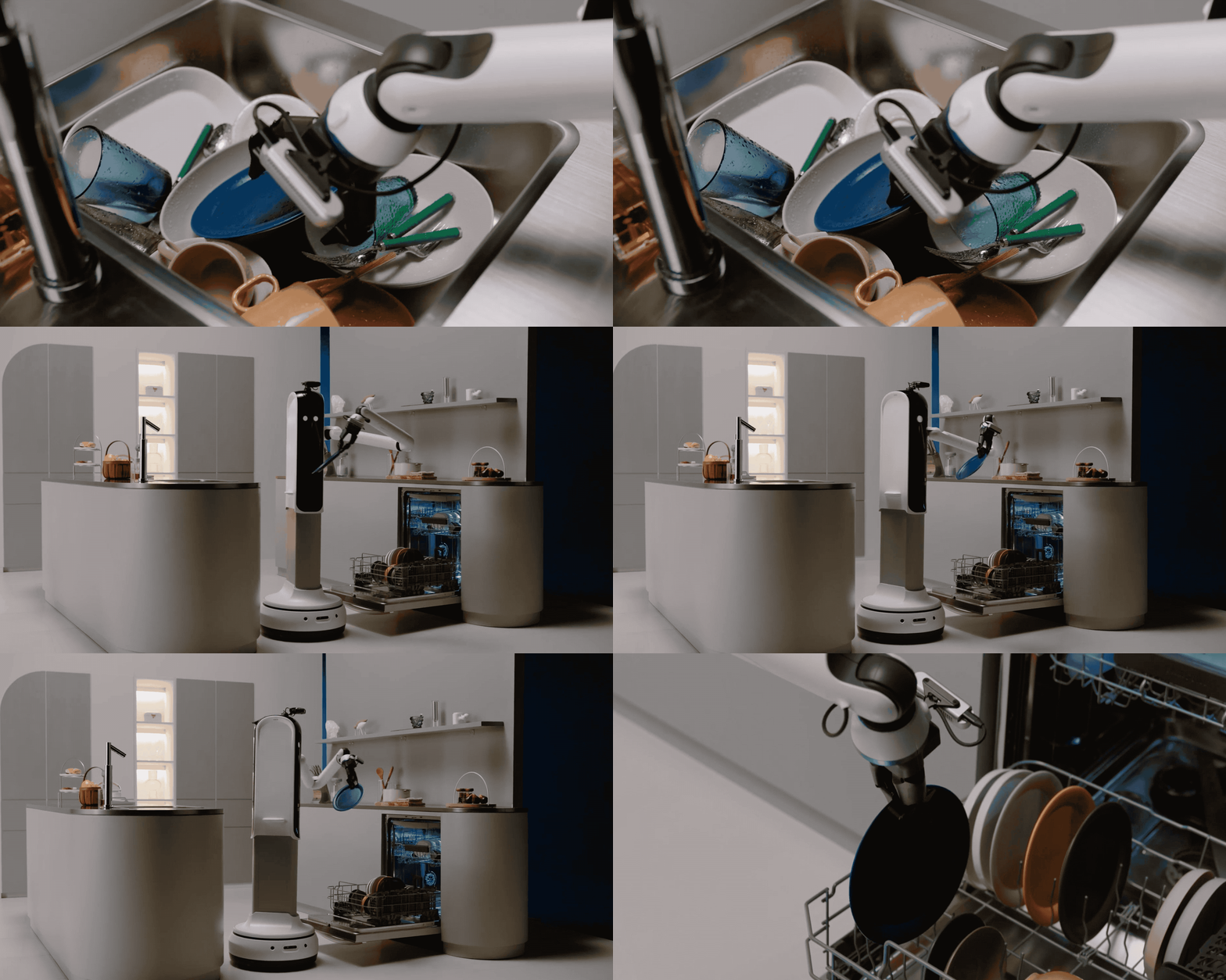
It’s the same reason the JetBot 90 AI+ Vacuum seems to be the one really viable bit of home robotics from the event. The company also showed off updates to the Bot Handy it introduced at last year’s show. That, coupled with the new Bot Care, is far more in line with the kind of humanoid designs science fiction has led us believe we’ll be getting in the next few years.

And science fiction seems to still be an operative descriptor here. At last years show, the robots put on a kind of Chuck E. Cheese-style presentation, running through choreographed tasks on stage, with limited human interaction. Understandably – there’s a lot that goes into this sort of thing, and for the moment, the technology feels like proof of concept more than anything.

Image Credits: Samsung

The company mentioned the “not too distant future” in reference to the tech, while the small print at the corner of the screen said “This robot is undergoing research and development, and is not yet for sale.” That seems to be putting it mildly, as the wheeled Bot Care reminds its owner of a meeting and pops up a screen for a conference call.

I don’t think anyone has an illusions that we’ll be seeing any of this tech during the current epidemic, though I suppose there’s an argument to be made that this is the “new normal” the company is prepping us for. The Bot Handy moving dishes from the sink to dishwasher seems roughly as realistic.

Image Credits: Samsung

I’m happy to be wrong, but I don’t think any of us are holding our breath for a viable version of this tech in the near term. We can, however, appreciate the JetBot 90 AI+ Vacuum. That, after all, has a rough date, arriving in the U.S. at some point in the first half of this year.

The robot vacuum features an on-board LiDAR sensor, coupled with an object detection algorithm that helps it build an ideal path around the user’s home. Interestingly, the camera can also be viewed remotely by the user, doubling as a kind of security cam (though Samsung seems to avoid actually using the word) and a pet monitor.