Year: 2021

11 Jan 2021

China’s search giant Baidu to set up an EV making venture

China’s search giant Baidu is extending its car ambitions from mere software to production. The company said Monday that it will set up a company to produce electric vehicles with the help of Chinese automaker Geely. Baidu, a dominant player in China’s internet search market for the last decade or so, will provide smart driving technologies while Geely, which has an impending merger with Sweden’s Volvo, will be in charge of car design and manufacturing.

The move marks the latest company in China’s internet industry to enter the EV space. In November, news arrived that Alibaba and Chinese state-owned carmaker SAIC Motor had joined hands to produce electric cars. Ride-share company Didi and EV maker BYD co-developed a model for ride-hailing, which is already attracting customers like Ideanomics. Meanwhile, the stocks of China’s Tesla challengers, such as Xpeng, Li Auto, and NIO, have been in a steady uptrend over the past year.

Baidu’s car push is part of its effort to diversify a business relying on search advertising revenue. New media platforms such as ByteDance’s Toutiao news aggregator and short-video app Douyin come with their own search feature and have gradually eroded the share of traditional search engines like Baidu. Short video services have emerged as the second-most popular channel for internet search in China, trailing after web search engines and coming ahead of social networks and e-commerce, data analytics firm Jiguang shows.

Baidu has been working aggressively on autonomous driving since 2017. Its Apollo ecosystem, which is billed as “an Android for smart driving,” has accumulated over a hundred manufacturing and supplier partners. Baidu has also been busy testing autonomous driving and recently rolled out a robotaxi fleet.

The new venture will operate as a Baidu subsidiary where Geely will serve as a strategic partner and Baidu units like Apollo and Baidu Maps will contribute capabilities. The firm will cover the entire industrial chain, including vehicle design, research and development, manufacturing, sales, and service.

It’s unclear how Baidu’s tie-up with Geely will affect Apollo’s operation, though Baidu promised in its announcement that it will “uphold its spirit of open collaboration across the AI technology industry, striving to work closely with its ecosystem partners to advance the new wave of intelligent transformation.”

“At Baidu, we have long believed in the future of intelligent driving and have over the past decade invested heavily in AI to build a portfolio of world-class self-driving services,” said Robin Li, co-founder and chief executive officer of Baidu.

“We believe that by combining Baidu’s expertise in smart transportation, connected vehicles and autonomous driving with Geely’s expertise as a leading automobile and EV manufacturer, the new partnership will pave the way for future passenger vehicles.”


11 Jan 2021

San Francisco police are prepping for a pro-Trump rally at Twitter headquarters

San Francisco police are preparing for a pro-Trump protest at Twitter’s headquarters, a building which has been essentially abandoned since the start of the pandemic last year, with most Twitter employees working remotely.

The potential protest comes days after Twitter banned the President from using its service — his favorite form of communication to millions of followers — following what the company called his continued incitements to violence in the wake of the January 6th assault on the Capitol last week by a mob of his followers.

“The San Francisco Police Department is aware of the possibility of a demonstration on the 1300 block of Market Street (Twitter) tomorrow, Monday January 11, 2021. SFPD has been in contact with representatives from Twitter. We will have sufficient resources available to respond to any demonstrations as well as calls for service citywide,” a police department spokesperson wrote in an email. “The San Francisco Police Department is committed to facilitating the public’s right to First Amendment expressions of free speech. We ask that everyone exercising their First Amendment rights be considerate, respectful, and mindful of the safety of others.”

The San Francisco Chronicle, which first reported the preparations from SF police, noted that posts on a popular internet forum for Trump supporters who have relocated from Reddit called for the president’s adherents to protest his Twitter ban outside of the company’s headquarters on Monday.

Twitter is one of several tech companies to deplatform the current President and many of his supporters in the wake of the riot at the Capitol on Wednesday.

11 Jan 2021

Indonesian investment platform Ajaib gets $25 million Series A led by Horizons Venture and Alpha JWC

Ajaib Group, an online investment platform that says it now runs the fifth-largest stock brokerage in Indonesia by number of trades, announced it has raised a $25 million Series A led by Horizons Ventures, the venture capital firm founded by Li Ka-Shing, and Alpha JWC. Returning investors SoftBank Ventures Asia, Insignia Ventures and Y Combinator also participated in the round, which was made in two closes.

Founded in 2019 by chief executive officer Anderson Sumarli and chief operating officer Yada Piyajomkwan, Ajaib Group focuses on millennials and first-time investors, and currently claims one million monthly users. It has now raised a total of $27 million, including a $2 million seed round in 2019.

Stock investment has a very low penetration rate in Indonesia, with only about 1.6 million capital market investors in the country, or less than 1% of its population (in comparison, about 55% of Americans own stocks, according to Gallup data).

The very low penetration rate, coupled with growing interest in the capital market among retail investors during the pandemic, has spurred VC interest in online investment platforms, especially ones that focus on millennials. Last week, Indonesian investment app Bibit announced a $30 million growth round led by Sequoia Capital India, while another online investment platform, Bareksa, confirmed an undisclosed Series B from payment app OVO last year.

Ajaib Group’s founders said it differentiates as a low-fee stock trading platform that also offers mutual funds for diversification. Bibit is a robo-advisor for mutual funds, while Bareksa is a mutual fund marketplace.

In an email, Sumarli and Piyajomkwan told TechCrunch that the stock investment rate is low in Indonesia because it is typically done by high net-worth individuals who use offline brokers and can afford high commissions. Ajaib Group was launched in 2019 after Sumarli became frustrated by the lack of investment platforms in Indonesia where he could also learn about stock trading.

Inspired by companies like Robinhood in the United States and XP Investimentos in Brazil, Ajaib Group was created to be a mobile-first stock trading platform, with no offline brokers or branches. It appeals to first-time investors and millennials with a simple user interface, in-app education features and a community where people can share investment ideas and low fees.

Since people prefer to invest small amounts when trying out the app for the first time, Ajaib requires no minimums to open a brokerage account. Piyajomkwan said “we typically see investors triple their investment amount within the second month of investing with Ajaib.”

Ajaib Group’s platform now includes Ajaib Sekuritas for stock trading and Ajaib Reksadana for mutual funds. The company says that Ajaib Sekuritas became the fifth-largest stock brokerage in Indonesia by number of trades just seven months after it launched in June 2020.

The Indonesian government and Indonesia Stock Exchange have launched initiatives to encourage more stock investing. Some of Ajaib Group’s Series A will be used for its #MentorInvestai campaign, which works with the government to educate millennials about investing and financial planning. The round will also be spent on expanding Ajaib’s tech infrastructure and products, and to hire more engineers.

Ajaib may eventually expand into other Southeast Asian markets, but for the near future, it sees plenty of opportunity in Indonesia. “Ajaib was built with regional aspiration, having two founders from the two biggest capital markets in Southeast Asia, Indonesia and Thailand,” Piyajomkwan said. “But for the immediate term, we are focused on Indonesia as investment penetration is still low and there are many more millennial investors we can serve.”


11 Jan 2021

Stripe reportedly joins the tech platforms booting President Trump from their services

It might be easier at this point to ask which tech platforms President Donald Trump can still use.

Payment-processing company Stripe is the latest tech company to kick Donald Trump off of its platform, according to a report in The Wall Street Journal.

That means the president’s campaign website and online fundraising arms will no longer have access to the payment processor’s services, cutting off the Trump campaign from receiving donations.

Sources told the Journal that the reason for the company’s decision was the violation of company policies against encouraging violence.

The move comes as the president has remained largely silent through the official channels at his disposal in the wake of last week’s riot at the Capitol building.

While Trump has been silent, technology companies have been busy repudiating the president’s support by cutting off access to a range of services.

The deplatforming of the president has effectively removed Trump from all social media outlets including Snap, Facebook, Twitter, Pinterest, Spotify and TikTok.

The technology companies that power most financial transactions online have also blocked the president. Shopify and PayPal were the first to take action against the extremists among President Trump supporters who participated in the riot.

As we wrote earlier this week, PayPal has been deactivating the accounts of some groups of Trump supporters who were using the money-transfer fintech to coordinate payments to underwrite the rioters’ actions on Capitol Hill.

The company has actually been actively taking steps against far-right activists for a while. After the Charlottesville protests and subsequent rioting in 2017, the company banned a spate of far-right organizations. These bans have so far not extended directly to the president himself from what TechCrunch can glean.

On Thursday, Shopify announced that it was removing the storefronts for both the Trump campaign and Trump’s personal brand. That’s an evolution on policy for the company, which years ago said that it would not moderate its platform, but in recent years has removed some controversial stores, such as some right-wing shops in 2018.

Now, Stripe has joined the actions against the president, cutting off a lucrative source of income for his political operations.

As the Journal reported, the Trump campaign launched a fundraising blitz to raise money for the slew of lawsuits that the president brought against states around the country. The lawsuits were almost all defeated, but the effort did bring in hundreds of millions of dollars for the Republican party.


10 Jan 2021

Original Content podcast: Despite some odd choices, ‘The Undoing’ lays out a satisfying mystery

The HBO miniseries “The Undoing” wrapped up back in November, but the hosts of the Original Content podcast took advantage of the holidays to get caught up.

Based on a novel by Jean Hanff Korelitz, “The Undoing” tells the story of Grace Fraser (played by Nicole Kidman), a Manhattan psychologist whose husband Jonathan (Hugh Grant) is accused of a brutal murder. As the trial turns into a media spectacle, Grace tries to navigate how she feels about her husband and to discover who else might be guilty of the crime.

While Jordan had already watched the show as it aired, Anthony and Darrell were inspired to binge it thanks to an email from listener Michael Benedosso, who shared some amusing thoughts on Kidman’s wavering attempts at a New York accent — resulting in what he called “a world tour expressed via spoken word.”

We agreed that Kidman’s accent left a lot to be desired, and that her performance often felt a bit oblique (the latter, at least, was probably intentional).

We had other quibbles. For one thing, although the cast is relatively diverse, the story spends most of its time on the wealthy white family at its center, as their wealthy white friends. And there were perhaps a few too many red herrings that didn’t lead anywhere interesting.

Still, we were pretty satisfied in the end. With only six episodes and plenty of plot twists, there was really no time to get bored, and we were particularly impressed by Grant’s performance as Jonathan, as well as Noah Jupe as the Frasers’ adolescent son Henry and Noma Dumezweni as Jonathan’s steely lawyer Haley.

Before reviewing he show, we also discussed the recent launch of the Discovery+ streaming service.

You can listen to our review in the player below, subscribe using Apple Podcasts or find us in your podcast player of choice. If you like the show, please let us know by leaving a review on Apple. You can also follow us on Twitter or send us feedback directly. (Or suggest shows and movies for us to review!)

f you’d like to skip ahead, here’s how the episode breaks down:
0:00 Intro
0:30 Discovery+ discussion
6:41 “The Undoing” review
20:40 “The Undoing” spoiler discussion

10 Jan 2021

Lenovo launches AR glasses for enterprise

Lenovo seems to have gotten the memo that the real money in the augmented reality space is going to be made in enterprise. Ahead of tomorrow’s CES kick off, the hardware company announced the impending arrival of the ThinkReality A3, a pair of enterprise AR glasses that look to follow the lead set by companies like Epson and Microsoft.

The glasses are set to arrive at some point in the middle of the year. No word from Lenovo on pricing — which isn’t entirely surprising for an enterprise-only device. The headset sports a 1080p resolution, powered by Qualcomm’s Snapdragon XR1 chip. A pair of fish-eye cameras provide motion tracking, while an eight-megapixel RGB camera grabs video for remote use.

Image Credits: Lenovo

The device is designed to tether to a PC or a handful of Motorola (owned by Lenovo) phones via USB-C. The glasses follow the announcement of the ThinkReality A6 head-mounted display, which offers a more traditional form factor (insofar as there is a traditional form factor for AR, I suppose).

“For use in scenarios from factory floors and laboratories to busy retail and hospitality spaces, certified turnkey applications on the Think Reality platform powers remote assistance, guided workflows, and 3D visualization,” the company writes. “Now, industrial workers have a light, flexible, and scalable set of smart glasses to increase productivity and safety while decreasing error rates in daily tasks.”

Clearly Lenovo thinks the immediate future for AR is in the enterprise space. The company has dabbled with it a bit in the consumer space with products like the Star Wars Jedi Challenges headset, but for now at least, that feels like something of a one-off.

10 Jan 2021

These 6 browser extensions will protect your privacy online

The internet is not a private place. Ads try to learn as much about you to sell your information to the highest bidder. Emails know when you open them and which links you click. And some of the biggest internet snoops, like Facebook and Amazon, follow you from site to site as you browse the web.

But it doesn’t have to be like that. We’ve tried and tested six browser extensions that will immediately improve your privacy online by blocking most of the invisible ads and trackers.

These extensions won’t block every kind of snooping, but they will vastly reduce your exposure to most of the efforts to track your internet activity. You might not care that advertisers collect your data to learn your tastes and interests to serve you targeted ads. But you might care that these ad giants can see which medical conditions you’re looking up and what private purchases you’re making.

By blocking these hidden trackers from loading, websites can’t collect as much information about you. Plus by dropping the unnecessary bulk, some websites will load faster. The tradeoff is that some websites might not load properly or refuse to let you in if you don’t let them track you. You can toggle the extensions on and off as needed, or you could ask yourself if the website was that good to begin with and could you not just find what you were looking for somewhere else?

HTTPS Everywhere

We’re pretty much hardwired to look for that little green lock in our browser to tell us a website was loaded over an HTTPS-encrypted connection. That means the websites you open haven’t been hijacked or modified by an attacker before it loaded and that anything you submit to that website can’t be seen by anyone other than the website. HTTPS Everywhere is a browser extension made by the non-profit internet group the Electronic Frontier Foundation that automatically loads websites over HTTPS where it’s offered, and allows you to block the minority of websites that don’t support HTTPS. The extension is supported by most browsers, including Chrome, Firefox, Edge, and Opera.

Privacy Badger

Another extension developed by the EFF, Privacy Badger is one of the best all-in-one extensions for blocking invisible third-party trackers on websites. This extension looks at all the components of a web page and learns which ones track you from website to website, and then blocks them from loading in the browser. Privacy Badger also learns as you travel the web, so it gets better over time. And it requires no effort or configuration to work, just install it and leave it to it. The extension is available on most major browsers.

uBlock Origin

Ads are what keeps the internet free, but often at the expense of your personal information. Ads try to learn as much about you — usually by watching your browsing activity and following you across the web — so that they can target you with ads you’re more likely to click on. Ad blockers stop them in their tracks by blocking ads from loading, but also the tracking code that comes with it.

uBlock Origin is a lightweight, simple but effective, and widely trusted ad blocker used by millions of people, but it also has a ton of granularity and customizability for the more advanced user. (Be careful with impersonators: there are plenty of ad blockers that aren’t as trusted that use a similar name.) And if you feel bad about the sites that rely on ads for revenue (including us!), consider a subscription to the site instead. After all, a free web that relies on ad tracking to make money is what got us into this privacy nightmare to begin with.

uBlock Origin works in Chrome, Firefox, and Edge and the extension is open source so anyone can look at how it works.

PixelBlock & ClearURLs

If you thought hidden trackers in websites were bad, wait until you learn about what’s lurking in your emails. Most emails from brand names come with tiny, often invisible pixels that alerts the sender when you’ve opened them. PixelBlock is a simple extension for Chrome browsers that simply blocks these hidden email open trackers from loading and working. Every time it detects a tracker, it displays a small red eye in your inbox so you know.

Most of these same emails also come with tracking links that alerts the sender which links you click. ClearURLs, available for Chrome, Firefox and Edge, sits in your browser and silently removes the tracking junk from every link in your browser and your inbox. That means ClearURLs needs more access to your browser’s data than most of these extensions, but its makers explain why in the documentation.

Firefox Multi-Account Containers

And an honorary mention for Firefox users, who can take advantage of Multi-Account Containers, built by the browser maker itself to help you isolate your browsing activity. That means you can have one container full of your work tabs in your browser, and another container with all of your personal tabs, saving you from having to use multiple browsers. Containers also keep your private personal browsing separate from your work browsing activity. It also means you can put sites like Facebook or Google in a container, making it far more difficult for them to see which websites you visit and understand your tastes and interests. Containers are easy to use and customizable.

10 Jan 2021

Amazon Web Services gives Parler 24-hour notice that it will suspend services to the company

Parler is at risk of disappearing, just as the social media network popular among conservatives was reaching new heights of popularity in the wake of President Donald Trump’s ban from all major tech social platforms.

Amazon Web Services, which provides backend cloud services, has informed Parler that it intends to cut ties with the company in the next 24 hours, according to a report in BuzzFeed News. Parler’s application is built on top of AWS infrastructure, services that are critical for the operation of its platform. Earlier today, Apple announced that it was following Google in blocking the app from its App Store, citing a lack of content moderation.

Parler, whose fortunes have soared as users upset at the President’s silencing on mainstream social media outlets flocked to the service, is now another site of contention in the struggle over the limits of free speech and accountability online.

Parler CEO John Matze said that the platform would be offline for at least a week, as “they rebuild from scratch” in response to AWS’ communications.

In the wake of the riots at the Capitol on Wednesday and a purge of accounts accused of inciting violence on Twitter and Facebook, Parler had become the home for a raft of radical voices calling for armed “Patriots” to commit violence at the nation’s capitol and statehouses around the country.

Most recently, conservative militants on the site had been calling for “Patriots” to amplify the events of January 6 with a march on Washington DC with weapons on January 19.

Even as pressure was came from Apple and Amazon, whose employees had called for the suspension of services with the company, Parler was taking steps to moderate posts on its platform.

The company acknowledged that it had removed some posts from Trump supporter Lin Wood, who had called for the execution of Vice President Mike Pence in a series of proclamations on the company’s site.

Over the past few months, Republican lawmakers including Sen. Ted Cruz and Congressman Devin Nunes — along with conservative firebrands like Wood have found a home on the platform, where they can share conspiracy theories with abandon.

In an email quoted by BuzzFeed News, Amazon Web Services’ Trust and Safety Team told Parler’s chief policy officer, Amy Peikoff that calls for violence that were spreading across Parler’s platform violated its terms of service. The company’s team also said that Parler’s plan to use volunteers to moderate content on the platform would prove effective, according to BuzzFeed.

“Recently, we’ve seen a steady increase in this violent content on your website, all of which violates our terms. It’s clear that Parler does not have an effective process to comply with the AWS terms of service,” BuzzFeed reported the email as saying.

Here’s Amazon’s letter to Parler in full.

Dear Amy,

Thank you for speaking with us earlier today.

As we discussed on the phone yesterday and this morning, we remain troubled by the repeated violations of our terms of service. Over the past several weeks, we’ve reported 98 examples to Parler of posts that clearly encourage and incite violence. Here are a few examples below from the ones we’ve sent previously: [See images above.]

Recently, we’ve seen a steady increase in this violent content on your website, all of which violates our terms. It’s clear that Parler does not have an effective process to comply with the AWS terms of service. It also seems that Parler is still trying to determine its position on content moderation. You remove some violent content when contacted by us or others, but not always with urgency. Your CEO recently stated publicly that he doesn’t “feel responsible for any of this, and neither should the platform.” This morning, you shared that you have a plan to more proactively moderate violent content, but plan to do so manually with volunteers. It’s our view that this nascent plan to use volunteers to promptly identify and remove dangerous content will not work in light of the rapidly growing number of violent posts. This is further demonstrated by the fact that you still have not taken down much of the content that we’ve sent you. Given the unfortunate events that transpired this past week in Washington, D.C., there is serious risk that this type of content will further incite violence.

AWS provides technology and services to customers across the political spectrum, and we continue to respect Parler’s right to determine for itself what content it will allow on its site. However, we cannot provide services to a customer that is unable to effectively identify and remove content that encourages or incites violence against others. Because Parler cannot comply with our terms of service and poses a very real risk to public safety, we plan to suspend Parler’s account effective Sunday, January 10th, at 11:59PM PST. We will ensure that all of your data is preserved for you to migrate to your own servers, and will work with you as best as we can to help your migration.

– AWS Trust & Safety Team

10 Jan 2021

Apple suspend Parler from App Store

Following reports of a warning to site developers sent earlier this Apple today confirmed that it has pulled right wing social media platform Parler from the App Store.

Apple tells TechCrunch,

We have always supported diverse points of view being represented on the App Store, but there is no place on our platform for threats of violence and illegal activity. Parler has not taken adequate measures to address the proliferation of these threats to people’s safety. We have suspended Parler from the App Store until they resolve these issues.

The news comes shortly after Google banned it from Google Play. The app, which became a home to Trump supporters and several high-profile conservatives in the days leading up the Capitol riots, had been operating in violation of Apple’s rules, we understand. Apple’s App Store guidelines require apps hosting user-generated content to have moderation policies to remove content that incites violence.

Despite these policies, neither Apple nor Google had taken action to remove Parler in prior weeks, even though Trump supporters and other far-right users had used the app to call for violence and organize their plans to storm the Capitol. The insurrection left five people dead, over 50 police officers injured, and more than a dozen facing federal charges, in addition to the growing number of arrests emerging as suspects are identified.

Image Credits: Parler via the App Store

BuzzFeed News on Friday reported Parler had received a letter from Apple which warned that the app would be removed from the App Store within 24 hours, unless the company submitted a content moderation improvement plan.

Apple’s notice read:

“We have received numerous complaints regarding objectionable content in your Parler service, accusations that the Parler app was used to plan, coordinate, and facilitate the illegal activities in Washington D.C. on January 6, 2021 that led (among other things) to loss of life, numerous injuries, and the destruction of property. The app also appears to continue to be used to plan and facilitate yet further illegal and dangerous activities.”

(TechCrunch additionally confirmed BuzzFeed’s reporting.)

Parler CEO John Matze posted about Apple’s ultimatum to his own Parler account, saying he would not cave to “those authoritarians who hate free speech.”

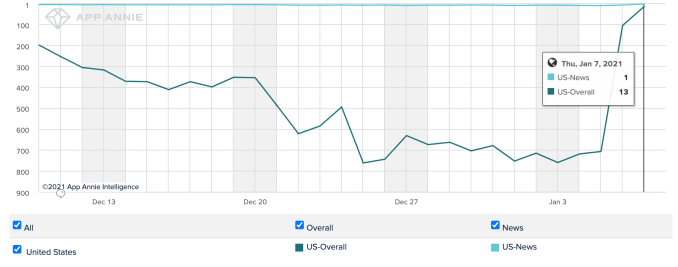
Ahead of its removal, Parler had ranked No. 1 in News on the iPhone App Store and No. 13 Overall, according to data from App Annie. On Friday, it was ranking as high as No. 1, at times, on the iPhone’s Top Charts of free non-game apps, though final data was not available.

Image Credits: App Annie

Typically, when an app is removed from an app store it will continue to function for those who already have it installed. But Parler’s future remains more uncertain than most, as there’s a growing push inside Amazon to pull the plug on Parler, too.

Currently, the app is hosted by Amazon Web Services (AWS), but it appears to be in violation of the AWS Acceptable Use Policy which could serve as grounds for its removal.

The collective action of tech company employees is playing a key role in some of the decisions being made regarding Trump and his supporters’ access to platforms to communicate and organize in the days following the Capitol riots. According to The Washington Post, for example, over 350 Twitter employees signed a letter urging CEO Jack Dorsey and other execs to permanently suspend Trump’s account before the company followed through.

Trump has now lost his ability to post to Facebook, Twitter, Snapchat, and Twitch, to name a few. Meanwhile, Parler’s removal from both app stores will limit the reach of the more radical and violent Trump supporter movement to some extent, forcing them to more obscure corners of the web. However, many argue these measures have come too late, as the damage to not only Capitol, but to the nation’s psyche as whole, has already been done.

Developing…

10 Jan 2021

Apple suspend Parler from App Store

Following reports of a warning to site developers sent earlier this Apple today confirmed that it has pulled right wing social media platform Parler from the App Store.

Apple tells TechCrunch,

We have always supported diverse points of view being represented on the App Store, but there is no place on our platform for threats of violence and illegal activity. Parler has not taken adequate measures to address the proliferation of these threats to people’s safety. We have suspended Parler from the App Store until they resolve these issues.

The news comes shortly after Google banned it from Google Play. The app, which became a home to Trump supporters and several high-profile conservatives in the days leading up the Capitol riots, had been operating in violation of Apple’s rules, we understand. Apple’s App Store guidelines require apps hosting user-generated content to have moderation policies to remove content that incites violence.

Despite these policies, neither Apple nor Google had taken action to remove Parler in prior weeks, even though Trump supporters and other far-right users had used the app to call for violence and organize their plans to storm the Capitol. The insurrection left five people dead, over 50 police officers injured, and more than a dozen facing federal charges, in addition to the growing number of arrests emerging as suspects are identified.

Image Credits: Parler via the App Store

BuzzFeed News on Friday reported Parler had received a letter from Apple which warned that the app would be removed from the App Store within 24 hours, unless the company submitted a content moderation improvement plan.

Apple’s notice read:

“We have received numerous complaints regarding objectionable content in your Parler service, accusations that the Parler app was used to plan, coordinate, and facilitate the illegal activities in Washington D.C. on January 6, 2021 that led (among other things) to loss of life, numerous injuries, and the destruction of property. The app also appears to continue to be used to plan and facilitate yet further illegal and dangerous activities.”

(TechCrunch additionally confirmed BuzzFeed’s reporting.)

Parler CEO John Matze posted about Apple’s ultimatum to his own Parler account, saying he would not cave to “those authoritarians who hate free speech.”

Ahead of its removal, Parler had ranked No. 1 in News on the iPhone App Store and No. 13 Overall, according to data from App Annie. On Friday, it was ranking as high as No. 1, at times, on the iPhone’s Top Charts of free non-game apps, though final data was not available.

Image Credits: App Annie

Typically, when an app is removed from an app store it will continue to function for those who already have it installed. But Parler’s future remains more uncertain than most, as there’s a growing push inside Amazon to pull the plug on Parler, too.

Currently, the app is hosted by Amazon Web Services (AWS), but it appears to be in violation of the AWS Acceptable Use Policy which could serve as grounds for its removal.

The collective action of tech company employees is playing a key role in some of the decisions being made regarding Trump and his supporters’ access to platforms to communicate and organize in the days following the Capitol riots. According to The Washington Post, for example, over 350 Twitter employees signed a letter urging CEO Jack Dorsey and other execs to permanently suspend Trump’s account before the company followed through.

Trump has now lost his ability to post to Facebook, Twitter, Snapchat, and Twitch, to name a few. Meanwhile, Parler’s removal from both app stores will limit the reach of the more radical and violent Trump supporter movement to some extent, forcing them to more obscure corners of the web. However, many argue these measures have come too late, as the damage to not only Capitol, but to the nation’s psyche as whole, has already been done.

Developing…