It seems that even the “free speech” social network Parler has its limits.
The social network that has attracted scores of conservative commentators because of its commitment to free speech has taken down several posts from Trump affiliate Lin Wood, according to a report in Mediaite.
In one of the posts removed from the social media platform, Wood called for the execution of Vice President Mike Pence .
In a statement to Mediaite, Parler chief executive John Matze confirmed that the service had taken action against Wood’s posts to the platform.
“Yes, some of his parleys that violated our rules were taken down,” Matze told Mediaite. “Including the ones you are talking about.”
The move from Parler is significant because it would mark one of the first instances of a high profile conservative figure having their content removed from the service.
Parler, despite its reputation as a social platform dedicated to free speech, does have some rules governing content.
And, as Mediaite flagged, the posts from Wood likely ran afoul of a rule in the company’s terms of service that states “reported parleys, comments, or messages sent using our service will be deemed a violation of these Guidelines if they contain: an explicit or implicit encouragement to use violence, or to commit a lawless action, such that: (a) the Parleyer intends his or her speech to result in the use of violence or lawless action, and (b) the imminent use of violence or lawless action is the likely result of the parley, comment, or message.”
Meanwhile, the incitements to execute Pence seem to have been animating factor for at least some of the rioters who stormed the Capitol building on Wednesday. Reuters Photo News Editor Jim Bourg tweeted about hearing at least three different rioters hoping to “find Vice President Mike Pence and execute him by hanging him from a Capitol Hill tree as a traitor.”
I heard at least 3 different rioters at the Capitol say that they hoped to find Vice President Mike Pence and execute him by hanging him from a Capitol Hill tree as a traitor. It was a common line being repeated. Many more were just talking about how the VP should be executed. https://t.co/fxHREouEWF
Congrats on surviving this wild first week of 2021. Outside all-things political, a few labor developments happened that are worth noting. Also, shortly before the mob of Trump supporters wreaked havoc on the U.S. Capitol, I caught up with Dr. Timnit Gebru, the prominent AI ethics researcher who said she was fired from Google last month for speaking out about diversity issues. Our full conversation will be available to listen to next Saturday on the newest episode of TC Mixtape, but I’ve included some snippets for y’all below.
Sign up here to get Human Capital delivered straight to your inbox every Friday at 1 p.m. PT.
Of the roughly 227 workers who had signed on to support the union as of earlier this week, they all committed to set aside 1% of their yearly compensation to go toward union dues. Those dues will be used to help compensate folks for lost wages in the event of a strike. The bulk of the workers who have signed on are mostly based in offices in the San Francisco Bay Area and one in Cambridge.
To be clear, though, the Alphabet Workers Union is a bit untraditional. The current union consists of just 227 workers out of Alphabet’s 132,121 people. For the Alphabet union, the intent is not necessarily to be able to bargain with Alphabet-owned companies but to be able to work collectively toward common goals.
Labor department issues filing ruling re: gig workers
Earlier this week, the U.S. Department of Labor issued a final rule pertaining to gig workers. The rule, which goes into effect March 8, 2021, makes it easier for gig economy companies like Uber, Lyft, DoorDash and Instacart to legally classify workers as independent contractors throughout the country.
However, it remains to be seen if this rule will fully manifest under the new leadership of President-Elect Joe Biden, who is set to be inaugurated on Jan 20, 2021. According to the Wall Street Journal, Biden spokesperson Jen Psaki previously pointed to the labor rule as an example of regulation Biden could stop or delay on his inauguration day.
“IDG beat the odds to win higher pay and benefits for drivers in New York City and working together, we know we can do the same here in Chicago,” Steven Everett, a Chicago rideshare driver-organizer, said in a statement.
What’s next for Dr. Timnit Gebru
Many of you are likely familiar with Dr. Timnit Gebru, but the TL;DR is that she recently left Google after speaking out about diversity issues in artificial intelligence. Google says Gebru resigned and it merely accepted her resignation, while Gebru says Google fired her.
I caught up with Dr. Gebru on Wednesday to chat about what’s next for her, as well as some recent developments in tech’s labor struggles.
On the Alphabet Workers Union:
This is a combination of a lot of peoples work and frustration. And i think this is the only way because this is a way to give workers power, and so that they can be at the negotiating table, because right now, they don’t have power.
[…] One thing I really appreciate about this union is that it’s all workers. It’s not just, you know, full time workers, it’s temp workers and full-time workers, which is extremely important because the tech industry is right now running on the backs of these contract workers who have zero security.”
[…] What I worry about though, is that [Google has] been extremely aggressive with trying to union bust and trying to stop these kinds of organizing — any type of organizing and now that it’s become something real, I think they’re going to intensify their efforts, like a lot more in trying to stop this organizing from happening. And there are many well-known tactics to do this, right. This kind of like propaganda and kind of dividing and conquering and all that. So that’s my worry. And I think everybody needs to stay vigilant to make sure that that doesn’t happen.
On fighting for severance:
“I don’t know if I’m going to, you know, explain to you exactly what I’m thinking right now about that,” she said, adding that “I definitely have lawyers.”
Obviously, what they did to me was wrong and I definitely want to, you know, take some sort of action but what that is is not necessarily crystal clear.
On working at a tech company again
Prior to joining Google, Dr. Gebru held roles at Apple and Microsoft. While, she still plans to work in the field of artificial intelligence ethics and work with Black in AI, Dr. Gebru said “it’s very hard for me to imagine joining a corporation right now.”
I’m just sick of these institutions because you spend so much of your energy, fighting for simple things, just simple things that people don’t have any incentive to change.
[…] I want to spend more time thinking about how we can have our own institutions rather than just you know, fighting these people over and over again. That’s my current thinking.
Envisioning a firm or a non-profit that does what the ethical AI team at Google was doing under her leadership, but that’s not affiliated with any corporation.
“We want to create technology that would also work for us, rather than just playing catch up,” she said. “So I think that’s the idea of Black in AI.”
Welcome back to The TechCrunch Exchange, a weekly startups-and-markets newsletter. It’s broadly based on the daily column that appears on Extra Crunch, but free, and made for your weekend reading. Click here if you want it in your inbox every Saturday morning.
Ready? Let’s talk money, startups and spicy IPO rumors.
So much for a quiet start to the year.
Any hopes of 2021 giving us respite from the turbulent waters of 2020 went splat, as the first week of the New Year was busy with venture capital deals (Divvy! Gtmhub!), IPO news (Affirm! Poshmark! Roblox!), SPAC news (SoFi! BuzzFeed!), and violence in the American capital. We’ll get to all of that in a minute, minus the political stuff as I don’t have the heart to scream again before the work week is over.
Today we’re starting with two growth stories, one from a company that is nearing IPO scale, and the other from a startup that is just getting its feet underneath it after a product launch.
We’ll start with Cloudinary, a media-focused software company that we covered in early 2020, when the bootstrapped company announced that it had reached $60 million in annual recurring revenue, or ARR. I caught up with the private upstart again this week to check in on what it was like to bootstrap through a pandemic.
Cloudinary co-founder and CEO Itai Lahan told TechCrunch that his company has reached $80 million ARR, or 33% growth during a very busy year. Not bad, right? But according to Lahan, Cloudinary had targeted a number over $90 million for the year. So what happened?
Well, Cloudinary intentionally decelerated a little bit.
Lahan walked TechCrunch through how Cloudinary dealt with the COVID-19 pandemic, which had an impact on parts of its customer base. Lahan and the rest of the company decided to slow down, he said, reducing the pace at which it was hiring, among other initiatives. The goal was to get the company through the pandemic, switch to remote work with its culture intact, he said.
The Exchange is looking for startups between $35 million and $60 million ARR that are growing quickly and are willing to share performance metrics. Email in if that’s you. More on the project here.
The gap between the company’s $80 million ARR result and its original goal was a mix of COVID-19’s commercial impact and the company’s own choices, Lahan said.
When’s the last time I heard the CEO of a private technology company tell me that they were making conscious choices to slow their company down? I honestly don’t remember. Lahan had reasons, however, that went past not having recently raised $100 million or whatever. Instead, the company decided to exchange short-term financial growth for what the CEO described variously as long-term growth or sustainable growth.
Lahan said that if Cloudinary focuses on its customers and employees over short-term financial goals, it will grow more in the next half-decade than it will if it decided to sprint as fast as it could today. One example of the choice to go a little slower in 2020? The company has around 285 people today, under its original plan to have around 320.
Wild, right? This is all possible because Lahan and his team at once don’t have to answer to external investors with short, or medium-term time frames in mind for liquidity, and because Cloudinary makes secondary liquidity available to its workers, alleviating internal agitating for an IPO.
Not that we would mind Cloudinary going public so we could dig into its numbers more deeply. It should cross $100 million ARR this year, so it’s nearly time to start sending it regular, annoying emails.
Now on to our smaller company: OnJuno! If Cloudinary is nearly ready to go public, OnJuno is getting ready to think about a Series A. So it’s just a little bit younger.
TechCrunch first spoke with OnJuno in December, right after it launched, trying to figure out why the world needed another neobank of sorts. According to co-founder Varun Deshpande, OnJuno is targeted at affluent individuals, while other neobanks have more traditionally targeted less-wealthy customers.
OnJuno entices them with higher interest rates, and a focus on what Deshpande described as the more debit-focused Asian American community. How is it going? We checked back in with OnJuno, about three-and-a-half weeks after it launched. Per Deshpande, OnJuno expects to reach the $10 million assets under management (AUM) threshold shortly, with users bringing average deposits of $7,000 to $8,000. That’s a multiple of some other neobanks, the startup said.
The fintech upstart said that it expects to reach $100 million AUM in the next two to three quarters, adding that around 80% of its users come from traditional banks. Let’s see how fast it can reach $25 million AUM, and if its deposit averages hold up.
Now, venture rounds, IPOs news, and then — I am sorry — some SPAC news we need to discuss.
Venture capital
Despite it being the first minutes and hours and days of 2021, so very much happened. To pick an example, we have now seen around a half dozen new unicorns born, with another group in the provisional camp.
On the slightly-smaller-but-still-very-interesting side of the VC coin, Bangalore-based Jumbotail picked up $14.2 million this week to help it pursue what we called “the opportunity to digitize neighborhood stores in the world’s second-largest internet market.” That actually sounds cool? And important?
And in an even smaller round, Atlanta, Georgia-based Voxie raised a $6.7 million in Series A. Voxie “offers tools to help businesses automate and manage” their text message-based marketing. This shows how much space there still is in the software market for new startups. I would have bet you an espresso that we had tapped out the text messaging startup space three years ago. Nope!
Zooming out from our regular coverage of IPOs, here’s what you need to know: Affirm and Poshmark are pursuing traditional IPOs at huge markups to their final private valuations. That means that the 2021 IPO market is kicking off like a mirror to the late-2020 IPO market. Expect some big pops in coming months for some companies you know by name.
The other bit of news that matters is that Roblox has scrapped its IPO plans, raised an enormous brick of cash, and now intends to direct list. Why is a perfectly fine question to ask, and one that we tried to answer here.
Takeaways? The IPO market will be active, and perhaps more diverse than expected in 2021. At least to start.
SPACs (alas)
While you are tired and bored of SPACs, and I am as well, they are actually doing things at last that we do care about. In brief to respect your time and sanity:
SoFi might go public via a SPAC, you can read the investor deck here, which seems dumb. Why not just go public? But as Chamath is involved, this one is going to do a lot of press.
Lots of venture capital funds raised capital, which we yammered about here on the podcast. But I wanted to throw one more into the mix: Transformation Capital, which put together a $500 million fund focused on digital health.
The nice thing about thematic funds, like this and USV’s new climate fund, is that you actually know what they do. Which in the case of Transformation Capital, is investing “investing in commercial-stage digital health companies,” in its own words. Word.
This is the second such fund from the group, which now has $800 million under management. Cool.
Want this newsletter in your inbox every Saturday morning? Sign up here.
In the past few months, there hasn’t been one conversation I’ve had about remote work that doesn’t include a mention of Hopin, a virtual events platform last valued at $2.1 billion.
For a company only a little older than a year, Hopin has a wild growth story. It grew its ARR from $0 to $20 million in nine months. It scooped up two businesses to differentiate its business, including StreamYard for $250 million just this week. And its last financing round left the company’s valuation at $2.1 billion.
Hopin’s growth amid Zoom’s fatigue is giving validation to a whole crop of remote-work-focused startups. I see startups in the category sitting in two camps: Either you’re betting that users want a more passive way to interact with video or you’re betting that users want a more active way to interact with video.
This week, for example, I wrote about Rewatch, which creates internal private channels for startups to archive all their videoconferencing meetings. The company is essentially turning live meetings into transcribed documents that employees can sift through on their own time, shifting from synchronous to asynchronous.
In contrast, I also covered Teamflow, a platform that wants to give a virtual space to companies to recreate the serendipity and productivity of an office. Unlike Rewatch, Teamflow thinks that employees want there to be more live moments in a distributed world.
Both previously in-stealth companies cited Hopin as an example of the need for innovation around how we interact virtually. Rewatch and Teamflow, respectively, see Zoom as a plug-in or competitor – not inspiration.
As I mentioned in this week’s podcast, it’s a dynamic I expect to play out even more over the next few months, as we evolve from a Zoom world to a Zoom alternative world. I want to hear from you, even if you disagree, about what companies in the remote work space should be on my radar. E-mail me at natasha.mascarenhas@techcrunch.com or tweet me @nmasc_ with companies you think should be on my remote-work radar.
The power of platform
This week, the U.S. Capitol building was stormed by pro-Trump insurrectionists in a fatal riot. Many in the tech community blamed Jack Dorsey and Mark Zuckerberg for not limiting hate speech on their respective platforms, thus stoking flames of domestic terrorism.
Sticking to our government and tech theme, P&G has officially terminated its plan to acquire razor startup, Billie, after the FTC sued over antitrust concerns.
Here’s what to know: Billie was founded in 2017 with the goal of fighting the “pink tax” on goods marketed to women, including razors and body wash. It was going to be acquired by P&G after raising just $35 million in venture capital.
Etc: Direct-to-consumer brands are not happy. The failed deal is not-so-subtly signaling to DTC brands that there is a cap to their scale, at least in the FTC’s eyes. Government regulation and limited scale also could hurt VC interest in the category.
Many product-based brands, as it turns out, are no longer interested in chasing venture capital, playing the “grow-at-all-costs” game and relinquishing partial control to investors, despite the pandemic and the uncertain circumstances many founders find themselves facing.
Image Credits: Billie
IPOs, a direct listing, and sky-high valuations
My colleague Alex puts together a brilliant newsletter each week after his column, The Exchange. Subscribe to it for his in-depth analysis on the IPO market and late-stage startups. In the meantime, though…
If you’re new here, welcome! Equity is TechCrunch’s venture capital-focused podcast. I chat with Alex and Danny about the most important tech news each week, from early-stage startups to IPOs, and crack a few jokes in the meantime. Produced by Chris, Equity is a perfect appetizer to this newsletter.
Despite your wishes for a slower and perhaps more uneventful year, tech clearly isn’t slowing down in 2021. The Equity team had a mountain of news to get through, from Twitter’s very active checkbook to a $185 million Series A round.
Users are surging on small, conservative, social media platforms after President Donald Trump’s ban from the world’s largest social networks, even as those platforms are seeing access throttled by the app marketplaces of tech’s biggest players.
Parler saw approximately 210,000 installs globally on Friday 1/8, up 281% from approximately 55,000 on 1/7, according to data from the analytics service Sensor Tower. “In the U.S., the app saw approximately 182,000 first-time downloads on 1/8, up 355% from about 40,000 installs on 1/7. Since Wednesday, the app has seen approximately 268,000 installs from across U.S. app stores,” a press rep from Sensor Tower wrote in an email.
Parler’s ballooning user base comes at a potentially perilous time for the company. It has already been removed from Google’s Play store and Apple is considering suspending the social media app as well if it does not add some content moderation features.
Both Parler and Gab have billed themselves as havens for free speech, with what’s perhaps the most lax content moderation online. In the past the two companies have left up content posted by an alleged Russian disinformation campaign, and allow users to traffic in conspiracy theories that other social media platforms have shut down.
The expectation with these services is that users on the platforms are in charge of muting and blocking trolls or offensive content, but, by their nature, those who join these platforms will generally find themselves among like-minded users.
Their user counts might be surging, but would-be adopters may soon have a hard time finding the services.
On Friday night, Google said that it would be removing Parler from their Play Store immediately — suspending the app until the developers committed to a moderation and enforcement policy that could handle objectionable content on the platform.
In a statement to TechCrunch, a Google spokesperson said:
“In order to protect user safety on Google Play, our longstanding policies require that apps displaying user-generated content have moderation policies and enforcement that removes egregious content like posts that incite violence. All developers agree to these terms and we have reminded Parler of this clear policy in recent months. We’re aware of continued posting in the Parler app that seeks to incite ongoing violence in the US. We recognize that there can be reasonable debate about content policies and that it can be difficult for apps to immediately remove all violative content, but for us to distribute an app through Google Play, we do require that apps implement robust moderation for egregious content. In light of this ongoing and urgent public safety threat, we are suspending the app’s listings from the Play Store until it addresses these issues.“
On Friday, Buzzfeed News reported that Parler had received a letter from Apple informing them that the app would be removed from the App Store within 24 hours unless the company submitted an update with a moderation improvement plan. Parler CEO John Matze confirmed the action from Apple in a post on his Parler account where he posted a screenshot of the notification from Apple.
“We want to be clear that Parler is in fact responsible for all the user generated content present on your service and for ensuring that this content meets App Store requirements for the safety and protection of our users,” text from the screenshot reads. “We won’t distribute apps that present dangerous and harmful content.
Parler is backed by the conservative billionaire heiress Rebekah Mercer, according to a November report in The Wall Street Journal. Founded in 2018, the service has experienced spikes in user adoption with every clash between more social media companies and the outgoing President Trump. In November, Parler boasted some 10 million users, according to the Journal.
Users like Fox Business anchor Maria Bartiromo and the conservative talk show host Dan Bongino, a wildly popular figure on Facebook who is also an investor in Parler, have joined the platform. In the Journal article Bongino called the company “a collective middle finger to the tech tyrants.”
Sarah Perez and Lucas Matney contributed additional reporting to this article.
Welcome back to This Week in Apps, the weekly TechCrunch series that recaps the latest in mobile OS news, mobile applications and the overall app economy.
The app industry is as hot as ever, with a record 204 billion downloads and $120 billion in global consumer spend in 2019. Consumer spend also hit a record $112 billion across iOS and Android alone.
Not including third-party Chinese app stores, iOS and Android users downloaded 130 billion apps in 2020. Due to COVID-19, time spent in apps jumped 25% year-over-year on Android.
To varying degrees, social apps had to quickly figure out where to draw the line on allowing Trump to continue to use their platforms this week, after his false claims about a rigged election led Trump supporters to storm the U.S. Capitol on Wednesday, destroying property, stealing at least one computer, potentially gaining access to other unlocked computers and causing chaos that led to five deaths, including a Capitol Police officer who has now died of injuries sustained on duty.
Social platforms, however, have been complicit in allowing these dangerous and radicalized groups to emerge in the first place. Facebook, for example, allowed StoptheSteal and Secession groups to organize using its platform. It also waited years to sweep the platform of QAnon groups, and then didn’t even finish the job — these disinformation networks remain live on the platform today. But even smaller gestures aimed at cleaning up the mess of a platform that prioritized ad dollars over safety led some Trump supporters to flee to other social media networks used by the far-right, such as Gab and Parler. There, they could post even more violent rhetoric without repercussions.
Following the riot, Facebook CEO Mark Zuckerberg announced Trump would be banned from both Facebook and Instagram for two weeks. Twitter initially locked Trump’s account on Wednesday, then allowed him to return after deleting a few tweets, noting that another violation would result in permanent suspension. On Friday, it permanently banned Trump, and his other close associates.
Both also removed Trump’s video where he showed support for rioters, telling them to go home but also “we love you, you’re very special.”
TikTok, though obviously not used by Trump, took down re-shares of Trump’s video, but allowed counter speech against it and some posts by news organizations. And it proactively blocked the hashtags used by rioters. Snapchat locked Trump’s account as well, and Twitch disabled him until the end of his term.
New social apps and startups with social features will often mimic the general approaches of the large platforms as they craft their own content policies. But human rights organizations argue that what’s being done is not enough.
Said activist group Color of Change this week, “Mark Zuckerberg does not deserve applause for taking action at the 11th hour, after years of damage has already been done. Facebook is unquestionably complicit in the violent insurrection on Capitol Hill yesterday, and in the erosion of our democracy that’s continued to unfold in plain sight.”
The group is urging for Trump’s permanent ban from Facebook and for the network to “take action against his enablers and allies who continue to use the platform to incite violence and spread dangerous misinformation.”
App Stores take action on Parler
On Friday, Buzzfeed News reported Parler had received a letter from Apple that said they had 24 hours to come up with a moderation plan for the app, otherwise it would be banned from the App Store. Google Play, however, more quickly banned the app on Friday until the company could commit to a moderation and enforcement policy to handle objectionable content on its network.
Google’s statement reads as follows:
“In order to protect user safety on Google Play, our longstanding policies require that apps displaying user-generated content have moderation policies and enforcement that removes egregious content like posts that incite violence. All developers agree to these terms and we have reminded Parler of this clear policy in recent months. We’re aware of continued posting in the Parler app that seeks to incite ongoing violence in the US. We recognize that there can be reasonable debate about content policies and that it can be difficult for apps to immediately remove all violative content, but for us to distribute an app through Google Play, we do require that apps implement robust moderation for egregious content. In light of this ongoing and urgent public safety threat, we are suspending the app’s listings from the Play Store until it addresses these issues.“
Parler had been one of the places where Trump supporters and other extremists to organized their plans to storm the Capitol this week as well as plan future attacks. Posts on Parler, which has a looser moderation policy compared with Twitter, often call for people’s deaths and even for Civil War.
Several high-profile conservatives, including members of Trump’s family, had been participating on Parler, following the increased enforcement of various polices against election misinformation and false claims about COVID-19, among other things, on mainstream social platforms.
It is not unusual for Apple and Google to take action against apps with harmful content, though one has to wonder why it took a deadly insurrection aimed at toppling U.S. democratic processes for them to care.
U.S. bans transactions with Chinese payments apps
Ahead of the violence at the Capitol this week, the Trump administration continued its crackdown on Chinese mobile applications. Via an executive order signed on Tuesday, the U.S. banned transactions with eight Chinese mobile apps, including Ant Group’s Alipay mobile payment app, Reuters first reported.
Others named in the order include CamScanner, SHAREit, Tencent QQ, VMate (published by Alibaba Group subsidiary UCWeb) and Beijing Kingsoft Office Software’s WPS Office.
The move is meant to cut off China’s access to U.S. user data, including, per the order, the ability for China to “track the locations of federal employees and contractors” and “build dossiers of personal information.”
The administration had previously banned TikTok and WeChat, but U.S. courts blocked the orders from going into effect.
FTC settles with Tapjoy over deceptive practices, but lays blame at feet of app store gatekeepers
Image Credits: Tapjoy
Mobile advertising company Tapjoy settled with the U.S. Federal Trade Commission over allegations that it was misleading consumers about the in-app rewards they could earn in mobile games. The FTC said Tapjoy deceived consumers who participated in various activities — like purchasing a product, signing up for a free trial, providing their personal information like an email address or completing a survey — in exchange for in-game virtual currency. But when it was time to pay up, Tapjoy’s partners didn’t deliver.
The order will now require Tapjoy to follow up on complaints and monitor to ensure that offers are delivered, or face further fines of up to $43,280 per each violation.
Tapjoy serves as a middleman between developers, consumers and advertisers, and is one of many “offerwall”-based mobile ad networks available today.
Mobile game developers integrate Tapjoy’s technology to display ads — aka “offers” — to their customers, in order to earn payments for their users’ activity. When the consumer completes the offer by taking whatever action was required, they’re supposed to earn in-game coins or other virtual currency. The app developers then earn a percentage of that ad revenue. But the FTC said that would often not happen, and Tapjoy ignored hundreds of thousands of consumer complaints.
Though Tapjoy was the business being held accountable in the FTC’s ruling, the Commissioners harshly scolded the “rent-seeking” app store business model for allowing networks like Tapjoy to rise in the first place. Using language that strongly hinted that regulation of the app stores was on the way, the Commissioners scolded the app stores’ “vast power to impose taxes and regulations on the mobile gaming industry.”
“This market structure also has cascading effects on gamers and consumers,” the ruling stated. “Under heavy taxation by Apple and Google, developers have been forced to adopt alternative monetization models that rely on surveillance, manipulation, and other harmful practices,” it said.
Apple is being given a lot of credit in recent weeks for its privacy push, with the launch of its so-called app store “nutrition labels” that help to better highlight the bad actors in the mobile app market. But some of the recent reporting neglects to explain why these alternative business models rose in the first place or detail how Apple will financially benefit from the shift to subscriptions that will result from the mobile ad clampdown. It’s also rarely noted that Apple itself serves behavioral advertising within its own apps that is based on the user data it collects from across its catalog of first-party apps and services. That’s not to say that Apple isn’t doing a service with its privacy push, but it’s a complex matter. This isn’t sports; you don’t have to pick one side or the other.
The FTC then not-too-subtly warned Apple and Google that it “will need to use all of its tools — competition, consumer protection, and data protection — to combat middlemen mischief, including by the largest gaming gatekeepers.”
Weekly News
Platforms: Apple & Google
Google says it will add privacy labels to its app either this week or the next, following a report that claimed it hadn’t updated its app since Apple’s new labeling requirements.
iOS 14.4 beta indicates guided audio walking workouts are on the way to Apple Watch.
Quibi returns. Okay, not exactly. Instead, the content catalog from the deceased mobile streaming app has been bought by Roku, which will stream it for free in its The Roku Channel this year, including The Roku Channel app.
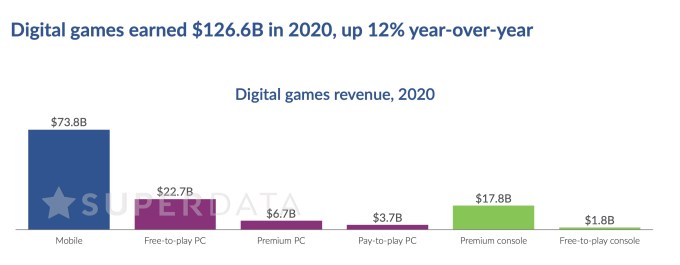
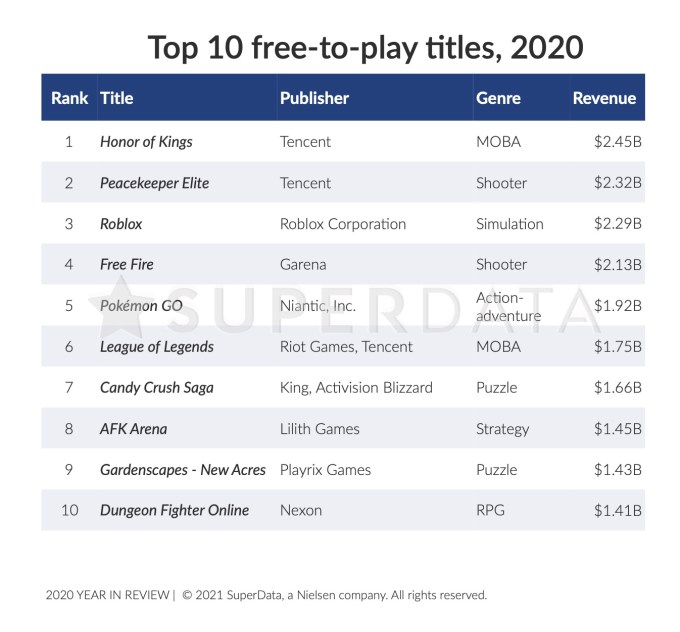
Mobile games accounted for 58% of the total gaming market in 2020, up 10% year-over-year, according to SuperData’s annual report. They also accounted for the majority of the revenue, at $73.8 billion, compared with $33.1 billion for PC games and $19.7 billion for console games. Mobile games were also eight out of 10 of the top free-to-play titles, led by Honor of Kings.
TikTok launches its first AR effect to leverage the LiDAR Scanner in iPhone 12 Pro and Pro Max. The effect arrived for New Year’s and involves a dropping ball, similar to the one in Times Square, that explodes with confetti. Thanks to the LiDAR Scanner’s tech, the confetti can fall on the furniture in the room much as it would in real life.
To ring in 2021 we released our first AR effect on the new iPhone 12 Pro, using LiDAR technology which allows us to create effects that interact with your environment – visually bridging the digital and physical worlds. We're excited to develop more innovative effects in 2021! pic.twitter.com/6yFD2FfHta
WhatsApp is working on multi-device support, according to references found in its 2.21.1.1 beta on Android.
Facebook reminds businesses it will have to comply with App Tracking Transparency in iOS 14, according to a recent email it sent them. The email states the change will hurt “the industry and the ability for businesses of all sizes to market themselves efficiently.”
Health & Fitness
Singapore confirmed its police can obtain COVID-19 tracing data to aid in criminal investigations via the TraceTogether app, used by more than 4.2 million residents.
Deadpool
Alibaba shuts down 12-year-old music streaming app Xiami, acquired in 2013.
Twitter to shut down podcast app Breaker following acquisition.
Microsoft will shut down Minecraft Earth AR game in June, due to pandemic.
BBVA to shut down neobank Simple, acquired in 2014. Users to be transferred to BBVA USA, which is merging with PNC.
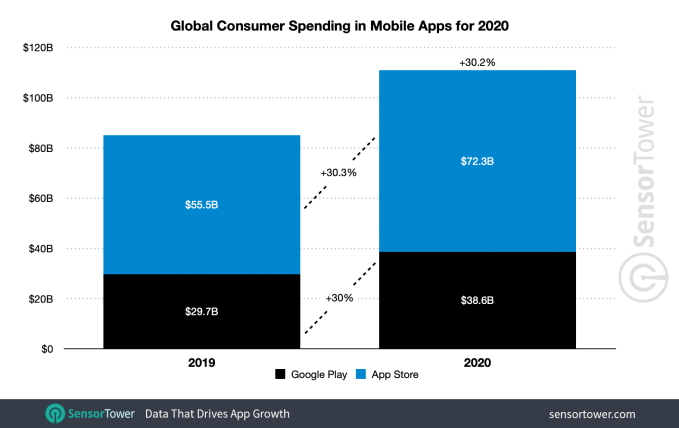
Global mobile app spending reached nearly $111 billion in 2020, up 30.2% year-over-year, according to Sensor Tower. The App Store accounted for the majority of the spending at $72.3 billion, up 30.3% from $55.5 billion in 2019.
First-time installs set a new record in 2020, with 143 billion installs across the App Store and Google Play combined.
European mobile app spending grew 31% in 2020 to reach $14.8 billion, also according to Sensor Tower, representing a 31% year-over-year increase. The App Store drove the majority of the spending at $8 billion.
Apptopia pulled data to create charts of 2020’s top downloaded apps across 20 different categories, both for U.S. and global apps. It also released top grossing charts for apps, games and “health & fitness” apps.
CNBC estimates App Store gross revenue was over $64 billion in 2020. The estimate uses the figures Apple released on Wednesday about money paid to developers to back out roughly how much revenue the App Store made.
Apple said its customers spent $1.8 billion during the week of Christmas Eve through New Year’s Day. App Store customers also set a new single-day spending record on New Year’s Day by more than $540 million.
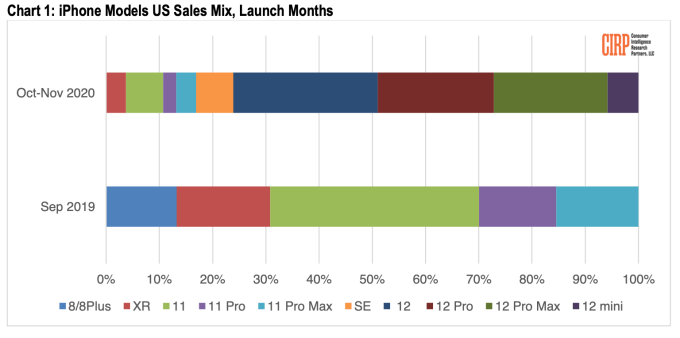
New CIRP data says the iPhone 12 models accounted for 76% of new iPhone sales from October-November 2020. The iPhone 12 mini only accounted for 6% of sales, however.
Cross-platform gaming company Roblox raises $520 million in a round led by Altimeter Capital and Dragoneer Investment Group ahead of its planned IPO. The new round values the business at $29.5 billion.
Perfect Corp. raises $50 million Series C led by Goldman Sachs. The company develops the virtual beauty app YouCam Makeup app along with other AR makeup products, including those now embedded in Google Search.
Local news app News Break raises $115 million in a round led by Francisco Partners. IDG also participated. The Mountain View-based company has roots in China, where founder Jeff Zheng previously led Yahoo Labs in Beijing, and has team members in Shanghai. But the majority are in the U.S.
Quantum Metric raises $200 million for its platform that helps companies improve their website and apps with real-time feedback from end users. It captures data at the session level, which can then be played back to see how customers interacted with the site or app.
(IPO) Poshmark plans to price its IPO between $35 and $39 per share, potentially valuing the business at $3 billion.
Indonesian robo-advisor app Bibit raises $30 million in round led by Sequoia Capital India.
AR gaming company Niantic acquires competitive gaming platform Mayhem for an undisclosed price. Mayhem had participated in YC’s winter 2018 batch before raising $5.7 million for its league and tournament organization platform.
Fortnite maker Epic Games acquires Rad Game Tools, the maker of game development tools. The companies had worked together, as Epic had used Rad Game Tools’ compression tech to speed the load time for Fortnite.
Indian social network ShareChat said to be raising funds from Google and Snap.
New app Overviewer, reviewed here by 9to5Mac, turns an iOS device into a document camera for sharing content on video conferencing apps, like Zoom. The app makes for a good companion for teachers doing virtual learning as well as businesses. The app was created by Dark Noise app developer Charlie Chapman.
Textcraft
Image Credits: TextCraft
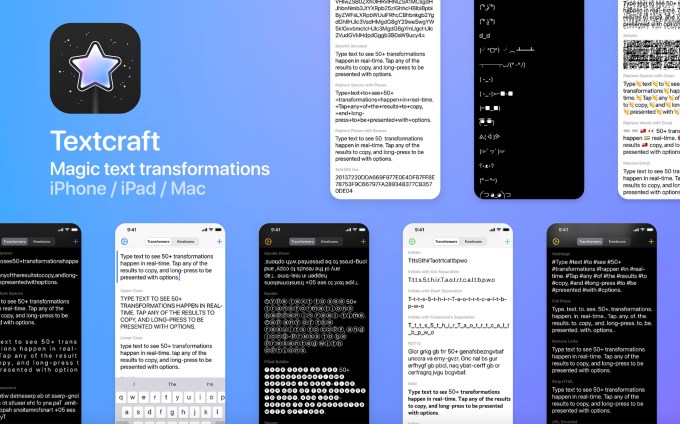
Want an easier way to insert the clapping hands emoji into your online rants, type text as bubbled letters, type In aLtErNaTe cAsE, in hashtags, in superscript or anything else? The new Textcraft app can help. The app allows you to type in the text then copy and paste or share any one of its over 50 text transformations. The app is well-designed with support for dark mode, drag-and-drop on iPad, and other macOS design guidelines in mind when using it across platforms.
According to a tween who reviewed the app for me: “This is cool. I want it.” They then ignored me as they played with it. I think that’s a good sign. (Paid download of $6.99 on iOS, iPad and Mac).
Discovery+
Image Credits: Discovery
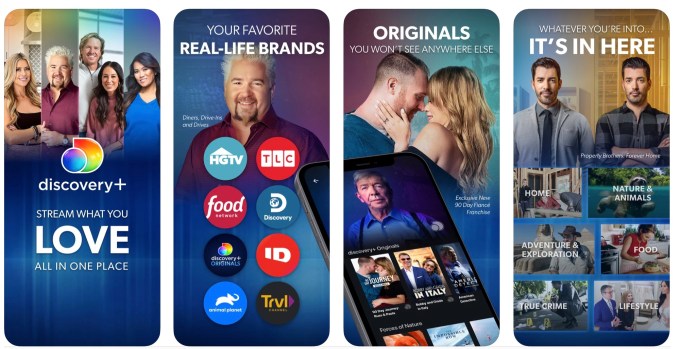
If you’ve binged it all during the pandemic, there’s a new option for you. Discovery+ launched this week, bringing Discovery’s networks — HGTV, Food Network, TLC, ID, OWN, Travel Channel, Discovery Channel and Animal Planet — to a $5 per month subscription video on demand service. (Or $7 if you don’t want ads.)
The app also includes some non-Discovery content, like nature documentaries from the BBC and programming from A&E, The History Channel and Lifetime.
If home renovation, travel and reality are your escapist favs, this could be the app for you.
Wellnest
Image Credits: Wellnest
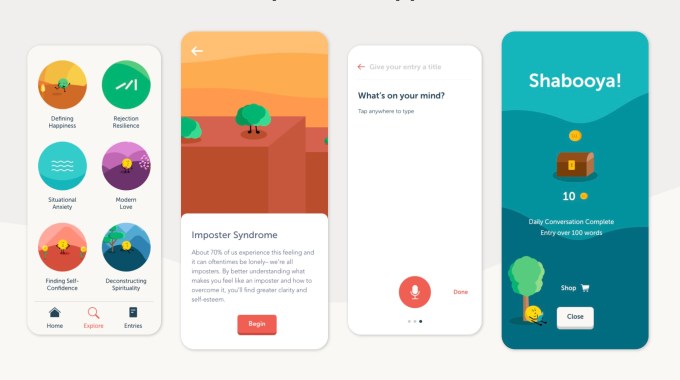
It’s been a stressful week. Maybe it’s time for some self-care? Guided journaling app Wellnest is helping users prioritize their mental health using game design techniques. The app offers deep dive question sets, daily prompts, mood check-in, speech to text, insights and more, wrapped up in a colorful and simple package. The app is a free download, then $24 per year or $5 per month for full access.
After years of placid admonishments, the tech world came out in force against President Trump this past week following the violent assault of the U.S. Capitol building in Washington D.C. on Wednesday. From Twitter to PayPal, more than a dozen companies have placed unprecedented restrictions or outright banned the current occupant of the White House from using their services, and in some cases, some of his associates and supporters as well.
The news was voluminous and continuous for the past few days, so here’s a recap of who took action when, and what might happen next.
Twitter: a permanent ban and a real-time attempt to shut down all possible account alternatives
Twitter has played a paramount role over the debate about how to moderate President Trump’s communications, given the president’s penchant for the platform and the nearly 90 million followers on his @realDonaldTrump account. In the past, Twitter has repeatedly warned the president, added labels related to electron integrity and misinformation, and outright blocked the occasional tweet.
At first, it looked like the situation would return to normal, with Twitter offering Thursday morning that it would reinstate the president’s account after he removed tweets the company considered against its policies around inciting violence. The president posted a tweet later on Thursday with a video attachment that seemed to be relatively calmer than his recent fiery rhetoric, a video in which he also accepted the country’s election results for the first time.
Enormous pressure externally on its own platform as well as internal demands from employees kept the policy rapidly changing though. Late Friday night, the company announced that it decided to permanently ban the president from its platform, shutting down @realDonaldTrump. The company then played a game of whack-a-mole as it blocked the president’s access to affiliated Twitter handles like @TeamTrump (his official campaign account) as well as the official presidential account @POTUS and deleted individual tweets from the president. The company’s policies state that a blocked user may not attempt to use a different account to evade its ban.
As for Trump himself, a permanent ban from his most prominent platform begs the question: where will he take his braggadocio and invective next? So far, we haven’t seen the president move his activities to any social network alternatives, but after the past few years (and on Twitter, the last decade), it seems hard to believe the president will merely return to his golf course and quietly ride out to the horizon.
Snap: a quick lock after dampening the president’s audience for months
Snap locked the president’s account late Wednesday following the events on Capitol Hill, and seemed to be one of the most poised tech companies to rapidly react to the events taking place in DC. Snap’s lock prevents the president from posting new snaps to his followers on the platform, which currently number approximately two million. As far as TechCrunch knows, that lock remains in place, although the president’s official profile is still available to users.
Following the death of George Floyd in Minneapolis and the concomitant Black Lives Matter protests, the company had announced back in June that it would remove the president’s account from its curated “Discover” tab, limiting its distribution and discoverability.
The president has never really effectively used the Snap platform, and with an indefinite ban in place, it looks unlikely he will find a home there in the future.
Facebook / Instagram: A short-to-medium ban with open questions on how long “indefinite” means
Facebook, like Twitter, is one of the president’s most popular destinations for his supporters, and the platform is also a locus for many of the political right’s most popular personalities. It’s moderation actions have been heavily scrutinized by the press over the past few years, but the company has mostly avoided taking direct action against the president — until this week.
On Wednesday as rioters walked out of the halls of Congress, Facebook pulled down a video from President Trump that it considered was promoting violence. Later Wednesday evening, that policy eventually extended into a 24-hour ban of the president’s account, which currently has 33 million likes, or followers. The company argued that the president had violated its policies multiple times, automatically triggering the one-day suspension. At the same time, Facebook (and Instagram) took action to block a popular trending hashtag related to the Capitol riots.
On Thursday morning, Mark Zuckerberg, in a personal post on his own platform, announced an “indefinite” suspension for the president, with a minimum duration of two weeks. That timing would neatly extend the suspension through the inauguration of president-elect Biden, who is to assume the presidency at noon on January 20th.
What will happen after the inauguration? Right now, we don’t know. The president’s account is suspended but not deactivated, which means that the president cannot post new material to his page, but that the page remains visible to Facebook users. The company could remove the suspension once the transition of power is complete, or it may continue the ban longer-term. Given the president’s prominence on the platform and the heavy popularity of the social network among his supporters, Facebook is in a much more intense bind between banning content it deems offensive, and retaining users important to its bottom line.
Shopify / PayPal: Ecommerce platforms won’t sell Trump official merchandise for the time being
It’s not just social networks that are blocking the president’s audience — ecommerce giants are also getting into moderating their platforms against the president. On Thursday, Shopify announced that it was removing the storefronts for both the Trump campaign and Trump’s personal brand.
Given the president’s well-known personal brand and penchant for product tie-ins before becoming president, it’s a major open question about how these two platforms and others in ecommerce will respond to Trump once he leaves office in two weeks. Will the president go back to shilling steaks, water and cologne? And will he need an ecommerce venue to sell his wares online? Much will depend on Trump’s next goals and whether he stays focused on politics, or heads back to his more commercial pursuits.
Google removes Parler from the Google Play Store, while Apple mulls a removal as well
For supporters of Trump and others concerned about the moderation actions of Facebook and other platforms, Parler has taken the lead as an alternative social network for this audience. Right now, the app is number one in the App Store in the United States, ahead of encrypted and secure messaging app Signal, which is at number four and got a massive endorsement from Elon Musk this week.
Parler’s opportunism for growth around the riots on Capitol Hill though has run into a very real barrier: the two tech companies which run the two stores for mobile applications in the United States.
Google announced Friday evening that it would be removing the Parler app from its store, citing the social network’s lack of moderation and content filtering capabilities. The app’s page remains down as this article was going to press. That ban means that new users won’t be able to install the app from the Play Store, however, existing users who already have Parler installed will be able to continue using it.
Meanwhile, Buzzfeed reports that Apple has reportedly sent a 24-hour takedown notice to Parler’s developers, saying that it would mirror Google’s actions if the app didn’t immediately filter content that endangers safety. As of now, Parler remains available in the App Store, but if the timing is to be believed, the app could be taken down later this Saturday.
Given the complexities of content moderation, including the need to hire content moderators en masse, it seems highly unlikely that Parler could respond to these requests in any short period of time. What happens to the app and the president’s supporters long-term next is, right now, anyone’s guess.
Discord / Twitch / YouTube / Reddit / TikTok: All the socials don’t want to be social anymore with President Trump
Finally, let’s head over to the rest of the social networking world, where Trump is just as unpopular as he is at Facebook and Twitter HQ these days. Companies widely blocked the president from accessing their sites, and they also took action against affiliated groups.
This week’s latest policy change is an escalation from the company’s previous approach, and would result in lengthier and lengthier temporary suspensions for each additional strike that a channel receives. Those strikes could eventual result in a permanent ban for a YouTube channel if they happen within a set period of time. That’s precisely what happened with Steve Bannon’s channel, which was permanently banned Friday late afternoon for repeated violations of YouTube’s policies. Meanwhile, President Trump’s official channel has less than 3 million followers, and is currently still available for viewing on the platform.
Outside YouTube, Twitch followed a similar policy to Facebook, announcing Thursday morning that it would ban the president “indefinitely” and at least through the inauguration on January 20th. The president has a limited audience of just about 151,000 followers on the popular streaming platform, making it among the least important of the president’s social media accounts.
Lastly, TikTok announced on Thursday that it was limiting the spread of some information related to the Capitol riots, including redirecting hashtags and removing violent content as well as the president’s own video message to supporters. The president does not have a TikTok account, and therefore, most of the company’s actions are focused on his supporters and broader content surrounding the situation on Capitol Hill this week.
Hello and welcome back to Equity, TechCrunch’s venture-capital-focused podcast, where we unpack the numbers behind the headlines. We’re back on this lovely Saturday with a bonus episode!
The normal crew assembled, including Alex, Natasha, Danny, and Chris, to chatter about a chunk of creator and gamer news. And some big numbers, the sorts that we always find fun to chat about.
A sneak peek at what we discussed during this second-ever Equity Leftovers:
Roblox’s epic pre-IPO raise, and its decision to go public through direct listing instead of the IPO that it had previously planned.
Nintendo buying a gaming studio, leading the crew to declare that the famous company is the Disney of video games.
Cameo, which allows fans to pay celebrities for personalized messages, is on a hiring spree after bringing in $100 million in transactions last year. The Information says that the company is seeking funding, which isn’t entirely surprising. Axios reports that it has brought in a couple high-profile hires, as well.
Back to our regular schedule Monday! Chat then!
Equity drops every Monday at 7:00 a.m. PST and Thursday afternoon as fast as we can get it out, so subscribe to us on Apple Podcasts, Overcast, Spotify and all the casts.
Twitter permanently banned the U.S. president Friday, taking a dramatic step to limit Trump’s ability to communicate with his followers. That decision, made in light of his encouragement for Wednesday’s violent invasion of the U.S. Capitol, might seem sudden for anyone not particularly familiar with his Twitter presence.
In reality, Twitter gave Trump many, manysecond chances over his four years as president, keeping him on the platform due to the company’s belief that speech by world leaders is in the public interest, even if it breaks the rules.
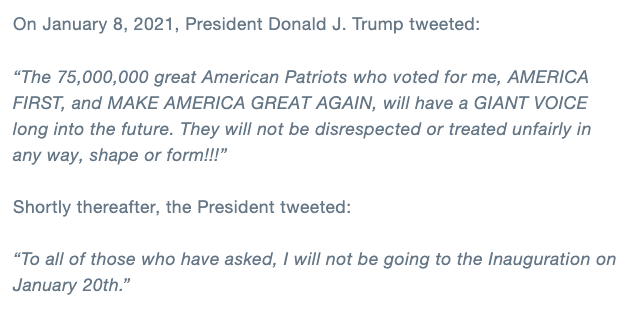
In that deep dive, the company explains that it gave Trump one last chance after suspendingand then reinstating his account for violations made on Wednesday. But the following day, a pair of tweets the president made pushed him over the line. Twitter said those tweets, pictured below, were not examined on a standalone basis, but rather in the context of his recent behavior and this week’s events.
“… We have determined that these Tweets are in violation of the Glorification of Violence Policy and the user @realDonaldTrump should be immediately permanently suspended from the service,” Twitter wrote.
“President Trump’s statement that he will not be attending the Inauguration is being received by a number of his supporters as further confirmation that the election was not legitimate and is seen as him disavowing his previous claim made via two Tweets (1, 2) by his Deputy Chief of Staff, Dan Scavino, that there would be an ‘orderly transition’ on January 20th.
“The second Tweet may also serve as encouragement to those potentially considering violent acts that the Inauguration would be a ‘safe’ target, as he will not be attending.
“The use of the words ‘American Patriots’ to describe some of his supporters is also being interpreted as support for those committing violent acts at the US Capitol.
“The mention of his supporters having a ‘GIANT VOICE long into the future’ and that ‘They will not be disrespected or treated unfairly in any way, shape or form!!!’ is being interpreted as further indication that President Trump does not plan to facilitate an ‘orderly transition’ and instead that he plans to continue to support, empower, and shield those who believe he won the election.
“Plans for future armed protests have already begun proliferating on and off-Twitter, including a proposed secondary attack on the US Capitol and state capitol buildings on January 17, 2021.”
All of that is pretty intuitive, though his most fervent supporters aren’t likely to agree. Ultimately these decisions, as much as they do come down to stated policies, involve a lot of subjective analysis and interpretation. Try as social media companies might to let algorithms make the hard calls for them, the buck stops with a group of humans trying to figure out the best course of action.
Twitter’s explanation here offers a a rare totally transparent glimpse into how social networks decide what stays and what goes. It’s a big move for Twitter — one that many people reasonably believe should have been made months if not years ago — and it’s useful to have what is so often an inscrutable high-level decision making process laid out plainly and publicly for all to see.
After Twitter took the major step Friday of permanently banning President Trump’s @realdonaldtrump Twitter account, the President aimed to get the last word in through his government account @POTUS which has a fraction of the Twitter followers but still offered the President a megaphone on the service to send out a few last tweets.
The tweets were deleted within minutes by Twitter which does not allow banned individuals to circumvent a full ban by tweeting under alternate accounts.
In screenshots captured by TechCrunch, Trump responds to the account ban by accusing Twitter employees of conspiring with his political opponents. “As I have been saying for a long time, Twitter has gone further and further in banning free speech, and tonight, Twitter employees have coordinated with the Democrats and Radical Left in removing my account from their platform, to silence me — and YOU, the 75,000,000 great patriots who voted for me.”
The President’s rant further contends that he will soon be joining a new platform or starting his own. Many contended Trump would join right wing social media site Parler following the ban, though Friday afternoon the site was removed from the Google Play Store with the company saying Apple had threatened to suspend them as well.
“We have been negotiating with various other sites, and will have a big announcement soon, while we also look at the possibilities of building out our own platform in the near future,” other tweets from the @POTUS account read in part.

 (@HipCityReg)