Year: 2021

08 Jan 2021

Tencent investment stays on game in 2020

It’s no secret that Tencent, the Chinese tech giant behind WeChat and a handful of blockbuster video games, is an aggressive investor. Even during 2020 when the pandemic slowed down economic activity in many parts of the world, Tencent was charging ahead with its investment ambitions.

During the year, the company participated in more than 170 funding rounds that amounted to a total of 249.5 million yuan ($38 million), according to the Chinese startup database ITJuzi. That made 2020 the most active year to date for Tencent’s investment team, which had been delivering superior results in the last decade.

By January 2020, over 70 of Tencent’s 800 portfolio companies had gone public and more than 160 of them surpassed $100 million in valuation, Martin Lau, Tencent’s president, told a room of investees at the time. The achievement could well place Tencent side by side with some of the world’s top venture funds.

Tencent established an investment and M&A unit back in 2008 and began to seriously ramp up financing around 2012. Since 2015, it has been funding more than 100 companies per year, ITJuzi data shows.
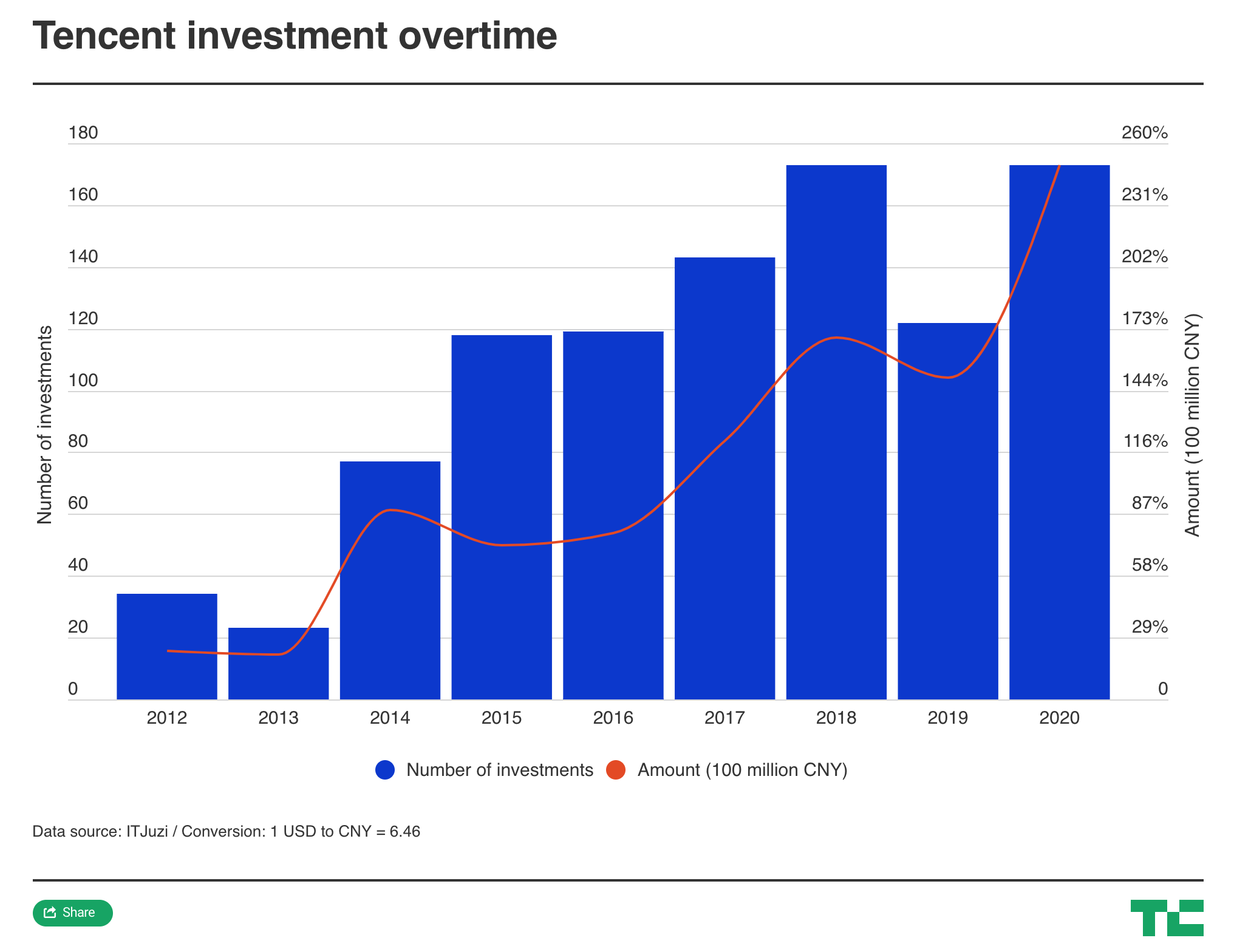
The social and entertainment giant has for long kept its funding activity close to its chest and data gleaned by third-party organizations like ITJuzi is often not exhaustive. The company did not immediately respond to TechCrunch’s questions about its investment in 2020, and the story draws mainly from public disclosures and interviews with people of knowledge.

B2B interest

While Tencent’s overall investment strategy has remained consistent — a diversifying portfolio with a focus on digital entertainment — it has quietly stepped up efforts in areas outside its main gaming arena. For instance, the firm has paid more attention to enterprise services ever since it announced a B2B pivot in 2018, putting more focus on cloud computing, fintech and the likes. The number of investments it made in enterprise software went from five in 2015 to 28 in 2020, according to ITJuzi.

In line with its new focus on enterprise, Tencent has also upped its game in fintech. In 2019 and 2020, it backed 18 and 15 fintech startups, respectively, ITJuzi shows, up from only four in 2015. The rise, though incremental, reflects the firm’s increased interest in an area that’s both hugely lucrative but also comes with many constraints.

In China, Tencent has long been competing with Ant Group, the Alibaba fintech affiliate, to court users in payments, lending, wealth management, and even insurance. The regulatory troubles facing Ant are not exclusive to the Jack Ma empire and will likely come to daunt its smaller contenders, including Tencent’s fintech segments.

That said, Tencent is “not nearly as aggressive” as Ant when it comes to strengthening its position in China’s financial market, a person who partners with Tencent’s overseas fintech business told TechCrunch.

Fintech overseas

The company is also prudent with its fintech expansion overseas in times of geopolitical tensions. So far, it’s mostly limited its ambition to providing cross-border payment services to China’s outbound tourists, rather than serving locals directly.

“There’s a lot of scrutiny around what Tencent and Alibaba are doing within the United States and that presents challenges,” said the CEO of a Tencent-backed startup based in the U.S. who declined to be named.

Through investments, however, Tencent has familiarized itself with the foreign financial markets. In 2015, the company made one fintech investment outside China. In 2020, it funded eight, according to public data collected by Crunchbase.

A significant portion of Tencent’s outside investments doesn’t bear strategic significance, and the company tends to let its portfolio startups operate autonomously. Partly for that reason, Tencent was slammed for prioritizing investment and financial return over product development and innovation in a viral article in 2018, titled ominously “Tencent Has No Dream.” The hands-off attitude is a stark contrast to the stranglehold practice of Alibaba, which prefers buying controlling stakes in businesses and shaking up their top management, as it did for Lazada.

But many Tencent investments do add value to its business, even when the press announcements leave out the potential strategic synergies. Over the years, Tencent has made a series of small investments in the U.S. and other Western countries. Few of them appear to bring collaborative opportunities in the near term, but Tencent would still invite executives from these companies to China where they would learn from each other.

“Tencent made those investments really just to kind of learn what people are doing in the U.S. and how it might be able to be applied in China,” said the executive from the Tencent-backed startup.

“We don’t have any near term plans to do anything in China. But Tencent is a very reputable name, whether it’s in China or the U.S. And you know, it’s good to have the option to be able to do something more strategic in partnership with Tencent down the road.”

Tencent’s fintech investments outside China could also be conducive to the firm’s gaming expansion overseas, according to a Hong Kong-based fund manager. The goal is to have half of its gamers to be overseas users, Tencent pleged in 2019.

“For the gaming industry in Latin America and Southeast Asia, the biggest bottleneck is, surprisingly, not hardware but payments,” the fund manager told TechCrunch. “Of course, localization and compatibility are also important.”


08 Jan 2021

Trump returns to Twitter with what sounds like a concession speech

It’s been a long couple of days for the country, but President Trump only had to wait 12 hours before returning to his social network of choice.

In an uncharacteristically scripted three-ish minute speech, the president denounced the “heinous attack” on the Capitol. “The demonstrators who infiltrated the Capitol have defiled the seat of American democracy,” Trump said, warning the individuals involved that they will “pay.”

The previous day, Trumped directed a crowd of his supporters to march to the Capitol. After that event turned into a violent riot that disrupted Congress as it worked to certify election results, Trump encouraged the rioters, telling them they were “special” and “we love you” in a video posted to Twitter .

After yesterday’s video, Twitter locked Trump’s account and required him to delete a handful of tweets before having his access restored. On Thursday, Facebook froze his account for the remainder of his time in office.

Noting that he had explored “every legal avenue” to stay in power, Trump appeared to throw in the towel Thursday in his undemocratic crusade to overturn the legitimate results of the American election.

In the video Trump concedes for the first time, claiming that he will willingly leave office on January 20. “My focus now turns to ensuring a smooth, orderly and seamless transition of power,” Trump said.


08 Jan 2021

Google AI concocts ‘breakie’ and ‘cakie’ hybrid baked goods

If, as I suspect many of you have, you have worked your way through baking every type of cookie, bread, and cake under the sun over the last year, Google has a surprise for you: a pair of AI-generated hybrid treats, the “breakie” and the “cakie.”

The origin of these new items seems to have been in a demonstration of the company’s AutoML Tables tool, a codeless model generation system that’s more spreadsheet automation than what you’d really call “artificial intelligence.” But let’s not split hairs, or else we’ll never get to the recipe.

Specifically it was the work of Sara Robinson, who was playing with these tools earlier last spring, as a person interested in machine learning and baking was likely to start doing around that time as cabin fever first took hold.

What happened was she wanted to design a system that would look at a recipe and automatically tell you whether it was bread, cookie, or cake, and why — for instance, a higher butter and sugar content might bias it towards cookie, while yeast was usually a dead giveaway for bread.

Image Credits: Sara Robinson

But of course, not every recipe is so straightforward, and the tool isn’t always 100% sure. Robinson began to wonder, what would a recipe look like that the system couldn’t decide on?

She fiddled around with the ingredients until she found a balance that caused the machine learning system to produce a perfect 50/50 split between cookie and cake. Naturally, she made some — behold the “cakie.”

A cakie, left, and breakies, right, with Robinson.

A cakie, left, and breakies, right, with Robinson.

“It is yummy. And it strangely tastes like what I’d imagine would happen if I told a machine to make a cake cookie hybrid,” she wrote.

The other hybrid she put together was the “breakie,” which as you surely have guessed by now is half bread, half cookie. This one ended up a little closer to “fluffy cookies, almost the consistency of a muffin.” And indeed they look like muffin tops that have lost their bottoms. But breakie sounds better than muffin tops (or “brookie,” apparently the original name).

These ingredients and ratios were probably invented or tried long ago, but it’s certainly an interesting way to arrive at a new recipe using only old ones.

The recipes below are perfectly doable, but to be transparent were not entirely generated by algorithm. It only indicates proportions of ingredients, and didn’t include any flavorings or features like vanilla or chocolate chips, both which Robinson added. The actual baking instructions had to be puzzled out as well (the AI doesn’t know what temperature is, or pans). But if you need something to try making that’s different from the usual weekend treat, you could probably do worse than one of these.

07 Jan 2021

TikTok bans videos of Trump inciting mob, blocks #stormthecapital and other hashtags

For obvious reasons, Trump doesn’t have a TikTok account. But the President’s speeches that helped incite the mob who yesterday stormed the U.S. Capitol will have no home on TikTok’s platform. The company confirmed to TechCrunch its content policy around the Capitol riots will see it removing videos of Trump’s speeches to supporters. It will also redirect specific hashtags used by rioters, like #stormthecapitol and #patriotparty, to reduce their content’s visibility in the app.

TikTok says that Trump’s speeches, where the President again reiterated claims of a fraudulent election, are being removed on the grounds that they violate the company’s misinformation policy. That policy defines misinformation as content that is inaccurate or false. And it explains that while TikTok encourages people to have respectful conversations on subjects that matter to them, it doesn’t permit misinformation that can cause harm to individuals, their community or the larger public.

A rioting mob intent on stopping democratic processes in the United States seems to fit squarely under that policy.

However, TikTok says it will allow what it calls “counter speech” against the Trump videos. This is a form of speech that’s often used to fight misinformation, where the creator presents the factual information or disputes the claims being made in another video. TikTok in November had allowed counter speech in response to claims from Trump supporters that the election was “rigged,” even while it blocked top hashtags that were used to promote these ideas.

In the case of Trump’s speeches, TikTok will allow a user to, for example, use the green screen effect to comment on the speech — unless those comments support the riots.

In addition, TikTok is allowing some videos of the violence that took place at the Capitol to remain. For example, if the video condemns the violence or originates from a news organization, it may be allowed. TikTok is also applying its recently launched opt-in viewing screens on “newsworthy” content that may depict graphic violence.

These screens, announced in December, appear on top of videos some viewers may find graphic or distressing. Videos with the screens applied are already eligible for TikTok’s main “For You” feed, but may not be prohibited. When viewer encounters a screen, they can just tap a button to skip the video or they can choose to “watch anyway.” (It could not provide any example of the screens in use, however.)

Anecdotally, we saw videos that showed the woman who was shot and killed yesterday appear on TikTok and then quickly disappear. But those we came across were from individual users, not news organizations. They were also not really condemning the riot — they were just direct video footage. It’s unclear if the specific videos we saw were those that TikTok itself censored or if the user chose to remove them instead.

Separately from graphic content, TikTok says it will remove videos that seek to incite, glorify, or promote violence, as those also violate its Community Guidelines. In these cases, the videos will be removed as TikTok identifies them — either via automation or user reporting.

And, as it did in November, TikTok is proactively blocking hashtags to reduce content’s visibility. It’s now blocking tags like #stormthecapitol and #patriotparty among others, and redirects those queries to its Community Guidelines. There are currently redirections across dozens of variations of those hashtags and others. The company doesn’t share its full list in order to protect its safeguards, it says.

TikTok had previously blocked tags like #stopthesteal and #QAnon, in a similar proactive manner.

We should point out that for all Twitter’s posturing about safety and moderation, it allowed Trump to return to its app, after a few key tweets were deleted. And it has yet to block hashtags associated with false claims, like #stopthesteal, which continues to work today. Facebook, on the other hand, banned Trump from Facebook and Instagram for at least two weeks. Like TikTok, it had previously blocked the #stopthesteal and #sharpiegate hashtags with a messages about its Community Standards. (Today those searches are erroring out with messages that say “This Page Isn’t Available Right Now,” we noticed.)

TikTok’s content moderation efforts have been fairly stringent in comparison with other social networks, as it regularly hides, downranks, and removes users’ posts. But it’s also been accused of engaging in “censorship” by those who believe it’s being too aggressive about newsworthy content.

That’s led to users finding more creative ways to keep their videos from being banned — like using misspellings, coded language or clever editing to route around TikTok policies. Other times, creators will simply give up and direct viewers to their Instagram where their content is backed up and less policed.

“Hateful behavior and violence have no place on TikTok,” a TikTok spokesperson told TechCrunch, when we asked for a statement on the Capitol events. “Content or accounts that seek to incite, glorify, or promote violence violate our Community Guidelines and will be removed,” they added.


07 Jan 2021

Detroit’s Ludlow Ventures goes for fund four

Ludlow Ventures, an 11-year-old, Detroit-based seed-stage venture firm, is in the process of closing on $65 million in capital commitments for its fourth and newest fund, shows SEC paperwork filed this week.

We reached out to firm founder Jonathan Triest, who declined to comment, citing SEC regulations.

Ludlow closed its previous fund, a $45 million vehicle, in 2019. Its second fund, announced in 2017, also closed with $45 million. Ludlow’s debut fund closed in 2014 with $15.5 million.

Ludlow, based in downtown Detroit, counts among its investors Stemcentrx co-founder Dan Reiner (who grew up in Detroit and attended school there) and Dan Gilbert, the billionaire founder of Quicken Loans and owner of the Cleveland Cavaliers.

Indeed, the outfit was thought of early on as a regional firm. It quickly expanded outside of Detroit to invest across the U.S., however, and just last month was named an an investor in the $2 million seed round of Umba, a 2.5-year-old, Lagos, Nigeria-based digital bank for emerging markets.

Ludlow has also written checks in recent months — both new and follow-on — to Welcome, a 1.5-year-old, New York-based HR software startup; Boulevard, a four-year-old, L.A.-based spa management and payment platform; and Lightyear, a 16-month-old, New York-based startup that wants to make it easier for large companies to procure networking infrastructure like internet and SD-WAN.

Ludlow has only had a couple of exits to date, but one is particularly notable: it was an early investor in Honey, the L.A.-based coupon finder that PayPal agreed to buy for $4 billion in late 2019.

The firm was also an investor in Product Hunt, which sold to AngelList for a reported $20 million in 2016.

Like all firms, Ludlow has had its write-downs. Navdy, for example, maker of a heads-up automotive display, went out of business in 2017. Still, in addition to its newest bets, it holds stakes in a variety of fast-growing startups. Among these is the nearly six-year-old, Boston-based online notary platform Notarize, which has now raised more than $80 million from investors and said last summer it had seen dramatic growth owing to the pandemic and the shift to remote work.

Triest also appears to have worked a check into the Series B round of Detroit-based resale marketplace StockX in 2018, a company that was valued at $2.8 billion during its most recent funding round last month.

Along with Triest, Ludlow is run by partner Brett deMarrais, who joined the firm in 2012; and a third investor, Blake Robbins, who joined the firm in 2016 as an associate and was promoted to partner in 2019.

Illustration above courtesy of Ludlow Ventures, featuring, from left to right, Triest, deMarrais, and Robbins.

07 Jan 2021

F5 snags Volterra multi-cloud management startup for $500M

F5, the applications networking company announced today that it is acquiring Volterra, a multi-cloud management startup for $500 million. That breaks down to $440 million in cash and $60 million in deferred and unvested incentive compensation.

Volterra emerged in 2019 with a $50 million investment from multiple sources including Khosla Ventures and Mayfield along with strategic investors like M12 (Microsoft’s venture arm) and Samsung Ventures. As the company described it to me at the time of the funding:

Volterra has innovated a consistent, cloud-native environment that can be deployed across multiple public clouds and edge sites — a distributed cloud platform. Within this SaaS-based offering, Volterra integrates a broad range of services that have normally been siloed across many point products and network or cloud providers.

The solution is designed to provide a single way to view security, operations and management components.

F5 president and CEO François Locoh-Donou sees Volterra’s edge solution integrating across its product line. “With Volterra, we advance our Adaptive Applications vision with an Edge 2.0 platform that solves the complex multi-cloud reality enterprise customers confront. Our platform will create a SaaS solution that solves our customers’ biggest pain points,” he said in a statement.

Volterra founder and CEO Ankur Singla, writing in a company blog post announcing the deal, says the need for this solution only accelerated during 2020 when companies were shifting rapidly to the cloud due to the pandemic. “When we started Volterra, multi-cloud and edge were still buzzwords and venture funding was still searching for tangible use cases. Fast forward three years and COVID-19 has dramatically changed the landscape — it has accelerated digitization of physical experiences and moved more of our day-to-day activities online. This is causing massive spikes in global Internet traffic while creating new attack vectors that impact the security and availability of our increasing set of daily apps,” he wrote.

He sees Volterra’s capabilities fitting in well with the F5 family of products to help solve these issues. While F5 had a quiet 2020 on the M&A front, today’s purchase comes on top of a couple of major acquisitions in 2019 including Shape Security for $1 billion and NGINX for $670 million.

The deal has been approved by both companies boards, and is expected to close before the end of March subject to regulatory approvals.

07 Jan 2021

Daily Crunch: Facebook bans Trump for two weeks

Online platforms take action against President Trump, Lenovo tries out a swiveling screen and Roblox raises $250 million. This is your Daily Crunch for January 7, 2021.

The big story: Facebook bans Trump for two weeks

After a pro-Trump mob stormed the U.S. Capitol yesterday, a number of online platforms moved to suspend accounts connected to the outgoing president.

For example, Twitter locked Trump’s account for 12 hours after he posted several (subsequently deleted) tweets repeating his unsubstantiated claims of election fraud and expressing support for the rioters (while also calling for an end to violence). Twitch also disabled his channel until the end of his term and Shopify pulled down stores tied to the president and his campaign.

But the most notable move came from Facebook, which banned Trump from both Facebook and Instagram for “at least the next two weeks,” until the end of his term. Mark Zuckerberg wrote that this was necessary due to the “use of our platform to incite violent insurrection against a democratically elected government.”

The tech giants

Waymo is dropping the term ‘self-driving,’ but not everyone in the industry is on board — Alphabet-owned Waymo will no longer use the term “self-driving” to describe its technology.

Lenovo’s new all-in-one has a swiveling screen, because sure, why not? — When it comes to staid product categories, why not try something weird?

Samsung simplifies with a lower-priced premium Chromebook — Samsung just dropped what’s almost certainly one of its biggest pieces of news for CES, with the arrival of the Galaxy Chromebook 2.

Startups, funding and venture capital

SoFi to go public in merger with Chamath Palihapitiya’s newest SPAC — The deal, confirmed by SoFi, would value the fintech company at $8.65 billion.

Roblox raises at $29.5B valuation, readies for direct listing — Roblox is now one of the world’s most valuable private companies in the world.

Local news app News Break raises $115M — CEO Jeff Zheng said there’s “strong user demand” for local news but “weak supply.”

Advice and analysis from Extra Crunch

Decrypted: How bad was the US Capitol breach for cybersecurity? — The breach will likely present a major task for Congress’ IT departments.

The tech-powered wave of smart, not slow, tutoring sessions — While starting a tutoring marketplace is easy, scaling is often where the troubles begin.

With 5 new unicorns in first week of 2021, are we in for a stampede this year? — The pace at which new unicorns are being announced feels incredibly rapid.

(Extra Crunch is our membership program, which aims to democratize information about startups. You can sign up here.)

Everything else

Hopin might be the fastest growth story of this era — The Equity team discusses Hopin’s acquisition of livestreaming company StreamYard.

Elon Musk has a new title: world’s richest person — He reached the pinnacle Thursday thanks to Tesla’s skyrocketing share price, along with a substantial pay package.

Remembering TechCrunch Japan’s Hirohide Yoshida (1971-2020) — On New Year’s Eve, TechCrunch Japan’s Editor-in-Chief Hirohide Yoshida passed away at age 49.

The Daily Crunch is TechCrunch’s roundup of our biggest and most important stories. If you’d like to get this delivered to your inbox every day at around 3pm Pacific, you can subscribe here.

07 Jan 2021

Epic acquires Rad Game Tools, veteran of many gaming generations

Epic today announced the acquisition of Rad Game Tools, maker of game development tools for many years. They’ve stayed largely behind the scenes, but many gamers will recognize the colorful Bink Video logo, which has appeared in the openings of many a title over the years.

“Our work with Epic goes back decades, and joining forces is a natural next step given our alignment on products, mission, and culture,” said Rad Game Tools founder and CEO Jeff Roberts said in the announcement. And it has seemingly only intensified recently.

Close integration with engines and platforms makes for good standards, and good standards get embraced by developers. That’s why Epic has been cozying up to Sony as well as snapping up components to fit into its Unreal engine, positioning it as an all-encompassing development platform for next-generation games.

Image Credits: RAD Game Tools

Rad (styled RAD) has been in games for a long time, as its decidedly old-school website attests. Bink is a video codec for games that focuses on high compression and speedy rendering, both important in the gaming world. Oodle, Telemetry, Granny 3D, and Miles Sound System are all development tools beyond what the lay person would understand, but no doubt have many fans.

Epic may be known now as the creator of money printing machine Fortnite, but the company has been around for decades and probably knows the Rad team well. That may help explain the friendly terms under which the acquisition will take place.

“RAD will continue supporting their game industry, film, and television partners, with their sales and business development team maintaining and selling licenses for their products to companies across industries – including those that do not utilize Unreal Engine,” Epic said in its announcement.

So while Bink and the rest will continue to be available for anyone to use outside Epic’s domain, they will almost certainly be better integrated with the Unreal ecosystem. As game development cost and complexity rises, means of simplification are often taken advantage of. Epic is working hard to make Unreal not just the most graphically powerful engine for development, but also the most unified.

A request for comment and further details on the deal sent to Rad Game Tools was intercepted by Epic and declined.

07 Jan 2021

Text marketing startup Voxie raises $6.7M

Like many startups, Atlanta-based Voxie was created to solve a problem that founder and CEO Bogdan Constantin faced himself.

In Constantin’s case, this was at his previous tuxedo rental startup Menguin (ultimately acquired by Generation Tux), where he said he had to market a product with a six-to-nine month sales cycle, as customers were usually weighing different options for their weddings.

Email marketing, Constantin said, would result “worse and worse” open rates over time. So one day, he decided to just try texting everyone who signed up, introducing himself as “your personal stylist here at Menguin.” Not surprisingly, he got a lot more responses.

The challenge, of course, is having those kinds of text conversations across a large customer base. And that’s why Voxie — which is announcing that it has raised $6.7 million in Series A funding — offers tools to help businesses automate and manage that process.

Constantin claimed that compared to other text marketing tools, messages sent via Voxie feel like a real, personalized conversation — even though 80% to 90% are actually automated, with the rest of the messages written by people. Plus, Voxie will allow businesses to send their messages from a normal 10-digit phone number (rather than the more common five-digit numbers used for marketing).

Voxie

Image Credits: Voxie

Voxie was initially built for large enterprise customers, but Constantin said that during the pandemic, the company built a lower-cost version that is now being used by “a lot of retail, restaurant franchise brands, main street brands that are struggling right now.”

He added, “We’re working with brands that have hundreds of locations all over the country that needed a better way to engage their customers — to ask their names, ask how many kids they have and store that information at the individual profile level.”

Current Voxie customers include LG, Danone, Massage Heights and Buff City Soap.

The funding, meanwhile, was led by Noro-Moseley Partners with participation from Circadian Ventures and Engage Ventures, as well as Atlanta entrepreneurs Wain Kellum, Andy Powell, David Cummings and Fred Castellucci.

“Voxie leads the market as the only platform that allows brands to have personalized conversations with customers at scale, which we believe will be key for its target customers to succeed in a post-COVID world,” said Noro Moseley’s John Ale in a statement. “Businesses love Voxie as they see meaningful revenue uplift quickly and the personalization of the content means customers find the messages useful and highly relevant to their needs.”

Next, Constantin said the company will launch “reply to buy” functionality, allowing customers to place orders directly from their text conversations. And while Voxie is currently focused on SMS messaging, he claimed its vision is broader: “We want to deliver the right message at the right time via the right medium.”

07 Jan 2021

MadeiraMadeira, Brazil’s answer to Wayfair and Ikea, is now worth over $1 billion

MadeiraMadeira, the Brazilian answer to Wayfair or Ikea, is now worth $1 billion after raising $190 million in late stage financing from investors led by SoftBank’s Latin American investment fund and the Brazilian public and private investment firm, Dynamo.

An online marketplace specializing in home products, MadeiraMadeira offers roughly 300,000 products so customers can build furnish, renovate and decorate their homes.

Founded in 2009 by Daniel Scandian, Marcelo Scandian and Robson Privado, the company has seen huge tailwinds come from the shift to online shopping in Brazil as a result of the global COVID-19 pandemic.

With stores closed, online shopping in Brazil surged. As Daniel Scandian noted, before the pandemic ecommerce penetration in Brazil was at roughly 7%, that number ballooned to 17% at the height of the pandemic in Brazil and has now stabilized at around 10%.

Combining third party sales with private labeled goods and its own shipping and logistics facilities has meant that MadeiraMadeira can take the best practices from several online retailers and home furnishing stores, Scandian said.

There are more than 10,000 sellers on the MadeiraMadeira platform and roughly 2.5 million stock keeping units. In recent years the company has added showrooms to its mix of retail facilities, where customers can check out merchandise, but complete their orders online.

“That’s the way we can tackle the offline market with a digital mindset,” Scandian said. 

Money from the most recent financing will be used to invest in expanding its logistics capabilities with the addition of new warehouse facilities to expand on its existing ten locations. The company also intends to add same day delivery and the expansion of its private label services.

The new capital, likely the last round before a potential public offering, included previous investors like Flybridge and Monashees along with public-focused investment firms Velt, Brasil Capital and Lakewood.

Early investors like Monashees, Kaszek, Fundo Avila, Endeavour Catalyst and angel backers like Niraj Shah, the founder of Wayfair, and Build.com founder Christian Friedland were instrumental to MadeiraMadeira’s early success, Scandian said.

Based in Curitiba, MadeiraMadeira has over 1300 employees, with the majority of them focused on technology, logistics and product development.

“With this new investment, we are raising our commitment to MadeiraMadeira’s long-term value creation vision as the company consolidates its position as the leader in Latin America’s home goods market. Since our initial investment, MadeiraMadeira’s management team has delivered everything they’ve promised, and our faith in them continues to grow,” said Paulo Passoni, Managing Investment Partner to SoftBank Latin America fund.