Year: 2021

07 Jan 2021

YouTube will start penalizing channels that post election misinformation

YouTube just announced that channels publishing “false claims” about the U.S. presidential election will be penalized with a strike, which would temporarily suspend them from posting videos.

If you’re wondering why it took this long, YouTube announced last month (a full month after the presidential election, but right after the “safe harbor” deadline for audits and recounts) that it would remove videos alleging widespread fraud or errors in the election. However, there was a grace period during which videos would be removed without additional penalty to the account.

YouTube says that grace period was supposed to expire on January 21, after Inauguration Day. But since the election results were certified early this morning, after a pro-Trump mob stormed the Capitol, the Google -owned video platform says it’s ending the grace period now.

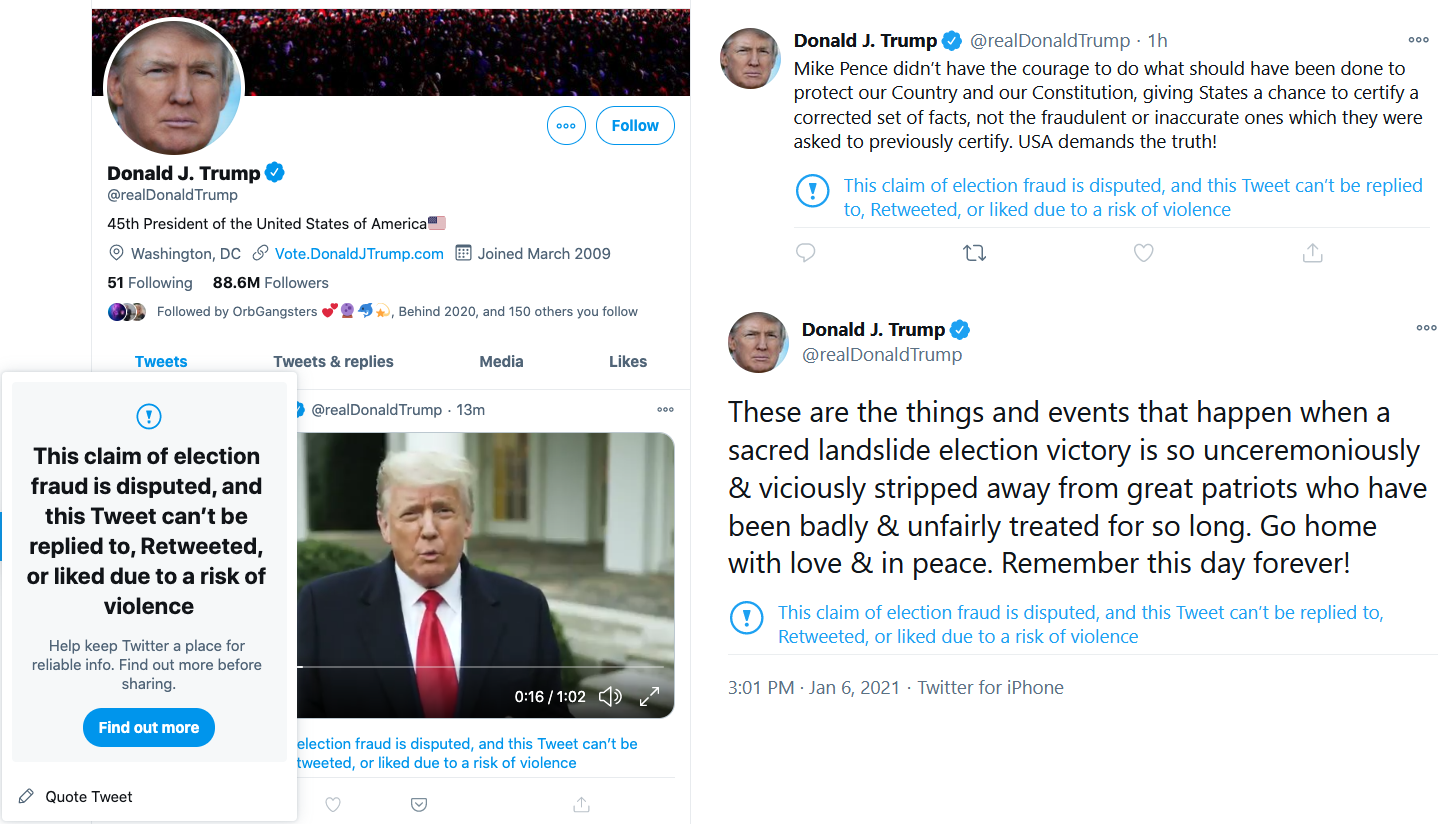
YouTube also says it has already removed “thousands of videos which spread misinformation claiming widespread voter fraud changed the result of the 2020 election, including several videos President Trump posted to his channel.” That includes taking down a video Trump posted yesterday in which he told rioters, “Go home, we love you. You’re very special.”

The penalties for a strike differ depending on the number of offenses. A first strike results in a one-week suspension of the ability to post videos or livestreams, edit playlists or share other content on YouTube. If an account gets a second strike in a 90-day period, they’ll be suspended for two weeks, with a third strike resulting in permanent removal.

A Google spokesperson provided the following statement on the changes:

Over the last month, we’ve removed thousands of videos which spread misinformation claiming widespread voter fraud changed the result of the 2020 election, including several videos that President Trump posted yesterday to his channel. Due to the disturbing events that transpired yesterday, and given that the election results have been certified, any channel posting new videos with these false claims in violation of our policies will now receive a strike, a penalty which temporarily restricts uploading or live-streaming.  Channels that receive three strikes in the same 90-day period will be permanently removed from YouTube.


07 Jan 2021

The tech-powered wave of smart, not slow, tutoring sessions

While starting a tutoring marketplace is easy, scaling is often where the troubles begin. Tutoring marketplaces require a base of tutors that have the bandwidth and empathy to work with students across different learning styles, goals and comprehension levels. The nuance means that fast scale isn’t foolproof and can lead edtech startups into a classic marketplace downfall: the inability to grow consistently while also providing definite outcomes.

But, as 2020 showed edtech, the demand for quick and convenient help is high. To win post-pandemic, the sector needs to think bigger about the way it can reach more students in an effective and savvy way.

In 2021, tutoring platforms can’t simply be middlemen that take a cut; they have to be extensive, smart and responsive.

Innovation from Quizlet, Chegg, Course Hero and Brainly shows that the future of tutoring might not look like a 30-minute video on Zoom or Google Hangouts. Instead, modern-day extra help might take the form of an AI-powered chatbot, a live calculator or tech more subtle than either.

Regardless, the rise of tutoring bots over marketplaces illustrates that some of the biggest decision-makers in edtech are taking a scalpel to the way that tutoring used to work and hope to scale faster by doing so.

The businesses driving the change

On January 31, Chegg will close its standalone tutoring service, which matched vetted tutors with students, relaunching it into a live chatbot that answers students’ questions. The move from a tutoring marketplace to chat interface, according to a spokesperson, will help Chegg “dramatically differentiate our offerings from our competitors and better service students.”

“Ever since Chegg Tutors was launched in 2014 we have seen what a powerful tool synchronous tutoring is for learners,” the company said in a statement. “What we have also learned is that the real need for learners is contextualized help directly in the experience of their actual learning environment.”

The closure of a marketplace isn’t necessarily a failure; the company says that live tutoring was never a big part of its business. Still, it’s clear that Chegg didn’t see enough opportunity to match students and tutors live and saw more promise in a chatbot approach. Plus, it goes well with Chegg’s theme of self-directed learning. CEO Dan Rosensweig was unavailable for comment.

07 Jan 2021

Shopify pulls Donald Trump stores off its platform

Facebook isn’t the only big tech company taking action against Donald Trump’s web presence in the wake of yesterday’s riots in Washington DC.

Shopify, which hosted shops related to Trump’s campaign paraphernalia and the outgoing President’s personal brand, TrumpStore, has apparently taken down both of those properties.

“Shopify does not tolerate actions that incite violence. Based on recent events, we have determined that the actions by President Donald J. Trump violate our Acceptable Use Policy, which prohibits promotion or support of organizations, platforms or people that threaten or condone violence to further a cause,” a Shopify spokesperson wrote in a statement to TechCrunch. “As a result, we have terminated stores affiliated with President Trump.”

News of the move was first reported by The Wall Street Journal.

It’s a reversal of policy for the company which had previously defended the rights of any customer to use the platform and a refusal to engage in what chief executive Tobias Lütke termed censorship.

In a now-deleted letter Lütke had authored back in 2017, the Shopify chief executive wrote that “commerce is a powerful, underestimated form of expression.”

Drawing a parallel between individual purchases made by consumers and votes, Lütke had said that it was not Shopify’s place to interrupt that free expression, even if personally and as an organization, they disagree with the positions of those on the platform.

Since that 2017 stand, Shopify has softened its position somewhat. In 2018 the company banned some right wing groups from the platform — including shops affiliated with the Proud Boys organization (who were involved in yesterday’s riot at the Capitol). And, as Black Lives Matter protests erupted across the U.S. the company donated some of its funds to civil  rights organizations.

The company’s stock is trading up $66, or roughly 6%, at $1,152.94 on the New York Stock Exchange. 

07 Jan 2021

Report: SoFi nears deal to go public in merger with Chamath Palihapitiya’s newest SPAC

Consumer financial services startup SoFi is closing in on a deal to go public via a merger with special purpose acquisition company, Social Capital Hedosophia Holdings Corp V, the latest blank check company formed by venture capital investor Chamath Palihapitiya.

An agreement to take SoFi public via a SPAC has been rumored for weeks. This latest advancement, which reveals Palihapitiya as the possible SPAC connection, was first reported by Reuters. The deal would reportedly give SoFi a valuation of more than $6 billion.

SoFi, which is now led by ex-Twitter COO Anthony Noto, was founded more than decade ago to offer ways to secure better financial terms for student loans. The company has expanded those offerings for consumers such as loan, investment and insurance products as well as cash and wealth management tools. It made a move into the B2B realm with its acquisition last April of Galileo.

SoFi has raised millions in capital since its founding, the most recent a $500 million round in 2019 that was led by Qatar Investment Authority, a Doha, Qatar-based private equity and sovereign wealth fund. The company was most recently valued at $4.3 billion.

Palihapitiya has been credited for kicking off the SPAC craze. SPACs, also known as blank-check companies, are formed for the purpose of merging or acquiring other companies. The shell company raises money in an initial public offering with the intent of merging with a privately held company that then becomes publicly traded. A slew of SPACs have occurred in the past 18 months,

In 2017, he raised $600 million for his first SPAC called Social Capital Hedosophia Holdings, which was ultimately used to take a 49% stake in the British spaceflight company Virgin Galactic. Social Capital Hedosophia Holdings Corp V is Palihapitiya’s third SPAC. His second merged with Opendoor in 2020.

07 Jan 2021

With 5 new unicorns in first week of 2021, are we in for a stampede this year?

What a week. Democracy is still standing and the nation is getting back to work, so let’s press forward, even if it does feel surreal to cover business news after witnessing a live-streamed coup attempt.

Setting aside the tectonic political moment, there’s plenty of activity inside the world of startups we need to discuss.

The pace at which new unicorns are being announced feels incredibly rapid, possibly implying that private-market investors anticipate exit valuations will remain high, and that a venture market that tilted late-stage will continue its bias in this new year.


The Exchange explores startups, markets and money. Read it every morning on Extra Crunch, or get The Exchange newsletter every Saturday.


Regular readers will recall that as 2020 wrapped up, we noted that “new unicorn formation continue[d] to impress.” That late-2020 trend is becoming a 2021 narrative.

For context, 17 unicorns were minted in the United States during Q3 2020. We don’t have Q4 numbers yet, but should inside the next week or so. There were more than 200 un-exited unicorns in the United States as the fourth quarter kicked off last year.

We’re at four new domestic unicorns in the first week of Q1 2020, along with at least one more from other shores.

Keep in mind that announcement of private-market rounds lag their actual closing, so the deals we’re discussing were likely closed in Q4 2020, not Q1 2021.

Which startups reached the $1 billion threshold required to earn the unicorn tag? The list is long, but Divvy, Hinge Health, Salesloft, Starburst Data and Mambu seem to fit the bill. Lacework and iboss are possibles, along with Ikena Oncology and Senti Biosciences.

Let’s take a look at the rounds to see if we can spot any correlations amidst the data.

New-nicorns

Divvy raised earlier this week, putting together a $165 million round that valued the Utah-based company at $1.6 billion. That was up more than twice its preceding private valuation of around $700 million.

07 Jan 2021

Endeavor BioMedicines raises $62 million to combat pulmonary dissease

A new startup has officially emerged for stealth with the raise of its $62 million Series A funding round. Endeavor BioMedicines is led by co-founder and CEO John Hood, who previously led Impact Biomedicines, and its new funding comes from Omega Funds and Longitude Capital, as well as the company’s own management team. Endeavor is also co-founded by Miguel de los Rios, who serves as its Chief Science Officer and who was previously CEO of Rift Biotherapeutics.

Endeavor’s goal is to develop treatments specifically to address pulmonary disease, and the startup is putting its funding towards two Phase 2 clinical trials that will seek to determine whether their therapeutic candidate can reverse or slow the progression of idiopathic pulmonary fibrosis (IPF), a very common type of pulmonary fibrosis that results in long tissue scarring which causes difficulty in breathing for affected patients.

IPF has a significant and worrying fatality rate – the condition comes with “an estimated mean survival of 2-5 years from time of diagnosis,” according to Hood in a press release. Endeavor’s new treatment candidate, called ‘taladegib,’ is an inhibitor that addresses what’s known as the ‘Hedgehog’ pathway for IPF. This pathway, which is primarily responsible for cell differentiation during embryonic development, can also play a role in development of harmful conditions in adults when they malfunction while regulating the regeneration of mature tissues.

Hood’s last company Impact Biomedicines exited in a sale to Celgene Corp worth put to $7 billion, depending on performance milestones set in the terms of the acquisition for passing certain regulatory and sales conditions. That company focused on treatment development specifically for myelofibrosis, a type of blood cancer, using an inhibitor for a specific type of protein kinase.

07 Jan 2021

Former Disney and Discovery execs to launch Struum, a ‘ClassPass for streaming services’

Former Disney and Discovery execs are teaming up to launch a new streaming service called Struum, arriving in the spring, that aims to take the Classpass model and apply it to the streaming landscape. That is, Struum’s plan is to aggregate content from smaller video on demand services, then provide that under its own subscription.

The idea for Struum comes from founders Lauren DeVillier, the former Head of Product for Discovery Ventures; Eugene Liew, former Vice President of Product and Technology at Disney+; Paul Pastor, former Executive Vice President of Strategy, Revenue and Operations at Discovery Networks; and Thomas Wadsworth, the former lead Advanced Product Development for Walt Disney Imagineering.

The service is backed by former Disney CEO Michael Eisner through his investment firm, Tornante Company. Firstlight Media, a company that provides technology to power video services, is also an investor and collaborator on the new effort. A third investor, Gaingels, focuses on backing LGBT+ founders and allies.
The team at Struum believes there’s potential for its service, despite the market being saturated by larger subscription players, like Netflix, Hulu, Amazon Prime, Apple TV+, YouTube, HBO Max, and Disney+, who today have a combined 75% share of the streaming video distribution landscape, according to 2020 Nielsen data.

It argues that there is still a long tail of over 250 niche and speciality services it can work with to grow its content library, while also helping those partners connect with potential customers.

The model it’s using to go about this, however, is unique for streaming businesses — and very much inspired by the ClassPass service for sampling fitness classes from local gyms and studios.

“I was a huge user of ClassPass and I love that model,” explains DeVillier. “And we just started noodling on this idea of offering this aggregated service using that model.” The founders would talk about ways they could help address the underserved market of streamers, who were “trying to find space and voice,” she says.

Struum will work by charging customers a single monthly subscription to provide a range of services, accessed through the Struum app. However, instead of getting a full buffett of content within the app, the consumer is given a number of “credits” they can used to sample and consume content, just like ClassPass did with gym classes.

Then, if Struum sees the customer is routinely accessing content from one service, it will suggest they may be better managed by a managed service. The customer can choose to subscribe to that service from within the Struum app directly.

In other words, Strumm acts a customer acquisition engine for its partners, too, in addition to hosting their content.

For consumers, this means they don’t have to keep subscribing and unsubscribing to various services just to watch particular shows or movies. And for content providers, it allows them to find an audience without having to spin up their own standalone subscription app.

Struum generates revenue from its subscriptions, which it shares with its content partners. These may include what Pastor describes as “aspirational tier one” brands, that may be those from the traditional pay TV world that are now looking for a new, streaming audience. And they may also include vertical media brands and others who are currently operating an ad-supported video on demand (AVOD) service but want to enter the subscription video on demand market.
Image Credits: Struum

The company has already completed deals with nearly three dozen yet-to-be-named streaming partners, and now has over 20,000 TV series, movies, and shorts, as a result. It will serve up this content on a platform built in collaboration with Firstlight Media, which runs on Microsoft Azure architecture.

The startup’s co-founders have not been working on Struum that long, having only come together around the beginning of the year, just ahead of the pandemic’s outbreak in the U.S.

The pandemic, of course, accelerated the streaming market as consumers stuck at home tapped into video services to stay entertained.

But for Struum, it helped the startup speed its time to launch, too.

“The ability to be introduced to people — financiers and content partners and talent — within a matter of 24 to 48 hours by getting on the phone through Zoom, not having to fly across the country to do the pitches, not having to drive across town in Los Angeles to do pitches — we were able to more quickly accelerate our business from that aspect,” notes Pastor.

Struum also tapped into the ability to hire outside of its base in L.A., as remote work became more of the norm. On its team of ten, it has staff from elsewhere in the U.S. and even the U.K., and it aims to continue as a remotely distributed operation for the near future, even when the pandemic is over.


Struum has correctly identified a problem in the modern streaming landscape, in terms of large amount of untapped content now distributed across hundreds of smaller services, much of which lingers in obscurity. However, the approach it’s taking to address the problem — by aggregating the content under its ClassPass-like subscription/credit model — will still force the  service into competition with AVOD players, as this is where consumers turn when they can’t find anything else to watch on Netflix and elsewhere.

That means the challenge Struum faces will be convincing those consumers to essentially change their TV habits.

“Today, those habits and rituals are built around first going to a Netflix…and the next thing is to go to Amazon,” explains Pastor. Consumers might then turn to Disney+ or HBO Max as a third option, he says, depending on whether they’re looking for family fare or more adult content.

“What we’re hoping to be able to do, by aggregating these pieces together, is to say, listen: your third or fourth choice should be Struum. It’s a place where you can manage one subscription and explore all these [other} services,” Pastor adds.

After launching, Struum plans to quickly iterate on the customer data it has — another advantage of the aggregational model — to optimize its content library and help guide its future partnerships.

“We come from a very strategic background approach. And we come from a discipline of listening to consumers — that’s so much the history of the Discovery and the Disney brand. That’s very much the near-term focus,” Pastor says.

The company plans to launch in the spring with support for web, mobile and TV platforms. An international expansion is also on the roadmap further down the road.


07 Jan 2021

Twitter will reinstate Trump’s account following his deletion of tweets

A Twitter spokesperson has confirmed with TechCrunch this morning that Trump has deleted three tweets that led to the temporarily suspension of this account last night.

Twitter locked the account pending deletion of the offending tweets on Wednesday following the riot and siege of the Capitol building in Washington, D.C., and said that the suspension would remain in place so long as the tweets were not removed, and that any further violation of its rules could result in an actual permanent account suspension for Trump.

The President’s account is to remain lock 12 hours after his deletion of the tweets (seen below). While we don’t have exact timing on when the countdown started, he has yet to tweet from the account. The account also still bears the warning that, “this Tweet is no longer available because it violated the Twitter Rules.”

While Trump has previously enjoyed the benefit of a rule Twitter put in place that allowed a special exemption for content that would normally violate its terms of service, but that it would allow to remain in the interest of public access in cases where it comes from accounts with a significant public interest component, like Trump’s while he’s occupying the office of U.S. President.

The three tweets that finally proved a bridge too far for Twitter included a video posted by Trump that called for an end to the violence on Capitol Hill, but that also said “We love you, you’re very special” to the terrorists taking part in the action. The other two included statements that falsely suggested the legitimate results of the most recent U.S. presidential election were somehow fraudulent, including one that suggested the terrorist actions in Washington that resulted were somehow justified.

It’s worth noting that Twitter didn’t actually deleted the offending tweets; the company generally has a policy of removing tweets that violate its terms from public view, and notifying the offending account that they must be deleted by the account holder themselves in order to re-instate the ability to actively use the account.

While Trump does not have access to his own official Twitter account, his deputy chief of staff Dan Scavino posted a statement early Thursday morning about the Electoral Certification process, which was completed in the early hours. The statement again included inciting language falsely disputing the election results, but remains available and untouched by any of Twitter’s flagging measures.

Until this week, most anticipated that Trump would continue to enjoy protections that come with his political status. Yesterday’s move marked a shift for Twitter, but there remains a major question around his status in the remaining two weeks of his Presidential term. Facebook, meanwhile, has taken the opposite action, altogether banning Trump from its platform, for “at least the next two weeks.”

07 Jan 2021

Mark Zuckerberg announces Trump banned from Facebook and Instagram for ‘at least the next two weeks’

Facebook CEO Mark Zuckerberg has announced via his platform that Donald Trump will be blocked from using both Facebook and Instagram “for at least the next two weeks until the peaceful transition of power is complete.” The company blocked his accounts temporarily on Wednesday following Trump’s posting on content that incited his followers to violence, but now Zuckerberg says the ban is extended “indefinitely,” extending at least until Biden takes over as President.

Both Facebook and Instagram removed Trump’s video post yesterday, in which the President called for rioters who laid siege to the Capitol building in Washington to go home – but in which he also said “we love you” to the same violent terrorists. They followed that action with a 24-hour account lock, preventing Trump from posting via his Facebook and Instagram accounts during that period.

Zuckerberg acknowledges that Trump content has in the past been labeled or removed when found to violate its policies, but that he had been allowed up until now to “use our platform consistent with our own rules.” He says that has now changed, due to “use of our platform to incite violent insurrection against a democratically elected government.” There’s a lot of careful, heavily PR’d language doing heavy lifting here – Zuck is careful to say that use until now has lined up with the platform’s rules in place, and not instead been an exception to them, and he’s also careful not to say Trump has directly incited violent insurrection in leaving an actor out of that particular sentence. Still, this is the strongest action by far from the platform to date to limit Trump’s access.

Here’s the full post from Zuckerberg:

The shocking events of the last 24 hours clearly demonstrate that President Donald Trump intends to use his remaining time in office to undermine the peaceful and lawful transition of power to his elected successor, Joe Biden.

His decision to use his platform to condone rather than condemn the actions of his supporters at the Capitol building has rightly disturbed people in the US and around the world. We removed these statements yesterday because we judged that their effect — and likely their intent — would be to provoke further violence.

Following the certification of the election results by Congress, the priority for the whole country must now be to ensure that the remaining 13 days and the days after inauguration pass peacefully and in accordance with established democratic norms.

Over the last several years, we have allowed President Trump to use our platform consistent with our own rules, at times removing content or labeling his posts when they violate our policies. We did this because we believe that the public has a right to the broadest possible access to political speech, even controversial speech. But the current context is now fundamentally different, involving use of our platform to incite violent insurrection against a democratically elected government.

We believe the risks of allowing the President to continue to use our service during this period are simply too great. Therefore, we are extending the block we have placed on his Facebook and Instagram accounts indefinitely and for at least the next two weeks until the peaceful transition of power is complete.

Developing…

07 Jan 2021

Elon Musk has a new title: world’s richest person

Elon Musk, the controversial and enigmatic entrepreneur who heads up SpaceX and Tesla, has reached a status that only three others have held in the past two decades: world’s richest person.

On his way to the top spot, Musk has surpassed a bevy of billionaires this year, including Warren Buffet and Bill Gates. He reached the pinnacle Thursday thanks to Tesla’s share price that has skyrocketed nearly 830% since March 2020 along with a substantive pay package that was triggered after achieving certain market capitalization and profitability milestones. In the process, Musk unseated rival Jeff Bezos, the founder and CEO of Amazon who held the world’s richest person position since 2017. 

Musk is now worth more than $188 billion, per Bloomberg’s Billionaire Index. Tesla shares continued their seemingly unabated climb on Thursday, trading up more than 5% to $795.75.

In true Musk fashion, he acknowledged the milestone in a tweet, noting “how strange” and “well, now back to work.”

The world’s richest person title isn’t what makes Musk’s position so intriguing. It’s the speed at which he reached it. Just a year ago, Musk was in the dregs of the world’s wealthiest list. This year, Musk was propelled forward by some $150 billion thanks to Tesla’s popping share price. Musk holds about 20% equity in Tesla. He also has some $42 billion in vested stock options, according to SEC filings.

It’s a stock that has historically suffered from volatility, with huge swings occurring after a tweet or financial update. Take 2018, for example. Tesla’s share price ended the year with about 3.8% gain. In between the those two bookends of the stock market calendar — January 2 and December 31 — and the 3.8 percent gain they produced obfuscated a year of tumult and whipsaw-like swings in the stock price.

While Tesla shares have been on an upwards trend in 2020. This year, and after only one decade as a publicly traded company, Tesla became the most valuable automaker in the world by market value, passing the valuations of Ford, GM, VW Group and Toyota. Tesla’s market cap is now $757 billion.