Year: 2021

07 Jan 2021

Local news app News Break raises $115M

The popular news app News Break is announcing that it has raised $115 million in new funding.

The press release claims this round makes News Break “one of the first new unicorns of 2021,” but the company declined to disclose its actual valuation.

Founder and CEO Jeff Zheng said that when he started the company in 2015, the goal was to differentiate itself from other news aggregation apps by focusing on local news, and to “help or empower these local content creators.”

To be clear, you can find similar stories in News Break that you’d see in other news apps (there’s a whole section for coronavirus news and this morning you’ll see plenty of stories about yesterday’s violent takeover of the U.S. Capitol), you’ll also see many stories that are highlighted specifically based on your location.

“Technology is interweaving with every aspect of the company — in how we empower local publishers and local journalists to generate content more effectively and to reach an online audience more effectively,” Zheng said. “We have AI tools help to provide all these relevant articles … We have location profiles and what you’re most interested in, which we basically match against the content.”

The local approach seems to have paid off, with News Break reaching the top spot in the News category of the U.S. App Store multiple times (it’s currently ranked number four). The startup says it’s currently reaching 12 million daily active users.

News Break previously raised $26 million in funding. The new round was led by Francisco Partners, which is taking a seat on the News Break board. IDG Capital also participated.

Updating

07 Jan 2021

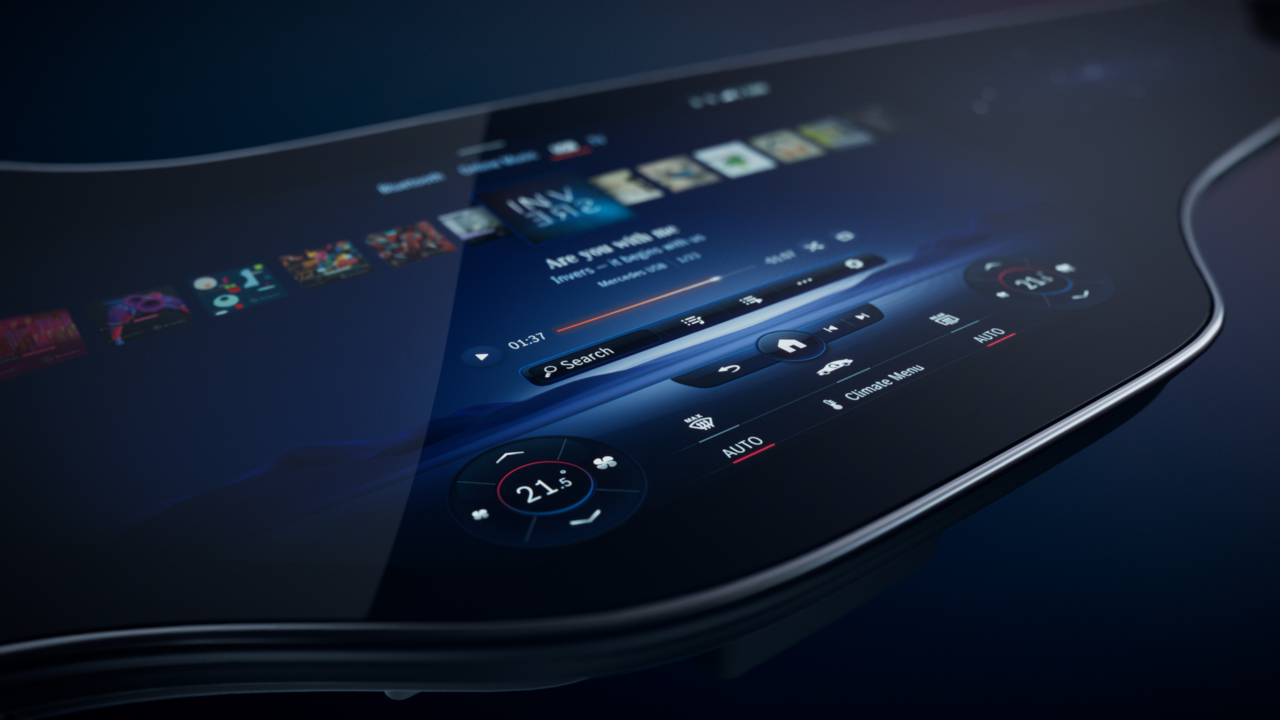
Mercedes unveils Hyperscreen, a curved 56-inch screen for its flagship EQS electric vehicle

Three years ago, Mercedes-Benz unveiled MBUX, an infotainment system that represented a leap forward in the legacy automotive industry. The system, with its crisp graphics, intuitive user interface and voice assistant, was closer to the experience of using a smartphone and finally got away from the pixelated screens and cluttered designs found in most modern infotainment systems.

Mercedes unveiled Thursday the next iteration of the MBUX, a 56-inch curved screen that runs the length of a dashboard — the central feature of a next-generation infotainment system that learns the behaviors of its driver. The MBUX Hyperscreen, as its called, will be option in the 2022 Mercedes EQS, the flagship sedan under the automaker’s electric EQ brand. The Hyperscreen, which was unveiled ahead of the virtual CES tech trade show, features 8 CPU cores, 24-gigabyte RAM and 46.4 GB per second RAM memory bandwidth. There’s a multifunction camera and a sensor that adapts the brightness of the screen depending on the lighting conditions.

All of this technology is meant to deliver an intuitive infotainment system that can be individualized for up to seven people. The software behind the Hyperscreen allows the system to continually get to know the customer better, according to Mercedes-Benz CTO Sajjad Khan, adding that it’s designed without the occupant needing to click or scroll anywhere.

“The MBUX Hyperscreen is both the brain and nervous system of the car,” Khan, said in a statement.

Mercedes-EQ. MBUX Hyperscreen

Mercedes-EQ. MBUX Hyperscreen

The curved screen, which is really several individual displays under a glass housing, is protected by two coatings of scratch-resistant aluminum silicate on the cover plate to reduce reflections and make cleaning easier. Mercedes also designed the screen with predetermined breaking points in case of a crash.

On either side of the curved screen are two physical air vents that have been integrated into the screen,

Putting the look and size of the screen aside, the user interface and how it operates is what stands out. (Althoug to be clear, we have yet to truly test it). Mercedes chose to put information on charging, entertainment, phone, navigation, social media, connectivity and massage — yes massage — right up front on the screen. This means no scrolling through menus or using the voice assistant to locate these options. 

The system’s software, which will learn the patterns of the driver, will prompt the user, removing any need to go deeper into the sub-menu. The navigation map is always visible in the center and located just below it are the controls for the phone and entertainment – or the feature that best suits the specific situation, according to the automaker.

Mercedes leaned into the software of the system, playing up its smart features during the Thursday reveal. For instance, if the driver always calls one particular person on the way home on certain days, the system begin to anticipate that action. A business card will appear with their contact information and — if it’s stored — their photo will appear. If someone else drives the EQS on that same evening, this recommendation would not be made.

Mercedes-EQ. MBUX Hyperscreen

Mercedes-EQ. MBUX Hyperscreen

The driver can dive deeper into the system to change settings or access other features. The front seat passenger has their own section of the screen called the co-driver display to play around with during a trip. In certain markets, the passenger will also be able to watch videos while traveling using the Bluetooth headphones. An intelligent camera-based locking concept will prevent the driver from looking at the passenger display to avoid distraction.

07 Jan 2021

Elon Musk dunks on Facebook and recommends Signal in wake of U.S. Capitol insurrection attempt

Elon Musk, the tech billionaire set to likely soon become the world’s richest man, and one of the most influential voices in the world of tech entrepreneurship, continued his recent trend of criticizing Facebook with a Twitter post late Wednesday night, following the attempted insurrection by pro-Trump rioters at the U.S. Capitol building. Musk shared a meme suggesting the founding of Facebook ultimately led to the day’s disastrous and shameful events.

Musk, who has himself used his massive reach (he has around 42.5 million followers on Twitter) to spread misinformation to his many followers, specifically around COVID-19 and its severity, also followed that up on Thursday morning with a reply expressing a lack of surprise at WhatsApp’s new Terms of Service and Privacy Policy, which will make sharing data from WhatsApp users back to Facebook mandatory for all on the platform.

The Tesla and SpaceX CEO also recommended that people instead use Signal, an encrypted messaging client which uses encryption by default and which is based on open-source standards. Side-note: If you do end up following Musk’s advice, you should also enable the app’s “disappearing messages” feature for an added layer of protection on both ends of the conversation.

Musk has a long history of opposing the use of Facebook, including the deletion of not just his own personal page, but also those of both Tesla and SpaceX, in 2018 during the original #deletefacebook campaign following the revelation of the Cambridge Analytica scandal.

07 Jan 2021

Glia raises $78M for its integrated, hands-on, AI-based customer service platform

The ongoing push for social distancing to slow the spread of Covid-19 has meant that more people than ever before are using internet-based services to get things done. And that is having a direct impact on digital customer service, which is seeing unprecedented traffic and demands when things are not running smoothly. Today, one of the startups that’s built an interesting, very “hands-on” approach to addressing that problem is announcing a round of funding to expand its business.

Glia, which has built a platform that not only integrates and helps manage different customer support channels, but also provides tools to help agents proactively get into a customer’s app or web page to help them find things or fix issues, is today announcing that it has picked up $78 million, a Series C. Dan Michaeli, the co-founder and CEO who is based out of New York (the company has a substantial operation in Estonia too), said will be used to continue developing its technology and expanding to address inbound interest for its services after seeing its revenues grow by 150% in 2020.

The company’s original focus was around financial services and it counts a large base of customers in that area, but it is also seeing a lot of activity in adjacent industries like insurance, as well as education, retail and other categories Michaeli said.

“We’ve had overwhelming demand and it’s incredible to see how businesses want to adopt us right now,” he said in an interview. “The plan is to significantly scale up and continue to define and meet that demand for digital customer service.” The company is likely also to use some of the funding for acquisitions in what appears to be a rapidly consolidating market.

The round is being led by Insight Partners, with Don Brown (an entrepreneur in the world of customer service, with his company Interactive Intelligence acquired by Genesys for $1.4 billion) also participating.

Glia isn’t disclosing other investors, but past backers include Tola Capital, Temerity Capital, Grassy Creek and Wildcat Capital, as well as Insight. Prior to this, the company, which has been around since 2012 and was previously known as Salemove, had raised just $28 million and its valuation was a modest $69 million according to PitchBook data (and it’s not disclosing valuation today).

While there are a lot of customer service startups in the market today, and a number of them are seeing huge boosts in their business, and even some consolidation as others snap up tech to make sure they have their own customer service strategies going in the right direction. (Witness Facebook of all companies acquiring omnichannel customer support and CRM leader Kustomer for $1 billion in November.)

Glia is not unlike many of the new guard of these companies, in that its focus is very squarely on providing a platform to be able to manage and interact across whatever digital channel a customer happens to be using. Glia, I should point out, means “glue” in Greek.

What makes Glia quite interesting and different from these are some of the twists it uses to engage with users. One of these involves being able to give agents the ability to actually get on the screen of the user in question, in order to both guide the user around the screen, and to see what the user is doing on that screen.

To be clear, the connection and ability to track what the user is doing is just on the screen in question, and it’s done with the user’s awareness of what is going on. In the demo of the service that I went through, it’s a very smooth service, which reminded me just a little of things like Clippy on Microsoft Word.

Alongside this, Glia provides tools to agents to let coach them on questions to ask, phrasing to use, and links for answers, and Glia also develops virtual customer service assistants, to help with more basic questions. These also have the ability to interact with people’s screens when they make contact with a company. This in effect sees the company combining a number of technologies in one place, from natural language to suggest (and in some cases run) customer service responses, through to computer vision to help detect what is going on on the remote screen, through to more fundamental CRM technology to run those services across multiple platforms.

While screen sharing has been a well-used tool in other areas — for example in workforce collaboration environments, or for presenting online — Glia is seen as one of the pioneers in leveraging that for customer service. For investors, the interest in Glia has been to tap into that.

“We are proud to expand our investment in Glia as the company continues to lead the evolution of Digital Customer Service for businesses across the globe,” said Lonne Jaffe, managing director at Insight Partners, in a statement. “Glia’s platform provides the modern technology necessary for businesses to meet customers in their digital journeys and communicate through the customer’s channel of choice. With this capital, the company will continue to scale and keep up with skyrocketing demand.”

We are in a key moment of digital transformation in customer services. Surprisingly, there are still many who opt for calling in to ask questions, but as Michaeli noted, these days, even when they are still using phones, customers will do so with “their screens in front of them.”

Brown believes that this is the other opportunity to seize. “Many companies are still focused on moving antiquated, on-premises telephony systems to cloud contact centers that essentially offer the same functionality,” he said in a statement. “Instead, businesses can leapfrog this process and move directly to a digital-first cloud approach by partnering with Glia. If I were to build Interactive Intelligence for today’s contact center, I would take Glia’s approach.”

07 Jan 2021

Lacework lands $525M investment as revenue grows 300%

As the pandemic took hold in 2020, companies accelerated their move to cloud services. Lacework, the cloud security startup, was in the right place at the right time as customers looked for ways to secure their cloud native workloads. The company reported that revenue grew 300% year over year for the second straight year.

It was rewarded for that kind of performance with a $525 million Series D today. It did not share an exact valuation, only saying that it exceeded $1 billion, which you would expect on such a hefty investment. Sutter Hill and Altimeter Capital led the round with help from D1, Coatue, Dragoneer Investment Group, Liberty Global Ventures, Snowflake Ventures and Tiger Capital. The company has now raised close to $600 million.

Lacework CEO Dan Hubbard says one of the reasons for such widespread interest from investors is the breadth of the company’s security solution. “We enable companies to build securely in the cloud, and we span across multiple different categories of markets, which enable the customers to do that,” he said.

He says that encompasses a range of services including configuration and compliance, security for infrastructure as code, build time and runtime vulnerability scanning and runtime security for cloud native environments like Kubernetes and containers.

As the company has grown revenue, it has been adding employees quickly. It started the year with 92 employees and closed with over 200 with plans to double that by the end of this year. As he looks at hiring, Hubbard is aware of the need to build a diverse organization, but acknowledges that tech in general hasn’t done a great job so far.

He says they are working with the various teams inside the company to try and change that, while also working to support outside organizations that are helping educate under represented groups to get the skills they need and then building from that. “If you can help solve the problem at an earlier stage, then I think you’ve got a bigger opportunity [to have a base of people to hire] there,” he said.

The company was originally nurtured inside Sutter Hill and is built on top of the Snowflake platform. It reports that $20 million of today’s total comes from Snowflake’s new venture arm, which is putting some money into an early partner.

“We were an alpha Snowflake customer, and they were an alpha customer of ours. Our platform is built on top of the Snowflake data cloud and their new venture arm has also joined the round with an investment to further strengthen the partnership there,” Hubbard said.

As for Sutter Hill, investor Mike Speiser sees Lacework as one of his firm’s critical investments. “[Much] like Snowflake at a similar point in its evolution, Lacework is growing revenue at over 300% per year making Lacework one of Sutter Hill Ventures’ most important and promising portfolio companies,” he said in a statement.

07 Jan 2021

Hopin buys livestreaming startup StreamYard for $250M as it looks to expand its product lineup

This morning Hopin, a quickly-growing startup that sells a technology platform for hosting digital events, announced that it has acquired StreamYard. The acquired company, which bootstrapped itself to material revenue scale, will retain its brand and in-market product.

The deal is worth $250 million, paid in a mix of cash and stock. Hopin raised a $40 million Series A in late June of 2020, and a $125 million Series B last November at a valuation of $2.125 billion.1

At the time of its most recent round, Hopin told TechCrunch that it had grown its annual recurring revenue (ARR) from zero to $20 million in around nine months. In an email Hopin told TechCrunch that StreamYard had itself scaled to $30 million ARR without external capital. And during a conversation regarding the StreamYard deal, Hopin CEO Johnny Boufarhat said that the combined entity would sport around $65 million in ARR.

You can infer from the numbers that Hopin has continued to grow rapidly since its Series B.

If it feels strange that a Series B company is nearly at IPO-scale, recall that Hopin’s technology benefited from the COVID-19 pandemic during which events around the world from conference centers and into browsers, and that Series demarcations for startup funding rounds have lost their historical size, and maturity tethers. (TechCrunch used Hopin’s service to host several of its events in 2020.)

The deal will not subsume StreamYard whole-cloth into the Hopin product. Instead, StreamYard will retain its brand and product, so that it can continue to serve its existing customer base.  Hopin does intend to better integrate StreamYard’s streaming tech into his company’s marquee product, though its platform will remain streaming-provider agnostic; StreamYard will become the default Hopin streaming option, however.

StreamYard co-founder Geige Vandentop told TechCrunch that around 15% to 20% of its customers use its service for events-related activities. The rest comes from sources like the creator economy, and small businesses.

As a company, StreamYard decided to eschew external capital during its growth, keeping its team nigh-skeletal while focusing on customer feedback to help it make product choices. Vandentop said in an interview that StreamYard will keep up its current cadence of weekly livestreams to solicit customer input while part of the Hopin product lineup.

On the same theme, Boufarhat told TechCrunch that Hopin is working to build a customer-first, multi-product lineup, of which StreamYard will be a key piece that the larger company will be known for.

Why would StreamYard sell to Hopin, if it had managed to scale to eight-figure ARR without requiring booster shots of external cash? Vandentop described the deal as best for his current customers, his team, adding that the tie-up should allow his startup to move more quickly.

TechCrunch’s read of the deal is that Hopin managed to roughly double its own size through the transaction that came at a relatively modest cost, when we contrast StreamYard’s revenue scale compared to the acquiring company’s own. However, StreamYard partially traded its equity for Hopin shares that, given the company’s rapid 2020 fundraising pace may indicate, could rapidly grow in value. And as Vandentop noted during our chat with the two executives, Hopin was growing even more quickly than his own startup.

The virtual events space, and the hybrid, online and offline events space that Hoping originally set out to serve before COVID-19, is one worth watching in 2021 as vaccines are deployed and the world looks forward to a future of safe travel. With StreamYard in its camp, however, any slowdown in the growth of virtual events software sales could be mitigated by streaming outfit’s largely distinct customer base.

Now we can begin a countdown of sorts for when the combined Hopin and StreamYard entity reaches $100 million in ARR. After that we’ll start the IPO timer.

  1. As an aside, Hopin paying around 10% of its current value for StreamYard puts the deal into a similar bucket to the Facebook-WhatsApp deal. A 10% deal implies that the acquiring company is making a material wager on the choice; the recent Slack-Salesforce deal was just over 10% of the acquiring company’s December market capitalization peak, for reference.


07 Jan 2021

Waymo is dropping the term ‘self-driving,’ but not everyone in the industry is on board

Waymo will no longer use the term ‘self-driving’ to describe the technology it has been developing for more than a decade, opting instead for ‘autonomous.’

The Alphabet company said that this seemingly small shift is an important effort to clarify what the technology does and doesn’t do. It’s also been viewed as an attempt to set the standard for the rest of the autonomous vehicle technology industry as well as distance itself from the “full self-driving” terminology that Tesla uses to describe its advanced driver assistance system.

“This past year, we explored the importance of language and how terms like “self-driving car” inaccurately describe what autonomous driving companies, like Waymo, are building,” the company wrote in a blog post Wednesday. “Waymo’s vehicles don’t drive themselves. Rather, Waymo is automating the task of driving and thus the term “autonomous driving” is more accurate. The conflation of terms used to describe vastly different technology — such as advanced driver assist systems and autonomous driving technology — is referred to as and has serious implications for road safety. find people consistently overestimate the capabilities of driver-assisted features.”

Waymo’s decision to drop the self-driving term has been viewed by other AV companies as a call to action by the entire industry. But not everyone in the industry on board.

Several industry insiders and founders that TechCrunch spoke to wondered if a push to drop “self-driving” might have the unintended effect of ceding the term to Tesla. Others suggested efforts would be better spent on other means of education.

“We’re pursuing a driverless application of this technology, and will continue to educate the public on its benefits with language that makes a clear distinction between technologies that drive a truck or car as opposed to technologies that assist a driver,” Aurora CEO Chris Urmson said. “Rather than rename technology based on misleading marketing efforts of other companies, we agree it is important as an industry to align on clear language to define the life-saving technology we’re building.”

The light push back on Waymo is in part an acknowledgement of the company’s position in the industry. Waymo, the former Google self-driving project, is one of the leaders in the development and commercialization of autonomous vehicles. Its efforts carry weight and influence in a nascent industry.

Waymo, which changed the name of its education campaign from Let’s Talk About Self-Driving to Let’s Talk About Autonomous Driving as part of its announcement, argues that automakers have described or marketed the advanced driver assistance systems in personally owned vehicles as self-driving or semi-autonomous. That, the company says, is creating confusion. Waymo never names Tesla as one of the drivers behind this name change. However, Tesla and its use of the terms Autopilot and FSD has prompted criticism from an array of automotive and safety organizations as well as autonomous vehicle companies.

Waymo points to research that has found that human drivers operating cars, trucks and SUVs that have been marketed as self-driving don’t understand the limited capabilities of the technology, which can lead to misuse. The company cited one study conducted in 2019, in which half of respondents believed a driver-assist feature allowed them to drive hands-free, even though these systems require drivers to keep their hands on the steering wheel at all times.

Questions and confusion around how to describe technology that allows a vehicle to operate on its own without a human driver behind the wheel have persisted for years. Terms like autonomous, automated driving, driverless and self-driving have been used interchangeably for a decade, some fading off for a time before popping back up in popularity. Fully autonomous driving is another more recent entrant in the sphere of AV linguistics. Even Waymo uses the term autonomous and “fully autonomous” at different times within its blog post announcing its decision to drop the self-driving term.

‘Self-driving’ has been the go-to term for companies dedicated to developing and commercializing autonomous vehicle technology. Argo AI, Aurora, Cruise, Motional, Nuro and Voyage — other leading companies in the industry — use the term ‘self-driving’ on their websites to describe what they’re doing. Zoox is perhaps the one outlier that uses autonomous ride-hailing.

Other companies such as Argo AI are taking a different approach, opting for a storyteller or learn through conversation strategy. Argo AI, which is backed by Ford and VW, launched a podcast in November 2019 and has published about three dozen episodes to date. The company has expanded that effort with the launch of Ground Truth, which Argo describes as a “storytelling platform that provides an inside look at the development of autonomous driving technology.”

“Since there’s no shortage of hype and speculation about self-driving cars, there is a need for a place where people can get a realistic understanding of this revolutionary technology and how it could one day impact their lives,” Argo AI co-founder and CEO Bryan Salesky said in a statement about the new platform. “Ground Truth will be a destination for stories not just about the technology, but about the people doing the work, the cities where it will be deployed, and the businesses it can enable.”

07 Jan 2021

Mambu raises $122M at a $2B+ valuation for a SaaS platform that powers banking services

Challenger banks, incumbent banks, and all of the many businesses that are making inroads into any kind of banking service all have something in common: when it comes to launching a new product like a credit line or a deposit or current account, these days many of them are opting not to build from the ground up, but are instead using third-party technology to power these services. Today, one of the big players in providing that tech is announcing a large round of funding to expand its business, underscoring the growth in this market.

Mambu, a Berlin-based startup that describes itself as an SaaS banking platform — providing, by way of APIs, technology to banks and others to power lending, deposit and other banking products — has closed a round of €100 million (about $122 million at today’s rates). The funding gives Mambu a post-money valuation of €1.7 billion (just over $2 billion at today’s rates), the company has confirmed.

CEO and co-founder Eugene Danilkis said it will be using the money to expand deeper in the 50 markets where it is already active, as well as focus more on specific regions like South America and Asia. (And for those keeping tabs on the “Is the Bay Area dead?” story, it’s one of the many tech companies with its US offices established in Miami.)

Mambu has been seeing 100% growth year-on-year, but notably, Mambu covered 50 markets when it last raised money, €30 million in 2019, so you can argue it has some investing and expanding to do on that front.

The round is being led by TCV, with Tiger Global and Arena Holdings, along with past investors Bessemer Venture Partners, Runa Capital and Acton Capital Partners, also participating. TCV, known for making big growth round bets (it’s invested in the likes of Netflix, Facebook and Spotify in the past) has also been carving out a name for itself for backing some of the biggest names in European fintech and e-commerce, with recent investments including Revolut, Spryker, Mollie and Relex.

The market that Mambu is courting is the vast opportunity for a new wave of banking and financial services that tap into the growth of smartphone and web usage.

Long gone are the days where people have to go into physical banks to take out or deposit money, or fill out loan applications and meet with assessors who ultimately decide whether you or your business will get money or not. In fact, many of those brick-and-mortar locations don’t even exist anymore. In their place are apps, websites, and on-demand services that live wherever people are spending time and money online.

Mambu’s platform, according to Danilkis, covers some 7,000 different banking products at the moment. These are roughly split across three primary categories: lending, current accounts and deposit accounts, but the sheer number of products really speaks to just how many ways and forms in which you are offered banking services today. (Take credit for example: you can get it through various kinds of cards, point of sale pay-later products, straight loans, and so on.) Alongside its own products, it also provides links through to certain third-party financial services like TransferWise, additional services such as security (perhaps a given for a banking platform) and a platform for “process orchestration” (its equivalent of providing business process management tools).

Gartner estimates (cited by Mambu) put the banking software market at over $100 billion and growing at double-digits, and Mambu’s customer list reveals the range of companies that are vying these days for a piece of that action: they include the likes of challenger banks like N26 and OakNorth, but also large incumbent banks like Santander and ABN Amro, and telecoms carriers like Orange, which together cover some 20 million customers and some $12 billion under management, Mambu said.

And indeed, the bigger opportunity has also meant that companies like Mambu have a large and growing list of competitors too: they include newer companies like Rapyd and Unit, as well as Thought Machine, which raised a big round last year; Temenos and Italy’s Edera. It will be interesting to see how newer entrants in the SaaS banking-platform space disrupt what are, effectively, becoming incumbents in their own right: Mambu is now approaching 10 years old (it was founded in 2011). That could lead to consolidation, too.

Turning back to that customer list, I can understand the logic of a company not really in the business of financial services like a telco, or a neo-bank taking an API-based service to power banking — it focuses instead on building clever algorithms for running those services, and fast interfaces to make them easy to use — it was interesting to me to see large banks on that list, too. It turns out that the reason is because banks are up against it in another way.

“Yes, banks have the functionality and capability, but launching something new is often a case of speed and cost,” said Danilkis. “The banks might have a generation-2 system but many will be much older. And  changing how a financial product behaves is very difficult and highly risky because even a small change can create problems. And those systems are not designed to work with APIs, so it is extremely hard if not impossible to connect to other systems, never mind in real time. Certain solutions or offerings become impossible or impractical to build yourself.”

John Doran, the TCV partner, is joining Mambu’s board with this round, and while the company may be seen as an incumbent to some, its early mover position has helped it not only gain market share, but to stand out for investors as one of the players with staying power.

“Mambu was one of the first companies to leverage the opportunity to move banking software into the cloud,” he said in a statement. “The team has built a highly composable, truly cloud-native product in a multi-billion dollar, rapidly-growing market traditionally dominated by large, slow-moving on-prem vendors. We have been following Mambu’s progress for many years and are truly delighted to be able to partner with Eugene and the entire Mambu team on their journey to expand their offerings to customers worldwide.”


07 Jan 2021

US says India, Italy, and Turkey digital taxes are discriminatory, but won’t take any actions for now

Digital services taxes adopted by India, Italy, and Turkey in the past years discriminate against U.S. companies, the U.S. Trade Representative said on Wednesday.

USTR, which began investigations into the three nation’s digital services taxes in June last year, said it found them to be inconsistent with international tax principles, unreasonable, and burdening or restricting U.S. commerce.

In its detailed reports, which the office has made public, USTR studied how these digital taxes affected companies including Amazon, Google, Facebook, Airbnb, and Twitter. USTR said it conducted these investigations on the ground of Section 301 of the U.S. Trade Act of 1974.

India, which has become the largest market for Silicon Valley giants Google and Facebook, introduced digital taxes in 2016 to target foreign firms. Last year, the world’s second largest internet market expanded the scope of its levy to cover a range of additional categories.

USTR investigation found (PDF) that New Delhi was taxing “numerous categories of digital services that are not leviable under other digital services taxes adopted around the world” and that the aggregate tax bill for U.S. companies could exceed $30 million per year.  It also took issue with India not levying similar taxes on local companies.

Despite the strong findings on three nations’ digital services taxes, USTR said it is not taking any specific actions “at this time” but will “continue to evaluate all available options.”

U.S. tech companies have in the past supported terms brokered by the Organisation for Economic Co-operation and Development. But OECD, which is currently in the middle of working out technical details for agreements for over a 100 nations, doesn’t expect to finish the work until mid-2021. In the absence of OECD agreements, various countries are moving forward with their own versions of the taxes.

Since June last year, USTR has initiated investigations into digital services tax instituted — or proposed to be put in place – by a number of countries including Austria, Brazil, the Czech Republic, the European Union, Indonesia, Spain, the United Kingdom, and France, which resumed collecting digital services tax from US companies late last year.

In retaliation, USTR had set a January 6 deadline for levying a 25% tariff on a range of French imported goods including cosmetics and handbags.

USTR did not say whether the tariff had been enforced, but in a statement said it expects to announce the progress or completion of additional investigations in the near future.

07 Jan 2021

Too Good To Go raises $31 million to fight food waste

Too Good To Go, the startup that lets you buy food right before it goes to waste, is raising a $31.1 million round. blisce/ is leading the round and investing $15.4 million as part of today’s round. Existing investors and employees are also participating. While the company has been around for a while, this is the first time Too Good To Go is raising money from a VC firm.

The startup has been operating across several European countries for a few years now. It runs a marketplace focused on food waste. On one side, restaurants, grocery stores, bakeries and other food businesses contribute surplus food items. On the other side, consumers can snatch food right before it becomes unsellable.

It’s a win for everybody as businesses can generate a bit of revenue from surplus food, customers can buy food at great prices and it reduces unnecessary waste. Of course, it’s also beneficial for Too Good To Go as the company takes a commission on transactions.

The company’s CEO Mette Lykke told TechCrunch’s Ingrid Lunden that one-third of food produced today is either lost or wasted — so there’s a big market opportunity. While the startup has been growing nicely, the pandemic has had a big impact on revenue — many restaurants shut down and many customers prefer to stay at home.

Back in September, Lykke told TechCrunch that Too Good To Go saw a 62% drop in revenue due to Covid-19. But that’s not going to stop the company.

Overall, Too Good To Go is operating in 15 countries and has saved 50 million meals. 65,000 businesses have sold something on Too Good To Go so far. 30 million people signed up to the service.

Too Good To Go is already working on its biggest expansion — the U.S. Just like in Europe, billions of pounds of food go to waste. According to USDA’s Economic Research Service, it represents 30 to 40% of the food supply.

As the startup’s operations are extremely local, Too Good To Go is starting with specific metropolitan areas in the U.S. In September, the company started its operations in the U.S. with New York City and Boston. Too Good To Go has expanded to part of New Jersey since then.

In the U.S. alone, the startup has attracted 150,000 users and is working with 600 businesses. It has sold 50,000 meals. Those numbers are still somewhat small, but it’s been a weird quarter for restaurants and grocery stores in the U.S.

Let’s see how it evolves in the coming months. With today’s new funding round, it should definitely boost usage in the U.S. and make it easier to plan for the long run.