Year: 2021

07 Jan 2021

Twitter locks Trump out of his account for at least 12 hours

In a reversal of its long standing policy, Twitter has locked the President of the United States’ Twitter account and forced the removal of three offending tweets.

As a result of the unprecedented and ongoing violent situation in Washington, D.C., we have required the removal of three  @realDonaldTrump Tweets that were posted earlier today for repeated and severe violations of our Civic Integrity policy,” the site writes. 

As part of the action, Trump will be locked out of his account for at least 12 hours. The account will remain locked beyond that, as long as the tweets are not deleted, the site adds.

The service has long contended that tweets from a prominent figure like Trump were in the public interest, in spite of breaking its stated terms of service. According to Twitter guidelines,

A critical function of our service is providing a place where people can openly and publicly respond to their leaders and hold them accountable. With this in mind, there are certain cases where it may be in the public’s interest to have access to certain Tweets, even if they would otherwise be in violation of our rules.

The removed tweets include content that was early flagged by the service, “due to a risk of violence,” all arriving in the wake of a violent storming of the U.S. Capitol:

The trio includes a pre-recorded video that pleaded with rioters to “go home,” before adding, “We love you; you’re very special.” Following the earlier action, Twitter told TechCrunch, “In regard to the ongoing situation in Washington, DC, Twitter’s Trust & Safety teams are working to protect the public conversation occurring on the service and will take action on any content that violates the Twitter Rule. Let us be clear: Threats of and calls to violence have no place on Twitter, and we will enforce our policies accordingly.”

Calls for the President’s twitter account to be deleted have intensified during today’s events.

Developing…

06 Jan 2021

Facebook and YouTube remove Trump video calling extremists ‘special’

Facebook and YouTube have removed a video posted by President Trump telling rioters who stormed Congress “we love you.” The same video was left online but blocked from being shared by Twitter just minutes ago.

A great deal of video and content from the chaotic scene in Washington, D.C. can be found on social media, but Trump’s commentary was spare. His posts suggested the rioters “remain peaceful,” well after they had broken into the Capitol buildings and Congress had been evacuated.

At about 5 PM Eastern time, Trump posted a video in which he reiterated that the election was “stolen” but that “you have to go home now. Go home, we love you. You’re very special.”

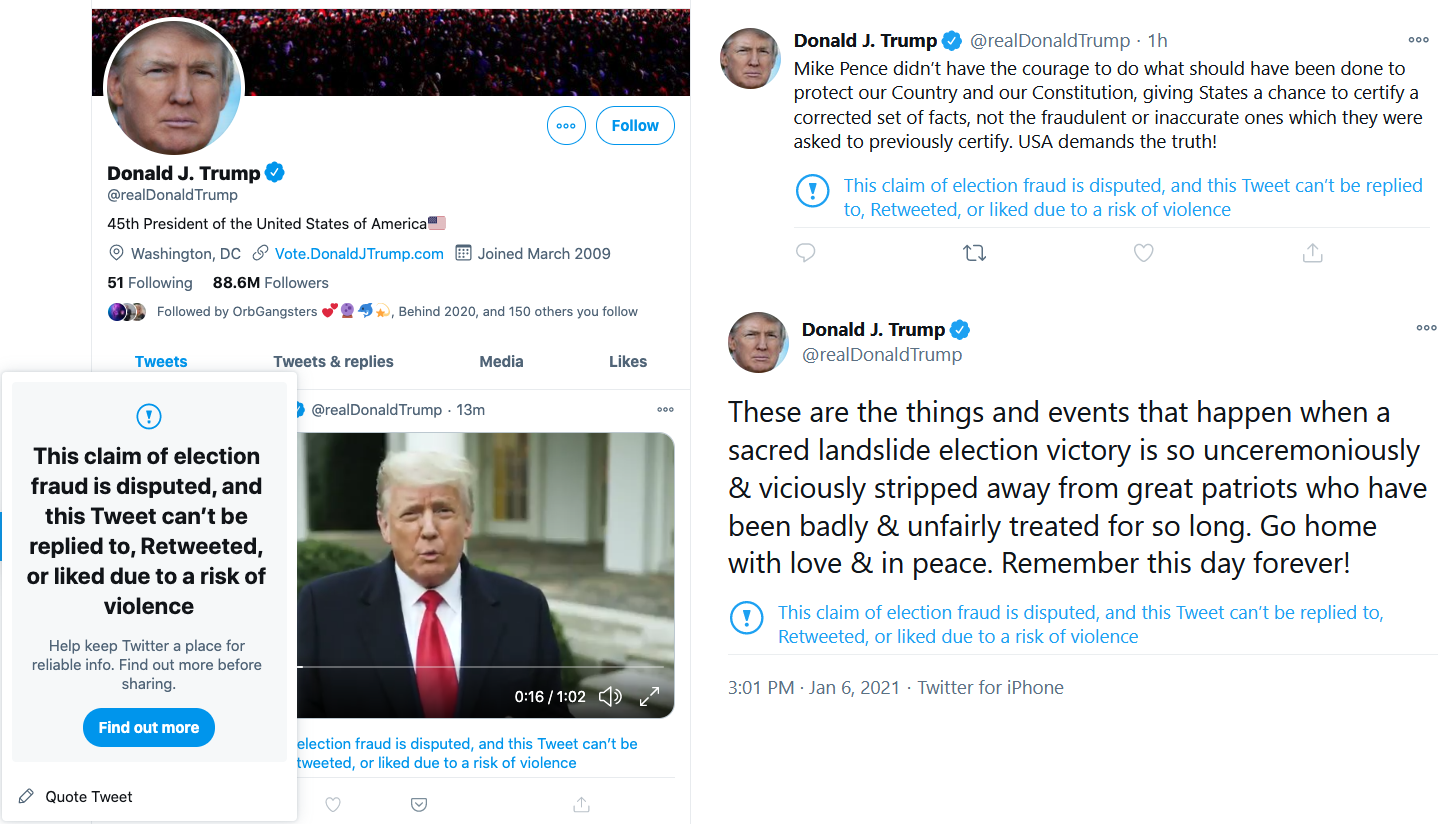
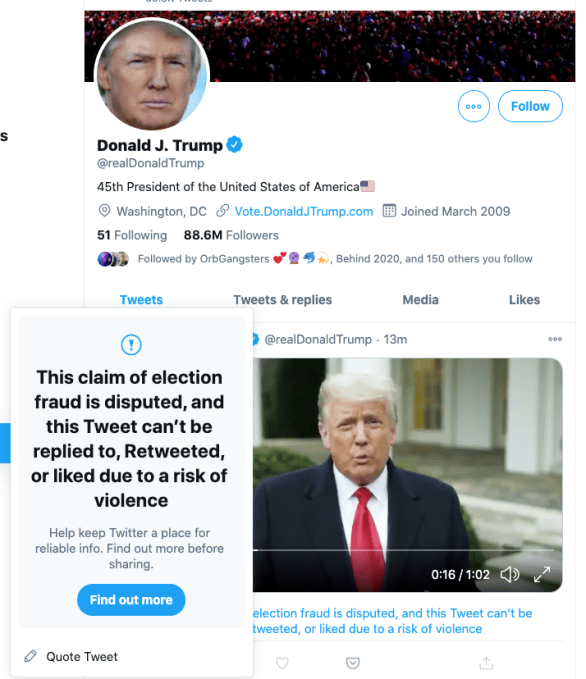
On Twitter this was soon restricted, with a large warning that “this Tweet can’t be replied to, Retweeted, or liked due to a risk of violence.”

Guy Rosen, VP of Integrity at Facebook, wrote on Twitter that “this is an emergency situation and we are taking appropriate emergency measures, including removing President Trump’s video. We removed it because on balance we believe it contributes to rather than diminishes the risk of ongoing violence.”

At Facebook there is some precedent for one of Trump’s posts being removed. In August, the company took down a video in which Trump stated that children were “almost immune” to COVID-19, a dangerous and false claim not supported by science.

As Twitter and Facebook crafted bespoke policies to address threats to the election leading into November, YouTube mostly remained quiet. In early December, a month after the election, the company announced that it would begin removing content that made false claims that the U.S. election was affected by “widespread fraud or errors.” YouTube’s decision to remove president’s video on Wednesday aligned with that policy.

“We removed a video posted this afternoon to Donald Trump’s channel that violated our policies regarding content that alleges widespread fraud or errors changed the outcome of the 2020 U.S. Election,” a YouTube spokesperson told TechCrunch, noting that the video is allowed if accompanied by proper context for “educational” value.

This story is developing.

06 Jan 2021

Daily Crunch: Trump tweets approvingly as rioters storm US Capitol

A pro-Trump mob stormed the U.S. Capitol while the president encouraged them on Twitter and … well, it feels extremely hard to care about anything else right now.

That said, there was a whole other news cycle before then, and I know you read The Daily Crunch for tech headlines. So I’ll do my best to carry on and squeeze everything in.

This is your Daily Crunch for January 6, 2021.

The big story: Trump tweets approvingly as rioters storm US Capitol

As you almost certainly know already, a pro-Trump mob entered the U.S. Capitol today, forcing the Senate and House to flee as they were in the process of debating and certifying Joe Biden’s election as president.

These Trump supporters were chanting slogans like “stop the steal,” which grew out of online conspiracy theories that have spread on social media. At least one gunshot victim has been reported, and an explosive device was also detonated safely outside the Republican National Committee.

Meanwhile, President Trump continued to tweet his unfounded and unsubstantiated claims of election fraud and even posted a video telling the rioters, “Go home, we love you.” Twitter has posted warnings but there are calls for the platform to go further.

The tech giants

Facebook redesigns Pages with a more simplified layout and no ‘Like’ button — The redesign includes a new look-and-feel, updated navigation, the introduction of a dedicated News Feed and a new Q&A format.

Twitter acqui-hires creative agency Ueno to help design new products — Twitter is essentially buying an agency with which it already had a close working relationship.

TikTok rolls out its first lidar-powered AR effect — The effect features an AR ball, similar to the one that drops in Times Square on New Year’s Eve.

Startups, funding and venture capital

Perfect Corp., developer of virtual beauty app YouCam Makeup, closes $50M Series C led by Goldman Sachs — The YouCam Makeup app lets users “try on” virtual samples from more than 300 global brands.

Plant-centered prepared food delivery startup Thistle raises $10.3M — The company delivers plant-based full menus for its customers, along with a range of juices and sides.

Teamflow lands $3.9M for a productive virtual HQ platform — Teamflow, formerly Huddle, is creating a virtual headquarters to help distributed teams collaborate and communicate from a singular platform.

Advice and analysis from Extra Crunch

Why VC funding is falling out of favor with top D2C brands — In 2020, venture capitalists unceremoniously broke up with D2C brands and product-based businesses.

Revenue-based financing: The next step for private equity and early-stage investment — The financial structures used by VCs haven’t evolved much since they first emerged in 1957.

Extra Crunch Live is back in 2021, connecting founders with tech giants and each other — Somehow, we did 44 episodes of the show in 2020.

(Extra Crunch is our membership program, which aims to democratize information about startups. You can sign up here.)

The Daily Crunch is TechCrunch’s roundup of our biggest and most important stories. If you’d like to get this delivered to your inbox every day at around 3pm Pacific, you can subscribe here.

06 Jan 2021

Daily Crunch: Trump tweets approvingly as rioters storm US Capitol

A pro-Trump mob stormed the U.S. Capitol while the president encouraged them on Twitter and … well, it feels extremely hard to care about anything else right now.

That said, there was a whole other news cycle before then, and I know you read The Daily Crunch for tech headlines. So I’ll do my best to carry on and squeeze everything in.

This is your Daily Crunch for January 6, 2021.

The big story: Trump tweets approvingly as rioters storm US Capitol

As you almost certainly know already, a pro-Trump mob entered the U.S. Capitol today, forcing the Senate and House to flee as they were in the process of debating and certifying Joe Biden’s election as president.

These Trump supporters were chanting slogans like “stop the steal,” which grew out of online conspiracy theories that have spread on social media. At least one gunshot victim has been reported, and an explosive device was also detonated safely outside the Republican National Committee.

Meanwhile, President Trump continued to tweet his unfounded and unsubstantiated claims of election fraud and even posted a video telling the rioters, “Go home, we love you.” Twitter has posted warnings but there are calls for the platform to go further.

The tech giants

Facebook redesigns Pages with a more simplified layout and no ‘Like’ button — The redesign includes a new look-and-feel, updated navigation, the introduction of a dedicated News Feed and a new Q&A format.

Twitter acqui-hires creative agency Ueno to help design new products — Twitter is essentially buying an agency with which it already had a close working relationship.

TikTok rolls out its first lidar-powered AR effect — The effect features an AR ball, similar to the one that drops in Times Square on New Year’s Eve.

Startups, funding and venture capital

Perfect Corp., developer of virtual beauty app YouCam Makeup, closes $50M Series C led by Goldman Sachs — The YouCam Makeup app lets users “try on” virtual samples from more than 300 global brands.

Plant-centered prepared food delivery startup Thistle raises $10.3M — The company delivers plant-based full menus for its customers, along with a range of juices and sides.

Teamflow lands $3.9M for a productive virtual HQ platform — Teamflow, formerly Huddle, is creating a virtual headquarters to help distributed teams collaborate and communicate from a singular platform.

Advice and analysis from Extra Crunch

Why VC funding is falling out of favor with top D2C brands — In 2020, venture capitalists unceremoniously broke up with D2C brands and product-based businesses.

Revenue-based financing: The next step for private equity and early-stage investment — The financial structures used by VCs haven’t evolved much since they first emerged in 1957.

Extra Crunch Live is back in 2021, connecting founders with tech giants and each other — Somehow, we did 44 episodes of the show in 2020.

(Extra Crunch is our membership program, which aims to democratize information about startups. You can sign up here.)

The Daily Crunch is TechCrunch’s roundup of our biggest and most important stories. If you’d like to get this delivered to your inbox every day at around 3pm Pacific, you can subscribe here.

06 Jan 2021

Reddit ‘taking action’ on site violations as rioters storm US Capitol

As chaos and violence have erupted in Washington D.C., social media platforms are grappling with the fallout. A spokesperson for Reddit tells TechCrunch,

Reddit’s site-wide policies prohibit content that promotes hate or encourages, glorifies, incites, or calls for violence. In accordance with this, we have been proactively reaching out to moderators to remind them of our policies and to offer support or resources as needed. We are also taking action on reported violations.

The site reportedly hasn’t seen a major change in user activity leading up to today’s  storming of the U.S. Capitol building — apparently owing in part to the banning of a number of Subreddits, including The_Donald, over violations earlier this year.

The statement follows similar wording from Twitter,

In regard to the ongoing situation in Washington, DC, Twitter’s Trust & Safety teams are working to protect the public conversation occurring on the service and will take action on any content that violates the Twitter Rules.

It seems clear that much of the current reaction to the situation is in flux as this unprecedented and dark moment continues to unfold in Washington D.C. For now, much of Reddit’s content control lies in the hands of site moderators.

06 Jan 2021

Twitter puts huge warning label on Trump video telling Capitol Hill rioters ‘we love you’

Twitter took a new action against President Trump’s account Wednesday, adding a large, pop-up warning message to his latest tweet addressing the ongoing chaos on Capitol Hill. The company has restricted engagement on the tweet, citing a “risk of violence.”

Trump’s new message to his mob of angry supporters came in video form, following an earlier tweet encouraging the crowd to be “peaceful.” In the video, Trump both affirmed his supporters’ conspiracy-rooted grievances and gently encouraged them to leave.

“I know your pain. I know you’re hurt. We had an election that was stolen from us. It was a landslide election and everyone knows it. Especially the other side. But you have to go home now,” Trump said. “Go home, we love you. You’re very special.”

A crowd of agitated Trump supporters broke into the U.S. Capitol building in Washington D.C. Wednesday, storming into Congressional chambers and even invading the office of House Speaker Nancy Pelosi. The effort, connected to the “Stop the Steal” movement which Trump has regularly encouraged, happened as Congress was meeting to certify President-elect Joe Biden’s electoral win.

Twitter has previously hidden the president’s rule-breaking tweets, affixed them with small warning labels and limited their engagement, but the large pop-up is a tool we hadn’t yet seen the company use. Twitter said today that it would “[explore] other escalated enforcement actions” in light of the situation unfolding at the Capitol. It’s not clear if the pop-up is appearing for all users and we’ve asked the company if this was one of the escalated measures it referred to.

“In regard to the ongoing situation in Washington, DC, Twitter’s Trust & Safety teams are working to protect the public conversation occurring on the service and will take action on any content that violates the Twitter Rules,” a Twitter spokesperson said. “Let us be clear: Threats of and calls to violence have no place on Twitter, and we will enforce our policies accordingly.”

06 Jan 2021

Pro-Trump mob storms the US Capitol, touting ‘Stop the Steal’ conspiracy

A chaotic scene unfolded in Washington D.C. on Wednesday as a large crowd of pro-Trump protesters stormed the U.S. Capitol Building.

The Trump supporters flooded into the nation’s capital to attend a rally held earlier by President Trump outside the White House. The rally was timed to protest lawmakers gathering Wednesday to certify President-elect Joe Biden’s electoral win.

At his own event, Trump encouraged his supporters to continue demonstrating against Congress, claiming incorrectly that Vice President Mike Pence holds the power to overturn the election results. While the situation is still unfolding, protesters penetrated the Capitol building and injuries have been confirmed, including at least one gunshot victim.

As Trump supporters flooded up the Capitol steps with “Make America Great Again” hats and “Stop the Steal” banners, the president did little to quell the violence. “Mike Pence didn’t have the courage to do what should have been done to protect our Country and our Constitution, giving States a chance to certify a corrected set of facts, not the fraudulent or inaccurate ones which they were asked to previously certify,” Trump wrote in a tweet. “USA demands the truth!”

Twitter appended a warning label calling Trump’s election fraud claims “disputed” to the tweet. After his supporters already made their way into the Capitol building, the president seemed to walk back his calls to action, calling for supporters to remain peaceful.

The Stop the Steal movement grew out of online conspiracies boosting Trump’s unfounded claims that Democrats had in some way rigged the presidential election. In reality, U.S. electoral results were decisively in favor of Biden, though votes trickled in over an extended period of time, as expected, due to a massive expansion of pandemic-related mail-in voting.

Facebook made efforts to rein in Stop the Spread groups soon after the election, blocking the hashtag for violating its rules around election misinformation. “The group was organized around the delegitimization of the election process, and we saw worrying calls for violence from some members of the group,” Facebook spokesperson Andy Stone said at the time.

Stop the Steal supporters also found a foothold on many other platforms, including Reddit, Twitter and alternative social networks like Gab and Parler, which have attracted far-right users with policies much friendlier to extremist content. The crowd at the capitol also shares considerable overlap with QAnon, a constellation of conspiracy theories that exploded on Facebook, YouTube and other online platforms over the last few years.

This story is developing.

06 Jan 2021

Revenue-based financing: The next step for private equity and early-stage investment

Revenue-based investing (RBI), also known as revenue-based financing, or revenue-share investing,1 is a natural next step for the private equity and early-stage venture investment industry. However, due to RBI being a relatively new model, publicly available data is limited.

To address this foundational gap in market information, we have developed a proprietary data set of 32 RBI investment firms, 57 distinct funds and 134 companies that have secured revenue-based investing.

Bootstrapp developed this extensive analysis on revenue-based investing for the purpose of accelerating the shift toward greater transparency and standardization within the industry.

Upon thoroughly analyzing the data, we’ve been able to identify the total number of investment firms and amount of capital that comprise the RBI industry, the specific verticals and business models that are most actively leveraging RBI, and the typical profile of companies that access this form of capital.

These findings are summarized below; a full industry-spanning report that defines the overall revenue-based investing market as it stands today is available to download here.

As context, the financial structures used by VCs haven’t evolved much since they first emerged in 1957. Today, the model is almost precisely the same, with only incremental changes such as more efficient capital markets and industry standards for structuring deals, pricing companies and more.

More recently, we have seen numerous new investment models and financing instruments, including shared earnings agreements and point-of-sale capital. One of the most prominent and popular new models for investors is revenue-based investing (RBI).

However, because the model is new, there is a lack of publicly available data, industry standards have not yet been fully established, and similarly to the equity investment market, there is little transparency into the cost of capital that investees truly pay in exchange for taking on a revenue-based investment.

Thankfully, there have been some notable efforts to drive transparency in the RBI market. For example, Bigfoot Capital open-sourced its RBI model, outlining it in a blog post and sharing their RBI financial model and anonymized term sheet, but a thorough, quantitative, industry-wide analysis has not been conducted until now.

In order to raise RBI, the company must normally be generating revenue, but is not necessarily required to be profitable, although profitability, or at least a near-term path to profitability, is often an important criteria for many investors. “For startups with revenue, RBI may be a good option because, even though the startup may not be profitable, it can reduce dilution — especially for founders,” said Emily Campbell of The Campbell Firm PLLC, a law firm that represents serial entrepreneurs and venture-backed businesses.

“Taking in some smart equity or convertible debt and balancing that money with other financing can be a good strategy for a startup,” she said. Profitability decreases the risk of default and assures that the investee has the ability to service the debt.

In regards to the applications that are best suited to RBI, B2B software-as-a-service (SaaS) companies rise to the top of the list primarily because one is able to — in essence — securitize the revenue being generated by a company and then lend capital against that theoretical security. In addition to SaaS companies, RBI is being used quite frequently in the impact investing community as it solves the problem of a lack of normal M&A or IPO exit paths for impact-driven companies and are sometimes marketed as a nonextractive form of investment structure.

Beyond B2B SaaS and impact investing, many other verticals are adopting the model as well, including e-commerce/D2C, consumer software, food and beverage, and more. It ought to be noted, however, that regardless of the specific business model a company employs, the investee is typically required to have repeatable sales and a track record that demonstrates a strong revenue stream, and therefore a clear ability to return the capital to the investors.

The U.S. RBI landscape

We have identified 32 U.S.-based firms actively investing via a revenue-based investing instrument, with those firms managing 57 distinct funds representing an estimated $4.31 billion in capital. Through our analysis of those firms, funds and investees, we found that:

  1. The number of firms and the amount of capital committed to RBI is increasing, and we forecast that this trend will continue.
  2. B2B software was not surprisingly the largest consumer of RBI,
  3. There was a surprising amount of activity across industries that are not yet typically associated with revenue-based investing such as food and beverage, consumer products, fashion, and healthcare.

Firms were included in the data set (and by extension, determined to be actively making revenue-based investments) if they:

  1. Invest in companies using an instrument where the return is generated from the principal plus a flat fee that is paid back via a fixed percentage of revenue.
  2. Payments to investors are made on a monthly (or longer) basis.
  3. The payback period is expected to be longer than 12 months.

The specific number of firms we believe to be quite accurate, representing only active, U.S.-based revenue-based investing firms. The number of funds, however, may be underestimated. This is due to the fact that, although each firm is associated with at least one fund, we did not include additional funds beyond that unless they were confirmed through other sources, such as the firms’ public communications, their SEC Form D or other sources as outlined in the methodology section at the conclusion of the full report.

The total amount of RBI capital that has already been allocated to companies across all firms and all years is $2.1 billion. However, it should be noted that this includes the outliers in our dataset, namely Kapitus, Clearbanc, Braavo and United Capital Source. Once we remove those firms, the remaining 28 firms, representing 51 funds, have allocated $592.8 million.

This figure of $592.8 million is almost certainly an underestimate due to the fact that only 19 of 32 firms had a known “amount of allocated capital,” whereas the remaining 13 firms have unknown values (i.e., zeros) for the amount of capital they have allocated thus far. Therefore, if all 32 firms had a valid and confirmed amount of allocated capital, we can logically conclude that the number would rise dramatically from the current figure of $592.8 million.

Increasing popularity of RBI

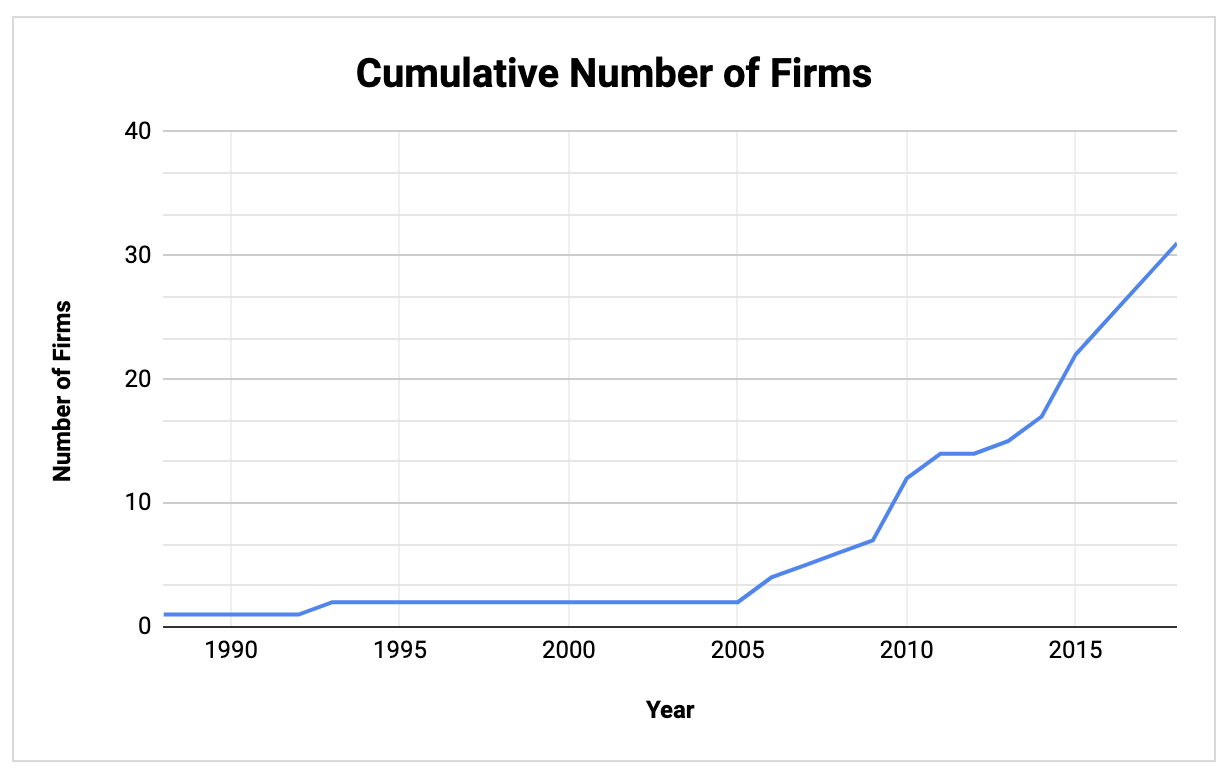
New RBI firms have been founded every year since 2013. In 2010, five firms were founded and in 2015 four additional firms were founded, then from 2014-2019, two or more firms were founded each year.

Clearly, there has been a major uptick in RBI firms being founded since 2005, with a relatively consistent number of new firms being founded over the 15 years since then. In the last 10 years alone, 25 RBI firms have been founded.


06 Jan 2021

TikTok rolls out its first LiDAR-powered AR effect

Snapchat was among the first apps to leverage the iPhone 12 Pro’s LiDAR Scanner for AR, but now TikTok has followed suit. The social video app confirmed today it has launched its first-ever LiDAR-powered effect to help its users ring in the new year. The effect features an AR ball, similar to the one that drops in Times Square on New Year’s Eve. After a countdown, the ball drops and explodes to fill the room with confetti, as well as a floating “2021” in the air.

Support for LiDAR, or Light Detection and Ranging, was introduced on the new flagship 5G iPhone models, the iPhone 12 Pro and 12 Pro Max, in the fall. The technology helps the iPhone better understand the world around you, by measuring how long it takes for light to reach an object in the space and reflect back.

Along with improvements to the iPhone’s machine learning capabilities and dev frameworks, this allows for more immersive Augmented Reality (AR) experiences.

Snapchat, an early adopter of the technology, had first used the new LiDAR Scanner to create a Lens in its app where flowers and grasses would grow in the room around you. The Lens included virtual vegetation that even climbed up the walls and around the cabinets in the room, for example.

Similarly, TikTok’s effect aims to use LiDAR’s understanding of the room to land the confetti more realistically after the ball explodes.

In the example video the company published on Twitter, it showed the confetti covering the floor, sofa and throw pillows, much as it would in real life. This effect wasn’t perfect by any means — it was still very clear this was an AR experience and not real confetti — but it was an improvement over AR effects that lack the same spatial awareness.

TikTok described the effect as being able to visually bridge the digital and physical worlds, thanks to how the AR effects interact with the user’s environment.

Of course, fun AR effects are only one of many use cases for something like LiDAR. The technology is also being adopted by apps that let you scan to create 3D models, like 3D Scanner App, or those that help with interior design, like RoomScan LiDAR, or even games, like the Apple Arcade title, Hot Lava.

TikTok says it plans to roll out “more innovative effects” over the course of 2021.

06 Jan 2021

FAA issues rules for supersonic jet flight testing in the U.S.

The U.S. Federal Aviation Administration (FAA) has issued new final rules to help pave the way for the re-introduction of supersonic commercial flight. The U.S. airspace regulator’s rules provide guidance for companies looking to gain approval for flight testing of supersonic aircraft under development, which includes startups like Boom Supersonic, which has just completed its sub-scale supersonic demonstrator aircraft and hopes to begin flight testing it this year.

Boom, which is in the process of finalizing a $50 million funding round and has raised around $150 million across prior fundraising efforts, rolled out its XB-1 supersonic demonstrator jet in October. This test aircraft is smaller than the final design of its Overture passenger supersonic commercial airliner, but will be used to prove out the fundamental technologies in flight that will then be used to construct Overture, which the company is targeting for a 2025 rollout with airline partners.

Other startups, including Hermeus, are also pursuing supersonic flight for commercial use. Meanwhile, SpaceX and others focused on spaceflight like Virgin Galactic are exploring not only supersonic flight, but how point-to-point flight that includes part of the trip at the outer edge of Earth’s atmosphere might reduce flight times dramatically and turn long-haul flights into much shorter, almost regional trips.

The FAA’s rules finalization comes in under the wire as the agency prepares for a transition when current U.S. Transportation Secretary Elaine Chao moves aside for incoming Biden pick Pete Buttigieg. You can read the full FAA final rule in the embed belt.