Year: 2021

06 Jan 2021

Looking Glass is launching 3D photo software for its holographic tech

Last month, Looking Glass Factory introduced the Portrait, its first offering for a more general audience. The device utilizes the company’s impressive holographic imaging technology for a far more accessible form factor – a technically impressive digital photo frame, put simply.

Of course, one of the biggest question marks for technology like this is always content. More specifically, how do the people who buy the $349 product actually create 3D images to use with it? Then startup announced its solution to that issue today in the form of HoloPlay Studio. The company’s proprietary software was created to convert 2D images to 3D.

“Now extremely realistic holographic memories of all sorts can be created and enjoyed by more people than ever before, getting us one step closer to a world in which we’re creating in, communicating with, and reliving our memories through holograms,” CEO Shawn Frayne said in a release.

The company promises a low barrier of entry here. Users just need to upload images to the software. Results will likely vary depending on a number of factors. This is the kind of thing I’d normally like to see in person, first, but it’s been a bad couple of years for hands-on experiences.

The tech is set to go live through Looking Glass’s site at some point in the Spring. After that, it will be bundled with the new portrait devices. Backers get 20 conversions for free and then it’s $20 for 100 photos.

06 Jan 2021

Teamflow lands $3.9 million for a productive virtual HQ platform

After a year of video calls and Slack messages, the definition of workplace is set to shift again. In a post pandemic world, some will return to the office, many will remain remote, and regardless of where an employee sits, Florent Crivello, the co-founder of Teamflow, has raised millions for what he views as a trillion-dollar idea to make their work day easier.

Teamflow, formerly Huddle, is creating a virtual headquarters to help distributed teams collaborate and communicate from a singular platform. The startup, which has been in private beta for six months, today announced it has raised $3.9 million in a seed financing round led by Menlo Ventures.

It’s good timing, as Crivello notes, as the competition is red hot. There are dozens of other virtual HQ platforms, some venture-backed and some bootstrapped, similarly mixing gamification and productivity into a service.

“I think every engineer and every tech person in the Valley has been having a very first-hand experience of this problem over the last year,” Crivello said. “A lot of small brains are thinking about this issue right now.”

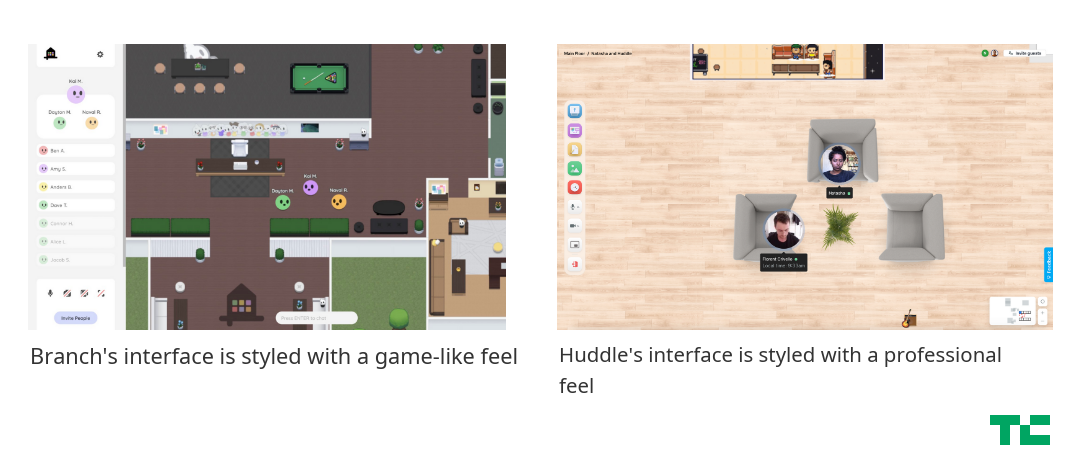
Crivello, who previously led teams at Uber, sees Teamflow’s focus on virtual work, instead of virtual socializing, as its competitive advantage against other platforms. Competitors include Branch, which has a more social feel, and Hopin, a platform last valued at $2 billion which produces digital conferences.

“We’re not pokemon kind of fun,” he said. “We’re still very work-focused.”

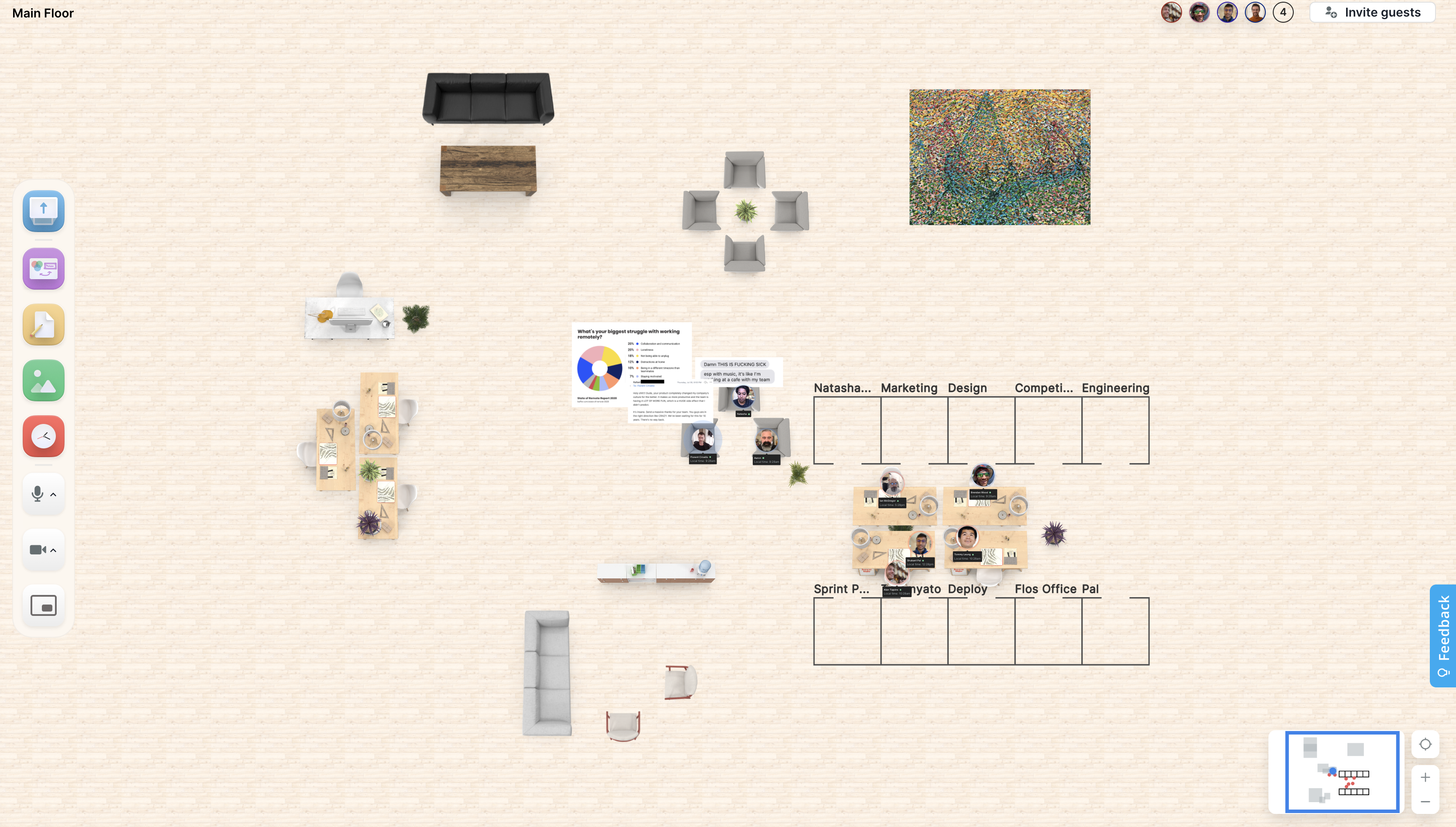
A quick tour through Teamflow illustrates its emphasis on productivity over aesthetic. When you enter the virtual space, you’re greeted with a sidebar of options: ranging from white boards, countdown timers, and soon integrations with Notion and Google Docs.

Crivello views Teamflow as being a response to the very “app-centric” world of remote work right now. The platform can be the collaboration layer that brings all the apps out of unorganized tab hell and into one place.

Teamflow uses spatial technology to give employees the feel of spontaneity. If you walk – or toggle – past a co-worker, you’ll be able to join in conversation. The farther you move, the less you hear. There are also breakout rooms where people can enter to have focused, invite-only meetings.

The product has shown some signs of growth since launching its beta. There is 30% growth in hours on the platform week over week, bringing a total of over 50,000 hours of user testing into the platform experience. There are 1,000 users on the waitlist.

“We believe that we are this thing you open in the morning and leave open all day,” Crivello said.

While Teamflow is focusing heavily on productivity, user design does matter when you’re trying to convince consumers to spend an entire work day on your app. Teamflow will need to make more investments in its experience to give it the feel and culture of a virtual HQ, versus another place for employees to spend screen time. It’s why some competitors are opting for a gamified approach.

Any virtual HQ company will have to convince users to exist passively on its platform for a meaningful amount of time, every single day.

If all goes well, Teamflow is looking to be a remote work solution that can replace Slack and Zoom. Crivello says that he has “several customers” who have stopped using both apps altogether, and Teamflow is currently building an internal chat feature that rivals Slack.

The cost for a subscription, per seat, starts at $20 a month.

“There’s so much more to remote work collaboration than communication,” Crivello said. Slack and Zoom’s primary features are connecting employees to each other to talk; while he hopes that Teamflow allows employees to talk and work in one place.

Undoubtedly, the opportunity for a platform that can get widespread adoption around distributed teams is grandiose. Pandemic or not, Teamflow thinks that the world has experienced a tipping point which will bring distributed work mainstream. Founders will be looking for solutions to keep their teams happy, and productivity high.

“Now, if you don’t offer remote work, you’re at a competitive disadvantage [as a company],” Crivello said.

The beauty of early-stage startups is that long-term success doesn’t need to be obvious from the get go. Yet, when it comes to Teamflow, or any virtual HQ platform, the validation will be simple to prove (or disprove) the moment that post-pandemic consumer habits materialize.


06 Jan 2021

Twitter acquihires creative agency Ueno to help design new products

Twitter this morning announced it’s bringing the full-service creative agency Ueno in-house to work alongside Twitter’s own design and research teams. The move, an acquihire of sorts, is one where Twitter is essentially buying the agency it already had a close working relationship with, as Ueno had previously partnered with Twitter on various design and product experiences in the past.

The agency itself was founded by Haraldur Thorleifsson in Reykjavik, Iceland in 2014. Today, it has dozens of employees working in Reykjavik, San Francisco, New York, and L.A.

Over the years, Ueno has worked on a number of projects for large brands and startups alike, including Google, Facebook, Reuters, Uber, ESPN, Sotheby’s, Walmart, Visa, NYT, Apple, Slack, and others. Startups that contracted the agency include Zero, Checkout.com, Superhuman, Tagomi, Strava, Cruise, Credit Karma, Boosted, and many more. (Ueno also worked on Clubhouse per its website, but not the same Clubhouse that’s competing with Twitter Spaces.)

Also among its clients were those that had other Twitter ties: Medium and Jelly. The former is the publishing platform from Twitter co-founder Evan Williams, and the latter was a Q&A app created by Twitter co-founder Biz Stone, which later sold to Pinterest.

Twitter Chief Design Officer, Dantley Davis announced the news of Ueno’s joining on Twitter this morning, saying Ueno has a “highly experienced and innovative team of designers, strategists, and producers.”

He also said the team will help Twitter to “accelerate the quality and execution of Twitter’s product experiences.”

Ueno’s founder, meanwhile, also announced the news then teased Twitter CEO Jack Dorsey about the edit button.

Twitter tells TechCrunch that Ueno will wind down its agency and will complete its existing projects for other clients over the weeks ahead.

The company also said it will be meeting with Ueno’s 50 global employees over the weeks ahead to learn more about their professional backgrounds and goals — essentially, to determine if they can fit inside Twitter’s design and research orgs. That means Twitter may or may not end up hiring all 50.

Twitter isn’t publicly sharing what projects it has in mind for Ueno, but we understand the Ueno staff will end up embedded across key teams within the design and research organizations so they can work on top product initiatives, including “conversational tools” and other upcoming features. Reading between the lines, this seems to indicate that Twitter Spaces, the company’s new audio-based conversations tool, will benefit from the acquihire.

The company also noted it will continue to be on the lookout for other talent to help it accelerate its work in a similar way, so this may not be the last acquihire deal to come.

The news of Ueno’s acquirhire follows that of Twitter’s acquisition of social podcasting app Breaker, announced just this week, also with the goal of staffing up on Twitter’s new audio-based networking project and Clubhouse rival (the audio app), Twitter Spaces.

Deal terms were not shared.

06 Jan 2021

Why VC funding is falling out of favor with top D2C brands

In 2020, venture capitalists unceremoniously broke up with D2C brands and product-based businesses.

Many watched as the consumer brands in their portfolios rushed to make hefty layoffs and eke out more runway and grew more concerned with their business models.

Some simply monitored the “lackluster” Casper IPO or skimmed articles about Brandless and others “imploding” and started pulling a slow fade on D2C brands — not taking pitches, not following up.

Many product-based brands, as it turns out, are no longer interested in chasing venture capital.

Last year, investors adopted a wait-and-see approach to all new investments and prayed portfolio brands could cut their burn significantly enough, stay relevant and ride things out.

Product-based businesses fell out of favor and venture capitalists, if they did invest last year, mainly focused on AI startups, or companies focused on data collaboration, data privacy and healthcare (mostly founded by men, might I add).

From a distance, it sounds like direct-to-consumer founders were left destitute and desperate for financing, wounded by every slow fade or hard pass, beholden as ever to the whims of Silicon Valley.

But as Hal Koss so eloquently shared in his “DTC playbook” post-mortem, this wasn’t a one-way breakup; this parting of ways is actually mutual. Many product-based brands, as it turns out, are no longer interested in chasing venture capital, playing the “grow-at-all-costs” game and relinquishing partial control to investors, despite the pandemic and the uncertain circumstances many founders find themselves facing.

Through my work running and scaling Bulletin, I’ve followed thousands of product-based businesses ranging from indie beauty brands selling clean serums and cleansers to sex tech companies making couples’ vibrators and foreplay accessories. I’ve followed them on Instagram, in the press and across various platforms, and in many cases, I’ve spoken to their founders directly.

Over the past two years, I interviewed executives at more than 30 women-owned businesses for my upcoming book, “How to Build a Goddamn Empire,” and had long phone calls with dozens of independent brands and makers as Bulletin got a handle on how the pandemic was impacting customers. And I noticed something new and remarkable about what founders want now, in 2021, compared to what they wanted in years past.

Back then, I’d get dozens of cold emails and DMs asking how I successfully raised VC and what the unspoken rules might be. I’d hear from business owners who were considering a raise or gearing up for one. Product-based entrepreneurs approached me at panels or Bulletin events and say they wanted to be the “Glossier for X” or the “Away for Y.” Many younger founders didn’t even know what venture capital really was, but they saw it as symbolic validation for the business, or the only way to get “big.”

Now, brands would rather scrape by than pursue an injection of funding on someone else’s terms; just ask the Gorjana founders or Scott Sternberg. Many brands that saw astronomical growth in 2020, like Rosen, Golde, Entireworld and others that spurred similar growth for Etsy and Shopify are fully bootstrapped businesses, and proudly so.

Some founders I’ve spoken to have even outright rejected offers for investment. A lot of D2C brands are interested in learning about alternative forms of financing like bank loans, lines of credit and crowdfunding, and ask about iFundWomen or Kickstarter, observing the success of other fully crowdfunded brands like Dame and Pepper.

Venture capital, from my vantage point, has lost its sheen for a lot of product-based brands. They’re not destitute and desperate for financing. They’re actually scoffing at the prospect and trusting they can succeed, scale and maintain long-term profitability without swapping equity for cash. They’re tripped up by what they’ve been reading in the media, or they’ve survived or even thrived during COVID, as a fully bootstrapped company, and feel more conviction than ever that the “grow slow” approach is the right move.

They’re reading the same stories about layoffs and tenuous unit economics at massive D2C companies and agreeing with Sam Kaplan that the old playbook — pricey customer acquisition practices, rapid scale, endless rounds of funding — is out of date. It’s 2021 and we’re midpandemic. These brands want to turn a profit.

06 Jan 2021

The NYSE will delist three Chinese telecoms after all

The New York Stock Exchange announced this morning that it will be delisting three major Chinese telecom companies, a move that it first announced last week before seeming to reverse course on Monday.

This is all happening in response to the Trump Administration’s broader order barring U.S. investment in companies that support the Chinese military. (Trump has been trying to ban TikTok through a separate order.)

Why the double reversal? To be fair to the NYSE, in its first reversal, the exchange had only said it would allow the telecoms to continue trading while it evaluates whether the executive order applies to them.

Now it seems that the further evaluation is complete. In today’s announcement, the NYSE said it’s making the decision after receiving “new specific guidance” confirming that yes, the executive order does apply to China Telecom, China Mobile and China Unicom.

As a result, trading of all three stocks will be suspended on the exchange as of 4am Eastern time on Monday, January 11. The move is seen as largely symbolic, since the telecoms’ trading volume via the NYSE only represents a small percentage of their total tradable shares.

06 Jan 2021

At $35 to $39 per share, Poshmark’s IPO could 5x its last private valuation

The new year is off to a busy IPO start. As The Exchange reported a few weeks ago, investors anticipate a busy Q1 IPO cycle, followed by a slower Q2 and a busy Q3 and Q4.

With Affirm releasing an initial IPO price range last night and Poshmark repeating the feat this morning, private-market investor expectations are holding up thus far.

Secondhand fashion marketplace Poshmark anticipates its IPO could price between $35 and $39 per share. Using its simple share count, the former startup could be worth nearly $3 billion. So, we’ve seen two multi-unicorns set early pricing terms this week: that’s comfortably busy.


The Exchange explores startups, markets and money. Read it every morning on Extra Crunch, or get The Exchange newsletter every Saturday.


As we did with Affirm, we’ll dig into Poshmark’s new pricing interval, calculate valuations for the company using both simple and fully-diluted share counts, and figure out how they compare to its most-recent financial results and final private valuation. For the last bit, we’ll pull from PitchBook data and the S-1/A filing itself.

But for those of you in a hurry, the short gist is that for Mayfield, GGV, Menlo Ventures, Inventus Capital, and Temasek, the company’s first pricing estimate looks like a win.

If you want to read our first dig into the company’s IPO filing that is more focused on performance than pricing, head here. Let’s go!

Poshmark’s hugely “up” IPO

Poshmark’s $35 to $39 per-share IPO price interval could change, but even if it fails to rise, the company’s implied valuation is a dramatic step up from prior rounds.

For example, the company’s S-1 filings note that during its 2017 venture round — the last that it raised per the IPO filing and PitchBook data — Poshmark sold shares at $8.3729 per share. That’s a fraction of the price that the company now expects public-market investors to pay.

As with Affirm, let’s calculate Poshmark’s valuation using both simple and fully-diluted share counts. The latter takes into account shares that have been earned, but not yet exercised or converted.

Here’s the company’s valuation range using a simple share count, inclusive of its underwriters’ option to purchase 990,000 shares at its IPO price:

  • Poshmark valuation, low-end of range: $2.60 billion
  • Poshmark valuation, high-end of range: $2.90 billion

If we expand the company’s share count to include vested options and RSUs, the numbers go up. Again, the following math is inclusive of the underwriters’ option:1

  • Poshmark valuation, low-end of range: $2.95 billion billion
  • Poshmark valuation, high-end of range: $3.29 billion

So, are those good numbers? Yes.

06 Jan 2021

Extra Crunch Live is back in 2021, connecting founders with tech giants and each other

In April 2020, when the entire world was laser-focused on the coronavirus pandemic, we realized that startupland was in unprecedented territory. How should startups navigate fundraising, operations, and better understand the market? 

In a matter of a couple weeks, we spun up a little series called Extra Crunch Live, giving Extra Crunch members the chance to hear from and connect with leaders across the industry. We brought on some of the biggest names in tech and VC, including likes of Roelof Botha, Kirsten Green, Zach Perret, Charles Hudson, Aileen Lee, Mark Cuban, Howard Lerman, Niko Bonatsos, Alexa Von Tobel, Aileen Lee and the list could go on and on and on

Somehow, we did 44 episodes of the show in 2020, the year of our Lord. 

By any measure, it’s been a huge success. But we’re not ones to rest on our laurels here at TechCrunch. Which is why I’m thrilled to announce Extra Crunch Live 2.0. 

In 2021, we’ll be tweaking the format of ECL to provide even more interactivity between founders and audience members and the speakers we host on the show. You’re going to love it. 

What’s New: 

  • Series A – Learn how others have fundraised! We’ll have a segment dedicated to hearing from founder/investor duos who walk us through the Series A pitch deck that led to investment. 
  • Pitch Deck Teardowns – Extra Crunch members will have the opportunity to submit their pitch deck and get feedback from our guests, which will include VCs and founders (EC members can submit their pitch decks right here!). 
  • Live Pitch-offs – Audience members can raise their hand to practice their elevator pitch in front of the audience and get real-time feedback from VCs.
  • Networking!! – The Extra Crunch membership is a community. ECL will be an opportunity to meet your fellow audience members, even in a virtual environment. Who knows? Maybe you’ll meet your next cofounder or investor! 
  • Consistency – ECL will always be at 12pm PT/3pm ET on Wednesdays. When it comes to your calendar, set it and forget it. 

We’re super excited about our ECL plans for 2021 and we hope you are, too. More on upcoming speakers soon. 

Remember, Extra Crunch Live events are for EC members only, so if you haven’t joined Extra Crunch, get over here! 

06 Jan 2021

Apple App Store customers spent $1.8B over the week of Christmas, set a spending record on New Year’s Day

Apple this morning offered an updated look at its App Store business with the release of its holiday sales figures. The company said App Store customers spent $1.8 billion in apps during the week of Christmas Eve and New Year’s Eve, driven largely by games. And App Store customers also hit a new single-day spending record on New Year’s Day of over $540 million.

What Apple didn’t fully spell out was to what extent the pandemic played a role in increased app spending over the course of 2020. It did again note that top apps during the year had included those that helped customers stay connected and be entertained, like Zoom and Disney+, as well as games that brought people together, like Roblox and Among Us.

However, the company didn’t detail how much customers spent on apps and games over 2020. That leaves us to look to third-party estimates for those figures. According to Sensor Tower’s year-end report, global consumer spending on the App Store reached $72.3 billion in 2020, up 30.3% year-over-year from $55.5 billion in 2019. App Annie came up with a similar figure in a preliminary estimate ahead of its annual report.

Apple, on the other hand, noted that App Store developers have now earned over $200 billion to date since the App Store began in 2008, a figure that’s up from the $155 billion it announced last year.

The company’s holiday week last year had also set a new record with $1.42 billion spent on apps and games, a 16% increase over the year prior. Given that consumers in 2020 spent $1.8 billion, it seems a new record has now been set as well, but it’s unclear why Apple didn’t highlight that today.

Apple also shared a few updates related to its other services businesses in its 2020 wrap-up. It said Apple Music had a “record year” without sharing specifics. Instead, it only noted that 90% of iOS 14 listeners had tried out its new features, like Listen Now, the updated Search, personal radio stations, and Autoplay. Apple also said engagement with its lyrics feature doubled in 2020.

Apple additionally noted the Apple TV+ app is now available across 1 billion screens in over 100 countries, and customers can now buy or rent over 100,000 new release and classic movies and shows.

Apple Pay, meanwhile, is now available at over 90% of U.S. stores, 85% of stores in the U.K., and 99% of stores in Australia.

Apple News, iCloud, and its new service, Fitness+ were mentioned, but Apple didn’t offer any new metrics related to user adoption or growth.

The company also said Apple Arcade had reached over 140 games, Apple Books now has 90+ million monthly active users, and Apple Podcasts is now available in over 175 countries.

06 Jan 2021

UK’s markets regulator asks for views on Nvidia-Arm

The UK’s competition and markets regulator is seeking views on Nvidia’s takeover of Arm Holdings as it prepares to kick off formal oversight of potential competition impacts of the deal.

The US-based chipmaker’s $40BN purchase of the UK-based chip designer, announced last September, has triggered a range of domestic concerns — over the impact on UK jobs, industrial strategy/economic sovereignty and even national security — although the Competition and Markets Authority (CMA)’s probe will focus solely on possible competition-related impacts.

It said today that the probe will likely to consider whether, post-acquisition, Arm would have an incentive to “withdraw, raise prices or reduce the quality of its IP licensing services to Nvidia’s rivals”, per a press release.

The CMA is inviting interested third parties to comment on the acquisition before January 27 — ahead of the launch of its formal probe. That phase 1 investigation will include additional opportunities for external comment, according to the regulator, which has not yet provided a date for when it will take a decision on the acquisition.

Further details can be found on its case page — here.

Commenting in a statement, Andrea Coscelli, the CMA’s chief executive, said: “The chip technology industry is worth billions and critical to many of the products that we use most in our everyday lives. We will work closely with other competition authorities around the world to carefully consider the impact of the deal and ensure that it doesn’t ultimately result in consumers facing more expensive or lower quality products.”

Among those sounding the alarm about the impact on the UK of an Nvidia-Arm takeover is the original founder of the company, Hermann Hauser.

In September he wrote to the prime minister saying he’s “extremely concerned” about the impact on UK jobs, Arm’s business model and the future of the country’s economic sovereignty.

A website Hauser set up to gather signatures of objection — called savearm.co.uk — states that more than 2,000 signatures had been collected as of October 12.

As well as the CMA, a number of other international regulators will be scrutinizing the deal, with Nvidia saying in September that it expected the clearance process to take 1.5 years.

It has sought to preempt UK concerns, saying it will double down on the country as a core part of its engineering efforts by expanding Arm’s offices in Cambridge — where it said it would establish “a new global center of excellence in AI research”.

On wider national security concerns that are being attached to the Nvidia-Arm deal from some quarters, the CMA noted that the UK government could choose to issue a public interest intervention notice “if appropriate”.

Arm was earlier bought by Japan’s SoftBank for around $31BN back in 2016.

Its subsequent deal to offload the chip designer to Nvidia is a mixture of cash and stock — and included an immediate $2BN cash payment to SoftBank. But the majority of the transaction’s value is due to be paid in Nvidia stock at close of the deal, pending regulatory clearances.

06 Jan 2021

Dear Sophie: Banging my head against the wall understanding the US immigration system

Here’s another edition of “Dear Sophie,” the advice column that answers immigration-related questions about working at technology companies.

“Your questions are vital to the spread of knowledge that allows people all over the world to rise above borders and pursue their dreams,” says Sophie Alcorn, a Silicon Valley immigration attorney. “Whether you’re in people ops, a founder or seeking a job in Silicon Valley, I would love to answer your questions in my next column.”

Extra Crunch members receive access to weekly “Dear Sophie” columns; use promo code ALCORN to purchase a one- or two-year subscription for 50% off.


Dear Sophie:

Now that the U.S. has a new president coming in whose policies are more welcoming to immigrants, I am considering coming to the U.S. to expand my company after COVID-19. However, I’m struggling with the morass of information online that has bits and pieces of visa types and processes.

Can you please share an overview of the U.S. immigration system and how it works so I can get the big picture and understand what I’m navigating?

— Resilient in Romania

Dear Resilient:

We welcome you to the U.S.! Our country greatly benefits from international entrepreneurs like you who expand here to innovate, create jobs and bolster the global economy.

I followed in my father’s footsteps to become an immigration attorney to fulfill my personal mission of helping people live the life of their dreams in the United States. A big part of making that happen is to give individuals the information and the tools they need to clearly set their immigration goals and to reach them quickly.

Check out my recent podcast where I provide a brief, high-level overview of the U.S. immigration system. The United States is a nation founded by immigrants. The immigration system is based on many of the same values and principles enshrined in our Constitution.

In 1965, the U.S. Congress passed the Immigration and Nationality Act, the foundation of all of our immigration laws today. Although some amendments to the act have been made over more than 50 years since then, the immigration system still operates under the same framework created back then. One of the things I appreciate about this framework is that there are so many legal routes to immigrate to the U.S. that are available.

There are many visa and green card categories you can use to chart your course. As a creative lawyer with plenty of lead time before somebody moves to the U.S., it provides many options to work with. Law doesn’t just place restrictions on people; it can be used as a tool for creation.

So, even though the system has its challenges and can be greatly improved, successfully navigating the system is doable. Everyone from individuals to founders, CEOs at startups and HR and Global Mobility at giant companies, families and couples in love — you just need to know the right questions to ask and the information to empower you to find the right immigration path.

My father used to always say there are five main areas of immigration law:

  • Business immigration
  • Family immigration
  • Asylum
  • Appeals
  • Removal and deportation

I have worked on cases in each of these areas, but my firm focuses primarily on business and family immigration. Business immigration encompasses both visas and green cards, whereas family immigration only involves green cards that are based on an individual’s relationship to a U.S. citizen or permanent resident (green card holders), including fiance visa and different pathways to green cards.

At a high level, the U.S. offers two types of visas: nonimmigrant visas and immigrant visas. Immigrant visas are also called green cards.

Nonimmigrant visas allow for a temporary stay in the U.S. Each nonimmigrant visa that allows its holder to work in the U.S. requires an employer to sponsor the individual and hire them after approval and arrival. Each nonimmigrant is designed to allow an individual with certain skills, education or expertise that will benefit the employer, the employer’s industry or the U.S in general, such as a multinational executive (L-1) an individual in a specialty occupation (H-1B) or with extraordinary ability (O-1).

Some nonimmigrant visas are based on the candidate’s home country or whether the individual’s home country has a trade agreement with the U.S. Each work visa has different requirements for renewals. I discuss these and other startup-friendly visas and green cards in more detail in a podcast on the most startup-friendly visas and green cards.

A green card allows its holder to live and work permanently in the U.S. and is the first step to obtaining U.S. citizenship. Some nonimmigrant visas lead directly to a green card. However, many do not. So it’s important to be creative and strategic from the beginning of your U.S. immigration journey.

Most employment-based green cards require an employer sponsor. The two exceptions are the EB-1A green card for extraordinary ability and the EB-2 NIW (National Interest Waiver) for exceptional ability. Individuals can apply for these green cards on their own without an employer sponsor or job offer. We cover both of these green cards, as well as the O-1 nonimmigrant visa in Extraordinary Ability Bootcamp, an online course that takes a deep dive into the O-1A nonimmigrant visa, and the EB-1A and EB-2 NIW green cards, for which you may be eligible to apply.

Most international founders and entrepreneurs typically qualify for an E-2, L-1 or O-1 visa, or an EB-1A, EB-1C or EB-2 NIW green card. Take a look at the immigration options chart we created that outlines the most common visa and green card categories that apply to founders, investors and talent.

In addition to the various visa and green card options, you should know that you can apply for a visa or green card while living outside the U.S. or while living inside the U.S. Living outside the U.S., you can apply for a visa or green card at a U.S. embassy or consulate, which is called consular processing. Once living in the U.S., you can apply for change of status to another visa or adjustment of status to a green card. For more information about specific visas and green cards and how to navigate the U.S. immigration system, check out my weekly podcast.

Even during COVID, I’m confident you’ll find your way to the U.S. to begin your journey of expanding your company. I wish you good health and much success in 2021!

Best regards,

Sophie


Have a question? Ask it here. We reserve the right to edit your submission for clarity and/or space. The information provided in “Dear Sophie” is general information and not legal advice. For more information on the limitations of “Dear Sophie,” please view our full disclaimer here. You can contact Sophie directly at Alcorn Immigration Law.

Sophie’s podcast, Immigration Law for Tech Startups, is available on all major podcast platforms. If you’d like to be a guest, she’s accepting applications!