Year: 2021

06 Jan 2021

Oxbotica raises $47M to deploy its autonomous vehicle software in industrial applications

While the world continues to await the arrival of safe, reliable and cost-effective self-driving cars, one of the pioneers in the world of autonomous vehicle software has raised some substantial funding to double down on what it sees as a more immediate opportunity: providing technology to industrial companies to build off-road applications.

Oxbotica, the Oxford, England startup that builds what it calls “universal autonomy” — flexible technology that it says can power the navigation, perception, user interfaces, fleet management and other features needed to run self-driving vehicles in multiple environments, regardless of the hardware being used — has picked up $47 million in a Series B round of funding from an interesting mix of strategic and financial investors.

Led by bp ventures, the investing arm of oil and gas giant bp, the round also includes BGF, safety equipment maker Halma, pension fund HostPlus, IP Group, Tencent, Venture Science, and funds advised by Doxa Partners.

Oxbotica said it plans to use the capital to fuel a raft of upcoming deployments — several that will be coming online this year, according to its CEO — for clients in areas like mining, port logistics and more, with its lead investor bp an indication of the size of its customers and the kinds of projects that are in its sights.

The question, CEO Ozgur Tohumcu said in an interview, is “Where is the autonomy needed today? If you go to mines or ports, you can see vehicles in use already,” he said. “We see a huge transformation happening in the industrial domain.”

The funding, and focus on industry, are interesting turns for Oxbotica. The startup has been around since about 2014, originally as a spinout from Oxford University co-founded by academics Paul Newman and Ingmar Posner — Newman remains at the startup as its CTO, while Posner remains an AI professor at Oxford.

Oxbotica has been associated with a number of high profile projects — early on, it provided sensor technology for Nasa’s Mars Rover, for example.

Over time, it has streamlined what it does to two main platforms that it calls Selenium and Caesium, covering respectively navigation, mapping, perception, machine learning, data export and related technology; and fleet management.

Newman says that what makes Oxbotica stand out from other autonomous software providers is that its systems are lighter and easier to use.

“Where we are good is in edge compute,” he said. “Our radar-based maps are 10 megabytes to cover a kilometer rather than hundreds of megabytes… Our business plan is to build a horizontal software platform like Microsoft’s.” That may underplay the efficiency of what its building, however: Oxbotica also has worked out how to efficiently transfer the enormous data loads associated with autonomous systems, and is working with companies like Cisco to bring these online.

In recent years Oxbotica has been synonymous with some of the more notable on-road self-driving schemes in the UK. But, as you would expect with autonomous car projects, not everything has panned out as expected.

A self-driving pilot Oxbotica kicked off with London-based car service Addison Lee in 2018 projected that it would have its first cars on the road by 2021. That project was quietly shut down, however, when Addison Lee was sold on by Carlyle last year and the company abandoned costly moonshots. Another effort, the publicly backed Project Endeavour to build autonomous car systems across towns in England, appears to still be in progress.

The turn to industrial customers, Newman said, is coming alongside those more ambitous, larger-scale applications. “Industrial autonomy for off-road refineries, ports and airports happens on the way to on-road autonomy,” he said, with the focus firmly remaining on providing software that can be used with different hardware. “We’ve always had this vision of ‘no atoms, just software,” he said. “There is nothing special about the road. Our point is to be agnostic, to make sure it works on any hardware platform.”

It may claim to have always been interested in hardware- and application-agnostic autonomy, but these days its being joined by others that have tried the other route and have decided to follow the Oxbotica strategy instead. They include FiveAI, another hyped autonomous startup out of the UK that originally wanted to build its own fleet of self-driving vehicles but instead last year pivoted to providing its software technology on a B2B basis for other hardware makers.

Oxbotica has now raised about $80 million to date, and it’s not disclosing its valuation but is optimistic that the coming year — with deployments and other new partnerships — will bear out that it’s doing just fine in the current market.

“bp ventures are delighted to invest in Oxbotica – we believe its software could accelerate the market for autonomous vehicles,” said Erin Hallock, bp ventures managing partner, in a statement. “Helping to accelerate the global revolution in mobility is at the heart of bp’s strategy to become an integrated energy company focused on delivering solutions for customers.”
05 Jan 2021

Google to add App Store privacy labels to its iOS apps as soon as this week

Contrary to reports, Google is not delaying updates to its iOS apps because it doesn’t want to comply with Apple’s recently announced App Store Privacy Labels policy. The new policy, a part of the company’s larger privacy push, requires developers to disclose how data is collected from App Store users and used to track them. TechCrunch confirmed Google is not taking a stand against the labels. It is, in fact, preparing to roll out privacy labels across its sizable iOS app catalog as soon as this week or the next.

TechCrunch looked into the situation with Google’s apps following a story by Fast Company today that speculated that Google’s slowdown on releasing iOS app updates could be because it was not ready to be transparent about the data it collects from its users. The report stated that “not a single one” of Google’s apps had been updated since December 7, 2020 — coincidentally, just one day before Apple’s new privacy label requirements went into effect on the App Store.

It went on to suggest the late November to early December time frame when many of Google’s iOS apps were updated was another indication that Google was trying to squeeze in a few last updates before the app privacy label deadline.

There are a few problems with speculation, however.

For starters, Google actually did update two of its apps after the deadline — but those updates didn’t include privacy labels.

Google Slides, the slideshow presentation app and one of Google’s more significant apps in the productivity space, was updated on December 14, 2020. And Socratic by Google, a homework helper and the No. 7 free app in the Education category, was updated on December 15. (We fact-checked this data with Sensor Tower’s assistance, as Google’s iOS catalog is nearing 100 iPhone apps!)

While it may seem Google is skirting Apple’s new rules, we must also be careful about reading too much into the update timing. A slowdown in December app updates isn’t unusual by any stretch. Nor is it suspicious to see app changes pushed out to the public in the weeks before Christmas and New Year’s because the Apple’s App Store itself shuts down over the holidays. This year, The App Store closed from December 23 through December 27, 2020 for its annual break.

And like other large companies, Google goes on a code freeze in late December through early January, so as not to cause major issues with its products and services over the holidays when staff is out.

Google also isn’t the only major app publisher that delayed an immediate embrace of app privacy labels. Amazon and Pinterest haven’t yet updated with privacy labels as of the time of writing, for example.

Of course, none of this is to say that app privacy labels aren’t a concern for Google, given its primary business is advertising. In fact, they’re being taken quite seriously — with execs attending meetings to discuss that sort of thing.

Apple may have given Google some leeway on the matter, it seems, as it allowed Google’s apps to update after the deadline without submitting the privacy label information. (That probably won’t make happy smaller developers who worked to comply with the deadline, however.)

Reached for comment, a Google spokesperson confirmed the company has a plan to add privacy labels across its app catalog. They also confirmed the labels are expected to begin rolling out as soon as this week or next week, though an exact date is not yet available.

05 Jan 2021

OpenAI’s DALL-E creates plausible images of literally anything you ask it to

OpenAI’s latest strange yet fascinating creation is DALL-E, which by way of hasty summary might be called “GPT-3 for images.” It creates illustrations, photos, renders, or whatever method you prefer, of anything you can intelligibly describe, from “a cat wearing a bow tie” to “a daikon radish in a tutu walking a dog.” But don’t write stock photography and illustration’s obituaries just yet.

As usual, OpenAI’s description of its invention is quite readable and not overly technical. But it bears a bit of contextualizing.

What researchers created with GPT-3 was an AI that, given a prompt, would attempt to generate a plausible version of what it describes. So if you say “a story about a child who finds a witch in the woods,” it will try to write one — and if you hit the button again, it will write it again, differently. And again, and again, and again.

Some of these attempts will be better than others; indeed, some will be barely coherent while others may be nearly indistinguishable from something written by a human. But it doesn’t output garbage or serious grammatical errors, which makes it suitable for a variety of tasks, as startups and researchers are exploring right now.

DALL-E (a combination of Dali and WALL-E) takes this concept one further. Turning text into images has been done for years by AI agents, with varying but steadily increasing success. In this case the agent uses the language understanding and context provided by GPT-3 and its underlying structure to create a plausible image that matches a prompt.

As OpenAI puts it:

GPT-3 showed that language can be used to instruct a large neural network to perform a variety of text generation tasks. Image GPT showed that the same type of neural network can also be used to generate images with high fidelity. We extend these findings to show that manipulating visual concepts through language is now within reach.

What they mean is that an image generator of this type can be manipulated naturally, simply by telling it what to do. Sure, you could dig into its guts and find the token that represents color, and decode its pathways so you can activate and change them, the way you might stimulate the neurons of a real brain. But you wouldn’t do that when asking your staff illustrator to make something blue rather than green. You just say, “a blue car” instead of “a green car” and they get it.

So it is with DALL-E, which understands these prompts and rarely fails in any serious way, although it must be said that even when looking at the best of a hundred or a thousand attempts, many images it generates are more than a little… off. Of which later.

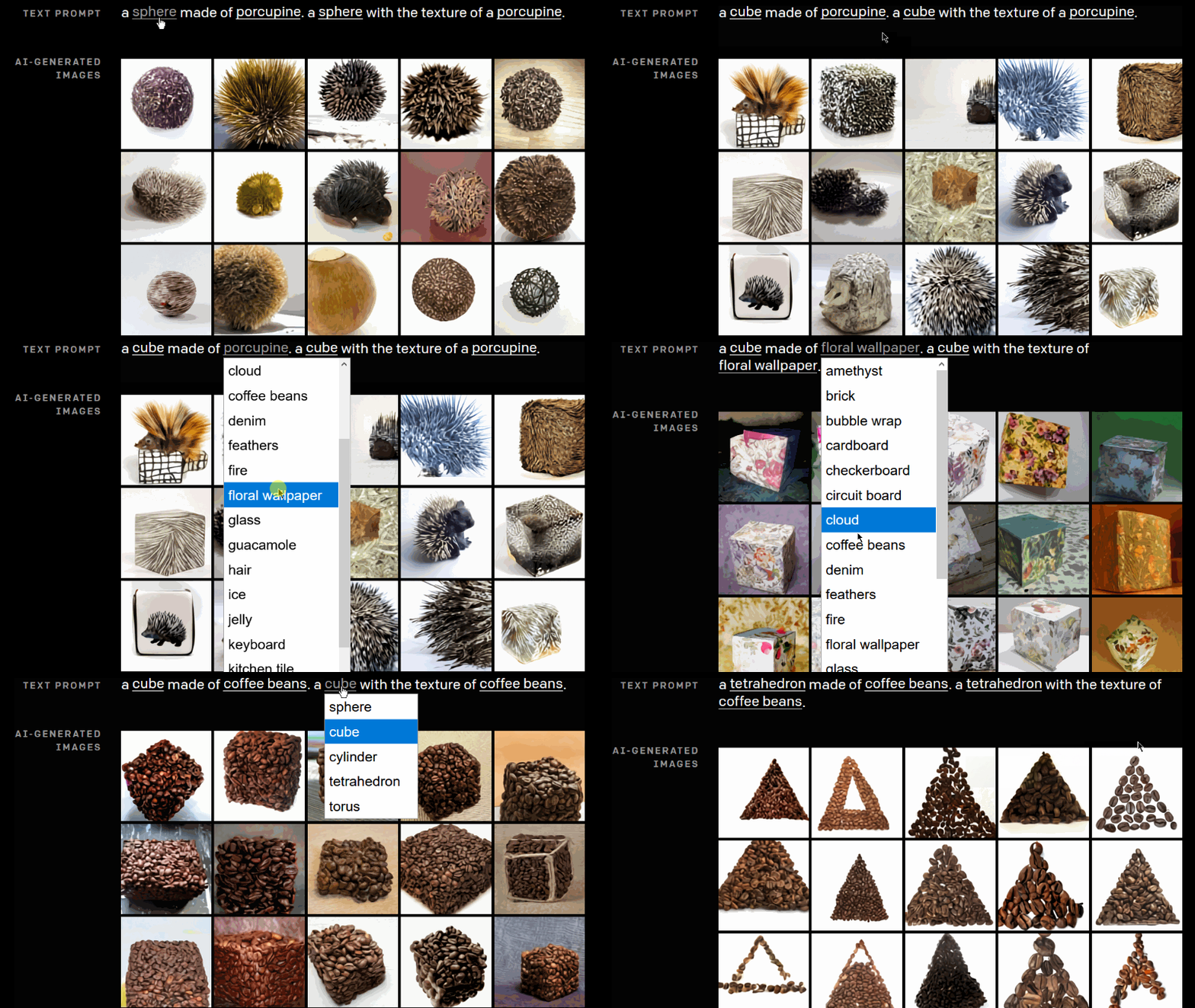
In the OpenAI post, the researchers give copious interactive examples of how the system can be told to do minor variations of the same idea, and the result is plausible and often quite good. The truth is these systems can be very fragile, as they admit DALL-E is in some ways, and saying “a green leather purse shaped like a pentagon” may produce what’s expected but “a blue suede purse shaped like a pentagon” might produce nightmare fuel. Why? It’s hard to say, given the black-box nature of these systems.

But DALL-E is remarkably robust to such changes, and reliably produces pretty much whatever you ask for. A torus of guacamole, a sphere of zebra; a large blue block sitting on a small red block; a front view of a happy capybara, an isometric view of a sad capybara; and so on and so forth. You can play with all the examples at the post.

It also exhibited some unintended but useful behaviors, using intuitive logic to understand requests like asking it to make multiple sketches of the same (non-existent) cat, with the original on top and the sketch on the bottom. No special coding here: “We did not anticipate that this capability would emerge, and made no modifications to the neural network or training procedure to encourage it.” This is fine.

Interestingly, another new system from OpenAI, CLIP, was used in conjunction with DALL-E to understand and rank the images in question, though it’s a little more technical and harder to understand. You can read about CLIP here.

The implications of this capability are many and various, so much so that I won’t attempt to go into them here. Even OpenAI punts:

In the future, we plan to analyze how models like DALL·E relate to societal issues like economic impact on certain work processes and professions, the potential for bias in the model outputs, and the longer term ethical challenges implied by this technology.

Right now, like GPT-3, this technology is amazing and yet difficult to make clear predictions regarding.

Notably, very little of what it produces seems truly “final” — that is to say, I couldn’t tell it to make a lead image for anything I’ve written lately and expect it to put out something I could use without modification. Even a brief inspection reveals all kinds of AI weirdness (Janelle Shane’s specialty), and while these rough edges will certainly be buffed off in time, it’s far from safe, the way GPT-3 text can’t just be sent out unedited in place of human writing.

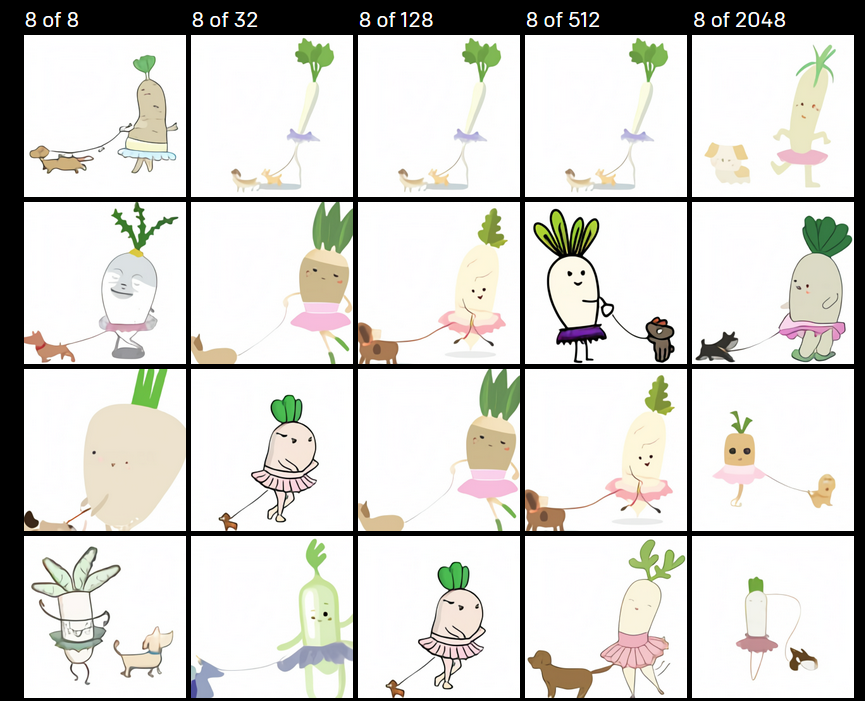
It helps to generate many and pick the top few, as the following collection shows:

AI-generated illustrations of radishes walking dogs.

The top 8 out of a total of X generated, with X increasing to the right.

That’s not to detract from OpenAI’s accomplishment here. This is fabulously interesting and powerful work, and like the company’s other projects it will no doubt develop into something even more fabulous and interesting before long.

05 Jan 2021

Daily Crunch: NYSE won’t delist Chinese telcos

The New York Stock Exchange reverses course, Nintendo acquires a game studio and an Indian electronics and lifestyle startup raises $100 million. This is your Daily Crunch for January 5, 2021.

The big story: NYSE won’t delist Chinese telcos

The New York Stock Exchange is reversing a recent decision to delist China’s three major telecom operators — China Mobile, China Unicom and China Telecom — which was supposed to be part of a Trump administration policy to block investment in companies that supply and support China’s military.

The exchange said the reversal is taking place “in light of further consultation with relevant regulatory authorities,” and that shares will be traded while NYSE officials evaluate how the executive order applies.

If the delisting does occur, it would be largely symbolic, since only a small percentage of the telecoms’ total shares are traded in New York.

The tech giants

Nintendo buys Canadian game studio in rare acquisition — Nintendo is acquiring Canada-based Next Level Games, which developed Luigi’s Mansion 3.

Jack Ma’s absence from public eye sparks Twitter discussions — The world’s attention is on Jack Ma’s whereabouts after reports noted the billionaire founder of Alibaba and Ant Group had been absent from public view since late October.

Startups, funding and venture capital

P&G terminates plan to acquire razor startup Billie following FTC lawsuit — In December, the FTC sued to block P&G’s acquisition of Billie.

Indian electronics and lifestyle brand Boat raises $100M from Warburg Pincus — The round gives Boat a post-money valuation of about $300 million.

Divvy raises $165M as the spend management space stays red-hot — Divvy’s market (corporate cards and software that help firms manage and limit expenses) is incredibly active.

Advice and analysis from Extra Crunch

Affirm targets up to $38 per share in IPO, pushing its valuation above $9B — The new S-1 follows a late-December filing of a similar nature.

8 investors discuss social gaming’s biggest opportunities — Investors expressed excitement around the widening entertainment ambitions of social platforms.

How Segment redesigned its core systems to solve an existential scaling crisis — Segment was just beginning to take off in 2015 when it ran into a scaling problem.

(Extra Crunch is our membership program, which aims to democratize information about startups. You can sign up here.)

Everything else

FBI, NSA say ongoing hacks at US federal agencies ‘likely Russian in origin’ — The U.S. government says hackers “likely Russian in origin” are responsible for breaching the networks of at least 10 federal agencies and several major tech companies.

C by GE gets rebranded under new ownership, expands beyond lighting — Back in May, General Electric sold off its more than 100-year-old GE Lighting division to smart home company Savant.

The Daily Crunch is TechCrunch’s roundup of our biggest and most important stories. If you’d like to get this delivered to your inbox every day at around 3pm Pacific, you can subscribe here.

05 Jan 2021

Sources: Hinge Health has raised $310M Series D at a $3B valuation

Hinge Health, the San Francisco-based company that offers a digital solution to treat chronic musculoskeletal (MSK) conditions — such as back and joint pain — has closed a $310 million in Series D funding, according to sources.

The round is led by Coatue and Tiger Global, and values 2015-founded Hinge at $3 billion post-money, people familiar with the investment tell me. It comes off the back of a 300% increase in revenue in 2020, with investors told to expect revenue to nearly triple again in 2021 based on the company’s booked pipeline.

I also understand that Hinge’s founders — Daniel Perez and Gabriel Mecklenburg – retain voting control of the board. I’ve reached out to CEO Perez for comment and will update this post should I hear back.

Hinge’s existing investors include Bessemer Venture Partners, which backed the company’s $90 million Series C round in February, along with Lead Edge Capital, Insight Partners (which led the Series B), Atomico (which led the Series A), 11.2 Capital, Quadrille Capital and Heuristic Capital.

Originally based in London, Hinge Health primarily sells into U.S. employers and health plans, billing itself as a digital healthcare solution for chronic MSK conditions. The platform combines wearable sensors, an app and health coaching to remotely deliver physical therapy and behavioral health.

The basic premise is that there is plenty of existing research to show how best to treat chronic MSK disorders, but existing healthcare systems aren’t up to the task due to funding pressures and for other systematic reasons. The result is an over tendency to use opioid-based painkillers or surgery, with poor results and often at even greater cost. Hinge wants to reverse this through the use of technology and better data, with a focus on improving treatment adherence.

Meanwhile, Hinge’s jump in valuation is significant. According to sources, the company’s February round produced a valuation of around $420 million, so the new valuation is more than a 6x increase.

05 Jan 2021

Facebook will turn all U.S. political advertising off again after Georgia runoffs

Georgia is the only state in the U.S. right now where Facebook allows political ads to run, but after Tuesday’s polls close that’s set to change.

According to Facebook’s site detailing changes to its ad policies and a story from Axios, the company will no longer allow political and social issue ads anywhere in the country, Georgia included, beginning early tomorrow.

Facebook told TechCrunch that the decision to toggle political ads in Georgia off again brings that state in line with its current “nationwide pause” on social issue, election and politics ads. A Facebook spokesperson declined to say when political ads will again be allowed or if permanently blocking them from the platform is under consideration.

The company first hit pause on those ad categories November 4 as a precaution designed to reduce misinformation in the U.S. presidential election. On December 16, the company re-allowed political ads in Georgia, inviting eager campaigns to pay to get their messages in front of Facebook users. It appears that some politicians, Sen. Ted Cruz (R-TX) among them, pounced on Facebook’s Georgia loophole to raise money for themselves in spite of restrictions.

When political ads came flooding back in for Georgians, they edged out mainstream news sources, according to new reporting from The Markup. While that result is fairly intuitive, it does underline the outsized influence of targeting political advertising in Facebook’s information ecosystem.

It’s also worth noting that Facebook’s head of advertising integrity Rob Leathern left the company at the end of December, calling his team’s work on the 2020 U.S. election the “culmination of a huge amount of effort over several years.” Leathern helped sculpt the company’s policies around political advertising — decisions that were often controversial due to the prevalence of paid misinformation sweeping through the platform throughout 2020.

Because they will decide control of the Senate, the unusual pair of runoff races in a state that just flipped blue are high-stakes for both political parties. With a Democratic Senate, the Biden administration’s ambitious plans for things like COVID relief and the climate crisis will have a much better shot at becoming a reality. And for Republicans looking to stymie the president-elect’s policy priorities, extended control of the Senate would put a powerful barrier in Biden’s way.


05 Jan 2021

Remembering TechCrunch Japan’s Hirohide Yoshida (1971-2020)

On New Year’s Eve, TechCrunch Japan’s Editor-in-Chief Hirohide Yoshida passed away at age 49. In addition to being a tremendously valuable member of our international team who helped build the site’s presence on the international stage, Hiro-san was a thoughtful, warm and kind colleague who impacted the lives of those of us who had the pleasure to work with him.

I worked alongside Hiro-san at two consecutive TechCrunch Tokyo events. The size and scope of the shows were impressive testaments to the team he led, as well as his own passion for technology. Throughout it all, he was an ideal ambassador for an electric startup community and tech journalism – a passion evident in every aspect of his work and life. He continued that vision as he helped transform the conference into a virtual event amid the COVID-19 pandemic.

He is survived by his wife, two young children and a site and staff that will continue to bear his mark for a long time to come.

TechCrunch Japan published its own reflections on the life and career of Hirohide Yoshida that you can read here. We’ve asked the site’s Editor, Takya Kimura to share additional thoughts below,

He started his career at KADOKAWA / ASCII. He had been writing articles about Apple and tech companies for over 20 years. With his deep knowledge, he became Editor-in-Chief of MacPeople, a magazine for Apple fans, and ASCII Weekly, publications he led for eight years.

In 2018, he became Editor-in-Chief of TechCrunch Japan. He was an incredibly hard worker, with long term vision, who never voiced a complaint about work. As Editor-in-Chief of TCJ, his team ran TechCrunch Tokyo, the biggest startup event in Japan for three consecutive years, including its first online event “TechCrunch Startup Battle Online 2020.”

Until the last moment, he loved his wife, his newborn twins, his cat and TechCrunch Japan. After his long journey, he now rests in peace, wearing his beloved TechCrunch Japan t-shirt.

Image Credits: TechCrunch Japan


05 Jan 2021

Any San Francisco teacher who needs a second monitor can get one, via Two Screens for Teachers

Any teacher in the San Francisco Unified School District who needs a second monitor can request one free of charge from Two Screens for Teachers, the nonprofit that recently extended a similar privilege to Seattle educators. If you’re a teacher in SF, you can sign up here.

Having a second monitor may sound like a power user move or luxury to some, but for teachers, whose days are essentially one giant group call, it’s a huge benefit to be able to put the call on one screen while the lesson and other tools are on another.

Two Screens for Teachers was started in September by Walkscore’s Matt Lerner and Mike Mathieu, and the first effort of simply connecting teachers in need to people who had a hundred bucks to spare quickly grew into something larger.

By tapping local businesses and VCs, they were able to secure enough money that any teacher in Seattle had a monitor available for the asking. Turns out it’s more efficient to do it that way. Lerner and his team have negotiated bulk pricing with Dell and others, which significantly lowers the necessary amounts for a given district.

San Francisco was a natural next location to try to get enough dollars together, and they’ve now collected enough for that city as well as Oakland, Redwood City, and Contra Costa County. (San Jose is still a little short.)

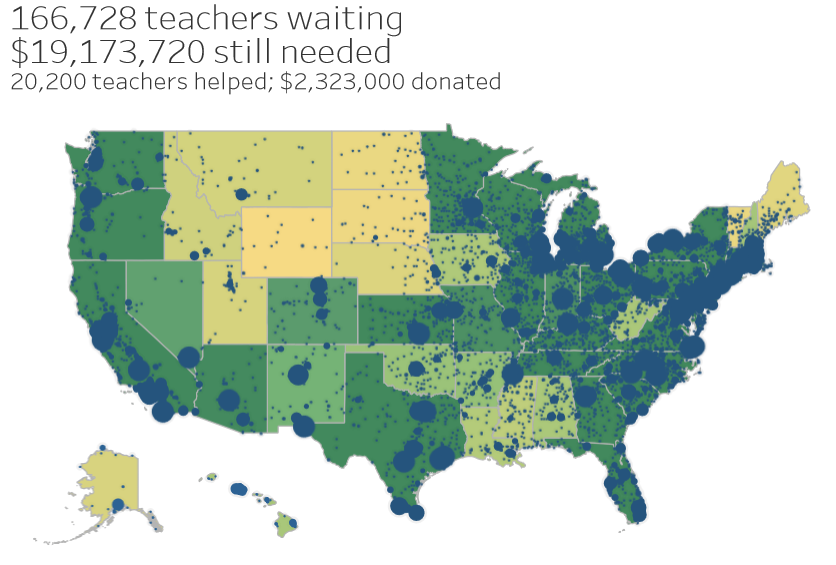
This remarkable map, both hopeful and terrifying, shows the scale of what’s needed versus what’s been accomplished.

A map showing where and how many teachers need a second monitor.

Yet even though the idea of hooking up more than 150,000 teachers with monitors seems gargantuan, it must be pointed out that in the few months since its humble beginnings, Two Screens for Teachers has rustled up more than 20,000, for both big cities and tiny towns. One order of magnitude is nothing!

The final cost for equipping teachers across the company with essential equipment is about $23 million. It seems an almost ridiculously low number for a single billionaire, perhaps one of the many whose net worth has grown by ten times that amount in the last year, to provide with a single check. Here’s something with which one could buy genuine cross-country goodwill, cheap at the price.

Do it, Jeff

Here’s the link, guys!

For those of you not in the three (going on four) comma club, it’s still possible to help out in a smaller way either by donating or following the instructions here to ship a monitor to a teacher in need.

05 Jan 2021

Minecraft Earth will shut down in June

Throughout 2019, Microsoft experimented with building a real world, augmented reality Minecraft game designed in the same vein as Pokémon GO. Called Minecraft Earth, they finally opened it up to everyone in November of 2019.

In just a few months, it’ll shut down and all player data will be deleted.

So what happened? Writes the Minecraft Earth team:

Minecraft Earth was designed around free movement and collaborative play – two things that have become near impossible in the current global situation. As a result, we have made the difficult decision to re-allocate our resources to other areas that provide value to the Minecraft community and to end support for Minecraft Earth in June 2021.

In other words: this game just isn’t going to work in a pandemic. Pokémon GO might be doing just fine thanks to a strong foundation of super dedicated players and a steady stream of curious newcomers, but it’d be pretty damned hard to go from zero to sixty with a real world game when everyone is supposed to be staying at home.

What happens next:

  • The team is releasing one final patch that removes all in-app purchases and makes all in-game mechanics easier/faster
  • On June 30th, the game shuts down. Even if you’ve got it installed already, it’ll stop working.
  • On July 1st, they’re deleting all player data.
  • Anyone who has spent any money in Minecraft Earth is getting a free copy of Minecraft Bedrock version, and players who have unused Minecraft Earth rubies will get an unspecified amount of Minecoins that’ll work in Minecraft-proper’s marketplace

It’s a disappointing end to what was really a pretty cool concept — but if they’re announcing its shutdown barely a year after launch, the data probably suggest there’s not much else they can do.

05 Jan 2021

Virgin Orbit targets launch window opening January 10 for next orbital flight attempt

Virgin Orbit is wasting no time in 2021 getting back to active flight testing: The company has a window for its next orbital demonstration launch attempt that opens on Sunday, January 10, and that continues throughout the rest of the month. This follows an attempt last year made in May, which ended before the LauncherOne rocket reached orbit – shortly after it detached from the Cosmic Girl carrier aircraft, in fact.

While that mission didn’t go exactly as Virgin Orbit had hoped, it was a significant milestone for the small satellite launch company, and helped gather a significant amount of data about how the vehicle performs in flight. LauncherOne was able to briefly lit its rocket booster before safety systems on board automatically shut it down. The company had been looking to fly this second test before the end of last year, but issues including COVID-19 meant that they only got as far as the wet dress rehearsal (essentially a run-through of everything leading up to the flight with the vehicles fully fueled).

This next mission will once again attempt an orbital launch, and this time, the stakes are somewhat higher because actual customer payloads from NASA are on board. They include a number of small satellite science experiments and demonstrations, and while they’re specifically selected for the mission profile (meaning it’s not a tremendous loss if the launch fails), it still would make everyone happiest to actually get them to their target destination.

The nature of the launch window means that Virgin Orbit will likely wait for conditions to be as good as possible before taking off from the Mojave Air and Space Port in California, so take that January 10 date as the earliest possible launch time, but not necessarily the most likely. If successful, Virgin Orbit will join a select group of private small launch vehicles that have made it to orbit, so the industry will definitely be watching the next time Cosmic Girl takes off with LauncherOne attached.