Year: 2021

05 Jan 2021

Dell monitors embrace video calls with pop-up webcams and Teams buttons built in

Dell’s latest monitors reflect the growing need for simple, solid solutions to video conferencing needs, with a clever pop-up camera and a perhaps too clever by half Teams integration. The new displays integrate a number of advanced features — but they’re still made strictly with offices in mind.

The new Dell 24, 27, and 34 Video Conferencing Monitors are clearly meant to be a turnkey solution to the need at many companies for video-capable setups that don’t cost a fortune.

The most interesting feature is a pop-up camera at the top; this isn’t the first one of these by far (we’ve seen them going back a few years) or even the first by Dell, but it is the first of theirs in a monitor as opposed to an all-in-one system, and it is probably the best one yet.

Dell's monitor has a pop-up camera.

Image Credits: Dell

The five-megapixel camera (which translates to somewhat more than 1080p, likely around 3K) won’t blow any minds, so if you want things like optical background blur and improved lighting, you’ll have to build your own setup. But it should be perfectly fine for work calls, and having it slip away when not in use is reassuring to the privacy-conscious.

An additional, non-obvious reason to like this setup is it means the camera isn’t confined to the bezel of the monitor itself, possibly allowing for a better lens and bigger sensor. I’ve asked Dell for the detailed specs and I don’t expect anything extraordinary, but it’s always better to have space than to pack the camera module into the margins.

At the bottom of these new screens is a pleasantly felted speaker bar, with just enough wattage for calls to sound fine — it won’t work for bangers, though.

But on the left side of that speaker are some interesting, if not entirely practical, new buttons. Most prominent is a dedicated Microsoft Teams button, along with call, volume, and mute buttons.

Close up of Teams button on Dell monitor.

Image Credits: Dell

I don’t know about you, but I wouldn’t want one of those. And not just because we don’t use Teams.

Maybe this is just me, but I don’t like the idea of reaching forward and whacking my monitor, which I’ve carefully positioned, every time I want to adjust the volume or answer a call, or mute myself — good luck doing it subtly when the whole view shakes every time. Even if I did, I wouldn’t want a button dedicated specifically to a single brand of video conferencing. Seems limiting when so many video platforms are in play.

I would be far more likely to pay for a puck with those controls on it as well as a mono speaker for voices and mic that’s closer to me. And by the way, it might be better to leave noise cancellation to the software side of things — calling apps often integrate their own, and who knows how built-in noise blocking interacts with those.

No doubt this is a simpler product solution, of course, and also presumably one that Microsoft and Dell worked together on. The pop-up webcam also has an IR camera that works with Windows Hello, the face-recognition login method I didn’t realize existed until very recently.

Obviously this is Dell and Microsoft going after enterprise customers who are already in their ecosystem. But as a Dell monitor lover myself, I wouldn’t mind having a pop-up camera — minus the unnecessary sound bar and Teams button. Where’s the love, Dell?

The new video conferencing monitors will be available next month, starting at $520 for a 24-inch, then going up to $720 for the 27-inch and $1,150 for the (curved) 34-inch.


05 Jan 2021

FBI, NSA say hacks on US federal agencies ‘likely Russian in origin’

The U.S. government says hackers “likely Russian in origin” are responsible for breaching the networks of at least 10 U.S. federal agencies and several major tech companies, including FireEye and Microsoft.

In a joint statement published Tuesday, the FBI, the NSA, and Homeland Security’s cybersecurity advisory unit CISA said that the government was “still working to understand the scope” of the breach, but that the breaches is likely an “intelligence gathering effort.”

The statement didn’t name the breached agencies, but the Treasury, State, and the Department of Energy are among those reported to be affected.

News of the widespread espionage campaign emerged in early December after cybersecurity giant FireEye, normally the first company that cyberattack victims will call, discovered its own network had been breached. Soon after it was reported that several government agencies had also been infiltrated.

All of the victims are customers of U.S. software firm SolarWinds, whose Orion network management tools are used across the U.S. government and Fortune 500 companies. FireEye said that hackers broke into SolarWinds’ network and pushed a tainted software update to its customers, allowing the hackers to easily break in to any one of thousands of companies and agencies that installed the backdoored update.

Some 18,000 customers downloaded the backdoored software update, but the government’s joint statement said that it believes only a “much smaller number have been compromised by follow-on activity on their systems.”

Several news outlets have previously reported that the hacks were carried out by a Russian intelligence group known as APT 29, or Cozy Bear, which has been linked to several espionage-driven attacks, including attempting to steal coronavirus vaccine research.

Tuesday’s joint statement would be the first time the government acknowledged the likely culprit behind the campaign.

Russia had previously denied involvement with the hacks.

05 Jan 2021

P&G terminates plan to acquire razor startup Billie following FTC lawsuit

Procter & Gamble will not acquire women’s beauty products startup Billie, as previously planned, following action taken by the U.S. Federal Trade Commission to stop the deal from proceeding. In December, the FTC sued to block P&G’s acquisition of the New York-based startup Billie, a maker of women’s razors and other beauty products, on the grounds that the merger would eliminate competition in the wet shave razor market.

Today, P&G and Billie issued a joint statement, expressing their regret over the Commission’s decision to attempt to block their merger, which led to the deal’s termination:

“We were disappointed by the FTC’s decision and maintain there was exciting potential in combining Billie with P&G to better serve more consumers around the world. However, after due consideration, we have mutually agreed that it is in both companies’ best interests not to engage in a prolonged legal challenge, but instead to terminate our agreement and refocus our resources on other business priorities.”

Billie had made a name for itself in the women’s razor market by offering to eliminate the so-called “pink tax,” which refers to how women’s products are often marked up at higher price points compared with similar products aimed at men. It later expanded into the broader beauty market with a focus on more natural products that are free of additives and chemicals, including sulfates, parabens, formaldehydes, GMOs, drying alcohols, synthetic dyes, fragrances, cheap foaming agents, unstable silicones and BHT.

The startup was also particularly successful in capturing the interest of a younger, Gen Z to Millennial-aged consumer, who responded to its mission as well as its modern, and often even progressive, marketing across social media and the web. In its advertisements, Billie would show women with body hair — a message that went against the grain of traditional societal expectations, where women are often shown in marketing messages — including razor ads — as already hairless and smooth.

Billie’s message was that women should feel free to do what they want about their body hair –but for those who prefer to shave, it would be happy to sell them an affordably priced razor.

What also made Billie interesting was its business model. The company offers to ship replacement blades on a subscription basis to its customers, which helped it grow revenues and customer loyalty.

Ahead of the P&G acquisition, Billie was planning to expand into physical retail stores, which would have made the brand a more direct competitor to P&G products, the FTC had said.

“As its sales grew, Billie was likely to expand into brick-and-mortar stores, posing a serious threat to P&G,” noted Ian Conner, director of the FTC’s Bureau of Competition, in a statement issued last month. “If P&G can snuff out Billie’s rapid competitive growth, consumers will likely face higher prices,” he added.

As a result of the FTC’s actions, the companies chose to put an end to their plans to merge as opposed to pursuing further legal action.

The FTC praised this decision in a release issued today. Reuters also reported on the companies’ decision to terminate.

“Procter & Gamble’s abandonment of the acquisition of Billie is good news for consumers who value low prices, quality, and innovation,” the FTC statement reads. “Billie is a direct-to-consumer company whose advertising targets customers who are tired of paying more for comparable razors. The FTC voted to challenge this merger because it would have eliminated dynamic competition from Billie.”

The FTC lawsuit was the second antitrust suit the agency filed in 2020 after it previously sued to block Edgewell Personal Care’s (maker of Schick razors) $1.37 billion deal to acquire the razor startup Harry’s, Inc., another direct-to-consumer brand. As a result, that deal fell through, too.


05 Jan 2021

Coral Vita cultivates $2M seed to take its reef restoration mission global

Coral reefs all over the world are struggling to survive, with millions of people and billions of dollars in business that rely on them at risk — on top of the fundamental tragedy of losing such a crucial ecosystem. Coral Vita aims to modernize both coral restoration techniques and the economy surrounding them, and has raised a $2 million seed round to kick things off in earnest.

I wrote about Coral Vita late in 2019 when I encountered co-founder Gator Halpern on the Sustainable Ocean Alliance’s Accelerator at Sea. At the time, the operation was both smaller and under siege by Hurricane Dorian, which wiped out the team’s coral farm in the Bahamas — and then, of course, the pandemic arrived just in time to spoil the team’s 2020 plans along with everyone else’s.

But despite the general chaos of the last year, Coral Vita managed to start and at last close a $2M round, with the intention to come back bigger and better and demonstrate a new global model for the field.

“We decided rather than just rebuilding our pilot farm to that pilot level, we’d just take the next step forward in our journey. We really believe this is an opportunity to jump start a restoration economy,” said Sam Teicher, co-founder and Chief Reef Officer.

To picture how reef restoration looks today, imagine (Teicher invited me) an underwater garden near the shore, with floating ropes and structures on which grow coral fragments that are occasionally harvested and transported to the area in need of young, healthy corals.

Corals grow in a tank at Coral Vita in the Bahamas.

Image Credits: Coral Vita

“But when you think about the scale of the problem — half the world’s reef are dead and the other half are predicted to die in the next 30 years — relying on underwater facilities isn’t possible,” he said.

The plan Coral Vita has is to transition away from ocean-based farms to land facilities that allow for much improved yield and survivability, and employ advanced techniques to speed up coral’s growth and increase its survival rate. One such technique is coral fragmenting, developed by the restoration community at large, in which corals are broken up into tiny pieces, which can grow as much as 50 times faster in aggregate. And by doing so on land they can exert much more control over the coral’s attributes.

“We’ve got tanks on land with clean sea water pumping through and the ability, among other things, to control conditions,” he explained. “So if you think of what it’ll be like off the coast of Grand Bahama in 40-50 years, we can essentially simulate that to harden the corals against those conditions. Up front, an ocean-based nursery is much cheaper, but when you start thinking about the need to grow millions or billions of corals around the world, land-based facilities start to look a lot more realistic. The cost goes down with scale, too — ocean-based nurseries go to about $30-40 per coral; we can get it down to $10 as we get up to a hundred or a thousand tanks.”

Onlookers view the coral growing tanks at Coral Vita

On the left, a Bahamanian tourism official (far left) listens to Sam Teicher. On the right, Gator Halpern (center) talks with others before the pandemic.

Not only is the physical scale limited at present, but the income sources are as well: often it’s government money instead of the inexhaustible well of private cash. Coral Vita hopes to be able to change that by increasing and diversifying supply and going directly to those affected.

“We’re trying to transform the space away from grants and aid — we’re selling to customers that depend on the ecosystems of reefs,” Teicher said. “If you’re a hotel that relies on scuba or snorkel tourists, if you’re a coastal property owner or insurer, a government, a development bank, a cruise line, you can hire Coral Vita to restore the reefs that you work on.”

This superficially mercenary business model where commercially important reefs get priority wouldn’t be necessary, of course, if governments and industry hadn’t systematically neglected these reefs to begin with. Not that privately funded projects are somehow fundamentally tainted, but this type of restoration work tends to be seen as the milieu of nonprofits and government agencies. One might consider this approach a direct, if late, tax that cuts out the government middle man.

The fact is this is globally crucial work that needs to start now, not in five or ten years when the correct conservation funds are organized by concerned parties. Every month counts when reefs are actively deteriorating, and private money is the only realistic option to scale up fast and do what needs to be done. Plus, as the process becomes cheaper, it becomes easier to fund projects without commercial backing.

Corals grow in a tank at Coral Vita in the Bahamas.

Image Credits: Coral Vita

“On top of that is the ability to innovate,” added Teicher. “What we’re trying to do with this round is to make advances to the science and engineering, including 3D printing and robotics in the process. We’re launching R&D projects not just for restoration but protection.”

He cited Tom Chi, co-founder of Google X and an early advisor and investor, as someone who has pushed on the automation side, comparing the industry to agriculture, where robotics is currently having a transformative effect.

Proving out the scalable land-based farms opens up the possibility of a global presence, as well — lowering costs and lead times for corals to be brought to where they’re needed.

“We’re at a point where we need to rethink adaptation and how to fund it,” said Teicher. “The two year plan is to launch more farms in other countries — ultimately we want this to be the biggest coral farm that ever existed.”

Leading the $2M round was the environment-focused Builders Collective, with participation from Apollo Projects’ Max Altman and baseball’s Max and Erica Scherzer. Earlier investors (in a pre-seed or “Seed one” round) include the Sustainable Ocean Alliance, Tom Chi as mentioned, Adam Draper, Yale University, and Sven and Kristen Lindblad.

05 Jan 2021

Nintendo buys Canadian game studio in rare acquisition

While gaming giants Sony and Microsoft have made M&A a critical part of their strategic growth plans, Nintendo has always seemed to be more reluctant to bring outside talent into the fold of its video game empire. Today, the company announced that it will be acquiring the developer behind Luigi’s Mansion 3, Canada-based Next Level Games.

Nintendo’s announcement is the first studio acquisition for the company since their 2007 purchase of Xenoblade Chronicles developer Monolith Soft.

Next Level Games has been working on Nintendo-licensed IP exclusively for the better part of the last decade, crafting a number of titles across some of the company’s second tier of intellectual property including the Super Mario Strikers series as well as mobile iterations of Metroid Prime and Luigi’s Mansion.

The Vancouver-based studio’s recent Luigi’s Mansion 3 title for the Nintendo Switch has been a pretty huge success for the company which has had pretty light offerings of first-party IP since the system’s launch. In a recent earnings report, Nintendo shared that Luigi’s Mansion 3 had sold nearly 8 million copies, earning it a spot as one of the system’s top-selling titles.

05 Jan 2021

Affirm targets up to $38 per share in IPO, pushing its valuation above $9B

Today Affirm, a fintech startup that offers payment options to e-commerce customers, released a new S-1/A filing. The new document follows a late-December filing of a similar nature, though that update focused on changing the language of Affirm’s reported results, tweaking its language to remove some adjusted metrics, and hewing closer to generally accepted accounting principles, or GAAP.

The company’s more recent filing details what could be its first IPO price interval, indicating that Affirm may price its shares between $33 and $38 per share in its IPO. If Affirm raises its estimates, expect that price range to tighten.

Let’s calculate Affirm’s valuation marks at its new price range before digging into what we think of the company’s estimated worth against its most recent performance.

Valuation

There are two ways to calculate a company’s IPO valuation. The first takes into account only shares that will exist after the offering. The second, the so-called diluted valuation, takes into account shares that are available for exercise or conversion, but have yet to be. To avoid choosing sides today, we’ll calculate both.

The first, simple valuation is a doddle to tally:

  • Affirm shares outstanding post-IPO, including its underwriters’ option: 246,436,771
  • Affirm IPO price interval: $33 to $38 per share
  • Affirm simple IPO valuation range: $8.1 billion to $9.4 billion

Affirm’s fully-diluted valuation involves a larger share count, so it generates larger results. Doing our own math, here’s how it shakes out (Bloomberg came up with slightly different numbers,

  • Affirm fully-diluted shares outstanding post-IPO, including its underwriters’ option: 318,865,2461
  • Affirm IPO price interval: $33 to $38 per share
  • Affirm fully-diluted IPO valuation range: $10.5 billion to $12.1 billion

At the time of its April, 2019 Series F, Affirm was worth $2.9 billion after the capital was raised, according to PitchBook. The company also raised a $500 million Series G in September of 2020. That final round sold shares at $19.93 apiece, along with some convertible notes, per today’s filing; investors in that transaction are set to do very well in under a year.

Those who put money in even earlier will do even better.

Do those numbers make sense?

05 Jan 2021

Indian electronics and lifestyle brand Boat raises $100 million from Warburg Pincus

Boat, an electronics and lifestyle startup in India, has raised $100 million in a new financing round that many independent investors termed as the most successful hardware startup story in the world’s second largest internet market.

An affiliate of Warburg Pincus, a New York-headquartered private equity firm, financed the entire Series B round for the four-year-old Indian startup, which sells low-cost, durable headphones, earphones and other mobile accessories.

The round gives Boat, which had raised about $3 million in equity and debt financing prior to the new round, a post-money valuation of about $300 million, a person familiar with the matter told TechCrunch. Executives of Boat declined to comment on the valuation, other than saying that Warburg Pincus had bought a “significant minority stake” in the startup.

An investor who did not want to be named said Boat has grown to be an anomaly case among hardware startups in India. There aren’t many hardware startups in India. Among those that do exist, very few have been able to raise much money. And on top of that, Boat is also profitable — and it has been for several years, said Sameer Mehta, co-founder of the startup, in an interview with TechCrunch.

The secret sauce of Boat, at least in part, is that it has managed to keep the price points of its accessories low while also making them aesthetically appealing. The startup counts the young generation as its target audience, who want good-looking accessories at low prices but also tend to upgrade every few months.

Boat has expanded into several categories in recent years, and it has followed the same strategy all along. Its fitness wearable starts at Indian rupees 1,799 ($24.5), smartwatches at $34, charging cables at $3.4, home theatre soundbars at $54, wireless speakers at $13.5, headphones at $5.5, and AirPod-like earbuds at $27.

According to marketing research firm IDC, Boat commands over 30% of the wearable market in India and is the fifth largest brand globally in the category.

The startup sells through both online and offline retail channels. Its devices are available through Flipkart, Amazon India, Reliance Retail, as well as Tata Stores, Croma, and Vijay Sales. Analysts at HDFC bank estimated in a note last month that Boat Lifestyle’s products are available through over 5,000 retail stores across India and it plans to enter global markets.

“We see a compelling growth story in boAt and believe the company is well-poised to build upon the strong leadership position it has carved out within the industry and stands to benefit from the secular tailwinds of e-commerce growth in India. Warburg Pincus is excited to partner with the management team of boAt led by Aman [the other co-founder] & Sameer in this journey and we look forward to supporting them through the next phase of the company’s growth,” said Vishal Mahadevia, Managing Director and Head of Warburg Pincus India, in a statement.

Mehta said the startup will deploy the fresh capital to shift more of its manufacturing from China to India, and expand to more categories including gaming keyboards.

More to follow…

05 Jan 2021

How Segment redesigned its core systems to solve an existential scaling crisis

Segment, the startup Twilio bought last fall for $3.2 billion, was just beginning to take off in 2015 when it ran into a scaling problem: It was growing so quickly, the tools it had built to process marketing data on its platform were starting to outgrow the original system design.

Inaction would cause the company to hit a technology wall, managers feared. Every early-stage startup craves growth and Segment was no exception, but it also needed to begin thinking about how to make its data platform more resilient or reach a point where it could no longer handle the data it was moving through the system. It was — in a real sense — an existential crisis for the young business.

The project that came out of their efforts was called Centrifuge, and its purpose was to move data through Segment’s data pipes to wherever customers needed it quickly and efficiently at the lowest operating cost.

Segment’s engineering team began thinking hard about what a more robust and scalable system would look like. As it turned out, their vision would evolve in a number of ways between the end of 2015 and today, and with each iteration, they would take a leap in terms of how efficiently they allocated resources and processed data moving through its systems.

The project that came out of their efforts was called Centrifuge, and its purpose was to move data through Segment’s data pipes to wherever customers needed it quickly and efficiently at the lowest operating cost. This is the story of how that system came together.

Growing pains

The systemic issues became apparent the way they often do — when customers began complaining. When Tido Carriero, Segment’s chief product development officer, came on board at the end of 2015, he was charged with finding a solution. The issue involved the original system design, which like many early iterations from startups was designed to get the product to market with little thought given to future growth and the technical debt payment was coming due.

“We had [designed] our initial integrations architecture in a way that just wasn’t scalable in a number of different ways. We had been experiencing massive growth, and our CEO [Peter Reinhardt] came to me maybe three times within a month and reported various scaling challenges that either customers or partners of ours had alerted him to,” said Carriero.

The good news was that it was attracting customers and partners to the platform at a rapid clip, but it could all have come crashing down if the company didn’t improve the underlying system architecture to support the robust growth. As Carriero reports, that made it a stressful time, but having come from Dropbox, he was actually in a position to understand that it’s possible to completely rearchitect the business’s technology platform and live to tell about it.

“One of the things I learned from my past life [at Dropbox] is when you have a problem that’s just so core to your business, at a certain point you start to realize that you are the only company in the world kind of experiencing this problem at this kind of scale,” he said. For Dropbox that was related to storage, and for Segment it was processing large amounts of data concurrently.

In the build-versus-buy equation, Carriero knew that he had to build his way out of the problem. There was nothing out there that could solve Segment’s unique scaling issues. “Obviously that led us to believe that we really need to think about this a little bit differently, and that was when our Centrifuge V2 architecture was born,” he said.

Building the imperfect beast

The company began measuring system performance, at the time processing 8,442 events per second. When it began building V2 of its architecture, that number had grown to an average of 18,907 events per second.

05 Jan 2021

Extra Crunch Perks: 20% discount on all TechCrunch 2021 events

We’ve announced our slate of 2021 events, and we’d like to take this time to remind you that annual or two-year Extra Crunch members can receive a 20% discount on all TechCrunch 2021 virtual events.

How to get the discount

If you’re an annual or two-year subscriber, contact extracrunch@techcrunch.com to request your event ticket discount code. Our customer service team typically responds with the code within 24 hours. Some exclusions of ticket types may apply, and monthly members are not eligible for TechCrunch event ticket discounts.  

What else is included with an annual Extra Crunch membership?

Extra Crunch is a membership program from TechCrunch that helps you spot technology trends and opportunities, build better startups and stay connected. It features thousands of articles, including weekly investor surveys, daily private market analysis and expert interviews on fundraising, growth, monetization and other work topics.

Extra Crunch members can also find answers to burning questions about startups and investing through Extra Crunch Live, and stay informed with our members-only Extra Crunch newsletters. Other benefits include an improved TechCrunch.com experience and savings on software services from Typeform, DocSend, Crunchbase and more.

Please contact extracrunch@techcrunch.com if you have any additional questions or if you are interested in upgrading your membership to an annual or two-year plan.

05 Jan 2021

GitHub alumni are building Rewatch, a solution for your Zoom fatigue

The rise of distributed teams in response to the coronavirus has led to more video-conferencing meetings for all of us. As offices remain closed, distributed work is forcing companies to figure out a better way than Zoom or Google Hangouts to meet with employees across time zones and teams.

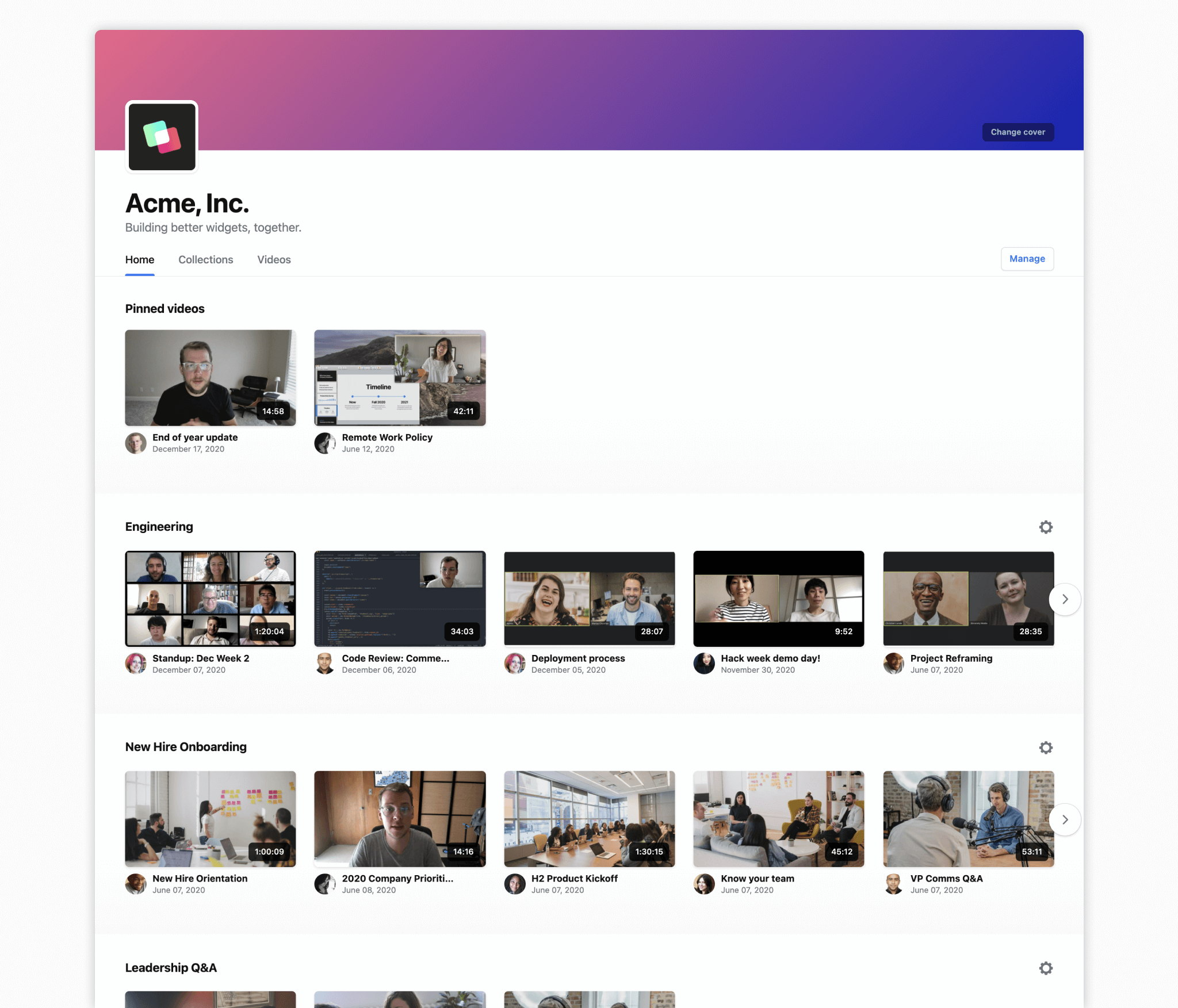
Rewatch wants to make meetings more efficient, and maybe even shorter. Co-founded by Connor Sears and Scott Goldman, Rewatch creates and organizes private video channels for companies to store meetings so employees can sift through them on their own time.

And at its core, Rewatch is a counterintuitive play: The startup thinks it can combat ‘Zoom fatigue’ by giving employees more ways to watch video-conferencing calls.

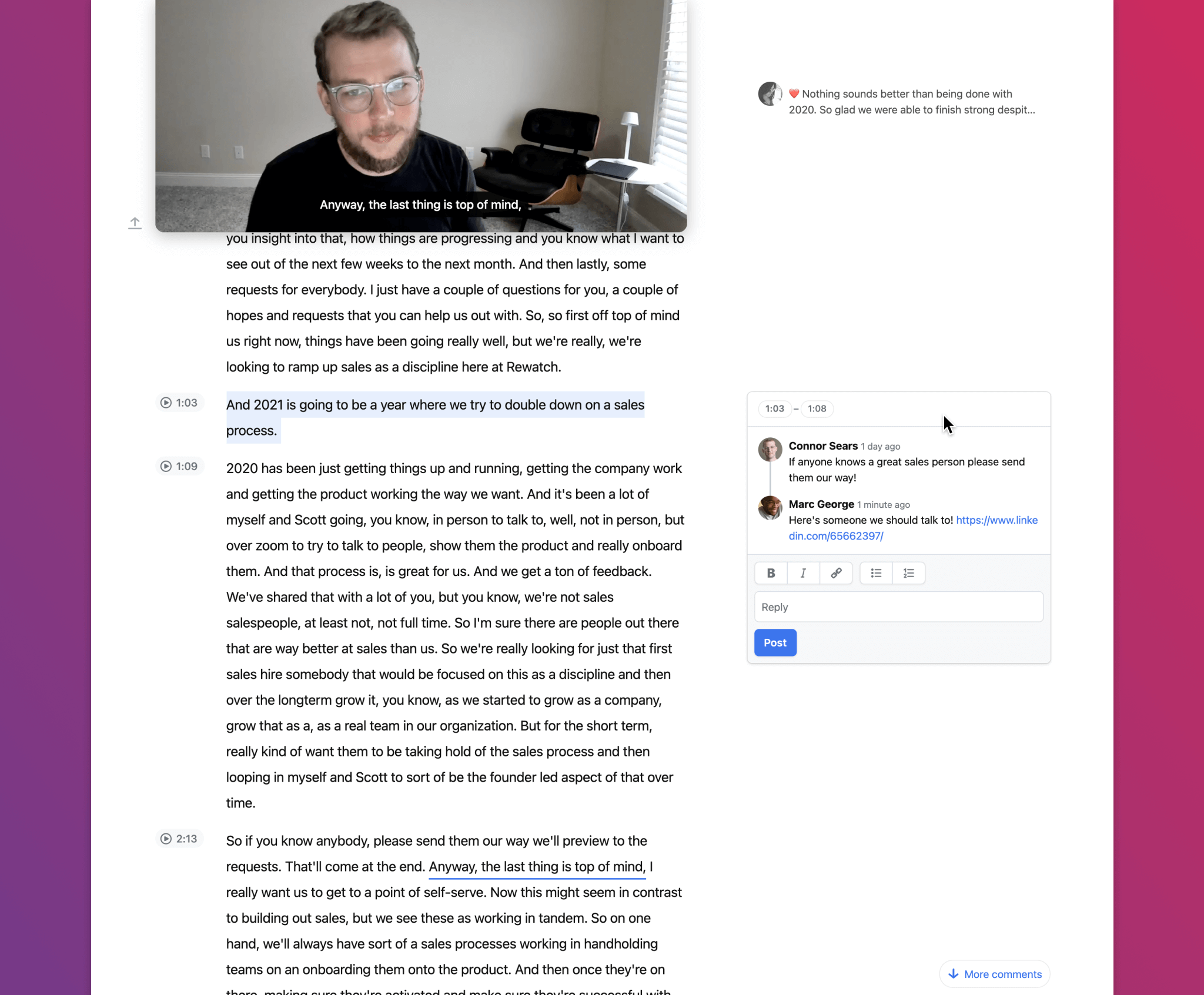
The product works like this: companies can record their meetings, over Google Hangouts or Zoom, and then Rewatch archives the meetings into a database. Using tags and notes, the videos become more searchable and easier to find. For example, you can tag a co-worker in a meeting they got an unexpected shout out in. Or you can search for the last time a manager brought up the project you’re working on.

The video libraries, which the company describes as “mini-YouTube channels,” also include transcriptions of all meetings. Rewatch is turning synchronous meetings into asynchronous bulletins and documents.

“In the past, the only way to scale a meeting was just to have a longer meeting, or more meetings,” Sears said.

If Rewatch works, the founders hope to see meetings shift from squares of muted floating heads to interactive across various teams and timezones with text and annotations.

Sears first had the idea for Rewatch when he was an employee at GitHub, a space for developers. GitHub, which is fully distributed, created an internal YouTube channel to enable employees across time zones to work with one another. Now, the two co-founders are trying to take one of GitHub’s internally loved features and bring them, and more, to the mainstream.

So far, the startup has been able to land a number of customers, including Github, although it wouldn’t disclose total numbers. When it launches, the company will charge a subscription fee, but Sears and Goldman have not disclosed the pricing yet.

One of Rewatch’s competitors is Google Drive, which has lagged in creativity around storing and structuring video content. The startup competes with the tool by adding more search-friendly features for video like live transcriptions. Other competitors include Berlin-based Acapela, which is working on asynchronous meetings, and Storyboard, a podcast company that helps directors publish on-demand audio content to their stakeholders. Both companies have recently raised millions of dollars.

While innovation around how meetings are held certainly feels important, Rewatch and others are betting that employees will turn to these content repositories on a semi-often basis and engage with them in a meaningful way. But how many of us watch the standup we missed while on vacation? The business is contingent on that singular consumer habit.

This reality doesn’t mean innovation isn’t welcome. It just means that a huge shift in consumer habits needs to change in order for this startup, and many others, to be successful. And that too-early-to-know reality makes the fact that investors have put millions into the startup even more compelling.

Rewatch has convinced a number investors on its vision. The startup tells TechCrunch that it has raised a $2 million pre-seed round led by Semil Shah at Haystack with participation from Kent Goldman at Upside Partnership. Other investors include Gumroad CEO Sahil Lavingia, GitHub CTO Jason Warner, and SVP of Zendesk Jason Smeale.