Year: 2021

05 Jan 2021

Kyte raises $9 million to deliver rental cars to your doorstep

More than two years ago, Ludwig Schoenack, Nikolaus Volk and Francesco Wiedemann looked at the bevy of scooter services, ride-hailing apps, public transit and car-sharing options available in most urban centers in the United States and saw a gap in the mobility market.

Consumers who didn’t want to own a car, but needed one for a few days or weeks had two options: head to a car rental center, likely located at an airport or outside the city center, or turn to a car-sharing platform. The three friends — all German immigrants whose paths had crossed in San Francisco — decided to pool their collective expertise from BMW, McKinsey and Uber and launch Kyte to create a new kind of car rental experience without taking on the costly business of owning and maintaining large fleets.

Kyte built a fleet-logistics platform that lets consumers rent vehicles through their app or website. The vehicles, which are located in hubs throughout a city center, are delivered by gig economy workers right to the renters’ home. Kyte also handles the pickup and refuels the vehicle for no extra charge.

“We still believe people own cars because they want it outside their door, so we thought why don’t we put it right there,” Schoenack said in a recent interview.

Kyte partners with car rental firms and other companies that manage fleets, allowing the startup to focus on consumers and the tech.

The startup, which launched in late 2018 and operates in Boston, Los Angeles and San Francisco, has caught the attention of capital of investors. The startup said Tuesday it has raised $9 million in funding from DN Capital and Amplo VC. Numerous individual investors from the mobility industry also participated, including former Uber executives Ed Baker, Jörg Heilig, Josh Mohrer and William Barnes, as well as Lime co-founder Toby Sun and Kayak and Travelocity co-founder Terry Jones.

The funds are already being put to work to help drive Kyte’s expansion into markets, starting with Washington, D.C.

Kyte car rental app

Image Credits: Kyte

Kyte’s founders wouldn’t disclose their revenue, except to say it’s generating a “solid six-figure” amount of revenue monthly. Schoenack added that Kyte’s monthly revenue has grown 400% since March as more consumers have turned to cars during the COVID-19 pandemic.

“Even before COVID was on the horizon, it was clear that we needed to change the way we interact with cars,” Schoenack said. Consumers have been more willing to try alternatives like Kyte to travel as COVID-19 has turned many off from air travel.

Despite this fast growth, Schoenack said more than half of Kyte’s bookings come from recurring users.

Kyte has also found its clients — which Schoenack would only describe as the biggest rental car companies in the country — are willing and enthusiastic participants since it helps get vehicles in the hands of customers. Rental car companies were hit hard by COVID-19 since the bulk of operations are at airports. These companies were left with millions of dollars of depreciating assets that weren’t generating any revenue.

DN Capital’s co-founder and managing director Steve Schlenker believes that Kyte will be a core building block to the future of mobility.

“The pandemic has accelerated the transformation of cities and consumer behavior with respect to transportation,” Schlenker said. “Kyte’s unique operations layer facilitates this transformation while providing a level of service and convenience that other solutions fail to meet.”


05 Jan 2021

Divvy raises $165M as the spend management space stays red-hot

Today Divvy, a Utah-based startup that focuses on corporate spend management, announced that it has closed a $165 million round at a $1.6 billion valuation. The company said that the new capital was raised from Hanaco, Schonfeld, PayPal Ventures, and Whale Rock, along with a cadre of prior investors.

The new investment is not Divvy’s first megaround of private capital. The well-known startup raised $200 million in April of 2019. TechCrunch reported at the time that that round valued Divvy at around $700 million, making today’s deal a more than 2x increase in valuation for the company.

Divvy exists amongst the current generation of Utah-based tech upstarts that are keeping the state’s tech scene in the broader startup conversation. Podium fits in the same cohort, for example, while Qualtrics feels like it’s from the preceding peer group.

Divvy’s market, the corporate spend management space — broadly corporate cards and software that helps firms manage and limit expenses — is incredibly active today as businesses look to modernize their financial infrastructure. The new capital for Divvy comes after multiple other competitors recently announced fresh funds itself, for example. Let’s take a look at who Divvy is taking on with its new round.

Competition

A few weeks back Ramp, another corporate-cards-and-software startup, announced a $30 million raise and that it had reached $100 million in spend through its service in its first 18 months of business. At the same time Divvy shared with TechCrunch that it had seen 120% customer growth and over 100% growth in platform spend in 2020, compared to 2019. At the time, Brex, which also competes in the corporate spend space, declined to share metrics.

That Divvy was able to raise so much capital given its recent growth rates is not surprising. But that so many companies in its sector are managing similarly-strong to-line expansion stands out. After covering the Ramp round in December and noting Divvy’s metrics at the same time, both Airbase (more here) and Teampay (more here) reached out with numbers of their own.

Teampay reiterated its October-era metrics, that it has seen its annual recurring revenue (ARR) grow by 320% and its total spend grow by 800% since its then year-ago Series A. Airbase noted what it described as 250% growth in ARR — up by 2.5x, in other words — and 700% growth in payment volume (annualized).

Divvy, Teampay, and Airbase are therefore growing like all heck, though in slightly different fashions. Divvy and Ramp offer their corporate spend products and software for free, taking a slice of payment volume through interchange revenues. Teampay and Airbase generate incomes from interchange as well, but also charge for their software. This gives them both spend and software revenues.

Which brings us back to Divvy’s news from today. I normally avoid quoting from releases, but in today’s case a paragraph is worth sharing:

The valuation of $1.6 billion and the addition of key investors validates Divvy’s ambition to modernize financial processes by combining credit, vendor, and spend management into a single platform. With this round of funding, Divvy plans to invest heavily in product development and engineering in order to accelerate their future roadmap.

Divvy is going to invest heavily in product? That makes sense. But to give away its software forever just seems odd. Some of its competitors are charging for theirs! Why not Divvy as well?

We’ll see, but what is clear today is that the capital that has gone into startups in Divvy’s cohort was put into a niche that has shown huge demand. So, expect to hear more from this product area in 2021.

05 Jan 2021

Chronosphere nabs $43M Series B to expand cloud native monitoring tool

Chronosphere, the scalable cloud native monitoring tool launched in 2019 by two former Uber engineers, announced a $43.4 million Series B today. The company also announced that their service was generally available starting today.

Greylock, Lux Capital and venture capitalist Lee Fixel, all of whom participated in the startup’s $11 million Series A in 2019, led the round with participation from new investor General Atlantic. The company has raised $54.4 million.

The two founders, CEO Martin Mao and CTO Rob Skillington, created the open source M3 monitoring project while they were working at Uber, and left in 2019 to launch Chronosphere, a startup based on that project. As Mao told me at the time of the A round, the company wanted to simplify the management of running the open source project:

“M3 itself is a fairly complex piece of technology to run. It is solving a fairly complex problem at large scale, and running it actually requires a decent amount of investment to run at large scale, so the first thing we’re doing is taking care of that management,” Mao said.

He said that the company spent most of last year iterating the product and working with beta customers, adding that they certainly benefited from building the commercial service on top of the open source project.

“I think we’re lucky that we have the foundation already from the open source project, but we really wanted to focus a lot on building a product on top of that technology and really have this product be differentiated, so that was most of the focus of 2020 for us,” he said.

Mao points out that he and Skillington weren’t looking for this new round of funding as they still had money left from the A round, but the company’s previous investors approached them and they decided to strike to add additional money to the balance sheet, which would help grow the company, attract employees and help reassure customers they had plenty of capital to continue building the product and the company.

As the company has developed over the last year, it has been adding employees at a rapid clip, growing from 13 at the time of the A round in 2019 to 50 today with plans to double that by the end of next year. Mao says the founders have been thinking about how to build a diverse company from its early days.

“So […] beginning last year we were making sure we were hiring the right leaders, and the right recruiting team who also care about diversity, then following that we made company-wide goals and targets for both gender and ethnic diversity, and then [we have been] holding ourselves accountable on these particular goals and tracking against them,” Mao said.

The company has been spread out from the beginning, even before COVID, with offices in Seattle, New York and Lithuania, and that has helped in terms of having a broader base to recruit from. Mao wants to remain mostly remote whenever it’s possible to return to the office, but maintain hubs on each coast where employees can meet and see each other in person.

With the product generally available today, the company will look to expand its customer base, and with the open source project to drive interest, they have a proven way to attract new customers to the commercial product.

05 Jan 2021

Tile to launch to launch a new tracker powered by ultra wideband technology

Tile is preparing to introduce a new product this year that will serve as a rival to Apple’s long-awaited AirTags and other lost item trackers coming to the market, including those from Samsung, TechCrunch has learned. While previous Tile trackers have leveraged Bluetooth to help users locate lost items — like a misplaced set of keys, for example — Tile’s new product will take advantage of UWB (ultra wideband) technology to find the missing items. It will also use augmented reality to help guide users to the lost item’s location via the Tile mobile app.

Ultra wideband technology is available on newer iPhone 11 and iPhone 12 models and select Android-powered devices, including more recent devices from Samsung.

Like Bluetooth and Wi-Fi, UWB is a short-range, wireless communication protocol, but one that operates at very high frequencies. It can be used to capture spatial and directional data, which is where it comes in handy to lost item finders, like Tile’s trackers.

Apple last year began to give third-party developers access to its U1 chip, which uses UWB technology to make the iPhone spatially aware, via its “NearbyInteraction” framework. Some Android devices also ship with the technology. It’s unclear to what extent Tile is using the new frameworks with its forthcoming product, and the company is likely under NDA with regard to its work with Apple specifically, per earlier reports.

Based on Tile’s internal concept art for the device (shown below), Tile’s UWB model will look similar to its other small trackers, like the Tile Mate and Tile Pro. It will also have a square shape, center button, and flat back to support being mounted using an adhesive. And like other Tile dongles, it can be attached to a keychain.

Image Credits: Tile concept art

Typically, Tile dongles would be attached to things like keys, remote controls, handbags, duffels, luggage, or other small carry items, or stuck to larger devices like personal electronics or bikes. However, lost items could only be located by way of Bluetooth, when nearby, or via Tile’s “community find” network when further away. The latter leveraged the Tile app installed on its users’ phones to help locate any Tile tracker set to a lost mode, then ping the item’s owner when the item was found. This has allowed Tile users in the past to locate lost items like those left on an airplane by mistake, for example.

The new Tile tracker, on the other hand, will use UWB to make the finding process easier than before.

Because UWB offers spatial awareness capabilities, it will be able to locate missing items inside or outside, even when you can’t hear the tracker’s ring. This could help when the missing item is buried under something — like a sofa cushion — or inside something like a dresser drawer, for example. It can also help to find items more easily in a larger space, like a house with multiple floors.

The Tile app, meanwhile, will allow users to launch to an AR-enabled camera view that will help to guide them to the item’s location using overlays, like directional arrows and an AR view of the item’s location.

Image Credits: Tile internal concept art


Per sources familiar with Tile’s plans, we understand Tile expects to release the new tracker later this year with support for both iOS and Android devices. Pricing is unknown. Tile will still sell its popular Bluetooth-enabled devices, of course, as a good portion of the market does not yet own a UWB-enabled smartphone at this time — the technology is only found in newer devices.

Though Tile has historically led the market in comparison with other third-party lost item trackers, the company is due to face increased competition in 2021 as new trackers arrive from top smartphone brands, like Samsung and Apple.

At the 2020 Samsung Galaxy Unpacked virtual event, Samsung discussed its plans to integrate UWB into a new SmartThings Find application. This week, its upcoming Samsung Galaxy SmartTag tracker was spotted in images provided to the certification authority NCC. The device very much looks like a Tile tracker, with its square-ish shape and keychain hole, for instance.

Meanwhile, according to a new research note from analyst Ming-Chi Kuo, Apple will reveal its own Tile competitor, AirTags this year. Apple has already all but confirmed AirTag’s existence, as it even accidentally published references to its lost item tracker in an official support video at one point. Leaked images of the AirTags also began to circulate this week, adding fuel to these reports of a “soon-ish” AirTags launch.

A UWB-powered tracker could help allow Tile to maintain its position in the market. Tile, as of last year, had sold 26 million Tile devices, and was locating around 6 million items per day across 195 countries. Tile’s website now says its devices reach over 230 countries and territories. With this scale, Tile today leads the market. But Apple’s AirTags could have a first-party advantage with deep integrations into its “Find My” app  — a concern that was brought up by Tile in last year’s antitrust hearings in reference to how Apple wields its platform and market power to overrun competitive businesses.

Tile is not speaking publicly about its plans for a UWB device at this time.

“While we can’t comment on our product roadmap, we’re constantly looking to improve our customer experience and solve the pain point of finding lost items,” a spokesperson for Tile told TechCrunch.

05 Jan 2021

What’s going on with fintech venture capital investment?

Over the next few weeks, the venture capital industry will compile and release data concerning its Q4 2020 performance, capping a year that saw the world of private capital freeze, thaw and burn.

But we can get a peek at a critical part of the VC universe early, thanks to a preview of global fintech investment results from CB Insights. The dataset deals with worldwide investments into fintech companies from the start of October through December 12th.


The Exchange explores startups, markets and money. Read it every morning on Extra Crunch, or get The Exchange newsletter every Saturday.


Given that the last two weeks of the year are not famous for productivity, the dataset we have should prove representative for this critical slice of the venture capital market. (For our look at the third-quarter fintech VC market, head here.)

To be honest, I didn’t plan on writing up this data when I first dug into it; I was prepping for later releases, hoping to ground myself ahead of the full numbers. However, the collected results aligned with several themes that cropped up during 2020, making it a representative capstone of sorts concerning the year’s venture capital market. So it was too interesting to not unpack.

What happened to fintech venture capital investment in Q4 and 2020? Some startup stages and regions did well, but amidst the good news, one of the hotter domestic segments of startup land is not set to have a good global year. Let’s get into the numbers.

A final warning: although these results are missing a few weeks’ worth of inputs, we believe these numbers will prove more than directionally accurate when all results are tallied and released by the various organs of venture data tracking.

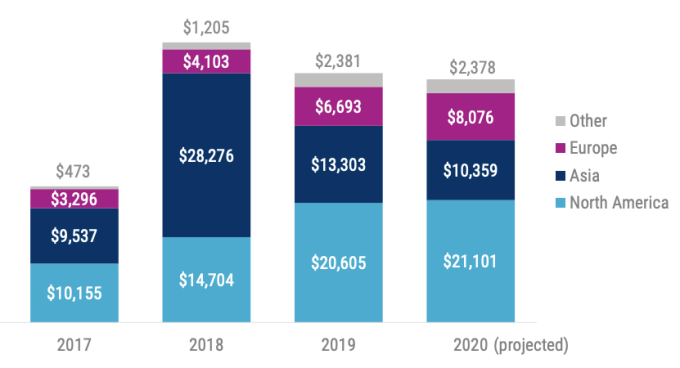
North America and Europe shine, Asia falls

Using numbers that include projections for the rest of 2020, it’s clear that the fintech venture capital world is not equally distributed. If you are reading this in the United States, for example, or the UK, you might be surprised to learn that CB Insights expects global fintech venture capital deal and dollar volume to fall in 2020. Surely not, with all the neobank and trading-platform deals we saw?

Yes, actually, because while fintech investment has risen in dollar terms in both North America and Europe, huge declines in Asia have overshadowed results in the other two regions. Here’s the clip of the preview chart:

Via CB Insights

05 Jan 2021

8 investors discuss social gaming’s biggest opportunities

The gaming industry has had plenty of watershed moments in 2020 as consumer entertainment habits have shifted in response to the pandemic. One trend has been the crystallization of MMOs as social entertainment hubs that serve more needs for users than ever before.

Following my survey of gaming-focused investors on trends in the AR/VR world several months ago, I pinged a handful of investors to tap their thoughts on the shifting trends and opportunities in social gaming.

One thing that most investors expressed excitement around was the widening entertainment ambitions of social platforms, as concerts and movie screenings find homes on gaming platforms like Fortnite.

While evolving free-to-play mechanics continue to elevate the experience of single-player titles into something more living and breathing, platforms like Roblox have found areas for growth that seem more unique, developing into destinations for users to communicate and share.

“It’s where culture is created,” Madrona’s Daniel Li told TechCrunch.

Not all of the respondents shared the belief that a gaming platform like Fortnite would grow to become the next Facebook. General Catalyst’s Niko Bonatsos pointed to adjacent platforms like Discord or Twitch as the constants that would remain as consumers cycled through different platform ecosystems. Other pointed to the the still-disjointed experience switching between mobile and desktop experiences as a yet-to-be-solved stumbling block.

Building the metaverse and building a popular casual mobile game are two different things. Most investors I talked with emphasized how much the pace of scaling has accelerated across categories though with breakout hits rising faster than ever while disasters seem to grow evident just as quickly.

“I think that you look at Among Us, and Cyberpunk on the other side, anything can happen much faster and more extreme than it used to be just because of distribution,” Rogue VC’s Alice Lloyd George told TechCrunch.

Read below for the full answers; some responses have been edited for length and clarity.


Hope Cochran and Daniel Li, Madrona Venture Group

The idea that the next big social network will be an MMO seems to be a trendy take in the VC world, what are the roadblocks to this actually happening?

Daniel Li: Hope and I were trading some notes and part of our thesis is that gaming is the future of social and for Gen Z, gaming is replacing not just old games, but it’s replacing TV and Netflix. So instead of going to watch music videos on YouTube, you’re going to a concert in Roblox and that’s a social experience with your friend … instead of going to the mall, now you’re in Roblox. It’s where kids are hanging out and it’s where culture is created.

Hope Cochran: And in COVID, it’s the only place where they can hang out and I think the gaming industry has done a really fabulous job creating another social engagement that we need right now. I don’t want to focus too much on kids, but parents are becoming more accepting of their kids in the games because there is this social engagement and, for instance, I can see that my child is upstairs connecting with his four best friends. They log in together and they play. They normally might be out on a soccer field but they can’t right now so I think parents are becoming a little more comfortable saying, “Oh, he’s playing with his friends.”

Gaming has seemingly become a more “mainstream” area for investment, as someone who has been in the space a bit, what’s different about investing in the gaming sector?

HC: It’s very hard to find that balance between creative or understanding what might become a hit and a real business mind. So my experience has been that when you look into a gaming company as an investor, it’s actually more driven by math, stats and analytics, and then you have a core team who has the creative juices, so I try to look for that kind of dynamic.

So, who is developing what the users will love and who is analyzing it and how are they responding to what the users are loving. I do think there’s a point where a team develops a game and it’s mostly a creative process but then you have to kind of toggle to the analytics. It’s where the mathematicians meet the magicians and there needs to be a combination of that within every game.

What’s different about how popular games and MMOs are scaling these days? Have you seen any interesting growth hacks or strategies that seem promising?

DL: I think there are more and more of these cultural memes that just seem to come out of nowhere, like Among Us kind of just sat there for two years and streamers started picking it up and now it’s super popular. I’d say for nearly all of those, they’re going to be a social category of games, you don’t see a game like Cyberpunk come out of nowhere without any marketing dollars behind it.

So I do think one of those new channels is getting influencers to talk about your games, and typically I think for those it’s not actually the big influencers picking it up, it’s a whole bunch of small influencers all starting to play a game and have it start to build up steam that way. It’s more likely the Call of Duty’s that can hire the big streamers and pay them millions of bucks to play a new game, but I don’t think there’s a new to go-to-market for smaller studios around that.

How can MMOs, which feel like fundamentally active experiences, provide a better passive experience for users that may be more interested in the community than playing a first-person shooter or battle royale? How do games become more approachable to a wider audience?

DL: A lot of people are saying these single-player games aren’t really fun games anymore, they’re just like cinematic experiences. Like playing Cyberpunk for 60 hours versus binge-watching three TV series, it’s definitely a different experience. The thing that’s actually more interesting here is the virtual events that are happening inside these games. Thinking about what the next Twitch looks like, it’s probably some kind of experience where you’re inside the game doing something more passive.

Niko Bonatsos, General Catalyst

05 Jan 2021

Niantic buys competitive gaming platform Mayhem

Pokèmon Go creator Niantic has acquired a small SF gaming startup building a league and tournament organization platform to help gamers create their own communities around popular titles.

Mayhem was in Y Combinator’s winter 2018 batch and went onto raise $5.7 million in funding according to Crunchbase. Other backers include Accel, which led the startup’s Series A in 2018, Afore Capital and NextGen Venture Partners.

The startup’s focus has shifted quite a bit since its initial YC debut, when it announced a service called Visor that would analyze video of esports gameplay and coach users on how they could improve their performance. The company has seemed to shift its focus wholly to community tools to help gamers find matches and organize tournaments for games like Overwatch on its platform.

Terms of the acquisition weren’t disclosed by Niantic .

The “majority” of Mayhem’s team will be joining Niantic with the startup’s CEO Ivan Zhou landing in the company’s Social Platform Product team while the rest of the team joins Platform Engineering.

In a statement, Niantic asserts that the acquisition “reinforces our commitment to real-world social as the centerpiece of our mission.”

Read a deep dive of Niantic on Extra Crunch

Most of Niantic’s acquisitions of late have focused on augmented reality backend technologies so it’s interesting to see them buying tech that focuses on community organization.

Pokèmon Go continues to be Niantic’s cash cow though the company hasn’t seen the same levels of viral success with subsequent releases where organic growth hasn’t been quite as easy to come by. Buying a startup building community tools suggests the company is ready to bring in some outside tech to push their own efforts forward as they strive to create a broader platform for their AR ambitions and more standalone hits of their own.

05 Jan 2021

C by GE gets rebranded under new ownership, expands beyond lighting

There’s a decent chance you missed the news back in May — there was, after all, a lot going on at the time. General Electric sold off its more than 100-year-old GE Lighting division to smart home company Savant. Today, the division’s new owner is announcing a key rebranding effort, six months after the initial deal.

Clearly there’s still value in the GE name, even divorced of its original parent company. In its new home, the C by GE line is getting a rebrand, however. Seems totally reasonable — C by GE was never the most straightforward name. Going forward, the line will be rebranded as “Cync” — which, if not better is, at the very least different.

Along with the change in ownership, the name connotes a broadening of scope — that much was probably an inevitability under Savant. GE Lighting is becoming a larger smart home brand in its new home. CES, which kicks off next week, will find the company introducing a new thermostat and a range of outdoor products, including a new smart plug. The brand will also introduce a connected camera and fan speed switch.

The new products will test the value of the GE Lighting brand name, both outside of General Electric and beyond just lighting. The smart home category is already a crowded one (and has been for years), and Savant’s going up against offerings from big names like Amazon’s Ring.

The new Cync app will arrive in March, bringing with it “a more user-friendly and customizable experience that enhances comfort, control and confidence,” according to Savant. More news next week at CES.

05 Jan 2021

NYSE reverses plans to delist China’s three big telcos

In an unexpected turn, the New York Stock Exchange said Monday that it no longer intends to delist China’s three major telecoms operators, a decision that was originally announced on December 31.

The initial action targeted China Mobile, China Unicom and China Telecom as part of the Trump Administration’s move to bar investment in companies deemed to supply and support China’s military, intelligence and security services.

The current blacklist names 35 companies, including the parent organizations of the three listed telecoms firms as well as Huawei and China’s major chipmaker SMIC.

The reversal was made “in light of further consultation with relevant regulatory authorities,” said the exchange. The companies will continue to be listed and traded on the NYSE while the exchange will continue to evaluate how the executive order applies to them and their listing status, according to the announcement.

The delisting of the three telecoms giants, which have been trading on NYSE for about two decades, was seen by some experts as merely symbolic. The trading volumes of these firms in New York are only a small percentage of their total tradable shares, thus the impact of the potential delisting “would be rather limited on the companies’ growth and general market performance,” said the China Securities Regulatory Commission in a statement issued on Sunday.

“The recent move by some political forces in the U.S. to continuously and groundlessly suppress foreign companies listed on the U.S. markets, even at the cost of undermining its own position in the global capital markets, has demonstrated that U.S. rules and institutions can become arbitrary, reckless and unpredictable,” the Chinese exchange authority said.

“We hope that the U.S. side could show respect for the market and reverence for the rule of law, do more things that can benefit the order of global financial markets, the legitimate rights of investors, and the stability and development of the global economy.”

In recent times, a number of Chinese companies trading in the U.S. have opted for secondary listings in Hong Kong. Alibaba, JD.com and NetEase have debuted in Hong Kong and more tech companies are reportedly weighing their homecoming. Chinese tech bosses are wary of the U.S. government’s potential clampdown, but they also hope to replicate Alibaba’s success in Hong Kong and see funding opportunities in China’s new Nasdaq-style board, which was introduced in 2019 in part to lure its tech darlings home.

05 Jan 2021

NYSE reverses plans to delist China’s three big telcos

In an unexpected turn, the New York Stock Exchange said Monday that it no longer intends to delist China’s three major telecoms operators, a decision that was originally announced on December 31.

The initial action targeted China Mobile, China Unicom and China Telecom as part of the Trump Administration’s move to bar investment in companies deemed to supply and support China’s military, intelligence and security services.

The current blacklist names 35 companies, including the parent organizations of the three listed telecoms firms as well as Huawei and China’s major chipmaker SMIC.

The reversal was made “in light of further consultation with relevant regulatory authorities,” said the exchange. The companies will continue to be listed and traded on the NYSE while the exchange will continue to evaluate how the executive order applies to them and their listing status, according to the announcement.

The delisting of the three telecoms giants, which have been trading on NYSE for about two decades, was seen by some experts as merely symbolic. The trading volumes of these firms in New York are only a small percentage of their total tradable shares, thus the impact of the potential delisting “would be rather limited on the companies’ growth and general market performance,” said the China Securities Regulatory Commission in a statement issued on Sunday.

“The recent move by some political forces in the U.S. to continuously and groundlessly suppress foreign companies listed on the U.S. markets, even at the cost of undermining its own position in the global capital markets, has demonstrated that U.S. rules and institutions can become arbitrary, reckless and unpredictable,” the Chinese exchange authority said.

“We hope that the U.S. side could show respect for the market and reverence for the rule of law, do more things that can benefit the order of global financial markets, the legitimate rights of investors, and the stability and development of the global economy.”

In recent times, a number of Chinese companies trading in the U.S. have opted for secondary listings in Hong Kong. Alibaba, JD.com and NetEase have debuted in Hong Kong and more tech companies are reportedly weighing their homecoming. Chinese tech bosses are wary of the U.S. government’s potential clampdown, but they also hope to replicate Alibaba’s success in Hong Kong and see funding opportunities in China’s new Nasdaq-style board, which was introduced in 2019 in part to lure its tech darlings home.