Year: 2021

05 Jan 2021

Alibaba shuts down 12-year-old music streaming app Xiami

Using Xiami was once synonymous with having good music taste in China. The music app, which debuted around 2008 and was acquired by Alibaba in 2013, is discontinuing its streaming service today, Xiami said in a notice to users.

Xiami, which means “smalll shrimp” in Chinese, was once known for its smart discovery, elegant design, social features and support for indie musicians which helped attract a loyal following among China’s artsy, hipster types. The beginning of its decline coincided with the battle for music rights in China. A digital music behemoth was formed in 2016 when Tencent bought a majority stake in China Music Group, which brought to Tencent a reservoir of exclusive music deals. By 2017, Tencent’s music apps controlled as much as 75% of China’s music streaming market.

Xiami, on the other hand, lost large quantities of music rights and consequently users who converted to more resource-rich platforms, albeit grudgingly.

Alibaba did have a shot at online music. In 2015, the e-commerce giant appointed two renowned industry veterans — a songwriter and a music company executive — to steer its newly minted music group. Neither was necessarily seen as having the experience for running an internet music business. Instead of growing Xiami, they poured resources into a platform called Alibaba Planet to build artist-fan relationships. The idea didn’t take off.

In the meantime, newcomers like NetEase Music are holding out in their battle against Tencent’s music empire, of which dominance has endured to this day.

While users will lose access to the app and all their data, Xiami is not totally dead. Its copyrights-focused segment Yin Luo (音螺 or Conch Music) will continue to operate, according to the notice. But the dream of Xiami’s utopian founders, “earn music & money” (hence the app’s original name “EMUMO”), a vision they laid out inside a cafe on a snowy day in Hangzhou, is surely gone.

05 Jan 2021

TrendForce expects the smartphone market to slowly recover in 2021, but Huawei won’t benefit

After a dismal year, the global smartphone market will slowly start recovering in 2021, predicts TrendForce. But Huawei won’t benefit and, in fact, will fall out of the research firm’s list of the world’s top six smartphone makers.

In 2020, global smartphone production dropped 11% year-over-year to 1.25 billion units. This year, TrendForce expects it to increase by 9% to 1.36 million units, as people replace old devices and demand grows in emerging markets. But even that slight recovery is contingent on how the pandemic continues to impact the economy and the global chip shortage that is currently causing production delays across almost the entire electronics industry.

In 2020, the top six smartphone brands in order of production volume were Samsung, Apple, Huawei, Xiaomi, OPPO and Vivo. But this year TrendForce expects Huawei to slip out of that ranking, with the new top-six list comprising of Samsung, Apple, Xiaomi, OPPO, Vivo and Transsion.

Those six companies are expected to account for 80% of the global smartphone market in 2021, while Huawei will come in at seventh place.

The main reason for Huawei’s drop is the divestment of its budget smartphone brand, Honor. Huawei confirmed in November that it is selling Honor to a consortium of companies to save the division’s supply chain from the impact of United States government trade restrictions.

The spin-out was meant to shield Honor from the sanctions that have hurt Huawei’s business. But “it remains to be seen whether the ‘new’ Honor can capture consumers’ attention without the support from Huawei. Also, Huawei and the new Honor will be directly competing against each other in the future, especially if the former is somehow freed from the U.S. trade sanctions at a later time,” said TrendForce’s report.

In a previous report published shortly after Honor’s sale was announced, TrendForce predicted that the deal, along with the global chip shortage, meant Huawei would take just 4% of the market in 2021, compared to the 17% it held in 2019, and estimated 14% in 2020. Apple is expected to take away some market share from Huawei’s high-end smartphones, while Xiaomi, OPPO and Vivo will also benefit. TrendForce expects the newly spun-out Honor to take 2% market share in 2021.

05 Jan 2021

Silicon Valley Bank just made an even bigger push into wealth management

SVB Financial Group agreed today to buy Boston Private Financial Holdings in Boston for $900 million in cash and stock.

It’s a big deal for SVB, which has earned a reputation over its 37-year history as a bank that’s friendly to startups, as well as venture and private equity investors. Boston Private, founded in 1987, has roughly $16.3 billion in assets under management, compared with SVB Asset Management’s $1.4 billion in related assets.

SVB, which formed its wealth advisory business in 2011, has been pushing more aggressively into wealth management for several years, hiring Yvonne Butler, who’d previously led wealth strategies at Capital One, in the middle of 2018.

Butler has since been adding members to the bank’s wealth management team, telling Business Insider last year of the job that “I see my job primarily as a retention strategy . . .Clients are already here. We’ve helped them grow their fund or business — and I see our role as private bank and wealth advisory as retaining.”

Underscoring SVB’s bid to strengthen its relationship with wealthy individuals who already have business dealings with the bank, Greg Becker, its president and CEO, said today in a release about the tie-up: “Our clients rely on us to help increase the probability of their success — both in their business and personal lives.”

Butler will lead the combined private banking and wealth management business with Anthony DeChellis, who has been the CEO of Boston Private for the last two years. DeChellis joined the outfit after a short stint as president of the crowdfunding platform OurCrowd and before that, as the CEO of Credit Suisse Private Banking (Americas) for more than seven years.

As part of the deal, Boston Private shareholders will receive 0.0228 shares of SVB common stock and $2.10 of cash for each of their shares.

Bank stocks were generally battered in 2020, but as the Boston Globe notes, SVB’s stock is up more than 60% over the past three years because of its focus on the tech world, while Boston Private’s shares have fallen by 45%.

05 Jan 2021

Jack Ma’s absence from public eye sparks Twitter discussions

The world’s attention is on Jack Ma’s whereabouts after reports noted the billionaire founder of Alibaba and Ant Group had been absent from public view since late October.

On October 24, Ma delivered fiery remarks against China’s financial system to an audience of high-rank officials. Days later the Chinese authorities abruptly halted Ant’s initial public offering, an act believed to be linked to Ma’s controversial speech. The Chinese government subsequently told the fintech behemoth, which had thrived in a relatively lax regulatory environment, to “rectify” its business according to the law. The future of Ant hangs in the air.

Concurrently, Chinese regulators have launched an unprecedented probe into Alibaba over suspected monopolistic behavior.

Ma is known for his outspoken personality and love for the limelight, so it’s no surprise that his missing from recent events, including the final episode of an African TV program he created, is sparking widespread chatter. From economists to journalists, the Twitter world has tuned in:

“Regarding the Africa’s Business Heroes competition, Mr. Ma had to miss the finale due to a scheduled conflict,” an Alibaba spokesperson said.

While China’s Twitter equivalent Weibo has not blocked searching for “Jack Ma missing,” the posts it surfaced barely have any like or repost. Elsewhere on the Chinese internet, users are speculating inside WeChat groups that Ma was either “made vanished” or has fled the country.

It’s worth noting that Ma has long stepped back from day-to-day operations at Alibaba. In September 2019, he officially handed his helm as the company’s chairman to his successor Daniel Zhang. That said, the billionaire still holds considerable sway over the e-commerce business as a lifetime partner at the so-called Alibaba Partnership, a group comprising senior management ranks who can nominate a majority of the directors to the board.

It’s not unusual to see Chinese tycoons choosing to lie low in tough times. After Richard Liu was accused of rape, the flamboyant founder of JD.com, Alibaba’s archrival, skipped a key political event in China last year. Tencent founder Pony Ma, who already keeps a low profile, has been absent from the public eye for about a year, though the cause is his chronic “back problems,” a source told TechCrunch, and the tech boss has made virtual appearances at events by sending voice messages in the past year.

04 Jan 2021

Looking to decarbonize the metal industry, Bill Gates-backed Boston Metal raises $50 million

Steel production accounts for roughly 8 percent of the emissions that contribute to global climate change. It is one of the industries that sits at the foundation of the modern economy and is one of the most resistant to decarbonization.

As nations around the world race to reduce their environmental footprint and embrace more sustainable methods of production, finding a way to remove carbon from the metals business will be one of the most important contributions to that effort.

One startup that’s developing a new technology to address the issue is Boston Metal. Previously backed by the Bill Gates financed Breakthrough Energy Ventures fund, the new company has just raised roughly $50 million of an approximately $60 million financing round to expand its operations, according to a filing with the Securities and Exchange Commission.

The global steel industry may find approximately 14 percent of its potential value at risk if the business can’t reduce its environmental impact, according to studies cited by the consulting firm McKinsey & Co.

Boston Metal, which previously raised $20 million back in 2019, uses a process called molten oxide electrolysis (“MOE”) to make steel alloys — and eventually emissions-free steel. The first close of the funding actually came in December 2018 — two years before the most recent financing round, according to chief executive Tadeu Carneiro, the company’s chief executive.

Over the years since the company raised its last round, Boston Metal has grown from 8 employees to a staff that now numbers close to 50. The Woburn, Mass.-based company has also been able to continuously operate its three pilot lines producing metal alloys for over a month at a time.

And while the steel program remains the ultimate goal, the company is quickly approaching commercialization with its alloy program, because it isn’t as reliant on traditional infrastructure and sunk costs according to Carneiro.

Boston Metal’s technology radically reimagines an industry whose technology hasn’t changed all that much since the dawn of the Iron Age in 1200 BCE, Carneiro said.

Ultimately the goal is to serve as a technology developer licensing its technology and selling components to steel manufacturers or engineering companies who will ultimate make the steel.

For Boston Metal, the next steps on the product roadmap are clear. The company wil look to have a semi-industrial cell line operating in Woburn, Mass. by the end of 2022, and by 2024 or 2025 hopes to have its first demonstration plant up and running. “At that point we will be able to commercialize the technology,” Carneiro said.

The company’s previous investors include Breakthrough Energy Ventures, Prelude Ventures, and the MIT-backed “hard-tech” investment firm, The Engine. All of them came back to invest in the latest infusion of cash into the company along with Devonshire Investors, the private investment firm affiliated with FMR, the parent company of financial services giant, Fidelity, which co-led the deal alongside Piva Capital and another, undisclosed investor.

As a result of its investment, Shyam Kamadolli will take a seat on the company’s board, according to the filing with the SEC.

MOE takes metals in their raw oxide form and transforms them into molten metal products. Invented at the Massachusetts Institute of Technology and based on research from MIT Professor Donald Sadoway, Boston Metal makes molten oxides that are tailored for a specific feedstock and product. Electrons are used to melt the soup and selectively reduce the target oxide. The purified metal pools at the bottom of a cell and is tapped by drilling into the cell using a process adapted from a blast furnace. The tap hole is plugged and the process then continues.

One of the benefits of the technology, according to the company, is its scalability. As producers need to make more alloys, they can increase production capacity.

“Molten oxide electrolysis is a platform technology that can produce a wide array of metals and alloys, but our first industrial deployments will target the ferroalloys on the path to our ultimate goal of steel,” said Carneiro, the company’s chief executive, in a statement announcing the company’s $20 million financing back in 2019. “Steel is and will remain one of the staples of modern society, but the production of steel today produces over two gigatons of CO2. The same fundamental method for producing steel has been used for millennia, but Boston Metal is breaking that paradigm by replacing coal with electrons.”

No less a tech luminary than Bill Gates himself underlined the importance of the decarbonization of the metal business.

Boston Metal is working on a way to make steel using electricity instead of coal, and to make it just as strong and cheap,” Gates wrote in his blog, GatesNotes. Although Gates did have a caveat. “Of course, electrification only helps reduce emissions if it uses clean power, which is another reason why it’s so important to get zero-carbon electricity,” he wrote.

04 Jan 2021

Daily Crunch: Hundreds of Google and Alphabet employees unionize

Google employees take another step in their activism, Venmo adds a check-cashing feature and Slack has some issues. This is your Daily Crunch for January 4, 2021.

The big story: Hundreds of Google and Alphabet employees unionize

More than 200 employees at Google and its parent company Alphabet have announced that they have formed the Alphabet Workers Union.

Obviously, that’s only a tiny fraction of Alphabet’s workforce of more than 130,000 employees. But according to The New York Times, the group is a “minority union” designed to give more structure to employee activism, rather than one that negotiates for a contract. And it will also be open to contractors.

“This is historic—the first union at a major tech company by and for all tech workers,” said Google software engineer Dylan Baker in a statement. “We will elect representatives, we will make decisions democratically, we will pay dues, and we will hire skilled organizers to ensure all workers at Google know they can work with us if they actually want to see their company reflect their values.”

The tech giants

It’s not just you, Slack is struggling this morning — Precisely when the downtime began is not clear, though problems amongst the TechCrunch staff began a little after 10 a.m. Eastern time.

Venmo adds a check-cashing feature, waives fees for stimulus checks — The feature can be used to cash printed, payroll and U.S. government checks, including the new stimulus checks.

Samsung’s next Unpacked event is January 14 — This one’s called “Welcome to the Everyday Epic.”

Startups, funding and venture capital

Color raises $167M funding at $1.5B valuation to expand ‘last mile’ of US health infrastructure — Color’s 2020 was a record year for the company.

Lidar startup Aeva raises another $200M ahead of its debut as a public company — Aeva is one of a handful of lidar companies to eschew the traditional IPO path and go public via a SPAC merger.

India’s CRED raises $81M, buys back shares worth $1.2M from employees — CRED has nearly doubled its customer base to about 5.9 million in the past year, or about 20% of the credit card holder base in India.

Advice and analysis from Extra Crunch

How artificial intelligence will be used in 2021 — Scale AI CEO Alexandr Wang forecasts the biggest emerging use cases.

2020 was a record year for Israel’s security startup ecosystem — A look back at notable funding trends, rounds and exits.

Five questions about 2021’s startup market — Each question relates to a 2020 change that is expected to persist.

(Extra Crunch is our membership program, which aims to democratize information about startups. You can sign up here.)

Everything else

Astronaut Anne McClain on designing and piloting the next generation of spacecraft — McClain is one of the astronauts who will be taking part in the Artemis missions.

Mixtape podcast: Behind the curtain of diversity theater — Most TechCrunch readers have probably heard of diversity reports, but you may not know what’s going on behind the scenes.

Original Content podcast: ‘Wonder Woman 1984’ might be a beautiful mess, or maybe just a mess — And yet one of my co-hosts actually preferred the sequel to the original.

The Daily Crunch is TechCrunch’s roundup of our biggest and most important stories. If you’d like to get this delivered to your inbox every day at around 3pm Pacific, you can subscribe here.

04 Jan 2021

Daily Crunch: Hundreds of Google and Alphabet employees unionize

Google employees take another step in their activism, Venmo adds a check-cashing feature and Slack has some issues. This is your Daily Crunch for January 4, 2021.

The big story: Hundreds of Google and Alphabet employees unionize

More than 200 employees at Google and its parent company Alphabet have announced that they have formed the Alphabet Workers Union.

Obviously, that’s only a tiny fraction of Alphabet’s workforce of more than 130,000 employees. But according to The New York Times, the group is a “minority union” designed to give more structure to employee activism, rather than one that negotiates for a contract. And it will also be open to contractors.

“This is historic—the first union at a major tech company by and for all tech workers,” said Google software engineer Dylan Baker in a statement. “We will elect representatives, we will make decisions democratically, we will pay dues, and we will hire skilled organizers to ensure all workers at Google know they can work with us if they actually want to see their company reflect their values.”

The tech giants

It’s not just you, Slack is struggling this morning — Precisely when the downtime began is not clear, though problems amongst the TechCrunch staff began a little after 10 a.m. Eastern time.

Venmo adds a check-cashing feature, waives fees for stimulus checks — The feature can be used to cash printed, payroll and U.S. government checks, including the new stimulus checks.

Samsung’s next Unpacked event is January 14 — This one’s called “Welcome to the Everyday Epic.”

Startups, funding and venture capital

Color raises $167M funding at $1.5B valuation to expand ‘last mile’ of US health infrastructure — Color’s 2020 was a record year for the company.

Lidar startup Aeva raises another $200M ahead of its debut as a public company — Aeva is one of a handful of lidar companies to eschew the traditional IPO path and go public via a SPAC merger.

India’s CRED raises $81M, buys back shares worth $1.2M from employees — CRED has nearly doubled its customer base to about 5.9 million in the past year, or about 20% of the credit card holder base in India.

Advice and analysis from Extra Crunch

How artificial intelligence will be used in 2021 — Scale AI CEO Alexandr Wang forecasts the biggest emerging use cases.

2020 was a record year for Israel’s security startup ecosystem — A look back at notable funding trends, rounds and exits.

Five questions about 2021’s startup market — Each question relates to a 2020 change that is expected to persist.

(Extra Crunch is our membership program, which aims to democratize information about startups. You can sign up here.)

Everything else

Astronaut Anne McClain on designing and piloting the next generation of spacecraft — McClain is one of the astronauts who will be taking part in the Artemis missions.

Mixtape podcast: Behind the curtain of diversity theater — Most TechCrunch readers have probably heard of diversity reports, but you may not know what’s going on behind the scenes.

Original Content podcast: ‘Wonder Woman 1984’ might be a beautiful mess, or maybe just a mess — And yet one of my co-hosts actually preferred the sequel to the original.

The Daily Crunch is TechCrunch’s roundup of our biggest and most important stories. If you’d like to get this delivered to your inbox every day at around 3pm Pacific, you can subscribe here.

04 Jan 2021

Twitter acquires social podcasting app Breaker, team to help build Twitter Spaces

Twitter has acquired social broadcasting app Breaker, the companies announced today via a combination of blog posts and tweets. The deal will see Breaker’s team joining Twitter to help “improve the health of the public conversation” on the service, as well as work on Twitter’s new audio-based networking project, Twitter Spaces. The Breaker app, however, will shut down on January 15, 2020.

Breaker announced the acquisition on its company blog, explaining why it believes its team will be a good fit at Twitter.

“Here at Breaker, we’re truly passionate about audio communication and we’re inspired by the ways Twitter is facilitating public conversations for people around the world,” wrote Breaker CEO Erik Berlin. “We’re impressed by the entrepreneurial spirit at Twitter and enthusiastic about the new experiences that the team is creating.”

Breaker was founded in 2016 and is led by both CEO Berlin, previously the founder and CTO at social advertising company 140 Proof (which sold to Acuity), and CTO Leah Culver, who previously founded Pownce and Grove and co-authored web technologies OAuth and oEmbed.

The app had launched at a time when podcasts were still very much thought of as audio feeds and podcast apps as productivity tools — not experiences around which a community could be built. Breaker helped to change that perception by offering an app where users could like and comment on episodes, discover new podcasts by following friends, share favorite shows to social media, and much more.

According to Culver’s tweet, she’ll be joining Twitter with a focus on Twitter Spaces, Twitter’s audio-based social networking product and Clubhouse rival. Spaces allow Twitter users chat in real-time using voice instead of text, as they do today. The new product entered beta testing in December. Twitter is is currently trying to work out not only the technical issues and bugs with the feature, but also the more complex issues that arise from hosting live audio, including moderation.

In a separate tweet, Twitter Engineering lead Michael Montano confirmed that Berlin, Culver and Breaker designer Emma Lundin will all be moving to Twitter as a result of the deal.

He also praised both Berlin and Culver’s entrepreneurial spirit as well as Culver’s push for open standards over the years.

Reached for comment, Twitter pointed to Montano’s tweet but offered no further details on the acquisition, price, or broader plans.

Breaker says it will close down its apps and services it built over the past years in a matter of days.

On Jan. 15, 2020, Breaker will shut down for good. Up until that point, Breaker users will be able to export their OPML file to transfer their subscriptions to another podcasting app. Breaker recommends apps like Apple, Spotify, Stitcher, Overcast, Pocket Casts, or Castro, as an alternative. For those hosting a podcast on Breaker, these can be transferred elsewhere via the RSS feed.

The Breaker acquisition adds to a string of recent podcast M&A activity. But unlike recent deals that involved podcast content, Breaker’s sale is made up of staff and technology, not podcasts themselves. This maps to Twitter’s general focus on collating content from others instead of making its own.

The Breaker deal, with its unannounced price, feels modest. Which means that while the company’s exit to Big Tweet is another point on the board for podcasting companies finding their way to some sort of payout, it fits the general narrative that podcasting services, and podcasting content only has so much value.

The acquisition follows other podcast content deals in recent weeks and months, including Amazon’s $300 million acquisition of Wondery, Sirius buyinig Stitcher for $300 million, not to mention all the content deals Spotify has picked up as of late.

That another podcast service sold for around $300 million has become a running joke. That number, while impressive-sounding to the individual, is not the sort of exit that venture capitalists target. The Breaker-Twitter tie-up, then, doesn’t push back on the idea that building a company focused on podcasting is to admit to a future that will have capped future upside.

Whether venture capitalists pull back from podcasting investments in 2021 is not yet clear, but Breaker’s sale does little to argue that private investors shouldn’t.


 

04 Jan 2021

How to convert customers with subscription pricing

The lure of subscription pricing is the guarantee of recurring revenue for your business. Once a customer flips the switch to turn on your subscription, it’s easy money:

  • Easy to recognize your revenue.
  • Easy to determine your margins and profits.
  • Easy to enhance your product and extend that revenue out for months, even years.

While that’s true, converting a subscription customer isn’t as simple as flipping a switch. You can build a platform, launch with fanfare, offer all sorts of incentives and trials to attract potential customers — and watch as they disengage and lapse into limbo.

Contrary to popular belief, subscription pricing doesn’t work because of the lower price point that a monthly installment allows.

That’s the actual guarantee that comes with subscription pricing, which will happen unless you cultivate a funnel that catches potential subscribers as soon as they learn about your product and follows them until their very last sign-in.

I built my first subscription-model product in 1999. I’m currently in early-access on my latest, and I’ve launched a bunch more along the way.

While the customer dynamic has changed over the last 20 years, the conversion process has not. In fact, it’s actually gotten easier to convert and retain customers through the subscription funnel.

Here’s what I’ve learned.

Why subscription pricing works

Subscription pricing is a hot trend in just about every business in every industry. Pay-as-you-go is the new normal from software to retail to service.

In my mind, the major shift occurred when mobile phones started pricing unlimited usage per period instead of fixed or cost per minute. Once usage limits were removed, use cases exploded and the promise of a truly mobile computer was finally realized.

Makers of all stripes learned that lesson: From razors to video streaming to accounting software, pricing models have emerged that focus on time periods instead of units.

But contrary to popular belief, subscription pricing doesn’t work because of the lower price point that a monthly installment allows. It’s effective because a subscription reorients each customer’s mind from product function to value proposition.

I don’t care what kind of German engineering went into my razor blades, as long as I have working blades when I need them.

As an entrepreneur, you probably use at least one digital subscription service to build your own product and company, if not several. In fact, just to get to the MVP of my new project, I subscribed to AWS, MailChimp, Zapier and Bubble. I’m still on the free tier of a few more services for some lower-priority features. There’s a few more I quit or never tried.

Thus, you know that value prop plays a big part of whether the customer will pay and stay. So reinforcing your value proposition should play a big part in every level of your customer funnel.

You must catch and track customers to be effective

A subscription-pricing model without an ability to track the steps in the conversion funnel will result in all the headaches of subscription pricing without any of the benefits.

04 Jan 2021

2020 was a record year for Israel’s security startup ecosystem

From COVID-19’s curve to election polls, public temperature checks to stimulus checks, 2020 was dominated by numbers — the guiding compass of any self-respecting venture capital investor.

As a VC exclusively focused on investments in Israeli cybersecurity, the numbers that guide us have become some of the most interesting to watch over the course of the past year.

The start of a new year presents the perfect opportunity to reflect on the annual performance of Israel’s cybersecurity ecosystem and prepare for what the next twelve months of innovation will bring. With the global cybersecurity market outperforming this year’s panic-stricken expectations, we carefully combed through the figures to see how Israel’s market, its strongest performer, compared — and predict what it has in store.

The cybersecurity market continues to draw the confidence of investors, who appear to recognize its heightened importance during times of crisis.

The “cyber nation” not only remained strong throughout the pandemic, but even saw a rise in fundraising, especially around application and cloud security, following the emergence of remote workflow security gaps brought on by social distancing. Encouraged by this, investors have demonstrated committed enthusiasm to its growth and M&A landscape.

Emboldened by the sector’s overall strength and new opportunities, today’s Israeli visionaries are developing stronger convictions to build larger companies; many of them, already successful entrepreneurs, are making their own bets in the industry as serial entrepreneurs and angel investors.

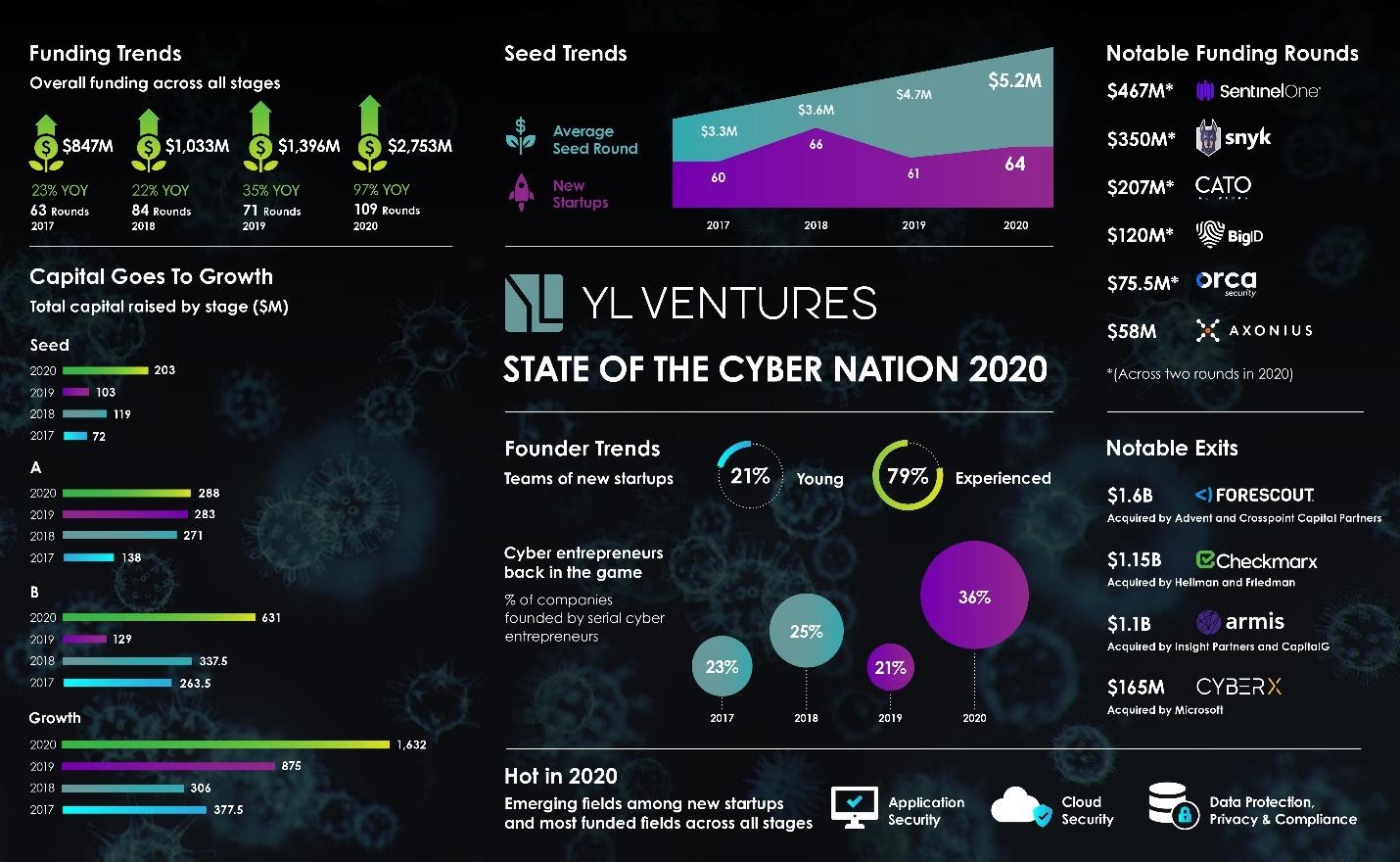
The numbers also reveal how investors are increasingly concentrating their funds on larger seed rounds for serial entrepreneurs and the foremost industry trends. More than $2.75 billion was poured into the industry this year to back companies across all stages, a 97% increase from last year’s $1.39 billion. If its long-term slope is any indication, we can only expect it to continue to grow.

However, though they clearly indicate progress, the numbers still make the need for a demographic reset clear. Like the rest of the industry, Israel’s cybersecurity ecosystem must adapt to the pace of change set out by this year’s social movements, and the time has long passed for true diversity and gender representation in cybersecurity leadership.

Seed rounds reveal fascinating shifts

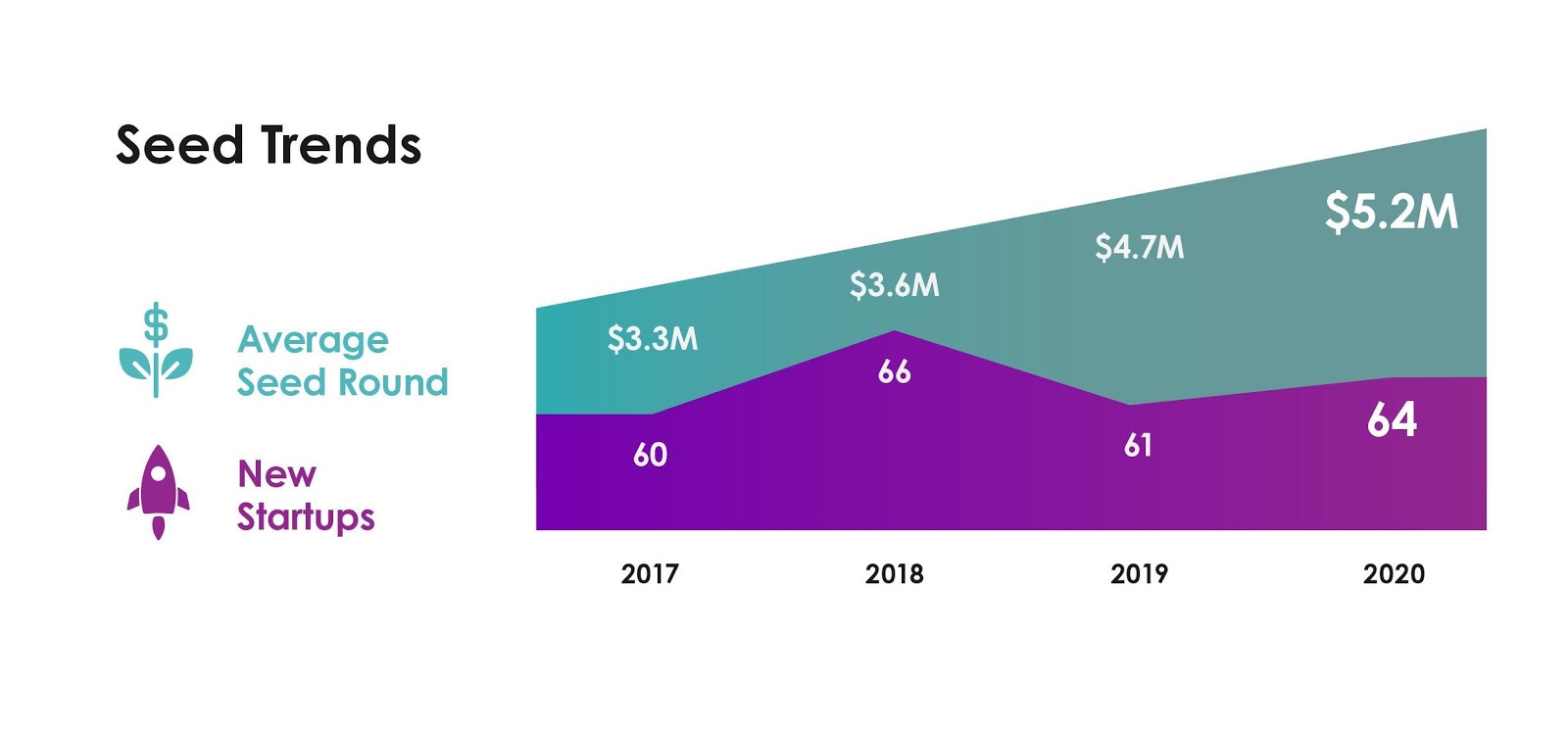
As the market’s biggest leaders garner experience and expertise, the bar for entry to Israel’s cybersecurity startup ecosystem has gradually risen over the years. However, this did not appear to impact this year’s entrepreneurial breakthroughs. 58% of Israel’s newly founded cybersecurity companies received seed rounds this year, totaling 64 seeded companies in 2020 compared with last year’s 61. The total number of newly founded companies increased by 5%, reversing last year’s downward trend.

The amount invested at seed hit an all-time high as average deal size in 2020 increased by 11%, amounting to an average of $5.2 million per deal. This continues an upward trend in average seed rounds, which have surged over the last four years due to sizable year-on-year increases. It also provides further support for a shift toward higher caliber seed rounds with a strategically focused and “all-in” approach. In other words, founders that meet the new bar for entry are raising bigger rounds for more ambitious visions.

YL ventures seed trends 2020

Image Credits: YL Ventures

Where is the money going?

2020 proved an exceptional year for application security and cloud security startups. Perhaps the runaway successes of Snyk and Checkmarx left strong impressions. This year saw an explosive 140% increase in application security company seed investments (such as Enso Security, build.security and CloudEssence), as well as a whopping 200% increase in cloud security seed investments (like Solvo and DoControl), from last year.