Author: azeeadmin

10 Jul 2020

A recapitalization reckoning

If you’re an angel who invested in a startup that was meant to go public in 2014, you might be getting a little bit impatient. High-risk, high-reward investing has lost its shine in this environment: the stock market is a mess these days, and you want your cash back.

Enter recapitalization events, where startups restructure their entire cap table to squeeze out old investors, bring on new ones and shift the way equity and debt is managed. For investors, it’s a killer way to enter a company on friendlier terms than normal (read: desperation), and a nice way to get liquidity on a startup you’re betting on.

For founders, it’s rarely good news, as departing investors is not a metric they’re going to add to the pitch deck. As one investor said on background, the spur of coronavirus-related recapitalization events shows “hella dilution for desperate times.”

That’s what makes Workhuman’s transparency with its recent recapitalization event all the more enticing.

Last year, the human-resources platform brought in $580 million in revenue from customers like LinkedIn, Cisco, J&J and other clients. In April, business grew 40%. Co-founder and CEO Eric Mosley says business has grown five times in size since the company pulled back from its 2014 plans to IPO. Workhuman hasn’t raised a single venture round since 2004 (and doesn’t plan to any time soon).

Being conservative has paid off; although Workhuman has operated for nearly two decades, Mosley says he thinks the company is still at the “tip of the iceberg.” The company recently had a recapitalization event to sell the stakes of its earliest investors, who cut a $200,000 check more than 20 years ago.

10 Jul 2020

Rackspace preps IPO after going private in 2016 for $4.3B

After going private in 2016 after accepting a $32 per share, or $4.3 billion, price from Apollo Global Management, Rackspace is looking once again to the public markets. First going public in 2008, Rackspace is taking second aim at a public offering around 12 years after its initial debut.

The company describes its business as a “multicloud technology services” vendor, helping its customers “design, build and operate” cloud environments. That Rackspace is highlighting a services focus is useful context to understand its financial profile, as we’ll see in a moment.

But first, some basics. The company’s S-1 filing denotes a $100 million placeholder figure for how much the company may raise in its public offering. That figure will change, but does tell us that firm is likely to target a share sale that will net it closer to $100 million than $500 million, another popular placeholder figure.

Rackspace will list on the Nasdaq with the ticker symbol “RXT.” Goldman, Citi, J.P. Morgan, RBC Capital Markets and other banks are helping underwrite its (second) debut.

Financial performance

Similar to other companies that went private, only later to debut once again as a public company, Rackspace has oceans of debt.

The company’s balance sheet reported cash and equivalents of $125.2 million as of March 31, 2020. On the other side of the ledger, Rackspace has debts of $3.99 billion, made up of a $2.82 billion term loan facility, and $1.12 billion in senior notes that cost the firm an 8.625% coupon, among other debts. The term loan costs a lower 4% rate, and stems from the initial transaction to take Rackspace private ($2 billion), and another $800 million that was later taken on “in connection with the Datapipe Acquisition.”

The senior notes, originally worth a total of $1,200 million or $1.20 billion, also came from the acquisition of the company during its 2016 transaction; private equity’s ability to buy companies with borrowed money, later taking them public again and using those proceeds to limit the resulting debt profile while maintaining financial control is lucrative, if a bit cheeky.

Rackspace intends to use IPO proceeds to lower its debt-load, including both its term loan and senior notes. Precisely how much Rackspace can put against its debts will depend on its IPO pricing.

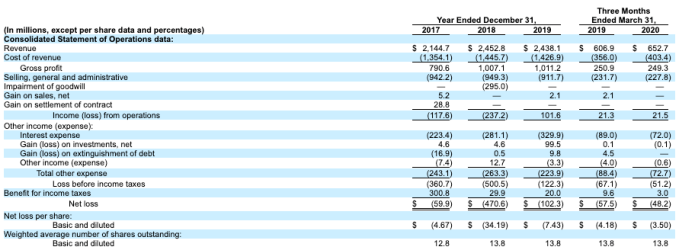
Those debts take a company that is comfortably profitable on an operating basis and make it deeply unprofitable on a net basis. Observe:

Image Credits: SECLooking at the far-right column, we can see a company with material revenues, though slim gross margins for a putatively tech company. It generated $21.5 million in Q1 2020 operating profit from its $652.7 million in revenue from the quarter. However, interest expenses of $72 million in the quarter helped lead Rackspace to a deep $48.2 million net loss.

Not all is lost, however, as Rackspace does have positive operating cash flow in the same three-month period. Still, the company’s multi-billion-dollar debt load is still steep, and burdensome.

Returning to our discussion of Rackspace’s business, recall that it said that it sells “multicloud technology services,” which tells us that its gross margins will be service-focused, which is to say that they won’t be software-level. And they are not. In Q1 2020 Rackspace had gross margins of 38.2%, down from 41.3% in the year-ago Q1. That trend is worrisome.

The company’s growth profile is also slightly uneven. From 2017 to 2018, Rackspace saw its revenue expand from $2.14 billion to $2.45 billion, growth of 14.4%. The company shrank slightly in 2019, falling from $2.45 billion in revenue in 2018 to $2.44 billion the next year. Given the economy that year, and the importance of cloud in 2019, the results are a little surprising.

Rackspace did grow in Q1 2020, however. The firm’s $652.7 million in first-quarter top-line easily bested in its Q1 2019 result of $606.9 million. The company grew 7.6% in Q1 2020. That’s not much, especially during a period in which its gross margins eroded, but the return-to-growth is likely welcome all the same.

TechCrunch did not see Q2 2020 results in its S-1 today while reading the document, so we presume that the firm will re-file shortly to include more recent financial results; it would be hard for the company to debut at an attractive price in the COVID-19 era without sharing Q2 figures, we reckon.

How to value Rackspace is a puzzle. The company is tech-ish, which means it will find some interest. But its slow growth rate, heavy debts and lackluster margins make it hard to pin a fair multiple onto. More when we have it.

10 Jul 2020

Operator Collective brings diversity and inclusion to enterprise investing

When Mallun Yen started Operator Collective last year, she wanted to build an investment firm for people who didn’t have a voice in Silicon Valley. That meant connecting women and people of color with operators who have been intimately involved in building companies from the ground up, then providing early-stage investment.

She then brought in Leyla Seka as a partner. Seka helped build the AppExchange at Salesforce into a powerful marketplace for companies built on top of the Salesforce platform, or that plugged into the platform in some meaningful way to sell their offerings directly to Salesforce customers. Through that role, she met a lot of people in the startup world, and she saw a lot of inequities.

Yen, whose background includes eight years as a VP at Cisco, and co-founder of Saastr with Jason Lemkin, wanted to build a different kind of firm, one that connected these operators — women like herself and Seka, who had walked the walk of running substantial businesses — with people who didn’t typically get heard in the corridors of VC firms.

Those operators themselves tend to be underrepresented at investment shops. The firm today consists of 130 operator LPs, 90% of whom are women and 40% people of color (which includes Asians). One way that the company can do this is by removing rigid buy-in requirements. LPs can contribute as little as $10,000, all the way up to millions of dollars, depending on their means, and that makes for a much more diverse pool of LPs.

While Seka admits they are far from perfect, she says they are fighting the good fight. So far, the company has invested in 18 startups with a more diverse set of founders and executives than you find at most firms that invest in enterprise startups. That means that 67% of their investments include people of color (which breaks down to 44% Asian, 17% Latinx and 6% Black), 56% include a female founder, 56% have an immigrant founder and 33% have a female CEO.

I sat down with Yen and Seka to discuss their thinking about enterprise investing. While they have a far more inclusive philosophy than most, their general approach to enterprise investing isn’t all that different than what we’ve seen in previous surveys with enterprise investors.

Which trends are you most excited about in the enterprise from an investing perspective?

10 Jul 2020

Fringe pitches a monthly stipend for app purchases and subscriptions as the newest employee benefit

Fringe is a new company pitching employers on a service offering lifestyle benefits for their employees in addition to, or instead of, more traditional benefits packages.

“We didn’t think it made sense that employees need to be sick, disabled, dead or 65+ to benefit from their benefits,” wrote Fringe chief executive Jordan Peace, in an email.

The Richmond, Va.-based company was founded by five college friends from Virginia Tech rounded up by Peace and Jason Murray, who serves as the company’s head of Strategy and Finance. The two men previously owned a financial planning firm called Greenhouse Money, which worked with small businesses to set up benefits packages and retirement accounts.

During that time, the two men had a revelation… Employees at these small and medium-sized businesses didn’t just want retirement or healthcare benefits, they wanted perks that were more applicable to their day-to-day lives. Since Murray and Peace couldn’t find a company that offered a flexible benefits package on things like Netflix, Amazon, or Hulu subscriptions, Uber rides, Grubhub orders, or Instacart deliveries, they built one themselves.

As they grew their business they brought in college friends including Isaiah Goodall as the vice president of partnerships, Chris Luhrman as the vice president of operations and Andrew Dunlap as  the head of product.

Peace and Murray first launched the business in 2018 and now count over 100 delivery services, exercise apps, cleaning services and other apps of convenience among their offerings.

For their part, employers pay $5 per employee-covered per month and set up a monthly stipend (that may or may not be subtracted from a total benefits package) of somewhere between $50 and $200 that employees can spend on subscription services.

It’s a pitch to employers that Peace says is especially compelling as office culture changes in the wake of massive office closures and work-from-home orders from major US companies as a response to the COVID-19 epidemic.

“In-office perks and even most ‘off-site’ perks (gyms, massage spas, etc.) are all null and void,” wrote Peace. “Even post-COVID, it’s highly likely that many of these aspects of office culture will bear less significance with many CEOs vowing to allow ‘WFH forever’. This means companies need a way to package of their office culture, and ship them home. Fringe is perfectly positioned for this and determined to be the first name that comes to mind to provide a solution.”

Peace sees this as the next step in the evolution of benefits offerings for employees. He traces its legacy to the development of private health insurance, 401k retirement plans. “After another 40 years lifestyle benefits are the newest breakthrough — and like its predecessors, will be almost universally adopted in the next 5 years,” Peace wrote.

10 Jul 2020

nCino sharply raises its IPO price range, boosting possible valuation to $2.6B

As expected, fintech company nCino has raised its IPO price range. The North Carolina-based banking software firm now expects to sell its shares for between $28 and $29 per share, far more than its initial price range of $22 to $24 per share.

At its $28 to $29 per-share price interval, nCino is worth $2.50 billion to $2.59 billion, sharply more than its preceding $1.96 billion to $2.14 billion range.

The valuation makes more sense for the company, given its growth rate, revenue scale and how the market is currently valuing similar companies. As TechCrunch wrote earlier this week, concerning the SaaS company’s scale and value (emphasis ours):

Annualizing the company’s Q1 (the April 30, 2020 period) revenue results, nCino’s $178.9 million run rate would give it a revenue multiple of 11x to 12x at its expected IPO prices, a somewhat modest result by current standards.

Indeed, as nCino grew about 50% from Q1 2019 to Q1 2020, it feels light. The firm’s GAAP losses are slim compared to revenue as well for a SaaS business, though the company’s operating cash burn did grow from $4.6 million in its fiscal year ending January 31, 2019 to $9 million in its next fiscal year. Its numbers are mostly good, with some less-than-perfect results. Still, given its growth rate, an 11x-12x revenue multiple feels modest; that figure rises, of course, if we use a trailing revenue figure instead of our annualized number.

It would not be a shock, then, if nCino targets a higher price interval for its shares before it formally prices.

With its new IPO price range, nCino’s implied revenue multiple is now 14x to 14.5x, figures that seem far closer to present-day norms.

Now the question for nCino, which is expected to price and trade next week, is whether it can price above its raised range. Given some recent historical precedent, a $1 per-share price beat above its raised interval would not be a shock.

nCino is one of two companies that we’re currently tracking on its way to the public markets. The other is GoHealth, which is expected to go public around the same time. Expect next week to be chock-full of IPO news. Heading into earnings season no less!

10 Jul 2020

Societal upheaval during the COVID-19 pandemic underscores need for new AI data regulations

As a long-time proponent of AI regulation that is designed to protect public health and safety while also promoting innovation, I believe Congress must not delay in enacting, on a bipartisan basis, Section 102(b) of The Artificial Intelligence Data Protection Act — my proposed legislation and now a House of Representatives Discussion Draft Bill. Guardrails in the form of Section 102(b)’s ethical AI legislation are necessary to maintain the dignity of the individual.

What does Section 102(b) of The AI Data Protection Act provide and why the urgent need for the federal government to enact it now?

To answer these questions, it is first necessary to understand how artificial intelligence (AI) is being used during this historic moment when our democratic society is confronting two simultaneous existential threats. Only then can the risks that AI poses to our individual dignity be recognized, and Section 102(b) be understood as one of the most important remedies to protect the liberties that Americans hold dear and that serve as the bedrock of our society.

America is now experiencing mass protests demanding an end to racism and police brutality, and watching as civil unrest unfolds in the midst of trying to quell the deadly COVID-19 pandemic. Whether we are aware of or approve of it, in both contexts — and in every other facet of our lives — AI technologies are being deployed by government and private actors to make critical decisions about us. In many instances, AI is being utilized to assist society and to get us as quickly as practical to the next normal.

But so far, policymakers have largely overlooked a critical AI-driven public health and safety concern. When it comes to AI, most of the focus has been on the issues of fairness, bias and transparency in data sets used to train algorithms. There is no question that algorithms have yielded bias; one only need to look to employee recruiting and loan underwriting for examples of unfair exclusion of women and racial minorities.

We’ve also seen AI generate unintended, and sometimes unexplainable, outcomes from the data. Consider the recent example of an algorithm that was supposed to assist judges with fair sentencing of nonviolent criminals. For reasons that have yet to be explained, the algorithm assigned higher risk scores to defendants younger than 23, resulting in 12% longer sentences than their older peers who had been incarcerated more frequently, while neither reducing incarceration nor recidivism.

But the current twin crises expose another more vexing problem that has been largely overlooked — how should society address the scenario where the AI algorithm got it right but from an ethical standpoint, society is uncomfortable with the results? Since AI’s essential purpose is to produce accurate predictive data from which humans can make decisions, the time has arrived for lawmakers to resolve not what is possible with respect to AI, but what should be prohibited.

Governments and private corporations have a never-ending appetite for our personal data. Right now, AI algorithms are being utilized around the world, including in the United States, to accurately collect and analyze all kinds of data about all of us. We have facial recognition to surveil protestors in a crowd or to determine whether the general public is observing proper social distancing. There is cell phone data for contact tracing, as well as public social media posts to model the spread of coronavirus to specific zip codes and to predict location, size and potential violence associated with demonstrations. And let’s not forget drone data that is being used to analyze mask usage and fevers, or personal health data used to predict which patients hospitalized with COVID have the greatest chance of deteriorating.

Only through the use of AI can this quantity of personal data be compiled and analyzed on such a massive scale.

This access by algorithms to create an individualized profile of our cell phone data, social behavior, health records, travel patterns and social media content — and many other personal data sets — in the name of keeping the peace and curtailing a devastating pandemic can, and will, result in various governmental actors and corporations creating frighteningly accurate predictive profiles of our most private attributes, political leanings, social circles and behaviors.

Left unregulated, society risks these AI-generated analytics being used by law enforcement, employers, landlords, doctors, insurers — and every other private, commercial and governmental enterprise that can collect or purchase it — to make predictive decisions, be they accurate or not, that impact our lives and strike a blow to the most fundamental notions of a liberal democracy. AI continues to assume an ever-expanding role in the employment context to decide who should be interviewed, hired, promoted and fired. In the criminal justice context, it is used to determine who to incarcerate and what sentence to impose. In other scenarios, AI restrict people to their homes, limit certain treatment at the hospital, deny loans and penalize those who disobey social distancing regulations.

Too often, those who eschew any type of AI regulation seek to dismiss these concerns as hypothetical and alarmist. But just a few weeks ago, Robert Williams, a Black man and Michigan resident, was wrongfully arrested because of a false face recognition match. According to news reports and an ACLU press release, Detroit police handcuffed Mr. Williams on his front lawn in front of his wife and two terrified girls, ages two and five. The police took him to a detention center about 40 minutes away, where he was locked up overnight. After an officer acknowledged during an interrogation the next afternoon that “the computer must have gotten it wrong,” Mr. Williams was finally released — nearly 30 hours after his arrest.

While widely believed to be the first confirmed case of AI’s incorrect facial recognition leading to the arrest of an innocent citizen, it seems clear this won’t be the last. Here, AI served as the primary basis for a critical decision that impacted the individual citizen — being arrested by law enforcement. But we must not only focus on the fact that the AI failed by identifying the wrong person, denying him his freedom. We must identify and proscribe those instances where AI should not be used as the basis for specified critical decisions — even when it gets it “right.”

As a democratic society, we should be no more comfortable with being arrested for a crime we contemplated but did not commit, or being denied medical treatment for a disease that will undoubtedly end in death over time, as we are with Mr. Williams’ mistaken arrest. We must establish an AI “no-fly zone” to preserve our individual freedoms. We must not allow certain key decisions to be left solely to the predictive output of artificially intelligent algorithms.

To be clear, this means that even in situations where every expert agrees that the data in and out is completely unbiased, transparent and accurate, there must be a statutory prohibition on utilizing it for any type of predictive or substantive decision-making. This is admittedly counter-intuitive in a world where we crave mathematical certainty, but necessary.

Section 102(b) of the Artificial Intelligence Data Protection Act properly and rationally accomplishes this in the context of both scenarios — where AI generates correct and/or incorrect outcomes. It does this in two key ways.

First, Section 102(b) specifically identifies those decisions which can never be made in whole or in part by AI. For example, it enumerates specific misuses of AI that would prohibit covered entities’ sole reliance on artificial intelligence to make certain decisions. These include recruitment, hiring and discipline of individuals, the denial or limitation of medical treatment, or medical insurance issuers making decisions regarding coverage of a medical treatment. In light of what society has recently witnessed, the prohibited areas should likely be expanded to further minimize the risk that AI will be used as a tool for racial discrimination and harassment of protected minorities.

Second, for certain other specific decisions based on AI analytics that are not outright prohibited, Section 102(b) define those instances where a human must be involved in the decision-making process.

By enacting Section 102(b) without delay, legislators can maintain the dignity of the individual by not allowing the most critical decisions that impact the individual to be left solely to the predictive output of artificially intelligent algorithms.

Mr. Newman is the chair of Baker McKenzie’s North America Trade Secrets Practice. The views and opinions expressed here are his own.


10 Jul 2020

Nanoleaf’s new Hexagon Shapes are a surprisingly lively and organic addition to your home decor

Nanoleaf essentially created a new smart lighting category with its connected light panels, and since then it has iterated with its pixel-like Canvas, and most recently, its new Shapes Hexagons. The Hexagons already seem to be proving popular with customers, since they’re currently waitlisted, but I got the chance to spend some time with them and have found them to be a unique, interesting and very addition to my home decor.

The basics

The Nanoleaf Hexagons don’t change the basic formula of Nanoleaf’s products: They’re individual light panels, which connect to one control unit that has a hardware controller and connects to the power supply. Each one has a electronic connector which snaps into a two-sided connection module that you can then use to connect another panel, in whatever configuration you desire. The panels attach to walls by way of 3M strips, which are pre-mounted on a plastic pad that makes it relatively easy to detach them from the panels for damage-free removal from walls, and replacement by using new 3M strips if you’re redecorating or changing things up. You can also optionally mount them with screws if you want a more permanent installation.

The panels come in a few different configurations, including a Starter Kit that includes seven panels ($199.99), add-on packs that contain three additional panels, and larger packs including 13 and 19-panel bundles. You can configure them basically any way you want – but if that sounds like too much freedom, Nanoleaf provides a number of preset configuration suggests, and its app has an augmented reality feature that lets you mock up and preview different arrangements on your walls before installing. I ended up just free-styling with a rough idea of where I wanted the design to start and end in terms of height and width, and was very happy with the results.

In terms of specs, each panel is very thin at only around 0.24 inches, and they measure roughly 9-inches by 7.75-inches. They each put out around 100 lumens of light, which is not going to replace an overhead light fixture, but which proves perfectly usable for actually supplanting entirely things like bedside lamps and mood lighting in other rooms.

Nanoleaf has made the Hexagon controllable in a number of ways, including via the hardware controller included with the base kit, though their mobile or desktop app, and through smart assistants, with compatibility for Amazon Alexa, Google Assistant, and Apple HomeKit – all of which proved convenient and user-friendly ways to interact with the panels in my experience. You can also touch individual panels to provoke a lighted response.

The Hexagons also include audio responsiveness, meaning they can react to sound. You can use the default programs included with the app, download user-created ones, or make your own, both for sound-reactive modes and for configurations that just play back a set pattern. The sound-reactive modes work amazingly well with music played back through your home audio devices, and really bring the Nanoleaf Hexagons alive – lending an almost biological feel to the devices.

Design

The individual Hexagon panels are each very lightweight and thin, but still feel sturdy and durable. They feature a lighted area that takes up nearly all of their surface, minus rounded corners at each point of the hexagon shape to create a more organic look once they’re powered on. Each side of the hexagon features a receptacle for the connector clip on the back, allowing you to connect another panel to them and provide power and control through each. One controller unit can control up to 500 hexagons, so you shouldn’t ever really need more than one, and one power supply can provide power for up to 21 hexagons. Each can be snapped to any panel in your configuration for flexible positioning.

Nanoleaf’s original light panels are triangular, and they also created the square Canvas later on. The Hexagons have a honeycomb effect and are the most organic looking to my eye, with an ability to work with a wider range of decor, including softer, less industrial interior aesthetics.

The light emitted by each panel is even and bright, and can be tuned across the RGB spectrum. Whites ranging from warm to very cool can also be achieved with the panels for more general day-to-day use. The hardware controller allows you to cycle through some standard white presets, too, including Warm White (2700K), Reading Light (4000K) and Daylight White (5000K) – plus you can control it to essentially any temperature you want, as well as different colors, through the app.

Nanoleaf has come up with a very simple mounting solution that’s easy to do on your own. I had mine installed and configured in probably around 15 minutes today, once I’d worked out a rough idea of how I wanted to lay them out on the wall. I used a level to get the first panel plumb but it’s not necessarily required, as the shapes look great even if they’re off-level relative the room and surrounding objects.

Because of their modular nature, you can easily add more to your existing layout by picking up additional expansion packs, should you decide to grow your collection in future. There’s enough play with the mounting equipment that you can snap one fo the connectors in place behind previously-installed panels to attach new ones.

Features

Nanoleaf has evolved their product since its introduction to include a wide range of built-in features, including ambient music modes that use audio to dynamically change the lighting on the panels. This is probably my favorite feature of the Hexagons, and the mode I use most often, especially because I’m often playing music via Sonos throughout the house on most days.

The hardware controller is also a great option in case you want to skip the app features altogether and treat your Hexagons more like a traditional light source – with added flexibility. It allows you to turn the brightness up and down, power them on and off, and cycle through different stored patterns and sequences.

App-based control offers a much wider range of options, however. It provides access to a range of pre-installed scenes, including both standard dynamic ones as well as Rhythm modes (those that react to sound) and you can set scheduled events, including scene changes, and have them occur just once or repeat on whatever schedule you prefer.

A built-in scene creator allows you to fully customize your light show, panel-by-panel, and then save that and share it with the community as well. It’s a great way to get just the look you want, and combined with the scheduler, means you can ensure your setup is custom-tailored to exactly what colors, brightness and effects you’re looking for throughout the day.

Bottom line

The Nanoleaf Hexagons are a terrific addition to the Nanoleaf lineup, and I think they’re the model that’s mostly likely to appeal to a much broader customer base when compared to the company’s existing options. I personally didn’t expect to be that big of a fan of Nanoleaf in general – I’d never been more than mildly interested in their offerings before. But as soon as I powered on the Hexagon, I was amazed at how much I felt like they improved the aesthetics of the space.

Their Rhythm features feels like having a living, dancing electric decor element, and the general pattern and even ambient lighting modes are all very pleasant additions to any room that impress without feeling overly techy or overwhelming of other aspects of your home design and furnishings. They command a high price vs. traditional lighting, but when you factor in their smart features, they’re a good value in terms of bringing something unique and highly personal into your home’s look and feel.

10 Jul 2020

Facebook code change caused outage for Spotify, Pinterest and Waze apps

If you’re an iPhone user, odds are fairly good you spent a frustrating portion of the morning attempting to reopen apps. I know my morning walk was dampened by the inability to fire up Spotify. Plenty of other users reported similar issues with reported similar issues with a number of apps, including Pinterest and Waze.

The issue has since been resolved, with Facebook noting that the problem rests firmly on its shoulders. A log page notes a sudden spike in errors stemming from Facebook’s iOS SDK, dating back several hours. Facebook says the issue is the fault of a change in code.

“Earlier today, a code change triggered crashes for some iOS apps using the Facebook SDK,” the developer team writes. “We identified the issue quickly and resolved it. We apologize for any inconvenience.”

While the issue was addressed relatively swiftly (though a few hours can feel like a lifetime, depending on how reliant you are on a given app), annoyed parties will no doubt remember back in May when an SDK update created a similar wave of issues. The issue was no doubt even more distressing to developers whose apps utilize the SDK.

After the second major issue in recent memory, it’s easy to imagine many reconsidering their relationship with the social network — after all, a bad experience can put people off an app entirely, as social media debates around Apple Music vs. Spotify appeared to point to this morning. Many users will ultimately place the blame at the feet of a given app, rather than a third-party SDK that caused the crash.

When it comes to updating the SDK, Facebook is seemingly moving too fast and breaking too many things. We’ve reached out to the company to see how it plans to address the issue going forward.

10 Jul 2020

What do investors bidding up tech shares know that the rest of us don’t?

The biggest story to come out of the post-March stock market boom has been explosive growth in the value of technology shares. Software companies in particular have seen their fortunes recover; since March lows, public software companies’ valuations have more than doubled, according to one basket of SaaS and cloud stocks compiled by a Silicon Valley venture capital firm.

Such gains are good news for startups of all sizes. For later-stage upstarts, software share appreciation helps provide a welcoming public market for exits. And, strong public valuations can help guide private dollars into related startups, keeping the capital flowing.


The Exchange explores startups, markets and money. You can read it every morning on Extra Crunch, and now you can receive it in your inbox. Sign up for The Exchange newsletter, which drops every Friday starting July 24.


For software-focused startup companies, especially those pursuing recurring revenue models like SaaS, it’s a surprisingly good time to be alive.

Indeed, after COVID-19 hit the United States, layoffs and rising software sales churn were key, worrying indicators coming out of startup-land. Since then, the data has turned around.

As TechCrunch reported in June, startup layoffs have declined and software churn has recovered to the point that business and enterprise-focused SaaS companies are on the bounce.

But instead of merely recovering to near pre-COVID levels, software stocks have continued to rise. Indeed, the Bessemer Cloud Index (EMCLOUD), which tracks SaaS firms, has set an array of all-time highs in recent weeks.

There’s some logic to the rally. After speaking to venture capitalists over the past few weeks, notes from EQT VenturesAlastair Mitchell, Sapphire’s Jai Das, and Shomik Ghosh from Boldstart Ventures paint the picture of a possibly accelerating digital transformation for some software companies, nudged forward by COVID-19 and its related impacts.

The result of the trend may be that the total addressable market (TAM) for software itself is larger than previously anticipated. Larger TAM could mean bigger future sales for and more substantial future cash flows for some software companies. This argument helps explain part of the market’s present-day enthusiasm for public tech equities, and especially the shares of software companies.

We won’t be able explain every point that Nasdaq has gained. But the TAM argument is worth understanding if we want to grok a good portion of the optimism that is helping drive tech valuations, both private and public.

10 Jul 2020

New report outlines potential roadmap for Apple’s ARM-based MacBooks

When Ming-Chi Kuo offers up a new report, Apple followers listen. The latest offering from the analyst adds key detail to the potential roadmap for Apple’s recently-announced push into its home baked ARM-based processors.

Once again, Kuo notes that a 13.3-inch MacBook will be arrive in the fourth quarter of this year, sporting Apple’s own silicon. That laptop will reportedly be joined by a new version of the MacBook Air, which recently had its own upgrade. The thin-and-light laptop is said to be arriving either along with the Pro in Q4 2020 or Q1 2021.

Even more intriguing, is the reported arrival of two new Pros — a 14.1- and 16-inch — which will sport an “all-new form factor design.” That marks a potential change from earlier reports that have the updated 16-inch arriving alongside the 13 by year’s end. As MacRumors notes, the redesigned iMac is absent from the letter.

Most reports have suggested that the all-in-one is set for a redesign before year’s end, but will still be sporting an Intel chip. A version with Apple silicon likely wouldn’t arrive on the desktop until next year at the earliest, potentially making the new iMac somewhat outdated shortly after its arrival.

Thus far the only system that’s been officially announced is a Mac mini designed specifically for developers. The company used WWDC to offer a rare early look at future tech, in order to help give app developers sufficient time to upgrade for the upcoming hardware.