Author: azeeadmin

09 Jul 2020

YouTube Kids app is now available on Amazon Fire TV

YouTube Kids, the family-friendly version of YouTube with built-in parental controls and a curated selection of kids content, is now available on Amazon’s Fire TV. The app’s arrival comes after Google and Amazon came to a mutually beneficial agreement that also allowed YouTube to launch on Fire TV last year and Amazon’s Prime Video to make its way to Chromecast and Android TV.

The agreement was meant to soon see the additions of other YouTube apps, including YouTube TV and YouTube Kids, on the Fire TV platform. But while YouTube TV arrived on Fire TV last September, YouTube Kids has seen a significant delay, considering it was promised to arrive sometime in 2019.

In any event, the YouTube Kids app is here now, offering parents a somewhat less risky version of YouTube’s service for younger children. Parents can create individual profiles for each child, customized to one of several age groupings, like preschool, younger and older — the latter meant for the tween crowd. However, the app’s content isn’t hand-selected. Instead, YouTube’s automated systems determine what’s considered age-appropriate. This can sometimes lead to mistakes, which parents can report using in-app tools.

For those who want a more customized and controlled experience, YouTube Kids also allows parents to handpick which channels the child can access.

Amazon says the YouTube Kids app will begin to roll out to Fire TV customers starting today, July 9, 2020.

For those not on Fire TV, YouTube Kids also recently launched on Apple TV earlier this spring. It’s not yet available on Roku.

In addition to news of the YouTube Kids launch, Amazon also today announced that Fire TV Cube owners in the U.S. and select markets will be able to watch over-the-air TV and use Alexa to tune to various channels. This will require customers to attach their own over-the-air tuner, which is configured in the Settings menu under “Equipment Control/Manage Equipment/Add Equipment” and then “Live TV.”

Once set up, customers can ask Alexa to change the channel using either its name or number.

These Fire TV updates follow yesterday’s news about Fire TV updating its Live TV experience to integrate top live TV streaming services, YouTube TV, Sling TV, and Hulu + Live TV.


09 Jul 2020

Canon’s new R5 and R6 mirrorless cameras offer big video upgrades, bird eye autofocus and more

Canon has finally fully revealed its much-anticipated R5 and R6 mirrorless interchangeable lens cameras, and they look like very strong contenders for the field. The R5 is the new flagship of Canon’s mirrorless line, and it’s priced accordingly at $3,899 for the body alone. The R6 is its ‘affordable’ sibling at $2,499 for the body alone, and still includes an impressive list of features including some of the biggest autofocus system improvements common to the R5.

Canon EOS R5

The R5 is essentially now Canon’s top of the line interchangeable lens camera, barring the 1D X III. It has a 45 megapixel full-frame sensor, which is brand new with this camera, and uses the same DIGIC X processor found in the EOS-1D X III. Along with in-body image stabilization (which stacks with lens stabilization, if available), it has the ability to shoot 8K video at 30 frames per second – uncropped, meaning it uses the full resolution capabilities of that large sensor for maximum quality.

The R5 can capture 4K footage at up to 120 fps, and it can record 10-bit 4:2:2 footage using either C-Log and HDR PQ internally for maximum dynamic range and editing flexibility. This is really the camera that video pros and enthusiasts have been asking Canon to make, and beyond, since the 8K capabilities should mean it’s relatively future-proof.

Image Credits: Canon

Catering further to video pros, there are both mic and headphone jacks on the R5 body, and an optional wireless title transmitter grip can add an Ethernet jack and facilitates more advanced multi-camera linked shooting features. The R5 also features a fully articulating fold out display, and an electronic viewfinder with 5.76 million dot resolution. It’s weather sealed for outdoor shooting in a range of conditions, and has two card slots, including one CFexpress slot and one SD card slot.

For both still and video shooters there’s an autofocus system that uses Canon’s Dual Pixel technology to deliver AF across the entire frame. It can also detect human faces and yes, as well as the eye face and body of animals including not only dogs and cats but also birds – sure to be a popular feature among wildlife photographers. Also great news for still shooters is the 12 fps burst rate, which climbs to 20fps when using the software shutter.

Canon EOS R6

Image Credits: Canon

The R6 is similar in size and feature set to the R5, but has a much lower resolution 20.1 megapixel full frame sensor. It also shoots video at a maximum of 4K/60fps (with slight cropping), and has a lower resolution OLED EVF vs. its more expensive sibling. It also has Dual UHS-II SD card slots in place of the CF/SD combo on the R5, and less rigorous weather sealing. It also lacks the R5’s top e-ink display.

Still, it does include the same AF features and uses the same new battery type as the R5, and is compatible with the BG-R10 battery grip that also works with the more expensive camera. It finally sounds like a true and capable competitor to other options that have retained popularity among video enthusiasts and creators like the Sony A7 III even as Canon has released newer cameras like the EOS R and RP.

One potentially disappointing note for both cameras is regarding battery life, where the rating is around 320 shots with the LCD or just 220 shots on a full charge when shooting with the EVF. Sony’s A7R IV manages between 530 to 670 shots with the EVF and LCD respectively, for comparison.

New RF lenses

Canon’s camera hardware sounds like it delivers on a lot of what Canon fans, photographers and videographers have been looking for from the company for many years. But the real advantage of Canon’s system might reside in its RF glass, which has excellent reviews for all its existing lenses, and which is also gaining a bunch of versatile new products across the price range.

Image Credits:


These include a new 100-500 f4.5-7.1 superzoom ($2,699), which includes built-in image stabilization and should be a fantastic option for birders and wildlife photographers. There’s also affordable new RF600mm ($699) and 800mm ($899) fixed aperture f11 primes that won’t be useful in low lighting but that should be fantastic for sports and wildlife outdoors. Finally, a new RF85mm F2 ($599) with close-focusing macro capabilities seems like an awesome mid-range portrait and close-up lens.

Canon is also releasing 1.4x ($499) and 2x ($599) teleconverters for its RF lenses, which is a standby that every well-rounded system needs.

The R5 is set to be available at the end of July, and the R6 is going to begin shipping at the end of August. The lenses range in available from July to October, and the extenders will be shipping at the end of July as well.

09 Jul 2020

Smartwatch hack could trick patients to ‘take pills’ with spoofed alerts

Security researchers say a smartwatch, popular with the elderly and dementia patients, could have been tricked into letting an attacker easily take control of the device.

These watches are designed to help patients to easily call their carers and for carers to track the location of their patients. They come with their own cellular connection, so that they work anywhere.

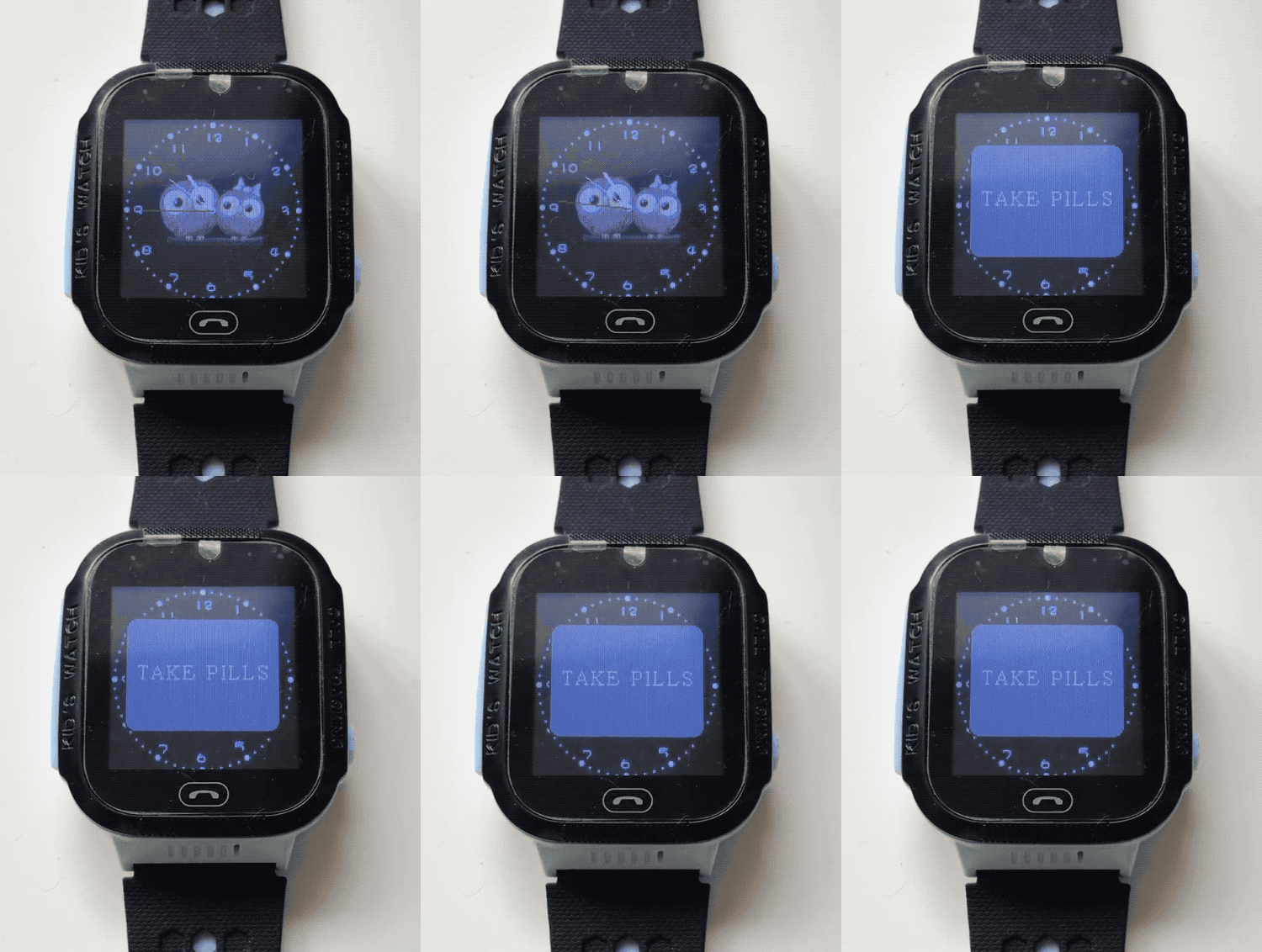
But researchers at U.K.-based security firm Pen Test Partners found that they could trick the smartwatch into sending fake “take pills” reminders to patients as often as they want, they said.

“A dementia sufferer is unlikely to remember that they had already taken their medication,” wrote Vangelis Stykas in a blog post. “An overdose could easily result.”

Researchers triggering the “take pill” alert on a vulnerable smartwatch. (Image: Pen Test Partners/supplied)

The vulnerabilities were found in the back-end cloud system, known as SETracker, which powers the smartwatch. The same cloud system also powers millions of other white-label smartwatches and vehicle trackers across Europe, all of which were vulnerable to basic attacks, the researchers said.

The researchers found a copy of the source code that powers the back-end cloud system, allowing the researchers to find security weaknesses in the code. One of the major flaws found was that the server was using a hardcoded key which, if used, an attacker could have sent any commands to remotely control any one of these devices.

With this key, an attacker could trigger the “take pills” alert, secretly make phone calls from the device, send text messages, or — in the case of vehicle trackers — cutting the engine altogether.

The code also had passwords and tokens to SETracker’s cloud storage, which the researchers believe — based on the code — stored data uploaded by these devices. But the researchers were unable to check as doing so would have broken U.K. computer hacking laws.

The researchers said that the vulnerabilities have now been fixed. It isn’t known if the flaws had been exploited by someone else.

This latest research comes just months after Pen Test Partners found similar vulnerabilities in another widely-used white-label child-tracking smartwatches.

Security, or a lack of, is a growing trend among smart device makers, often which build devices with little consideration for good cybersecurity practices. That prompted the U.K. government to propose new legislation that would help improve their security by mandating that smart devices must be sold with a baseline level of security, such as unique passwords.

09 Jul 2020

Singaporean startup Karana raises $1.7 million for meat substitutes made from jackfruit

Singaporeans have a growing appetite for plant-based meat substitutes. In fact, demand for products from companies like Beyond Meat, Impossible Foods and Quorn have grown during the pandemic, partly because consumers are making more health-conscious decisions, according to the Straits Time. Now there is a new entrant to the market. Headquartered in Singapore, Karana announced today it has raised $1.7 million in seed funding and plans to launch its first product, a pork substitute made from jackfruit, this year.

Karana’s seed investors include Henry Soesanto, the CEO of Monde Nissin Group, which acquired Quorn Foods in 2015; agtech investment firms Big Idea Ventures and Germi8; and angel investors Kevin Poon and Gerald Li, both Hong Kong entrepreneurs with experience in the food and beverage industry. Karana said the round also included participation from an undisclosed leading Asia-based FMCG (fast-moving consumer goods) distributor.

Karana’s jackfruit is sourced from Sri Lanka, where jackfruit is already a common meat substitute. What Karana’s processing method does is create a texture that replicates minced and shredded pork more closely, making it easier to use in dishes like dumplings, char siu bao or bahn mi.

Founded in 2018 by Dan Riegler and Blair Crichton, Karana turns organic jackfruit into a pork substitute by using a proprietary mechanical technique that the company says does not use any chemical processing. Its pork substitute will be available in restaurants this year, before arriving in retail stores at the beginning of next year.

Riegler and Crichton told TechCrunch in an email that Karana uses jackfruit because it not only has a “naturally meaty texture,” but is an environmentally-friendly crop. It is usually grown intercropped (or with other produce, in the same field), has a high yield and low water usage. But about 60% of jackfruit harvested currently goes to waste, they added. “There is a lot of room for further commercialization, which means additional income streams for farmers.”

Karana’s founders started with pork because it is the most frequently consumed meat in Asia. Its seed funding will be used on research and development to launch new products and the company currently talking to strategic partners in other Asian markets. Future Karana products will use other crops grown in Asia to create new meat substitutes.

“Karana is a whole-plant meat company, our focus is on leveraging what nature has given us and enhancing these amazing biodiverse ingredients to create delicious products. In the future, we will launch products using other regional ingredients that will enable us to expand beyond pork,” the founders said. “This is a real differentiator from other companies that are by-and-large relying on commodity crops in processed forms.”

09 Jul 2020

GoPro turns the Hero 8 Black into a $249 webcam

The GoPro Hero 8 action camera can now be used as a webcam thanks to a software utility. The software, which is still in beta, lets users connect a Hero 8 camera through USB and use it as a webcam. Without this utility, owners had to use a combination of dongles and HDMI cables to use the camera with their computers.

The GoPro app comes as most camera companies have released similar utilities for their latest DSLR cameras — Sony is the notable exception. TechCrunch has a running list right here.

With this new software from GoPro, owners can use their Hero 8 camera — and its handy wide-angle lens — in video chats with Zoom, Microsoft Teams, Discord, and many others. And if used through Chrome, the camera will work with Webex, Skype, Slack, and others.

The work-from-home aspect of the COVID-19 pandemic led to a shortage of webcams. As the global economy shifted to home offices, webcams from Logitech and Microsoft quickly sold-out. The few HDMI adapters that allowed DLSRs to act as a webcam sold out, too. Camera companies suddenly started retooling their software to allow their cameras to work as a webcam through USB instead of HDMI.

This move from GoPro is smart. At a new low price of $249, the GoPro Hero 8 Black is one of the least expensive routes to use a real camera as a webcam. Right now, the software solution only works with Macs. GoPro says a Windows version is in the works. To use a Hero 8 as a webcam, download the latest firmware from GoPro and snag GoPro’s new Webcam Desktop Utility app.

09 Jul 2020

LogDNA announces $25M Series C investment and new CEO

LogDNA, a startup that helps DevOps teams dig through their log data to find issues, announced a $25 million Series C investment today along with the promotion of industry vet Tucker Callaway to CEO.

Let’s start with the funding. Emergence Capital led the round with participation from previous investors Initialized Capital and Providence Equity. New investors TI Platform Management, Radianx Capital, Top Tier Capital and Trend Forward Capital also joined the round. Today’s investment brings the total raised to $60 million, according to the company.

Current CEO and co-founder Chris Nguyen says the company provides a centralized way to manage log data for DevOps teams with an eye towards troubleshooting issues and getting applications out faster.

New CEO Callaway, whose background includes executive stints at Chef and Sauce Labs, came on board in January as president and CRO with an eye toward moving him into the top spot when the time was right. Nguyen, who will move to the role of Chief Strategy Officer, says everyone was on board with the move, and he was ready to step back into a more technical role.

“When we closed the latest round of funding and looked at what the journey forward looks like, there was just a lot of trust and confidence from my co-founder, the board of directors, all of the investors on the team that Tucker is the right leader,” Nguyen said.

As Callaway takes over in the midst of the pandemic, the company is in reasonably good shape with 3000 customers using the product and a strategic partnership with IBM to provide logging services for IBM Cloud. Having $25 million in additional capital certainly helps, but he sees a company that’s still growing and intends to keep hiring..

As he brings more people on board to lead the company of approximately 100 employees, he says that diversity and inclusion is something he is passionate about and takes very seriously. For starters, he plans to put the entire company through unconscious bias training. They have also hired someone to review their hiring practices to date and they are bringing in a consultant to help them design more diverse and inclusive hiring practices and hold them accountable to that

The company was a member of the same Y Combinator winter 2015 cohort as GitLab. It actually started out building a marketing technology product, only to realize they had built a powerful logging tool on the back end. That logging tool became the basis for LogDNA .

09 Jul 2020

MariaDB raises $25M more to expand its SkySQL cloud database platform

Cloud services continue to be a key component of how organisations remain operational even as so much else — such as physically working in enclosed offices — is forced to change because of the COVID-19 health pandemic. Today, MariaDB Corporation, the company behind MariaDB SkySQL and one of the startups leading the charge on open source cloud databases, is announcing $25 million in funding to continue its growth.

The money is coming in the form of an extension to the company’s Series C round, and it’s being led by SmartFin Capital, a Belgian VC, with participation also from previous investor GP Bullhound.

(Side note: extensions to existing rounds seem to have become more frequent in recent months. That’s in part because extensions can be faster to close than opening and closing completely new rounds; in part because they are typically smaller amounts; and in part because fundraising has become a lot more challenging and harder to do in recent months, with people travelling and meeting in person much less, and sometimes not at all.)

Notably, however, being an extension doesn’t mean the valuation is not changing. This latest infusion brings the total raised by MariaDB Corp. to over $125 million, “doubling our valuation,” CEO Michael Howard noted in a statement.

Howard didn’t reveal the exact figure of that valuation, but for some context, the company — founded in Helsinki, Finland and now co-headquartered in Redwood City, CA — was last valued at €300 million ($340 million at today’s rates) in 2017, in a $27 million round led by Alibaba. That would put today’s round at a €600 million ($680 million), a big leap for the the startup — and for open source — in the space of three years.

Part of the boost for MariaDB’s business is coming directly as a result of the demands we’re seeing in the enterprise sector today for database-as-a-service tools built on cloud and open source architecture, Howard noted.

“Expanding MariaDB SkySQL cloud operations is our key focus,” Howard said in a statement. “There is an addressable and immediate market need with a growing number of companies who want to enable faster innovation and agility by adopting cloud technologies and shifting database management to DBaaS solutions.”

MariaDB says that DBS Bank, ServiceNow, Walgreens, Samsung and more than 75% of the Fortune 500 customers run MariaDB in both private and public clouds, speaking to the reach of the platform.

MariaDB Corp. is not disclosing its own growth numbers — we’re asking and will update as and when we learn more — but it’s likely they have been strong, judging by the valuation hike.

“MariaDB continues to exceed our expectations,” said Jürgen Ingels, founding partner, SmartFin Capital, in a statement. “The company’s innovation in cloud database technology will help support the rapid growth in IT modernization that businesses large and small are pursuing to keep up with the world around us. We feel MariaDB is well-positioned to take a large share of the growing cloud database market as companies continue to push forward into the cloud. We are proud to invest more in MariaDB to continue their exceptional growth.”

Apart from the more immediate effects of the health pandemic, MariaDB Corp’s growth speaks to other trends in enterprise IT that have been in play for years.

Gartner estimates that 75% of all databases will have migrated to cloud architectures by 2022 either with all-in or hybrid deployments, “with only 5% ever considered for repatriation to on-premises.”

While MariaDB remains committed to open source — indeed there is a MariaDB Foundation that includes members like Microsoft, Booking.com, Tencent and Alibaba — MariaDB Corp has positioned itself as something of a consolidator in terms of building commercial services on top of the open source relational database. Its acquisitions have included Clustrix and MammothDB to expand its functionality, and this funding will be used to that end as well, particularly around scaling and improving the speed of SkySQL.

“MariaDB has risen to be a household name in the IT industry,” said Per Roman, co-founder and managing partner of GP Bullhound in a statement. “We have been particularly interested in MariaDB’s focus on bringing its flexibility, security and stability to the cloud. That’s why we’re excited to invest in MariaDB, as we see enormous opportunities for its SkySQL product.”

09 Jul 2020

Google expands its Swirl 3D ad format

Google is announcing the global availability of Swirl, an ad format that the company unveiled in beta just over a year ago.

The Swirl format involves banner ads that include interactive 3D product models. As the company put it in a blog post:

Swirl lets consumers engage with a product like it’s right in front of them by allowing them to rotate, zoom and expand the creative in the ad. Swirl ads allow brands to illustrate changes in behavior, new technology performance, unique product features and more.

The post went on to describe different campaigns that have already been created using the format, including Nissan Spain, which used a Swirl ad to show off the new features of its Qashaqai SUV, and adidas Latin America, which advertised the adidas Ultra Boost 2019 shoe.

Google Swirl

Image Credits: Google

The ads don’t have to be purely product-focused either — apparently Purina used Swirl to allow potential customers to play fetch with a 3D dog model, an ad that apparently saw six times the engagement of a standard 2D ad.

To create Swirl campaigns, advertisers can upload 3D assets to Google Web Designer, or edit the models using Poly.

09 Jul 2020

Data brokers track everywhere you go, but their days may be numbered

Everywhere you go, you are being followed. Not by some creep in a raincoat, but by the advertisers wanting to sell you things.

The more advertisers know about you — where you go, which shops you visit, and what purchases you make — the more they can profile you, understand your tastes, your hobbies and interests, and use that information to target you with ads. You can thank the phone in your pocket — the apps on it, to be more accurate — that invisibly spits out gobs of data about you as you go about your day.

Your location, chief among the data, is by far the most revealing.

Apps, just like websites, are filled with trackers that send your real-time location to data brokers. In return, these data brokers sell on that data to advertisers, while the app maker gets a cut of the money. If you let your weather app know your location to serve you the forecast, you’re also giving your location to data brokers.

Don’t be too surprised. It’s all explained in the privacy policy that you didn’t read.

By collecting your location data, these data brokers have access to intensely personal aspects of your life and can easily build a map of everywhere you go. This data isn’t just for advertising. Immigration authorities have bought access to users’ location data to help catch the undocumented. In one case, a marketing firm used location data harvested from phones to predict the race, age, and gender of Black Lives Matter protesters. It’s an enormous industry, said to be worth at least $200 billion.

It’s only been in recent years that it was possible to learn what these data brokers know about us. But the law is slowly catching up. Anyone in Europe can request access to obtain or delete their data  under the GDPR rules. California’s new consumer privacy law grants California residents access to their data.

But because so many data brokers collect and resell that data, the data marketplace is a fragmented mess, making it impossible to know which companies have your data. That can make requesting it a nightmare.

Jordan Wright, a senior security architect at Duo Security, requested his data from some of the biggest data brokers in the industry, citing California’s new consumer privacy law. Not all went to plan. As an out-of-state resident, only one of the 14 data brokers approved his request and sent him his data.

What came back was a year’s worth of location data.

Wright works in cybersecurity and knows better than most how much data spills out of his phone. But he takes precautions, and is careful about the apps he puts on his phone. Yet the data he got back knew where he lives, where he works, and where he took his family on holiday before the pandemic hit.

“It’s frustrating not fully knowing what data has been collected or shared and by whom,” he wrote in a blog post. “The reality is that dozens of companies are monitoring the location of hundreds of millions of unsuspecting people every single day.”

Avoiding this invasive tracking is nearly impossible. Just like with web ad tracking, you have little choice but to accept the app’s terms. Allow the tracking, or don’t use the app.

But the winds are changing and there is an increasing appetite to rein in the data brokers and advertising giants by kneecapping their data collection efforts. As privacy became a more prominent selling point for phone consumers, the two largest smartphone makers, Apple and Google, in recent years began to curb the growing power of data brokers.

Both iPhones and Android devices now let you opt-out of ad tracking, a move that doesn’t reduce the ads that appear but prevents advertisers from tracking you across the web or between apps.

Apple threw down the gauntlet last month when it said its next software update, iOS 14, would let users opt-out of app tracking altogether, serving a severe blow to data brokers and advertisers by reducing the amount of data that these ad giants collect on millions without their explicit and direct consent. That prompted an angry letter from the Interactive Advertising Bureau, an industry trade group that represents online advertisers, expressed its “strong concerns” and effectively asked it to back down from the plans.

Google also plans to roll out new app controls for location data in its next Android release.

It’s not the only effort taking on data brokers but it’s been the most effective — so far. Lawmakers are scrambling to find bipartisan support for a proposed federal data protection agency before the end of the year, when Congress resets and enters a legislative session.

Shy of an unlikely fix by Washington, it’s up to the tech giants to keep pushing back.

09 Jul 2020

Twilio acquires Electric Imp to bolster its growing IoT business

While you may mostly think about Twilio in the context of its voice and text messaging platform, the company has recently made a number of moves to bolster its IoT platform, which is already one of its fastest-growing business units. To accelerate this push, the company today announced that it quietly acquired IoT platform Electric Imp a few months ago.

Before the acquisition, Electric Imp, which was one of the earlier IoT startups, had raised about $44 million from firms like Ramparts Capital, which led its 2016 Series C round, with participation from Redpoint, Foxconn, Lowercase Capital and PTI Ventures. The two companies did not disclose the price of the acquisition.

Electric Imp makes it easier for businesses to securely connect their IoT devices with their data centers and third-party services. The company was co-founded by Hugo Fiennes, who was the engineering manager for the hardware team at Apple that launched the first iPhone. After managing four phone launches at Apple, he briefly went to Google to work on IoT projects there, but quickly realized that Google had already built the idea he wanted to work on in the company with Android for Things. He also turned down a job at Nest — though he did the design and architecture of their first thermostat, too. His, interest, and that of his co-founders (which include Gmail designer Kevin Fox, who left the company in 2013, and software architect Peter Hartley), was elsewhere, though.

“My worry for IoT was, I didn’t want to be spending many years building something which was just going to be a thermostat,” he said. “Not that a thermostat is not an important thing — it does save lots of energy — but it was more like, ‘oh my God, this technology — IoT, connecting a business service to the real world — allows you to optimize the real world.”

So the idea behind Electric Imp was to build a flexible, architecture-agnostic platform that would take care of all the plumbing to build an IoT system and then manage its life cycle throughout the years. Most businesses struggle with things like updates and, related to that, security, Fiennes argues. That’s what Electric Imp aims to essentially abstract away for its customers.
Image Credits: Twilio

“We always wanted it to be really accessible,” Fiennes said. “We don’t know all the applications. It’s not like ‘this is gonna be for us to tracking, let’s just chase asset tracking.’ If we know it’s for general purpose, has to be available to anyone, they just buy a dev kit and sign up, whatever, just try it. And a lot of our marketing, for better or for worse, was really just, ‘hey, it’s a great product, right?’ ”

As Fiennes noted, in that respect Electric Imp wasn’t that different from Twilio — and the company actually used Twilio when it demoed its product to potential Series A investors.

Twilio CEO and co-founder Jeff Lawson also noted that the IoT space hasn’t been innovating at the pace of software. “It’s been fun watching Twilio customers invent new connected experiences like shared scooters, and wearables that enable kids to communicate with their parents,” he said. “It reminds me of the explosion of customer engagement use cases Twilio customers invented using our Programmable Voice and SMS APIs. But overall, the IoT industry doesn’t seem to attract innovation at the same rate as software. One possible reason is that experimentation — real experimentation — that is, testing real business models in the wild — remains difficult.  By democratizing access to cellular IoT connectivity, we’ve been able to help move things along, but many of the hardest infrastructure problems remain unsolved. With the Electric Imp acquisition, we gain the team and technology needed to make a bigger dent in the problems facing future IoT developers.”
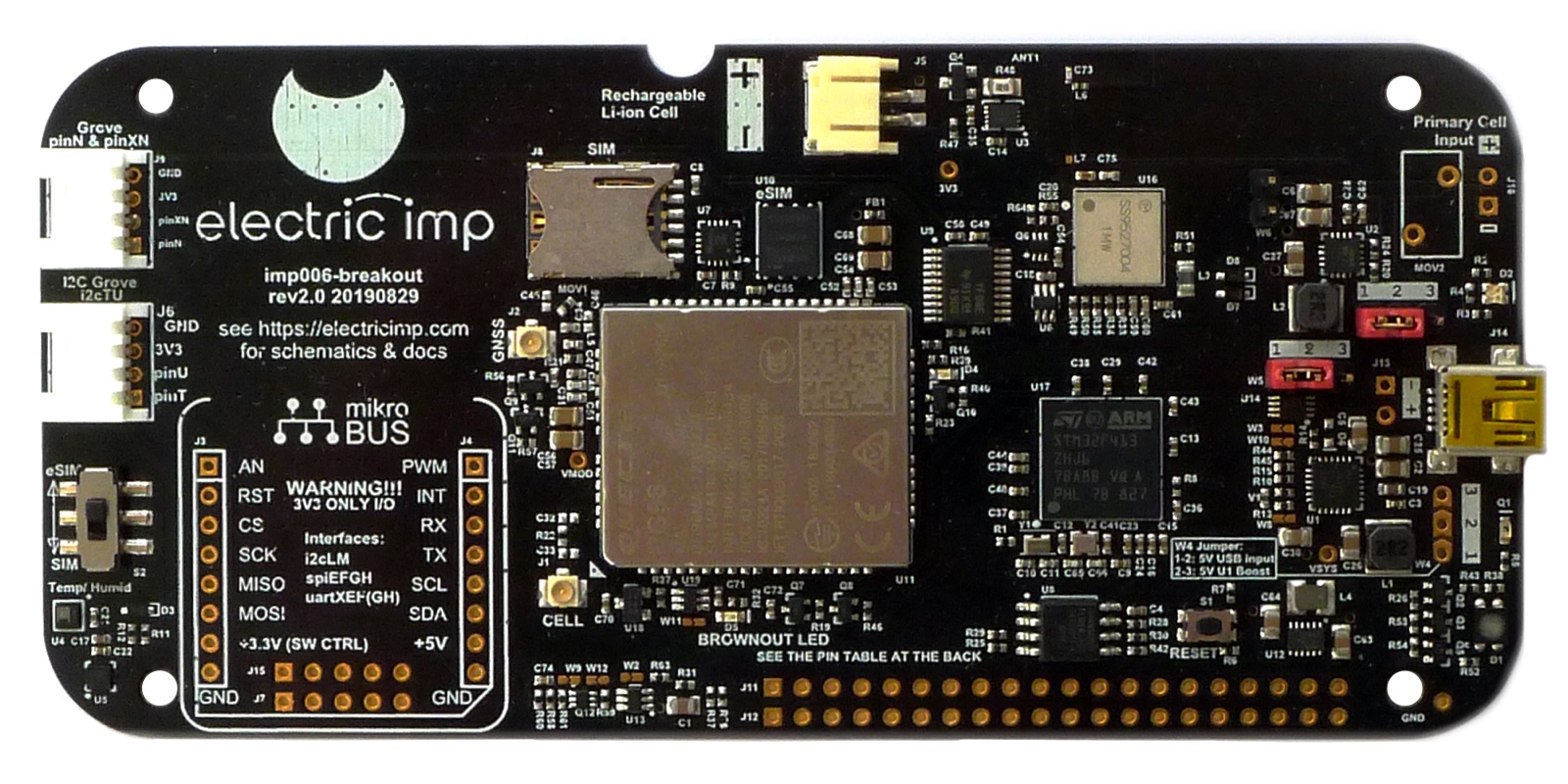
Image Credits: Electric Imp

It’s worth noting that Electric Imp isn’t meant to be a platform for high-bandwidth use cases, like streaming video, but more for connecting sensors that produce a more manageable amount of data to the cloud. One of Electric Imp’s customers is Pitney Bowes, which makes postage meters, but you can also think smart grids, river-level monitoring etc. And while Electric Imp’s technology can also be found in smart devices for consumers, Fiennes believes that the real value of the platform isn’t necessary in high-volume products.

“I think it’s kind of like, a lot of those [consumer use cases are] are just like, ‘you can connect it, yes. But why?’ But there’s really a lot of things like, river-level monitoring and a whole load of things which are very hard to deal with without IoT. And they’re not necessarily hugely high volume, which is why a repeatable platform that can be sold to many customers without change is really important because you get to target the niches where there’s a lot of value.”

With this acquisition, Twilio is not just buying a product but also a lot of expertise in building an IoT infrastructure. While the company doesn’t disclose the size of its IoT team, Twilio’s Evan Cummack, the GM of Twilio IT, and Chetan Chaudhary, the VP of Sales for IoT, who together founded the IoT business unit, tell me that a lot of early Twilio employees now work on the IoT side, including Twilio’s very first architect and the company’s first sales rep.

Cummack and Chaudhary told me that after a few years of working at Twilio, the realized there was a lot of untapped potential in IoT for the company.

In the early days of Twilio, both worked on building out Twilio’s strategy for selling to enterprise companies — and to some degree, they are now aiming to use a similar playbook to build out Twilio’s IoT business, though the idea is actually quite a bit older and pre-dates Twilio’s 2016 IPO.

“What I realized was that it was the combination of a really strong go to market with the technical prowess that allowed us to get to the early big wins [for Twilio],” Chaudhary said. “And we had this idea around doing the same thing for cellular connectivity for IoT devices because we were already buying wholesale voice and messaging. And I got to work with some of our carrier relations folks and helping them close some of the connectivity deals. And I was like: ‘Why can’t we sell SIM cards?’ ”

Twilio launched its IoT business in partnership with T-Mobile in 2016. The first product was its programmable wireless service. It then acquired Berlin’s Core Network Dynamics in 2018 to solve another set of problems that IoT developers were facing around connecting their IoT devices.

“What we saw once we started playing in connectivity was that there’s still just a tremendous amount of plumbing that’s not solved for,” Cummack noted. “So you have a tremendous amount of customers having to build their own security stacks, over-the-air update capabilities, secure boot, manufacturing tools, testing, manufacturer, even just things like getting connected to wireless networks, cellular networks and Wi-Fi networks was way too high. And all of this stuff is what I would consider to be platform stuff. It’s all kind of plumbing.”

In its early days Twilio though of the IoT group as a bit of a startup within the company. But that seems to be changing. “Twilio IoT evolved from an internal experiment into a fully fledged business unit with a thriving connectivity business,” Lawson told me. “It has the potential to evolve again into a market-leading platform for the emerging IoT developer community.”

Twilio has already integrated a lot of Electric Imp’s services into its go-to-market strategy, Chaudhary noted. “They’ve already brought […] a lot of credibility in a couple of deals because of their DNA and because of the things that they were able to solve, especially around the embedded design and hardware design, we were able to see some really good synergies early on  and now we’ll start to see some net new customers, I think, come from it.”

Fiennes will continue at Twilio as a Senior Product Architect, working on IoT and Electric Imp is actually releasing its newest product today: the imp006 breakout board for prototyping IoT products, which — no surprise there — comes with Twilio’s Super SIM for global connectivity already pre-installed.