Author: azeeadmin

07 Jul 2020

MonkeyLearn raises $2.2M to build out its no-code AI text analysis service

A few years back, startups focusing on artificial intelligence had a whiff of bullshit about them; venture capitalists became inured to young tech companies claiming that their new AI-powered product was going to change the world as hype exceeded product reality.

But in the time since, AI-powered startups have matured into real companies, with investors stepping up to fund their growth. In niches, from medical imaging, of course, to speech recognition, machine learning and deep learning and neural nets and everything else that one might scoop into the AI bucket has seemed to have grown neatly in recent quarters.

Indeed, AI investing has become so popular amongst VCs that this publication wound up debating the finer points of AI-focused startup revenue quality earlier this year.

But AI is not the only startup niche appearing to enjoy tailwinds lately. No-code and low-code startups have also enjoyed increasing media recognition, and, as TechCrunch has covered, notable venture capital rounds.

Sitting in the middle of the two trends, a startup called MonkeyLearn wants to bring low-code AI to companies of all sizes. And the firm just raised $2.2 million. Let’s take a look.

No-code AI

Starting with the round, MonkeyLearn has raised $2.2 million in a round led by Uncork Capital and Bling Capital. Speaking with Raúl Garreta, a co-founder at the company and also its CEO, TechCrunch learned that MonkeyLearn started off as a more developer-focused service that provided machine learning tooling via an API. But after demand materialized from people who couldn’t code to use the company’s tech for text analysis, the company wound up heading in a slightly different direction.

Garreta gave TechCrunch a demo of the company’s service, which allows users to upload data — think rows of text in an Excel file, for example — and quickly train MonkeyLearn’s software to parse out what they are looking for. After the model is trained over the course of a few minutes, it can then be set to work on a full data set.

According to Garreta, text analysis has a lot of demand in corporate environments, from categories like support ticket sorting to sentiment analysis.

But MonkeyLearn’s product that TechCrunch saw is not the company’s final vision. Today the service focuses on data analysis. In time, Garreta wants it to do more with data visualization, providing graphing and other similar outputs to give more of a dashboard-feel to its product.

Demand

At the core of MonkeyLearn’s early market traction that helped it land its seed round is the ever-increasing need for non-developers to collect, parse, act on and share data inside of their workplace. If you’ve ever worked nearby to a startup’s marketing or customer success team, you understand this phenomenon. MonkeyLearn wants to give non-developer teams the tools they need to understand data sets without forcing them to go find the engineering team and argue for a spot on the roadmap.

“Our vision is to make AI approachable by providing a toolkit for teams to actually use AI in their daily operations,” Garreta said in a release. MonkeyLearn is theoretically well-situated in the market. Companies are increasingly data-driven at the same time as the market is strapped for employees who can make data sing.

The startup has a free tier, and a few paid tiers, along with add-ons and a one-off option. You can call that the “all of the above” pricing model, which is fine, given the youth of the company; startups are allowed to experiment.

After slower than anticipated early fundraising, MonkeyLearn told TechCrunch that it could have raised double in its seed round what it wound up accepting.

What plans does the company have for the new capital? A more aggressive go-to-market motion, and a more formal sales team, it said. As MonkeyLearn sells to to mid-market and enterprise firms, Garreta explained, a more formal sales team is needed, though he also emphasized that founders must start the selling process at a startup.

As with most seed companies that raise capital, there’s a lot to like with MonkeyLearn. Let’s see how well it executes and how fast it can get to a Series A.

07 Jul 2020

Replenysh raises a $2 million seed round to streamline recycling for buyers and sellers

Replenysh has been kicking since 2016, but up til now, the Orange County, California startup hasn’t done much press. That changes today, as the company announces that it has raised a $2 million seed round with the fairly lofty goal of transforming recycling in the U.S.

A press release outlining Replenysh’s plans offers up plenty of information about what’s wrong with recycling here in the States. Among some of the key figures are the fact that it can be up to 3x more expensive to recycle a ton of material rather than simply dropping it off in a landfill. Outside of the positive press around sustainability and the rare instance of corporate altruism, that’s a rather large fiscal penalty for doing the right thing.

For its part, the Replenysh team says it’s “building this new digital supply chain.” What that means in less buzzwordy terms is that the company is working to provide software solutions designed to benefit both those selling recycled goods and companies looking to acquire the materials. That latter bit is hotter market than you’re likely aware, as big corporations have set commitments to adopt recycled materials as part of larger pledges for sustainability.

Image Credits: Replenysh

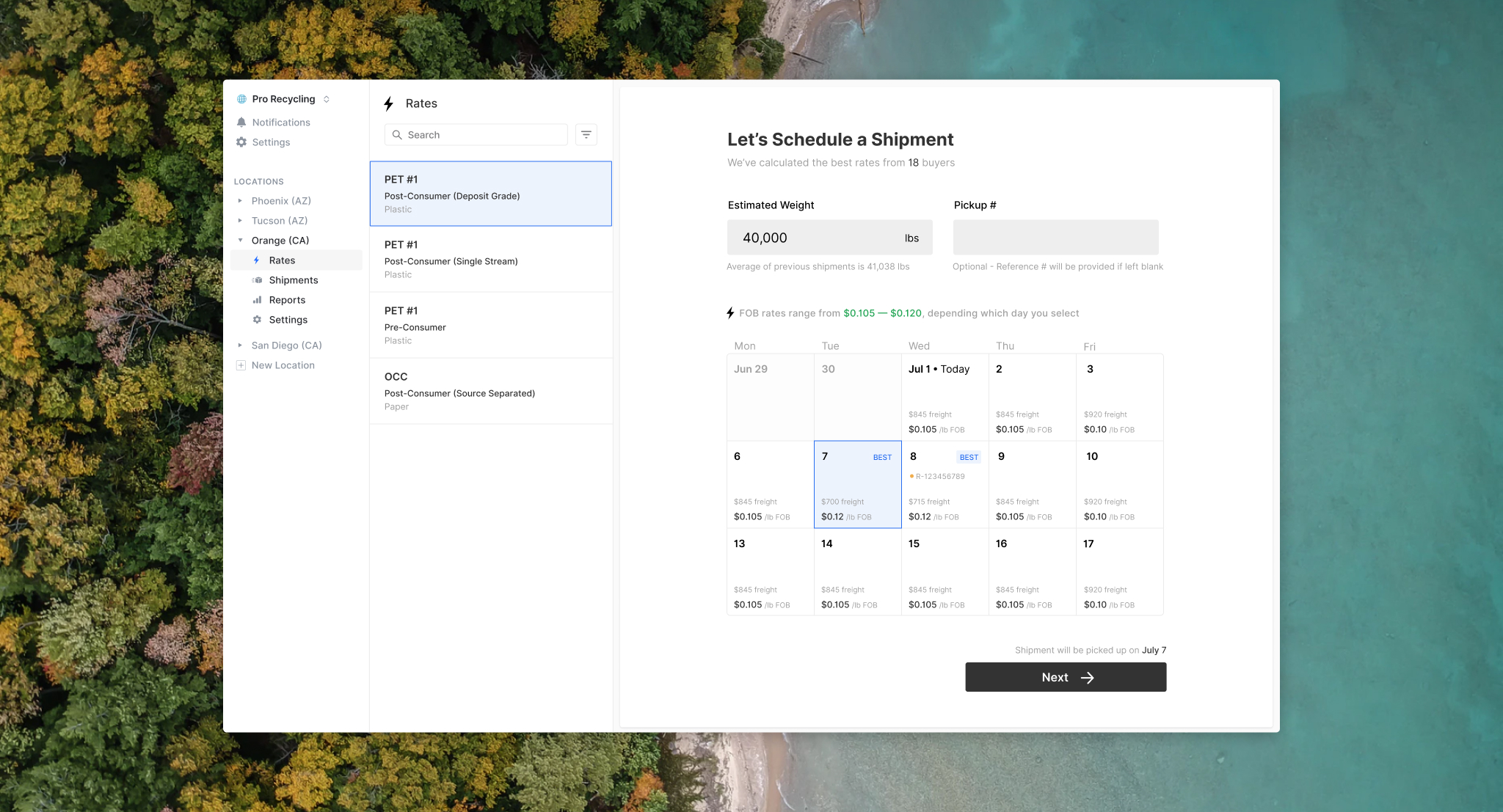
The company’s primary value comes by way of its interfacing with the owners and employees at the thousands of recycling centers based in the U.S. Replenysh has developed a software dashboard that allows the centers to find the best price for materials and schedule shipments. On the buyer side, the company also offers means by which brands can find sufficient materials and foster relationships with the aforementioned recycling centers. The company says it already has relationships with hundreds of recycling centers it has helped connect with buyers from large retailers and big brands (though it’s not yet disclosing the names of either).

“The response to our technology and services has been exciting,” founder Mark Armen told TechCrunch. “Recycling centers benefit from our rate discovery, price transparency, and workflow automation tools – and we are just getting started. We envision a world where all materials circulate through an intelligent system of continual reuse, which brands, recycling centers, and collectors can tap into and propel. The result will be a regenerative economy that restores ecosystems, relationships, and value.”

Replenysh is still a lean team, with an eight-person headcount (plus one intern). While it was founded and began working on pilots way back in 2016, the company says it really began work in earnest when it incorporated last year. The $2 million seed round is led by Kindred Ventures and Floodgate Fund, with plans to further build out the technologies and Replenysh’s network.

07 Jul 2020

Northflank announces $2.6M seed to create end-to-end DevOps workflow in cloud

Northflank, a startup from a couple of guys in their 20s, has been working on a full-stack DevOps platform in the cloud since their first year at university in 2016. Today the startup announced a $2.6 million seed investment and the launch of that platform.

The round was led by ​Kindred Ventures, ​Stride.VC​ and Amaranthine Partners with support from numerous CTO angel investors, who believe in the company’s vision.

Those CTOs like that the company is building a one-stop shop for DevOps in the cloud, says co-founder and CEO Will Stewart. “Northflank is what we call a full-stack cloud platform that allows a developer to sign up, connect their version control — GitHub, Bitbucket or GitLab — and immediately build and deploy all of their repositories via a Docker file,” he explained.

The two founders, Stewart and Frederik Brix, met in 2011 as young teens, through online multi-player gaming. Stewart was in London, while Brix grew up in Zurich. As they got older, they helped build online communities around their passion for gaming, and eventually decided to build an online DevOps platform together as they entered university because they saw first hand the issues they had running game servers in the 2015 timeframe.

Even though they were quite young at the time, they wanted to take advantage of the nascent cloud native tooling like Kubernetes and they began to tinker with it, and the idea of building their own platform began to take shape. They continued working on the idea while attending university and didn’t even meet in person until last year when they attended an accelerator together in Paris.

That led to £250,000 in angel money and bought them time to hire some additional engineers to build out the platform and get it ready for market. Today it provides a soup-to-nuts modern developer experience in a slick interface where you can schedule jobs and projects and manage and run builds.

They currently have a team of 9 people including the two founders. The pandemic did not change the way they worked since they have worked remotely from the start. Most of the team has never met in person. He says as an international, fully remote company, he can hire people from anywhere, and he’s hopeful that will lead to a more diverse workforce as they grow and develop as a company.

Stewart admits that making the transition from full time developer to managing a company has been challenging, but he’s learning as he goes. “It’s been an interesting learning process. It’s almost like diving in at the deep end. We obviously have to get at least some things right immediately like running payroll and the legal stuff,” he says.

He has leaned on accountants and lawyers to help, as well as financial services like Revolut and Transferwise. They have also set up spreadsheets to automate some activities like managing payroll.

Today marks the first day of the company with the platform going live, and the two founders have high hopes for the product they have been working on in some ways since they were kids. Now, they will try to grow a successful company based on all they learned through all of those experiences along the way.

07 Jul 2020

Koyeb is a serverless startup that ingests, processes and stores data with multiple cloud providers

Meet Koyeb, a new French startup founded by Yann Léger, Édouard Bonlieu and Bastien Chatelard who have previously worked at Scaleway for many years. Koyeb is a serverless startup that helps you manipulate data in different ways without worrying about your server infrastructure.

Competition has become incredibly fierce between cloud service providers, and Koyeb wants to take advantage of that. You can integrate Koyeb with multiple cloud service providers and let Koyeb do the heavy lifting.

For instance, you may store a ton of videos on an object storage bucket managed by DigitalOcean. Let’s say you want to re-encode those videos to optimize them for a new device. Koyeb can import data from this bucket, re-encode those videos and upload the new files to your bucket.

But Koyeb goes one step-further by letting you mix and match services and APIs. As cloud platforms become smarter, they provide services that go beyond running servers and storing data for you.

For instance, Google Cloud’s speech-to-text API is arguably better than Amazon Transcribe. Instead of having to manually set up a multi-cloud workflow, Koyeb can take video files from an AWS S3 bucket, transcribes the audio from those video files on Google Cloud and save the result on the AWS S3 bucket.

There are many use cases for Koyeb. It ranges from copying data from an S3-compatible object storage provider to another every day for redundancy to triggering data processing with API calls. Everything scales automatically and once a workflow is done, you no longer get billed for runtime.

There are already dozens of integrations with data sources (as input and output) and ready-to-use processing APIs. Everything can be configured in the web interface with multiple processing steps, using a command-line interface or the Koyeb API.

The company is just coming out of stealth and is already working on more product updates. For instance, you’ll be able to use Docker containers and custom functions in the future, which should enable a lot more workflows. But it’s a promising start.

07 Jul 2020

Instagram swaps out its ‘Activity’ tab for ‘Shop’ in new global test

Instagram today is starting a small global test of the Instagram Shop tab, first announced this May, which allows Instagram users to shop from top brands and creators via a new tab in the app’s navigation bar with just one tap. Here, users will be able to filter products by categories, as they can today via the existing Shop experience within Instagram Explore.

Though the company in May had also announced plans for a newly designed Instagram Shop with a different layout than what’s available today through Explore, those changes aren’t being tested at present. Instead, this new global test will direct users to the same “Shop” experience that U.S users been able to reach by tapping the “Shop” button in Explore.

The main difference is that the Shop icon will replace the heart icon (Activity) in Instagram’s main navigation.

Image Credits: Instagram


Thankfully, the Activity section isn’t totally gone. For those in the test, the Activity tab can either be accessed at the top right of your Feed (next to the paper airline Direct icon) or by going to your profile and clicking the heart icon from there.

In this version of Instagram Shop accessed from the main navigation bar, users can filter by brands they follow or by category, including things like Beauty, Clothing & Accessories, Home, Jewelry & Watches, and Travel, for example. In addition, not all products showcased in this version of Shop allow users to check out directly from Instagram’s universal cart. Instead, some brands have items tagged for shopping, but direct users to their own website to complete the transaction.

If the business is testing Instagram’s own Checkout feature, however, a small selling fee is involved.

An upcoming Instagram Shop experience will look a little different. Instagram had said in May it will feature collections from @shop, alongside selections from the user’s favorite brands and creators. These shopping options are laid out on the screen in a more intentional manner, with bigger images at the top of the screen, following by a scrollable row of brands, and then personalized content below in a “Suggested For You” section.

This new experience is still expected to arrive later this year, but an exact date has yet to be determined.

Instagram had already been testing today’s change with some portion of its U.S. user base. The expanded test will now introduce the change to a small number of users worldwide, including the U.S. 

Instagram says it will use the results of this test to determine how it will roll out Shop further down the road. It’s possible the company could revisit the idea of replacing Activity with Shop if it didn’t increase Shop traffic and conversions.

“This is a small global test of the Instagram Shop tab that we announced in May. We’ll use this test to assess how we decide to roll this out further,” a company spokesperson said.


07 Jul 2020

Athlane looks to connect brands and esports streamers with a fresh $3.3 million in funding

Athlane, the YC-backed company from the Summer ’19 cohort, is today ready to launch with a fresh $3.3 million in capital. Investors include Y Combinator, Jonathan Kraft (New England Patriots), Michael Gordon (President of Fenway Sports Group, which owns the Red Sox and Liverpool Football Club), Global Founders Capital, Romulus Capital, Seabed VC, and more.

The startup originally positioned itself as the ‘NCAA of esports’ but, after some time in stealth, has taken a new approach. Athlane is looking to be the connective fiber between streamers and brands, facilitating sponsorship and endorsement deals with more transparent data and analytics and a streamlined communications flow.

Athlane has products for both brands and streamers.

Brands can use the Athlane Terminal to manage their sponsorships. The Insights Hub uses proprietary data to help brands understand which streamers are followed by their target demographic, and whether or not the products will resonate with that fanbase. Insights also allow brands to see when a streamer’s viewership is growing.

From there, brands can send out sponsorship deals to streamers directly through the Athlane Terminal, and then track the ROI on that sponsorship deal throughout the campaign.

On the streamer side, the company has built out a platform called Athlane Pro, which lets streamers manage each task from their sponsors individually. Streamers can also use Athlane Pro to counter-offer inbound sponsorship deals or negotiate terms.

Streamers can also use Athlane’s machine learning algorithm to get clearer insights on their stream performance, such as whether their YouTube viewership overlaps with their Twitch viewership, or see which videos do better based on title or thumbnail. But more importantly, the Athlane Content Hub gives streamers the opportunity to understand if their fanbase specifically aligns with this or that brand, and gives them the tools to reach out directly to that brand and solicit a sponsorship.

Athlane has also built out a Shop tool that lets streamers build out a no-code storefront for their fans, which they can link to on their Twitch, Twitter, Instagram, etc. This storefront can be a repository for all the products that streamer is endorsing, allowing fans to see products from multiple brands in a single place.

“We have a number of proprietary partnerships with data providers including companies like Twitter,” said cofounder Faisal Younus. “For example, we have a partnership with the leading manufacturer of apparel in eSports, which ties back into our system so we can look at how merchandise is moving.”

That data, when paired with the data provided when a streamer signs in and integrates with the platform, becomes very precise, according to the company.

The startup charges brands using a tiered SaaS model, and streamers can do their first sponsorship for free on the platform. After the first sponsorship, streamers are charged a fee between $10 and $20 per deal. Athlane has also started working with agencies that represent brands and charges a discovery fee for talent those agencies find on the platform.

“COVID-19 has brought on very rapid growth on the viewership side, and because of that we’ve seen an intense interest from a number of brands while conventional entertainment is shut down,” said Younus. “A lot of media spend is going to go unspent, but there is also a higher risk appetite for spending a little bit in esports, and our challenge is making sure this industry growth is sustained.”

He added that helping brands understand the true ROI of that spend will be key.

07 Jul 2020

Magic Leap has a new chief executive and it’s former Microsoft exec Peggy Johnson

Peggy Johnson, the former executive vice president of business development at Microsoft, has been named as the new chief executive of Magic Leap, the company said in a statement.

Johnson, who will begin her new role on August 1, 2020, comes to Magic Leap after a thirty year career in the technology industry.

It’s been a tumultuous 2020 for Magic Leap. Struggling to survive amid a cash crunch and facing bankruptcy, the company laid off most of its staff in April and was casting around for a white knight investor to come in and keep the company afloat. While the Paradise, Fla.-based company found the $375 million in funding it needed, according to The New York Times, that investment came at the price of Rony Abovitz’s position as chief executive.

Abovitz, whose vision for the future of spatial computing managed to rake in over a billion dollars in funding, was a consummate hype man whose products failed to deliver on the promise they’d held.

In Johnson Magic Leap has a proven executive who joined Microsoft in 2014 from Qualcomm as an executive hire made by chief executive Satya Nadella. There, she ran business development and had a hand in a number of the company’s major acquisitions and partnerships including the $26.2 billion blockbuster acquisition of LinkedIn . The 58 year-old Johnson also launched Microsoft’s venture capital fund (known as M12).

At Magic Leap, Johnson will take the reins of a company whose direction has shifted to focus more on businesses than on consumers — a strategy that mirrors approaches taken both by Microsoft’s Hololens extended reality product and by early wearable tech progenitor Google Glass.

It’s also a company that managed to burn through nearly $3.5 billion under Abovitz’s stewardship and lose a valuation of

“Since its founding in 2011, Magic Leap has pioneered the field of spatial computing, and I have long admired the relentless efforts and accomplishments of this exceptional team. Magic Leap’s technological foundation is undeniable, and there is no question that has the potential to shape the future of XR and computing,” said Ms. Johnson.

Before joining Microsoft, Ms. Johnson spent 24 years at Qualcomm, where she held various leadership positions, and served as a member of Qualcomm’s Executive Committee.

“As a company that has been a leader in transforming what will become the next era of computing, we have been fortunate to have a number of extremely qualified candidates express interest in the position of CEO. However, as soon as Peggy raised her hand there was no question in my mind, or the Board’s, that she was absolutely the best person to lead this company into the future,” said Abovitz in a statement. “As Magic Leap drives towards commercializing spatial computing for enterprise, I can’t think of a better and more capable leader than Peggy Johnson to carry our mission forward.”


07 Jul 2020

Uber grocery delivery launches in Latin America and Canada, US to follow later this month

A day after acquiring Postmates for $2.65 billion, Uber has officially launched grocery delivery in select Latin American and Canadian cities. The initiative is the product of the also recently announced acquisition of Cornershop (still pending regulatory approval), back in late-2019. The Santiago, Chile-based startup brought grocery delivery to the Latin American market, before moving North to Toronto.

Today’s launch covers 19 cities in  Brazil, Canada, Chile, Colombia and Peru, and is set to expand to the U.S. market at some point later this month — specifically to Miami and Dallas. Members of Eats Pass and Uber Eats in those two cities will also get free grocery deliveries on orders topping $30.

Grocery delivery has become an important lifeline for many, as COVID-19 has made shopping or simply leaving the house a calculated risk. The company says demand for grocery delivery has increased 197% since March.

“Over the last six months, it’s become increasingly clear that grocery delivery is not only popular, but often a necessity,” Uber writes. “We expect to see this trend continue as people across the world look for new ways to save time and stay safe.”

Likely the surge in popularity will wane a bit, as coronavirus-related restrictions are eased, but many customers may never look back after discovering the ease of delivery. The new offering operates similarly to Uber’s other services. You do your ordering from the app and can track the driver’s progress accordingly. There’s also a no-contact option, which is all the rage in the era of COVID-19.

Following the limited launch this month, Uber will be bringing the service to additional cities around the world in “the coming months.”

07 Jul 2020

Uber grocery delivery launches in Latin America and Canada, US to follow later this month

A day after acquiring Postmates for $2.65 billion, Uber has officially launched grocery delivery in select Latin American and Canadian cities. The initiative is the product of the also recently announced acquisition of Cornershop (still pending regulatory approval), back in late-2019. The Santiago, Chile-based startup brought grocery delivery to the Latin American market, before moving North to Toronto.

Today’s launch covers 19 cities in  Brazil, Canada, Chile, Colombia and Peru, and is set to expand to the U.S. market at some point later this month — specifically to Miami and Dallas. Members of Eats Pass and Uber Eats in those two cities will also get free grocery deliveries on orders topping $30.

Grocery delivery has become an important lifeline for many, as COVID-19 has made shopping or simply leaving the house a calculated risk. The company says demand for grocery delivery has increased 197% since March.

“Over the last six months, it’s become increasingly clear that grocery delivery is not only popular, but often a necessity,” Uber writes. “We expect to see this trend continue as people across the world look for new ways to save time and stay safe.”

Likely the surge in popularity will wane a bit, as coronavirus-related restrictions are eased, but many customers may never look back after discovering the ease of delivery. The new offering operates similarly to Uber’s other services. You do your ordering from the app and can track the driver’s progress accordingly. There’s also a no-contact option, which is all the rage in the era of COVID-19.

Following the limited launch this month, Uber will be bringing the service to additional cities around the world in “the coming months.”

07 Jul 2020

Alphabet’s Loon launches its balloon-powered Kenyan internet service

Alphabet’s Loon has officially begun operating its commercial internet service in Kenya . This is the first large-scale commercial offering that makes use of Loon’s high-altitude balloons, which essentially work as cell service towers that drift on currents in the Earth’s upper atmosphere. Loon’s Kenyan service is offered in partnership with local telecom provider Telkom Kenya, and provides cellular service through their network to an area covering roughly 50,000 square kilometres (31,000 square miles) that normally hasn’t had reliable service due to the difficulty of setting up ground infrastructure in the mountainous terrain.

Loon has been working towards deploying its first commercial service deployment in Kenya since it announced the signed deal in 2019, but the company says that the mission has taken on even greater significance and importance since the onset of COVID-19, which has meant that reliable connectivity, especially in light of the restrictions upon travel that the epidemic has placed, making the ability to remotely contact doctors, family members and others all the more important.

Some of the technical details of how Loon’s stratospheric balloons will offer this continuous service, and what kind of network quality people can expect include that the fleet includes around 35 balloons acting together which are moving constantly to maintain the target area coverage. Average speeds look to be around 18.9Mbps down, and 4.74 Mbps up, with 19 second latency, and real-world testing has shown that this has served well for use across voice and video calls, as well as YouTube streaming, WhatsApp use and more, according to Loon.

The path followed by Alphabet’s balloons as they provide service to the target area in Kenya.

The company actually began testing its service earlier this year, with many customers connecting to the network without even realizing it during those tests, and Loon says it has served over 35,000 customers and provided the services listed during those tests.

Prior to today’s commercial service launch, Loon has also employed its balloons to provide emergency service to areas affected by disaster, including Puerto Rico in the aftermath of Hurricane Maria in 2017. It’s now working with a number of commercial telecom partners to deploy non-emergency service in a number of underserved regions globally.