Author: azeeadmin

01 Jul 2020

TuSimple kicks off plan for a nationwide self-driving truck network with partners UPS, Xpress and McLane

Self-driving trucks startup TuSimple laid out a plan Wednesday to create a mapped network of shipping routes and terminals designed for autonomous trucking operations that will extend across the United States by 2024. UPS, which owns a minority stake in TuSimple, carrier U.S. Xpress, Penske Truck Leasing and Berkshire Hathaway’s grocery and food service supply chain company McLane Inc. are the inaugural partners in this so-called autonomous freight network (AFN).

TuSimple’s AFN involves four pieces: its self-driving trucks, digital mapped routes, freight terminals and a system that will let customers monitor autonomous trucking operations and track their shipments in real-time. For now, TuSimple will operate the trucks and carry goods for its customers, which now number 22.  TuSimple wants to eventually be able to sell its autonomous trucks so customers can choose to operate their own fleets.

The plan was made public just days after TechCrunch learned that TuSimple had hired investment bank Morgan Stanley to help it raise $250 million. Morgan Stanley recently sent potential investors an informational packet, viewed by TechCrunch, that provides a snapshot of the company and an overview of its business model, as well as a pitch on why the company is poised to succeed — all standard fare for companies seeking investors. TuSimple, which has raised $298 million to date, has also shared its plans to build its autonomous freight network with potential investors.

“Our ultimate goal is to have a nationwide transportation network consisting of mapped routes connecting hundreds of terminals to enable efficient, low-cost long-haul autonomous freight operations,” TuSimple President Cheng Lu said in a statement. “By launching the AFN with our strategic partners, we will be able to quickly scale operations and expand autonomous shipping lanes to provide users access to autonomous capacity anywhere and 24/7 on-demand.”
TuSimple already carries freight in its autonomous trucks (always with human safety operators on board) along seven different routes between Phoenix, Tucson, El Paso and Dallas. TuSimple said it will expand its service area with existing customers UPS and McLane. U.S. Xpress is a new partner. Penske will help TuSimple scale its fleet operations nationwide and provide preventative maintenance for the self-driving trucks, the company said. 

TuSimple said the network will be rolled out in three phases, starting with a focus on a service area in the Southwest where it already operates. Phase 1, which will launch in 2020 and into 2021, will cover service between cities Phoenix, Tucson, El Paso, Dallas, Houston and San Antonio. TuSimple plans to open this fall a new shipping terminal in Dallas. TuSimple said these terminals are designed to be shared by mid-sized customers. TuSimple will carry freight directly to a company’s distribution center if it is a high-volume customer.

The second phase will begin in 2022 and expand service from Los Angeles to Jacksonville and connect the east coast with the west, the company said.

The final phase will expand across the lower 48 states, beginning in 2023. The company said it will replicate the strategy in Europe and Asia after the AFN rolls out nationwide.

01 Jul 2020

State-backed COVID-19 disinfo spreads faster and farther than local news outlets in 4 languages

Questionable stories on COVID-19 from state-backed outlets in Russia, China, Turkey, and Iran are being shared more widely than reporting by major news organizations around the world, according to Oxford analysts. French German, Spanish and English news sites see far less social engagement than these foreign-originated ones in their languages.

The study is part of ongoing monitoring of COVID-19 disinformation campaigns by the Computational Propaganda Project. The group found that major outlets like Le Monde, Der Spiegel, and El Pais are being outshared four or five to one in some metrics by content from Russia Today, China Radio International, and other state-backed organizations.

Earlier reports focused on English-language sharing of this type of media, which can be generally described as act-adjacent with a strong emphasis on certain narratives. The repeated finding was that although mainstream news outlets have an overall stronger presence, state-backed and junk news is way ahead in engagement per post or article. In the latest report it is shown that on average, mainstream articles collect about 25 engagements per post, while state-backed items get 125. When multiplied by millions of users and followers, that becomes an enormous discrepancy.

There is more nuance to the data than that, of course, but it gives a general idea of what’s happening: disinformation is being spread widely, whether by bots or organic reach, while ordinary news sources only reach a similar amount of people through more output and wider initial reach. It wasn’t, however, clear whether this was the case outside English-language media.

It certainly seems to be, according to data collected over three weeks from a variety of news sources. Mainstream media had a larger overall reach but state-backed media often produced far higher engagement per article. This is perhaps explained by the fact that the state-backed organizations tended to pursue and push controversies and divisive narratives. As the study puts it:

  • Russian outlets working in French and German consistently emphasized weak democratic institutions and civil disorder in Europe, but offered different kinds of conspiracy theories about the pandemic;
  • Chinese and Turkish outlets working in Spanish promoted their own countries’ global leadership in combating the pandemic, while Russian and Iranian outlets generated polarizing content targeted at Latin America and Spanish-speaking social media users in the United States.

That sort of clickbait spreads like wildfire on social media, of course, and few of those who thoughtlessly hit that share button will have the inclination to check whether the source is a government-backed news agency plainly attempting to sow discord.

On the other hand, it seems as if some consider turnabout fair play. For example: a Chinese state-backed news countering the flourishing U.S. conspiracy theory that the virus is a Chinese bioweapon with a counter-theory that it is a U.S. bioweapon released in and blamed on China.

“Many of these state-backed outlets blend reputable, fact-based reporting about the coronavirus with misleading or false information, which can lead to greater uncertainty among public audiences trying to make sense of the Covid-19 pandemic,” said Oxford’s Katarian Rebello in a news release.

The countries and state-backed outlets mentioned also have a major presence in Arabic language markets and the researchers are working on a follow-up study inclusive of those.

01 Jul 2020

Venmo begins piloting ‘Business Profiles’ for small sellers

Venmo is going after small businesses. The PayPal-owned mobile payments app maker announced today it’s piloting a new feature called Business Profiles that offers small sellers and other sole proprietors a more professional profile page on its platform, allowing sellers to share key business details like their address, phone number, email website, and more. By adopting a Business Profile, sellers will be able to raise awareness about their business through Venmo’s social feed and search, as well as keep their personal transactions separate from those for their business, for accounting purposes.

The profiles give smaller sellers a way to do business without having to necessarily establish a larger web presence, like a Facebook Page or Google Business listing, for example.

Instead, Venmo’s Business Profiles may be better suited to sellers such as local artists, crafters, or farmer’s market booth holders, or those who casually use Venmo to support their side hustle income, like that from mowing lawns or doing neighborhood home repair jobs.

As Venmo users pay these small sellers, the payment is published to the Venmo social feed where friends or even the public can view the transaction, depending on the user’s privacy settings. Interested friends and neighbors could then click on the Business Profile to learn more about the seller, as these new profile pages also offers a space to write a short introduction to business.

They’ll also be able to see how many customers the seller has and if any of their Venmo friends have ever transacted with the seller. Sellers can also email, print out, text or AirDrop their Venmo QR code for their profile to make it easier for customers to find their business on the app.

In addition, a new Venmo Search experience would allow users to switch between a “People” and “Business” tab when looking for a particular Venmo username.

Businesses with a profile page will be able to more easily track their transactions without having to create a separate account. Instead, users will be able to switch between their personal account and business profile from the same login.

Venmo says the new feature will also offer transactional insights and information, including number of customers and a customer list.

The system would formalize what’s already a top use case for Venmo’s platform. It would also offer Venmo a way to expand its revenue opportunities. Though the service is free during the pilot, Venmo indicates that may not always be the case.

In an online FAQ about the new feature, Venmo notes that in the future, business owners would be changed a per-transaction fee of 1.9% + $0.10 on every payment made to their profile. This is still a lower fee than Square charges or even Venmo parent PayPal.

The new feature, however, isn’t just about offering a new way for sellers to transact. Because Venmo is also a social platform, sellers can tap into the network effects its provides — similar to Messenger or WhatsApp, where businesses often now have their own profiles.

The Business Profiles feature is starting to pilot today with a limited number of users on iOS. It will roll out to Android in he week ahead and in the coming months will become more broadly available.

01 Jul 2020

Dish closes Boost Mobile purchase, following T-Mobile/Sprint merger

T-Mobile today announced that it has closed a deal that divests Sprint’s pre-paid businesses, including Boost and Virgin Mobile. The news finds Dish entering the wireless carrier game in earnest, courtesy of the $1.4 billion deal.

The whole thing was, of course, a key part of T-Mobile’s bid to merge with Sprint. It was a relatively small concession to those worried that such a deal would decrease competitiveness in the market, as the number of major U.S. carriers shrunk from four down to three. The $26 billion T-Mobile/Sprint deal was finally completed April of this year, and has already resulted in hundreds of lost jobs, as reported on last month by TechCrunch.

The deal gives Dish a nice head start in the pre-paid phone game, with north of nine million customers and access to T-Mobile’s wireless network for the next seven years. It also finds current Dish’s COO John Swieringa stepping in to lead the new subsidiary. Oh, and there’s a new Boost logo, too, seen below,

Dish

See? It’s basically the old Boost Mobile logo, but with the little Dish wireless symbols in the middle, to really show you who’s boss. Dish used the opportunity to announce a new plan for Boost users with 15GB of data for $45, and has already begun switching consumers with compatible devices over to the new T-Mobile-backed network.

01 Jul 2020

Student-led accelerator Envision is shaking up which startups get funded

Meet Envision, a new startup accelerator. The group, built and run by a collection of students and recent graduates, just closed the application process for its first cohort of startups.

Its goal isn’t merely to find some companies and give them a boost, however. According to Annabel Strauss and Eliana Berger, two co-founders of Envision, it’s to shake up the diversity stats that we’ve all come to know.

“We started Envision because we believe in a future where womxn, Black, and Latinx founders receive more than 3% and 1% of venture funding, respectively,” they said in an email. “As a team of students, we wanted to take matters into our own hands to help founders succeed — it’s our mission to support entrepreneurs early in their journeys, and amplify voices that are often underestimated.”

According to its own data, Envision attracted 190 applications, far above its initial, stretch-goal of 100. From its nearly 200 submissions, the group intends to select 15 entrants. According to Strauss and Berger, their initial goal was to winnow it to just 10. But, the pair told TechCrunch in an interview, they doubled the starting cohort size based on the strength of applications.

Envision will provide an eight-week curriculum and around $10,000 in equity-free capital to companies taking part (the group is still closing on part of the capital it needs, but appears to be making quick progress based on numbers shared with TechCrunch).

Each of the eight weeks that Envision lasts will feature a theme, 1:1 mentorship, office hours with startup veterans and, at the end, a blitz of investor-focused mentorship, and an invite-only demo day. The core of the Envision accelerator rotates around the mentors and other helpers it has accreted since coming into existence in early June.

Envision, run by 11 college students and recent graduates, quickly picked up enough startup veterans to run its program (names like Ryan Hoover and Alexia Tsotsis), and seemingly ample corporate support. In an email this morning, Envision told TechCrunch that Soma Capital, Underscore VC, Breyer Capital, Grasshopper Bank and Lerer Hippeau have joined as sponsors. Indeed, looking at Envision’s partner page reads a bit like a who’s who of Silicon Valley and startup names that you know.

Talking to Envision I was slightly surprised how many students are involved in venture capital today. The Envision team is a good example of the trend. Strauss is involved with Rough Draft Ventures, for example, which is “powered” by General Catalyst. Quinn Litherland from the Envision team is also part of the Rough Draft crew. Contrary Capital, which TechCrunch covered this morning and focuses on student founders, is represented by Timi Dayo-Kayode, James Rogers, Eliana Berger, and Gefen Skolnick on the team.

For Strauss, Berger and the rest of the Envision team the pressure is now on to select intelligently from their 190 applications, and provide maximum boost to their first cohort. If the program goes well, and the demo day it has planned in two months proves useful to both startups and investors alike, I don’t see why Envision wouldn’t stage another class down the road. Though of course, it might want to follow in the footsteps of Y Combinator, TechStars and 500 Startups at that point and take an equity stake in the companies it works with.

Envision says in large letters at the top of its website that it is “helping diverse founders build their companies.” If the group succeeds in meeting that mark, it will be an implicit critique of the old-fashioned venture capital world that has historically not invested in diverse founders.

If a dozen college students and recent grads can spin up an accelerator in a few weeks, get nearly 200 applications, and select a diverse cohort to support, then what’s everyone else’s excuse.

01 Jul 2020

AR 1.0 is dead: Here’s what it got wrong

The first wave of AR startups offering smart glasses is now over, with a few exceptions.

Google acquired North this week for an undisclosed sum. The Canadian company had raised nearly $200 million, but the release of its Focals 2.0 smart glasses has been cancelled, a bittersweet end for its soft landing.

Many AR startups before North made huge promises and raised huge amounts of capital before flaring out in a similarly dramatic fashion.

The technology was almost there in a lot of cases, but the real issue was that the stakes to beat the major players to market were so high that many entrants pushed out boring, general consumer products. In a race to be everything for everybody, the industry relied on nascent developer platforms to do the dirty work of building their early use cases, which contributed heavily to nonexistent user adoption.

A key error of this batch was thinking that an AR glasses company was hardware-first, when the reality is that the missing value is almost entirely centered on missing first-party software experiences. To succeed, the next generation of consumer AR glasses will have to nail this.

Image Credits: ODG

App ecosystems alone don’t create product-market fit

01 Jul 2020

AR 1.0 is dead: Here’s what it got wrong

The first wave of AR startups offering smart glasses is now over, with a few exceptions.

Google acquired North this week for an undisclosed sum. The Canadian company had raised nearly $200 million, but the release of its Focals 2.0 smart glasses has been cancelled, a bittersweet end for its soft landing.

Many AR startups before North made huge promises and raised huge amounts of capital before flaring out in a similarly dramatic fashion.

The technology was almost there in a lot of cases, but the real issue was that the stakes to beat the major players to market were so high that many entrants pushed out boring, general consumer products. In a race to be everything for everybody, the industry relied on nascent developer platforms to do the dirty work of building their early use cases, which contributed heavily to nonexistent user adoption.

A key error of this batch was thinking that an AR glasses company was hardware-first, when the reality is that the missing value is almost entirely centered on missing first-party software experiences. To succeed, the next generation of consumer AR glasses will have to nail this.

Image Credits: ODG

App ecosystems alone don’t create product-market fit

01 Jul 2020

Instagram’s latest test puts all Stories on one page

Instagram Stories has grown to become one of Facebook’s best products to date. As of last year, roughly half of Instagram’s users — or 500 million people — were interacting with Stories on a daily basis. That’s nearly double the entire daily active user base of all of Snapchat, which first popularized the Stories format. Now, it appears Instagram is testing a way to expand the Stories experience, making it a more of a central focus in the Instagram app.

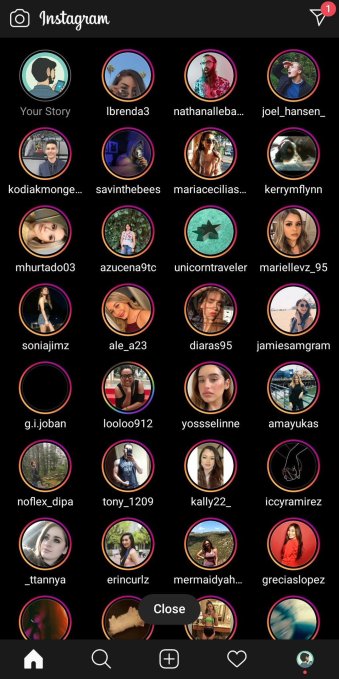
The company is newly testing a feature that will allow Instagram users to see more Stories at once, both on the home screen and in a new Stories-only experience.

In the test, users will initially see two rows of Stories instead of one at the top of the screen when they first open the Instagram app. A button will also appear beneath this expanded Stories area that lets you click to “See All Stories.”

This will then launch a new screen where you can view and scroll through all your available Stories in a full-screen experience.

The feature was first spotted by California-based social media manager Julian Gamboa late last week, who shared a screenshot of the new Stories interface to Twitter.

Instagram confirmed to TechCrunch this is a test with a small number of users for the time being. The company declined to provide further details, but said the test has been live for over a month.

It’s not surprising to see Facebook toying with ideas that would allow it to push more users to engage with Stories, given the product’s massive appeal, growth, and increasing importance to Facebook advertisers.

In Q3 2019, Facebook called Stories one of its biggest growth areas, noting that then 3 million of its 7 million total advertisers were now advertising across Facebook, Instagram and Messenger Stories combined. By Q4, the number of advertisers using Story Ads had grown to 4 million.

To cater to advertisers’ needs, Facebook last year introduced customizable templates where businesses can upload their photos and videos, then choose from different layouts, color and text options to make more engaging Stories. And to make it easier to participate in Stories, Facebook now allows advertisers to buy across Facebook, Messenger, and Instagram all at once.

When Facebook reported its Q1 2020 earnings, it noted the total number of ad impressions across its services had grown by 39%. It attributed the jump to both engagement increases across feed products and Stories combined.

However, Facebook has often said that Stories ads monetize at lower rates than News Feed — something the company believes will change in the long run as more advertisers migrate to Stories.

Given this context, it’s interesting to see Instagram testing a full-screen, scrollable Stories experience in the app. If Instagram decided to launch this product publicly, it could capture more daily users and then, in turn, more advertisers.

“We’re always testing new ways to improve the Instagram experience for our community,” a Facebook company spokesperson said, in reference to the test.

01 Jul 2020

Unpacking how Dell’s debt load and VMware stake could come together

Last week, we discussed the possibility that Dell could be exploring a sale of VMware as a way to deal with its hefty debt load, a weight that continues to linger since its $67 billion acquisition of EMC in 2016. VMware was the most valuable asset in the EMC family of companies, and it remains central to Dell’s hybrid cloud strategy today.

As CNBC pointed out last week, VMware is a far more valuable company than Dell itself, with a market cap of almost $62 billion. Dell, on the other hand, has a market cap of around $39 billion.

How is Dell, which owns 81% of VMware, worth less than the company it controls? We believe it’s related to that debt, and if we’re right, Dell could unlock lots of its own value by reducing its indebtedness. In that light, the sale, partial or otherwise, of VMware starts to look like a no-brainer from a financial perspective.

At the end of its most recent quarter, Dell had $8.4 billion in short-term debt and long-term debts totaling $48.4 billion. That’s a lot, but Dell has the ability to pay down a significant portion of that by leveraging the value locked inside its stake in VMware.

Yes, but …

Nothing is ever as simple as it seems. As Holger Mueller from Constellation Research pointed out in our article last week, VMware is the one piece of the Dell family that is really continuing to innovate. Meanwhile, Dell and EMC are stuck in hardware hell at a time when companies are moving faster than ever expected to the cloud due to the pandemic.

Dell is essentially being handicapped by a core business that involves selling computers, storage and the like to in-house data centers. While it’s also looking to modernize that approach by trying to be the hybrid link between on-premise and the cloud, the economy is also working against it. The pandemic has made the difficult prospect of large enterprise selling even more challenging without large conferences, golf outings and business lunches to grease the skids of commerce.

01 Jul 2020

Google brings its AI-powered SmartReply feature to YouTube

Google’s SmartReply, the four-year old, A.I.-based technology that helps suggest responses to messages in Gmail, Android’s Messages, Play Developer Console, and elsewhere, is now being made available to YouTube Creators. Google announced today the launch of an updated version of SmartReply built for YouTube which will allow creators more easily and quickly interact with their fans in the comments.

The feature is being rolled out to YouTube Studio, the online dashboard creators use to manage their YouTube presence, check their stats, grow their channel, and engage fans. From YouTube Studio’s comments section, creators can filter, view and respond to comments from across their channel.

For creators with a large YouTube following, responding to comments can be a time-consuming process. That’s where SmartReply aims to help.

Image Credits: Google

Instead of manually typing out all their responses, creators will be able to instead click one of the suggested replies to respond to comments their viewers post. For example, if a fan says something about wanting to see what’s coming next, the SmartReply feature may suggest a response like “Thank you!” or “More to come!”

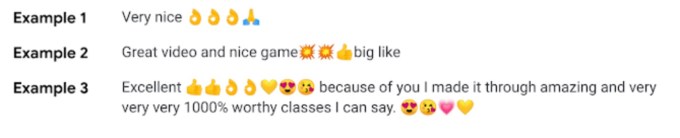
Unlike the SmartReply feature built for email, where the technology has to process words and short phrases, the version of SmartReply designed for YouTube has to also be able to handle a more diverse set of content — like emoji, ASCII art, or language switching, the company notes. YouTube commenters also often post using abbreviated words, slang, and inconsistent use of punctuation. This made it more challenging to implement the system on YouTube.

Image Credits: Google

Google detailed how it overcame these and other technical challenges in a post on its Google AI Blog, published today.

In addition, Google said it wanted a system where SmartReply only made suggestions when it’s highly likely the creator would want to reply to the comment and when the feature is able to suggest a sensible response. This required training the system to identify which comments should trigger the feature.

At launch, SmartReply is being made available for both English and Spanish comments — and it’s the first cross-lingual and character byte-based version of the technology, Google says.

Because of the approach SmartReply is now using, the company believes it will be able to make the feature available to many more languages in the future.