Author: azeeadmin

30 Jun 2020

Black Innovation Alliance aims to increase Black ownership and shrink the racial wealth gap

Over the years, a number of support organizations geared toward fostering diversity and inclusion in tech have emerged. Black Innovation Alliance, which launches today, aims to serve as a unifying force for the many organizations focused on supporting Black innovators. Meanwhile, The Alliance’s existence signals to white folks that there are other organizations focused on advancing Black people beyond the NAACP, United Negro College Fund, Color of Change and others.

“There’s so much that we owe to the organizations like the NAACP and UNCF and others,” Aniyia Williams, co-creator of BIA and founder of Black & Brown Founders told TechCrunch. “They’re wonderful, but are they going to get us to the next stage of where this movement has to go? I have people who work in these organizations that I know who also tell me the answer is no. […] It’s like white people want to grab the closest Black thing to them and say, ‘here, you fix the problem.’ But can we be just a little bit more intentional than that?”

To name a few more innovation-oriented organizations, there’s Black & Brown Founders, Founders of Color, Black Female Founders, HBCU.vc and many more. Through BIA, organizations like those mentioned will work together to create a more structured system around supporting Black entrepreneurs, tech startup founders and creative technologists. Over the next ten years, BIA hopes to have at least 500 organizations on board.

More specifically, BIA is looking at how these disparate organizations can “work together and leverage the innovation economy to get us to this place of Black prosperity — kind of being the promised land there — and that being a collective show of strength and love and trust, above all else,” Williams said.

Much of this fragmentation is due to the fact that “everybody’s starving,” Williams said. “So we’re all in survival mode. We’re all doing whatever it takes to keep our lights on and make sure that we have a bed to sleep in and food on the table for that day. And that is not always going to be aligned with what someone else is doing when you want to show up and partner with someone. But you also have to keep moving or you’re going to die.”

Many of these organizations try to do it on a shoestring budget, while some leaders at these organizations don’t pay themselves in order to help people within their community get ahead, Williams said.

“It shouldn’t have to be that sacrificial, especially when we have this money in the industry that we throw around for people to make fucking juicers and scooters,” Williams said. “We are trying to build the actual future that people want to live in — not just make another cute, shiny thing that a VC thought was cool.”

Still, BIA is an invitation to VCs and those in Silicon Valley that are often on the other side of the table, Williams said. Now, however, BIA has built its own table.

“We’ve spent the last however long clamoring to get our seat at the table,” Williams said. “And BIA is being basically like, fuck it, we’ve just built this table and you can have a seat at it, if you step correct. We would love to have you co-create this with us but you’re not going to be running the show because this is not your show to run.”

At this new table, BIA plans to build and streamline pathways for entrepreneurs to get from idea to revenue to exit, if that’s what they want, and putting that infrastructure in place, Williams said.

She added, “And not having that be something that comes from another kind of ivory tower, you know, basically white institutions that often times very much miss the mark on how to deliver exactly what this ecosystem needs and not empowering the people who are actually from the community to be serving them.”

Within the first six to 12 months, BIA hopes to raise $10 million from supporters and $1 billion over the next ten years. This money will go toward building out the organization’s operational capacity and infrastructure. In terms of infrastructure, BIA co-creator and Founders of Color CEO Kelly Burton likes to use the federal government’s creation of the highway system in the 1930s as a metaphor for what BIA is trying to do.

“Right before then, states and local governments were essentially all doing their own thing,” Burton said. “It was just a series of paved-over cow paths. And so what we have today in terms of the ecosystem that exists to support Black and brown founders is a bunch of like paved over cow paths.”

Currently, the system for supporting Black and brown founders is hyper inefficient, Burton said. In order to close the wealth gap and achieve economic prosperity in Black and brown communities, “we have to convert these paved over cow paths to something akin to a superhighway.”

That means increased connectivity across all of these disparate organizations that enable a more effective deployment of education, programming, resources and capital.

“Right now, we’re in a digital world working on an analog system,” Burton said.

It’s still early days for the organization, which just started meeting a few months ago. That means there’s still a lot of work to be done and clarity to be achieved around how BIA accomplishes its goals. But all decision-making happens through a democratic process, in which all the organizations have equal say.

“People come to these meetings because they feel isolated, they feel marginalized and for one hour every other week, they get to be in a space with other people who fundamentally get them,” Burton said. “So a lot of what we’re trying to do is build community in this space and build these connections. Our goal is to make history — we’re very explicit and matter of fact about it. Nothing like this has ever been done in this space, as far as we know, in terms of this generation. We feel that it’s an opportunity to figure out how you build and sustain collective movement around this innovation work. We find this to be a demonstration of collective Black love. We are going to reimagine what Black community looks like within this innovation space, which has been very, very less than hospitable to Black and brown folks.”

Generally speaking, Williams believes people in Silicon Valley really do want to be on the right side of doings things but she is trying “to reconcile that gulf between who they think they are and who they actually are,” she said. “That’s what we’re feeling a lot of tension about right now.”

Through BIA, folks who need their hands held can get closer to their ideals of who they think they are, Williams said. BIA has the patience to work through people on these topics of race, equity and inclusion, as long as they’re willing to do the work, she said. Other than funding, BIA is looking for people with expertise in cybersecurity to help protect digital assets, people to help create tools to track member contributions and projects, as well as lawyers and other specialists who can help the Alliance.

“So, you know, this is the olive branch,” Williams said.

30 Jun 2020

As Uber hunts for a deal, can Postmates leverage an IPO?

It’s been a busy last 24 hours or so for on-demand delivery company Postmates. According to reporting, the company is reviving its IPO plans, possibly selling to Uber, or perhaps looking to go public with the help of a special purpose acquisition vehicle, also known as a SPAC.

For Postmates, a company caught somewhere between DoorDash’s cash-fueled rise and Uber’s ability to lose hundreds of millions on its Uber Eats delivery service every quarter, multiples options are likely welcome.

Postmates first filed to go public in early 2019, but its IPO failed to materialize. The company was also reported to be pursuing a sale in 2019 after it had filed to go public. An M&A exit also failed to appear.


The Exchange is a daily look at startups and the private markets for Extra Crunch subscribers; use code EXCHANGE to get full access and take 25% off your subscription.


But 2020 is very different from 2019. With GrubHub’s bidding war behind us, Uber appears hungry for more volume, and the IPO market is surprisingly hot given the global pandemic. Postmates may have a number of viable options in front of it, instead of a continued grind as a private company.

The IPO market

So what to do?

Despite some blips, if Postmates has managed anything like revenue growth acceleration because people have been staying home and ordering more food and other goods, the company’s IPO story could prove attractive. And if so, the firm could perhaps best what a cash-burning company can afford to part with in an M&A transaction by going public.

Let’s check the tape. It’s a commonly known fact that the public markets have favored technology companies this year, especially software companies. For many venture-backed companies, this is great news. For Postmates, it’s a slightly different equation, as its margins won’t match those of software companies, nor will its revenue recur in a similar fashion.

But, there are IPOs from this year that we can point to featuring companies that also do not feature strong margins or recurring revenue that did great. So, there is an IPO path for venture-backed startups and unicorns to go public even if they are not software entities.

Vroom

30 Jun 2020

WeWork sells Flatiron School to Carrick Capital Partners

WeWork, the once $47 billion company that was on the brink of a public offering, has been divesting a great number of its assets as it looks to right the course since releasing its S-1, which exposed its expanding costs, among other things, and sent its valuation plummeting.

Today, WeWork is announcing the sale of 100 percent of the equity in Flatiron School to Carrick Capital Partners, an investment firm focused on software-enabled businesses. Other terms of the deal, such as acquisition price, were not disclosed.

WeWork acquired Flatiron School, a coding academy that offers ‘intensive and expensive’ technical courses, according to founder and CEO Adam Enbar, in 2017. New York-based Flatiron School launched in 2012 and raised more than $14 million from investors like Matrix Partners, CRV, BoxGroup and Thrive Capital before being acquired.

One of the strategic benefits of the merger with WeWork was Flatiron School’s access to hundreds of thousands of square feet of real estate space, which is one of the great challenges for startups with physical services.

While the COVID-19 pandemic has temporarily allayed the need for a physical presence, the deal does allow Flatiron School to continue its in-person courses at WeWork locations once it makes sense to return to offices.

The divesture of the educational asset will allow WeWork to better focus on its core business of co-working.

“Over the past number of months, we’ve actually been really grateful to have received a lot of inbound interest in Flatiron School,” said Enbar. “After enough conversations between myself and the WeWork leadership team and with their continued focus on their own core business and our evolution as a school — especially as we increasingly grow, especially recently online — with all of that in mind, we thought it would make sense to kind of pursue conversations about finding a new home for Flatiron School.”

Flatiron offers courses in software engineering, data science, cyber security and design, operating 11 physical campuses as well as online courses. The company grew its physical footprint from one campus in 2018.

The company has 400 employees and all will stay on through the transition to Carrick Capital Partners. Flatiron School declined to share the diversity and inclusion numbers of its workforce because the company is compiling them and plans to report them both internally and externally in the coming weeks.

Enbar also said that the company has seen 140 percent growth in graduates since 2018. Since the beginning of 2019, Flatiron School has had more than 1,100 unique employers hire from their pool of graduates, with 93 percent of graduates in 2019 accepting a job offer.

Flatiron School will operate as an independent business under Carrick Capital ownership.

Enbar said that, among the inbound interest in Flatiron School, Carrick Capital stood out because the firm understood Flatiron’s mission-driven culture of educating and empowering students to go out and build the career they desire.

“Most people, when we got on the phone, asked about financials and customer acquisition costs,” said Enbar. “All of that is important. But the first thing Carrick Capital asked about was our student outcomes. The first person they wanted to talk to when doing due diligence was our Head of Career Services. So that went a long way in terms of building a close relationship with them.”

30 Jun 2020

Facebook cofounder Saverin’s B Capital just closed its third flagship fund with $822 million

It hasn’t taken long for B Capital to amass a pretty hefty third fund.

Just five years after the venture firm was launched by Facebook co-founder Eduardo Saverin and Raj Ganguly, a veteran of private-equity firm Bain Capital, the firm is taking the wraps off a third fund that has amassed $822 million in capital commitments.

That’s almost precisely twice what the now 70-person, growth-stage outfit raised for its second, $410 million fund, which was itself closer in size to B Capital’s debut fund. (That closed with $360 million in capital commitments in 2016.)

All three funds count as an anchor investor the management consulting giant Boston Consulting Group, where Ganguly was an advisor for several years and with which the firm continues to work closely.

As Ganguly has explained the relationship to us previously, through their affiliation, B Capital gets an inside track into what BCG’s corporate clients are missing so it can invest in startups accordingly. B Capital companies also gain access to a dedicated BCG partner who opens up his or her resources and network, which can ostensibly result in big partnerships and other deals.

All three funds count the firm’s partners — including Saverin — as outsize investors. But while they were the biggest investors in their first two funds, that’s no longer the case, says Ganguly, who says outside limited partners now own slightly more of the new fund, including two sovereign wealth funds, along with a U.S. nonprofit foundation, an untold number of pension funds, and family offices. (If helpful to know, Asia makes up a substantial part of B Capital’s limited partner base, but it has backers in Europe, as well as the U.S., which is home to the majority of its investors.)

The investors are a reflection of the firm’s global approach, Ganguly said yesterday, noting that the firm has, and continues, to see promising opportunities outside of Silicon Valley. Among its biggest bets to date are Icertis, an 11-year-old, Seattle-based contract life cycle management software company, and Ninja Van, a now six-year-old, Singapore-based company that specializes in next-day deliveries for e-commerce companies.

Still, the firm, which has offices in Manahattan Beach, Calif.; San. Francisco, New York and Singapore, sees plenty of promise in the Bay Area, especially when it comes to companies whose cross-border strategies it can help develop. For example, B Capital has backed Evidation Health, an eight-year-old, San Mateo, Calif. company that provides clinical validation of health apps and that is expanding into Asia with the help of B Capital.

B Capital, which has two partners in San Francisco, also sees a growing number of interesting startups with a small presence in the Bay Area but a large focus elsewhere. Ganguly points to a CRM company that B Capital recently funded (but can’t yet name publicly). Its executives are based based primarily in Mexico and Brazil and the company isn’t selling into U.S. markets. As for why they have a business development person and a sprinkling of other employees in Silicon Valley, it mostly “helps them get a better valuation,” observes Ganguly.

In the meantime, other trends B Capital are tracking center around increasingly distributed teams, and overlooked small- and mid-sized businesses in India specifically that have proven durable over time but could be run far more efficiently given the right tools.

Toward that end, among the firm’s newest bets is Synack, a Redwood City, Ca-based crowdsourced cybersecurity testing platform that protects critical assets (which is especially helpful in a world with decentralized workplaces); and Khatabook, a Bangalore-based startup that digitizes local businesses through bookkeeping and online payments.

More broadly, B Capital invests in enterprise tech, fintech, healthcare tech, consumer enablement technology, and transportation and logistics. The firm typically invests between $10 and $60 million in companies at Series B, C and D stages, and Ganguly says that with its newest fund, it has the flexibility to write a check as small as $100,000 and to invest upwards of $100 million in a company.

30 Jun 2020

Hunters raises $15M Series A for its threat-hunting platform

Hunters, a Tel Aviv-based cybersecurity startup that helps enterprises defend themselves from intruders and analyze attacks, today announced that it has raised a $15 million Series A funding round from Microsoft’s M12 and U.S. Venture Partners. Seed investors YL Ventures and Blumberg Captial also participated in this round, as well as new investor Okta Ventures, the venture arm of identity provider Okta. With this, Hunters has now raised a total of $20.4 million.

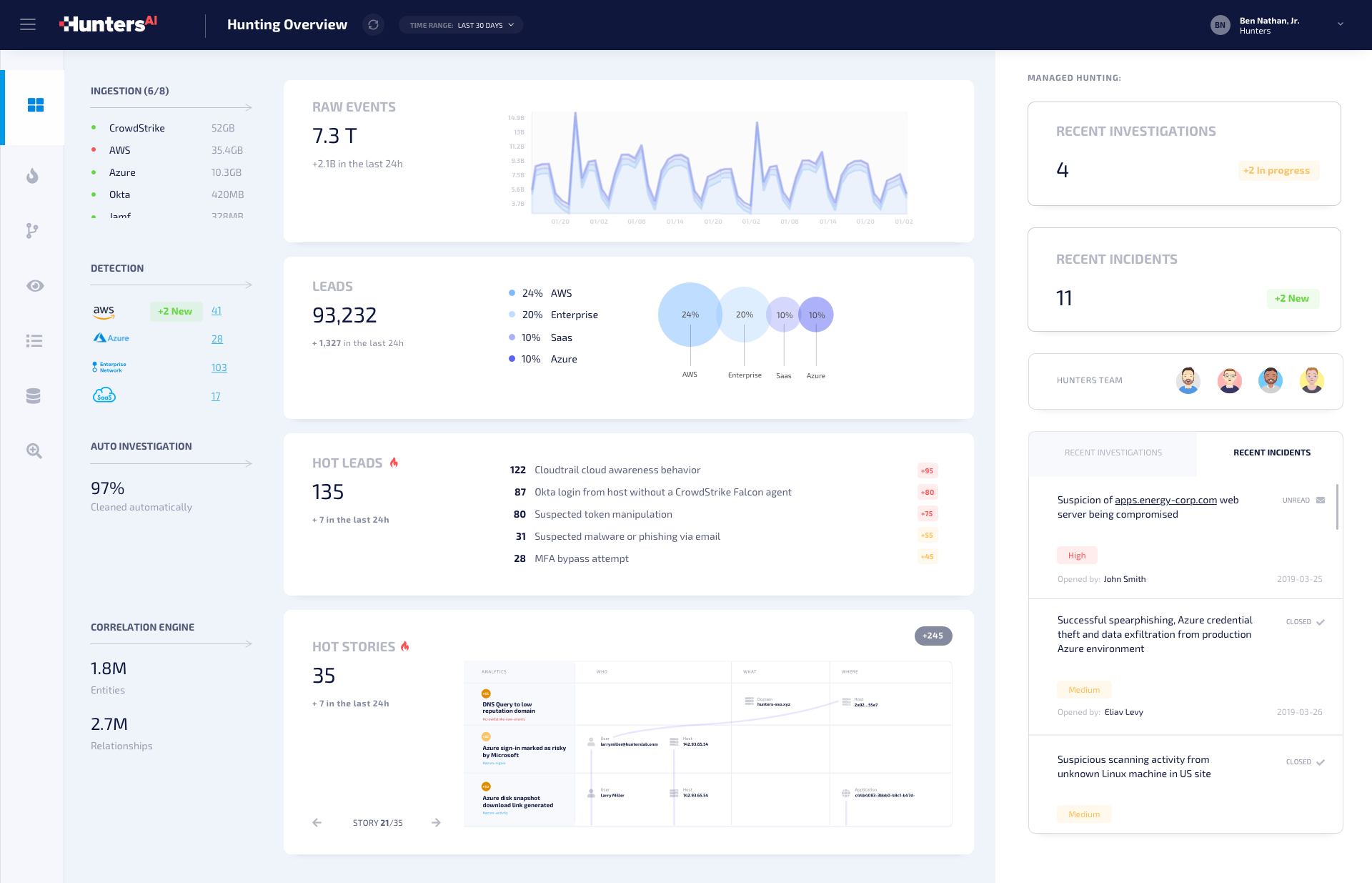
The company’s SaaS platform basically automates the threat-hunting processes, which has traditionally been a manual process. The general idea here is to take as much data from an enterprise’s various networking and security tools to detect stealth attacks.

“Hunters is basically this layer, a cognitive layer or connective tissue that you put on top of your telemetry stack,” Hunters co-founder and CEO Uri May told me. “So you have your [endpoint detection and response], your firewalls, cloud, production environment sensors — and all of those are shooting telemetry and detections all over the organization, generating huge amounts of data. And, basically, our place in the world depends on our ability to generate that delta. So without being able to find things that you can’t see with a single point solution or without really expediting response procedures and workflows by correlating things in a nontrivial way, we don’t have any excuse to exist. But we got pretty good at those — at showing that delta — and we onboarded customers — nice logos — and that was a very strong validation.”

Image Credits: Hunters

Hunters’ first customer was actually data management service Snowflake, which functioned as the company’s design partner. In addition to being a customer, Snowflake now also features Hunters in its partner marketplace, as does security service CrowdStrike. May also noted that Crowdstrike is a good example for the kind of customer Hunters is going after.

“Not necessarily Global 2000 or Fortune 500. It’s really high-end mid-market organizations, not necessarily tens of thousand employees, but billions of dollars in revenues, a lot of value at risk, born to the cloud, super mature tech stack, not necessarily a big security operation center, but definitely CISO and a team of security engineers and analysts, and they’re looking for the solution, that on-top solution that can make sense of a lot of the data and give them the confidence and also give them results in terms of cybersecurity, posture and their detection and response capabilities.”

Microsoft already has a large security development center in Israel and so it’s no surprise that Hunters appeared on the company’s radar. Hunters also spent some time proactively looking at the Microsoft ecosystem, May told me, but the company’s VCs also made some introductions. All of this culminated in a number of meetings at the Tel Aviv CyberTech conference in January and the RSA Conference in San Francisco in February, just before the coronavirus pandemic essentially shut down travel.

Hunters says it will use the new funding to build out its go-to-market capabilities in the U.S. and expand its R&D team in Israel. As for the product itself, the company will look to broaden its product integration and machine learning capabilities to help it generate better attack stories. May also noted that it plans to give its users capabilities to customize the system for their needs by allowing them to develop their own signals and detections to augment the company’s default tools. This, May argued, will allow the company to go after higher-end enterprise customers that already have threat-hunting teams but that are looking to automate more of the process. With that, it will also look to partner with other security firms to leverage its system to provide better services to their customers as well.

30 Jun 2020

Kong donates its Kuma control plane to the Cloud Native Computing Foundation

API management platform Kong today announced that it is donating its open-source Kuma control plane technology to the Cloud Native Computing Foundation (CNCF). Since Kong built Kuma on top of the Envoy service mesh — and Envoy is part of the CNCF’s stable of open-source projects — donating it to this specific foundation was likely an obvious move.

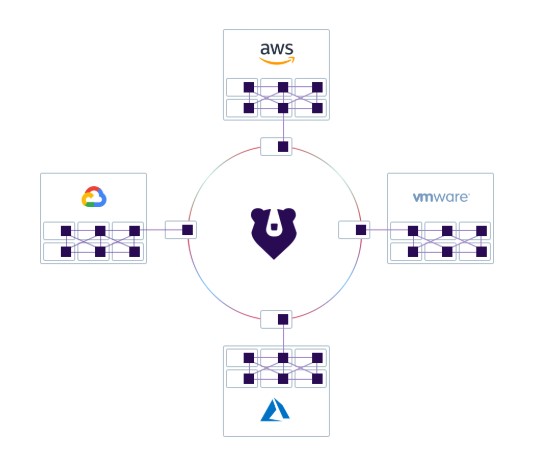
The company first open-sourced Kuma in September 2019. In addition to donating it to the CNCF, the company also today launched version 0.6 of the codebase, which introduces a new hybrid mode that enables Kuma-based service meshes to support applications that run on complex heterogeneous environments, including VMs, Kubernetes clusters and multiple data centers.

Image Credits: Kong

Kong co-founder and CTO Marco Palladino says that the goal was always to donate Kuma to the CNCF.

“The industry needs and deserves to have a cloud native, Envoy-based control plane that is open and not governed by a single commercial entity,” he writes in today’s announcement. “From a technology standpoint, it makes no sense for individual companies to create their own control plane but rather build their own unique applications on proven technologies like Envoy and Kuma. We welcome the broader community to join Kuma on Slack and on our bi-weekly community calls to contribute to the project and continue the incredible momentum we have achieved so far.”

Kuma will become a CNCF Sandbox project. The sandbox is the first stage that projects go through to become full graduated CNCF projects. Currently, the foundation is home to 31 sandbox projects, and Kong argues that Kuma is now production-ready and at the right stage where it can profit from the overall CNCF ecosystem.

“It’s truly remarkable to see the ecosystem around Envoy continue to develop, and as a vendor-neutral organization, CNCF is the ideal home for Kuma,” said Matt Klein, the creator of the Envoy proxy. “Now developers have access to the service mesh data plane they love with Envoy as well as a CNCF-hosted Envoy-based control plane with Kuma, offering a powerful combination to make it easier to create and manage cloud native applications.”

30 Jun 2020

Menten.AI’s combination of buzzword bingo brings AI and quantum computing to drug discovery

Menten AI has an impressive founding team and a pitch that combines some of the hottest trends in tech to pursue one of the biggest problems in healthcare — new drug discovery. The company is also $4 million richer with a seed investment from firms including Uncork Capital and Khosla Ventures to build out its business.

Menten AI’s pitch to investors was the combination of quantum computing and machine learning to discover new drugs that sit between small molecules and large biologics, according to the company’s co-founder Hans Melo.

A graduate of the Y Combinator accelerator, which also participated in the round, Menten AI looks to design proteins from scratch. It’s a heavier lift than some might expect, because, as Melo said in an interview, it takes a lot of work to make an actual drug.

Menten AI is working with peptides, which are strings of amino acid chains similar to proteins that have the potential to slow aging, reduce inflammation, and get rid of pathogens in the body.

“As a drug modality [peptides] are quite new,” says Melo. “Until recently it was really hard to design them computationally and people tried to focus on genetically modifying them.”

Peptides have the benefit of getting through membranes and into cells where they can combine with targets that are too large for small molecules, according to Melo.

Most drug targets are not addressable with either small molecules or biologics, according to Melo, which means there’s a huge untapped potential market for peptide therapies.

Menten AI is already working on a COVID-19 therapeutic, although the company’s young chief executive declined to disclose too many details about it. Another area of interest is in neurological disorders, where the founding team members have some expertise.

Image of peptide molecules. Image Courtesy: D-Wave

While Menten AI’s targets are interesting, the approach that the company is taking, using quantum computing to potentially drive down the cost and accelerate the time to market is equally compelling for investors.

It’s also unproven. Right now, there isn’t a quantum advantage to using the novel computing technology versus traditional computing. Something that Melo freely admits.

“We’re not claiming a quantum advantage, but we’re not claiming a quantum disadvantage,” is the way the young entrepreneur puts it. “We have come up with a different way of solving the problem that may scale better. We haven’t proven an advantage.”

Still, the company is an early indicator of the kinds of services quantum computing could offer, and it’s with that in mind that Menten AI partnered with some of the leading independent quantum computing companies, D-Wave and Rigetti Computing to work on applications of their technology.

The emphasis on quantum computing also differentiates it from larger publicly traded competitors like Schrödinger and Codexis.

So does the pedigree of its founding team, according to Uncork Capital investor, Jeff Clavier. “It’s really the unique team that they formed,” Clavier said of his decision to invest in the early stage company. “There’s Hans… the CEO who is more on the quantum side; there’s Tamas [Gorbe] on the bio side and there’s Vikram [Mulligan] who developed the research. It’s kind of a unique fantastic team that came together to work on the opportunity.”

Clavier has also acknowledged the possibility that it might not work.

Can they really produce anything interesting at the end?” he asked. “It’s still an early stage company and we may fall flat on our face or they may come up with really new ways to make new peptides.”

It’s probably not a bad idea to take a bet on Melo who worked with Mulligan, a researcher from the Flatiron Institute focused on computational biology, to produce some of the early research into the creation of new peptides using D-Wave’s quantum computing.

Novel peptide structures created using D-Wave’s quantum computers. Image Courtesy: D-Wave

While Melo and Mulligan were the initial researchers working on the technology that would become Menten AI, Gorbe was added to the founding team to get the company some exposure into the world of chemistry and enzymatic applications for its new virtual protein manufacturing technology.

The gamble paid off in the form of pilot projects (also undisclosed) that focus on the development of enzymes for agricultural applications and pharmaceuticals.

“At the end of the day what they’re doing is they’re using advanced computing to figure out what is the optimal placement of those clinical compounds in a way that is less based on those sensitive tests and more bound on those theories,” said Clavier. 

30 Jun 2020

13 Boston-focused venture capitalists talk green shoots and startup recovery

Welcome back to the second half of our two-part Boston investor survey.

Catching you up, TechCrunch reached out to a host of Boston-area venture capitalists to get their take on the current state of their market, and what they think might be coming up in the future. More VCs than we initially anticipated got back to us, so we broke the survey into two pieces so that there was enough room to include everyone.

Today, in contrast, we’re looking a little further ahead: Are they seeing green shoots? When is a recovery likely to begin? What’s making them feel hopeful in this tenuous era? Here’s who took part:


Boston VC’s vision of tomorrow

Recovery is going to be slow, but most importantly, the comeback is not going to look like one, sole aha moment for any startup or entrepreneur. After poring through dozens of responses, we distilled that Boston-focused VCs think that recovery will favor Boston-area companies to some degree, as the areas they are working on, or the problems that they are working to solve, will still matter after COVID-19.

On the slowness of recovery, NextView’s Rob Go provided TechCrunch with the most vivid prognostication, saying that “while it’s difficult to predict” when the post-COVID recovery will begin, he anticipates “a swoosh-shaped recovery is more likely” than anything V-shaped. “The recovery is likely to be painfully slow,” the VC added.

It’s perhaps unsurprising then that green shoots and fruitful deals are thinner on the ground in Boston today than its startup community probably would have hoped. Momentum through dollars or deals will lead to more sustained recovery. Flare Capital’s Michael Greeley said that it is “still too early” to see green shoots, while other VCs noted that, on a sector-by-sector basis, there are some positive signs that give hope.

Glasswing is an AI-focused fund, making the following comment from its Rudina Seseri interesting, if niche. On the question of green shoots, Seseri said that her firm has “been surprised by the number of companies that are leveraging AI to drive automation, cost savings, optimization and higher performance.” The result of that surprise has been that “over the last five months these companies have beaten their pre-COVID budgets and forecasts for growth.”

The other side of that coin is startup areas that touch on travel or food. It’s hard to find recovery there, for obvious reasons.

The Victress Capital team put the dynamic well: “We’ve also been encouraged by the increased pace in innovation that we’ve seen across sectors where innovation has been slow in the past. From edtech to telehealth to food and beverage and more, we are seeing nimble entrepreneurs pivot or change their businesses to respond to the needs of today.”

Our broadest takeaway is that VC firms have not fully written off any sectors given today’s turbulence. The future, largely according to Boston-focused VCs, is startups that are important after the world opens again and focus on the next generation of businesses. It means that investments might look a bit like a risky game of hopscotch. They’re all trying to land on the deal that accounts for the next generation of businesses.

With that, let’s get into full questions and answers.


Lily Lyman, Underscore VC

When do you expect a startup recovery to begin?

“Recovery” is hard to speak to. We’ve been evaluating different phases of behavior and how that will affect the economy and the startup ecosystem. We have been thinking in terms of (1) lockdown opening up (summer 2020); (2) period of remaining social distancing behavior, likely with intermittent periods of lockdowns (into spring 2021); and (3) new normal (spring/summer 2021). But this changes and we are constantly reassessing it. For startups, we remain believers that great companies with great leadership can not only survive but find ways to thrive in this new environment.

Are you seeing green shoots regarding revenue growth, retention or other momentum that you didn’t expect a few weeks ago?

Again, it varies by industry. We have seen a surge in demand for players in the cloud infrastructure space such as CloudZero or for remote collaboration software (an investment not yet announced).

Tell us about the most interesting, Boston-based company you’ve invested in recently.

We are really excited about Popcart and how they are positioned as the world rapidly migrates to e-commerce. The founding team is a pair of engineer leaders from Endeca. Popcart offers consumers price and availability transparency across retail platforms (Amazon, Target, Walmart, etc.). The cross-platform capabilities are particularly unique. When COVID-19 hit, the team quickly created the Supply Finder to help consumers find goods that are in short supply and ensure they are protected against price gouging.

What is a moment that has given you hope in the past 30 days? This can be professional, personal or a mix of the two.

I’m inspired by the great leadership I’ve seen our founders display. They’ve made hard decisions with imperfect information and managed a difficult time with both empathy and conviction.

I’m also appreciating the humanizing reality that working from home and operating in uncertainty brings that unites people. My hope is that pieces of this uniting and empathy will persist.

30 Jun 2020

Upsolver announces $13M Series A to ease management of cloud data lakes

There’s a lot of complexity around managing data lakes in the cloud that often requires expensive engineering expertise. Upsolver, an early stage startup, wants to simplify all of that, so that a database administrator could handle it. Today the startup announced a $13 million Series A.

Vertex Ventures US was lead investor with participation from Wing Venture Capital and Jerusalem Venture Partners. Today’s investment brings the total raised to $17 million, according to the company.

Co-founder and CEO Ori Rafael says that as companies move data to the cloud and store it in data lakes, it becomes increasingly difficult to manage. The goal of Upsolver is to abstract away a lot of those management tasks and allow users to query the data using SQL, making it a lot more accessible.

“The main criticism of data lakes over the years is they become data swamps. It’s very easy to store data there very cheaply, but making it [easy to query] and valuable is hard. For that you need a lot of engineering, which turns the lake into a swamp. So we take the data that you put into a lake and make it easier to query, and we take the biggest disadvantage of using a lake, which is the complexity of doing that process, and we make that process easy,” Rafael explained.

Investor Sik Rhee, who is general partner and co-founder at Vertex Ventures US sees a company that’s creating a cloud-native standard for data lake computing. “Upsolver succeeded in abstracting away the engineering complexity of data pipeline management so that enterprise customers can quickly solve their modern data challenges in real time and at any scale without having to build another silo of expertise within the organization,” he said in a statement.

The company currently has 22 employees spread out between San Francisco, New York and Israel. Rafael says they hope to expand to 50 employees by the end of next year including adding new engineers for their R&D center in Israel and building sales and customer success teams in the U.S.

Rafael says he and his co-founder sat down early on and wrote down the company’s core values and they see a responsibility of running a diverse company as part of that, as they search for these new hires. Certainly the pandemic has shown them that they can hire from anywhere and that can help contribute to a more diverse workforce as they grow.

He said running the company and raising money has been stressful during these times, but the company has continued to grow through all of this, adding new customers while staying relatively lean and Rafael says that the investors certainly recognized that.

“We had high revenue compared to the low number of employees with [sales] acceleration during COVID — that was our big trio,” he said.

30 Jun 2020

TikTok goes down in India, its biggest overseas market

A growing number of internet service providers in India have started to block their subscribers from accessing TikTok a day after New Delhi banned the popular short-video app and 58 other services in the world’s second largest internet market over security and privacy concerns.

Many users on Airtel, Vodafone and other service providers reported Tuesday afternoon (local time) that TikTok app on their phone was no longer accessible. Opening TikTok app, users said, showed they were no longer connected to the internet.

For many others, opening TikTok app promoted an error message that said the popular app was complying with the Indian government’s order and could no longer offer its service. Opening TikTok website in India prompts a similar message.

Earlier on Tuesday, TikTok app became unavailable for download on Apple’s App Store and Google Play Store in India. Two people familiar with the matter told TechCrunch that ByteDance, the developer of TikTok, had voluntarily pulled the app from the app stores.

The vast majority of other apps including Alibaba Group’s UC Browser and UC News as well as e-commerce service Club Factory that India blocked on Monday evening remain available for download on the marquee app stores, suggesting that Google and Apple are yet to comply with New Delhi’s direction.

TikTok, which has amassed over 200 million users in India, identifies Asia’s third-largest economy as its biggest overseas market. Nikhil Gandhi, who oversees TikTok’s operations in India, said the firm was “in the process” of complying with India’s order and was looking forward to engage with lawmakers in the nation to assuage their concerns.

This is the first time that India, the world’s second largest internet market with nearly half of its 1.3 billion population online, has ordered to ban so many foreign apps. New Delhi said nation’s Computer Emergency Response Team had received many “representations from citizens regarding security of data and breach of privacy impacting upon public order issues. […] The compilation of these data, its mining and profiling by elements hostile to national security and defence of India.”

The surprising announcement created confusion as to how the Indian government was planning to go about “blocking” these services in India. Things are becoming clearer now.

TikTok, which was blocked in India for a week last year but was accessible to users who had already installed the app on their smartphones, said last year in a court filing that it was losing more than $500,000 a day. Reuters reported on Tuesday that ByteDance had planned to invest $1 billion in India to expand the reach of TikTok, a plan that now appears derailed.

More to follow…