






Author: azeeadmin
19
Mar
2019
Twitter cracks down on API abuse, will charge B2B devs
To prevent its own Cambridge Analytica and make sure it’s getting paid for its data, Twitter will audit developers using its APIs. Starting June 19th, Twitter will require any app that calls a recent tweets from or mentions of a user more than 100,000 times per day to submit their app for review.
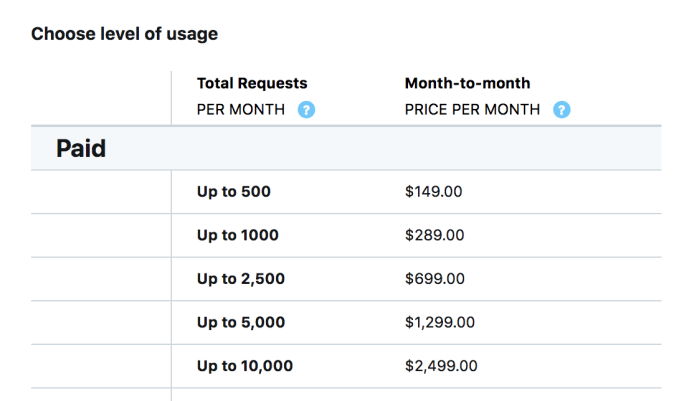
If a developer proves they have a legitimate consumer use case, like running a third-party Twitter client or doing research, they’ll be granted free access to the API at the same rate they have today. If they primarily use the data to serve business customers as a B2B tool, like for customer service or social media monitoring, they’ll have to pay to enter a commercial licensing agreement with Twitter with a custom price based on usage.
Developers found to breaking Twitter’s policies will be booted from the platform, while those that don’t submit for review will be capped at 100,000 requests per day for the user timeline and mentions APIs. Twitter says it suspended 162,000 apps in the second half of 2018, showing it’s willing to play hardball with developers that endanger its ecosystem.
The goal is “ensuring that our platform is safe and promoting the privacy and safety of our users, and providing a level playing field commercially” Twitter’s head of site integrity Yoel Roth tells me. “We’re fundamentally different than other platforms that have APIs since almost everything that happens on our service is public. That doesn’t mean we don’t have a deep responsibility to our users.”
This is the second big platform safety move Twitter has made after last year requiring all new developers who sign up to have their use cases reviewed, and get whitelisted if they publish more content to Twitter than a normal person could. But that still left all the old developers without proper oversight, which will change in June.
In the past, Twitter has thrashed developers with whiplash by suddenly changing its API policies. That led apps to break, businesses to fold, and a perception of Twitter as an unreliable or even hostile place for developers to build. This time, Twitter is giving developers a three-month heads up to minimize surprise and problems. At a time when developers are becoming increasingly suspicious of Facebook, treating them better so they keep building bonus experiences is a smart move for Twitter.
19
Mar
2019
Student, nonprofit & government discount passes to Disrupt SF 2019
Disrupt San Francisco 2019 takes place October 2-4, and we’re determined to make it financially accessible to as many people in the startup community as possible. One of the ways we do this is by offering deep discounts to students, nonprofit organizations, government employees and military personnel. If you fit any of these categories, you can apply for a discounted Innovator pass right here.
The only thing reduced about your Innovator experience is the price. Your pass provides access to all three days of Disrupt and a full slate of speakers and events. We’re talking all the programming across four stages: The Main Stage, the Extra Crunch Stage, Q&A Sessions and the Showcase Stage.
Watch the Startup Battlefield competition — heck, if you’re the founder of an early-stage startup, you should definitely apply to compete. Participate in interactive workshops, explore hundreds of early-stage startups and sponsor companies in Startup Alley. Make good use of CrunchMatch, Disrupt’s free networking platform that lets you match, schedule and meet people based on mutual business goals and interests.
Other perks include access to the Disrupt Mobile App, an agenda and communication tool that gives you the full conference agenda and ability to message attendees directly. Plus, you’ll get access to exclusive video content after the show wraps. Innovator pass holders also have access to discounted hotel rooms in San Francisco.
Here’s how this discount program works. First, you must apply. If you’re a student currently enrolled in a college or university program, your Innovator pass costs $295 (you save $1,700). Here’s the important fine print: you’ll need a valid student ID, proof of current enrollment or transcripts when you check in at Disrupt SF 2019 registration. If you don’t have a valid ID, you’ll pay the full on-site ticket price ($1,995).
If you work for a nonprofit organization, your Innovator pass costs $495 (you save $1,500). And of course, you have some fine print to read as well. You must provide your employee email address during the registration process. When you check in at the Disrupt SF registration desk, you must provide proof of your organization’s 501(c) 3 designation. If you don’t provide that info, you’ll pay the full on-site ticket price ($1,995).
Now let’s talk about full-time employees of federal, state or local government agencies, active military personnel or employees of international government agencies. Your Innovator pass costs $495 (you save $1,500). And here comes your special fine print: You must provide a valid .gov email address during the online registration process and, when you arrive at the Disrupt SF registration check-in, you must present a valid government identification card. If you don’t, you’ll pay the full on-site ticket price ($1,995).
Two final housekeeping notes: You can’t combine any of these student, nonprofit, government and military discounts with any other discount offers. And, if you’re younger than 21 years old, your access to certain venues, like the After Party, may be restricted.
Disrupt San Francisco 2019 takes place October 2-4, and the supplies of these affordable tickets are limited. Don’t waste any time — apply for your discounted Innovator pass today.
Is your company interested in sponsoring or exhibiting at Disrupt SF? Contact our sponsorship sales team by filling out this form.
19
Mar
2019
Snap is under NDA with UK Home Office discussing how to centralize age checks online
Snap is under NDA with the UK’s Home Office as part of a working group tasked with coming up with more robust age verification technology that’s able to robustly identify children online.
The detail emerged during a parliamentary committee hearing as MPs in the Department for Digital, Culture, Media and Sport (DCMS) questioned Stephen Collins, Snap’s senior director for public policy international, and Will Scougal, director of creative strategy EMEA.
A spokesman in the Home Office press office hadn’t immediately heard of any discussions with the messaging company on the topic of age verification. But we’ll update this story with any additional context on the department’s plans if more info is forthcoming.
Under questioning by the committee Snap conceded its current age verification systems are not able to prevent under 13 year olds from signing up to use its messaging platform.
The DCMS committee’s interest here is it’s running an enquiry into immersive and addictive technologies.
Snap admitted that the most popular means of signing up to its app (i.e. on mobile) is where its age verification system is weakest, with Collins saying it had no ability to drop a cookie to keep track of mobile users to try to prevent repeat attempts to get around its age gate.
But he emphasized Snap does not want underage users on its platform.
“That brings us no advantage, that brings us no commercial benefit at all,” he said. “We want to make it an enjoyable place for everybody using the platform.”
He also said Snap analyzes patterns of user behavior to try to identify underage users — investigating accounts and banning those which are “clearly” determined not to be old enough to use the service.
But he conceded there’s currently “no foolproof way” to prevent under 13s from signing up.
Discussing alternative approaches to verifying kids’ age online the Snap policy staffer agreed parental consent approaches are trivially easy for children to circumvent — such as by setting up spoof email accounts or taking a photo of a parent’s passport or credit card to use for verification.
Social media company Facebook is one such company that relies a ‘parental consent’ system to ‘verify’ the age of teen users — though, as we’ve previously reported, it’s trivially easy for kids to workaround.
“I think the most sustainable solution will be some kind of central verification system,” Collins suggested, adding that such a system is “already being discussed” by government ministers.
“The home secretary has tasked the Home Office and related agencies to look into this — we’re part of that working group,” he continued.
“We actually met just yesterday. I can’t give you the details here because I’m under an NDA,” Collins added, suggesting Snap could send the committee details in writing.
“I think it’s a serious attempt to really come to a proper conclusion — a fitting conclusion to this kind of conundrum that’s been there, actually, for a long time.”
“There needs to be a robust age verification system that we can all get behind,” he added.
The UK government is expected to publish a White Paper setting out its policy ideas for regulating social media and safety before the end of the winter.
The detail of its policy plans remain under wraps so it’s unclear whether the Home Office intends to include setting up a centralized system of online age verification for robustly identifying kids on social media platforms as part of its safety-focused regulation. But much of the debate driving the planned legislation has fixed on content risks for kids online.
Such a step would also not be the first time UK ministers have pushed the envelop around online age verification.
A controversial system of age checks for viewing adult content is due to come into force shortly in the UK under the Digital Economy Act — albeit, after a lengthy delay. (And ignoring all the hand-wringing about privacy and security risks; not to mention the fact age checks will likely be trivially easy to dodge by those who know how to use a VPN etc, or via accessing adult content on social media.)
But a centralized database of children for age verification purposes — if that is indeed the lines along which the Home Office is thinking — sounds rather closer to Chinese government Internet controls.
Given that, in recent years, the Chinese state has been pushing games companies to age verify users to enforce limits on play time for kids (also apparently in response to health concerns around video gaming addiction).
The UK has also pushed to create centralized databases of web browsers’ activity for law enforcement purposes, under the 2016 Investigatory Powers Act. (Parts of which it’s had to rethink following legal challenges, with other legal challenges ongoing.)
In recent years it has also emerged that UK spy agencies maintain bulk databases of citizens — known as ‘bulk personal datasets‘ — regardless of whether a particular individual is suspected of a crime.
So building yet another database to contain children’s ages isn’t perhaps as off piste as you might imagine for the country.
Returning to the DCMS committee’s enquiry, other questions for Snap from MPs included several critical ones related to its ‘streaks’ feature — whereby users who have been messaging each other regularly are encouraged not to stop the back and forth.
The parliamentarians raised constituent and industry concerns about the risk of peer pressure being piled on kids to keep the virtual streaks going.
Snap’s reps told the committee the feature is intended to be a “celebration” of close friendship, rather than being intentionally designed to make the platform sticky and so encourage stress.
Though they conceded users have no way to opt out of streak emoji appearing.
They also noted they have previously reduced the size of the streak emoji to make it less prominent.
But they added they would take concerns back to product teams and re-examine the feature in light of the criticism.
You can watch the full committee hearing with Snap here.
19
Mar
2019
Patreon ups its revenue cut, but grandfathers in old creators
Patreon couldn’t survive charging all creators just a 5 percent rake on the monthly subscriptions they earn from fans while building commerce tools like CRMs and merchandise to stay ahead of Twitch, YouTube, and Google. But it also didn’t want to screw all its loyal early creators.
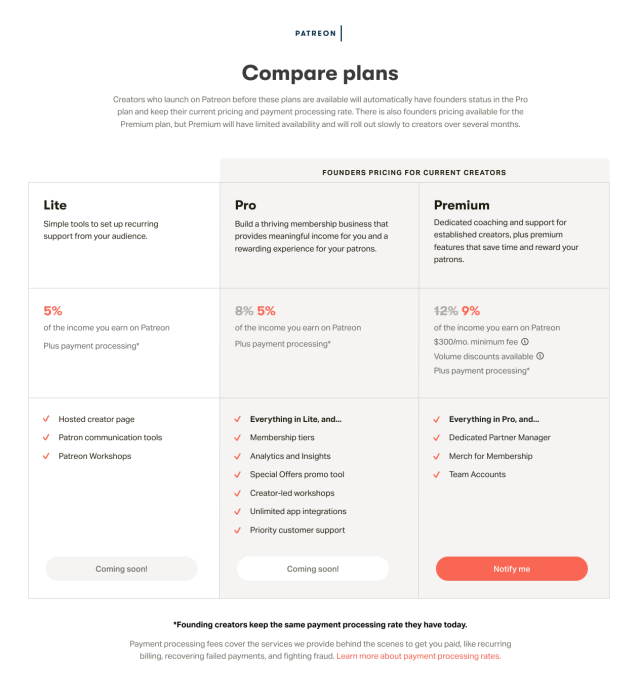
So today, Patreon is overhauling its pricing. Any creator can still get a 5 percent rate, but just for a Lite version without bonus tools or different fan tiers. All of Patreon’s extra features will now be in the Pro plan with an 8 percent rate, but with exising creators grandfathered in at 5 percent. And the new Enterprise plan for 12 percent (9 percent for existing creators) will offer full-service merchandise sales, multi-user team accounts, and premium customer support.
If you want the lower grandfathered rates, you’ll need to join Patreon in the next few weeks before the new rates go into effect in early May.
“With this change, Patreon is a long-term independent company that doesn’t need anyone else. That’s the move we’re making here” says Patreon’s SVP of Product Wyatt Jenkins. More sustainable pricing means creators won’t have to fear Patreon selling out in desperation to someone like Facebook that might neglect or exploit them.
Instead, Patreon CEO Jack Conte tells me he wants to balance powerful features with right-sized pricing for different creator types to become the platform agnostic home for subscription patronage when tech giants are each trying to build their own. “To have a different membership for each distribution platform, that’s not going to work. You need a single place for the bottom of your distribution funnel” Conte explains.
Patreon now has 3 million fans paying 100,000 creators over half a billion dollars per year, and it will cross $1 billion in payouts in 2019 after six years in business. But Patreon was starving on its 5 percent rate which some venture capitalists tell me is why they passed on its funding rounds totaling $105 million led by Thrive Capital and Index. Now it might make enough to keep the lights on, retain ownership, and maybe even earn a profit one day.
Jenkins tells me Patreon spent a year talking to over 1000 creators to figure out how to re-price its offering. “People don’t like change. But I think in terms of change, we’re going to be able to invest in the different products in different ways. We can put a lot of horsepower into membership” he explains. The company didn’t want to screw up like when it changed its payment processing rates a year ago, leading to creator backlash and some exodus. “We uniltarelly did something that impacted creators’ patrons. That was the real landmine we stepped on.”
What Patreon discovered was some creators, especially individuals and hobbyists, didn’t care for bells and whistles. They wanted cheap and easy recurring payments so they can focus on their art, so Patreon made the 5 percent Lite plan that strips out the extra features but keeps the old rate
More serious videographers, illustrators, comedians, and pundits wanted to offer different price tiers for different levels of exclusive content. They need analytics, special offers, integrations with other productivity and commerce apps, and priority customer support when things break. That’s what creators will get for 8 percent, unless they they’re grandfathered in at 5 percent.
But Patreon also found there were whole media organizations with 50 employees built atop its patronage platform. They needed to be able to share accounts and get immediate support when necessary. Meanwhile, tons of creators see merchandise as a powerful way to lure in fans who want signed photos, stickers, and other swag each month. They’ll all pay 12 percent unless grandfathered in at 9 percent.
19
Mar
2019
MoviePass brings back its unlimited movie plan, with a limited time price of $9.95
MoviePass is bringing back a version of the plan that made it so popular in the first place — a subscription where you pay a monthly fee and get an unlimited number of 2D movie tickets.
MoviePass Uncapped will have a regular price of $19.95 per month, but the company is offering cheaper deals for what it says is a limited time. If you’re willing to pay for a full year (via ACH payment), it will cost the same as that original unlimited plan, namely $9.95 per month. If you don’t want to make a full-year commitment, it will cost $14.95 per month.
Now, you may be thinking that this kind of deal is exactly what got MoviePass into so much trouble last year, to the point where it nearly ran out of money and began announcing new pricing plans and restrictions on a seemingly constant basis.
However, the company’s announcement today includes multiple references to its ability to “combat violations” of MoviePass’ terms of use. And those terms do say that “MoviePass has the right to limit the selection of movies and/or the times of available movies should your individual use adversely impact MoviePass’s system-wide capacity or the availability of the Service for other subscribers.”
So if you’re a heavy MoviePass user, the plan may not be truly unlimited.
In addition, you’ll only be able to reserve tickets three hours before showtime, and you’ll need to check in to the theater between 10 and 30 minutes before the movie starts.
This new plan replaces the ones announced in December. If you’ve already signed up, you can stick to those subscriptions, but new users won’t have that option.
In a statement, Ted Farnsworth, CEO of MoviePass parent company Helios and Matheson Analytics, said:
We are – and have been – listening to our subscribers every day, and we understand that an uncapped subscription plan at the $9.95 price point is the most appealing option to our subscribers. While we’ve had to modify our service a number of times in order to continue delivering a movie-going experience to our subscribers, with this new offering we are doing everything we can to bring people a version of the service that originally won their hearts.
19
Mar
2019
Xiaom Q4 sees strong growth in overseas shipment and internet services
Xiaomi, the Chinese company known for its cheap handsets and a vision to drive revenues by selling internet services, has come in ahead of analysts’ estimates in its fourth-quarter profit although revenues missed expectations.
The Hong Kong-listed company more than tripled its net profit to 1.85 billion yuan ($276 million), exceeding the 1.7 billion yuan average estimate, Reuters reported citing Refinitiv data. However, revenue from the quarter missed the 47.4 billion yuan expectation, rising 26.5 percent to 44.4 billion yuan ($6.62 billion).
Xiaomi singled out overseas markets in its latest earnings report as the segment grew 118.1 percent to make up 40 percent of its total revenue in the fourth quarter, compared with just 28 percent for the year-earlier period. Xiaomi has been particularly well-received in India, where it holds a leading position in smartphone shipments according to market researcher Canalys, and it’s seeing rapid growth in western Europe.
Unlike conventional smartphone makers that are fixated on selling hardware, Xiaomi runs what it calls a “triathlon” business model comprising of hardware, software and retail. To put it in layman’s terms, the company is selling hardware through its network of online and offline stores, upon which users will consume the app services and in-app ads that come with its smartphones, smartwatches, smart air purifiers and hundreds of other connected devices.
Xiaomi has repeatedly billed itself as an “internet” firm, though so far smartphones are still its main economic driver, accounting for 65.1 percent of overall revenue in Q4. Despite a sluggish year for smartphone brands around the world, Xiaomi handsets grew nearly 30 percent to 118.7 million units in sales last year. The company predicted back in October that it was on course to hit the 100 million sales mark that month.
25.1 percent of Xiaomi’s Q4 revenue went to smart devices (excluding phones) and lifestyle items, representing an 87 percent year-over-year growth. The latter category, which ranges from umbrellas and suitcases to clothes and shoes, is pivotal to Xiaomi’s goal to attract more female users, an effort that has seen the company team up with selfie app maker Meitu.
Internet services remain as Xiaomi’s smallest segment, bringing in only 9.1 percent of total revenue and growing at 61 percent year-over-year. But the highly lucrative business is bound to carry more load in the future as Xiaomi has promised to keep profit margins for smartphones and hardware under 5 percent.
Gross profit margin from Xiaomi’s internet services increased to 64.4 percent in 2018, up from 60.2 percent in 2017 driven by a higher-margin advertising business. The number is well above the 6.2 percent profit margin for Xiaomi smartphones, and the firm can potentially generate more internet-based income if it’s able to step up monetization of the 242.1 million monthly users on its ecosystems apps.
19
Mar
2019
AI has become table stakes in sales, customer service and marketing software
Artificial intelligence and machine learning has become essential if you are selling sales, customer service and marketing software, especially in large enterprises. The biggest vendors from Adobe to Salesforce to Microsoft to Oracle are jockeying for position to bring automation and intelligence to these areas.
Just today, Oracle announced several new AI features in its sales tools suite and Salesforce did the same in its customer service cloud. Both companies are building on artificial intelligence underpinnings that have been in place for several years.
All of these companies want to help their customers achieve their business goals by using increasing levels of automation and intelligence. Paul Greenberg, managing principal at The 56 Group, who has written multiple books about the CRM industry, including CRM at the Speed of Light, says that while AI has been around for many years, it’s just now reaching a level of maturity to be of value for more businesses.
“The investments in the constant improvement of AI by companies like Oracle, Microsoft and Salesforce are substantial enough to both indicate that AI has become part of what they have to offer — not an optional [feature] — and that the demand is high for AI from companies that are large and complex to help them deal with varying needs at scale, as well as smaller companies who are using it to solve customer service issues or minimize service query responses with chatbots,” Greenberg explained.
This would suggest that injecting intelligence in applications can help even the playing field for companies of all sizes, allowing the smaller ones to behave like they were much larger, and for the larger ones to do more than they could before, all thanks to AI.
The machine learning side of the equation allows these algorithms to see patterns that would be hard for humans to pick out of the mountains of data being generated by companies of all sizes today. In fact, Greenberg says that AI has improved enough in recent years that it has gone from predictive to prescriptive, meaning it can suggest the prospect to call that is most likely to result in a sale, or the best combination of offers to construct a successful marketing campaign.
Brent Leary, principle at CRM Insights, says that AI, especially when voice is involved, can make software tools easier to use and increase engagement. “If sales professionals are able to use natural language to interact with CRM, as opposed to typing and clicking, that’s a huge barrier to adoption that begins to crumble. And making it easier and more efficient to use these apps should mean more data enters the system, which result in quicker, more relevant AI-driven insights,” he said.
All of this shows that AI has become an essential part of these software tools, which is why all of the major players in this space have built AI into their platforms. In an interview last year at the Adobe Summit, Adobe CTO Abhay Parasnis had this to say about AI: “AI will be the single most transformational force in technology,” he told TechCrunch. He appears to be right. It has certainly been transformative in sales, customer service and marketing.
19
Mar
2019
Apple updates iMac Pro options
While Apple refreshed the iMac lineup this morning, the default iMac pro that you can buy for $4,999 remains the same. But Joe Rossignol from MacRumors spotted some changes in the configure-to-order options.
You can now buy an iMac Pro with 256GB of 2,666MHz DDR4 ECC memory — not storage, RAM. But that will cost you a small fortune as you need to spend an extra $5,200 to jump from 32GB of RAM to 256GB of RAM.
But if you don’t need that much RAM, the good news is that other RAM options are now cheaper than before. For instance, upgrading from 32GB to 64GB of RAM now costs $400 instead of $800. Given that you can’t easily replace the memory on the iMac Pro, this is a nice change for people planning to buy an iMac Pro.
When it comes to GPU, Apple has added a new top tier GPU — the AMD Radeon Pro Vega 64X with 16GB of HBM2 memory. It’s unclear whether the Vega 64X is much faster than the Vega 64 GPU. But once again, Apple is lowering the price of the Vega 64 upgrade, from $600 to $550. It costs $700 to get the Vega 64X.
Finally, SSD upgrades are now a bit cheaper as well. Upgrading from 1TB to 2TB now costs $600 instead of $800. And upgrading from 1TB to 4TB now costs $2,400 instead of $2,800.
The iMac Pro targets a specific market — people who need an incredibly powerful and stable computer when it comes to CPU, GPU, memory and connectivity. If you know you need a bottomless pit of performance, it’ll cost you a lot of money. But it’s good to see that there are now more options and more ways to configure the iMac Pro to your needs.
19
Mar
2019
Aluminum manufacturing giant Norsk Hydro shut down by ransomware
Norsk Hydro, one of the largest global aluminum manufacturers, has confirmed its operations have been disrupted by a ransomware attack.
The Oslo, Norway-based company said in a brief statement that the attack, which began early Tuesday, has impacted “most business areas,” forcing the aluminum maker to switch to manual operations.
“Hydro is working to contain and neutralize the attack, but does not yet know the full extent of the situation,” the company said in a statement posted to Facebook. It’s understood that the ransomware disabled a key part of the company’s smelting operations.
Employees were told to “not connect any devices” to the company’s network. Norsk Hydro’s website was also down at the time of writing.

(Photo by Terje PEDERSEN / NTB Scanpix / AFP)
The company manufacturers aluminum products, manufacturing close to half a million tons each year, and is also a significant provider hydroelectric power in the Nordic state.
Reuters said operations in Qatar and Brazil were also under manual operation, but the company said in a public disclosure with the Norwegian stock exchange there was “no indication” of impact on primary plants outside Norway.
“It is too early to assess the full impact of the situation. It is too early to assess the impact on customers,” said the aluminum maker.
Norway’s National Security Authority did not immediately respond to an email with questions, but told Reuters that the infection is likely LockerGoga, a new kind of digitally signed ransomware that went undetected until recently. The ransomware locks files and demands a ransom payment for a decryption key.
Security expert Kevin Beaumont said earlier this month the malware was also used to target Altran, a Paris, France-based consulting firm, last month. Beaumont said the malware doesn’t require a network connection or a command and control server like other ransomware strains. A sample of the ransomware shared to malware analysis site VirusTotal shows only a handful of anti-malware products can detect and neutralize the LockerGoga malware.
Norsk Hydro spokesperson Stian Hasle did not immediately comment.