Author: azeeadmin

19 Mar 2019

Firefox now automatically blocks autoplaying audio and video

Mozilla today released version 66 of its Firefox browser. It features all of the usual tech updates and bug fixes, but there’s also a clear theme here: reducing online annoyances.

With this update, Firefox can now automatically block autoplaying audio and video — the scourge of the modern web. The way Mozilla has implemented this is smart enough to recognize when a video is playing with the audio muted and it’ll still let the page quietly play that video. If it’s a news site that insists on bombarding you with the unmuted video of an anchor talking about a semi-related news story, though, it’ll mute it and leave you in peace.

To play the video on a site where Firefox has blocked the video, you simply click the play button. You can also always whitelist sites with autoplaying and unmuted videos, too.

Another major annoyance these days is ads that load after the text or other content on a site is already visible. Often, the ad then moves that text around (and occasionally, slow-loading images are to blame here, too). With this update, Firefox is introducing scroll anchoring, which ensures that you’re not going to bounce around on the page as these slow-loading ads load.

Other updates in this release include the ability to search within multiple tabs, better search in private browsing mode, improved and clearer security warnings and web authentication support for Windows Hello. Firefox 66 also promises an improved extension experience that should make pages load faster by storing extension settings in a single file instead of a series of individual files for every extension.

You can find the full release notes here.

19 Mar 2019

Apple upgrades the iMac line with boosted processors and graphics

For a company hosting a big event next week, Apple’s sure got a lot of news bubbling up these days. It kicked off the week by unveiling upgrades to the iPad line, and now just revealed a handful of upgrades to its bedrock iMac line.

The perennial favorite all-in-one is getting some key upgrades that will narrow the gap between the line and the high-end iMac Pro. The key additions are 9th gen Intel processors and Radeon Pro Vega graphics. The new models are priced the same and look identical to their predecessor — both good things. The two standard models shake out thusly:

21.5-inch: The 8th-gen quad-core is being joined by a six-core option, which the company says is capable of of delivering 60 percent faster performance. The new models also get the Radeon Pro Vega, which brings a boost of up to 80 percent faster graphics than their predecessor. The 4K desktop starts at $1,299.

27-inch: The larger model is now available with a 9th get Intel processor, sporting either six- or eight-cores. The Radeon Pro Vega will be hitting both of those models, as well. The 5K system starts at $1,799.

Both systems are replacing older models, hitting Apple’s site and stores starting today. Not ground, up refreshes by any stretch, but enough keep to keep the long-lived line up to date with the latest AOI offerings — and continue to make the case as a workhorse device for creative pros and hobbyist gamers. Those looking to take the next step should keep the eyes on the iMac Pro — though that desktop’s specs are staying put for the time being.


19 Mar 2019

Vonage brings number programmability to its business service

Chances are you still mostly think of Vonage as a consumer VOIP player, but in recent years, the company also launched its Vonage Business Cloud (VBC) platform and acquired Nexmo, an API-based communications service that competes directly with many of Twilio’s core services. Today, Vonage is bringing its VBC service and Nexmo a bit closer with the launch of number programmability for its business customers.

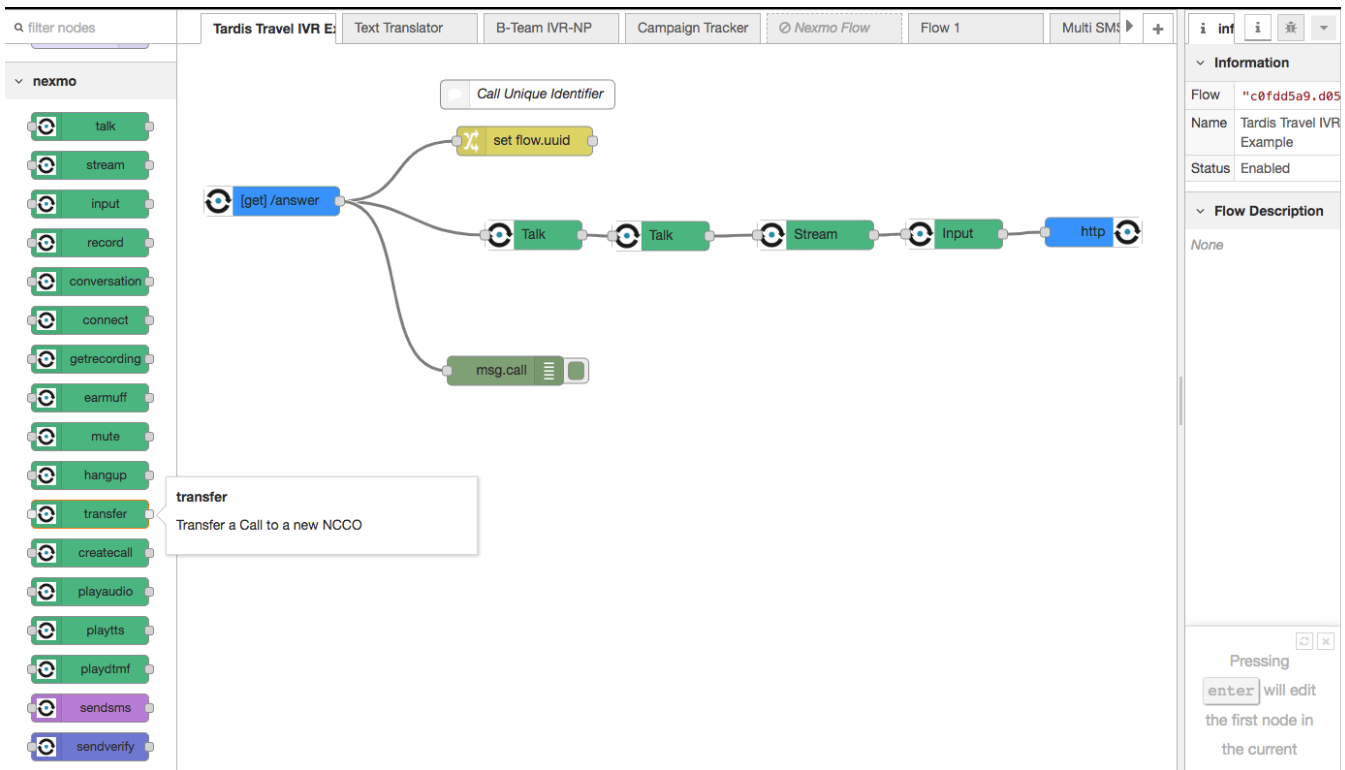
What this means is that enterprises can now take any VBC number and extend it with the help of Nexmo’s APIs. To enable this, all they have to do is toggle a switch in their management console and then they’ll be able to programmatically route calls, create custom communications apps and workflows, and integrate third-party systems to build chatbots and other tools.

“About four years ago we made a pretty strong pivot to going from residential — a lot of people know Vonage as a residential player — to the business side,” Vonage senior VP of product management Jay Patel told me. “And through a series of acquisitions [including Nexmo], we’ve kind of built what we think is a very unique offering.” In many ways, those different platforms were always separated from each other, though. With all of the pieces in place now, however, the team started thinking about how it could use the Nexmo APIs to allow its customers in the unified communications and contact center space to more easily customize these services for them.

About a year ago, the team started working on this new functionality that brings the programmability of Nexmo to VBC. “We realized it doesn’t make sense for us to create our own new sets of APIs on our unified communications and contact center space,” said Patel. “Why don’t we use the APIs that Nexmo has already built?”

As Patel also stressed, the phone number is still very much linked to a business or individual employee — and they don’t want to change that just for the sake of having a programmable service. By turning on programmability for these existing numbers, though, and leveraging the existing Nexmo developer ecosystem and the building blocks those users have already created, the company believes that it’s able to offer a differentiated service that allows users to stay on its platform instead of having to forward a call to a third-party service like Twilio, for example, to enable similar capabilities.

In terms of those capabilities, users can pretty much do anything they want with these calls — and that’s important because every company has different processes and requirements. Maybe that’s logging info into multiple CRM systems in parallel or taking a clip of a call and pushing it into a different system for training purposes. Or you could have the system check your calendar when there are incoming calls and then, if it turns out you are in a meeting, offer the caller a callback whenever your calendar says you’re available again. All of that should only take a few lines of code or, if you want to avoid most of the coding, a few clicks in the company’s GUI for building these flows.

Vonage believes that these new capabilities will attract quite a few new customers. “It’s our value-add when we’re selling to new customers,” he said. “They’re looking for this kind of capability or are running into brick walls. We see a lot of companies that have an idea but they don’t know how to do it. They’re not engineers or they don’t have a big staff of developers, but because of the way we’ve implemented this, it brings the barrier of entry to create these solutions much lower than if you had a legacy system on-prem where you had to be a C++ developer to build an app.

19 Mar 2019

Xiaomi outs Redmi Go, a $65 entry-level smartphone for India

Chinese smartphone maker Xiaomi has announced a new entry level smartphone at an event in Delhi.

The entry-level smartphone is targeted at the Indian market and looks intended to woo feature phone owners to upgrade from a more basic mobile.

It runs Google’s flavor of Android optimized for low-powered smartphones (Android Go) which supports lightweight versions of apps.

Under the hood the dual-SIM handset has a Qualcomm Snapdragon 425 chipset, 1GB RAM and 8GB of storage (though there’s a slot for expanding storage capacity up to 128GB).

Also on board: 4G cellular connectivity and a 3000mAh battery.

Up front there’s a 5 inch HD display with a 16:9 aspect ration, and 5MP selfie camera. An 8MP camera brings up the rear, with support for 1080p video recording.

At the time of writing the Redmi Go is being priced at 4,499 rupee (~$65). Albeit a mark-down graphic on the company’s website suggests the initial price may be a temporary discount on a full RRP of 5,999 rupees (~85). We’ve asked Xiaomi for confirmation.

Xiaomi’s website lists it as available to buy at 12PM March 22.

While Xiaomi is squeezing its entry level smartphone price-tag here, the Redmi Go’s cost to consumers in India still represents a sizeable bump on local feature phone prices.

For example the Nokia 150 Dual SIM candybar can cost as little as 1,500 rupees (~20). Though there’s clearly a big difference between a candybar keypad mobile and a full-screen smartphone. Yet 3x more expensive represents an immovable barrier for many consumers in the market.

The Redmi Go also looks intended to respond to local carrier Reliance Jio’s 4G feature phones, which are positioned — price and feature wise — as a transitionary device, sitting between a dumber feature phone and full-fat smartphone.

The JioPhone 2 launched last year with a price tag of 2,999 rupees (~40). So the Redmi Go looks intended to close the price gap — and thus try to make a transitionary handset with a smaller screen less attractive than a full screen Android-powered smartphone experience.

That said, the JioPhone handsets run a fork of Firefox OS, called KaiOS, which can also run lightweight versions of apps like Facebook, Twitter and Google.

So, again, many India consumers may not see the need (or be able) to shell out ~1,500 rupees more for a lightweight mobile computing experience when they can get something similar for cheaper elsewhere. And indeed plenty of the early responses to Xiaomi’s tweet announcing the Redmi Go brand it “overpriced”.

19 Mar 2019

Salesforce update brings AI and Quip to customer service chat experience

When Salesforce introduced Einstein, its artificial intelligence platform in 2016, it was laying the ground work for artificial intelligence underpinnings across the platform. Since then the company has introduced a variety of AI enhancements to the Salesforce product family. Today, customer service got some AI updates.

The goal of any customer service interaction is to get the customer answers as quickly as possible. Many users opt to use chat over phone, and Salesforce has added some AI features to help customer service agents get answers more quickly in the chat interface. (The company hinted that phone customer service enhancements are coming.)

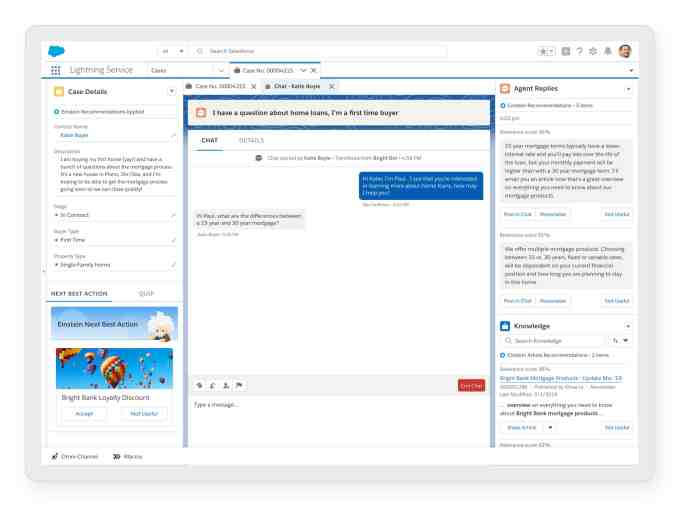
For starters, Salesforce is using machine learning to deliver article recommendations, response recommendations and next best actions to the agent in real time as they interact with customers.  “With Einstein article recommendations, we can use machine learning on past cases and we can look at how articles were used to successfully solve similar cases in the past, and serve up the best article right in the console to help the agent with the case,” Martha Walchuk, senior director of product marketing for Salesforce Service Cloud explained.

Salesforce Service Console. Screenshot: Salesforce

The company is also using similar technology to provide response recommendations, which the agent can copy and paste into the chat to speed up the time to response. Before the interaction ends, the company can offer the next best action (which was announced last year) based on the conversation. For example, they could offer related information, an upsell recommendation or whatever type of action the customer defines.

Salesforce is also using machine learning to help route each person to the most appropriate customer service rep. As Salesforce describes it, this feature uses machine learning to filter cases and route them to the right queue or agent automatically, based on defined criteria such as best qualified agent or past outcomes.

Finally, the company is embedding Quip, href="https://techcrunch.com/2016/08/01/salesforce-buys-word-processing-app-quip-for-750m/"> the company it acquired in 2016 for $750 million, into the customer service console to allow agents to communicate with one another to find answers to difficult problems. That not only helps solve the issues faster, the conversations themselves become part of the knowledge base, which Salesforce can draw upon to help teach the machine learning algorithms about the correct responses to commonly asked questions in the future.

As with the Oracle AI announcement this morning, this use of artificial intelligence in sales, service and marketing is part of a much broader industry trend, as these companies try to inject intelligence into workflows to make them run more efficiently.

19 Mar 2019

Employee retention platform Peakon raises further $35M in a new round led by Atomico

Peakon, the Denmark headquartered “employee retention platform,” has raised a further $35 million in funding. Described as a Series B extension, the round is led by European venture capital firm Atomico, with backing from existing investors, including EQT Ventures, IDInvest Partners, Balderton Capital, and Sunstone.

Originally offering “people analytics” by enabling companies to more regularly survey employees, Peakon has since evolved to become a fully fledged SaaS for employee retention. It claims to now tackle three critical areas. They are employee engagement, actionable insights to prevent employee problems before they arise, and competitor analysis through benchmarking employee engagement data against Peakon’s proprietory industry-wide data.

Peakon’s surveys are designed to be both fast and conducted weekly, rather than annually (as is the traditional way of surveying employees). They also adhere to standardised questions so as to enable industry wide comparisons. This means that companies using the employee retention software can not only get a more immediate feel for how engaged employees are at any given moment, but also use that data to drive operational decisions and competitor analysis.

For example, Peakon claims to be able to predict when certain employees are in danger of leaving 250 days in advance of doing so. As hiring gets increasingly competitive, this heads up is crucial as it theoretically provides enough time for management to attempt to prevent critical employees from leaving.

Zooming out further, Peakon’s adherence to standardised questions in the employee micro surveys it conducts on behalf of its customers is enabling the company to build what it claims to be the largest real-time database of “how the world’s workforce is feeling,” based on more than 30 million data points and rising. By diving deep into this data, macro trends can be better established, such as comparing the fall in worker productivity before the winter holidays across countries and demographics.

Meanwhile, I’m told Peakon has grown extremely fast over the last year. This has included opening an office in New York where co-founder Kasper Hulthin is now based, while the company expects its U.S. headcount to be over 50 employees within the next 12 months. Peakon also has offices in U.K., Denmark, Germany, and New Zealand, says current headcount sits at over 180.

Since launching in early 2016, Peakon’s customers have included the likes of Capgemini, Verizon, BMW, TrustPilot, Harrods and easyJet.

Adds Mattias Ljungman, Partner at Atomico: “As our world continues to change, traditional concepts of work are being redefined. Workers have to deal with constant change, and this is why it is more important than ever for companies to listen to their employees’ voices and create a positive culture through feedback and engagement. Yet, today companies are still struggling to measure their most important asset: their people. We were blown away by Peakon’s rigorous, data-driven approach to this problem”.

19 Mar 2019

Angry Birds AR is coming to iPhone this spring

Angry Birds: Isle of Pigs took the scenic route to the iPhone. Rovio began flirting with augmented reality on the Magic Leap of all places, releasing First Person Slingshot for the headset last year. Last month, Angry Birds VR: Isle of Pigs hit Steam for the HTC Vive and Oculus Rift.

Now, it seems, the AR version of the title is finally ready for a mainstream audience, as Rovio preps the game for a spring release on iOS. The game, developed by Swedish company Resolution Games, builds on the learnings from its predecessors, creating a customized version of the game for the mobile form factor.

Sami Ronkainen, Rovio’s creative director, Extended Reality, told TechCrunch that the more mainstream version of the title borrows some levels from the earlier versions, while introducing a number of originals.

“What we did with the Magic Leap was we wanted to start with something that’s fully immersive that can make use of the 3D space around you,” he says. “We realized that it’s going to be further in the future, so we decided to go with platforms that are much closer to customers today.”

Of course, an imminent release for iOS marks far and away the largest potential audience the game has seen to date. But Rovio, notably, doesn’t stray too far from its roots here. While the title adopts a first-person view to make the most of the augmented reality experience, it’s the same game at its core as the one that debuted on the iPhone 10 years ago this December.

You slingshot irritable avians into weak points of compromised structures in order to take down enemy pigs. You know the deal. They made a whole feature-length film about it (with a sequel on the way this summer). 

When you fire up the game, it will detect its environment for a suitable surface and start building structures on top of it once found. The environment and characters are brought to life in compelling ways, interacting with you as you move around. In fact, moving is a big part of the game. This isn’t one you’re going to want to play on the subway — it requires getting creative about the angles you adopt to fell the structures.

Rovio doesn’t have a dedicated AR team, instead partnering with Swedish developer Resolution to offer a fuller experience from the ground up. “There are games where the AR seems like a bit of an add-on,” says Ronkainen. “We wanted to explore this from the angle of building a game that really makes use of the space. You can either build a team of your own and make your own mistakes, or you can partner with the best people who have a good track record of building AR games.”

You can either build a team of your own and make your own mistakes, or you can partner with the best people who have a good track record of building AR games.

I had a little hands-on time with the game earlier this month, and was impressed with the little touches throughout, from the snowfall in certain levels, to the pigs’ snorts as you come near. And certainly the new angle adds a different dimension to a game that’s frankly been run into the ground after years of sequels and spin-offs.

How long it will maintain that fresh outlook is another question entirely. So too is the question of how much users will want to engage by moving around over the long run. Ditto for the question of interacting with an AR game through a mobile device, rather than a headset. It’s clear that one of the reasons Rovio chose headsets first is that they’re simply a more natural method for interacting with a title like this.

What iOS does represent, however, is a way to bring the experience to the masses. For Apple, meanwhile, the casual game represents the potential to bring the ARKit experience to a much broader user base. Apple really needs one or two titles to showcase augmented reality on the mobile platform for mainstream users, and Angry Birds has both the name recognition and simple gameplay to do just that.

The title is available for pre-order starting today. It will arrive at some point in “late-spring.” It’s free to play, but will likely feature some manner of in-game purchasing — though the company tells me it hasn’t “locked down a business model” just yet.


19 Mar 2019

In big tech’s future expansion plans, public good should be the corporate incentive

The cancellation of Amazon’s planned expansion in New York exposes the truth about its HQ2 promises. In the end, the company seemed mainly interested in tax incentives and being allowed to make a corner of NYC once set aside for public housing and schools its own.

Meanwhile, Arlington county officials are revisiting plans to deliver locally-funded financial incentives to Amazon in exchange for the development of DC-adjacent “National Landing.”

Increasingly, communities are demanding that tech companies bring more to the table than they take. Locals want them to stimulate the local economy and fortify startup ecosystems rather than hire away people and raise housing prices. After all, talent is the most precious resource in the digital economy, and if cities nourish it, the tech firms will come naturally.

There’s plenty to dislike about the way Amazon approached its HQ2 search. Encouraging cities to throw sweeteners at a multinational run by the world’s richest man was spectacularly tone deaf at a time of growing anxiety about inequality. But there is an upside: the HQ2 experiment can still serve as a watershed moment that brings into focus the need for greater corporate responsibility with big tech expansions.

Toronto was one of only two HQ2 bid “finalists” – along with Austin, Texas – that did not offer any tax incentives to Amazon leading up to the reveal. The reasoning by the city’s bid leader, Toronto Global CEO Toby Lennox, was simple: Toronto should win Amazon’s presence, job creation potential and global connectivity thanks to the city’s well-educated and culturally diverse workforce, connected economy and excellent quality of life.

Perhaps it’s no surprise that the HQ2 bid was not widely embraced by Toronto’s ecosystem. Subsidies aside, startup CEOs worried that the presence of Amazon might come at the expense of local companies already fighting for top engineers. Amazon offered little in return to the community – upskilling and expanding the talent pool was not part of its playbook.

It’s notable that in Virginia, where the other half of Amazon’s HQ2 has faced less controversy than New York, the state’s incentive package included investing $1.1 billion in its higher education system to build its talent pipeline. That creates benefits for everyone, not just Amazon.

Amazon’s move will, I suspect, come to be seen as the high-water mark for Big Tech hubris. There are enormous benefits to a city in attracting major tech firms – the name-recognition alone acts as a signal to investors and engineers that interesting things are happening there. But, in the future, I believe we will see far fewer attempts to create vast corporate campuses with helipads, and more effort to integrate into the existing ecosystem.

Apple iPad event

Apple and Google are both expanding in New York without a similar backlash because their plans are smaller scale and seen to complement the city rather than ignore it.

Last fall, when Uber CEO Dara Khosrowshahi announced plans to build a new engineering center in Toronto, he stressed the importance of ramping up operations responsibly. He underscored that the company will pace its hiring and staff relocation to avoid stifling the ecosystem of artificial intelligence startups and researchers that had attracted Uber to the city in the first place.

Investments in local economies – like Microsoft’s recent $500 million promise to deliver more affordable housing in Seattle – are also going to become increasingly important for Big Tech companies if they want to retain public support.

There are lessons here for both civic leaders and tech executives. It’s easy to see why cities jump at the chance of bringing in tens of thousands of jobs, but that has to be balanced against the interests of the city’s homegrown tech companies and existing communities.

Tech companies need to accept that their social license to operate is being called into question as never before and that they need to put more emphasis on public engagement, job creation for local people and infrastructure improvements in their future plans. The aim should be for new players to grow local economies that benefit every stakeholder – not arrive with a splash that destabilizes the communities we need to build.

Amazon and its fellow tech giants must embrace that public good is the best corporate incentive.

19 Mar 2019

Oracle adds more AI features to its suite of sales tools

As the biggest sales and marketing technology firms mature, they are all turning to AI and machine learning to advance the field. This morning it was Oracle’s turn, announcing several AI-fueled features for its suite of sales tools.

Rob Tarkoff, who had previous stints at EMC, Adobe and Lithium, and is now EVP of Oracle CX Cloud says that the company has found ways to increase efficiency in the sales and marketing process by using artificial intelligence to speed up previously manual workflows, while taking advantage of all the data that is part of modern sales and marketing.

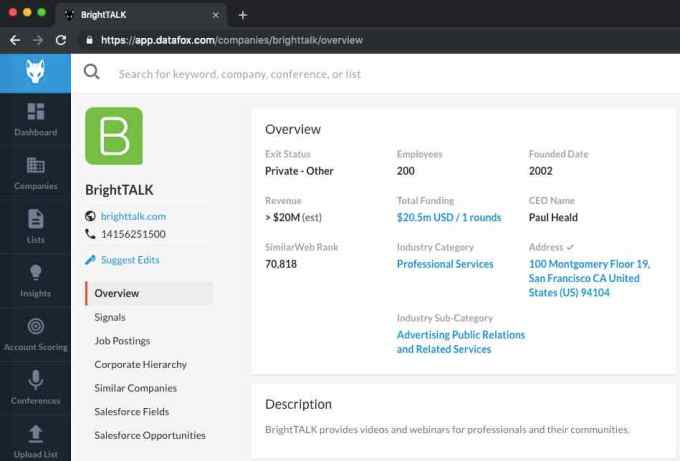
For starters, the company wants to help managers and salespeople understand the market better to identify the best prospects in the pipeline. To that end, Oracle is announcing integration with DataFox, the company it purchased last fall. The acquisition gave Oracle the ability to integrate highly detailed company profiles into their Customer Experience Cloud, including information such as SEC filings, job postings, news stories and other data about the company.

DataFox company profile. Screenshot: Oracle

“One of the things that DataFox helps you you do better is machine learning-driven sales planning, so you can take sales and account data and optimize territory assignments,” he explained.

The company also announced an AI sales planning tool. Tarkoff says that Oracle created this tool in conjunction with its ERP team. The goal is to use machine learning to help finance make more accurate performance predictions based on internal data.

“It’s really a competitor to companies like Anaplan, where we are now in the business of helping sales leaders optimize planning and forecasting, using predictive models to identify better future trends,” Tarkoff said.

Sales forecasting tool. Screenshot: Oracle

The final tool is really about increasing sales productivity by giving salespeople a virtual assistant. In this case, it’s a chatbot that can help handle tasks like scheduling meetings and offering task reminders to busy sales people, while allowing them to use their voices to enter information about calls and tasks. “We’ve invested a lot in chatbot technology, and a lot in algorithms to help our bots with specific dialogues that have sales- and marketing-industry specific schema and a lot of things that help optimize the automation in a rep’s experience working with sales planning tools,” Tarkoff said.

Brent Leary, principal at CRM Essentials, says that this kind of voice-driven assistant could make it easier to use CRM tools. “The Smarter Sales Assistant has the potential to not only improve the usability of the application, but by letting users interact with the system with their voice it should increase system usage,” he said.

All of these enhancements are designed to increase the level of automation and help sales teams run more efficiently with the ultimate goal of using data to more sales and making better use of sales personnel. They are hardly alone in this goal as competitors like Salesforce, Adobe and Microsoft are bringing a similar level of automation to their sales and marketing tools

The sales forecasting tool and the sales assistant are generally available starting today. The DataFox integration will GA in June.

19 Mar 2019

Singapore fintech startup Instarem closes $41M Series C for global growth

Singapore’s Instarem, a fintech startup that helps banks and consumers send money overseas at lower cost, has closed a $41 million Series C financing round to go after global expansion opportunities.

The four-year-old company announced a first close of $20 million last November, and it has now doubled that tally (and a little extra) thanks to an additional capital injection led by Vertex Ventures’ global growth fund and South Korea’ Atinum Investment. Crypto company Ripple, which has partnered with Instarem for its xRapid product, also took part in the round, Instarem CEO Prajit Nanu confirmed to TechCrunch, although he declined to reveal the precise amount invested. More broadly, the round means that Instarem has now raised $59.5 million from investors to date.

The company specializes in moving money between countries in Asia in a similar way to TransferWise although, unlike TransferWise, its focus is on banks as customers rather than purely consumers. Today, it covers 50 countries and it has offices in Singapore, Mumbai, Lithuania, London and Seattle.

Instarem said it plans to spend the money on expansion into Latin America, where it will open a regional office, and double down on Asia by going after money licenses in countries like Japan and Indonesia. The company is also on the cusp of adding prepaid debit card capabilities, which will allow it to issue cards to consumers in 25 countries and more widely offer the option to its banking customers. That’s thanks to a deal with Visa .

Further down the line, the company continues to focus on an exit via IPO in 2021. That’s been a consistent talking point for Nanu, who has been fairly outspoken on his desire to take the company public. That’s included shunning acquisition offers. As TechCrunch revealed last year, Instarem declined a buyout offer from one of Southeast Asia’s tech unicorns. Commenting on the offer, Nanu said it simply “wasn’t the right timing for us.”