Customers can already place an order for the Tesla Model Y, a mid-sized crossover SUV that won’t go into production until 2020.
Tesla requires a $2,500 deposit to complete the order for the all-electric vehicle, according to information posted on its website. A disclaimer on the order form states that “production is expected to begin late next year.” Under that timeline, deliveries wouldn’t begin until late 2020 or possibly early 2021.
There are other clues on the order page, including that the seven-seat interior won’t be available until 2021. The Model Y will come standard as a five seater.
Tesla CEO Elon Musk unveiled the Model Y on Thursday night at the Tesla Design Studio in Los Angeles. During the presentation, Musk didn’t mention that customers could order the Model Y. That’s a departure from previous events, notably the Model 3 reveal in March 2016, which prompted thousands of people to put down $1,000 deposits.
The Model Y bears a striking resemblance to Model 3, and for good reason. The Model Y shares about 75 percent of the same parts as the Model 3.
The vehicle, which will come in a standard, long range, dual-motor all-wheel and performance variants, is larger than the Model 3, allowing it to accommodate seven people (for those who opt to pay the $3,000 up charge). The order page of the Model Y shows that it comes standard as a 5-seater. To get the 7-seater configuration, customers have to pay an additional $3,000.
The Model Y also sits higher than the Model 3, a distinction that is more obvious once you’re sitting inside. One of the most distinguishing differences is the Model Y has a panoramic roof.
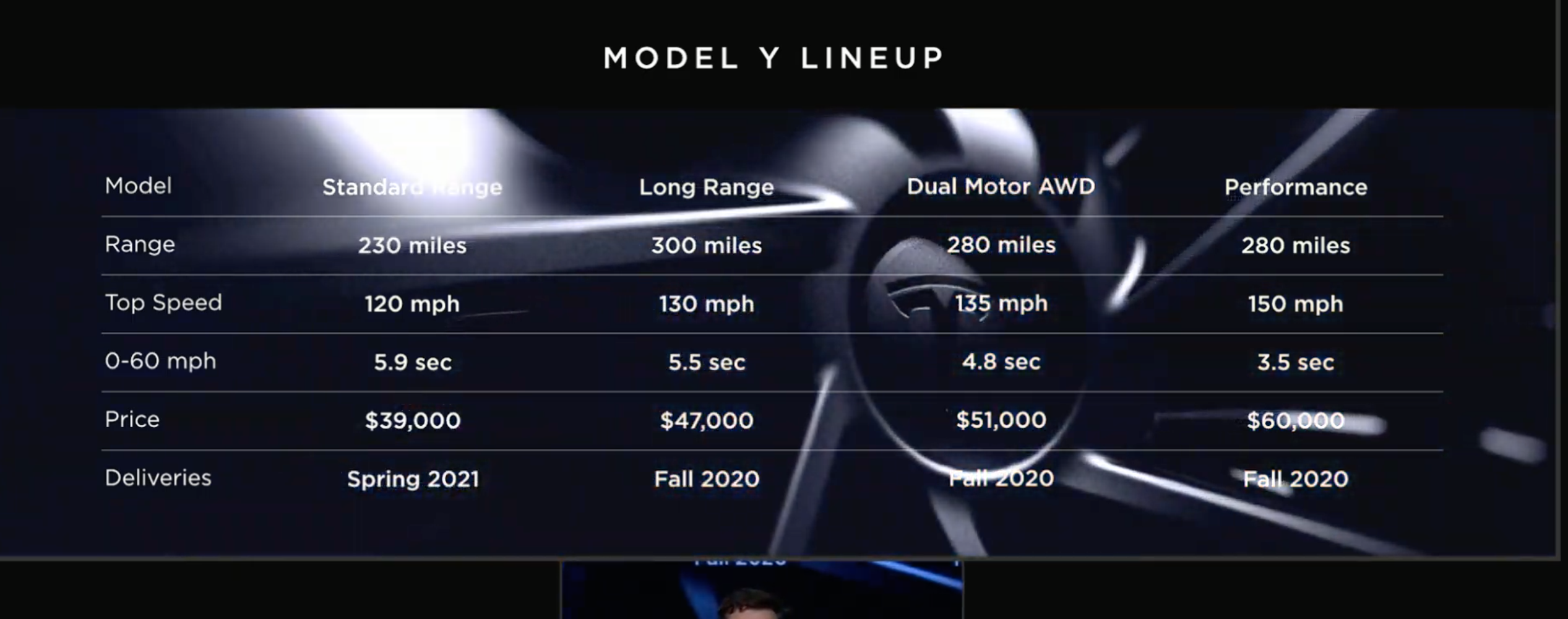
The standard range version will start $39,000 and have 230 mile range. However, Tesla will first produce the performance, dual-motor and long range versions. Customers who want the standard range version of the Model Y will have to wait until at least spring 2021. The performance and dual motor variants will be able to travel 280 miles on a single charge, while the long-range version will, as it sounds, have the longest range at 300 miles.
All of the variants are designed to have the same kind of performance as its smaller sibling. The performance version of the Model Y will be able to travel from 0 to 60 miles per hour in 3.5 seconds and reach a top speed of 150 mph.
But that kind of performance comes at a higher price. The performance version will start at $60,000. The dual motor variant will start at $51,000 and the base price of the long-range version will be $47,000.
At first glance, it appeared that Tesla Model 3 had a doppelganger.
After years of teasers and hints, Tesla CEO Elon Musk finally unveiled the Model Y, a mid-sized all-electric vehicle that will start at $39,000 and is slated to hit the marketplace in fall 2020.
The Model Y bears a striking resemblance to Model 3. The vehicle, which will come in a standard, long range, dual-motor all-wheel and performance variants, is a bit larger, allowing it to accommodate seven people. It also sits slightly higher than the Model 3.
And that’s where the differences start to fade away.
The Model Y has the same interior as the Model 3, including the same single 15-inch touchscreen interface as well as other features like the door handles.
The photo below is a Model 3.
And now, the Model Y. Notice a slightly higher stance and shorter front end.
Other important specs
The standard range version will start $39,000 and have 230 mile range. However, Tesla will first produce the performance, dual-motor and long range versions. Customers who want the standard range version of the Model Y will have to wait until at least spring 2021. The performance and dual motor variants will be able to travel 280 miles on a single charge, while the long-range version will, as it sounds, have the longest range at 300 miles.
All of the variants are designed to have the same kind of performance as its smaller sibling. The performance version of the Model Y will be able to travel from 0 to 60 miles per hour in 3.5 seconds and reach a top speed of 150 mph.
But that kind of performance comes at a higher price. The performance version will start at $60,000. The dual motor variant will start at $51,000 and the base price of the long-range version will be $47,000.
Musk didn’t say where the Model Y would be produced, nor did he get into other details beyond the vehicle specs and a vague timeline.
He did provide a bullish forecast for the Model Y, stating towards the end of the event that he expects Y sales to exceed Model S and Model X combined. Tesla has sold more than 500,000 vehicles to date, including the Roadster, S, X and 3.
Lee Fixel, the low-flying head of Tiger Global’s private equity business, is leaving at the end of June, the firm announced today in a letter sent to clients and seen by Reuters. Scott Shleifer and Chase Coleman will continue as co-managers of the portfolios Fixel has overseen, with Shleifer taking over as its head, according to the letter.
Fixel, 39, is reportedly planning to invest his own money and “may start an investment firm in the future,” Tiger Global wrote in the letter.
The move comes as a bit of a surprise. Despite that Fixel has operated largely in the shadows, avoiding public appearances unlike many investors, he has had an outsize impact on the venture industry over the last decade or so, as Tiger has shown up on the cap tables of a growing number of venture-backed companies. Among its portfolio companies is Stripe, the payments company that’s currently valued at $23 billion by private investors (with no apparent plans to go public); Panda Selected, a Beijing-based shared-kitchen company that just raised $50 million in Series C funding led by Tiger; and Olo, a 13-year-old mobile and online ordering platform for restaurant chains, who sold $18 million worth of secondary shares to Tiger in January.
Over time, investors in Silicon Valley who once viewed Fixel as something of a casino capitalist came to deeply respect him, seemingly, with Benchmark’s Bill Gurley referring publicly to Fixel as among the smartest investors on the scene.
There’s some evidence to support the claim, including the sale last year of Glassdoor, the jobs and salary website, to the Japanese human resources company Recruit Holdings for $1.2 billion in cash; Spotify’s direct listing on the U.S. stock market last year; and the more traditional IPOs last year of Eventbrite and SurveyMonkey. Tiger had backed all of them.
Tiger has also cashed in big on privately held companies in India into which it plowed at least $2 billion over the last decade — money it returned numerous times to its investors. Its biggest win ties to an early bet on Flipkart, which sold the majority of its e-commerce business to retail giant Walmart last year for $16 billion, but an early-bet on the ride hailing company Ola also appears to have paid off. (Tiger reportedly sold part of its stake to SoftBank but seems to remain a believer in the company, more newly investing in its electric mobility unit.)
Tiger was founded by Coleman, a protégé of hedge fund pioneer Julian Robertson, in 2000. Shleifer joined two years later, and Fixel came aboard in 2006.
This is not the firm’s first major leadership change. In 2015, one of its investment heads, Feroz Dwan, left to set up his own investment firm, now called Arena Holdings Management, in New York.
Whether Fixel follows a similar path remains to be seen. It’s also easy to see a firm like Softbank, which Fixel knows through both Ola, Flipkart, and other deals, trying to bring him into the fold if he’s amenable.
In the meantime, Fixel appears to be focusing in part on his family. In January, he and his wife gave the University of Florida a $20 million gift in support of a research institute focused on neurological diseases that has been named after his father Norman, who suffers from Parkinson’s. His father and his wife are both alums of the school.
Tiger’s clients are meanwhile still absorbing the news, presumably. Said Tiger’s letter to them: “Lee has been a driving force behind the expansion of Tiger Global’s private equity investing activities in the United States and India, and he has distinguished himself as a world-class investor across multiple sectors and stages.”
Augmented reality looked like it was supposed to a ubiquitous success, Apple and Google and Facebook seemed to say so, but things are taking a bit of time to get kicked off so the startups in the space are having to get real weird with it.
Adventurous is an augmented reality scavenger hunt geared towards families, but it drags in enough elements of the real world to make it a pretty robust experience. This isn’t your typical AR phone app that you pop open once. For one thing you have to be at a certain physical location in order to try it out, you also have to make an appointment, and, oh yeah, there are live actors involved.
This may be one of the more odd companies in Y Combinator’s latest startup batch, it’s basically a kind of tech-enabled live theater. The company’s co-founders acknowledge that having appointments and live actors involved with an app isn’t the most scalable business model in internet history, but they say that they’ll figure stuff out as they move along and that for now the families and kids involved really like the experience.
“We know that families are constantly looking for stuff to do with their kids and not all screen time is good screen time,” Adventurous co-founder Jeany Ngo tells TechCrunch.
Adventurous co-founders Jeany Ngo and Brian Schulman
When a family or group books an adventure, they meet at a designated location at a given time and get a run down on the mission and story from actors in full dress and character, then they’re tasked with walking around to different physical locations where different geo-tagged experiences will pop up on their ARKit or ARCore-enabled phone and they’ll have to complete the tasks to move on.
The experiences are designed to be around 45 minutes to 1 hour each and the whole shebang costs $15 per person.
One of the big selling points of augmented reality as a medium is that it can theoretically gain and understanding of a location’s geometry and plunk down digital content in a way that’s tailored to your space. That may be true for something like Google’s AR Stickers where it’s a little stationary 3D model, but when you start talking about actual storylines, the fact is that AI just can’t make reliable sense of a dynamic environment when it comes to a game or experience.
The company has been testing out various locations for their AR adventures, right now they’re sticking with missions in San Francisco’s Chinatown and Golden Gate Park. It’s a little unclear whether there could be any associated legal issues for a startup tying digital experiences to physical public locations, but the co-founders say they haven’t run in to any issues yet.
With Adventurous, the company is banking on the robustness of an ironed-out experience to suck in fans and bring them back. The company’s co-founders foresee a world where narratives fit together like episodes in a TV series bringing families back to book appointments to see what happens next.
Location-based entertainment has been a hit-or-miss vertical for the VR industry, though some startups have seen success. Sandbox VR finished out a $68 million Series B earlier this year in a round led by a16z. For AR startups, there haven’t been too many stories of entertainment experiences that have been strictly tied to geographic areas outside of event activations. While you can find Pokéstops inside Pokémon GO, it isn’t a full linear experience that requires everyone to move along an identical path.
Adventurous is live now, if you’re in SF you can book yourself a fancy scavenger hunt in augmented reality this weekend.
The games we see advertised the most aren’t necessarily the best representatives for what has become an incredibly diverse medium. Yearly AAA installments and massive open worlds are all well and good, but simplicity is rarely on display — which makes two recent releases, Ape Out and Baba Is You, all the more delightful.
Both are, in a way, very simple games, but from that simplicity arises complex and enjoyable gameplay concepts that can entertain (or frustrate) for hours. It’s a refreshing reversal of games that appear complex but ultimately have very little depth.
Ape Out is certainly the more simple of the two, at least in gameplay terms. You’re an ape — a great ape. A gorilla, to be precise. And you have gotten out.
The smooth top-down action has you navigating a procedurally-generated office patrolled by gun-wielding ne’er-do-wells. To prevent further ape blood from being spilled, you can either punch them — usually fatal, as you are strong — or grab them, which causes them to fire their gun. Then you can throw them into a wall. That’s pretty much it!
A few things elevate the game beyond the apparently arcade-level concepts here. First is a distinctive visual style that combines a sort of watercolor or chalky effect with starkly monochrome characters and surroundings, making gameplay elements highly distinctive and recognizable while giving a definite look to the whole world.
[gallery ids="1797601,1797602,1797600,1797603"]
The controls are also smooth and largely predictable, letting you confidently move through the world without worrying whether you’ll catch on something or whether your lunge will reach a guy — if you’re not sure, it’s exciting rather than frustrating. Well-spaced checkpoints make you master an area before passing on, but don’t feel punitive, and new enemies and obstacles are introduced gradually and logically.
But the music is the most striking bit. A base beat of jazz drums accompanies each stage, growing in intensity as you progress to the next level (it can take as little as 20 or 30 seconds to do so), and every action adds a beat or cymbal crash to the mix. The responsive music makes you feel like a real soundtrack to your acts, while also spurring you on to greater ones.
As Penny Arcade pointed out, Ape Out is fun and original from the moment you pick it up. There’s no boring tutorial, problematic dialogue, poorly characterized protagonist, obscure and frequently revised gameplay elements, and no “ludonarrative dissonance.” In other words you never think “wait, would an enraged ape really do that?” (By the way, it’s definitely violent — but in an absurd comic style, not graphic and horrible.)
Baba Is You is simple in a different way. Its graphics and simple grid-based movement place it in company with The Adventures of Lolo or similar block-pushing games from the ’80s and ’90s. The complexity of this game, however, comes from a mind-bending twist along the lines of Portal and The Witness: the rules of the game are actual blocks that you move around as well.
It sounds weird, but that’s the game: In addition to rocks, water, walls, and various other items, there are blocks defining the actual rules of that level with a crude, blocky logic, such as “flag is win” and “rock is push,” meaning you win if you touch the flag and rocks can be pushed.
Perhaps the flag is embedded in an inaccessible fortress of walls, though. No problem. A couple pushes mean that now “rock is win” — so just go touch a rock and the level is complete. Or perhaps if you can reach it, the rule “wall is stop” can be shifted, letting you walk right through them to the flag.
The simple, cute graphics let you focus on the seemingly limited, yet actually maddeningly diverse, ways of combining and shifting the blocks of the level. “Eureka!” moments are elusive things, as the creator seems to have a knack for predicting how you might think and putting roadblocks in the way of obvious solutions. But there is that amazing feeling that you’re a genius when you come back to an “impossible” level and see it with new eyes, solving it in a handful of seconds. That’s the complexity of simplicity — a single breakthrough that takes half an hour to arrive at.
[gallery ids="1797612,1797614,1797613"]
I won’t lie, though: Baba Is You is hard. It’s hard as hell. In the forums are puzzle fiends shame-facedly admitting they can’t beat the 6th level, or facepalming after a hint is offered. It’s easy to develop a mental block and never get past it — but fortunately the game is fairly open, letting you take on the first few puzzles of various themed areas of the map rather than making you clear one before moving on to the next. This isn’t a game you’ll be done with in an afternoon.
Both Baba Is You and Ape Out cost under $20 (on PC and Switch right now), in the sweet spot between the shovelware under $10 and “full” retail games twice the cost. Both are unique and created with obvious care and attention to detail. And neither ever requires more than two or three minutes of your time — though you can, as I did last night, lose hours just as easily as you would in a AAA title. This is simple done right.
On Thursday, Hawaii Senator Brian Schatz and Missouri Senator Roy Blunt introduced a bill designed to offer legislative oversight for commercial applications of facial recognition technology. Known as the Commercial Facial Recognition Privacy Act, the bill would obligate companies to inform consumers about any use of facial recognition and proposes limiting companies from freely sharing facial recognition data with third parties without first obtaining explicit user consent.
“Consumers are increasingly concerned about how their data is being collected and used, including data collected through facial recognition technology,” Senator Blunt said of the bill. “That’s why we need guardrails to ensure that, as this technology continues to develop, it is implemented responsibly.”
Microsoft endorsed the bipartisan bill, which dovetails with some of the company’s own ideas about how facial recognition tech might be regulated. “We believe it’s important for governments in 2019 to start adopting laws to regulate this technology,” Microsoft President Brad Smith wrote in December. “The facial recognition genie, so to speak, is just emerging from the bottle.”
As The Hill points out, the proposed legislation does not include some of the same provisions around the use of facial recognition by law enforcement that Microsoft has mentioned previously, including the requirement of a court order to limit “ongoing government surveillance of specified individuals.” The bill instead focuses on risks specific to the commercial side of facial recognition tech. Other facial recognition legislation has been making the rounds at a state level in Microsoft’s home state this year with buy-in from the company.
“Our faces are our identities. They’re personal. So the responsibility is on companies to ask people for their permission before they track and analyze their faces,” Senator Schatz said of the proposed legislation. “Our bill makes sure that people are given the information and – more importantly – the control over how their data is shared with companies using facial recognition technology.”
Whether the bill goes anywhere or not, proposed legislation does provide insight into the regulatory trends bouncing around Congress at any given moment. As Microsoft’s involvement makes clear, facial recognition is another area of intense interest in which companies may seek to shape legislation before it becomes law.
The options available to women who want to avoid getting pregnant today are bad. Most, like the widely used birth control pill, feed man-made estrogen and progestin hormones to women, which are capable of causing a number of awful side effects.
YourChoice Therapeutics — a startup launched by a team of Berkeley researchers, including two experts in sperm physiology and sperm-egg interactions — dreams of producing a unisex, non-hormonal alternative to existing contraceptives. The company has raised $400,000 in funding to date, plus a $150,000 check from Y Combinator. YourChoice will make its big pitch at Y Combinator Demo Days next week.
It’s seeking $2 million in venture capital funding to continue research on its sperm cell-targeting novel method of contraception, as well as to build out its team of chemists. Founders Akash Bakshi and Nadja Mannowetz tell TechCrunch they plan to have a contraceptive ready to market by 2025. Together, with co-founder and advisor Dr. Polina V. Lishko of Berkeley’s department of cell and molecular biology, they hope to reach women and men all over the world, in the process tapping a market expected to be worth $37 billion by 2023.
“There are perhaps ways that we could cut that time in half or just get something to market,” said Bakshi, YourChoice’s chief executive officer, whose background is in technology commercialization, research and development within the life sciences industry. “But we need to do this right so that we can benefit as many women as possible.”
Their first product will be a vaginal contraceptive to be applied before intercourse, then, the startup plans to release oral contraceptives for both genders. The team has discovered that the natural compound lupeol is capable of blocking a protein on sperm that is required for fertilization. YourChoice‘s non-hormonal approach doesn’t impact a cells’ ability to function or gene expression, so women and men are not at an increased risk of blood clots, cancer or other side effects associated with mainstream birth control methods’ use of added hormones.
“The bottom line is men don’t have good options and women apparently have so many choices, yet they are all really bad,” Mannowetz, a Ph.D. in sperm physiology, told TechCrunch. “They’re all based on that over 60-year-old idea of hormone-based drugs.”
YourChoice’s planned debut product will be applied directly in the vagina during the period of the month in which the woman is fertile. Whether that be a tablet, a gel or some other form factor is still up in the air. YourChoice’s second product will be an oral contraceptive because they believe that is the most convenient, universally accepted method.
“For women who have an implant … I understand that this might be a step backward, but women who have been on the pill for decades, for them, it wouldn’t be a big change,” Mannowetz said. “We totally understand we will not serve every woman out there but we need to get started with a product and then take it from there.”
“If the last 60 years have taught us anything, it’s that delivery is something that can continue to be developed,” she continued. “We need to develop a new mode of action.”
There are a number of startups innovating in the contraception space, as TechCrunch has written, though most of those businesses are focused on the access problem. Birth control can be very difficult for many to access and startups like The Pill Club or Nurx solve that problem by delivering the pill directly to women’s doorsteps. Other early-stage companies in the space lack experts in the field of reproductive biology necessary to improve contraceptive options. YourChoice’s team says seeking change to the actual medication with an advanced team sets them apart from other upstarts.
For YourChoice, it helps that venture capital investment in the reproductive tech space is increasing, making this a great time for YC to support these businesses (YourChoice isn’t the only reproductive tech startup in the latest YC cohort) and for YourChoice to successfully nab private investment.
“I personally think the industry is satisfied; they are making really good money, right? So why should they change anything,” Mannowetz said. “Millennials are the starting point of change happening. I think now, women stand up and say, ‘we are sick of it.’ ”
Tesla has turned to two insiders to manage and oversee the company’s finances.
The automaker officially tapped as its next chief financial officer Zachary Kirkhorn, a longtime employee who has been part of the automaker’s finance team for nine years, according to securities filings posted Thursday. The automaker also appointed Vaibhav Taneja, who led the integration of Tesla and SolarCity’s accounting teams, as its chief accounting officer. Taneja, who will report to Kirkhorn, will oversee corporate financial reporting, global accounting functions and personnel.
Kirkhorn’s new role was mentioned during the company’s earnings call in January when CEO Elon Musk announced that CFO Deepak Ahuja would be retiring. Ahuja was Tesla’s CFO from 2008 to 2015, and was replaced by Jason Wheeler. Ahuja returned in 2017 after Wheeler stepped down.
“There is no good time to make this change,” Ahuja said at the time. He noted that after two back-to-back profitable quarters, now might be the best time. Musk said Ahuja would likely stay on as a senior advisor “for probably years to come.”
Kirkhorn first joined Tesla in March 2010, moving up through various roles in the company’s finance department. He left between 2011 and 2012 to earn an MBA degree from Harvard Business School . His most recent role was as VP of Finance.
Kirkhorn will receive a stock option grant of $12 million and a restricted stock unit grant of $4 million, which will be granted and will vest over four years in accordance with Tesla’s standard equity policies, according to the securities filing posted Thursday.
Taneja was most recently Tesla’s corporate controller. His employment with the automaker began through SolarCity, the solar company that Tesla acquired in 2016. Taneja was vice president of SolarCity’s accounting department until February 2017. He then served as Tesla’s assistant corporate controller between February 2017 and May 2018 before taking the lead position.
Taneja will receive a stock option grant of $6 million and a restricted stock unit grant of $2 million, which will be granted and will vest over four years.
John Lin is an associate partner at Trinity Ventures supporting investments in developer tools, artificial intelligence and real estate.
From entertainment to transportation, technology has upended nearly every major industry — with one notable exception: real estate. Instead of disrupting the sector, the last generation of real estate technology companies primarily improved efficiencies of existing processes. Industry leaders Zillow/Trulia and LoopNet* helped us search for homes and commercial real estate better and faster, but they didn’t significantly change what we buy or lease or from whom or how.
The next generation of real estate technology companies is taking a more expansive approach, dismantling existing systems and reimagining entirely new ones that address our growing demand for affordability, community and flexibility.
The increasing need for affordability
Home ownership has long been integral to the American dream, but for many young Americans today it’s an unattainable dream. A third of millennials live at home, and as a cohort, they spend a greater share of their income on rent than previous generations did — about 45 percent during their first decade of work. This leaves little money left over for savings, much less for home ownership, the largest financial expenditure of most people’s lifetimes.
The increasing need for affordable housing is driving some creative tech-enabled solutions. One segment of startups is focused on making existing homes more affordable, especially in high-cost markets like New York and the Bay Area. Divvy helps consumers, many of them with low credit scores, rent-to-own homes, which are assessed for viability by a combination of contractors and machine learning. Landed, funded by the Chan Zuckerberg Initiative, helps educators afford homes in the communities in which they teach. Homeshare divides luxury apartments into multiple more-affordable units, and Bungalow takes a similar approach with houses. Both companies have built technology platforms to manage their tenant listings and to allocate tenant expenses and streamline payments.
Consumers aren’t just craving affordability, they’re also seeking company.
Another segment of startups is aiming to reduce the costs of building new homes, such as with modular, prefab housing to reduce construction costs. Katerra, which just raised $865 million, is aiming to create a seamless, one-stop shop for commercial and residential development, managing the entire building process from design and sourcing through the completion of construction. Taking a “full stack” approach to every step of the building process should enable them to find efficiencies and reduce costs.
If the economy weakens, the need for more affordable housing will only grow, making these startups not only recession-proof but even recession-strong. Collectively, they’re helping Americans right-size their dreams to something more broadly attainable.
In search of community
Consumers aren’t just craving affordability, they’re also seeking company. More than half of Americans feel lonely, and the youngest cohort in their late teens and early-to-mid-twenties are the loneliest of the bunch (followed closely by millennials). Millennials are the first generation to enter the workforce in the era of smartphones and laptops. While 24/7 connectivity enables us to work anywhere, anytime, it also creates expectations of working anywhere, anytime — and so many people do, bleeding the lines between work life and personal life. Longer work hours make community harder to build organically, so many millennials place value on employers and landlords who facilitate it for them.
Airbnb and WeWork were early to capitalize on the demand for community, with one changing how we travel and the other redefining the modern office space. Co-working companies like WeWork, as well more targeted providers like The Assembly*, The Wing and The Riveter, offer speaker series, classes and other free member events aimed at building connections. Airbnb, once focused only on lodging, has broadened its platform to include community-building shared experiences.
Shared living and hospitality startups are also investing in community to attract and retain customers. StarCity provides dorms for adults, Common and HubHaus rent homes intended to be shared by roommates and Ollie offers luxury micro apartments in a co-living environment. These companies are leveraging technology to foster in-person connections. For example, Common uses Slack channels to communicate with and connect members, and HubHaus uses roommate matching algorithms.
Within the hospitality sector, Selina offers a blended travel lodge, wellness and co-working platform geared toward creating community for travelers and remote workers, complete with high-tech beachside and jungle-side office spaces. Meanwhile, experience-driven lifestyle hotel company Life House* connects guests through onsite locally rooted food and beverage destinations and direct app-based social introductions to other travelers.
Modern life requires flexibility
Life can be unpredictable, especially for young people who tend to change jobs frequently. Short job tenures are especially common within the growing gig economy workforce. People who don’t know how long their jobs will last don’t want to be burdened with long-term lease commitments or furniture that’s nearly as expensive to move as it is to buy.
The next frontier in real estate technology is as boundless as it is exciting.
Companies like Feather, Fernish and CasaOne rent furniture to people seeking flexibility in their living environments. Among consumers ready to buy their homes but looking for some extra help, Knock, created by Trulia founding team members and which recently raised a $400 million Series B, provides an end-to-end platform to enable home buyers to buy a new home before selling their old one. Also emphasizing flexibility, OpenDoor, valued at more than $2 billion, pioneered “instant offers” for homeowners looking to sell their homes quickly, leveraging algorithms to determine how much specific houses are worth.
It’s not just residents who seek flexible leases; many companies do as well, particularly those accommodating distributed employees or experiencing periods of uncertainty or rapid growth. To enable flexibility, several commercial real estate technology companies have developed platforms that balance pricing, capacity and demand.
Knotel, a “headquarters as a service” for companies with 100-300 employees, builds out and manages office spaces at lower risk and with more flexibility than is typically possible through commercial real estate leases, enabling tenants to quickly add or shrink office space as needed. WeWork allows members to pay only for the time periods when they come in to work. Taking flexibility to an even greater level, Breather lets workers rent rooms by the hour, day or month.
The next frontier in real estate technology is as boundless as it is exciting. A whole new generation of startups is designing innovative solutions from the ground up to address our growing demands for affordability, community and flexibility. In the process, they’re fundamentally reimagining how we live, work and play by transforming the modern workplace, leisure space and even our definition of home. We look forward to seeing — and experiencing — what lies ahead.
There was a nice surprise morsel for those following Turtle Beach’s financial’s this week. In addition to a “record fourth quarter,” the headset maker announced that it has agreed to purchase fellow gaming peripheral company Roccat for $14.8 million in cash.
Turtle Beach is best known for creating gaming headsets for a wide range of different consoles, PCs and mobile devices. Picking up Germany-based Roccat will help the San Diego company further expand into additional peripherals like mice and keyboard. Turtle Beach is also hoping it will help expand its primarily U.S. and Europe-based sales into Asia, where Roccat has already made a dent.
In a press release tied to the news, Turtle Beach CEO Juergen Stark calls the deal, a key step in achieving our goal of building a $100 million PC gaming accessories business in the coming years.”
The complimentary nature of the two companies’ product portfolios should certainly go a ways toward helping expand Turtle Beach’s brand. No word, however, on whether the company will continue to maintain the Roccat line in those markets where it’s already founds some traction. Certainly that would make a lot of sense in the short term.