Author: azeeadmin

12 Mar 2019

Uber agrees to pay drivers $20 million to settle independent contractor lawsuit

At a time when the gig economy is under heavy scrutiny around its practices of classifying workers as 1099 independent contractors, IPO-bound Uber has officially settled a six-year-long case regarding this exact topic.

Today, Uber agreed to pay $20 million to settle the class-action lawsuit, brought forth by Douglas O’Connor and Thomas Colopy way back in 2013. This comes after a judge rejected Uber’s offer to settle for $100 million back in 2016.

The suit claimed Uber classified its drivers as contractors to skirt around paying them a minimum wage and providing benefits. Since its original filing, the suit was granted class-action status to represent hundreds of thousands of drivers in California and Massachusetts. That victory for drivers was short-lived when an appeals court ruled Uber’s arbitration agreements were valid and enforceable. That decision reduced the number of drivers in the class to about 13,600.

Those eligible for a payout from the settlement include those who drove for Uber between Aug. 16, 2009, and Feb. 28, 2019, in California or Massachusetts. They must also not be bound by Uber’s arbitration clause.

In addition to the $20 million settlement, Uber has agreed to implement a comprehensive written deactivation policy, a formal appeals process for certain deactivation decisions and quality courses for drivers.

“Uber has changed a lot since 2013. We have made the driver experience even better through improvements like in-app tipping, a redesigned driver app, and new rewards programs like Uber Pro,” an Uber spokesperson told TechCrunch. “We’re pleased to reach a settlement on this matter and we’ll continue working hard to improve the quality, security and dignity of independent work.”

The case is O’Connor v. Uber, 13-cv-03826 in the U.S. District Court for the Northern District of California (San Francisco).

12 Mar 2019

Harvard-MIT initiative grants $750K to projects looking to keep tech accountable

Artificial intelligence, or what passes for it, can be found in practically every major tech company and, increasingly, in government programs. A joint Harvard-MIT program just unloaded $750,000 on projects looking to keep such AI developments well understood and well reported.

The Ethics and Governance in AI Initiative is a combination research program and grant fund operated by MIT’s Media Lab and Harvard’s Berkman-Klein Center. The small projects selected by the initiative are generally speaking aimed at using technology to keep people informed, or informing people about technology.

AI is an enabler of both good and ill in the world of news and information gathering, as the initiative’s director, Tim Hwang, said in a news release:

“On one hand, the technology offers a tremendous opportunity to improve the way we work —
including helping journalists find key information buried in mountains of public records. Yet we
are also seeing a range of negative consequences as AI becomes intertwined with the spread of
misinformation and disinformation online.”

These grants are not the first the initiative has given out, but they are the first in response to an open call for ideas, Hwang noted.

The largest sum of the bunch, a $150K grant, went to MuckRock Foundation’s project Sidekick, which uses machine learning tools to help journalists scour thousands of pages of documents for interesting data. This is critical in a day and age when government and corporate records are so voluminous (for example, millions of emails leaked or revealed via FOIA) that it is basically impossible for a reporter or even team to analyze them without help.

Along the same lines is Legal Robot, which was awarded $100K for its plan to mass-request government contracts, then extract and organize the information within. This makes a lot of sense: People I’ve talked to in this sector have told me that the problem isn’t a lack of data but a surfeit of it, and poorly kept at that. Cleaning up messy data is going to be one of the first tasks any investigator or auditor of government systems will want to do.

Tattle is a project aiming to combat disinformation and false news spreading on WhatsApp, which as we’ve seen has been a major vector for it. It plans to use its $100K to establish channels for sourcing data from users, since of course much of WhatsApp is encrypted. Connecting this data with existing fact-checking efforts could help understand and mitigate harmful information going viral.

The Rochester Institute of Technology will be using its grant (also $100K) to look into detecting manipulated video, both designing its own techniques and evaluating existing ones. Close inspection of the media will render a confidence score that can be displayed via a browser extension.

Other grants are going to AI-focused reporting work by the Seattle Times and by newsrooms in Latin America, and to workshops training local media in reporting AI and how it affects their communities.

To be clear, the initiative isn’t investing in these projects — just funding them with a handful of stipulations, Hwang explained to TechCrunch over email.

“Generally, our approach is to give grantees the freedom to experiment and run with the support that we give them,” he wrote. “We do not take any ownership stake but the products of these grants are released under open licenses to ensure the widest possible distribution to the public.”

He characterized the initiative’s grants as a way to pick up the slack that larger companies seem are leaving behind as they focus on consumer-first applications like virtual assistants.

“It’s naive to believe that the big corporate leaders in AI will ensure that these technologies are being leveraged in the public interest,” wrong Hwang. “Philanthropic funding has an important role to play in filling in the gaps and supporting initiatives that envision the possibilities for AI outside the for-profit context.”

You can read more about the initiative and its grantees here.

12 Mar 2019

Mozilla launches its free, encrypted file sharing service, Firefox Send

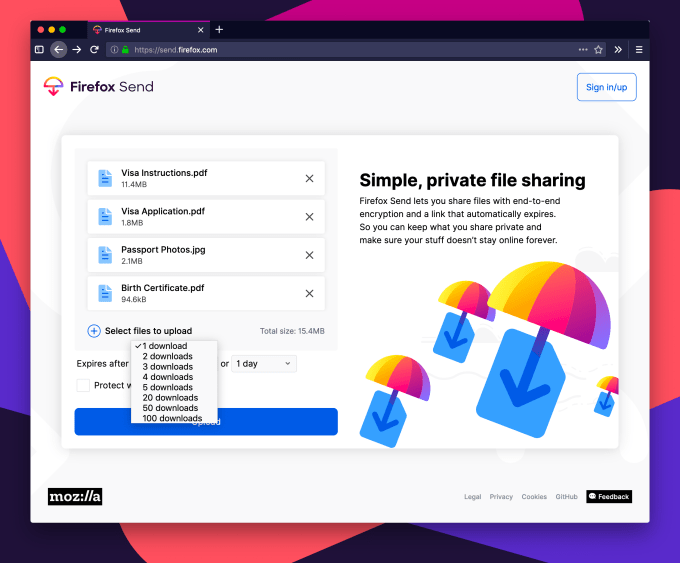
Firefox Send, Mozilla’s free, encrypted file transfer service, is officially launching to the public today following its debut as a “Test Pilot” experiment back in August 2017. The service allows web users to share files up to 2.5 GB in size through the browser, while protecting them with end-to-end encryption and a link that automatically expires to keep the shared files private.

When Mozilla first began testing the web-based Send tool, file shares were limited to 1GB. Today, that remains the limitation until users sign up for a free Firefox account. They can then opt to share files up to 2.5GB.

The system is offers an alternative to email, where larger file attachments are more of an issue, as well as cloud storage sites, like Google Drive and Dropbox, which can be time-consuming when all you need to do is share a single file one time – not store the file, edit it, or collaborate with others.

To use the service, the sender visits the Send website, uploads the files, and sets an expiration period – a design choice seemingly inspired by Snapchat, and its concepts around ephemerality. You can also opt to have the files protected with a password before sending.

Firefox Send then offers a link you can give to the recipient however you see fit, which they simply click to start the download. They will not need a Firefox account of their own to access the files, Mozilla notes.

The organization suggests that the new tool could be used for moving files around the web that you otherwise had worried about sharing – like financial information, for example.

However, security experts would still caution the use of any tool for sharing highly sensitive files through an online service, as there’s always the potential that something could go wrong with regard to unauthorized access.

That said, Mozilla is one of the more trustworthy organizations when it comes to things like this. Send, it says, is “Private By Design,” which means all files are protected. It designed Firefox accounts so users never send Firefox their passphrase, for example. It also says it stands by its mission to “handle your data privately and securely,” writes Mozilla in an announcement today. That speaks more to the organization’s ethos – that it believes privacy is a fundamental right.

Still, security experts need to test systems first-hand before signing off on their trustworthiness. As Send is only this morning debuting in its official, public iteration, that hasn’t yet been done.

The new tool could help Firefox attract a new audience to its web tools and services. Firefox was once a top web browser and household name, but its market share declined over the years as the built-in options from larger tech companies took hold – like IE, Safari and Chrome. However, with people’s increasing suspicion of big tech, as well as far-too-frequent data breaches, and the overall decline in online privacy, it’s the best time for Firefox to try to stage a comeback. Whether it will actually be able to deliver is another matter.

Firefox Send is launching today on the web at send.firefox.com and will be available as an Android app in beta later this week.

12 Mar 2019

Goalsetter gives parents a way to teach their kids how to save money

When the bubble burst in the year 2000, Tanya Van Court lost over $1 million in stock and options over the course of a few minutes. Then and there she vowed to never let something like that happen to her children.

Five years later, her daughter Gabrielle was born. At the time, she was a VP of Digital Product Dev at ESPN. She then went on to work as SVP of Digital Products, Parenting & Preschool for Nickelodeon and, in 2013, moved to SVP of Marketing at Discovery Education, leading the charge to roll out digital textbooks nationwide.

Today, she runs Goalsetter, an app that allows parents and their kids to replace gift-giving with goal-giving.

It started when her daughter Gabrielle was eight years old. Van Court told her daughter that if she could save $100, Van Court would match that $100 and start her an investment account. After learning how exactly an investment account works, Gabrielle decided all she wanted for her ninth birthday was a bike and an investment account.

“I thought that these are amazing things for a nine-year-old to want, but she was going to get all kinds of stuff she didn’t want or need instead,” said Van Court. “I realized how early consumerism starts. We all have more and more and more and value things less and less and less.”

After conversations with fellow moms, Van Court got to work on Goalsetter. The app has two main branches: a savings account for kids and a financial literacy learning center with fun quizzes.

Kids and parents together sign up for the app, where kids input some of their goals, from college tuition to a new bike or gaming console. Kids can then earn their allowance through the app, and can also receive ‘GoalCards’ (replacing a gift card) from parents and relatives to save towards their goals.

Moreover, parents can round-up their debit card swipes to go towards their kids bigger goals, such as college tuition or a first car. Parents can also set up auto-save to set aside a few dollars each month.

[gallery ids="1796089,1796090,1796091,1796092,1796093"]

“Moms in particular all feel the pain of their kids having too much stuff,” said Van Court. “When they step on yet another lego in the house or go into the kids room to find 80 toys, only five of which they play with, these become daily pain points for moms. The idea of teaching kids how to save instead of teaching them how to acquire more stuff really resonates with moms.”

Goalsetter also offers a financial literacy quiz game called “It’s LIT” that is mapped to financial literacy standards for K – 12. The game uses pop culture memes, song lyrics, etc. to engage kids while teaching them the fundamentals of personal finance. Parents can choose to reward their kids with money toward their goals for each question they get right.

What’s more, Goalsetter has plans to launch “It’s LIT” as a curriculum to school districts, complete with lesson plan materials, quizzes and more.

Alongside the curriculum, Goalsetter makes money by charging a dollar for every GoalCard sent through the platform. Goalsetter donates 5 percent of its transaction fee to children’s related charities. The company also has a donation function that allows users to pay the company whatever amount they find appropriate for the features offered.

Gaolsetter skews a bit younger than some of its competitors, including Current, Greenlight, and Step.

Goalsetter currently has more than 20,000 users and was recently featured on Shark Tank — Van Court turned down Mr. Wonderful’s investment offer.

The company graduated from the Entrepreneurs’ Roundtable Accelerator in 2017 and has raised a total of $2.1 million, including investment from Morgan Stanley, CFSI sponsored by JP Morgan Chase, Pipeline Angels and Backstage Capital.

“When the bubble burst, I had to learn the hard way that what goes up can actually come down,” said Van Court. “Our mission is to teach children that money has real value that can go towards the things you want to accomplish in life, and to people who are in need of it.”

12 Mar 2019

Truepill, the ‘AWS for pharmacies,’ gets $10M from Initialized Capital

Venture capitalists’ latest on-demand delivery bet is in the pharmaceutical space.

Truepill, an online pharmacy powering delivery for the likes of Hims, Nurx, LemonAID and other direct-to-consumer healthcare brands, has nabbed a $10 million Series A from early-stage VC fund Initialized Capital. The investment brings the Y Combinator graduate’s total raised to $13.4 million. Y Combinator, Sound Ventures, Tuesday Capital and others participated in the round.

Founded in 2016, the San Mateo-based startup employs 150 workers and plans to expand its team and fulfillment facilities into the U.K. with the fresh funding. Truepill is currently active in all 50 states and has delivered 1 million subscriptions for birth control, erectile dysfunction medication, hair loss treatment and more.

It is, as co-founders Sid Viswanathan and Umar Afridi explained, Amazon Web Services for pharmacies.

“We are really only scratching the surface of where this telemedicine landscape is going to go,” Viswanathan, who became a product manager at LinkedIn after the social network acquired his transcription service CardMunch, told TechCrunch. “We are catering to this first wave of those companies and we want to be that pharmacy fulfillment service powering that entire shift … We want to build the next generation of pharmacy infrastructure.”

Afridi, for his part, previously spent more than a decade as a pharmacist at retail chains like CVS and Fred Meyer.

In addition to operating a prescription delivery service, Truepill provides a set of APIs that give its customers programmatic access to its pharmacy and allows brands to fully customize packaging.

Foundation Capital, Index Ventures, Social Capital, Box Group and Joe Montana are also Truepill stakeholders.

12 Mar 2019

Investing app Stash raises $65M, launches banking and ‘stock-back’ rewards with Green Dot

Stash, the fintech startup and app that aims to introduce new people to the world of investing, is unveiling some interesting new services while also announcing that it has raised more funding to expand its business. The company is introducing mobile-based banking accounts from Green Dot Bank; and alongside it, a new rewards program it is called “Stock-Back”: when users spend money using their Stash accounts, they get “points” — which are either stocks in the companies where they are buying goods, or shares in ETFs approved by Stash. On top of that, Stash also said that it raised a Series E of $65 million that it will be using to grow its business on the back of these two launches.

A spokesperson for the company said that Stash is not disclosing the full round of investors in this round, which is coming at upwards of a $405 million valuation (Stash was valued at $350 million post-money in its Series D, according to figures from PitchBook).

But from the looks of it, the $65 million appears to include participation from Breyer Capital, a previous investor whose founder Jim Breyer has heartily endorsed the new Stock-Back service and accompanying loyalty program that’s tied in with it, which was tested early with companies like Netflix, T-Mobile and Chipotle all offering stock when people used their Stash accounts to pay for goods and services at the companies.

“I have invested in and served on the Board of many leading companies, and it’s clear how a program like Stock-Back can power immense brand loyalty,” he said in a statement. “The early data shows unequivocally that share ownership drives increased sales and customer appreciation. This innovative new technology from STASH will have CEOs and CMOs knocking on their door.”

From what we understand, the round was led by a private institutional investor and includes 40 percent existing and 60 percent returning investors. Previous backers in addition to Breyer include Union Square Ventures, Coatue Management, Entree, Goodwater and Valar. “We’re really excited and proud to be working with this incredible group of VCs,” the spokesperson noted.

The Green Dot-powered banking service comes with the core features that will sound familiar to those who have used or looked at next-generation banking services before. It will include a debit-card based account, no overdraft or monthly maintenance fees, access to a network of ATMs that can be used for free, direct deposit services, as well as “personal guidance” for their financial planning activities, from saving to investing.

Stash is part of a wave of fintech startups — others include the likes of Robinhood, Acorns, YieldStreet, Revolut, and many others — that have tapped into the popularity of apps and the advent of new financial services technology to democratise how individuals can save, spend, invest, borrow and lend money, moving many of those operations and transactions out of the hands of the big incumbent players who used to control them.

The average age of a Stash user is 29 and average income is under $50,000 per year, and tying in transactions made using Stash’s banking service — by way of reward points that are being picked up incidentally — will make it even more seamless for these users to take some of their money and invest with it, while at the same time demystifying some of the process and making it more likely that those users will choose to invest even more down the line.

The idea of tying investments to what you are actually purchasing is a clever one. For a startup whose user base includes no-nonsense professionals from fields like teaching, nursing, and retail, this is the embodiment of putting your money where your mouth is — literally speaking, since the investments can include things like shares in Chipotle each time you buy food there; and T-Mobile every time you pay your phone bill for all the talking you do.

Stash is layering the stock incentive with what sounds like an interesting tie-in with rewards and loyalty services as well, with discounts on goods as high as five percent in some cases.

“80% of Americans are living paycheck-to-paycheck. Stock-Back is our way of utilizing STASH’s smart, patent-pending technology to help people build better financial habits and invest in their future,” said cofounder and president, Ed Robinson, in a statement. “Our ability to give customers the opportunity to save and build portfolios that mirror their spending behavior and preferences is incredibly powerful.”

12 Mar 2019

Pluto is travel insurance aimed at millennials

Pitched as “travel insurance for people who don’t like insurance,” U.K.-based Pluto Insurance is officially launching today with an online travel insurance product targeting millennials.

Citing research that says 40 percent of millennials don’t actually buy travel insurance, mistakenly believing that it isn’t required, the mobile-first offering not only attempts to demystify travel insurance, but is also unbundling it in a way that ensures you only pay for the cover you need or desire.

“We’ve spoken to hundreds of millennials and three things keep coming up,” says Pluto co-founder and CEO Alex Rainey. “Travel insurance is too complicated and it’s hard to know what you’re actually buying. Secondly, a lot of younger people don’t think they need it. But most importantly, there is a distinct lack of trust towards insurers, and it’s easy to see why. With exclusions buried in the fine print and insurers expecting people to print out a claim form and post it in”.

To remedy this, Rainey says Pluto wants to make travel insurance more tailored, letting you build your own policy online. “We work hard to make sure everything is easy to understand, ensuring we always explain our cover in plain English,” he says. The startup also lets you submit a claim via the mobile web app “in under 10 minutes”.

Insurance options includes gadget cover, baggage cover, cancellation cover, level of excess, cover for certain activities and travel disruption. As you add more cover, the price of your insurance changes in real-time with each decision. Once you’ve built your policy, a short summary of your cover is displayed before you go ahead and purchase.

Meanwhile, the insurance itself — which, at launch, doesn’t cover pre-existing conditions, although that will be offered in the future — is in partnership with Zurich, which Rainey says was chosen because they had a 99 percent claims payout rate in 2017. “This is so so important for us to solve the trust issues in insurance,” he adds.

To that end, Pluto integrates with Facebook Messenger, including letting you use the messaging app to start a claim. You can also search your policy, check a summary of your cover, or chat to a Pluto team member.

“Our customers want to do everything from their phone, when and where they want. We’ve made sure that’s possible,” says Rainey.

12 Mar 2019

Twitter launches its first podcast, ‘Character Count,’ focused on its ad business

Twitter today is joining the podcasting arena. This morning, the social network is launching its first-ever podcast series with a new show focused on Twitter’s advertising business, which it’s calling “Character Count.” The company says, for now, it’s testing the waters with five already-produced episodes of around 25 to 30 minutes in length. It plans to wait to record more shows after getting the crowd’s reaction to the first few episodes, so it can make adjustments if need be.

The podcast will be hosted by Joe Wadlington, a marketer at Twitter who’s specifically supporting Twitter’s Business initiatives.

Each episode will involve talking to people behind the scenes of some of Twitter’s advertising stories, including the Monterey Bay Aquarium (@MontereyAq), Dropbox (@dropbox), and Simon & Schuster (@SimonBooks). The companies will speak about how they built effective ad campaigns and why Twitter’s audience mattered to them. The goal, says Twitter, is to offer others in the industry a look into which brands are “doing it right on Twitter,” and potentially spark more brands to do the same.

The launch of the podcast arrives when Twitter is trying to shift Wall Street’s attention away from the network’s stagnant user growth. Twitter recently said it would stop reporting monthly users, in favor of daily users, as a result of its inability to grow this key number. The change was announced in Twitter’s Q4 2018 earnings release, where the company said it had lost another 5 million monthly users in the final quarter of 2018 bringing its total down to 321 million.

Instead, Twitter wants more attention on its ability to turn a profit from the users it does have – as it did in Q4 for the fifth quarter in a row, and the fifth time ever. Its Q4 revenues were $909 million, which were more than the expected $868.1 million and up 24 percent on the year ago quarter. Advertising accounted for 87 percent of those revenues, Twitter said. It’s no surprise, then, that Twitter now wants to help advertisers learn from others succeeding in this space and grow that figure further.

Twitter is not the only company that’s tapping into the popular audio format of podcasting to talk to advertisers and marketers more directly.

In January, Facebook also launched its first U.S. podcast with a series focused on entrepreneurship – the larger, unspoken goal being to position Facebook as a place where entrepreneurs come to advertise their business. And somewhat related, LinkedIn debuted LinkedIn Live, a new video broadcast service which gives people and organizations the ability to stream real-time videos to groups in a sort of cross between YouTube Live and video podcasting, perhaps.

Twitter, like Facebook and LinkedIn, will not be running other ads within its programming. That makes sense, as the podcast itself is effectively an ad for Twitter’s business and advertising tools.

New episodes will debut every two weeks on Apple Podcasts, Google Podcasts, Spotify, TuneIn, and Stitcher.

12 Mar 2019

NVIDIA and OpenAI’s capped returns

Editor’s note: Starting as a trial, the Extra Crunch Daily newsletter is going to be delivered Tuesday-Saturday, in order to faithfully analyze the happenings in the startup and financial world Monday-Friday.

Open AI’s capped returns

OpenAI announced yesterday that they are going to be offering a “capped return” security for investors as part of the for-profit/non-profit split the organization is creating:

As mentioned above, economic returns for investors and employees are capped (with the cap negotiated in advance on a per-limited partner basis). Any excess returns go to OpenAI Nonprofit. Our goal is to ensure that most of the value (monetary or otherwise) we create if successful benefits everyone, so we think this is an important first step. Returns for our first round of investors are capped at 100x their investment (commensurate with the risks in front of us), and we expect this multiple to be lower for future rounds as we make further progress.

I candidly don’t understand this structure at all. For venture capitalists — and particularly early-stage investors — returns are driven by one, maybe two, and extremely rarely three startups in a portfolio (that would be Benchmark’s 2011 fund, which includes Uber, Snap, and WeWork). That one outlier investment may drive a majority of all fund returns. If OpenAI were to be that investment, how you could you possibly relinquish the remaining upside? Maybe you could prospectively sort of accept this, but how would you explain to LPs that “ah, yes, seven years ago we decided to give up that next 150x” or whatever.

OpenAI LP (the for-profit entity) is trying to target more mission-oriented investors, who presumably value incentive alignment but not (huge) profits. That’s fine, but the idea of capping a return as a mechanism to capture run-away value creation seems really off to me and should be discouraged.

My colleague Devin Coldewey also had a negative take, but sort of in the opposite direction — that OpenAI “may not be quite so open going forward” and is going to focus more on profits than science. That’s a fair criticism as well, although I think the profit motive will get us to AGI faster.

You’re reading the Extra Crunch Daily. Like this newsletter? Subscribe for free to follow all of our discussions and debates.

With Mellanox deal, NVIDIA buys a chance to salvage its growth
Photo by David Becker/Getty Images

Written by Arman Tabatabai

NVIDIA confirmed whispers Monday when it announced it was acquiring adjacent semiconductor player Mellanox for $6.9 billion. Mellanox specifically focuses on interconnects and networking components that transfer data between cloud compute and storage resources.

The strategic rationale for NVIDIA is fairly straight-forward despite being a little outside of the company’s core competency. As we’ve discussed a few times before, NVIDIA got absolutely crushed towards the end of last year as the company struggled to find growth while facing headwinds from a dried up crypto market, a testy geopolitical backdrop, customer erosion, and increased competition. NVIDIA cuts its sales guidance by $500 million in the last quarter which, as the NYT pointed out, CEO Jensen Huang called “a real punch in the gut.”

NVIDIA has been betting the farm on diving into the data center, cloud computing, and supercomputer/AI markets that require parallel computation well served by NVIDIA’s graphical processing unit (GPUs). With Mellanox, NVIDIA will not only gets access to a segment with higher margins than its current operations but will, more importantly, be able to offer solutions across the full compute stack for data storage and AI/ML.

As TechCrunch’s Ingrid Lunden put it:

“While NVIDIA has focused its energies on computing, Mellanox works across Ethernet and other networking technologies — complementary areas for the two when addressing new computing and data transfer challenges brought about with the rise of AI, cloud services, an explosion of smartphone and other connected device usage and as-yet nonexistent tech like self-driving cars, which will put even more strain on our data infrastructure.”

The deal had been fairly well-telegraphed prior to the official announcement and is expected to be cash and earnings accretive. And the purchase price doesn’t appear to be too outlandish either — especially given a bidding process Huang described as “very competitive” — coming in slightly below the over $7 billion NVIDIA was rumored to be offering in order to outbid Intel, Xilinx, and Microsoft, all of whom had been linked as potential buyers during the past year in which Mellanox has reportedly been up for sale .

Notably, Intel seems to have missed out again here during a time where the company has been pouring money into R&D trying to play catch-up after struggling in recent years to keep up with the industry’s transition to new technologies.

NVIDIA stock was up around 7% on the day and Mellanox traded up to roughly $118 — just below the $125 per share acquisition price — with the market seemingly baking in a five-to-six percent chance of the deal not going through given the US government’s increased scrutiny on the global chip industry and pushback seen in prior semiconductor transactions. While a rejection of the deal would certainly be negative for NVIDIA, the company would only have to cough up a termination fee of $225-$350 million if the deal is blocked by shareholders or regulators and both leadership teams seem to be on board.

For NVIDIA, it seems like a small price to pay for a new shot at growth and a chance to quickly gain share in an increasingly competitive market.

Where is China’s new NASDAQ?

Photo by JOHANNES EISELE/AFP via Getty Images

China has a money problem (well, it has a lot of money problems, but let’s just focus on one for today). The country has produced a dizzying array of global-scale technology companies, including Alibaba, Tencent, and many more. The problem is that these startups grow up in China, but perform their IPO debuts overseas, typically in New York and also often in Hong Kong. There are a whole lot of reasons why this happens, but it annoys the hell out of the senior Chinese leadership.

So the Shanghai Stock Exchange, one of the two leading markets in the country, has been working with regulators to introduce a “NASDAQ-style” trading board that would have fewer rules on new issues. Those more lenient rules would include allowing companies to be unprofitable at IPO and to allow for multiple share classes, presumably with differential voting rights. In other words, they are designed for Silicon Valley-style startups.

We learned last week that the board’s introduction will come near the end of May, and it unveiled a nearly final set of rules for the new exchange last week. That’s months late though, since back in December, the exchange had said that new equity issues could begin trading as early as March.

The reason all of this minutia matters is because of Ant Financial . The Chinese fintech company was last valued at $150 billion, and its IPO, which has been rumored for months now, will be one of the major financial blockbusters of the year.

Where Ant Financial chooses to debut is a hugely important question for these exchanges, and for getting a read on the future divide between U.S. and Chinese capital markets. At its scale, it could almost single-handedly christen Shanghai’s new board, and indeed, it is rumored that the company wants to do just that. Certainly the Chinese government wants the company to trade locally.

So the question is whether it has the time to wait for Shanghai to get all of its pieces in order, while also ignoring the large capital markets in New York, London, and Hong Kong that would almost certainly have to be tapped for a company its scale.

LinkedIn’s failures in China
Illustration by Bryce Durbin/TechCrunch

It’s not every day you get a direct takedown of a product by that product’s former leader. But over the weekend, former LinkedIn China president Derek Shen blasted the company’s approach to China, according to a translation by Jill Shen at TechCrunch editorial partner TechNode (who I presume is unrelated):

“It’s horrible that the LinkedIn product managers don’t even realize they have lagged way behind a list of new social networking services such as WeChat, feeling good about themselves instead,” said Shen in a LinkedIn post on Monday. The former LinkedIn executive said that he tried to improve the platform when he joined the company six years ago, but struggled to make progress as it involved so many stakeholders within the organization.

(Of course, knocking LinkedIn’s product is a favorite pastime of pretty much any worker in Silicon Valley today).

LinkedIn first took China seriously in early 2014, and has had reasonable success in the interim, growing to around 41 million users. LinkedIn is unique among Western-run social networks in having (any) access to the Chinese market — essentially no other major network (including Twitter and Facebook) has passed through the Great Firewall.

Yet, its fortunes appear to be turning. LinkedIn, which is owned by Microsoft, is feeling a bit of a pincer from both Chinese and Western critics. The professional network has followed the censorship edicts of Beijing, much to the chagrin of human rights organizers. It has also added in a real name requirement linked to mobile phone numbers, which is now mandated by the government.

Meanwhile, domestic competitors like Maimai (脉脉) and Zhaopin (招聘) are building traction with more native products, to Shen’s point above. Maimai in particular has raised hundreds of millions in venture capital and is rumored (like all late-stage companies) to be targeting an IPO.

We talk a lot about the market-entry barriers that China’s government has placed on Western tech companies, but at least when it comes to consumer apps, it is also important to note that product cultural awareness doesn’t come instantly. Even if China’s markets opened tomorrow, these apps would still have to compete in the marketplace, and there is no guarantee that Chinese professionals want garbage InMail offering “growth services” any more than Silicon Valley workers do.

Eliot Peper and “narrative responsive design” on the web

Novelist and strategist Eliot Peper gave Extra Crunch readers a lengthy reading list of great speculative fiction a few weeks ago to help inspire the creation of startups. Now, one of his major projects has been published.

A few years ago, Peper published True Blue, a short story about discrimination in which people’s life outcomes are determined by the color of their eyes. It’s a parable to our own world, infested with the kind of speculative details that Peper is known for.

After publishing the short story, he teamed up with Phoebe Morris and Peter Nowell to bring a fully-illustrated and responsively-designed version of the story to life, with some funding from TechStars founder David Cohen.

What’s quite exciting about this project is seeing how artists are using the web as a deeper narrative platform. From Peper’s discussions of how the team made the product:

One of the counterintuitive lessons we learned was how powerful it is to obscure certain details, letting readers bring more of their imagination to the story. Specifically, we discovered that detailed lines often trigger the sense of something being depicted for you, so we smudged and faded and shadowed until we felt the right balance of detail and suggestion. This philosophy carried through to design — which so often aims to reduce tension by making experiences simple, intuitive, and convenient. But stories thrive on conflict, and Peter challenged himself to use design to evoke tension instead of erasing it.

He even engineered a new tool that cropped images so that they adapted to different devices and screen sizes not only by changing size, but actually changing image composition to preserve narrative content and emotional impact. When I told him about the project over a slice of Arizmendi pizza, author/friend/media experimenter Robin Sloan coined a term for this new technique: Narrative Responsive Design.

A lot of work yes, but the wait and effort I think are worth it. Read the story and learn more about the process of making it.

Editor’s Note

  • We are slowing down a bit on the infrastructure side that we have been discussing ad nauseam.

Thanks

To every member of Extra Crunch: thank you. You allow us to get off the ad-laden media churn conveyor belt and spend quality time on amazing ideas, people, and companies. If I can ever be of assistance, hit reply, or send an email to danny@techcrunch.com.

This newsletter is written with the assistance of Arman Tabatabai from New York

You’re reading the Extra Crunch Daily. Like this newsletter? Subscribe for free to follow all of our discussions and debates.

12 Mar 2019

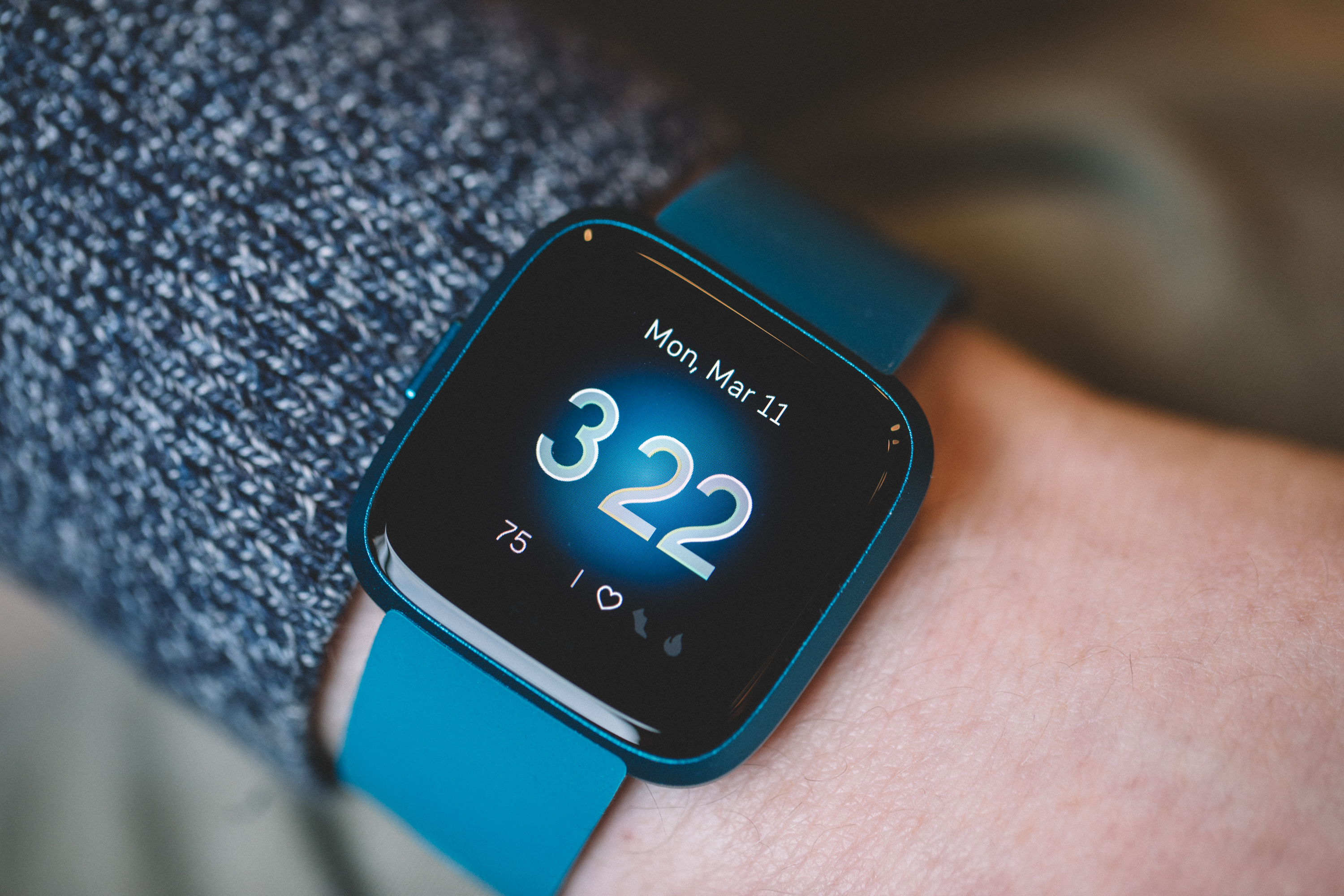
Fitbit Versa Lite review

It’s a tricky proposition for a product launch: last year’s model, but with fewer features. But sometimes the rules of consumer electronic update cycles were made to be broken — or at the very least, a little bent.

Last year’s Versa was itself a paring down from the company’s first true smartwatch, the Ionic. In that case, things worked out great. We were…less than enthusiastic about the device when it first hit, and by all accounts, it wasn’t the sort of runaway success Fitbit was counting on to right the then tenuous ship.

But Versa arrived with fixes to some of the product’s biggest issues — name pricing and size. Fitbit’s second take on the category was a much more immediate hit. The device has propelled the company to the number two smartwatch spot here in the U.S., behind you know who. It’s precisely the success story the company needed.

The Versa Lite finds the company dropping the entry-level price point even further, down from $200 to $160. That’s less than half the price of an Apple Watch Series 4 — an extremely tempting proposition for anyone who has been eyeing a Cupertino timepiece but has ultimately been too put off by the price tag to pull the trigger.

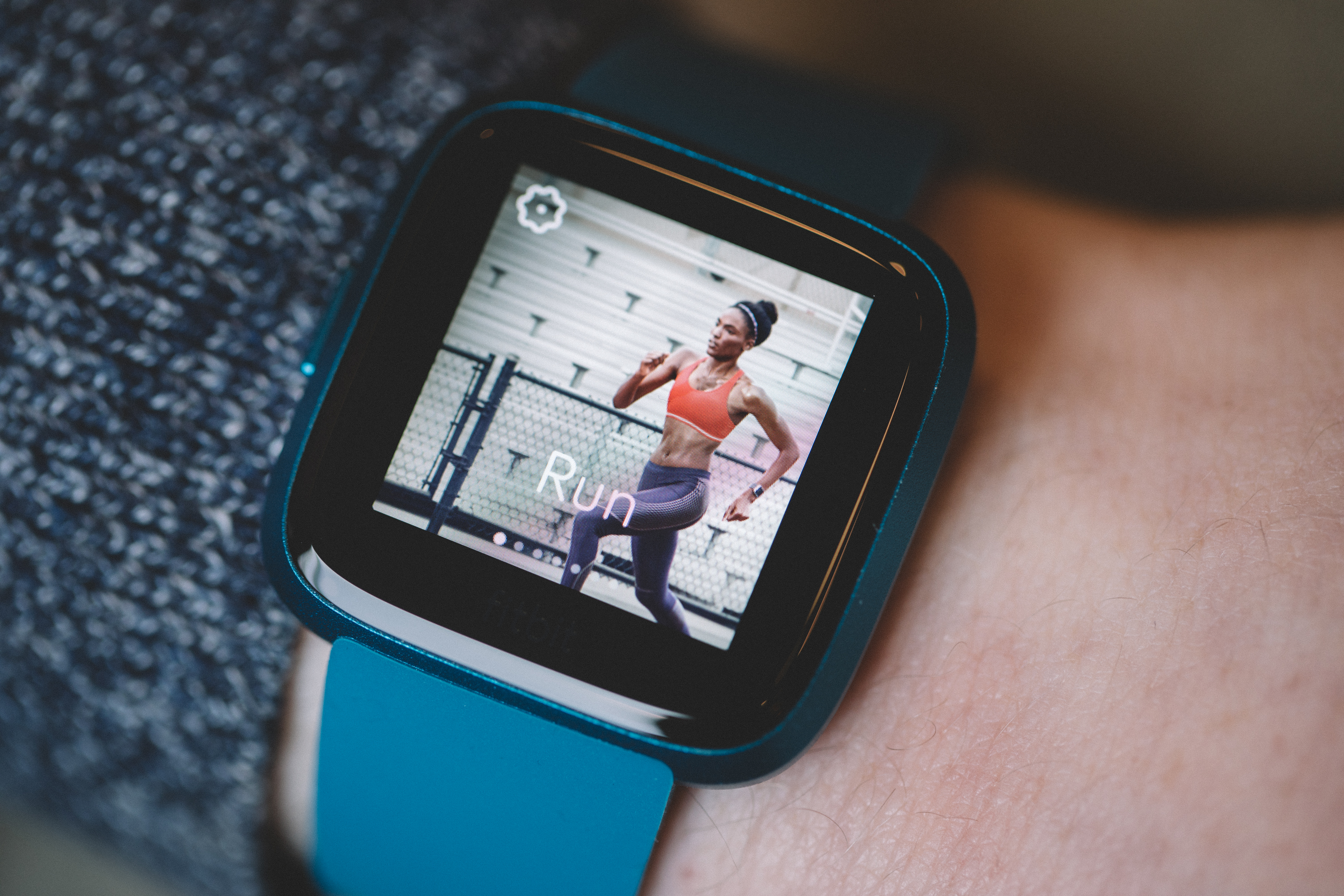
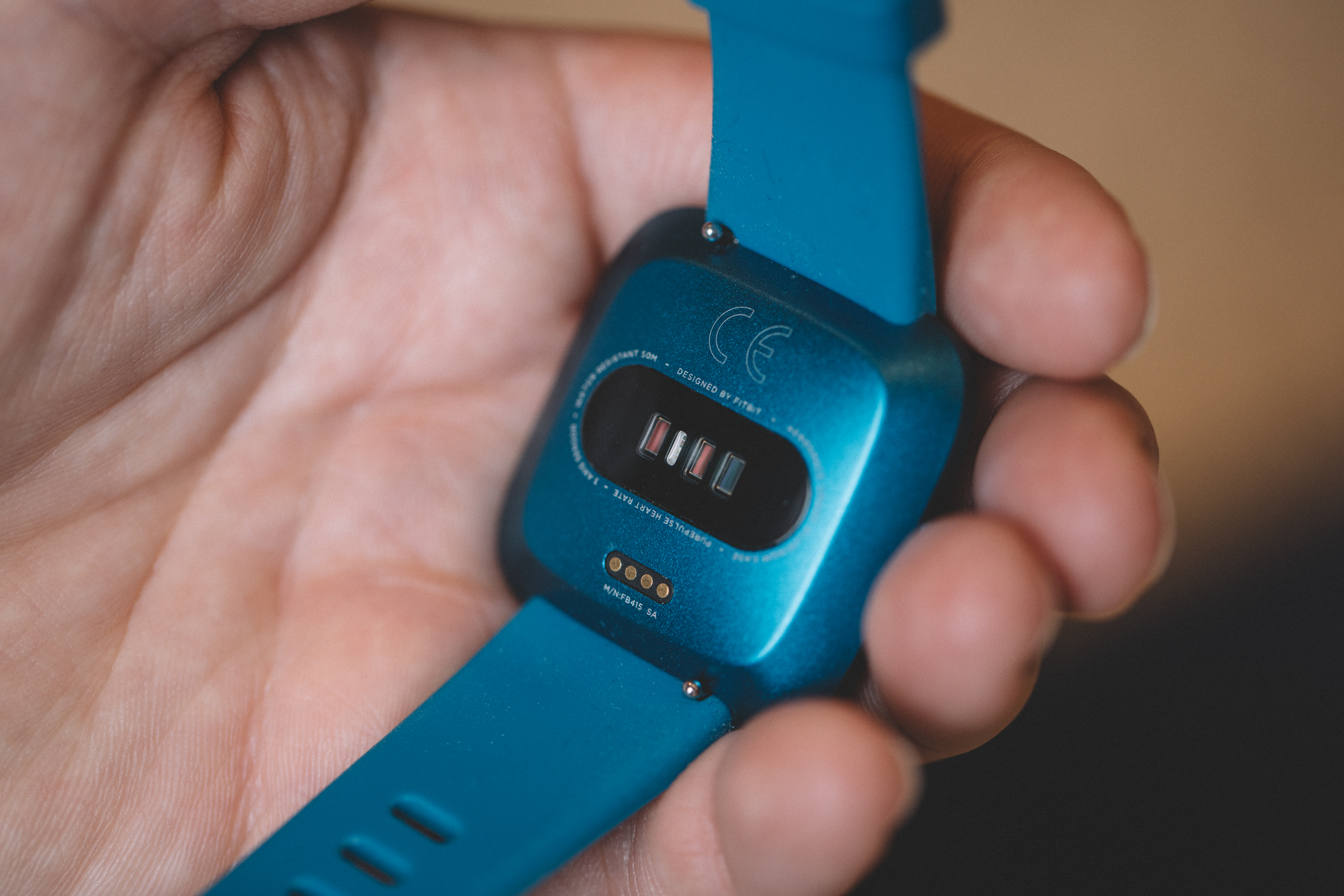
The new device looks nearly identical to the full version, save for its loss of a couple of buttons. And really, it’s the features that the product doesn’t have that are the most important to this story. So let’s break those down.

  1. Altimeter: Meaning the Lite doesn’t know how many steps you’ve climbed.
  2. Lap Tracking: You can still swim with the Lite, but it won’t tell you how far.
  3. Fitbit Coach: Those coaching videos won’t work on the watch.
  4. Fitbit Pay: No NFC chip.
  5. Music storage.

If none of those are jumping out at you, congrats. You just saved $40, because you, my friend, are the target demographic. It feels nice to be wanted, even if it’s just by a company trying to sell you gadgets.

I’ll be honest, none of those are jumping out at me as things I would truly miss (though your mileage will almost certainly vary). The last two jump out most among the lot. They’re probably the two most important features for those interested in leaving the smartphone at home. I’ve long been convinced this is a fairly small portion of the overall market — especially when you factor out a smartwatch with built-in LTE.

In a recent interview, CEO James Park told me that the Lite is the result of conversations with the company’s user base — weighing which features are the most important and worth sacrificing in the name of keeping the price down. Even more than that, however, I think the device is a testament to Fitbit zeroing in on the Versa’s real appeal: being a low-cost alternative to Apple and Samsung wearables.

In other words, the Lite makes the most sense as a stepping stone positioned somewhere between Fitbit’s highest-end tracker and the full-fledged version. It’s a product designed for people looking to get more out of their products than the company’s monochrome wearables are capable of delivering, and, more importantly, it’s a mere $10 more than the Charge 3.

It’s frankly a tough deal to resist.

Of course, all of the complaints about the original Versa still stand (but for those that were tied to features that aren’t present). There’s no GPS, the UI is almost too simple and the app selection is still lacking.

On the last front, things will continue to improve, at least. The company has demonstrated that it’s a force to be reckoned with among the smartwatch set, so eventually there should be more marquee additions. For now, however, it still means slim pickings.

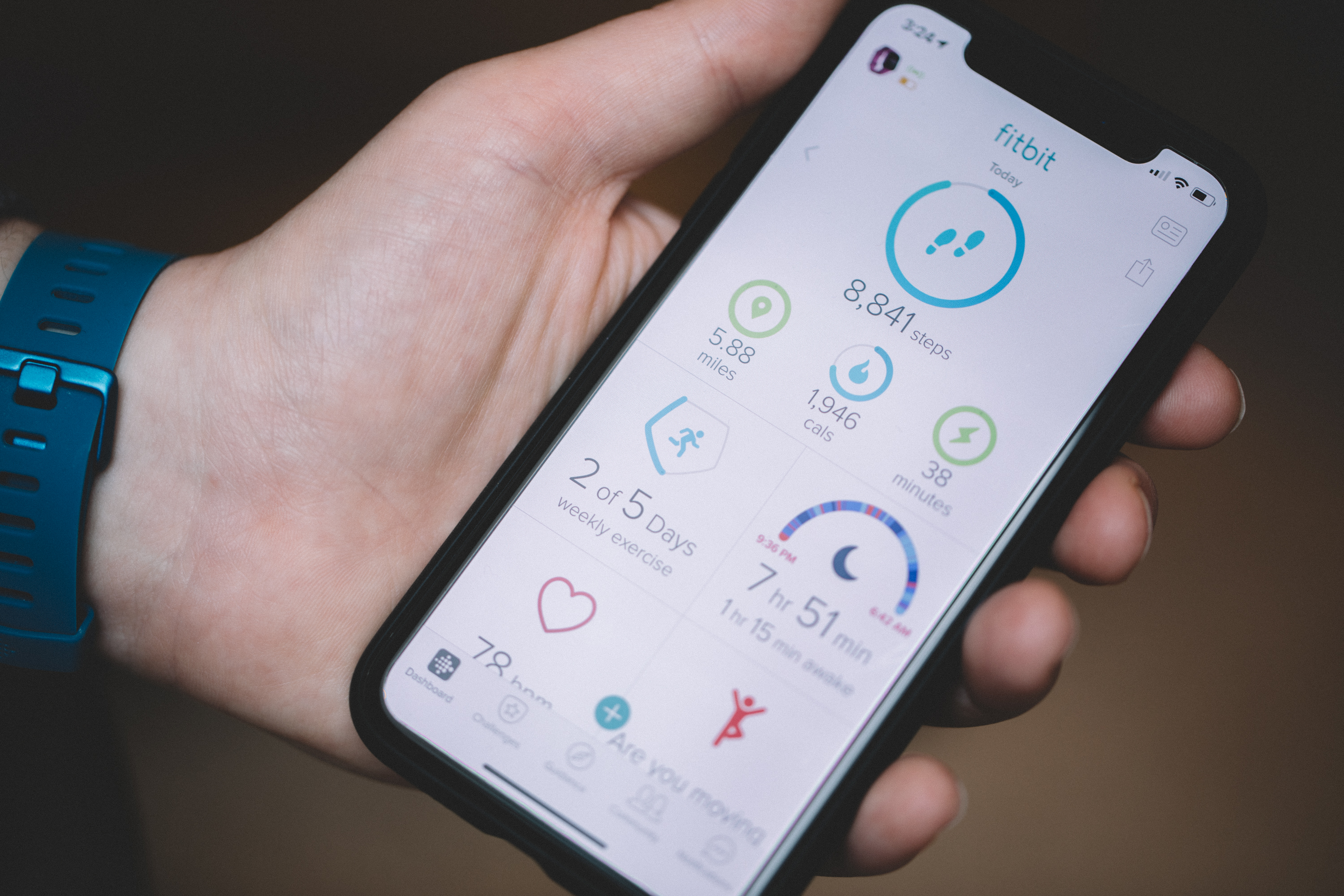
The one place that’s less true is on the fitness/wellness front, simply because Fitbit has spent years refining its own offerings. The product offers an insightful peek into movement, sleep and the like, with detailed breakdowns accessible via the app. Like a weirdo, I’ve been wearing both the Versa Lite and Apple Watch Series 4 on my wrist for a few days and found the step counts close enough to be within the margin of error.

The Versa does a good job determining the differences between running, walking and the treadmill — though I did miss the auto-tracking notification that pops up on the Apple Watch when it detects a workout. And unlike the Series 4, there’s no EKG/ECG option here — though again, pricing is a part of that. As is, frankly, the speed with which the company had to launch a smartwatch team.

The size and shape are great. A smaller version for smaller wrists would have been nice, but it’s compact enough to fit on a lot more body sizes than many of the clunky smartwatches currently crowding the market. It also looks nice, with a minimalist design that brings to mind nothing more than a squat, squircle Apple Watch with a more plasticky finish. As for the battery, that’s stated at four days. I haven’t been wearing the device that long, but I’m going on multiple days already without having to charge it up. So far, so good.

The biggest disappointment with the Lite is that it’s not the Versa 2. It’s nice to see a company like Fitbit reverse its fortunes, and the acquisitions that led to these new smartwatches are arguably the single-biggest driver.

The Ionic represented a bit of a swing and a miss, while the Versa was a solid line drive. That makes the Lite a bit of a bunt. It’s not bad. The players advance, but more than anything, it leaves you wondering what’s up next in the lineup.