Author: azeeadmin

11 Mar 2019

Meituan confirms Mobike’s retreat from most overseas markets

TechCrunch reported last Friday that Mobike has scrapped operations across the Asia Pacific region as a key step towards a long-term plan to scale back its international business. On Monday, its parent company Meituan confirmed that the pioneer in China’s bike rental sector will shut down most of its foreign markets.

“Mobike international business is undergoing restructuring, which will result in the closure of most international markets,” Meituan’s chief financial executive Chen Shaohu told analysts on a conference call on Monday.

The decision came as Meituan plans to further narrow the operating loss of Mobike, added the executive. Mobike has lost 4.55 billion yuan ($680 million) since April 4, 2018 when Meituan, the app that aspires to be the “Amazon for services”, bought it out. That compares to the 1.5 billion yuan ($220 million) the bike service generated in revenues over the same period, notes Meituan’s earnings latest report.

Backpedaling from foreign markets is also consistent with Meituan’s long-held strategy to stay focus on China. The Beijing-based firm earns most of its income by ferrying food and providing travel booking services inside its home country, and international expansion never seemed to be on the cards.

“Meituan has no international division of any shape or form and probably doesn’t want one, and when it acquired Mobike, it acquired the international arm,” the Financial Times reported earlier citing sources.

When inquired by TechCrunch on Monday about its international plans for Mobike, Meituan curiously directed us to the bike business. A spokesperson from Mobike confirmed it will shut down “in some markets, particularly in certain Asia countries” but “international operations will continue in North-East Asia, Latin America and Europe.”

“Looking ahead, we are continuing discussions with potential strategic partners to maintain sustainable International business,” the spokesperson added.

Tipsters who told us about Mobike’s withdrawal from APAC found the statement “vague” and saw it as a gesture to placate the public. One needs to also remember that APAC is Mobike’s major foreign market, so a retreat from the region is a telling sign of the bike unit’s global plans, save for Meituan’s ballooning losses that may spur a further rollback of its money-burning, non-core businesses.

While Meituan’s revenues from the fourth quarter almost doubled to 19.8 billion yuan ($2.94 billion), net loss widened to 3.4 billion yuan ($510 million) from 2.2 billion yuan a year ago. Investments in “new initiatives,” which include bike sharing and car-hailing, have “tempered” the firm’s rising profitability. Meanwhile, its core units of food delivery, in-store services like software for restaurant owners, and travel booking earned positive operating profits in 2018.


11 Mar 2019

AT&T to revamp DirecTV Now with new plans bundling in HBO, price hikes

AT&T CEO Randall Stephenson said in December the company would soon adjust the content mix on its DirecTV Now streaming service and raise the monthly subscription to around the “$50 to $60” point – meaning, at least $10 per month more than it is today. This week, AT&T is preparing to follow through on those plans by increasing the prices for its existing tiers by $10 per month. It’s also launching two new packages to replace its existing multi-tiered lineup, both of which bundle HBO into their channel lineups.

This is not the first time AT&T has leveraged HBO to entice streaming subscribers – it has also tried bundling free HBO in its wireless plans, and is preparing to launch its own WarnerMedia streaming service which will include HBO along with movies and other original content. 

The news of the DirecTV Now plan changes was first reported by Cord Cutter News. We’ve since independently confirmed the report’s accuracy.

Currently, DirecTV Now offers a variety of price points for its streaming TV service, starting at $40 per month for the Live a Little plan with over 65 channels. Its three tiers above that – Just Right, Go Big, and Gotta Have It – increase the lineup to 85, 105, or 125 channels, respectively, for $55, $65 or $75 per month. The service also offers a Spanish language-focused plan, Todo Y Mas, for $45 per month.

All of these packages are now being “grandfathered in” with the changes to DirecTV Now’s service and will no longer be offered to new subscribers. And all will see their prices increase by $10 per month.

The Brazilian International package, DirecTV Now Espanol, and other Premium channels will also see price increases, but not for customers who subscribed before March 12, 2019.

Existing DirecTV Now customers will be notified of these price changes in emails being sent out starting tomorrow, March 12. The increase will go into effect within 25 days of that notification.

In place of DirecTV Now’s currently multi-tiered service are two new plans: Plus and Max.

Plus will offer over 40 channels for $50 per month including local stations, sports and news along with ESPN, CNN, Fox News, Disney Jr., TNT, Hallmark Channel and Bravo, and premium networks HBO, HBO Family, and HBO Latino!.

Meanwhile, DirecTV Now Max will offer over 50 channels for $70 per month. This includes everything already in Plus, along with more national sports channels like CBS Sports Network, ESPNews, ESPNU, Fox Sports 2, Golf Channel, Olympic Channel, and Regional Sports Networks. On the premium front, Max will also include Cinemax.

In addition to the new plans, AT&T will launch streaming versions of its DirecTV packages: Entertainment, Choice, Xtra, Ultimate, and Optimo Mas. These are online-only versions of the plans, and may include fewer channels than offered to satellite TV customers.

Entertainment includes over 65 channels for $93 per month; Choice is $110 per month for over 85 channels; Xtra is $124 per month for over 105 channels; Ultimate is $135 per month for over 125 channels; and Optimo Mas is $86 per month for over 90 channels.

These pricing and plan changes should not be a surprise to those following AT&T’s news.

CEO Randall Stephenson told investors the company was planning to thin out the content available on DirecTV Now in order to keep only those channels that are “really relevant to customers.”

The pricing adjustments come at a time when AT&T’s streaming subscriber base is in decline. In its Q4 earnings, the company lost 267,000 DirecTV Now subscribers, ending the year with fewer customers (1.6M) than it had in Q2 (1.8M). With DirecTV Now’s promotional offers ending, some customers may have fled to rival services like Hulu with Live TV and YouTube TV, which now have a combined 3 million subscribers, according to Bloomberg.

AT&T declined to comment on the changes.

11 Mar 2019

Don’t break up big tech — regulate data access, says EU antitrust chief

Breaking up tech giants should be a measure of last resort, the European Union’s competition commissioner, Margrethe Vestager, has suggested.

“To break up a company, to break up private property would be very far reaching and you would need to have a very strong case that it would produce better results for consumers in the marketplace than what you could do with more mainstream tools,” she warned this weekend, speaking in a SXSW interview with Recode’s Kara Swisher. “We’re dealing with private property. Businesses that are built and invested in and become successful because of their innovation.”

Vestager has built a reputation for being feared by tech giants, thanks to a number of major (and often expensive) interventions since she took up the Commission antitrust brief in 2014, with still one big outstanding investigation hanging over Google.

But while opposition politicians in many Western markets — including high profile would-be U.S. presidential candidates — are now competing on sounding tough on tech, the European commissioner advocates taking a scalpel to data streams rather than wielding a break-up hammer to smash market-skewing tech giants.

“When it comes to the very far reaching proposal to split up companies, for us, from a European perspective, that would be a measure of last resort,” she said. “What we do now, we do the antitrust cases, misuse of dominant position, the tying of products, the self-promotion, the demotion of others, to see if that approach will correct and change the marketplace to make it a fair place where there’s no misuse of dominant position but where smaller competitors can have a fair go. Because they may be the next big one, the next one with the greatest idea for consumers.”

She also pointed to an agreement last month, between key European political institutions on regulating online platform transparency, as an example of the kind of fairness-focused intervention she believes can work to counter market imbalance.

The bread and butter work regulators should be focused on where big tech is concerned are things like digital sector enquiries and hearings to examine how markets are operating in detail, she suggested — using careful scrutiny to inform and shape intelligent, data-led interventions.

Albeit ‘break up Google’ clearly makes for a punchier political soundbite.

Vestager is, however, in the final months of her term as antitrust chief — with the Commission due to turn over this year. Her time at the antitrust helm will end on November 1, she confirmed. (Though she remains, at least tentatively, on a shortlist of candidates who could be appointed the next European Commission president.)

The commissioner has spoken up before about regulating access to data as a more interesting option for controlling digital giants vs breaking them up.

And some European regulators appear to be moving in that direction already. Such the German Federal Cartel Office (FCO) which last month announced a decision against Facebook which aims to limit how it can use data from its own services. The FCO’s move has been couched as akin to an internal break up of the company, at the data level, without the tech giant having to be forced to separate and sell off business units like Instagram and WhatsApp.

It’s perhaps not surprising, therefore, that Facebook founder Mark Zuckerberg announced a massive plan to merge all three services at the technical level just last week — billing the switch to encrypted content but merged metadata as a ‘pro-privacy’ move, while clearly also intending to restructure his empire in a way that works against regulatory interventions that separate and control internal data flows at the product level.

The Competition Commission does not have a formal probe of Facebook or the social media sector open at this point but Vestager said her department does have its eye on how social media giants are using data.

“We’re sort of hoovering over social media, Facebook — how data’s being used in that respect,” she said, also flagging the preliminary work it’s doing looking into Amazon’s use of merchant data. (Also still not yet a formal probe.)

“The good thing is now the debate is really sort of taking off,” she added, of competition regulation generally. “When I’ve been visiting and speaking with people on The Hill previously, I’ve sensed a new sort of interest and curiosity as to what can competition achieve for you in a society. Because if you have fair competition then you have markets serving the citizen in our role as consumer and not the other way around.”

Asked whether she’s personally convinced by Facebook’s sudden ‘appreciation’ of privacy Vestager said if the announcement signifies a genuine change of philosophy and direction which leads to shifts in its business practices it would be good news for consumers.

Though she said she’s not simply taking Zuckerberg at his word at this point. “It may be a little far-reaching to assume the best,” she said politely when pushed by Swisher on whether she believed a sincere pivot is possible from a company with such a long privacy-hostile history.

Big tech, small tax

The interview also delved into the issue of big tech and the tiny amounts it pays in tax.

Reforming the global tax system so digital businesses pay a fair share vs traditional businesses is now “urgent” work to do, said Vestager — highlighting how the lack of a consensus position among EU Member States is pushing some countries to move forward with their own measures, given resistance to Commission proposals from other corners of the bloc.

France‘s push for a tax on tech giants this year is “absolutely necessary but very unfortunate”, Vestager said.

“When you do numbers that can be compared we see that digital businesses they would pay on average nine per cent [in taxes] where traditional businesses on average pay 23 per cent,” she continued. “Yet they’re in the same market for capital, for skilled employees, sometimes competing for the same customers. So obviously this is not fair.”

The Commission’s hope is that individual “pushes” from Member States frustrated by the current tax imbalance will generate momentum for “a European-wide way of doing things” — and therefore that any fragmentation of tax policies across the bloc will be short-lived.

She also she Europe is keen for the Organisation for Economic Co-operation and Development to “push forward for this” too, remarking: “Because we sense in the OECD that a number of places in the world take an interest also in the U.S. side of things.”

Is the better way to reset inequalities related to big tech and society achieved via reforming the tax system or are regulators doomed to have to keep fining them “into the next century”, wondered Swisher.

“You get a fine when you do something illegal. You pay your taxes to contribute to society where you do your business. These are two different things and we definitely need both,” responded Vestager. “But we cannot have a situation where some businesses do not contribute and the majority of businesses they do. Because it’s simply not fair in the marketplace or fair towards citizens if this continues.”

She also made short shrift of the favored big tech lobbyist line — to loudly claim privacy regulation helps big guys because it’s easier for them to fund compliance — by pointing out that Europe’s General Data Protection Regulation has “different brackets” and does not simply clobber big and small alike with the same requirements.

Of course small businesses “don’t have the same obligations as Google”, said Vestager.

“I’d say if they find it easy, I’d say they can do better,” she added, raising the much complained about consumer rights issue of consent vs inscrutable T&Cs.

“Because I still find that it’s quite tricky to understand what it is that you accept when you accept your terms and conditions. And I think it would be great if we as citizens could really say ‘oh this is what I am signing up to and I’m perfectly happy with that’.”

Though she admitted there’s still a way to go for European privacy rights to be fully functioning as intended — arguing it’s still too hard for individual consumers to exercise the rights they have in law.

“I know I own my data but I really do not know how to exercise that ownership,” she said. “How to allow for more people to have access to my data if I want to enable innovation, new market participants coming in. If that was done in large scale you could have an innovative input into the marketplace and we’re definitely not there yet,” she said.

Asked about the idea of taxing data flows as another possible means of clipping the wings of big tech Vestager pointed to early signs of an intermediate market spinning up in Europe to help individual extract value from what corporate entities are doing with their information. So not literally a tax on data flows but a way for consumers to claw back some of the value that’s being stripped from them.

“It’s still nascent in Europe but since now we have the rights that establishes your ownership of your data we see there is a beginning market development of intermediaries saying should I enable you yourself to monetize your data, so it’s not just the giants who monetize your data. So that maybe you get a sum every month reflecting how your data has been passed on,” she said. “That is one opportunity.”

She also said the Commission is looking at how to make sure “huge amounts of data will not be a barrier to entry in a marketplace” — or present a barrier to innovation for newcomers. The latter being key given how tech giants’ massive data pools are translating into a meaty advantage in AI R&D.

In another interesting exchange, Vestager suggested the convenience of voice interfaces presents an acute competition challenge — given how the tech could naturally concentrate market power via preferring quick-fire Q&A style interactions which don’t support offering lots of choice options.

“One of the things that is really mindboggling for us is how to have choice if you have voice,” she said, arguing that voice assistance dynamic doesn’t lend itself to multiple suggestions being offered every time a user asks a question. “So how to have competition when you have voice search?.. How would this change the marketplace and how would we deal with such a market? So this is what we’re trying to figure out.”

Again she suggested regulators are thinking about how data flows behind the scenes as a potential route to remedying interfaces that work against choice.

“We’re trying to figure out how access to data will change the marketplace,” she added. “Can you give a different access to data because the one who holds the data, also holds the resources for innovation. And we cannot rely on the big guys to be the innovative ones.”

Asked for her worst case scenario for tech 10 years hence, she said it would be to have “all of the technology but none of the societal positive oversight and direction”.

On the flip side, the best case would be for legislators to be “willing to take sufficient steps in taxation and in regulating access to data and fairness in the marketplace”.

“We would also need to see technology develop to have new players,” she emphasized. “Because we still need to see what will happen with quantum computing, what will happen with blockchain, what other uses are there for all if that new technology. Because I still think that it holds a lot of promise. But only if our democracy will give it direction. Then you will have a positive outcome.”

11 Mar 2019

Original Content podcast: We’re happy to visit ‘Murder Mountain’

Among true crime shows, “Murder Mountain” clearly has the best title. It’s memorable, mysterious and alliterative — it was a real struggle not to just say “Murderrrrrrr Mountainnnnnnn” throughout this whole episode of the Original Content podcast, where we review the show.

“Murder Mountain” (the local nickname for the town of Alderpoint) tells the story of marijuana growers in California’s Humboldt County — and as the title suggests, it portrays a largely lawless and violent world, using one murder as its starting point, then following the story as it leads to one violent confrontation after another.

At the same time, the show offers plenty of historical context around the hippie beginnings of pot-growing in Humboldt, and what marijuana legalization means for small growers. And it’s beautifully shot, with compelling reenactments of key moments.

We also discuss Anthony’s lukewarm review of “Captain Marvel” and a recent sneak peek at HBO’s upcoming Theranos documentary “The Inventor.”

You can listen in the player below, subscribe using Apple Podcasts or find us in your podcast player of choice. If you like the show, please let us know by leaving a review on Apple. You can also send us feedback directly. (Or suggest shows and movies for us to review!)

11 Mar 2019

US threatens to reduce intelligence sharing if Germany doesn’t ban Huawei

The U.S. government is threatening to reduce the amount of intelligence it shares with Germany if Huawei wins a contract to build the country’s next-generation 5G network.

That’s the takeaway from a letter sent by the U.S. ambassador to Germany, Richard Grenell, to Germany’s economics minister, as reported by The Wall Street Journal. Grenell, appointed by President Trump last year, said the U.S. would not be able to continue sharing the same level or amount of classified intelligence over fears of Chinese spying.

It comes just days after Germany’s federal cybersecurity agency announced its 5G security requirements, but did not outright ban Huawei from the contract-bidding process.

It’s the latest move — if not a significant escalation — by the Trump administration to pressure its allies into dropping the Chinese networking gear maker over its links to the Chinese military.

The U.S.’ anti-Huawei cabal has so far seen CanadaAustraliaNew Zealand, Japan and most of Europe drop plans to use Huawei gear, which governments and phone networks have said is both cheap and reliable, but necessary for the anticipated explosion in 5G interest.

But Germany has — like the British — seen little conclusive evidence to show that Beijing is behind the scenes pulling the strings — only that the company could be compelled to spy in the future once use of the technology has been firmly established.

Neither representatives for the Department of State nor the Germany federal government responded to requests for comment.

The U.S. and Germany have worked to try to repair their intelligence sharing relationship following the Edward Snowden disclosures after allegations that the National Security Agency was caught tapping into the phone of German chancellor Angela Merkel. Germany is one of dozens of countries that obtain classified signals intelligence from the U.S. intelligence community, as both a member of NATO and the so-called 14 Eyes alliance of European countries, which rely on the data sharing alliance for counterterrorism efforts. Germany suffered several terrorist attacks in the past two years, most of which inspired by Kurdish extremists and supporters of the so-called Islamic State.

The European Commission is set to rule on a potential bloc-wide ban of Huawei gear in the coming weeks, per reports.

Meanwhile, Germany is expected to launch its 5G spectrum as early as next week, sparking the beginning of the country’s first foray into the next-generation mobile network.

11 Mar 2019

Nigeria’s Gloo.ng drops consumer e-commerce, pivots to e-procurement

Nigerian startup Gloo.ng is dropping consumer online retail and pivoting to B2B e-procurement with Gloopro as its new name.

The Lagos based venture has called it quits on e-commerce grocery services, shifting to a product that supplies large and medium corporates with everything from desks to toilet paper.

Gloopro’s new platform will generate revenues on a monthly fee structure and a percentage on goods delivered, according to Gloopro CEO D. O. Olusanya.

Gloopro, which raised around $1 million in seed capital as Gloo.ng, is also in the process of raising its Series A round. The startup looks to expand outside of Nigeria on that raise, “before the end of next year,” Olusanya told TechCrunch.

Gloopro’s move away from B2C comes as several notable consumer digital sales startups have failed to launch in Nigeria—Africa’s most populous nation with the continent’s highest number of online shoppers, per a recent UNCTAD report.

The country is home to the continent’s first e-commerce startup unicorn, Jumia, and serves as an unofficial bellwether for e-commerce startup activity in Africa.

Gloo.ng’s shift to B2B electronic commerce was prompted by Nigeria’s 2016 economic slump and a customer request, according Olusanya.

“When the recession hit it affected all consumer e-commerce negatively. We saw it was going to take a longer time to get to sustainability and profitability,” he told TechCrunch.

Then an existing client, Unilever, requested an e-procurement solution in 2017. “We observed that the unit economics of that business was far better than consumer e-commerce,” said Olusanya.

Gloopro dubs itself as a “secure cloud based enterprise e-procurement and commerce platform…[for]…corporate purchasing,” per a company description.

“The old brand Gloo.ng, is going to be rested and shut down completely. The corporate name will be PayMente Limited with the brand name Gloopro,” Olusanya said.

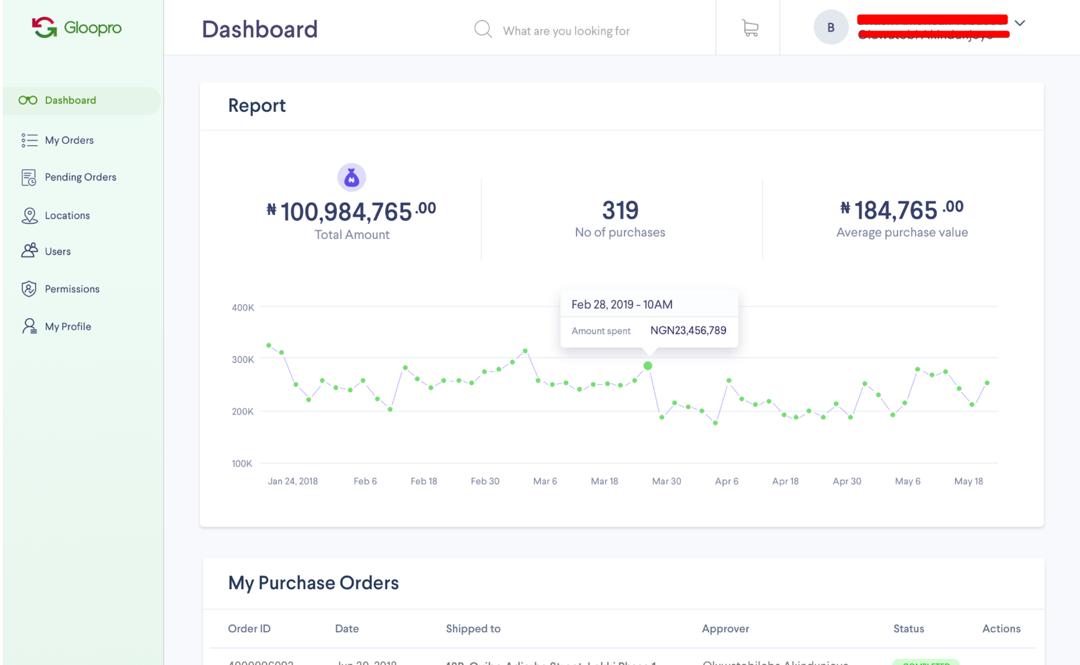
From the Gloopro interface customers can order, pay for, and coordinate delivery of office supplies across multiple locations. The product also produces procurement analytics and allows companies to designate users and permissions.


Olusanya touts the product’s benefits at improving transparency and efficiency in the purchasing process.

“It makes procurement transparent and secure. A lot of companies in Nigeria still use paper invoices and there are some shenanigans,” he said.

Gloopro began offering the service in beta and building a customer base prior to winding down its Gloo.ng grocery service.

In addition to Unilever, Gloopro clients include Uber Nigeria, Cars45, and industrial equipment company LaFarge. Cars45 CEO Etop Ikpe and a spokesperson for Uber Nigeria confirmed their client status to TechCrunch.

Gloopro CEO D. O. Olusanya believes the company can compete with other global e-procurement providers, such as SAP Ariba and GT-Nexus by “leveraging our sourcing and last-mile delivery experience in Nigeria” and expertise working around local requirements in Africa.

Gloopro expects to hit $4 million in revenue by the end of the year and the company could reach $100 million over the course of its international expansion into countries like South Africa, Kenya, Morocco, Egypt, and the Ivory Coast, according to Olusanya. A seed investor briefed on Gloo.ng’s estimates confirmed the company’s revenue expectations with TechCrunch.

Gloo.ng’s pivot to Gloopro and e-procurement comes during an up and down period for B2C online retail in Nigeria, home of Africa’s largest economy.

Last year, e-commerce startup Konga.com, backed by roughly $100 million in VC, was sold in a distressed acquisition, at a loss to investors, including Naspers. In late 2018, Nigerian online sales platform DealDey shutdown.

On the possible upside, several outlets reported this year that Jumia—Africa’s largest e-commerce site and first unicorn headquartered in Nigeria—is pursuing an IPO. But that information is unconfirmed based on a February 8, Bloomberg story without named sources. Jumia has declined to comment.


11 Mar 2019

Amazon expands program that pays developers for top voice apps to France, Italy & Spain

Amazon is expanding its program that directly pays Alexa developers in cash for building valuable, quality voice apps to new markets in Europe: France, Italy, and Spain. Originally launched in the U.S. in 2017 for those developers building game skills, the Alexa Developer Rewards program has since expanded to include a broader selection of Alexa skill categories, and later became available in top European markets, Germany and the U.K. as well as in Japan and India.

With the launch in France, Italy, and Spain, the Alexa Developer Rewards program will now offer payments to top skills in categories such as Education & Reference; Food & Drink; Games, Trivia & Accessories; Kids; Health & Fitness; Lifestyle; Music & Audio; and Productivity.

The program itself is one part of Amazon’s larger strategy around building out its ecosystem of voice applications, ahead of developers’ ability to generate sustainable income from their voice apps.

Though Amazon now offers developers other monetization tools like in-skill purchases, one-time purchases, and sales of physical goods, it could still be hard for some to make consistent income from voice apps without the additional direct support from Amazon. And without revenues to fund development, some might abandon their Alexa skills for other efforts.

So far, Amazon’s decision to invest directly in the developer ecosystem has been working.

Amazon’s Alexa Skill store today has the largest number of third-party voice apps, compared with rivals, having hit 80,000 skills as of last month following a holiday shopping season that saw a significant number of Alexa-powered devices sold. Its growth has come quickly, too, with the number of Alexa skills in the U.S. more than doubling over the past year.

Many of the popular Alexa skills so far have turned out to be voice-enabled counterparts to popular mobile apps – especially those that are audio-based, like music apps, spoken word, meditation apps, quizzes and games, and workout apps, for example.

But key to Alexa’s continued growth is ensuring that these sorts of voice apps are available in localized versions in key non-U.S. markets where smart speakers are growing in popularity. That’s a place where Google could have an advantage, thanks to Google Assistant’s advanced language capabilities, which includes support for a dozen some languages besides English, plus its multilingual abilities, support for interpretations, and more.

Amazon says it has paid out “millions” to developers based in over 20 countries since the 2017 launch of the Alexa Developer Rewards program. Developers don’t have to sign up for rewards – if the app qualifies, Amazon will email them.

11 Mar 2019

Niantic’s Harry Potter: Wizards Unite is a sorcerous smorgasbord for the Pokémon GO generation

Niantic’s follow-up to the absurdly popular Pokémon GO, the long-awaited Harry Potter: Wizards Unite, has one major drawback: unlike its predecessor, you can’t explain it in a single sentence. There’s so much to do in this game that it may repel some casual players — but while its depths of systems and collectibles may be nigh endless, don’t worry: you still basically just walk around doing wizard and witch stuff.

I got to spend a short time playing the game at Niantic’s office in San Francisco, and while they didn’t reveal all their secrets, I saw enough to convince me that HP:WU (I await a catchier nickname, like PoGO) will be a huge time sink for any Harry Potter fan and will probably convert or cannibalize many players from GO.

If you were worried this would be a slapdash cash-in effort like some of the HP tie-ins we’ve seen… don’t be. This is legit. Rowling isn’t involved, and the voice actors are sound-alikes, but still legit.

And just to get some of the major facts out of the way before we move on: it’s coming out sometime in 2019 (I’d guess before Summer but they wouldn’t say), in 17 languages (listed at bottom; actual countries where it’ll be offered unknown), there’s no wand accessory yet (I asked and they all looked nervous), minimum specs are reasonable and AR is optional, and it’s free but there are in-app purchases.

So what is this game? While it would be misleading to say it’s just HP:GO, the similarities are deep. But there’s a lot more going on. Perhaps I’d best summarize it in bullet point form before I embark on the many details. In HP:WU you:

  • Walk around a wizarding-themed version of the real world looking for locations at which to resupply and “foundables” to encounter
  • Dispel, battle, or otherwise deal with the “confoundable” associated with these
  • Earn reward items from encounters and for entering foundables in your registry
  • Use reward items to level up in various professions, brew potions, and battle alongside others at “fortresses”
  • Find rare foundables that advance the overall plot of why this is all happening anyway

So let’s take that piece by piece.

(By the way: The few images I have here were provided by Niantic and Portkey Games, the studio under WB Games who co-developed the game; I actually saw much more than what the shots show, so if something I describe isn’t illustrated directly, don’t worry — it’s in there.)

Walkable Wizarding World
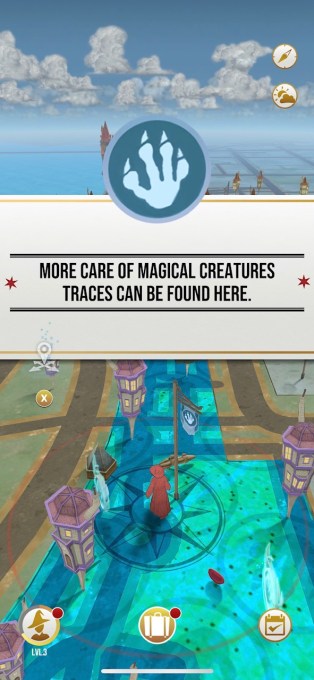
Yes, this was the only image of the map we got.

“For Harry Potter fans, the line between the real world and the wizarding world is paper thin,” said WB Games’s Jonathan Knight. So they wanted to make it seem like, as with the pervasive hidden nooks and secrets of the HP world, “magic is all around you.”

The plot that enables all this is that, in a post-Deathly Hallows HP world, a macguffin event has caused magical items and creatures to appear all over the muggle world, threatening to expose the existence of magic; Witches and wizards are being recruited to track these things down and deal with them.

Conveniently, the event snatched these things and people from all throughout history and the world, laying them down willy-nilly — so you’re just as likely to find Fleur Delacoeur as Hermione Granger, or a young Dumbledore as an old one.

As a member of the SOS squad (enforcing the “Statute Of Secrecy” mandating separation between the magic and muggle worlds, you know), you’re tasked with tracking down these various things wherever they appear and reporting back to the ministry.

The map is, like in Pokémon GO, where you’ll be spending most of your time.

As before, it reflects the streets and features nearby: streets, parks, landmarks, and so on. It’s decidedly busier this time, however, both with gameplay elements and set dressing. Brooms and owls zip overhead, potion ingredients clutter the ground around you, and locations to visit sprinkle every block. (Although I’d hoped they’d use the Marauder’s Map aesthetic, they were probably right not to: it would probably get old fast.)

You interact with these locations as you would spin Pokéstops in GO, with “inns” and “greenhouses” giving you a semi-randomized reward every time (and starting a 5-minute cooldown). Encounters and ingredients pop up like Pokémon did, appearing semi-randomly but with some tendencies or affinities — for example, you’re more likely to find school-related foundables by actual schools, and so on. These places are helpfully noted by a little flag that highlights the affected area, such as: “Golden Gate Park – you’ll encounter more magical creatures here.”

The equivalent to lures are “dark detectors,” which will cause encounters to pop up with more frequency around the location you attach it to — and you can stack them! These will no doubt be a popular purchase.

One nice touch: when you move quickly, your character flies on a broom. No more “running” along the highway. That always did bug me.

Of course you’ll also be able to customize your appearance, and you even get to make a (non-public) “wizarding passport” complete with a moving photo you can outfit with various AR props. Your Hogwarts house is just something you select and which has no gameplay effect — for now.

Swish and flick

When you tap an encounter, you enter an AR minigame where you may, for instance, have to cast a spell to free Buckbeak the gryphon from a magical ball and chain, or defeat a monster threatening a character from the books.

You do this generally by tracing a shape with your finger on the screen to cast a spell. You don’t get to choose the spell, unfortunately, it’s built into the encounter. The more accurate and quick your trace is, the better the power of the spell — a bit like throw quality in Pokémon.

It’s similar in combat except you’ll also have to quickly cast protego when the enemy attacks you. That’s right, there are hostiles in this game! And although you can’t “die,” running out of stamina will fail the encounter or mission. More combat options open up later, though, as you’ll see. Encounters also vary in difficulty, which can be determined from the map or within the encounter — you may find some foes or rescues are beyond your power until you pump up a bit (or quaff a potion).

There are other little twists on the formula, though — the team said they have over 100 unique encounters, all fully realized in AR. And although you can only interact with them from a sweet spot that appears on the ground in AR, you can take your time to walk around or closely inspect the scene.

Foundables and confoundables and the other 20 things

There are a ton of these little pages.

Everything you’ll encounter is a foundable, and falls under one of numerous categories: magic zoology, dark arts, oddities, magical games and sports, Hogwarts, and so on.

And every foundable is listed in a sort of sticker book you’ll fill in bit by bit as you encounter them. Free Buckbeak however many times and it’ll be fully filled in, giving you various bonuses and, perhaps more importantly, the ability to take AR photos with the creature or character in question.

The creatures and characters range from common to very rare, of course, and you’ll need to get dozens of the former to fill in the book, but only one or a handful for certain plot-related items. They only shared the bare bones of the story, which will be revealed through in-game text and events, but a “deep, multi-year narrative arc” is promised. You can probably expect new foundables and ingredients and such to be added regularly.

One detail I found highly compelling was that weather, time of day, and even astral phenomena like moon phase will affect what you encounter. So for instance, werewolves may only come out on the full moon, while certain potion ingredients only appear (or appear more) when it’s raining, or in the evening. This kind of real-world involvement is something I’ve always appreciated and one that Niantic’s games are uniquely suited to take advantage of.

Potions will be necessary for healing and buffing yourself and others, so you’ll want to collect ingredients all the time; you mix them in a sub-screen, and can follow recipes or try your luck making something new.

One very cool thing they showed off that doesn’t really show well in images is a Portkey — you know, the objects in HP that transport you from here to there. It’s not exactly a canon treatment in the game, as they create portals instead, but it makes for a great AR experience. You put the portal down and literally step through it, then look around at a new scene (for instance, Ollivander’s shop or Dumbledore’s office) in which you can find items or presumably encounter monsters and other stuff. Portkey “Portmanteaus” are a bit like egg incubators in that you charge them up by walking, and can find or buy more powerful ones.

Min-maxing managed

What perhaps surprised me most in the team’s presentation of the various systems of the game was the extent of the stats and professions. There are three “professions,” they explained: auror, magical zoologist, and professor (“if you’re a bit of a goody-goody” — I resent that).

I figured these would be a bit like a play style bonus — one gives you more combat prowess, another is better for taming creatures, and so on. Boy, is there a lot more to it than that!

First of all, you should know that you have stats in this game. And not weird hidden ones or a relatively meaningless one like your trainer level in Pokémon GO. No, you have a straight-up stat screen filled with all kinds of stuff.

And your profession isn’t just a bonus or special ability — it’s a whole skill tree, and one to rival those of many a “serious” RPG.

As in many other games, some nodes are simple things like an increase in stamina or spell power — some you can even upgrade several times to increase the effect. But others are entirely new abilities you’ll be able to use in various circumstances. I probed through a bunch in my limited time and found things that, for instance, healed allies, debuffed enemies, improved potion effectiveness, etc. These are definitely going to have a significant effect on gameplay.

You can advance in any of the professions you want, however you want, though of course the further you progress down a tree, the more powerful abilities you unlock. You do this with tokens you earn from encounters, leveling, and challenges, so you get a steady trickle. It should take a good while to fill these out, though no doubt we’ll have some real tiresome types who’ll do it in a week.

Fortress of Jollitude

(It’s a portmanteau of solitude and jolly cooperation, because this is the teamplay part… let me have my fun.)

The last major aspect of the game is Fortresses. These are a bit like Gyms from Pokémon GO, in that they are multiplayer focused, but for now they’re strictly player vs enemy.

Fortresses are large, obvious locations on the map where you and up to four other players can join battle against a host of enemies in order to receive rare foundables and other rewards. How it works is that you and whoever else wants to play get within range of the Fortress and tap it. (They didn’t provide any images of one, inside or out, but you can see the roof of one just at the top left of the paw circle in the map image above.)

You’ll then have a chance to join up with others by presenting a special item called a runestone. You’ll be getting these from normal encounters now and then or a few other sources, and there are 10 different kinds with multiple rarities — and depending on which you use, or which combination your team presents, the Fortress will have any of a variety of challenges and encounter types. (I only saw combat.)

This is where the combat complexity comes in, because all the enemies are presented to all the players at once, and you can take on whichever you choose. Have you leveled your magical creature taming? You better take on that hippogriff. Do extra damage against human foes? You’re on Death Eater duty. Stocked up on spells that hinder opponents or heal allies? You can use them from the select screen in real time, for instance if your friend is about to be knocked flat by a high-level Dementor and needs a hand.

I only got to test a small amount of this, but the possibilities for actual strategy and team synergy were very exciting, especially compared to the extended slugfests of Pokémon GO raids.

“Your forever Harry Potter game”

That’s how the team described Wizards Unite, and although a small-screen experience will never equal the immersion or magic (so to speak) of the cinema or the richness of the books, this does look like a dandy game and it will certainly be a heck of a time sink for countless players worldwide.

I only got to see a few minutes of the game in person, so there are parts I missed and parts that weren’t being shown; for instance, your Hogwarts house will likely figure later in multiplayer games, and more abilities are on the way.

I worry a bit that the simplicity and casual serendipity that defined Pokémon GO have been abandoned for a level of complexity that may be daunting for some. Yet at the same time I worry that the grind of collecting however many Buckbeaks you need to complete a page of the registry isn’t as satisfying as catching (and grinding up) a dozen Charmanders to power up your favorite ‘mon. And the AR experiences so far exhibit much visual variety but (that I saw) didn’t differ much from one another except in the trace you had to draw.

But there’s a great deal here and a great deal to like. It’s new, it’s fun, and it’s HP. I know I’m going to be playing.

(Lastly, the game will be released in the following languages: English, French, Italian, German, Spanish, Brazilian and European Portuguese, Polish, Russian, Swedish, Norwegian, Dutch, Danish, Turkish, Simplified and Traditional Chinese, Japenese, Korean, and Latin American Spanish.)


11 Mar 2019

Zortrax makes high resolution 3D printing easier and cheaper

3D printers have come a long way since the early days of RepRap and DIY hacker culture. First they flew to great heights with companies like Makerbot and Formlabs who aimed to create a prosumer product for designers, educators, and makers and then they fell to the doldrums when they became commodity hardware. Many people believed the space was dead.

Now, however, the Polish 3D printing company, Zortrax, has released their Inkspire UV LCD printer, a $2,000 SLA printer that offers the speed and quality of resin-based printers with the fit and finish of a carefully-designed piece of hardware.

The Inkspire works by shooting a bright blast of UV light through photosensitive resin. The printer creates object layer by layer at a resolution and quality that you’d never achieve with traditional extrusion printers. The Inkspire is so precise it can print a 50x50x25 micro cube yet it can also build larger objects that look completely smooth.

[gallery ids="1795401,1795402,1795403,1795404,1795405,1795406,1795407"]

Like other so-called stereo lithographic (SLA) printers, the resin is tricky to work with. The printer works with nearly any resin that cures under 405 nm wavelength length light so you don’t have to use Zortrax’s products. That said, the objects that come out of this printer are fairly difficult to “finish,” primarily because they stay sticky for a while until they finish curing in direct sunlight. The uncured resin itself is also quite sticky and messy so this printer definitely requires some sort of separate workshop with a slop sink and room for the printer and ultrasonic cleaner. You can use this in a home office or other enclosed space but you’ll want to keep the windows open and gloves on your hands.

That said, once the items are washed, cured, and dry they are almost indistinguishable from injection-molded parts.

The $2,000 printer comes with the print bed, a UV shield, and an optional ultrasonic cleaner – essentially an off-the-shelf ultrasonic cleaning vat that vibrates the objects in order to scrub them. Zortrax also includes their very powerful Z-Suite software. The software will automatically generate and slice the 3D objects, preparing them for printing. Because it prints in-reverse – the object grows out of the resin and hangs off of the build plate like a bat – each object requires a set of specialized supports that are easy to remove.

Zotrax’s solution is quite elegant. Because their resin is fairly innocuous it doesn’t require dangerous chemicals to finish and the curing process is quick and painless. The entire product is nicely packaged and the maximum build size is 2.9 x 5.2 x 6.9 inches.

This 3D printer is also much faster than you would expect, shooting out most smaller parts in less than an hour. Because the printer is so precise you can easily print multiple copies of the same object, creating a mini assembly line. You can also print large, solid objects that can stand up to much more abuse than FDM-printed objects.

Again, the Inkspire isn’t for the casual 3D printer user. Because the resin can get messy and the entire package requires good ventilation and access to water, this thing would work best in a design studio or workshop. That said, this is a desktop printer and you can easily leave it in an undisturbed corner and carefully take the finished build plate to a nearby water source for cleaning. It’s just a little bit harder.

SLA printers are powerful and Zortrax has made a truly usable and useful one. It’s fast, compact, and easy to use and it shows just how far the prosumer 3D printing market has come in a few short years.

11 Mar 2019

Dozens of companies leaked sensitive data thanks to misconfigured Box accounts

Security researchers have found dozens of companies inadvertently leaking sensitive corporate and customer data because staff are sharing public links to files in their Box enterprise storage accounts that can be easily discovered.

The discoveries were made by Adversis, a cybersecurity firm, which found major tech companies and corporate giants had left data inadvertently exposed. Although data stored in Box enterprise accounts is private by default, users can share files and folders with anyone, making data publicly accessible with a single link. But Adversis said these secret links can be discovered by others. Using a script to scan for and enumerate Box accounts with lists of company names and wildcard searches, Adversis found over 90 companies with publicly accessible folders.

Not even Box’s own staff were immune from leaking data.

The company said while much of the data is legitimately public and Box advises users how to minimize risks, many employees may not know the sensitive data they share can be found by others.

Worse, some public folders scraped and indexed by search engines, making the data found more easily.

In a blog post, Adversis said Box administrators should reconfigure the default access for shared links to “people in your company” to reduce accidental exposure of data to the public.

Adversis said it found passport photos, bank account and Social Security numbers, passwords, employee lists, financial data like invoices and receipts, and customer data were among the data found. The company contacted Box to warn of the larger exposures of sensitive data, but noted that there was little overall improvement six months after its initial disclosure.

“There is simply too much out there and not enough time to resolve each individually,” he said.

Adversis provided TechCrunch with a list of known exposed Box accounts. We contacted several of the big companies named, as well as those known to have highly sensitive data, including:

  • Amadeus, the flight reservation system maker, which left a folder full of documents and application files associated with Singapore Airlines. Earlier this year, researcher found flaws that made it easy change reservations booked with Amadeus.
  • Apple had several folders exposed, containing what appeared to be non-sensitive internal data, such as logs and regional price lists.
  • Television network Discovery had more than a dozen folders listed, including database dumps of millions of customers names and email addresses. The folders also contained some demographic information and developer project files, including casting contracts and notes and tax documents.
  • Edelman, the global public relations firm, had an entire project proposal for working with the New York City mass transit division, including detailed proposal plans and more than a dozen resumes of potential staff for the project — including their names, email addresses, and phone numbers.
  • Nutrition giant Herbalife left several folders exposed containing files and spreadsheets on about 100,000 customers, including their names, email addresses and phone numbers.
  • Opportunity International, a non-profit aimed at ending global poverty, exposed a list of donor names, addresses and amount given exposed in a massive spreadsheet.
  • Schneider Electric left dozens of customer orders accessible to anyone, including sludge works and pump stations for several towns and cities. Each folder had an installation “sequence of operation” document, which included both default passwords and in some cases “backdoor” access passwords in case of forgotten passwords
  • Pointcare, a medical insurance coverage management software company, had thousands of patient names and insurance information exposed. Some of the data included the last four-digits of Social Security numbers.
  • United Tissue Network, a whole-body donation non-profit, exposed a body donor information and personal information of donors in a vast spreadsheet, including the prices of body parts.

Box, which initially had no comment when we reached out, had several folders exposed. The company exposed signed non-disclosure agreements on their clients, including several U.S. schools, as well as performance metrics of its own staff, the researchers said.

Box spokesperson Denis Ron said in a statement: “We take our customers’ security seriously and we provide controls that allow our customers to choose the right level of security based on the sensitivity of the content they are sharing. In some cases, users may want to share files or folders broadly and will set the permissions for a custom or shared link to public or ‘open’. We are taking steps to make these settings more clear, better help users understand how their files or folders can be shared, and reduce the potential for content to be shared unintentionally, including both improving admin policies and introducing additional controls for shared links.”

The cloud giant said it plans to reduce the unintended discovery of public files and folders.

Amadeus, Apple, Box, Discovery, Herbalife, Edelman and Pointcare all reconfigured their enterprise accounts to prevent access to their leaking files after TechCrunch reached out.

Amadeus spokesperson Alba Redondo said the company decommissioned Box in October and blamed the exposure on an account that was “misconfigured in public mode” which has now been corrected and external access to it is now closed. “We continue to investigate this issue and confirm there has been no unauthorized access of our system,” said the spokesperson, without explanation. “There is no evidence that confidential information or any information containing personal data was impacted by this issue,” the spokesperson added. We’ve asked Amadeus how it concluded there was no improper access, and will update when we hear back.

Pointcare chief executive Everett Lebherz confirmed its leaking files had been “removed and Box settings adjusted.” Edelman’s global marketing chief Michael Bush said the company was “looking into this matter.”

Herbalife spokesperson Jennifer Butler said the company was “looking into it,” but we did not hear back after several follow-ups. (Butler declared her email “off the record,” which requires both parties agree to the terms in advance, but are printing the reply as we were given no opportunity to reject the terms.)

When reached, an Apple spokesperson did not comment by the time of publication.

Discovery, Opportunity International, Schneider Electric, and United Tissue Network did not return a request for comment.

Data “dumpster diving” is not a new hobby for the skilled, but it’s a necessary sub-industry to fix an emerging category of data breaches: leaking, public, and exposed data that shouldn’t be. It’s a growing space that we predicted would grow as more security researchers look to find and report data leaks.

This year alone, we’ve reported data leaks at Dow Jones, Rubrik, NASA, AIESEC, Uber, the State Bank of India, two massive batches of Indian Aadhaar numbers, a huge leak of mortgage and loan data, and several Chinese government surveillance systems.

And we’re still in the first quarter of the year. Adversis said it expects to find more exposed data down the line as it expands the wordlists it uses to scan for files. The company has open-sourced and published online.