
Author: azeeadmin

05 Mar 2019

SurveyMonkey acquires web survey company Usabilla for $80M

SurveyMonkey announced today that it has acquired Usabilla, an Amsterdam-based website and app survey company, for $80 million in cash and stock.

Zander Lurie, CEO at SurveyMonkey, said Usabilla filled in a missing piece in its survey toolkit. “A key product that we identified that we really wanted to add to the portfolio, which is really adjacent to our VOC (voice of the customer) solution is a website feedback collector helping people on the web or on mobile apps really understand what users are doing on their site,” Lurie told TechCrunch.

Usabilla CEO Marc van Agteren says his company is adding a complementary product to SurveyMonkey. “If you compare us to the SurveyMonkey enterprise solution where you create surveys that you need to send out via social media or email, our software sits on a website and instantly provides feedback,” he said. For example, if there is a bug on the page, the user can click the Usabilla tool, capture the area of the page that’s problematic as a screenshot, and send it with a comment to the website or app owner for review.

Conversely the website or app owner could display a question for the visitor to answer before he or she exits. This provides a way to get immediate feedback about design or why they are leaving without finishing a transaction, as examples.

Qualtrics, another survey company was about to go public last fall when it was acquired by SAP for $8 billion, but Lurie doesn’t necessarily see this move as a reaction to that. He said that today’s acquisition was really related to enhancing the company’s enterprise product.

As for Qualtrics, he says that with the acquisition, it is more aligned with SAP now and therefore really being marketed to SAP customers. He sees plenty of room in the survey market with customers of Adobe, Salesforce and Microsoft and others, whom he says probably aren’t looking for an SAP solution. 

With Usabilla, SurveyMonkey gains a stronger foothold in the EU as the company’s headquarters in Amsterdam will become the SurveyMonkey’s largest EU office. The transaction also adds 130 new employees to the SurveyMonkey family, bringing the total number to over 1000. In addition, it can now access Usabilla’s 450 customers, which include Lufthansa, Philips and Vodafone. Lurie said there is some customer overlap, but given that the majority of Usabilla’s customers are outside the U.S, there would likely be a net customer gain from the purchase.

SurveyMonkey was founded in 1999 and went public last September. This is the company’s sixth acquisition and the first in three years, according to Lurie. Usabilla was founded in 2009 and raised a modest $1 million dollars along the way.

The deal is subject to the normal regulatory approval process and is expected to close some time in the second quarter this year.
05 Mar 2019

You can now ask Alexa to control your Roku devices

Roku this morning announced its devices will now be compatible with Amazon’s Alexa. Through a new Roku skill for Alexa, Roku owners will be able to control their devices in order to do things like launch a channel, play or pause a show, search for entertainment options, and more. Roku TV owners will additionally be able to control various functions related to their television, like adjusting the volume, turning on and off the TV, switching inputs and changing channels if there is an over-the-air antenna attached.

The added support for Amazon Alexa will be available to devices running Roku OS 8.1 or higher, and will require customers enable the new Roku skill which will link their account to Amazon.

Roku has developed its own voice assistant designed specifically for its platform, which available with a touch of a button on its voice remote as well as through optional accessories like its voice-powered wireless speakers, tabletop Roku Touch remote, or TCL’s Roku-branded Smart Soundbar. However, it hasn’t ignored the needs of those who have invested in other voice platforms.

Already, Roku devices work with Google Assistant-powered devices, like Google Home and Google Home Mini, through a similar voice app launched last fall.

Support for the dominant streaming media platform – Amazon Alexa – was bound to be next. eMarketer said Amazon took two-thirds of smart speaker sales last year, and CIRP said Echo has a 70 percent U.S. market share.

The Roku app will work with any Alexa-enabled device, including the Amazon Echo, Echo Show, Echo Dot, Echo Spot and Echo Plus, as well as those powered by Alexa from third parties, the company confirmed to TechCrunch.

Once enabled, you’ll be able to say things like “Alexa, pause Roku,” or “Alexa, open Hulu on Roku,” or “Alexa, find comedies on Roku,” and more. The key will be starting the command with “Alexa,” as usual, then specify “Roku” is where the action should take place (e.g. “on Roku”).

One change with the launch of voice support via Alexa is that the commands are a bit more natural, in some cases. Where as Google Assistant required users to say “Hey Google, pause on Roku,” the company today says the same command for Alexa users is “Alexa, pause Roku.” That’s a lot easier to remember and say. However, most of the other commands are fairly consistent between the two platforms.

“Consumers often have multiple voice ecosystems in their homes,” said Ilya Asnis, senior vice president of Roku OS at Roku, in a statement about the launch. “By allowing our customers to choose Alexa, in addition to Roku voice search and controls, and other popular voice assistants; we are strengthening the value Roku offers as a neutral platform in home entertainment.”

05 Mar 2019

Fictiv raises $33M to be the ‘AWS of hardware manufacturing’

Hardware, as the saying goes, is hard, but today a startup has raised some money for a manufacturing service that it believes can make the prospect of starting and running hardware businesses a little easier. Fictiv, which positions itself as a kind of AWS for manufacturing — providing a platform both to design components and help get them produced — has raised $33 million, money that it will use to continue expanding its production ecosystem, the range of components that it can make, and to grow its customer base.

The company is not disclosing its valuation, but, according to PitchBook, the company was valued at around $65 million post-money in its last fundraise, which could put the company at around $100 million with this latest injection. This Series C was led by G2VP, with new strategic investor Mitsui & Co. and previous backers  Accel, Bill Gates, Intel Capital, Sinovation and Tandon Group, also participating. Fictiv has raised $58 million to date.

Injection may be the operative word here — or at least one of them. Fictiv today works across manufacturing plants in China and the Bay Area, covering a range of processes, including injection molding, CNC machining, 3D printing and urethane casting, covering a variety of materials. Customers use the company’s cloud-based software to design and order parts which are routed by Fictiv to the plants best suited to make them. Current customers include the likes of Sphero and Facebook, which use Fictiv’s services for prototyping,

The problem that Fictiv is solving has been a persistent one in the world of hardware: making prototypes can cost a lot and be very inefficient, and that’s before you move into full-scale manufacturing, which can be challenging even with economies of scale. It’s also a very crowded field, with a number of different companies all vying to help fill the role of manufacturing enabler (and it is a field also littered with failures). But over the years, we’ve seen a lot of advances in manufacturing tech, with the tradeoff that some of the work that it takes on freeing up staff to work on other challenges.

“Fictiv is developing the software infrastructure required to connect the manufacturing workforce and trillions of dollars of capital equipment,” said CEO Dave Evans, who co-founded the company with Nate Evans, in a statement. “In doing so, both product developers and manufacturers will benefit from the efficiencies gained by eliminating unnecessary, repetitive tasks and unlocking employees to focus on creative problem solving.”

“We are excited to be part of the digital transformation of the status quo in manufacturing,” said ​Daniel Oros​, Partner at G2VP, in a statement. “Fictiv’s innovative tools and services address the critical gap in contract manufacturing that will lead to a massive shift in how consumer and industrial products are manufactured.”

05 Mar 2019

Quip launches toothbrush for kids

Quip, the dental care startup, is releasing a new product aimed toward kids. Similar to the electric toothbrush it makes for adults, the kids’ brush features a timer that pulsates every 30 seconds and automatically turns off after two minutes.

The main differences between the brush for kids and one for adults is the non-slip grip plastic handle, smaller brush head and new colors. Quip for kids costs $25 for a brush head starter set with a flavored toothpaste subscription ($10 every three months) or $30 with a starter set and brush head subscription ($5 every three months).

“If we’re going to fulfill our mission of improving oral health for every age, it’s better to cast those habits and form those habits at an early age,” Quip CEO Simon Enever told TechCrunch. “And build right habits before you’re nine years old.”

Quip began as a subscription-based electric toothbrush service that replaces toothpaste and brush heads, partly because you’re apparently supposed to change your toothbrush every three months. Since its launch, Quip has steadily evolved its offerings by inviting dentists to join the platform to connect with Quip’s consumer subscribers.

“The features dentists were asking for was the same Quip for kids,” Enever said. “Knowing that the timer and pulses would guide basic habits, the biggest thing dentists wanted was getting kids to want to brush their teeth. That would be the win.”

Last May, Quip raised $10 million and acquired dental insurance startup Afora to live inside Quip Labs, the startup’s venture studio. The idea with Labs is to fuel innovation in oral health products, platforms and services. This brush for kids, however, is Quip’s first new product since launch.

That’s thanks to Quip’s $40 million funding round back in November. At the time, Enever told me Quip had a lot of new products and services launches ahead of it. To date, Quip has raised over $60 million in funding.

05 Mar 2019

Salesforce releases myTrailhead, a customizable training platform

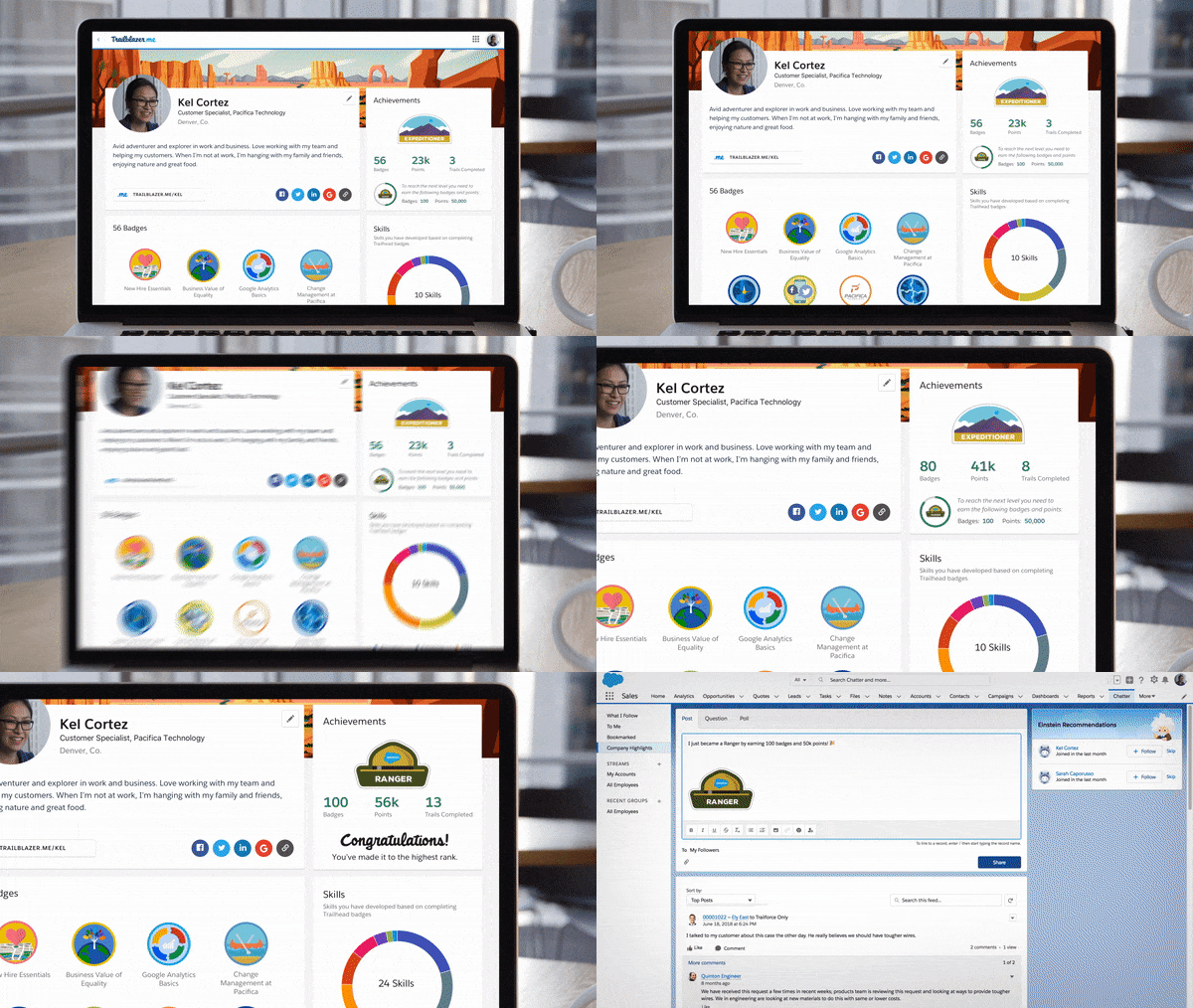
Salesforce has been using the notion of trailblazers as a learning metaphor for several years, since it created a platform to teach customers Salesforce skills called Trailhead. Today, the company announced the availability of myTrailhead, a similar platform that enables company to create branded, fully-customizable training materials based on the Trailhead approach.

It’s worth noting that the company originally announced this idea at Dreamforce in November, 2017, and after testing it on 13 pilot customers (including itself) for the last year is making the product generally available today.

While Trailhead is all about teaching Salesforce skills, myTrailhead is about building on that approach to teach whatever other skills a company might find desirable with its own culture, style, branding and methodologies.

It builds on the whole Trailhead theme of blazing a learning trail, providing a gamified approach to self-paced training, where users are quizzed throughout to reinforce the lessons, awarded badges for successfully completing modules and given titles like Ranger for successfully completing a certain number of courses.

By gamifying the approach, Salesforce hopes people will have friendly competition within companies, but it also sees these skills as adding value to an employee’s resume. If a manager is looking for an in-house hire, they can search by skills in myTrailhead and find candidates who match their requirements. Additionally, employees who participate in training can potentially advance their careers with the their enhanced skill sets.

While you can continue to teach Salesforce skills in myTrailhead, it’s really focused on the customization and what companies can add on top of the Salesforce materials to make the platform their own. Salesforce envisions companies using the platform for new employee onboarding, sales enablement or customer service training, but if a company is ambitious, it could use this as a broader training tool.

There is an analytics component in myTrailhead, so management can track when employees complete required training modules, understand how well they are doing as they move through a learning track or recognize when employees have updated their skill sets.

The idea is to build on the Trailhead platform idea to provide companies with a methodology for creating a digital approach learning, which Salesforce sees as an essential ingredient of becoming a modern company. The product is available immediately.

05 Mar 2019

More Atomico promotions sees three new Partners at the European VC firm

Atomico, the European venture capital firm founded by Skype’s Niklas Zennström, sometimes feels like it’s on a perpetual hiring and promotions spree, even if a number of partners have also departed over the years.

Most recently, in November Sophia Bendz, the former Spotify Global Director of Marketing, promoted to Partner. Bendz had already spent two and a half years as an Executive-in-Residence at the London-based VC firm. The same month, Partner Carolina Brochado left to join Softbank’s Vision Fund to help it source more deals in Europe.

Today we can add three more Partner promotions to the list, including Bryce Keane, who for the past two and a half years has been Atomico’s Head of Communications.

Prior to joining Atomico, Australia born Keane (who I promised not to refer to as the Aussie spin doctor — sorry!) founded the PR arm of creative agency Albion and worked with a number of now household names in European tech, such as TransferWise, years before the company was a celebrated fintech unicorn.

He also co-founded 3beards, which among other projects (involving beards, beer and the Unicorn Hunt jobs board), was the custodian of one of London’s most popular tech networking events, leading one BBC journalist to dub Keane “the social secretary for London’s tech community”. With my aversion to both crowds and heaping any resemblance of praise on PRs, I couldn’t possibly comment.

But what I will say, having covered TransferWise from Day One and reporting on Atomico pretty relentlessly over the years, is that Keane is possibly one of the hardest working flacks I know and certainly one of the best briefed, typically making it his business to know the founders and startups he supports at least as well as anyone. Well, almost anyone.

Also being promoted to Partner is Alison Smith, Atomico’s Chief of Staff. She has been with the VC firm for four years and as Partner will continue to lead key projects for Atomico, both internally and externally.

And last but definitely not least is Camilla Richards, who for the past four years has been Head of Investor Relations, overseeing Atomico’s own fundraising and its important relationship with LPs.

In her new role, she’ll continue to manage those relationships, as well as facilitating introductions between founders and LPs where new business opportunities arise or if direct investment makes sense.

“Bryce, Alison and Camilla have the ambition, shared mission and energy we need as we continue to build Atomico. I’m proud to have them as Partners at Atomico and excited to see what they will achieve in the years ahead in their new roles,” writes Atomico’s CEO and Founding Partner Niklas Zennström in a blog post.

Meanwhile, in addition to Atomico’s three new Partners, the European VC firm is making a number of promotions within its investment team. Senior Associate Stephen Thorne becomes a Principal, and Associates Hillary Ball, Will Dufton and Adam Lasri are moved up to Senior Associate. Notably, I’m told Lasri will also be relocating permanently to Paris, becoming Atomico’s first full-time investment member on the ground in the French capital city.

05 Mar 2019

A second patient appears to be cured of H.I.V., sparking new hope for a novel treatment

Twelve years after a first patient was identified as cured of H.I.V., the virus that causes AIDS, a second patient undergoing similar treatment was diagnosed as in long-term remission, according to a New York Times report citing an article in to be published tomorrow in the journal Nature.

The report means that a cure for the disease is possible, but several obstacles remain before it can be developed and applied broadly, according to scientists quoted by the Times.

The findings are set to be presented at the Conference on Retroviruses and Opportunistic Infections in Seattle, on Tuesday.

The successful treatment involved bone-marrow transplants that were given to patients infected with H.I.V. However, the transplants were meant to treat the patients’ cancer — not the virus.

Because of the risks and side-effects associated with bone marrow transplants, using the treatment broadly as a cure for H.I.V. likely isn’t a possibility, and drugs are available to control the infection.

What scientists find promising is the potential to replace infected cells with  immune cells modified to resist H.I.V.

Speaking to The Times, Dr. Annemarie Wensing, a virologist at the University Medical Center, Utrecht, in the Netherlands said, “This will inspire people that the cure is not a dream.”

Dr. Wensing co-led the team of European scientists that studied stem cell transplants to treat H.I.V. infection.

Backed by the American AIDS research organization, AMFAR, the IciStem organization is the second group of scientists to cure a patient.

Twelve years ago, at the same conference, a German doctor described using bone marrow treatments to cure a patient who was being treated for leukemia. The transplants also cured the patient of H.I.V.

After that initial success several doctors tried to replicate the results, with little to no success. Either patients died of cancer or the virus returned when they stopped taking their anti-retroviral medication.

The crux of the treatment depends on using mutated immune cells that have a variant of the standard CCR5 protein. The mutation blocks H.I.V. from infecting cells by stopping the virus from latching on to host white blood cells.

It’s a treatment that nearly killed the first patient it was used on. However, not all the conditions of that first cure apparently need to be replicated to ensure that a patient remains H.I.V. free following treatment.

The most recent patient was receiving treatment for Hodgkin’s lymphoma and as part of his therapy underwent a bone-marrow transplant from a donor that had the CCR5 mutation to their cells. The patient took a course of immunosuppressive drugs as part of his treatment.

In 2017 the patient stopped taking anti-H.I.V. drugs and has remained disease free ever since.

Despite the success, there’s no guarantee that the new patient will remain disease free. He’s undergone a series of tests to check whether the virus has returned and while all but one diagnostic revealed him to be H.I.V. free, doctors are still monitoring his situation closely.

This isn’t the first time that a scientist has identified the CCR5 protein as holding the potential for an H.I.V. cure.

China’s now-disgraced and imprisoned scientist, He Jiankui, used gene editing to modify the DNA of two children so that they would have the mutated CCR5 — ostensibly making them resistant to the H.I.V. virus.

While Dr. He’s research was premature, and was met with global condemnation, private companies and researchers are pursuing gene therapies to treat the H.I.V. virus.

The Times notes that the CCR5 therapy that’s being developed is only effective on about half of patients who are infected with the virus that causes AIDS. Another half are vulnerable or infected to a form of the virus which uses a different protein to enter cells.

One important caveat to any such approach is that the patient would still be vulnerable to a form of H.I.V. called X4, which employs a different protein, CXCR4, to enter cells.

05 Mar 2019

A second patient appears to be cured of H.I.V., sparking new hope for a novel treatment

Twelve years after a first patient was identified as cured of H.I.V., the virus that causes AIDS, a second patient undergoing similar treatment was diagnosed as in long-term remission, according to a New York Times report citing an article in to be published tomorrow in the journal Nature.

The report means that a cure for the disease is possible, but several obstacles remain before it can be developed and applied broadly, according to scientists quoted by the Times.

The findings are set to be presented at the Conference on Retroviruses and Opportunistic Infections in Seattle, on Tuesday.

The successful treatment involved bone-marrow transplants that were given to patients infected with H.I.V. However, the transplants were meant to treat the patients’ cancer — not the virus.

Because of the risks and side-effects associated with bone marrow transplants, using the treatment broadly as a cure for H.I.V. likely isn’t a possibility, and drugs are available to control the infection.

What scientists find promising is the potential to replace infected cells with  immune cells modified to resist H.I.V.

Speaking to The Times, Dr. Annemarie Wensing, a virologist at the University Medical Center, Utrecht, in the Netherlands said, “This will inspire people that the cure is not a dream.”

Dr. Wensing co-led the team of European scientists that studied stem cell transplants to treat H.I.V. infection.

Backed by the American AIDS research organization, AMFAR, the IciStem organization is the second group of scientists to cure a patient.

Twelve years ago, at the same conference, a German doctor described using bone marrow treatments to cure a patient who was being treated for leukemia. The transplants also cured the patient of H.I.V.

After that initial success several doctors tried to replicate the results, with little to no success. Either patients died of cancer or the virus returned when they stopped taking their anti-retroviral medication.

The crux of the treatment depends on using mutated immune cells that have a variant of the standard CCR5 protein. The mutation blocks H.I.V. from infecting cells by stopping the virus from latching on to host white blood cells.

It’s a treatment that nearly killed the first patient it was used on. However, not all the conditions of that first cure apparently need to be replicated to ensure that a patient remains H.I.V. free following treatment.

The most recent patient was receiving treatment for Hodgkin’s lymphoma and as part of his therapy underwent a bone-marrow transplant from a donor that had the CCR5 mutation to their cells. The patient took a course of immunosuppressive drugs as part of his treatment.

In 2017 the patient stopped taking anti-H.I.V. drugs and has remained disease free ever since.

Despite the success, there’s no guarantee that the new patient will remain disease free. He’s undergone a series of tests to check whether the virus has returned and while all but one diagnostic revealed him to be H.I.V. free, doctors are still monitoring his situation closely.

This isn’t the first time that a scientist has identified the CCR5 protein as holding the potential for an H.I.V. cure.

China’s now-disgraced and imprisoned scientist, He Jiankui, used gene editing to modify the DNA of two children so that they would have the mutated CCR5 — ostensibly making them resistant to the H.I.V. virus.

While Dr. He’s research was premature, and was met with global condemnation, private companies and researchers are pursuing gene therapies to treat the H.I.V. virus.

The Times notes that the CCR5 therapy that’s being developed is only effective on about half of patients who are infected with the virus that causes AIDS. Another half are vulnerable or infected to a form of the virus which uses a different protein to enter cells.

One important caveat to any such approach is that the patient would still be vulnerable to a form of H.I.V. called X4, which employs a different protein, CXCR4, to enter cells.

05 Mar 2019

After more than 10 years, Flickr frees its login system from Yahoo

Oh joy, oh rapture, unsubdued, Flickr’s login is no longer tied to Yahoo. The photo-sharing platform announced today that it will roll out a new system to members over the next few weeks that doesn’t require a Yahoo ID. This is welcome news to long-time Flickr users who are still bitter over the requirement, introduced in 2007, two years after Yahoo acquired Flickr, that forced everyone to use Yahoo credentials to sign in. Flickr was acquired by SmugMug in April 2018 and since then, a new login has been “the single most requested feature by our community,” according to a post on the company’s blog.

Flickr may no longer have the same clout as it did in the pre-Instagram era, but many users (like me) have been uploading photos to it for years and still use it as an archive for images taken before smartphones became ubiquitous. The Yahoo login system, however, was a lot more tedious than it needed to be, especially if you did not use Yahoo Mail or its other services and constantly forgot your password. Two enormous data breaches of Yahoo accounts made users even more upset that they were tied into a system that they otherwise never used.

Users still have to use their Yahoo credentials until they get access to the new login process. When that happens, they will be allowed to pick a new login email address and new password. That address will be the only one used by their Flickr account for both authentication and emails from the company.

05 Mar 2019

Facebook is introducing a new “Tributes” section for memorialized accounts

Facebook is rolling out a new feature for memorialized accounts that will allow people to leave messages in a Tributes section that is separate from the rest of the profile’s timeline. Depending on a memorialized account’s privacy settings, friends can currently still post on its timeline, including in the comments of posts the person made before they died. If a memorialized account has a Tributes section, however, posts made after the day it was memorialized (which prevents anyone else from logging in) will be placed there.

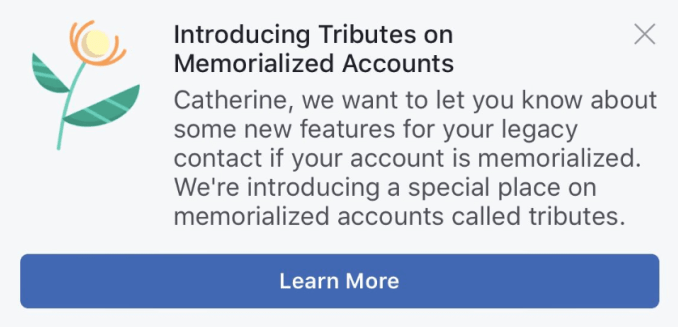
Some Facebook users who have designated “legacy contacts” to manage their accounts after they die were alerted to the new feature by a notification today that contained the euphemistic phrase “if your account is memorialized.”

A page on Facebook’s Help Center describes the new tributes section “as a space on memorialized profiles where friends and family can post stories, commemorate a birthday, share memories and more.”

“Legacy contacts” will have more leeway over tribute posts than they do over the rest of the account. For example, they have the ability to decide who can see and post tributes and can delete posts. They can also change who can see posts the deceased person is tagged in or remove the tag. If the account had timeline review turned on, the legacy contact will be able to turn it off for tribute posts. Posts made to a profile after it is memorialized will be separated into the tributes section. The feature’s help page says “we do our best to separate tribute posts from timeline posts based on the info we’re given.”

Legacy contacts still can’t log into accounts, read private messages or remove and add friends.