Author: azeeadmin

04 Mar 2019

Moka raises $27M led by Hillhouse to make hiring more data-driven in China

Moka, a startup that wants to make talent acquisition a little more data-driven for China-based companies that range from smartphone giant Xiaomi to Burger King’s local business, announced Monday that it has raised a 180 million yuan ($27 million) Series B round of funding.

The deal was led by Hillhouse Capital, an investor in top Chinese technology companies such as Tencent, Baidu, JD.com, Pinduoduo — just to name a few. Other investors who took part include Xianghe Capital, an investment firm founded by two former Baidu executives, Chinese private equity firm GSR Ventures and GGV Capital.

Moka claims more than 500 enterprise customers were paying for its services by the end of 2018. Other notable clients are McDonalds and one of China’s top livestreaming services YY. It plans to use its new capital to hire staff, build new products and expand the scope of its business.

Founded in 2015, Moka compares itself to Workday and Salesforce in the U.S. It has created a suite of software aiming to make recruiting easier and cheaper for companies with upwards of 500 employees. Its solutions take care of the full cycle of hiring. To start with, Moka allows recruiters to post job listings across multiple platforms with one click, saving them the hassle of hopping between portals. Its AI-enabled screening program then automatically filters candidates and make recommendations for companies. What comes next is the interview, which Moka helps streamline with automatic email and message reminders for job applicants and optimized plans for interviewers on when and where to meet their candidates.

That’s not the end, as Moka also wants to capture what happens after the talent is onboard. The startup helps companies maintain a talent database consist of existing employees and potential hires. The services allow companies to keep a close tap on their staff, whose resume update will trigger a warning to the employer, and alerts the recruiter once the system detects suitable candidates.

Moka is among a wave of startups founded by Chinese entrepreneurs with foreign education and work experiences. Zhao Oulun, whose English nickname is Orion, graduated from the University of California, Berkley and worked at San Francisco-based peer-to-peer car sharing company Turo before founding Moka with Li Guoxing. Li himself is also a “sea turtle,” a colloquial term in Chinese that describes overseas-educated graduates who return home to work. Li graduated from the University of Michigan and Stanford University, and had worked at Facebook as an engineer.

When the founders re-entered China, they saw something was missing in the booming domestic business environment: effective talent management.

“Businesses are flourishing, but at the same time many of them fall short in internal organization and operation. To a large extent, the issue pertains to the lack of digital and meticulous operation for human resources, which slows down decision-making and leads to mistakes around talents and company organization,” says chief executive Zhao in a statement.

Moka’s mission has caught the attention of investors. Jixun Foo, a partner at Moka backer GGV Capital, also believes China’s businesses can benefit from a data-driven approach to people management: “We are positive about Moka becoming a comprehensive HR service provider in the future through its unique data-powered and intelligent solutions.”

04 Mar 2019

Facebook won’t let you opt-out of its phone number ‘look up’ setting

Users are complaining that the phone number Facebook hassled them to use to secure their account with two-factor authentication has also been associated with their user profile — which anyone can use to “look up” your profile.

Worse, Facebook doesn’t give you an option to opt-out.

Last year, Facebook was forced to admit that after months of pestering its users to switch on two-factor by signing up their phone number, it was also using those phone numbers to target users with ads. But some users are finding out just now that Facebook’s default setting allows everyone — with or without an account — to look up a user profile based off the same phone number previously added to their account

The recent hubbub began today after a tweet by Jeremy Burge blew up, criticizing Facebook’s collection and use of phone numbers, which he likened to “a unique ID that is used to link your identity across every platform on the internet.”

Although you can hide your phone number on your profile so nobody can see it, it’s still possible to “look up” user profiles in other ways, such as “when someone uploads your contact info to Facebook from their mobile phone,” according to a Facebook help article. It’s a more restricted way than allowing users to search for user profiles using a person’s phone number, which Facebook restricted last year after admitting “most” users had their information scraped.

Facebook gives users the option of allowing users to “look up” their profile using their phone number to “everyone” by default, or to “friends of friends” or just the user’s “friends.”

But there’s no way to hide it completely.

Security expert and academic Zeynep Tufekci said in a tweet: “Using security to further weaken privacy is a lousy move — especially since phone numbers can be hijacked to weaken security,” referring to SIM swapping, where scammers impersonate cell customers to steal phone numbers and break into other accounts.

Tufekci’s argued that users can “no longer keep keep private the phone number that [they] provided only for security to Facebook.”

Facebook spokesperson Jay Nancarrow told TechCrunch that the settings “are not new,” adding that, “the setting applies to any phone numbers you added to your profile and isn’t specific to any feature.”

Gizmodo reported last year that Facebook uses that when a user gives Facebook a phone number for two-factor, it “became targetable by an advertiser within a couple of weeks.” And, if a user doesn’t like it, they can set up two-factor without using a phone number — which hasn’t been mandatory for additional login security since May 2018.

Even if users haven’t set up two-factor, there are well documented cases of users having their phone numbers collected by Facebook, whether the user expressly permitted it or not. In 2017, one reporter for The Telegraph described her alarm at the “look up” feature, given she had “not given Facebook my number, was unaware that it had found it from other sources, and did not know it could be used to look me up.”

To the specific concerns by users, Facebook said: “We appreciate the feedback we’ve received about these settings and will take it into account.”

Concerned users should switch their “look up” settings to “Friends” to mitigate as much of the privacy risk as possible.

When asked specifically if Facebook will allow users to users to opt-out of the setting, Facebook said it won’t comment on future plans. And, asked why it was set to “everyone” by default, Facebook said the feature makes it easier to find people you know but aren’t yet friends with.

Others criticized Facebook’s move to expose phone numbers to “look ups,” calling it “unconscionable.”

Alex Stamos, former chief security officer and now adjunct professor at Stanford University, also called out the practice in a tweet. “Facebook can’t credibly require two-factor for high-risk accounts without segmenting that from search and ads,” he said.

Since Stamos left Facebook in August, Facebook has not hired a replacement chief security officer.

04 Mar 2019

Researchers obtain a command server used by North Korean hacker group

In a rare move, government officials have handed security researchers a seized server believed to be used by North Korean hackers to launch dozens of targeted attacks last year.

Known as Operation Sharpshooter, the server was used to deliver a malware campaign targeting governments, telecoms, and defense contractors — first uncovered in December. The hackers sent malicious Word document by email that would when opened run macro-code to download a second-stage implant, dubbed Rising Sun, which the hackers used to conduct reconnaissance and steal user data.

The Lazarus Group, a hacker group linked to North Korea, was the prime suspect given the overlap with similar code previously used by hackers, but a connection was never confirmed.

Now, McAfee says it’s confident to make the link.

“This was a unique first experience in all my years of threat research and investigations,” said Christiaan Beek, lead scientist and senior principal engineer at McAfee, told TechCrunch in an email. “In having visibility into an adversary’s command-and-control server, we were able to uncover valuable information that lead to more clues to investigate,” he said.

The move was part of an effort to better understand the threat from the nation state, which has in recent years been blamed for the 2016 Sony hack and the WannaCry ransomware outbreak in 2017, as well as more targeted attacks on global businesses.

In the new research seen by TechCrunch out Sunday, the security firm’s examination of the server code revealed Operation Sharpshooter was operational far longer than first believed — dating back to September 2017 — and targeted a broader range of industries and countries, including financial services and critical infrastructure in Europe, the U.K. and the U.S.

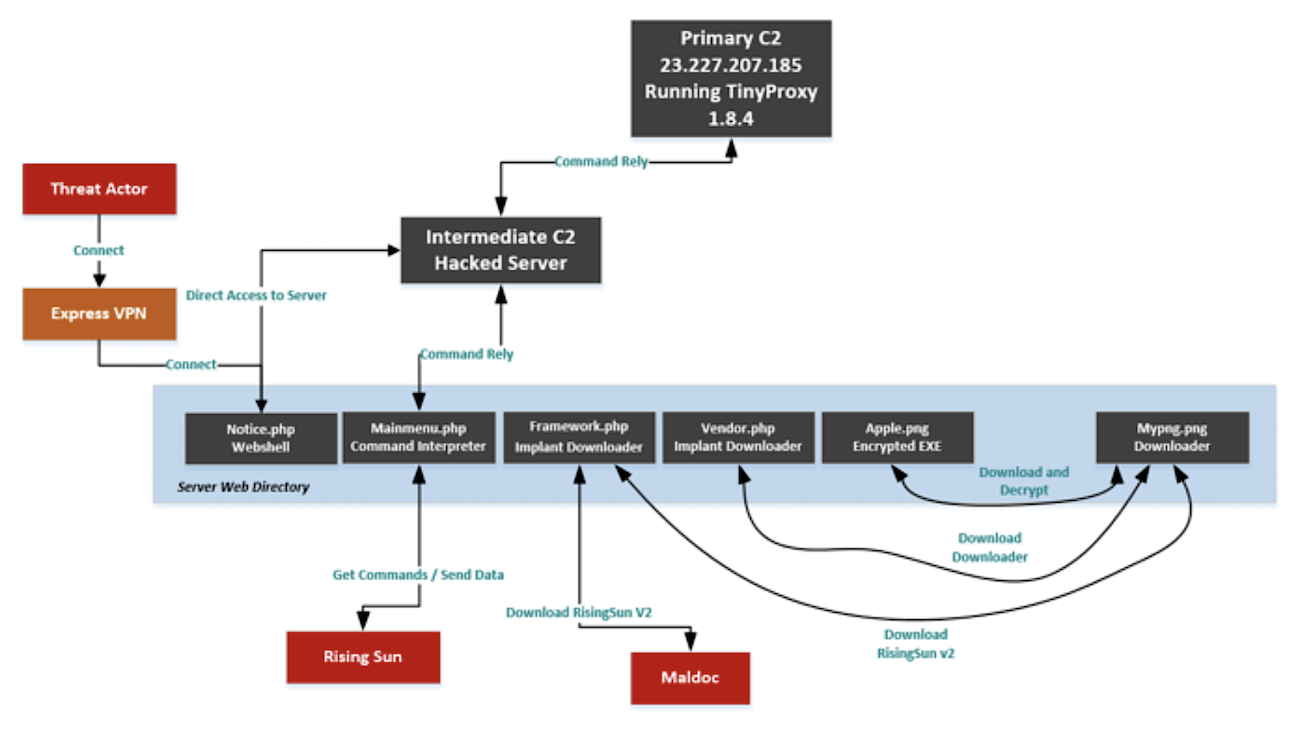
The modular command and control structure of the Rising Sun malware. (Image: McAfee)

The research showed that server, operating as the malware’s command and control infrastructure, was written in the PHP and ASP web languages, used for building websites and web-based applications, making it easily deployed and highly scalable.

The back-end has several components used to launch attacks on the hackers’ targets. Each component has a specific role, such as the implant downloader, which hosts and pulls the implant from another downloader; and the the command interpreter, which operates the Rising Sun implant through an intermediate hacked server to help hide the wider command structure.

The researchers say that the hackers use a factory-style approach to building the Rising Sun, a modular type of malware that was pieced together different components over several years. “These components appear in various implants dating back to 2016, which is one indication that the attacker has access to a set of developed functionalities at their disposal,” said McAfee’s research. The researchers also found a “clear evolutionary” path from Duuzer, a backdoor used to target South Korean computers as far back as 2015, and also part of the same family of malware used in the Sony hack, also attributed to North Korea.

Although the evidence points to the Lazarus Group, evidence from the log files show a batch of IP addresses purportedly from Namibia, which researchers can’t explain.

“It is quite possible that these unobfuscated connections may represent the locations that the adversary is operating from or testing in,” the research said. “Equally, this could be a false flag,” such as an effort to cause confusion in the event that the server is compromised.

The research represents a breakthrough in understanding the adversary behind Operation Sharpshooter. Attribution of cyberattacks is difficult at best, a fact that security researchers and governments alike recognize, given malware authors and threat groups share code and leave red herrings to hide their identities. But obtaining a command and control server, the core innards of a malware campaign, is telling.

Even if the goals of the campaign are still a mystery, McAfee’s chief scientist Raj Samani said the insight will “give us deeper insights in investigations moving forward.”

04 Mar 2019

Voi Technology, the European e-scooter rentals startup, raises an additional $30M

Well, that didn’t take long. Just three months after raising $50 million in Series A funding, e-scooter rentals startup Voi Technology has added another $30 million to its balance sheet. The new round sees existing investors Vostok New Ventures, Balderton Capital, LocalGlobe and Raine Ventures participate again, alongside new investors Project A and Creandum.

The inclusion of Project A won’t be entirely new news to close readers of TechCrunch. Based on my own sources, I reported that the Berlin-based early-stage VC was in the running in late October, and it was a surprise not to see the firm on the list of backers when VOI announced its Series A a month later. This new round sees those loose ends tidied up nicely.

A number of angel investors also participated. They include Cristina Stenbeck (Kinnevik), Justin Mateen (co-founder of Tinder), Keith Richman (board member, Grubhub), Jeff Wilke (Amazon), Sujay Jaswa (founder of WndrCo), Sujay Tyle (CEO Frontier Car Group), Diego Piacentini (Former Head of International Business, Amazon) Christian Leone (founder of Luxor Capital) and Spencer Rascoff (ex-CEO of Zillow).

Voi says the new capital will be used to ramp up expansion across Europe and invest in R&D. The company is also now claiming to be the leading “home-grown” e-scooter rentals company in Europe — as opposed to U.S.-founded Lime and Bird. In seven months, Voi says it has garnered a customer base of over 400,000 riders, who have taken a total of more than 750,000 rides.

Other competitors operating in various parts of Europe include Flash — the stealthy mobility startup from Delivery Hero and Team Europe founder Lukasz Gadowski that recently raised €55 million in Series A funding — as well as Berlin’s Wind Mobility ($22 million) and Tier (€25 million).

Taxify has also announced its entrance into e-scooter rentals, and Silicon Valley’s Bird and Lime not only operate in Europe but have received substantial investment from three of Europe’s top venture capital firms. Index and Accel have backed Bird, and Atomico has backed Lime.

Staying on message, Voi says that key to its success to date is working collaboratively with city authorities across the continent, including developing a Code of Conduct in Stockholm “to help the city’s multiple scooter-sharing operators work more safely and efficiently together”. However, that didn’t stop Voi having its license temporarily revoked in Madrid, alongside Lime and Wind after a change in the law required a change in the way e-scooter firms operate. It returned to the Spanish city in February.

Meanwhile, the company says its strongest markets so far are in the Nordics. Namely, Stockholm, Gothenburg, Malmö, Lund, Uppsala and Copenhagen, most of which it says will reach profitability in Q1. The e-scooter rental service is also live in Paris, Lyon, Madrid, Malaga, Zaragoza, Murcia, Lisbon and Faro. Today also sees a launch in Oslo, with Helsinki and other cities launching later this month. Italy, Germany, Norway and France are named as near-future expansions.

03 Mar 2019

Elon Musk says Tesla Model Y will be revealed at its LA design studio on March 14

Tesla will pull back the curtains and unveil its Model Y crossover vehicle at an event in Los Angeles on March 14th, according to a tweet from chief executive Elon Musk.

It’s the fifth new car design to come from Tesla’s shop since the company was founded in 2003. Musk has been teasing the car’s release since 2015, and in a January letter to shareholders said that high volume production would begin by the end of 2020.

Tesla said that it would begin tooling for the Model Y later this year and that the company would be producing the vehicle at its “gigafactory” in Nevada. In the same letter, Musk predicted that the cost of the Model Y line would be substantially lower than the Model 3 line in Fremont, Calif., because it will share roughly 75% of the same components with the new low-cost vehicle.

Tesla’s Model Y reveal comes amid sweeping changes that the automaker announced last week in tandem with the commercial availability of its $35,000 low-cost Model 3.

Tesla said that to achieve this lower price it will shift all sales globally to online only, meaning the company will be closing many of its stores over the next few months. The stores that remain, in high-traffic locations, will be turned into information centers, Musk said on a call with reporters. There will be some layoffs as a result. Musk later said they would be hiring more service technicians.

“Shifting all sales online, combined with other ongoing cost efficiencies, will enable us to lower all vehicle prices by about 6% on average, allowing us to achieve the $35,000 Model 3 price point earlier than we expected,” the company wrote in a post.

Tesla’s management expects that all of these changes should result in better results for the company. “Model 3 will become a global product, the profitability of our business should become sustainably positive, our new Gigafactory Shanghai should start producing cars, and we will start tooling for Model Y production,” the January shareholder read.

If the Model Y were to finally go into production, it could mean a phase out of older Tesla models, although that’s not a certainty.

Tesla also has two other models that are waiting in the wings — the Roadster and the Tesla Semi, which are both under development.

As the Verge noted, Musk joked about unveiling the new Model Y on March 15th “because the Ides of March sounded good.”

03 Mar 2019

Bill Gates and Jeff Bezos-backed fund invests in a global geothermal energy project developer

Breakthrough Energy Ventures, the investment firm financed by billionaires like Jeff Bezos, Bill Gates, and Jack Ma that invests in companies developing technologies to decarbonize society, is investing $12.5 million in a geothermal project development company called Baseload Capital.

Baseload Capital is a project investment firm that provides capital to develop geothermal energy power plants using technology developed by its Swedish parent company, Climeon.

Like the spinoff from Google’s parent company, Alphabet, Dandelion Energy, which recently raised $16 million in a new round of financing, Climeon builds standardized machines to tap geothermal energy. But Dandelion is targeting consumers with its technology to provide home heating, while Climeon turns geothermal energy into electricty.

The company’s modules — which stand around two meters cubed, produce 150 kilowatts of electricity, which is enough to power roughly 250 European households, according to a company spokesperson.

Climeon, which was founded back in 2011, formed Baseload Capital about a year ago to invest in special purpose vehicles to build the power plants that use Climeon’s technology. Baseload takes an equity stake in these companies and provides debt financing for them.

Through its investment into Baseload Capital, Breakthrough Energy Ventures will help finance and develop these small-scale power plants globally (Baseload has already formed special purpose vehicles that are developing projects in Japan).

Climeon and Baseload Capital focus on three primary industries — geothermal, shipping and heavy industry. “We sell our machines to the [maritime industry] where we turn the waste heat from the engines into electricity (Virgin Voyages has bought several systems), to industries such as steel where they also have a lot of waste heat and then to companies that develop and operate geothermal power plants,” a Climeon spokesperson wrote in an email. “This could be a newly formed SPV or an existing energy company. In the U.S., for example, our modules will be used in an existing geothermal site.”

The company’s pitch is that it’s modular units make it easy to scale up or decommission plants. Modules list for EUR350,000 and customers also spend EUR5,000 per-module, per-year on Climeon’s power plant management software.

So far, the company says it has an order backlog of roughly $88 million.

The investment in Baseload Capital is Breakthrough Energy’s second foray into the geothermal industry. Last year, the company backed Fervo Energy, which uses proven technologies to help speed the development of geothermal energy at a cost of 5 to 7 cents per kilowatt hour.

“We believe that a baseload resource such as low temperature geothermal heat power has the potential to transform the energy landscape. Baseload Capital, together with Climeon’s innovative technology, has the potential to deliver GHG-free electricity at large scale, economically and efficiently,” said Carmichael Roberts of Breakthrough Energy Ventures, in a statement.

03 Mar 2019

Transportation Weekly: Polestar CEO speaks, Tesla terminology, and a tribute

Welcome back to Transportation Weekly; I’m your host Kirsten Korosec, senior transportation reporter at TechCrunch . This is the fourth edition of our newsletter, a weekly jaunt into the wonderful world of transportation and how we (and our packages) move.

This week we chat with Polestar CEO Thomas Ingenlath, dig into Lyft’s S-1, take note of an emerging trend in AV development, and check out an experiment with paving. Oh, and how could we forget Tesla.

Never heard of TechCrunch’s Transportation Weekly? Catch up here, here and here. As I’ve written before, consider this a soft launch. Follow me on Twitter @kirstenkorosec to ensure you see it each week. (An email subscription is coming). 


ONM …

There are OEMs in the automotive world. And here, (wait for it) there are ONMs — original news manufacturers. (Cymbal clash!) This is where investigative reporting, enterprise pieces and analysis on transportation lives.

This week, we’re featuring excerpts taken from a one-on-one interview with Polestar CEO Thomas Ingenlath.

On February 27, Volvo’s standalone electric performance brand Polestar introduced its first all-electric vehicle, a five-door fastback called the Polestar 2. The EV, which has a 78 kWh battery pack and can travel 275 miles (estimated EPA guidance) on a single charge, will be manufactured at a new factory in Chengdu, China. Other notable specs: The infotainment system will be powered by Android OS, Polestar is offering subscriptions to the vehicle, and production starts in 2020.

yellow-jacket-polestar

Here is what Ingenlath had to say to me about …

EV charging infrastructure

To be very unpolitical, I think it would be totally stupid if we were to aim to develop electric charging infrastructure on our own or for our brand specifically. If you join the electric market today, of course, you would see partnerships; that’s sensible thing to do. Car companies together are making a big effort in getting out a network of necessary charging stations along the highway. 

That’s what we’re doing; we’re teaming up and have the contracts being designed and soon signed.

On the company’s approach to automation 

The terminology is important for us. We very clearly put that into a different picture, we’re not talking about, and we clearly do not ever want to label it, anautopilot.” The focus of this system is a very safe distance control, which breaks for you and accelerates for you, and of course, the lane keeping. This is not about developing an autopilot system, it is about giving your safety. And that’s where we don’t want to provoke people thinking that they have full rollout autopilot system there. But it is a system that helps you being safe and protected on the road.

I also reached out to Transportation Weekly readers and asked what they wanted to know and then sent some of those questions to Ingenlath.

TW Reader: How did it feel taking one of your personal styling elements – the C shaped rear lamps – from your previous brand over to Polestar?
Ingenlath: It’s an evolutionary process. Polestar naturally builds on its “mothers” DNA and as a new branch develops its own personality. Thor’s hammer, the rear light signature -—with each new model launch (Volvo and Polestar) those elements diverge into a brand specific species.
TW Reader: How much do you still get to do what you love, which is design?
Ingenlath: Being creative is still my main job, now applied on a broader scope — trying to lead a company with a creative and  brand building mindset. Still, I love the Fridays when I meet up with Robin and Max to review the models, sketches and new data. We really enjoy driving the design of both brands to new adventures.

Dig In

Tesla is finally going to offer customers a $35,000 Model 3. How the automaker is able to sell this electric vehicle at the long-awaited $35,000 price point is a big piece of that story — and one that some overlooked. In short, the company is blowing up its sales model and moving to an online only strategy. Tesla stores will close or be converted to “information centers” and retail employees will be laid off.

But this is not what we’re going to talk about today. Tesla has also brought back its so-called “full self-driving” feature, which was removed as an option on its website last year. Now it’s back. Owners can opt for Autopilot, which has automatic steering on highways and traffic-aware cruise control, or FSD.

FSD capability includes several features such as Navigate on Autopilot that is supposed to guide a car from a highway on-ramp to off-ramp, including navigating interchanges and making lane changes. FSD also includes Advanced Summon, Auto Lane Change, and Autopark. Later this year, the system will recognize and respond to traffic lights in more complex urban environments, Tesla says.

All of these features require the driver to be engaged (or ready to take over), yet it’s called “full self-driving.” Now Tesla has two controversially named automation features. (The other is Autopilot). As Andrew Hawkins at The Verge noted in his coverage, “experts are beginning to realize that the way we discuss, and how companies market, autonomy is significant.”

Which begs the obvious question, and one that I asked Musk during a conference call on Thursday. “Isn’t it a problem that you’re calling this full self-driving capability when you’re still going to require the driver to take control or be paying attention?” (I also wanted to ask a followup on his response, but the moderator moved onto the next reporter).

His response:

“We are very clear when you buy the car what is meant by full self driving. It means it’s feature complete, but feature complete requiring supervision.

As we get more — we really need billions of miles, if not maybe 10 billion sort of miles or kilometers on that order collectively from the fleet — then in our opinion probably at that point supervision is not required, but that will still be up to regulators to agree.

So we’re just very clear.  There’s really three steps: there’s being feature complete of full self driving that requires supervision, feature complete but not requiring supervision, and feature complete not requiring supervision and regulators agree.

In other Tesla news, the National Transportation Safety Board is investigating a crash, that at first glance seems to be similar to the fatal crash that killed Tesla owner Joshua Brown.


A little bird …

We hear a lot. But we’re not selfish. Let’s share.

blinky-cat-bird

It’s no secret that Pittsburgh is one of the hubs of autonomous vehicle development in the world. But what’s not so widely known — except for a group of government and company insiders — is that Mayor William Peduto is on the verge of issuing an executive order that will give more visibility into testing there. 

The city’s department of mobility and infrastructure is the central coordinator of this new executive order that aims to help guide testing and policy development there. The department is going to develop guidelines for AV testing, we’re told. And it appears that information on testing will be released to the public at least once a year.

Got a tip or overheard something in the world of transportation? Email me or send a direct message to @kirstenkorosec.


Deal of the week

Daimler and BMW are supposed to be competitors. And they are, except with mapping (both part of the HERE consortium), mobility services (car sharing, ride-sharing), and now the development of highly automated driving systems. The deal is notable because it illustrates a larger trend that has emerged as the AV industry hunkers down into the “trough of disillusionment.” And that’s consolidation. If 2016, was the year of splashy acquisitions, then 2019 is shaping up to be chockfull of alliances and failures (of some startups).

Also interesting to note, and one that will make some AV safety experts cringe, both companies are working on Level 3 driving automation, a designation by the SAE that means conditional driving automation in which multiple high levels of automation are available in certain conditions, but a human driver must be ready to take over. This level of automation is the most controversial because of the so-called “hand off” problem in which a human driver is expected to take control of the wheel in time.

Speaking of partnerships, another deal that got our attention this week involved New York-based mapping and data analytics startup Carmera and Toyota Research Institute-Advanced Development. TRI-AD is an autonomous drive unit started by Toyota with Denso and Aisin. TRI-AD’s mission is to take the research being done over at the Toyota Research Institute and turn its into a product.

The two companies are going to test a concept that will use cameras in Toyota test vehicles to collect data from downtown Tokyo and use it to create high definition maps for urban and surface roads.

TRI-AD considers this the first step towards its open software platform concept known as Automated Mapping Platform that will be used to support the scalability of highly automated driving, by combining data gathered from vehicles of participating companies to generate HD maps. AMP is new and has possible widespread implications at Toyota. And TRI-AD is full of A-listers, including CEO James Kuffner, who came from the Google self-driving project and Nikos Michalakis, who built Netflix’s cloud platform, and Mandali Khalesi, who was at HERE.

Read more on Khalesi and the Toyota’s open source ambitions here.

Other deals:


Snapshot

Snapshot this week is a bit untraditional. It’s literally a snapshot of myself and my grandmother, months before her 100th birthday. Her memorial service was held Saturday. She died at 101. She loved cars and fast ones, but not so much driving them. And every time I got a new press car, we’d hit the road and she’d encourage me to take the turns a bit faster.
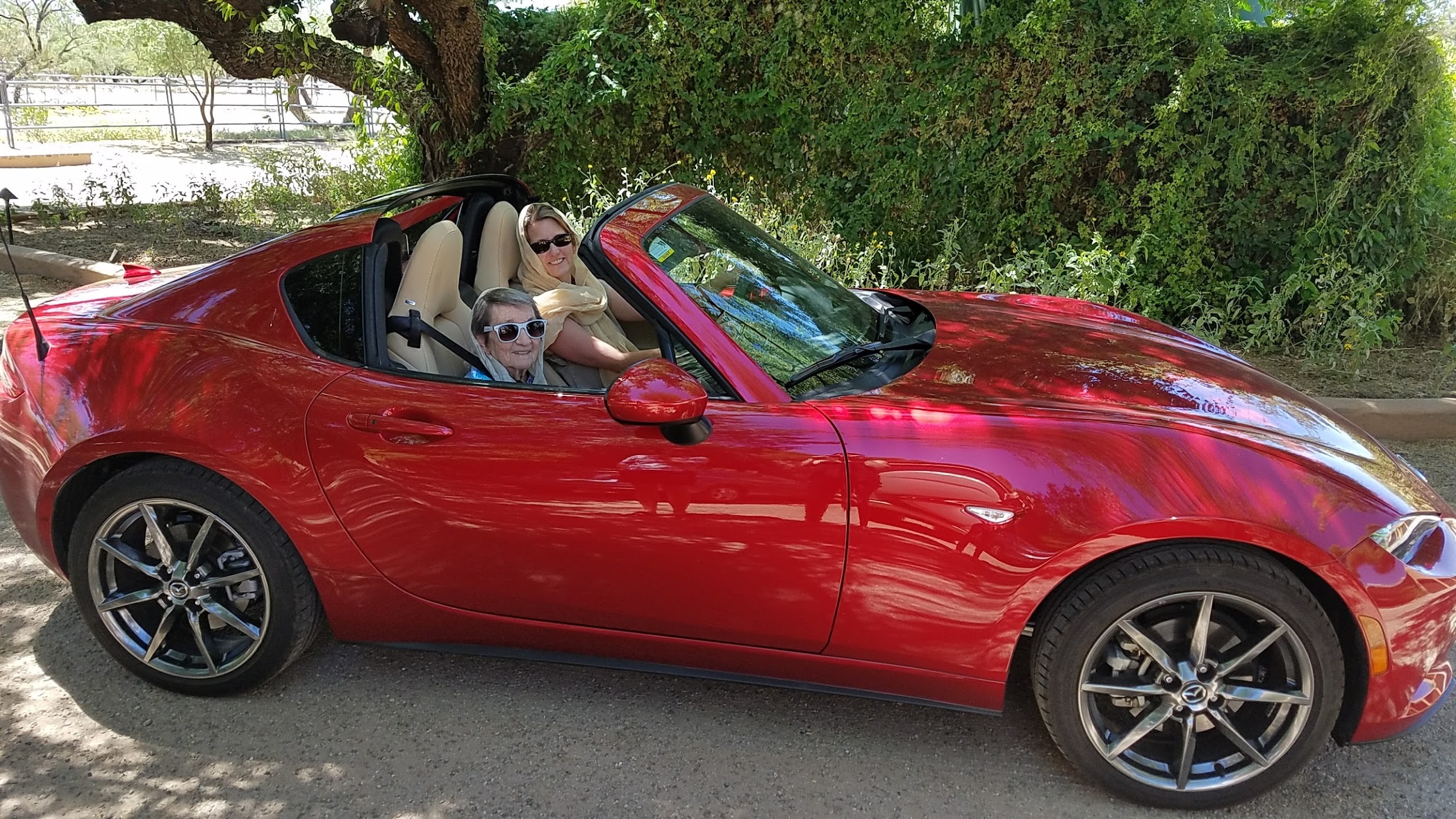
She also loved road trips and in the 1920s, her father would drive the family on the mostly dirt roads from New Jersey to Vermont and even Canada. In her teens, she loved riding in the rumble seat, a feature found in a few vehicles at the time including the Ford Model A.

She was young at heart, until the very end. Next week, we’ll focus on the youngest drivers and one automotive startup that is targeting that demographic.


Tiny but mighty micromobility

Lyft’s S-1 lays out the risks associated with its micromobility business and its intent to continue relying on third parties to manufacture its bikes and scooters. Here’s a key nugget about adoption:

“While some major cities have widely adopted bike and scooter sharing, there can be no assurance that new markets we enter will accept, or existing markets will continue to accept, bike and scooter sharing, and even if they do, that we will be able to execute on our business strategy or that our related offerings will be successful in such markets. Even if we are able to successfully develop and implement our network of shared bikes and scooters, there may be heightened public skepticism of this nascent service offering.”

And another about seasonality:

“Our limited operating history makes it difficult for us to assess the exact nature or extent of the effects of seasonality on our network of shared bikes and scooters, however, we expect the demand for our bike and scooter rentals to decline over the winter season and increase during more temperate and dry seasons.”

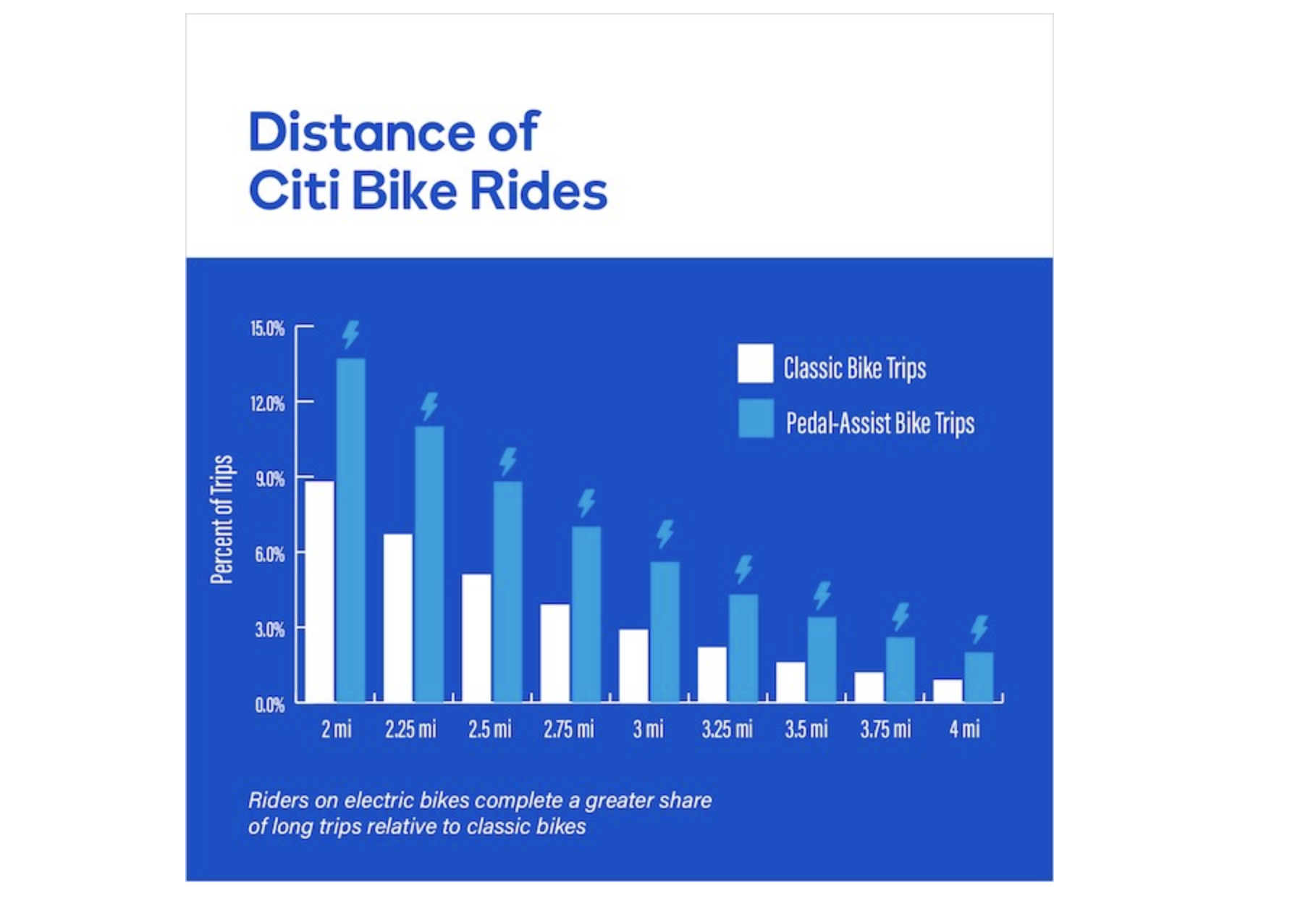
Lyft, which bought bike-share company Motivate back in July, also released some data about its electric pedal-assist bikes this week, showing that the pedal assist bikes are, unsurprisingly, more popular than the traditional bikes. They also traveled longer distances and improved winter ridership numbers. Now, Lyft is gearing up to deploy 4,000 additional electric bikes to the Citi Bike system in New York City.
One more thing …

Google Maps has added a feature that lets users see Lime scooters, pedal bikes and e-bikes right from the transit tab in over 80 new cities around the world. Users can click the tab to find out if Lime vehicle is available, how long it’ll take to walk to the vehicle, an estimate of how much their ride could cost, along with total journey time and ETA.


Notable reads

If take the time to read anything this week (besides this newsletter), spend some time with Lyft’s S-1. The ride-hailing company’s prospectus mentions autonomous 109 times. In short, yeah, it’s something the company’s executives are thinking about and investing in.

Lyft says it has a two-pronged strategy to bring autonomous vehicles to market. The company encouraging developers of autonomous vehicle technology to use its open platform to get access to its network and enable their vehicles to fulfill rides on the Lyft platform. And Lyft is trying to build its own autonomous vehicle system at its confusingly named “Level 5 Engineering Center.”

  • The company’s primary investors are Rakuten with a 13 percent stake, GM with 7.8 percent, Fidelity with 7.7 percent, Andreessen Horowitz with 6.3 percent and Alphabet with 5.3 percent. GM and Alphabet have business units, GM Cruise and Waymo respectively, that are also developing AV technology.
  • Through Lyft’s partnership with AV systems developer and supplier Aptiv, people in Las Vegas have taken more than 35,000 rides in Aptiv autonomous vehicles with a safety driver since January 2018.
  • One of the “risks” the company lists is “a failure to detect a defect in our autonomous vehicles or our bikes or scooters”

Other quotable notables:

Check out the Pedestrian Traffic Fatalities by State report, a newly released report from Volvo Car USA and The Harris Poll called  The State of Electric Vehicles in America.


Testing and deployments

Again, deployments doesn’t always mean the latest autonomous vehicle pilot.

On Saturday, Sidewalk Labs hosted its Open Sidewalk event in Toronto. This is part of Sidewalk Toronto, a joint effort by Waterfront Toronto and Alphabet’s Sidewalk Labs to create a “mixed-use, complete community” on Toronto’s Eastern Waterfront

The idea of this event was to share ideas and prototypes for making outdoor public space the “social default year-round.” One such prototype “hexagonal paving” got our attention because of its use case for traffic control and pedestrian and bicyclist safety. (Pictured below)

These individual precast concrete slabs are movable and permeable, can light up and give off heat. The idea is that these hexagonal-shaped slabs and be used to clear snow and ice in trouble spots and light up to warn drivers and pedestrians of changes to the street use or to illuminate an area for public uses or even designate bike lanes and hazard zones. And because they’re permeable they can be used to absorb stormwater or melted snow and guide it to underground stormwater management systems.

Sidewalk Labs tell me that the pavers have “plug and play” holes, which allow things like bike racks, bollards, and sign posts to be inserted. Sidewalk Labs initially built these with wood, and the new prototype is the next iteration, featuring modules built from concrete.


On our radar

There is a lot of transportation-related activity this month.

The Geneva Motor Show: Press days are March 5 and March 6. Expect concept, prototype and production electric vehicles from Audi, Honda, Kia, Peugeot, Pininfarina, Polestar, Spanish car company Hispano Suiza, and Volkswagen.

SXSW in Austin: TechCrunch will be at SXSW this coming week. Here’s where I’ll be.

  • 2 p.m. to 6:30 p.m. March 9 at the Empire Garage for the Smart Mobility Summit, an annual event put on by Wards Intelligence and C3 Group. The Autonocast, the podcast I co-host with Alex Roy and Ed Niedermeyer, will also be on hand.
  • 9:30 a.m. to 10:30 a.m. March 12 at the JW Marriott. The Autonocast and founding general partner of Trucks VC, Reilly Brennan will hold a SXSW podcast panel on automated vehicle terminology and other stuff.
  • 3:30 p.m over at the Hilton Austin Downtown, I’ll be moderating a panel Re-inventing the Wheel: Own, Rent, Share, Subscribe. Sherrill Kaplan with Zipcar, Amber Quist, with Silvercar and Russell Lemmer with Dealerware will join me.
  • TechCrunch is also hosting a SXSW party from 1 pm to 4 pm Sunday, March 10, 615 Red River St., that will feature musical guest Elderbrook. RSVP here

Self Racing Cars

Finally, I’ve been in contact with Joshua Schachter who puts on the annual Self Racing Car event, which will be held March 23 and March 24 at Thunderhill Raceway near Willows, California.

There is still room for participants to test or demo their autonomous vehicles, drive train innovation, simulation, software, teleoperation, and sensors. Hobbyists are welcome. Sign up to participate or drop them a line at contact@selfracingcars.com.

Thanks for reading. There might be content you like or something you hate. Feel free to reach out to me at kirsten.korosec@techcrunch.com to share those thoughts, opinions or tips. 

Nos vemos la próxima vez.

03 Mar 2019

Original Content podcast: We dance with the emo heroes of Netflix’s ‘Umbrella Academy’

Netflix’s “Umbrella Academy” opens in 1989, with 43 women across the world giving unexpected, simultaneous birth. Fast forward 30 years, and seven of those (mostly) super-powered children were adopted by a wealthy benefactor, formed a crimefighting team called The Umbrella Academy, experienced tragedy and went their separate ways.

On the latest episode of the Original Content podcast, we’re joined by our original co-host Darrell Etherington to review the show. The description above only scratches the surface of what’s going on in “The Umbrella Academy” (based on the comics by Gerard Way and Gabriel Bá) — there’s also a talking chimpanzee, an agency of time-traveling assassins, an impending apocalypse and much more.

What makes the series work, however, is a clear sense of the characters’ personalities and pain — particularly Ellen Page’s Vanya, who continues to feel isolated from her adopted siblings thanks to her lack of powers. And everything is accompanied by lively music, including a perfect dance scene set to Tiffany’s “I Think We’re Alone Now.”

We also cover last weekend’s Academy Awards: Who won, who should have won and who gave the best and worst speeches.

You can listen in the player below, subscribe using Apple Podcasts or find us in your podcast player of choice. If you like the show, please let us know by leaving a review on Apple. You also can send us feedback directly. (Or suggest shows and movies for us to review!)

03 Mar 2019

The shift to collaborative robots means the rise of robotics as a service

The 2018 Holiday shopping season was the biggest on record for e-commerce, with nearly $126 billion in online sales. But as e-commerce continues to expand, the demand for warehouse workers is growing faster than the labor supply and creating an increased need for automation.

Given its dominance in e-commerce and the massive scale of its business, there’s no surprise that Amazon was one of the first companies to supplement their human workforce with robotics. Since the acquisition of Kiva in 2012, a growing army of robots performs an increasing variety of tasks at Amazon facilities. However, those tasks remain limited in their ability to displace their human counterparts entirely.

Today, robotics are more affordable to a broader array of companies, thanks to lower cost components, and advancements in technology have paved the way for the rise of the collaborative robot or “cobot”.

inVia Robotics warehouse robots

Cobots are more precise and increasingly flexible with advanced sensor technology, AI, Lidar/Radar, GPS, and connectivity. Machine learning has also made cobots more versatile—not just in their hardware, but in software that facilitates adaptation to a broad array of tasks. And because sensor-rich robots can adapt to a variety of new challenges on the fly, we see more use cases for real-world application.

Don’t expect a severe shift to collaborative robots — we are still in the early innings. The global industrial robot market, dominated by the “Big 4” (Kuka, ABB, Fanuc, and Yaskawa) was valued at more than $15 billion in 2017, while the market for cobots reached only $287 million. However, the digital transformation of warehouses presents a tremendous market opportunity for new companies to create value.

We draw connections to the shift we saw from legacy software to SaaS, where traditional sales and business models switched to recurring revenue streams and cloud-based subscription services. By combining domain-specific go-to-market with robust software management platforms, the next generation of robotics companies has the opportunity to avoid long integrator-led sales cycles and become highly sticky over time, much like the early SaaS providers.

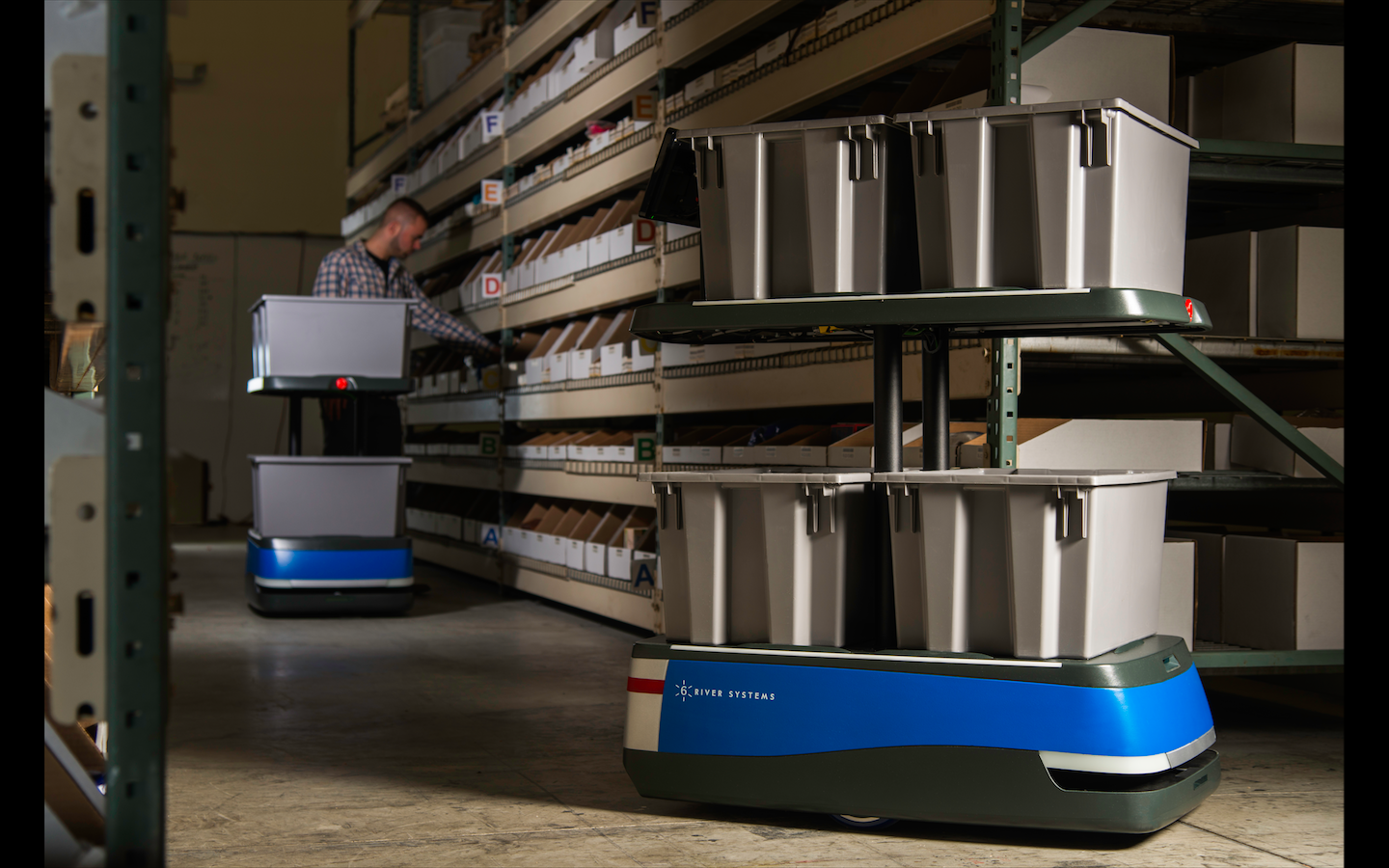
6 River Systems robots lead workers to items they need to get from a warehouse shelf.

Additionally, collaborative robotic technology allows robots to augment human labor, lowering the barriers to entry, while still providing clear payback arguments around efficiency. Like the shift to cloud software, best-in-class platforms are now available to the masses without significant upfront investment in infrastructure.

We believe that co-bots will unlock market verticals traditionally underserved by robotics, such as logistics, food, and security.  Companies that offer full-service solutions to these sectors provide attractive opportunities to build value. For example, 6 River Systems — whose cobots, known as Chucks, use cloud software to coordinate warehouse tasks and work side-by-side with human employees — are changing how we think about the human-robot dynamic.

Cobalt Robotics, in the security vertical, allows human security guards to remotely monitor offices, creating cost savings for the employer, and efficiencies for the security guard. And other companies like RightHand Robotics, inVia Robotics, Starship are poised to replace human labor in some commercial settings.

The rapid innovation in this industry promises to bring efficiency and growth to countless sectors in coming years. Robotics programs at esteemed universities such as MIT, Carnegie Mellon, and Georgia Tech are churning out a pool of world-class entrepreneurs who are not only seizing a timely—and hopefully profitable opportunity—but boldly advancing the industry.

To quote my fellow partner at Menlo Ventures, Matt Murphy, “We are entering a golden era of robotics, where robotics will become mainstream, drive huge efficiencies, and in some cases make the impossible possible.”

03 Mar 2019

Two Austin-based VC firms are each raising $100M funds

Texas startups will soon have two new sources for capital.

Crunchbase News has learned that two Austin-based venture capital firms, ATX Seed Ventures and Quake Capital, are in the process of each raising $100 million funds.

The news comes off a period in which the Austin tech scene saw a number of wins. Tech giants Apple and Google recently committed to expanding their presence in the Texas capital in a big way. And venture investing in the city is picking up at an impressive pace. In January alone, Austin startups raised nearly as much as was raised in all of the 2018 fourth quarter.

While both firms have different investment strategies, they share some similarities: They’re both trying to fill what they perceive as an early-stage gap in the Austin market, and they both are naturally bullish on the region.

First let’s discuss what ATX Seed Ventures has planned.

The firm only just recently closed its second $32 million fund and is already busy raising money for its third fund, which has a target of $100 million. It’s expecting a first close as soon as May, and a final close later this year.

While that might seem like a big jump, the five-year-old firm’s partners — managing director Chris Shonk, COO Danielle Allen and Brad Bentz — explained to me that the firm actually has more than $60 million under management, so the larger fund size may seem more dramatic than it actually is.

“We put a significant amount of capital to work outside of our primary fund with co-investments…” Shonk said. “But we’re excited to have investors not just doubling down, but tripling down. It’s a strong sign of investor confidence.”

ATX Seed Ventures launched its first fund at SXSW 2014, in which it deployed $17.25 million worth of capital. The firm currently has 26 portfolio companies and has already seen four exits: Incent Games (also known as FantasySalesTeam) was acquired by MicrosoftRideScout was acquired by moovel Group, a subsidiary of Daimler; Set.fm was acquired by VNUE Inc. and Unbill was acquired by Q2ebanking.

Per its name, ATX Seed Ventures started by primarily investing in Austin-based companies. It has since branched out to investing in other Texas cities and is now considering “surrounding” markets.

Despite its name, the firm doesn’t just invest in the seed stage, although that’s when it most prefers to get in.

“What we really came into the market trying to do was institutionalize seed by leading rounds, taking a board seat and structuring terms,” Shonk told Crunchbase News. “We like being a company’s first institutional round and bringing in what we think of as Series A and B rigor and discipline at the seed valuation stage.”

One of the things the firm likes most about being the first institutional check is that it can “control valuation a bit.”

“Valuations have kind of gone nuts, especially in later rounds,” Shonk said. “So this way, we’re not inheriting someone’s prior complexities.”

Bentz agrees.

“In terms of valuations, they’re not as out of control here in Texas as they are in some markets,” he said. “So, on a risk-adjusted basis you can still make some really good deals here.”

As for sectors, ATX is particularly focused on B2B — which Austin is known for — with a SaaS business model. But it’s also interested in supply chain/manufacturing, real estate tech and energy-related businesses.

“We try to run the races we think we can win,” Bentz said. “So we focus on our own areas of expertise as well as that of our LPs so that we can add strategic value, and not just put money into deals.”

Another quake

Meanwhile, Quake Capital — which moved its headquarters from New York to Austin last July — is also in the process of raising a $100 million fund.

Founded in January 2016, Quake started investing in early 2017 out of a $4.65 million fund. It invested in 31 companies out of that fund. Jim Brisimitzis, managing partner of Quake’s Seattle office, noted that Quake’s second fund was capped at $15 million “by request” of its LPs. That fund closed in December. Overall, the firm currently has more than 110 companies in its portfolio.

As part of what it describes as its increased commitment to the region, the firm has hired a new managing director, Jason Fernandez, to run its Austin office. As part of his new role, Fernandez will oversee Quake’s ATX accelerator program as well as the firm’s investor and advisor network. Most recently, he worked as an operations and finance partner at BASE Equity Partners.

“We believe Quake is coming into the Austin market at the right time,” Fernandez said. “We see a real opportunity to participate in this early-stage/seed category as most of the existing VCs seem to be moving up the food chain a bit and investing at later stages.”

Brisimitzis reiterated Quake’s confidence in the Austin market.

“We see a tremendous amount of growth in this ecosystem and want to be a part of it,” he told Crunchbase News.

As Austin’s startup ecosystem continues to grow, there’s no doubt two new nine-figure funds will be welcomed with open arms.