Author: azeeadmin

28 Feb 2019

Facebook says that Workplace now has 2M paying users

With Slack gearing up to go public and now seeing daily active users of 10 million with 85,000 organizations using it to help employees communicate with each other, Facebook today released some updated numbers of its own for Workplace, its enterprise-focused platform: the company says that there are now 2 million paid users on the service, not counting those who are using its free tier; and NGOs and educational organizations using Workplace for Good — if you add these in you get “millions” more, Facebook said, without providing a concrete number.

The company’s paid tier starts at $3 per month per user, with pricing arranged directly with organizations when numbers exceed 5,000 employees. It started to charge for its service in October 2017, after first launching in October 2016.

Being Facebook and already working at a huge scale with more than 2 billion monthly active users of its flagship service, the company has always pitched Workplace as a tool for very large enterprises, and today it said that it now has 150 companies with more than 10,000 users each on the platform.

These have included companies like Walmart (the world’s biggest employer) as well as Nestle, Vodafone, GSK, Telefonica, AstraZeneca and Delta Airlines.

Picking these metrics to talk about the company’s growth is a strategic move for Facebook. They are different enough from what Slack measures that it’s not immediately easy to draw a comparison and claim that Slack is much larger. At the same time, it highlights Workplace’s success in an area that Slack, Teams and others competing in this space are also chasing: enterprise users. These are the most lucrative customer segment, as they not only generate larger recurring revenues, but they are often slower to churn once they do sign on to your service.

Workplace has made an effort over the last several years to add more features to bring the platform in line both with what basic Facebook offers, as well as other enterprise communication services that Workplace competes with more directly. That includes integrating with a number of key apps, although it’s still far from the hundreds that can be fed into Slack.

The numbers do not give us a total number of users on Workplace but they set out also how Facebook is continuing to drive the product forward as a diverse and distinct revenue stream apart from its ad-based consumer service.

At the end of last year, Facebook appointed a new head of Workplace, Karandeep Anand, who came to Facebook three years ago from Microsoft (and thus has a close understanding of enterprise software). He works alongside Julien Codorniou to focus on the technical development of the product while Codorniou focuses on sales, client relations and business development.

28 Feb 2019

Google is not great at retaining black, Latinx and Native American employees

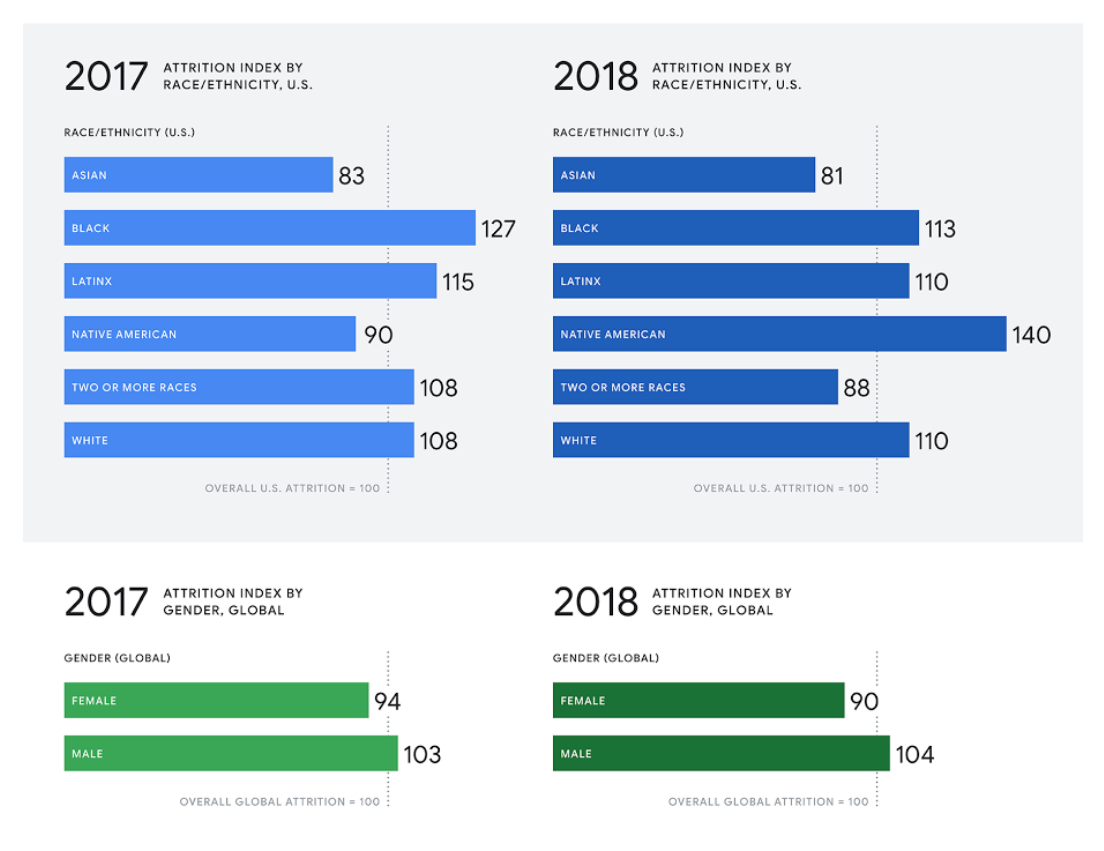
Believe it or not, the retention of black and Latinx employees at Google was better last year than in 2017. Though, Google’s attrition rates of black and Latinx — which indicate the rate at which employees leave on an annual basis — are still higher than the national average.

For Native American employees, Google’s attrition rates significantly increased from the year prior. To be clear, that’s a bad thing. For what it’s worth, Google is also not great at retaining white employees.

Google publishes the data as a weighted index and treats the average attrition rate as 100. The closer each group is to 100, the close to parity Google is. If a group’s index is 90, that means the group’s attrition rate was 10 percent lower than the average.

“While there are positive trends, there is still work to be done,” Global Director of Diversity, Equity & Inclusion Melanie Parker wrote in a blog post. “Specifically, attrition for Native Americans worsened. And while rates improved for Black and Latinx Googlers, they are still not on par with the average. These are all areas we plan to focus on over the coming year.”

Google released its first attrition index last year to show how many employees left the company on annual basis. Based on last year’s data, it was clear Google had the hardest time retaining black and brown employees. In fact, black and brown people were leaving Google at rates faster than the national average.

At the time, then-Google VP of Diversity and Inclusion Danielle Brown told TechCrunch the attrition rates for black and Latinx people were “a clear low light.”

A highlight, however, was that women were leaving Google at lower rates than the average. And this year’s data for women is slightly better, with an attrition rate of 90 compared to 94 the year prior. But we’ll see how the latest wave of controversy (harassment, walkouts, etc) at Google affects its attrition rates for 2019.

28 Feb 2019

Applications are open for Startup Battlefield at TechCrunch Disrupt SF 2019

Founders. This is your shot. TechCrunch is officially in the hunt for the most disruptive startups for this year’s Startup Battlefield at TechCrunch Disrupt San Francisco 2019. Startups can apply here to compete on our world-famous stage for a $100,000 equity-free prize and the coveted Disrupt Cup. With more than 10,000 attendees, hundreds of press outlets and top investors from around the world, your company will launch to the most influential players in tech.

The application. Simple. Fill out your app here. There is no cost to apply or participate. TechCrunch does not take any fees or equity. Early-stage startups from any country and any vertical are eligible. TechCrunch’s editors will review the applications and select the most promising startups to pitch the world’s top VCs on the main stage at Disrupt SF (October 2-4) — set to be the biggest event in TechCrunch’s history.

The training. The Startup Battlefield team will work intensively over many weeks with the Startup Battlefield contestants to hone pitches, sharpen business models and perfect demos.

The conference. At TechCrunch Disrupt SF, Startup Battlefield contestants are welcome at VIP events, backstage and more. The Battlefield startups receive complimentary exhibition space on the show floor for all three days, as well as access to CrunchMatch, TechCrunch’s investor-founder matching system. Battlefield startups also receive complimentary tickets to all future TechCrunch events, access to alumni events and free subscriptions to Extra Crunch.

The competition. The Startup Battlefield contestants, approximately 20 in number, pitch for six minutes each, including a live demo, followed by a six-minute Q&A with our elite judges — investors like Roelof Botha, Jeff Clavier, Cyan Banister, Kirsten Green and Aileen Lee. After the initial round, 4-6 companies will be selected to pitch again on the final day of the conference in front of a new panel of judges. They will choose the winner, who will receive the Disrupt Cup, a check for $100,000 and a post in TechCrunch, as well as the attention of media and investors around the world. All Startup Battlefield sessions are streamed live on TechCrunch to a global audience in the millions.

The Startup Battlefield Alumni Community. Join the ranks of alumni like Vurb, Dropbox, Get Around, Cloudflare, Mint.com and more. Don’t just take our word for it! Our Startup Battlefield Alumni metrics speak for themselves — 857 contestants have raised about $8.8 billion and produced 108 successful exits (IPOs or acquisitions). 

So what are you waiting for? Apply now.

28 Feb 2019

Announcing the Agenda for TC Sessions: Robotics/AI at UC Berkeley on April 18

We’re bringing TC Sessions: Robotics + AI back to UC Berkeley on April 18, and we’re excited to announce our jam-packed agenda that highlights the best and brightest in robotics and – new for 2019 – artificial intelligence.

For months we’ve been selecting the most innovative startups and top leaders from established tech companies working in Robotics and AI. There have been huge leaps forward in this field the past year, and we’re thrilled to bring you the latest and greatest.

Early-bird tickets ($100 savings) are currently available for a limited time – you can  pick up tickets here before prices increase.

We’ve still got some key guests to announce, and will be adding some new names to the agenda over the next few weeks, so keep your eyes open. In the meantime, check out these agenda highlights:

Agenda

9:35 AM – 10:00 AM

Building a Better Robotics Company with Nima Keivan (Canvas), Manish Kothari (SRI International), and Melonee Wise (Fetch Robotics)

Many have tried, but few have succeeded in launching a successful robotics company. A trio of experts, including Melonee Wise (Fetch Robotics), Manish Kothari (SRI) and Nima Keivan (Canvas) will discuss the successes and pitfalls of entering the world of robotic startups.


10:00 AM – 10:25 AM

Can’t We All Just Get Along? with Anca Dragan (UC Berkeley), Rana el Kaliouby (Affectiva), and Matt Willis (Softbank Robotics)

Robots and humans are working and living together more than ever, and that means we have to watch out for one another – literally. A trio of guests will be exploring the increasingly important world of human-robot interaction (HRI).


10:25 AM – 10:50 AM

This Reality Does Not Exist: Trust in an Age of Synthetic Media with Alexei Efros (UC Berkeley) and Hany Farid (Dartmouth College)

AI-based tools are proving capable of fabricating or modifying imagery and audio in ways that are nearly indistinguishable from reality. How can these systems and media be detected, and how can we trust anything when everything could be faked?


10:50 AM – 11:15 AM

Coming Soon!


11:35 AM – 11:55 AM

Artificial Intelligence: Minds, Economies and Systems that Learn with Ken Goldberg (UC Berkeley) and Michael Jordan (UC Berkeley)

AI and robots are being adopted by industry after industry, ushering in a new era in technology and services — but one that needs to be built as it grows. Berkeley’s Ken Goldberg and Michael Jordan discuss the advances that got us here and what comes next.


11:55 AM – 12:20 PM

AI Startups That Enable AI with Ali Farhadi (Xnor.ai), Daryn Nakhuda (Mighty AI)

Building AI is a difficult task on its own, and building a startup around it is even harder. Mighty AI, Xnor and DefinedCrowd have all shown that it’s possible to create powerful AI tools as well as empower others — while running a real business as well.


12:30 PM – 1:30 PM

WORKSHOP: How to Launch a Robotics Startup with Eric Migicovsky (Y Combinator)


1:30 PM – 1:55 PM

Putting Drones to Work with, Grant Canary (Droneseed), Laura Major (Aria Insights) and Arnaud Thiercelin (DJI)

Drones are being employed for more than just buzzing around the beach and recording weddings. In the last few years, we’ve seen drones that help stop poachers, deliver packages, inspect pipelines, and more. What’s next?


2:00 PM – 2:45 PM

Q&A with Founders: Your chance to ask questions to some of the greatest minds in technology. Workshop Room. 


2:35 PM – 3:05 PM

Investing In Robotics and AI: Lessons from the Industry’s VCs with Peter Barrett (Playground Global), Hidetaka Aoki (Global Brain), Helen Liang (FoundersX Ventures), and Andy Wheeler (GV)

Leading investors will discuss the rising tide of venture capital funding in robotics and AI. The investors bring a combination of early-stage investing and corporate venture capital expertise, sharing a fondness for the wild world of robotics investing.


3:10 PM – 3:45 PM

Q&A with Investors: Your chance to ask questions to some of the greatest investors in robotics and AI with Peter Barrett (Playground Global), Hidetaka Aoki (Global Brain), Helen Liang (FoundersX Ventures). Workshop Room.


3:55 PM – 4:15 PM

The Best Robots on Four Legs with Marc Raibert (Boston Dynamics)

Boston Dynamics rocked the world with the robots like Big Dog, Cheetah and Atlas. As one of the company’s latest creations SpotMini comes to market, CEO Marc Raibert will discuss the company’s journey to productizing. 


4:15 PM – 4:35 PM

Coming Soon!


4:35 PM – 5:00 PM

Building the Robots that Build with Noah Ready-Campbell (BUILT Robotics) and Saurabh Ladha (Doxel AI)

Can robots help us build structures faster, smarter, and cheaper? Built Robotics makes a self-driving excavator. Doxel builds a robot that helps to monitor and inspect job sites. We’ll talk with the founders of these two companies to learn how and when robots will become a part of the construction crew.


Tickets are on sale now

  • $249 Early Bird Tickets ($100 Savings) – Book Here
  • $45 Student Tickets – Book Here
  • $1500 Startup Demo Table Package (includes 3 tickets) – Book Here 
28 Feb 2019

Daily Crunch: TikTok faces children’s privacy fine

The Daily Crunch is TechCrunch’s roundup of our biggest and most important stories. If you’d like to get this delivered to your inbox every day at around 9am Pacific, you can subscribe here.

1. FTC ruling sees Musical.ly (TikTok) fined $5.7M for violating children’s privacy law, app updated with age gate

In an app update released yesterday, all users will need to verify their age, and the under 13-year-olds will then be directed to a separate, more restricted in-app experience that protects their personal information and prevents them from publishing videos to TikTok .

And if you’re confused about Musical.ly versus TikTok: The Federal Trade Commission had begun looking into TikTok back when it was known as Musical.ly, and the ruling itself is a settlement with Musical.ly.

2. How Disney built Star Wars, in real life

Over the course of the past five years, Walt Disney Imagineering has been hard at work making the world of Star Wars a reality on Earth. Matthew Panzarino has all the details, with plenty of tantalizing images.

3. Amazon Prime members can choose a weekly delivery date with launch of ‘Amazon Day’

The option lets shoppers pick a day of the week to take delivery of their recent orders. The boxes will then arrive together on the selected Amazon Day, in fewer boxes.

4. Zūm, a ridesharing service for kids, raises $40M

Zūm is a mobile app that enables parents to schedule rides for their kids from fully vetted drivers. It also partners with school districts to support their transportation needs.

5. Dow Jones’ watchlist of 2.4 million high-risk individuals has leaked

The data, since secured, is the financial giant’s Watchlist database, which companies use as part of their risk and compliance efforts.

6. SoftBank’s Vision Fund invests $1.5B in Chinese second-hand car startup Chehaoduo

The Beijing-based company operates two main sites — peer-to-peer online marketplace Guazi for used vehicles, and Maodou, which retails new sedans through direct sales and financial leasing.

7. Netflix may be losing $192M per month from piracy, cord cutting study claims

As many as one in five people today are mooching off of someone else’s account when streaming video from Netflix, Hulu or Amazon Video, according to a new study from CordCutting.com. Of these, Netflix tends to be pirated for the longest period.

28 Feb 2019

Privacy complaints received by tech giants’ favorite EU watchdog up more than 2x since GDPR

A report by the lead data watchdog for a large number of tech giants operating in Europe shows a significant increase in privacy complaints and data breach notifications since the region’s updated privacy framework came into force last May.

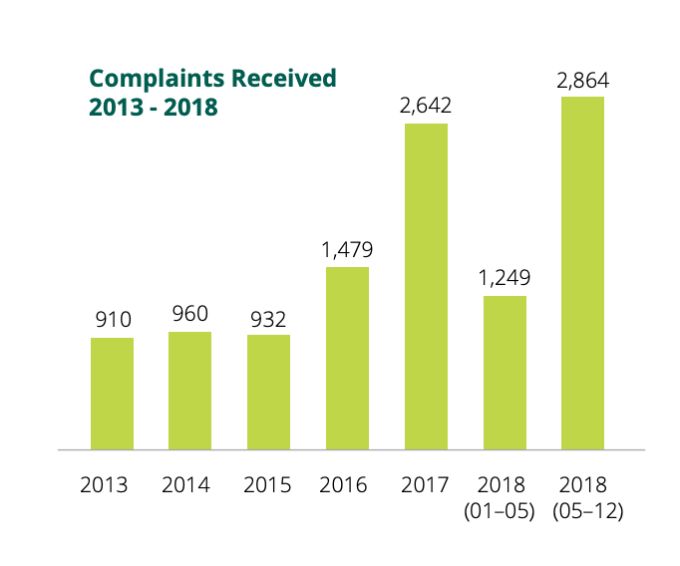
The Irish Data Protection Commission (DPC)’s annual report, published today, covers the period May 25, aka the day the EU’s General Data Protection Regulation (GDPR) came into force, to December 31 2018 and shows the DPC received more than double the amount of complaints post-GDPR vs the first portion of 2018 prior to the new regime coming in: With 2,864 and 1,249 complaints received respectively.

That makes a total of 4,113 complaints for full year 2018 (vs just 2,642 for 2017). Which is a year on year increase of 36 per cent.

But the increase pre- and post-GDPR is even greater — 56 per cent — suggesting the regulation is working as intended by building momentum and support for individuals to exercise their fundamental rights.
“The phenomenon that is the [GDPR] has demonstrated one thing above all else: people’s interest in and appetite for understanding and controlling use of their personal data is anything but a reflection of apathy and fatalism,” writes Helen Dixon, Ireland’s commissioner for data protection.

She adds that the rise in the number of complaints and queries to DPAs across the EU since May 25 demonstrates “a new level of mobilisation to action on the part of individuals to tackle what they see as misuse or failure to adequately explain what is being done with their data”.

While Europe has had online privacy rules since 1995 a weak regime of enforcement essentially allowed them to be ignored for decades — and Internet companies to grab and exploit web users’ data without full regard and respect for European’s privacy rights.

But regulators hit the reset button last year. And Ireland’s data watchdog is an especially interesting agency to watch if you’re interested in assessing how GDPR is working, given how many tech giants have chosen to place their international data flows under the Irish DPC’s supervision.

More cross-border complaints

“The role places an important duty on the DPC to safeguard the data protection rights of hundreds of millions of individuals across the EU, a duty that the GDPR requires the DPC to fulfil in cooperation with other supervisory authorities,” the DPC writes in the report, discussing its role of supervisory authority for multiple tech multinationals and acknowledging both a “greatly expanded role under the GDPR” and a “significantly increased workload”.

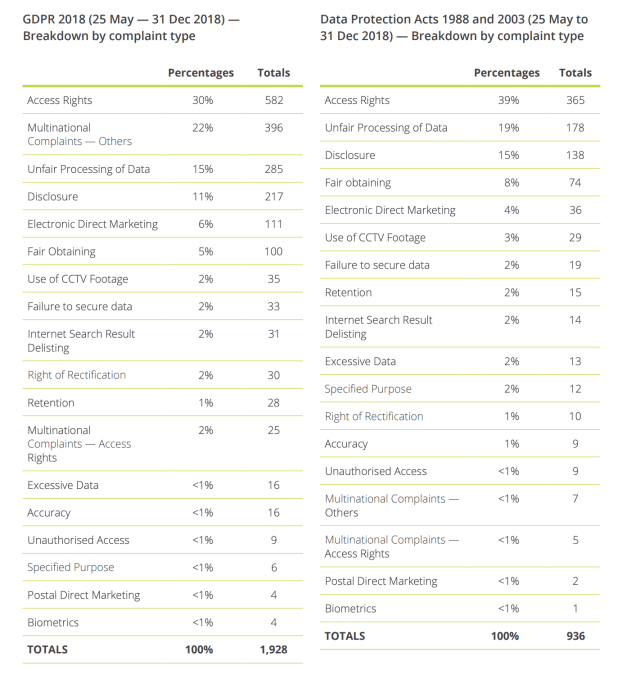
A breakdown of GDPR vs Data Protection Act 1998 complaint types over the report period suggests complaints targeted at multinational entities have leapt up under the new DP regime.

For some complaint types the old rules resulted in just 2 per cent of complaints being targeted at multinationals vs close to a quarter (22 per cent) in the same categories under GDPR.

It’s the most marked difference between the old rules and the new — underlining the DPC’s expanded workload in acting as a hub (and often lead supervisory agency) for cross-border complaints under GDPR’s one-stop shop mechanism.

The category with the largest proportions of complaints under GDPR over the report period was access rights (30%) — with the DPC receiving a full 582 complaints related to people feeling they’re not getting their due data. Access rights was also most complained about under the prior data rules over this period.

Other prominent complaint types continue to be unfair processing of data (285 GDPR complaints vs 178 under the DPA); disclosure (217 vs 138); and electronic direct marketing (111 vs 36).
EU policymakers’ intent with GDPR is to redress the imbalance of weakly enforced rights — including by creating new opportunities for enforcement via a regime of supersized fines. (GDPR allows for penalties as high as up to 4 per cent of annual turnover, and in January the French data watchdog slapped Google with a $57M GDPR penalty related to transparency and consent — albeit still far off that theoretical maximum.)

Importantly, the regulation also introduced a collective redress option which has been adopted by some EU Member States.

This allows for third party organizations such as consumer rights groups to lodge data protection complaints on individuals’ behalf. The provision has led to a number of strategic complaints being filed by organized experts since last May (including in the case of the aforementioned Google fine) — spinning up momentum for collective consumer action to counter rights erosion. Again that’s important in a complex area that remains difficult for consumers to navigate without expert help.

For upheld complaints the GDPR ‘nuclear option’ is not fines though; it’s the ability for data protection agencies to order data controllers to stop processing data.

That remains the most significant tool in the regulatory toolbox. And depending on the outcome of various ongoing strategic GDPR complaints it could prove hugely significant in reshaping what data experts believe are systematic privacy incursions by adtech platform giants.

And while well-resourced tech giants may be able to factor in even very meaty financial penalties, as just a cost of doing a very lucrative business, data-focused business models could be far more precarious if processors can suddenly be slapped with an order to limit or even cease processing data. (As indeed Facebook’s business just has in Germany, where antitrust regulators have been liaising with privacy watchdogs.)

Data breach notifications also up

GDPR also shines a major spotlight on security — requiring privacy by design and default and introducing a universal requirement for swiftly reporting data breaches across the bloc, again with very stiff penalties for non-compliance.

On the data breach front, the Irish DPC says it received a total of 3,687 data breach notifications between May 25 and December 31 last year — finding just four per cent (145 cases) did not meet the definition of a personal-data breach set out in GDPR. That means it recorded a total of 3,542 valid data protection breaches over the report period — which it says represents an increase of 27 per cent on 2017 breach report figures.

“As in other years, the highest category of data breaches notified under the GDPR were classified as Unauthorised Disclosures and accounted for just under 85% of the total data-breach notifications received between 25 May and 31 December 2018,” it notes, adding: “The majority occurred in the private sector (2,070).”

More than 4,000 data breach notifications were recorded by the watchdog for full year 2018, the report also states.

The DPC further reveals that it was notified of 38 personal data breaches involving 11 multinational technology companies during the post-GDPR period of 2018. Which means breaches involving tech giants.

“A substantial number of these notifications involved the unauthorised disclosure of, and unauthorised access to, personal data as a result of bugs in software supplied by data processors engaged by the organisations,” it writes, saying it opened several investigations as a result (such as following the Facebook Token breach in September 2018).

Open probes of tech giants

As of 31 December 2018, the DPC says it had 15 investigations open in relation to multinational tech companies’ compliance with GDPR.

Below is the full list of the DPC’s currently open investigations of multinationals — including the tech giant under scrutiny; the origin of the inquiry; and the issues being examined:

  • Facebook Ireland Limited — Complaint-based inquiry: “Right of Access and Data Portability. Examining whether Facebook has discharged its GDPR obligations in respect of the right of access to personal data in the Facebook ‘Hive’ database and portability of “observed” personal data”
  • Facebook Ireland Limited — Complaint-based inquiry: “Lawful basis for processing in relation to Facebook’s Terms of Service and Data Policy. Examining whether Facebook has discharged its GDPR obligations in respect of the lawful basis on which it relies to process personal data of individuals using the Facebook platform.”
  • Facebook Ireland Limited — Complaint-based inquiry: “Lawful basis for processing. Examining whether Facebook has discharged its GDPR obligations in respect of the lawful basis on which it relies to process personal data in the context of behavioural analysis and targeted advertising on its platform.”
  • Facebook Ireland Limited — Own-volition inquiry: “Facebook September 2018 token breach. Examining whether Facebook Ireland has discharged its GDPR obligations to implement organisational and technical measures to secure and safeguard the personal data of its users.”
  • Facebook Ireland Limited — Own-volition inquiry: “Facebook September 2018 token breach. Examining Facebook’s compliance with the GDPR’s breach notification obligations.”
  • Facebook Inc. — Own-volition inquiry: “Facebook September 2018 token breach. Examining whether Facebook Inc. has discharged its GDPR obligations to implement organizational and technical measures to secure and safeguard the personal data of its users.”
  • Facebook Ireland Limited — Own-volition inquiry: “Commenced in response to large number of breaches notified to the DPC during the period since 25 May 2018 (separate to the token breach). Examining whether Facebook has discharged its GDPR obligations to implement organisational and technical measures to secure and safeguard the personal data of its users.”
  • Instagram (Facebook Ireland Limited) — Complaint-based inquiry: “Lawful basis for processing in relation to Instagram’s Terms of Use and Data Policy. Examining whether Instagram has discharged its GDPR obligations in respect of the lawful basis on which it relies to process personal data of individuals using the Instagram platform.”
  • WhatsApp Ireland Limited — Complaint-based inquiry: “Lawful basis for processing in relation to WhatsApp’s Terms of Service and Privacy Policy. Examining whether WhatsApp has discharged its GDPR obligations in respect of the lawful basis on which it relies to process personal data of individuals using the WhatsApp platform.”
  • WhatsApp Ireland Limited — Own-volition inquiry: “Transparency. Examining whether WhatsApp has discharged its GDPR transparency obligations with regard to the provision of information and the transparency of that information to both users and non-users of WhatsApp’s services, including information provided to data subjects about the processing of information between WhatsApp and other Facebook companies.”
  • Twitter International Company — Complaint-based inquiry: “Right of Access. Examining whether Twitter has discharged its obligations in respect of the right of access to links accessed on Twitter.”
  • Twitter International Company — Own-volition inquiry: “Commenced in response to the large number of breaches notified to the DPC during the period since 25 May 2018. Examining whether Twitter has discharged its GDPR obligations to implement organisational and technical measures to secure and safeguard the personal data of its users.”
  • LinkedIn Ireland Unlimited Company — Complaint-based inquiry: “Lawful basis for processing. Examining whether LinkedIn has discharged its GDPR obligations in respect of the lawful basis on which it relies to process personal data in the context of behavioural analysis and targeted advertising on its platform.”
  • Apple Distribution International — Complaint-based inquiry: “Lawful basis for processing. Examining whether Apple has discharged its GDPR obligations in respect of the lawful basis on which it relies to process personal data in the context of behavioural analysis and targeted advertising on its platform.”
  • Apple Distribution International — Complaint-based inquiry: “Transparency. Examining whether Apple has discharged its GDPR transparency obligations in respect of the information contained in its privacy policy and online documents regarding the processing of personal data of users of its services.”

“The DPC’s role in supervising the data-processing operations of the numerous large data-rich multinational companies — including technology internet and social media companies — with EU headquarters located in Ireland changed immeasurably on 25 May 2018,” the watchdog acknowledges.

“For many, including Apple, Facebook, Microsoft, Twitter, Dropbox, Airbnb, LinkedIn, Oath [disclosure: TechCrunch is owned by Verizon Media Group; aka Oath/AOL], WhatsApp, MTCH Technology and Yelp, the DPC acts as lead supervisory authority under the GDPR OSS [one-stop shop] facility.”

The DPC notes in the report that between May 25 and December 31 2018 it received 136 cross-border processing complaints through the regulation’s OSS mechanism (i.e. which had been lodged by individuals with other EU data protection authorities).

A breakdown of these (likely) tech giant focused GDPR complaints shows a strong focus on consent, right of erasure, right of access and the lawfulness of data processing:
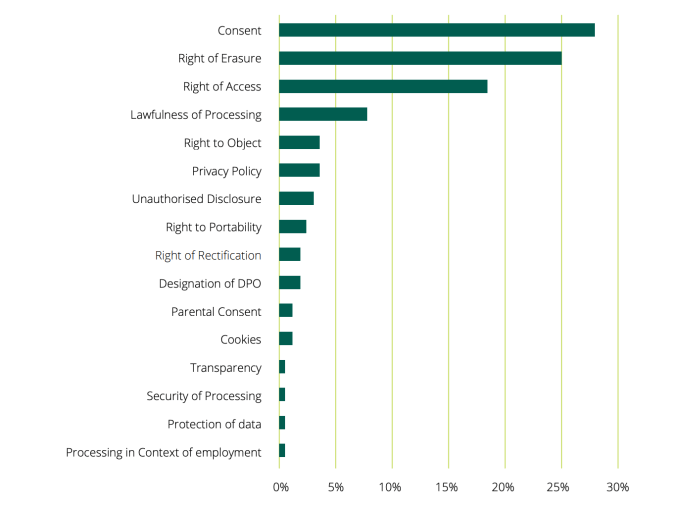
Breakdown of cross-border complaint types received by the DPC under GDPR’s OSS mechanism

While the Irish DPC acts as the lead supervisor for many high profile GDPR complaints which relate to how tech giants are handling people’s data, it’s worth emphasizing that the OSS mechanism does not mean Ireland is sitting in sole judgement on Silicon Valley’s giants’ rights incursions in Europe.

The mechanism allows for other DPAs to be involved in these cross-border complaints.

And the European Data Protection Board, the body that works with all the EU Member States’ DPAs to help ensure consistent application of the regulation, can trigger a dispute resolution process if a lead agency considers it cannot implement a concerned agency objection. The aim is to work against forum shopping.

In a section on “EU cooperation”, the DPC further writes:

Our fellow EU regulators, alongside whom we sit on the European Data Protection Board (EDPB), follow the activities and results of the Irish DPC closely, given that a significant number of people in every EU member state are potentially impacted by processing activities of the internet companies located in Ireland. EDPB activity is intense, with monthly plenary meetings and a new system of online data sharing in relation to cross-border processing cases rolled out between the authorities. The DPC has led on the development of EDPB guidance on arrangements for Codes of Conduct under the GDPR and these should be approved and published by the EDPB in Q1 of 2019. The DPC looks forward to industry embracing Codes of Conduct and raising the bar in individual sectors in terms of standards of data protection and transparency. Codes of Conduct are important because they will more comprehensively reflect the context and reality of data-processing activities in a given sector and provide clarity to those who sign up to the standards that need to be attained in addition to external monitoring by an independent body. It is clarity of standards that will drive real results.

Over the reported period the watchdog also reveals that it issued 23 formal requests seeking detailed information on compliance with various aspects of the GDPR from tech giants, noting too that since May 25 it has engaged with platforms on “a broad range of issues” — citing the following examples to give a flavor of these concerns:

  • Google on the processing of location data
  • Facebook on issues such as the transfer of personal data from third-party apps to Facebook and Facebook’s collaboration with external researchers
  • Microsoft on the processing of telemetry data collected by its Office product
  • WhatsApp on matters relating to the sharing of personal data with other Facebook companies

“Supervision engagement with these companies on the matters outlined is ongoing,” the DPC adds of these issues.

Adtech sector “must comply” with GDPR 

Talking of ongoing action, a GDPR complaint related to the security of personal data that’s systematically processed to power behavioral advertising is another open complaint on the DPC’s desk.

The strategic complaint was filed by a number of individuals in multiple EU countries (including Ireland) last fall. Since then the individuals behind the complaints have continued to submit and publish evidence they argue bolsters their case against the behavioral ad targeting industry (principally Google and the IAB which set the spec involved in the real-time bidding (RTB) system).

The Irish DPC makes reference to this RTB complaint in the annual report, giving the adtech industry what amounts to a written warning that while the advertising ecosystem is “complex”, with multiple parties involved in “high-speed, voluminous transactions” related to bidding for ad space and serving ad content “the protection of personal data is a prerequisite to the processing of any personal data within this ecosystem and ultimately the sector must comply with the standards set down by the GDPR”.

The watchdog also reports that it has engaged with “several stakeholders, including publishers and data brokers on one side, and privacy advocates and affected individuals on the other”, vis-a-vis the RTB complaint, and says it will continue prioritizing its scrutiny of the sector in 2019 — “in cooperation with its counterparts at EU level so as to ensure a consistent approach across all EU member states”.

It goes on to say that some of its 15 open investigations into tech giants will both conclude this year and “contribute to answering some of the questions relating to this complex area”. So, tl;dr, watch this space.

Responding to the DPC’s comments on the RTB complaint, Dr Johnny Ryan, chief policy and industrial relations officer of private browser Brave — and also one of the complainants — told us they expect the DPC to act “urgently”.

“We have brought our complaint before the DPC and other European regulators because there is a dire need to fix adtech so that it’s works safely,” he told TechCrunch. “The DPC itself recognizes that online advertising is a priority. The IAB and Google online ‘ad auction’ system enables companies to broadcast what every single person online reads, watches, and listens to online to countless parties. There is no control over what happens to these data. The evidence that we have submitted to the DPC shows that this occurs hundreds of billions of times a day.”

“In view of the upcoming European elections, it is particularly troubling that the IAB and Google’s systems permit voters to be profiled in this way,” he added. “Clearly, this infringes the security and integrity principles of the GDPR, and we expect the DPC to act urgently.”

The IAB has previously rejected the complaints as “false”, arguing any security risk is “theoretical”; while Google has said it has policies in place to prohibit advertisers from targeting sensitive categories of data. But the RTB complaint itself pivots on GDPR’s security requirements which demand that personal data be processed in a manner that “ensures appropriate security”, including “protection against unauthorised or unlawful processing and against accidental loss”.

So the security of the RTB system is the core issue which the Irish DPC, along with agencies in the UK and Poland, will have to grapple with as a priority this year.

The complainants have also said they intend to file additional complaints in more markets across Europe, so more DPAs are likely to join the scrutiny of RTB, as concerned supervisory agencies, which could increase pressure on the Irish DPC to act.

Schrems II vs Facebook 

The watchdog’s report also includes an update on long-running litigation filed by European privacy campaigner Max Schrems concerning a data transfer mechanism known as standard contractual clauses (SCCs) — and originally only targeted at Facebook’s use of the mechanism.

The DPC decided to refer Schrems’ original challenge to the Irish courts — which have since widened the action by referring a series of legal questions up to the EU’s top court with (now) potential implications for the legality of the EU’s ‘flagship’ Privacy Shield data transfer mechanism.

That was negotiated following the demise of its predecessor Safe Harbor, in 2015, also via a Schrems legal challenge, going on to launch in August 2016 — despite ongoing concerns from data experts. Privacy Shield is now used by close to 4,500 companies to authorize transfers of EU users’ personal data to the US.

So while Schrems’ complaint about SCCs (sometimes also called “model contract clauses”) was targeted at Facebook’s use of them the litigation could end up having major implications for very many more companies if Privacy Shield itself comes unstuck.

More recently Facebook has sought to block the Irish judges’ referral of legal questions to the Court of Justice of the EU (CJEU) — winning leave to appeal last summer (though judges did not stay the referral in the meanwhile).

In its report the DPC notes that the substantive hearing of Facebook’s appeal took place over January 21, 22 and 23 before a five judge Supreme Court panel.

“Oral arguments were made on behalf of Facebook, the DPC, the U.S. Government and Mr Schrems,” it writes. “Some of the central questions arising from the appeal include the following: can the Supreme Court revisit the facts found by the High Court relating to US law? (This arises from allegations by Facebook and the US Government that the High Court judgment, which underpins the reference made to the CJEU, contains various factual errors concerning US law).

“If the Supreme Court considers that it may do so, further questions will then arise for the Court as to whether there are in fact errors in the judgment and if so, whether and how these should be addressed.”

“At the time of going to print there is no indication as to when the Supreme Court judgment will be delivered,” it adds. “In the meantime, the High Court’s reference to the CJEU remains valid and is pending before the CJEU.”


28 Feb 2019

Report: Disney in talks with AT&T to buy WarnerMedia’s 10% Hulu stake

Disney is in discussions to buy AT&T’s 10 percent stake in Hulu, which it comes into by way of its WarnerMedia acquisition, according to a report from Variety this morning. The news is not surprising – AT&T had already said it was exploring a sale. And Disney has been looking to increase its stake in Hulu following its deal for 20th Century Fox which, when closed, will see Disney picking up Fox’s 30 percent share in Hulu.

Currently, Disney owns a 30 percent stake in Hulu’s streaming service. That means the Fox deal will give it a 60 percent stake in Hulu. Snagging AT&T’s Hulu share would bring Disney’s ownership to 70 percent.

Comcast/NBCU is Hulu’s other major owner, but isn’t currently prepared to sell, Variety said.

AT&T had detailed its streaming plans to investors in November, noting at the time it was thinking of selling its Hulu stake as part of its larger goal to “monetize assets” that were not essential to its current strategies and to help pay down its debt. Its Hulu share is valued at $930 million.

AT&T has little interest in Hulu because it’s building out its own internet-based streaming services, including live TV service DirecTV Now; the more lightweight WatchTV; and a new service that leverages its WarnerMedia properties. WarnerMedia also today operates streaming services for its brands, like HBO NOW, Boomerang, DC Universe, and others.

Disney, meanwhile, is preparing to launch its family-friendly Netflix competitor, Disney+, but sees Hulu as a place to house its more adult-oriented programming and general entertainment properties.

Hulu today has 25 million subscribers, but is still a smaller player compared with Netflix because it’s not yet available worldwide. It also hasn’t invested into original programming at Netflix’s scale. Disney’s increased ownership will change these things and could help Hulu compete on the market against larger rivals like Netflix, AT&T/WarnerMedia, and soon Apple, as well.

28 Feb 2019

Report: Disney in talks with AT&T to buy WarnerMedia’s 10% Hulu stake

Disney is in discussions to buy AT&T’s 10 percent stake in Hulu, which it comes into by way of its WarnerMedia acquisition, according to a report from Variety this morning. The news is not surprising – AT&T had already said it was exploring a sale. And Disney has been looking to increase its stake in Hulu following its deal for 20th Century Fox which, when closed, will see Disney picking up Fox’s 30 percent share in Hulu.

Currently, Disney owns a 30 percent stake in Hulu’s streaming service. That means the Fox deal will give it a 60 percent stake in Hulu. Snagging AT&T’s Hulu share would bring Disney’s ownership to 70 percent.

Comcast/NBCU is Hulu’s other major owner, but isn’t currently prepared to sell, Variety said.

AT&T had detailed its streaming plans to investors in November, noting at the time it was thinking of selling its Hulu stake as part of its larger goal to “monetize assets” that were not essential to its current strategies and to help pay down its debt. Its Hulu share is valued at $930 million.

AT&T has little interest in Hulu because it’s building out its own internet-based streaming services, including live TV service DirecTV Now; the more lightweight WatchTV; and a new service that leverages its WarnerMedia properties. WarnerMedia also today operates streaming services for its brands, like HBO NOW, Boomerang, DC Universe, and others.

Disney, meanwhile, is preparing to launch its family-friendly Netflix competitor, Disney+, but sees Hulu as a place to house its more adult-oriented programming and general entertainment properties.

Hulu today has 25 million subscribers, but is still a smaller player compared with Netflix because it’s not yet available worldwide. It also hasn’t invested into original programming at Netflix’s scale. Disney’s increased ownership will change these things and could help Hulu compete on the market against larger rivals like Netflix, AT&T/WarnerMedia, and soon Apple, as well.

28 Feb 2019

Siri gets new airline, food order and dictionary Shortcuts, with more on the way

Announced at last year’s WWDC, Apple’s been firing up Siri Shortcuts at a fairly steady clip. The company says there are now “thousands” of apps integrating the iOS 12 feature, which bring all sorts of third-party functionality to the smart assistant.

There are five new Shortcuts available starting today. Most notable (depending on where you get your airline miles, I suppose) is probably the one from American Airlines. Saying, “Hey Siri, flight update” will provide you with information on your upcoming travel plans. The response uses location information to determine what the share, including flight status, travel time and the gate it will depart from.

Caviar has a new Shortcut as well. It lets users check on food status or reorder frequent items, like, say, “order my usual pizza,” for those of us who are perfectly fine with the food related ruts we’ve dug ourselves into. Merriam Webster, meanwhile, is adding a “word of the day” Shortcut, while Dexcom is bringing glucose monitoring to the smart assistant.

In the next couple of months, Apple will add shortcuts from Airbnb, Drop, ReSound and coffee-maker Smarter. Those all join recent additions from Waze and Nike Run Club. Apple clearly sees the features as a way to build out Siri’s functionality following increased competition from the likes of Google and Amazon.

The addition of the sorts of features can make for a much richer voice ecosystem, all while leaving third-party developers to do a lot of the heavy lifting here.

28 Feb 2019

Two Chairs nabs $7M for its client-therapist matching app and brick-and-mortar clinics

The future of healthcare isn’t entirely digital. For encounters as intimate as the client-therapist dynamic, a face-to-face relationship is still key.

For those able to afford tech-enabled therapy services, Two Chairs, a San Francisco-headquartered mental healthcare business, may be of interest. The startup believes in the power of in-person therapy, as opposed to the new variety of affordable digital tools meant to replace or coexist with therapy services. Today, the company is announcing a $7 million Maveron-led Series A financing to open additional brick-and-mortar clinics and build out its client-therapist matching app, which leverages technology to pair its customers with a therapist best-tailored to their needs.

The company currently operates four clinics in the Bay Area, where patients can access individual or group therapy. Each of those clinics was built with modern, young professionals in mind using “thoughtful design” to create “non-judgmental spaces.”

A Two Chairs clinic, which emphasizes “non-judgmental” design

The mobile app and clinic interior design are the key differences between Two Chairs and a neighborhood private practice, it says. As far as pricing, at $180 an hour, a session doesn’t differ terribly from a typical session at a Bay Area private practice (the company does accept insurance). The startup currently employs 30 therapists, who also are available over video chat should a client be sick or traveling, with a customer base of 2,000.

Two Chairs was founded in 2017 by former Palantir employee Alex Katz (pictured). In a conversation with TechCrunch, Katz admitted procuring real estate for Two Chairs’ brick-and-mortar clinics has been an expensive and difficult endeavor. It’s no wonder venture capitalists tend to favor IT startups devoid of the overhead costs associated with firms in the real estate business. Katz is hoping the latest investment, which brings Two Chairs’ total raised to $8 million, will help the business quickly sign additional leases outside of the most expensive city in the U.S.

The cash will also be used to advance Two Chairs’ matching app. The app surveys potential clients on their history, preferences and goals, then uses a library of data to match the client with the most suitable therapist in its roster and to create a customized treatment plan. Katz says they’ve provided clients with an accurate match 95 percent of the time.

“We know that the client-therapist relationship is the best predictor of an outcome with care and while it sounds intuitive, matching is not a concept that has existed in the mental health field historically,” Katz told TechCrunch.

Two Chairs is one of several mental health startups to capture the attention of venture capitalists lately. Basis, which helps people cope with anxiety and depression through guided conversations via chat and video, emerged from stealth in 2018 with a $3.75 million investment led by Bedrock. Wisdo, a community-focused app that connects people seeking help with those who can offer help, brought in an $11 million investment in December and emotional well-being app Aura raised $2.7 million from Cowboy Ventures in October.

Those three businesses have one thing in common: they are digital-first endeavors looking to innovate on top of a broken mental healthcare model. Two Chairs’ plan to build additional therapy clinics, however, doesn’t feel particularly inventive. Opening a chain of therapy offices, rather, sounds like a hard-to-scale, expensive business idea.

As for the uptick in capital for mental health tech, Katz is satisfied Silicon Valley has finally acknowledged the problem: “I think Silicon Valley venture has had a preference for models that don’t involve brick-and-mortar and minimize the use of people; they prefer software businesses,” he said. “The reason we are taking this approach is we know from the research that really well-matched in-person therapy is really effective. Still, at a high level, it’s exciting. There are a lot of people thinking in innovative ways of how we can provide improved mental healthcare.”

Goldcrest Capital also participated in Two Chairs’ Series A.