Author: azeeadmin

26 Feb 2019

YieldStreet raises $62M to democratise alternative investments in shipping, real estate and more

There has been a wave of fintech startups emerging that make different kinds of investing more accessible to a wider pool of people, and today one of them has raised a substantial round of money to help fill out its mission.

YieldStreet — which provides a platform for making alternative investments in areas like real estate, marine/shipping, legal finance, commercial loans, and other opportunities that in the past were only open to institutional investors — is today announcing that it has raised $62 million in a Series B round of funding.

Cofounder and CEO Milind Mehere said in an interview that the money will be used to build a fundamental expansion of the platform so that any interested party can invest.

With a view to improving everyone’s financial lot in life, the name of the game is capitalism, and more specifically democratising the opportunity to invest, making it possible for more people beyond the often-cloistered and clubby environment of the investment world.

“In order for consumers to move to financial security and financial independence, they should be given access to the same products institutions have,” said Mehere. “This is about creating the most wealth out of people’s money, irrespective of their networks.”

The round was led by Edison Partners, with participation from Greenspring Associates, Raine Ventures and a large multi-billion dollar NY family office. YieldStreet’s valuation is not being disclosed with this round. Prior to this, the company raised around $116 million, with $100 million of that in debt, according to PitchBook.

To date, YieldStreet has seen more than $600 million invested on its platform from over 100,000 members, with an expected 12 percent IRR and more than 300K principal and interest payments made to its investors. Up to now a person had to be an accredited investor to benefit from this. That was already a progression on those investments being restricted only to institutions, but it is still a relatively small pool of users. In the US, where YieldStreet operates, being an accredited investor has a specific set of criteria that includes individuals having a net worth of at least $1 million and income of $200,000 or more.

The plan is now to use the funding to expand the funnel by creating new vehicles for investing that will not require people to be accredited to get involved. This will build on groundwork the company has already laid with YieldStreet Wallet, a savings account that provides 2.2 percent interest, which is open to everyone.

The idea will be to offer non-accredited investors investment vehicles, created by YieldStreet, where they will be able to access multiple products, Mehere said. “We are working through the legal and regulatory aspects now.” He added that the company is also looking at ways of tapping into retirement and IRA accounts for these users as well.

The Jobs Act in the US, and the wider growth of people shifting all of their financial services online, have created a landscape of startups that are liberalising how capital moves. Many of these are specifically freeing up the arcane and rarified world of investment. They include companies like Robinhood, which has built a platform for trading public stocks. In the area of private investment — that is, investing in businesses and opportunities that are not publicly traded — we have seen PeerStreet, which is offers a service similar to YieldStreet but focusing on real estate. In the UK, you also have startups like LendInvest which lets property buyers bypass traditional mortgages by letting others put up the funding for those purchases.

“The ability for individual, accredited and non-accredited, investors to access products that previously were only available to institutional investors is a key part of fintech’s promise to leverage technology to create access and reduce fees on these types of investments. In addition, lower fees can be passed on to investors to allow them to achieve a higher return,” said Chris Sugden, managing partner, Edison Partners, in an email. (Sugden will also be joining the startup’s board with this investment.) 

What’s interesting is that the sheer number of fintech startups, even if you only focus in on those centered around investing, will inevitably lead to some M&A down the line, and that is an area that YieldStreet will also be exploring ahead.

“We do see consolidation or another theme we call, ‘rebundling’ as well,” said Sugden. “Over the next few years we will hear more about the convergence of service offerings under a single platform. In my opinion, retail investors would like to get all of their financial services in a single, mobile application. Thus a key driver of consolidation will be the ability for sites such as YieldStreet, that are set up initially as a single product, to build or acquire new offerings. Whether these new offerings are by investment type, asset class, geography or structure all are critical to attracting investors at scale.”
26 Feb 2019

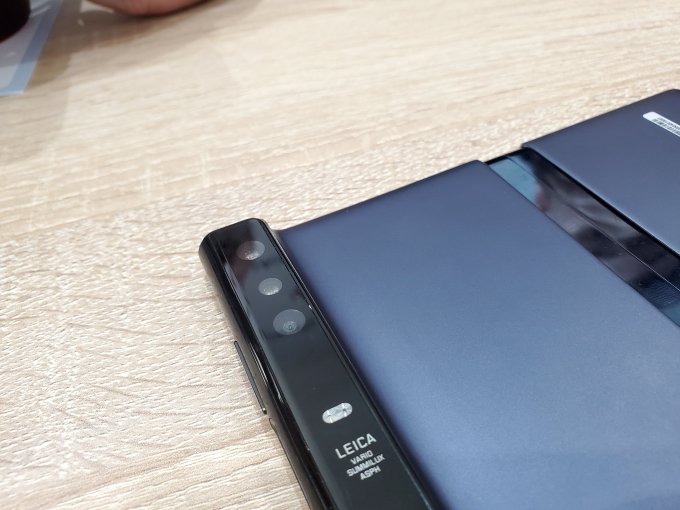
Huawei’s folding Mate X: a closer look

Yesterday gave us a closer view of the Samsung Galaxy Fold. Of course, there were still a plate of glass, a security rope and a few feet between us and the device. Huawei, thankfully, was a bit more willing to grant us access to their own foldable, the Mate X at a closed door meeting earlier this morning.

There were still ground rules for the foldable. Namely, a Huawei rep was driving the whole thing. Limited interaction with the device itself was allowed, but he was doing most of the navigating and all of the folding. While the product is pretty close to final, there’s still some work to be done before bringing it to market, and in Huawei’s words, the company wanted to give us “the best possible experience.”

In this case, that mostly means knowing the limitations of what the near-final product can actually do. For now, that means web browsing, some photography and opening up Google Maps — which, to be fair, comprises a fairly large chunk of what people will actually be doing with the product.

That said, there’s a lot to account for with a new form factor. After all, phone makers have gotten really good at working with a defined two-dimensional plan, a decade after the introduction of the first iPhone and Samsung Galaxy device. Folding, flipping and bouncing between screens presents all sorts of new challenge.

That said, in the demo at least, things seemed pretty smooth here. The device was pretty responsive in a less controlled environment than we’d previously seen it — or, for that matter, the Fold — in. There were few moments and some blank screens for half a second or so, however, when the apps had to jump screens. All of which is to see the Mate X is real. I’ve seen it, and am so far pretty impressive with the execution.

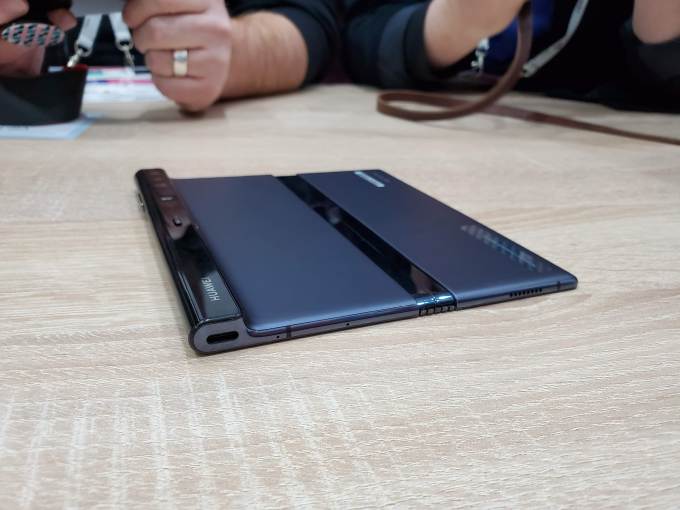
The product design, too, is quite well thought out. The product is surprisingly thin both folded and unfolded, and elements like the fold over camera lip, which offers a place to grip (a la the lip on the rear of the Kindle Oasis) are nice touches.

The screen, too, looks quite nice at first glance. That said, as with all of the foldable we’ve seen to date, capturing a glare from overhead light picks up crinkles on the display, along with a large seam in the middle, where the device folds over. You can’t feel them with your finger as you glide over to touch, but it’s easy to imagine how messy all of this could ultimately look after a few years of use.

The system also works when folded at a 90 degree angle, which could prove useful for future executions that Huawei is looking into. It’s clear that this is just the beginning of not only the form factor, but practical applications. It’s going to be watching developers figure out all of the stuff they can do with the product.

That “still early days” approach also to price point. Huawei acknowledges that the device is prohibitively expensive at ~ €2,200. That price includes the design to add 5G to the product — notably, there is no non-5G version planned, unlike the Galaxy Fold. That will no doubt make the Mate X even more of a niche product, until the next-gen cellular service rolls out for more users.

[gallery ids="1789090,1789091,1789092,1789093,1789094,1789095,1789096,1789097,1789099,1789100,1789101,1789102,1789103,1789104,1789105,1789098"]

In a way, the Mate X is a proof of concept — albeit proof that the thing can be relatively mass produced. At double the cost of a high-end flagship, I don’t expect the company plans to sell a lot of these, but the more it’s able to scale, the lower the price will ultimately be.

26 Feb 2019

Facebook finally bans UK far right activist, ‘Tommy Robinson’

Facebook has taken the decision to remove the Facebook page and Instagram profile of far right activist, Tommy Robinson, whose real name is Stephen Yaxley-Lennon.

Twitter permanently banned the founder of the far right English Defence League almost a year ago.

In a blog post announcing the decision Facebook says Yaxley-Lennon repeatedly broke its community standards. It writes:

Tommy Robinson’s Facebook Page has repeatedly broken these standards, posting material that uses dehumanizing language and calls for violence targeted at Muslims. He has also behaved in ways that violate our policies around organized hate. As a result, in accordance with our policies, we have removed Tommy Robinson’s official Facebook Page and Instagram profile. This is not a decision we take lightly, but individuals and organizations that attack others on the basis of who they are have no place on Facebook or Instagram.

“Our rules also make clear that individuals and organizations that are engaged in “organized hate” are not allowed on the platform, and that praise or support for these figures and groups is also banned. This is true regardless of the ideology they espouse,” Facebook adds.

It’s not clear what took the company so long to shutter Yaxley-Lennon’s pages given repeated breaches of its community standards.

The move comes two months after Facebook closed pages of another far right activist, James Goddard, also for hate speech violations.

Goddard had been using Facebook’s platform to solicit donations to fund activism which included intimidating politicians and journalists around Westminster — livestreaming the encounters to social media followers.

The activity of Goddard and small group of extreme Brexit supporters led the speaker of the House of Commons to write to the head of the Met Police urging action against the “aggressive, threatening and intimidating behaviour”.

Political attention has sharply stepped up around the social impacts of tech platforms and UK ministers are posed to set out a policy plan for regulating social media safety.

26 Feb 2019

Mangrove makes a first move into Portugal with $1.2M into Attentive, alongside Indico

Attentive, a Techstars Boulder alumnus, closing of a $1.2M Seed round co-led by Lisbon based Indico Capital Partners and Luxembourg based Mangrove Capital Partners. This also marks Mangrove’s first ever investment into a Portugal-based start-up. The southern-European country has surged as a European startup destination with the launch of new funds like Indico, acting as host to the giant Web Summit and offering warmer climes than chilly Northern Europe.

Attentive has an “augmented sales assistant” which allows teams to keep up with their sales pipeline, and guides managers to allocate resources better.

The new Attentive app works with Slack, so should fit relatively easily into teams that use that platform, allowing teams to update their CRMs without needing to open the Attentive app itself.

Ex-Googler Daniel Araújo, co-founder and CEO, says: “A very common problem in sales teams is that more than 1/3 of their time is ‘lost’ in administrative tasks… Technology should aim towards more efficient time management, which is what Attentive helps sales teams achieve”.

Stephan Morais, Partner at Indico Capital Partners, commented: “Enterprise sales and data are two crucial areas in today’s software world if you want to be competitive. Attentive is the intelligent layer that merges these and they are doing it at the right time. Moreover, the team has the resilience, technical ability and global network to take the company to the next level“.

Yannick Oswald, Principal at Mangrove adds: “By automating sales data input for teams across CRMs and industries, Attentive’s AI collects millions of sales actions that go beyond mere transactional database records and can guide users towards behaviors that achieve much better sales outcomes.”

26 Feb 2019

ThirdLove, the direct-to-consumer lingerie startup, gets a $55M boost, hits $750M valuation

Direct-to-consumer startups — making products that leverage the internet to bypass third-party marketplaces and retailers to engage with and sell directly to their customers — have been one of the biggest categories of growth in the world of e-commerce, and today one of the startups that helped create and prove the model is announcing a big round of funding to take its business to the next stage.

ThirdLove, which started with bras and now makes and sells a variety of lingerie and underwear catering to a wide variety of women’s shapes and sizes — in part through technology it developed that uses a smartphone camera to size and suggest products — has raised $55 million in funding.

CEO Heidi Zak, who co-founded the company with husband David Spector (both are ex-Google execs), said in an interview that the money will be used to help ThirdLove add even more sizes beyond the 78 that are offered today (“a bra for every body” is the expression she uses); as well as grow into three new areas: retail, international markets and category expansion into areas such as swim and athletic wear.

Not all of these may be coming online in the next year, she added, but the money will go towards building strategies in all three.

This round bumps ThirdLove’s valuation up to $750 million, a huge boost considering that the startup has only raised around $68 million since being founded in 2013. ThirdLove is already generating $100 million in revenues annually, Spector said, and has seen some 12 million to date use its Fit Finder, the tool in the app that measures a woman’s proportions in about a minute.

As impressive as that valuation sounds, so is the list of backers in this latest cash infusion. It’s being co-led by L. Catterton, which is owned in part by the luxury goods conglomerates LVMH and Groupe Arnault; and investment bank Allen & Company. But also participating are Anne Wojcicki, the cofounder and CEO of 23andMe; her sister Susan Wojcicki, the CEO of YouTube; broadcaster Katie Couric; Nancy Peretsman, MD of Allen & Company; Tim Armstrong, former CEO of Oath and AOL (who himself is making a big move now into DTC); Jeff Keswin; Michael Zeisser, former US chairman at Alibaba; Felicis Ventures and Valor Equity. (Existing investors include Andreessen Horowitz, NEA, Yuri Milner and Keith Rabois.)

“I’m a big fan of ThirdLove’s mission to build a brand for every woman, regardless of her shape, size, age, ethnicity, gender identity, or sexual orientation,” said Anne Wojcicki in a statement. “ThirdLove promotes reality over fantasy and shows the spectacular beauty of all sizes, shapes and colors of women.”

It’s a fair question to ask how and why a bra company is attracting attention from tech investors, and why TechCrunch (or any publication) might write about it as a tech startup.

The first answer is the most generic (but possibly the most important, as it’s one that we see infusing our news coverage at TC on a daily basis). Every company today is potentially a tech company, and every industry is potentially a tech industry. That is to say, we have well passed the point where just about any business or vertical can be built with a tech approach in mind, to underpin the product itself; or to help deliver that product to the world in a way that is better than what preceded it. ThirdLove is doing both of those.

On the part of the product itself, the company has leveraged the evolution in modern garment manufacturing, with the growth of smartphone usage and online shopping, as well as developments in AI-based computer vision.

To get a bra using the ThirdLove app, a woman takes some selfies, which are in turn used to help formulate the best bra size for her body. “Best size”, meanwhile, has taken on a new meaning. In the past, women with non-standard proportions would have needed to buy bras from ad hoc bra makers — time consuming and expensive.

ThirdLove, however, uses big data analytics to essentially aggregate the long tail, turning a single person’s quest into one from many people, and aggregating images of all the busts to help build the design of the bras, which it executes by tapping into more precise manufacturing techniques.

This is how ThirdLove manages to both create more individualised and tailored pieces while still achieving the all-important metric of e-commerce, economies of scale.

The second way ThirdLove uses technology is for what Zak describes as “using data for market fit.” It’s a big buyer of Facebook ads that target people it thinks could become customers, and it follows through with a more complete customer experience both in terms of recommending items and creating an efficient way to browse and then buy.

“We use the data we collect from Fit Finder” — that is the measuring tool in its app — “to create a better physical product and individual sizes, and then we use the data to create a better digital product experience,” Zak said. “We do all this in a way that more traditional retailers don’t.”

Indeed, that old versus new was highlighted to great impact last year, when ThirdLove waged a publicity campaign against the much-bigger Victoria’s Secret after its CEO made a dig against the company in an interview. It so happened that the CEO also used the same interview to make some other outmoded remarks that did not go down well with investors and the public, and ultimately he ended up stepping down. ThirdLove didn’t fully cause his departure, but its star definitely rose in the wake of all the controversy.

Zak said the resulting attention, which happened in November, may have had an effect. “We’re not a gifting destination traditionally, but then we suddenly had a stronger November and December,” she said.

With the new funds and new strategy, it will be worth watching how ThirdLove develops products down the road. Currently the company only has distribution in the US, although it’s already seeing a lot of orders coming from outside the country. The plan will be build more facilities more local to different international markets to seize the opportunity with that interest.

Similarly, its move into retail should be interesting. So far, the only work that the company has done in brick-and-mortar has been in pop-up shops where the aim was not to sell merchandise but simply to spread the word. Zak and Spector said they would like to retain some of its app-based individualised experience in any kind of physical retail play. It’s not clear how that would look, but it could potentially mean ThirdLove concessions in shops similar to what you typically see in the cosmetics department, where customers are consulted and sold items direct by people representing individual brands.

26 Feb 2019

With $90 million in funding, the Ginkgo spinoff Motif joins the fight for the future of food

Continuing its quest to become the Amazon Web Services for biomanufacturing, href="http://ginkgobioworks.com/">Ginkgo Bioworks has launched a new spinoff called Motif Ingredients with $90 million in funding to develop proteins that can serve as meat and dairy replacements.

It’s the second spinout for Ginkgo since late 2017 when the company partnered with Bayer to launch Joyn Bio, a startup researching and developing bacteria that could improve crop yields.

Now, with Motif, Ginkgo is tackling the wild world of protein replacements for the food and beverage industry through the spinoff of Motif Ingredients.

It’s a move that’s likely going to send shockwaves through several of the alternative meat and dairy companies that were using Ginkgo as their manufacturing partner in their quest to reduce the demand for animal husbandry — a leading contributor to global warming — through the development of protein replacements.

“To help feed the world and meet consumers’ evolving food preferences, traditional and complementary nutritional sources need to co-exist. As a global dairy nutrition company, we see plant- and fermentation-produced nutrition as complementary to animal protein, and in particular cows’ milk,” said Judith Swales, the Chief Operating Officer, for the Global Consumer and Foodservice Business, of Fonterra, an investor in Ginkgo’s new spinout.

To ensure the success of its new endeavor Ginkgo has raised $90 million in financing from industry insiders like Fonterra and the global food processing and trading firm Louis Dreyfus Co., while also tapping the pool of deep-pocketed investors behind Breakthrough Energy Ventures, the climate focused investment fund financed by a global gaggle of billionaires including Marc Benioff, Jeff Bezos, Michael Bloomberg, Richard Branson, Bill Gates, Reid Hoffman, John Doerr, Vinod Khosla, Jack Ma, Neil Shen, Masayoshi Son, and Meg Whitman.

Leading Ginkgo’s latest spinout is a longtime veteran of the food and beverage industry, Jonathan McIntyre, the former head of research and development at another biotechnology startup focused on agriculture — Indigo Ag.

McIntyre, who left Indigo just two years after being named the company’s head of research and development, previously had stints at Monsanto, Nutrasweet, and PepsiCo (in both its beverage and snack divisions).

“There’s an opportunity to produce proteins,” says McIntyre. “Right now as population grows the protein supply is going to be challenged. Motif gives the ability to create proteins and make products from low cost available genetic material.”

Photo: paylessimages/iStock

Ginkgo, which will have a minority stake in the new company, will provide engineering and design work to Motif and provide some initial research and development work on roughly six to nine product lines.

That push, with the financing, and Ginkgo’s backing as the manufacturer of new proteins for Motif Ingredients should put the company in a comfortable position to achieve McIntyre’s goals of bringing his company’s first products into the market within the next two years. All Motif has to pay is cost plus slight overhead for the Ginkgo ingredients.

“We started putting Motif together around February or March of 2018,” says Ginkgo co-founder Jason Kelly of the company’s plans. “The germination of the business had its inception earlier though, from interacting with companies in the food and beverage scene. When we talked to these companies the strong sense we got was if there had been a trusted provider of outsourced protein development they would have loved to work with us.”

The demand from consumers for alternative sources of protein and dairy — that have the same flavor profiles as traditional dairy and meats — has reached an inflection point over the past few years. Certainly venture capital interest into the industry has soared along with the appetite from traditional protein purveyors like Danone, Tyson Foods, and others to take a bite out of the market.

Some industry insiders think it was Danone’s 2016 acquisition of WhiteWave in a $12.5 billion deal that was the signal which brought venture investors and food giants alike flocking to startups that were developing meat and dairy substitutes. The success of companies like Beyond Meat and Impossible Foods has only served to prove that a growing market exists for these substitutes.

At the same time, solving the problem of protein for a growing global population is critical if the world is going to reverse course on climate change. Agriculture and animal husbandry are huge contributors to the climate crisis and ones for which no solution has made it to market.

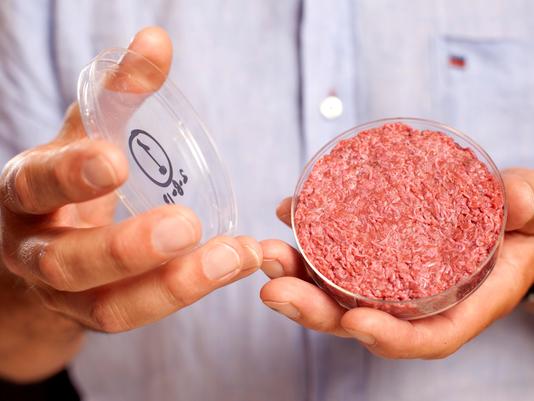
Investors think cultured proteins — fermented in tanks like brewing beer — could be an answer.

Photograph: David Parry/EPA

“Innovative or disruptive solutions are key to responding to changing consumer demand and to addressing the challenge of feeding a growing world population sustainably,” said Kristen Eshak Weldon, Head of Food Innovation & Downstream Strategy at Louis Dreyfus Company (LDC), a leading merchant and processor of agricultural goods. “In this sense, we are excited to partner with Motif, convinced that its next-generation ingredients will play a vital role.”

Breakthrough Energy Ventures certainly thinks so.

The investment firm has been busy placing bets across a number of different biologically based solutions to reduce the emissions associated with agriculture and cultivation. Pivot Bio is a startup competing with Ginkgo’s own Joyn Bio to create nitrogen fixing techniques for agriculture. And earlier this month, the firm invested as part of a $33 million round for Sustainable Bioproducts, which is using a proprietary bacteria found in a remote corner of Yellowstone National Park to make its own protein substitute.

For all of these companies, the goal is nothing less than providing a commercially viable technology to combat some of the causes of climate change in a way that’s appealing to the average consumer.

“Sustainability and accessible nutrition are among the biggest challenges facing the food industry today. Consumers are demanding mindful food options, but there’s a reigning myth that healthy and plant-based foods must come at a higher price, or cannot taste or function like the animal-based foods they aim to replicate,” said McIntyre, in a statement. “Biotechnology and fermentation is our answer, and Motif will be key to propelling the next food revolution with affordable, sustainable and accessible ingredients that meet the standards of chefs, food developers, and visionary brands.”

26 Feb 2019

Huawei: “The US security accusation of our 5G has no evidence. Nothing.”

Huawei’s rotating chairman Guo Ping kicked off a keynote speech this morning at the world’s biggest mobile industry tradeshow with a wry joke. “There has never been more interest in Huawei,” he told delegates at Mobile World Congress. “We must be doing something right!”

The Chinese company is seeking to dispel suspicion around the security of its 5G network equipment which has been accelerated by U.S. president Trump who has been urging U.S. allies not to buy kit or services from Huawei. (And some, including Australia, have banned carriers from using Huawei kit.)

Last week Trump also tweet-shamed U.S. companies — saying they needed to step up their efforts to rollout 5G networks or “get left behind”.

In an MWC keynote speech yesterday the European Commission’s digital commissioner Mariya Gabriel also signalled the executive is prepared to step in and regulate to ensure a “common approach” on the issue of network security — to avoid the risk of EU member states taking individual actions that could delay 5G rollouts across Europe.

Huawei appeared to welcome the prospect today.

“Government and the mobile operators should work together to agree what this assurance testing and certification rating for Europe will be,” said Guo, suggesting that’s Huawei’s hope for any Commission action on 5G security.

“Let experts decide whether networks are safe or not,” he added, implying Trump is the opposite of an expert. “Huawei has a strong track record in security for three decades. Serving three billion people around the world. The U.S. security accusation of our 5G has no evidence. Nothing.”

Geopolitical tensions about network security have translated into the biggest headache for Huawei which has positioned itself as a key vendor for 5G kit right as carriers are preparing to upgrade their existing cellular networks to the next-gen flavor.

Guo claimed today that Huawei is “the first company who can deploy 5G networks at scale”, giving a pitch for what he described as “powerful, simple and intelligent” next-gen network kit while clearly enjoying the opportunity of being able to agree with U.S. president Trump in public — that “the U.S. needs powerful, faster and smarter 5G”.

But any competitive lead in next-gen network tech also puts the company in prime position for political blowback linked to espionage concerns related to the Chinese state’s access to data held or accessed by commercial companies.

Huawei’s strategy to counter this threat has been to come out fighting for its commercial business — and it had plenty more of that spirit on show this morning. As well as a bunch of in-jokes. Most notably a reference to NSA whistleblower Edward Snowden which drew a knowing ripple of laughter from the audience.

“We understand innovation is nothing without security,” said Guo, segwaying from making a sales pitch for Huawei’s 5G network solutions straight into the giant geopolitical security question looming over the conference.

“Prism, prism on the wall who is the most trustworthy of them all?” he said. “It’s a very important question. And if you don’t ask them that you can go ask Edward Snowden.”

You can’t use “a crystal ball to manage cybersecurity”, Guo went on, dubbing it “a challenge we all share” and arguing that every player in the mobile industry has responsibility to defuse the network security issue — from kit vendors to carriers and standards bodies, as well as regulators.

“With 5G we have made a lot of progress over 4G and we can proudly say that 5G is safer than 4G. As a vendor we don’t operate carriers network, and we don’t all carry data. Our responsibility — what we promise — is that we don’t do anything bad,” he said. “We don’t do bad things.”

“Let me says this as clear as possible,” he went on, putting up another slide that literally underlined the point. “Huawei has not and will never plant backdoors. And we will never allow anyone to do so in our equipment.

“We take this responsibility very seriously.”

Guo’s pitch on network trust and security was to argue that where 5G networks are concerned security is a collective industry responsibility — which in turn means every player in the chain plays a monitoring role that allows for networks to be collectively trusted.

“Carriers are responsible for secure operations of their own networks. 5G networks are private networks. The boundary between different networks are clear. Carriers can prevent outside attacks with firewalls and security gateways. For internal threats carriers can manage, monitor and audit all vendors and partners to make sure their network elements are secure,” he said, going on to urge the industry to work together on standards which he described as “our shared responsibility”.

“To build safer networks we need to standardize cybersecurity requirements and these standards must be verifiable for all vendors and all carriers,” he said, adding that Huawei “fully supports” the work of industry standards and certification bodies the GSMA and 3GPP who he also claimed have “strong capabilities to verify 5G’s security”.

Huawei’s strategy to defuse geopolitical risk by appealing to the industry as a whole to get behind tackling the network trust issue is a smart one given the uncertainty generated by Trump’s attacks is hardly being welcomed by players in the mobile business.

Huawei’s headache might lead to the mobile industry as a whole catching a cold — and no one at MWC wants that.

Later in the keynote Guo also pointed to the awkward “irony” of the U.S Cloud Act — given the legislation allows US entities to “access data across borders”.

U.S. overreach on accessing the personal data of foreign citizens continues to cause major legal headaches in Europe as a result of the clash between its national security interest and EU citizens fundamental privacy rights. So his point there won’t have been lost on an MWC audience packed with European delegates attending the annual tradeshow in Barcelona.

“So for best technology and greater security choose Huawei. Please choose Huawei,” Guo finished, ending his keynote with a line that could very well make it as a new marketing slogan writ large on one of the myriad tech-packed booths here at Fira Gran Via.

26 Feb 2019

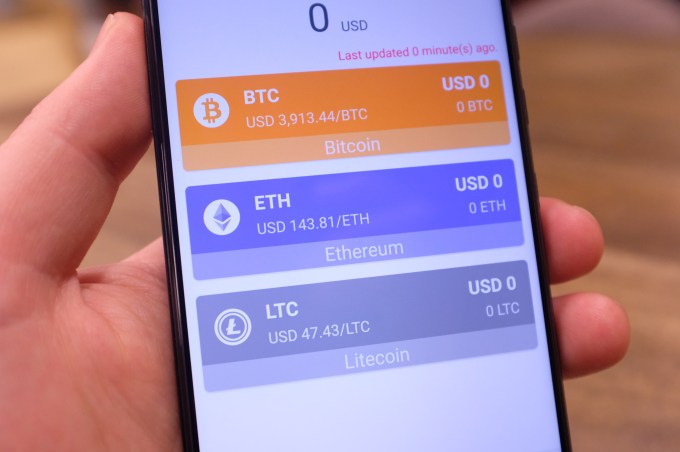
HTC’s blockchain phone can now be purchased with fiat currency

Until now, the Exodus 1 has, fittingly, only been available for purchase with cryptocurrency. Starting today, however, interested parties will be able to pick HTC’s blockchain phone up through more traditional means, including USD, which prices the handset at a not unreasonable $699.

One assumes, of course, if you’ve got enough of an interested in purchasing a blockchain phone that they’ve already got a bit of Bitcoin, Ether or Litecoin lying about. This move, however, is very clearly about helping growing the product beyond its initial soft launch. When the device was released last year, HTC was pretty clearly expecting to sell it in limited quantities to users who could essentially help beta test the product in the wild.

HTC Decentralized Chief Officer Phil Chen calls the product the company’s 1.0 solution. In fact, it’s planning to create a formal bounty program to discover and patch potential exploits.

But HTC has long held that a device like this will play an important role in the future of a company struggling to find its way as it feels the burn of a stagnating mobile industry. As project head and Chen told me on stage at a TechCrunch event  in Shenzhen last year that HTC is “as committed as they are to the Vive. I don’t think it’s number one of the priority list, but I would say it’s number three or four.”

When I spoke to Chen again this month, just ahead of today’s Mobile World Congress announcement, he told me that HTC currently has 25 engineers committed to the project. It’s perhaps not a huge number in the grand scheme of a company the size of HTC, but it’s a sizable chunk of manpower, considering the fact that the product is mostly built using existing HTC hardware. The company has also brought in outside help like blockchain security expert Christopher Allen to make sure things are as secure as possible.

And indeed, I’ve been carrying an Exodus One around for about a week now, and it feels like a pretty standard HTC handset, both in terms of hardware and Android software, right down to the inclusion the size-squeezing Edge Sense.

26 Feb 2019

Walmart acquires Israel’s Aspectiva, which analyses UGC to recommend products to shoppers

Walmart, the world’s biggest brick-and-mortar retailer, today made an acquisition that speaks to its ongoing efforts to build out its e-commerce experience to better compete with Amazon. Today, the company announced that it acquired Aspectiva, a startup out of Israel whose AI-based technology analyses user-generated content, like customers’ product reviews, and combines it with a shopper’s browsing behavior to make product suggestions to shoppers both online and in stores.

The startup will be joining Store No 8, Walmart’s in-house incubation arm established in 2017 to help the company develop and roll out more innovative shopping experiences. Store No 8 most recently launched a VR shopping experience “startup” called Spatial&, and last year it started a closed beta Jetblack, a text-based shopping concierge service for “busy moms.”

It’s not clear yet whether this will mean Aspectiva will build a standalone service or work on tech that Walmart will roll out across its own stores both offline and online. You could see where Walmart might be able to incorporate its tech to make the shopping experience in both scenarios less static as the startup already works across both.

Some of its products include tech that analyses what in-store shoppers search for on their phones or in store apps while walking around, to suggest what to buy. Aspectiva also crunches product reviews to provide customer overviews to online browsers based on different features of a product, and it also creates comparison reports between different brands of the same product — all from “reading” feedback from other shoppers.

Terms of the deal have not been disclosed by the companies but we’re trying to find out. Aspectiva had raised around $4 million in funding from investors that included KDDI and Global Brain out of Japan, JVP, as well as strategic backers LivePerson and online skate shop Union Five, according to Pitchbook.

Aspectiva was co-founded by Eyal Hurwitz and Ezra Daya, two text analytics engineer alums from CRM company Nice Systems. It looks like the whole team will be joining Walmart, but will continue to be based in Tel Aviv, in its existing offices.

“Our team is extremely excited to be joining Store N° 8 and be part of Walmart’s most recent investment in Israel. Store N° 8’s record of innovation and of developing capabilities that will transform retail as we know it makes for the perfect environment to leverage Aspectiva’s technology throughout the shopping funnel,” said Ezra Daya, CEO of Aspectiva, in a statement.

In its efforts to source more innovation particularly for tackling newer frontiers in commerce, Walmart has been stretching its wings internationally. Last year, the company acquired most of Flipkart, which had been known as the “Amazon of India” (before Amazon doubled down on India, one of the world’s fastest-growing markets for e-commerce, to make sure that it would be the Amazon of India).

And Walmart has also been active in Israel. It’s a strategic investor in Team8, an incubator that conceives of, funds and builds startups in the country; it has a $250 million content JV with media company Eko; it is part of The Bridge, a tech accelerator that promotes Israeli startups; and last year its Indian subsidiary Flipkart acquired Upstream Commerce to help with its own recommendation and pricing algorithms.

“Aspectiva has developed incredibly sophisticated machine learning techniques and natural language processing capabilities, both of which are areas we believe will have profound impact on how customers will shop in the future. Israel is a hotbed of tech talent and innovation. We’re thrilled to join the growing community of entrepreneurs in Israel and see it expand within Aspectiva,” said Lori Flees, Principal of Store No 8, in a statement.

26 Feb 2019

Alibaba challenger Pinduoduo is bringing imported goods to rural homes

Pinduoduo, the latest challenger to China’s ecommerce dominators Alibaba and JD.com, wants to bring affordable, imported items to shoppers in China’s smaller cities and rural areas.

The three-year-old Tencent-backed ecommerce upstart is recruiting importers to set up shop on its marketplace, shows a message on its website. The business is known for offering cheap, sometimes counterfeit goods that initially appealed to users from the less prosperous parts of China but have gradually garnered more price-sensitive urbanites. Its rise is closely linked to Tencent’s popular WeChat messenger, which lets it toy with viral marketing schemes like group deals, a level of access that’s unavailable to, say, Tencent rival Alibaba. Furthermore, the app’s focus on direct sales between manufacturers and consumers helps to keep costs down.

Pinduoduo’s social group-buying model works so well that it’s rapidly closing in on its larger rivals. It claimed 232 million monthly active users by the end of September. That represents only a fraction of Alibaba’s 700 million user base but the newcomer is growing at over 200 percent year-over-year. Pinduoduo already eclipsed JD.com in terms of market penetration according to data analytics company Jiguang. Over the past year, Pinduoduo was installed on 27.4 percent of all mobile devices in China, placing it ahead of JD.com which stood at 23.9 percent and behind Alibaba’s Taobao at 52.5 percent.

And now Pinduoduo becomes attuned to China’s booming cross-border business. People’s cravings for imported, higher-quality goods are surging along with their increasing disposable income. That new demand gives rise to a bountiful supply of “daigou”, or purchasing agents who send overseas goods to Chinese shoppers, and inspires ecommerce operators like Alibaba and JD.com to start their own cross-border businesses. The lucrative sector, estimated by market researcher iiMedia to have generated 9 trillion yuan ($1.34 trillion) in transactions last year, has even drawn unexpected players like NetEase. The Hangzhou-based firm is best known as one of China’s top game publisher but it’s made a dent in cross-border shopping in recent years with its Kaola service, which is reportedly buying Amazon China’s import unit.

TechCrunch has reached out to Pinduoduo for more information on its overseas shopping scheme and will update the story if we hear back. What we know for sure is that the ecommerce site plans to take on 500,000 small and medium-sized merchants for its overseas channel within the next three years, the company’s vice president Li Yuan announced at a November event. Pinduoduo was already deliverying imported goods to customers, a business that it said had seen surging transactions last year.

Pinduoduo has yet to make a profit, and the cost of battling Alibaba and JD.com became more evident after it recently announced to raise more than $1 billion just six months after a $1.63 billion initial public offering in the U.S. Time will tell whether cross-border ecommerce — where it plans to replicate its direct sales model — will help it gain an upper hand over the industry giants.