Author: azeeadmin

21 Feb 2019

Global smartphone growth stalled in Q4, up just 1.2% for the full year: Gartner

Gartner’s smartphone marketshare data for the just gone holiday quarter highlights the challenge for device makers going into the world’s biggest mobile trade show which kicks off in Barcelona next week: The analyst’s data shows global smartphone sales stalled in Q4 2018, with growth of just 0.1 per cent over 2017’s holiday quarter, and 408.4 million units shipped.

tl;dr: high end handset buyers decided not to bother upgrading their shiny slabs of touch-sensitive glass.

Gartner says Apple recorded its worst quarterly decline (11.8 per cent) since Q1 2016, though the iPhone maker retained its second place position with 15.8 per cent marketshare behind market leader Samsung (17.3 per cent). Last month the company warned investors to expect reduced revenue for its fiscal Q1 — and went on to report iPhone sales down 15 per cent year over year.

The South Korean mobile maker also lost share year over year (declining around 5 per cent), with Gartner noting that high end devices such as the Galaxy S9, S9+ and Note9 struggled to drive growth, even as Chinese rivals ate into its mid-tier share.

Huawei was one of the Android rivals causing a headache for Samsung. It bucked the declining share trend of major vendors to close the gap on Apple from its third placed slot — selling more than 60 million smartphones in the holiday quarter and expanding its share from 10.8 per cent in Q4 2017 to 14.8 per cent.

Gartner has dubbed 2018 “the year of Huawei”, saying it achieved the top growth of the top five global smartphone vendors and grew throughout the year.

This growth was not just in Huawei “strongholds” of China and Europe but also in Asia/Pacific, Latin America and the Middle East, via continued investment in those regions, the analyst noted. While its expanded mid-tier Honor series helped the company exploit growth opportunities in the second half of the year “especially in emerging markets”.

By contrast Apple’s double-digit decline made it the worst performer of the holiday quarter among the top five global smartphone vendors, with Gartner saying iPhone demand weakened in most regions, except North America and mature Asia/Pacific.

It said iPhone sales declined most in Greater China, where it found Apple’s market share dropped to 8.8 percent in Q4 (down from 14.6 percent in the corresponding quarter of 2017). For 2018 as a whole iPhone sales were down 2.7 percent, to just over 209 million units, it added.

“Apple has to deal not only with buyers delaying upgrades as they wait for more innovative smartphones. It also continues to face compelling high-price and midprice smartphone alternatives from Chinese vendors. Both these challenges limit Apple’s unit sales growth prospects,” said Gartner’s Anshul Gupta, senior research director, in a statement.

“Demand for entry-level and midprice smartphones remained strong across markets, but demand for high-end smartphones continued to slow in the fourth quarter of 2018. Slowing incremental innovation at the high end, coupled with price increases, deterred replacement decisions for high-end smartphones,” he added.

Further down the smartphone leaderboard, Chinese OEM, Oppo, grew its global smartphone market share in Q4 to bump Chinese upstart, Xiaomi, and bag fourth place — taking 7.7 per cent vs Xiaomi’s 6.8 per cent for the holiday quarter.
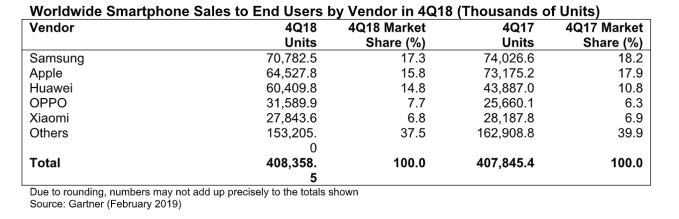
The latter had a generally flat Q4, with just a slight decline in units shipped, according to Gartner’s data — underlining Xiaomi’s motivations for teasing a dual folding smartphone.

Because, well, with eye-catching innovation stalled among the usual suspects (who’re nontheless raising high end handset prices), there’s at least an opportunity for buccaneering underdogs to smash through, grab attention and poach bored consumers.

Or that’s the theory. Consumer interest in ‘foldables’ very much remains to be tested.

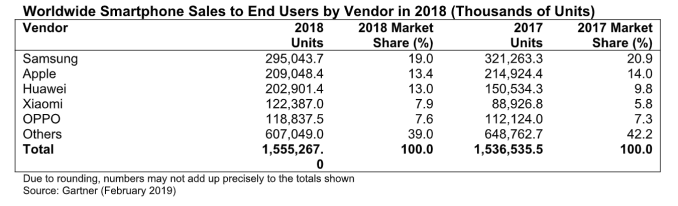
In 2018 as a whole, the analyst says global sales of smartphones to end users grew by 1.2 percent year over year, with 1.6 billion units shipped.

The worst declines of the year were in North America, mature Asia/Pacific and Greater China (6.8 percent, 3.4 percent and 3.0 percent, respectively), it added.

“In mature markets, demand for smartphones largely relies on the appeal of flagship smartphones from the top three brands — Samsung, Apple and Huawei — and two of them recorded declines in 2018,” noted Gupta.

Overall, smartphone market leader Samsung took 19.0 percent marketshare in 2018, down from 20.9 per cent in 2017; second placed Apple took 13.4 per cent (down from 14.0 per cent in 2017); third placed Huawei took 13.0 per cent (up from 9.8 per cent the year before); while Xiaomi, in fourth, took a 7.9 per cent share (up from 5.8 per cent); and Oppo came in fifth with 7.6 per cent (up from 7.3 per cent).
21 Feb 2019

JD.com’s drones take flight to Japan in partnership with Rakuten

Chinese e-commerce company JD.com is taking its drone delivery system to Japan.

Rakuten, the Japanese e-commerce giant, just announced a partnership with JD that will see its drones and unmanned vehicles become a part of Rakuten’s own unmanned delivery service efforts.

JD has been operating drones in its native China for a number of years, and it has wider expansion plans having recently gained a regional-level operating license. Its other human-less tech includes self-operating trucks, automated warehouses and unmanned stores, and it recently picked Indonesia for its first overseas drone pilot.

Rakuten has been offering drone delivery in Japan since 2016 and unmanned vehicle trials since 2018. It said that working with JD — which claims to have racked up 400,000 minutes of delivery flight time — will “accelerate the development and commercialization” of its human-free last mile delivery efforts.

21 Feb 2019

Clutter confirms SoftBank-led $200M investment for its on-demand storage service

There’s plenty of speculation right now around apparently disgruntled investors in SoftBank’s Vision Fund, but the drum continues to beat and the checks continue to be written. The latest deal for the $100 billion mega-fund is Clutter, an on-demand storage company that pulled in $200 million in new financing for growth.

Eagled-eyed viewers will recall that TechCrunch broke news of an impending SoftBank-led round of that size back in January, and now it is official.

The startup is one of a number of companies that provide storage options for consumers who don’t want to part with items but equally don’t have the capacity to keep it where they live. The service is based around an app that is used to summon Clutter staff to pack up, take away, store and (later) return possessions, but it can also be used for regular house moving, too. Competitors in the space include MakeSpaceOmniTroveLivible, and Closetbox.

Joining SoftBank in the deal are existing Clutter investors Sequoia, Atomico, GV, Fifth Wall and Four Rivers who fronted the company’s last round, a $64 million raise nearly two years ago. This new capital means that Clutter has raised $297 million from investors to date.

There’s no confirmation of a valuation for the startup, but our well-placed sources previously told us that this round would value Clutter at between $400 million and $500 million. One thing that is confirmed, however, is that SoftBank’s Justin Wilson will join the board.

The money will go towards expansion in the U.S. as Clutter explained in an announcement, but there are hints that it harbors overseas ambitions, too:

This funding will accelerate the company’s expansion into new markets in 2019, including Philadelphia, Portland and Sacramento. It’s also doubling down in its existing markets in the greater areas of New York, San Francisco, Los Angeles, Chicago, Seattle, San Diego, Orange County and northern New Jersey, as it marches toward a goal of operating in America’s largest 50 cities and expanding internationally.

“We believe that storage is a vast and traditional market with huge potential for disruption, and Clutter’s technology and superior customer proposition will help facilitate future growth in expanding urban communities where space is at a premium,” said SoftBank’s Wilson in a statement.

21 Feb 2019

Companies including Nestle, Epic and reportedly Disney suspend YouTube ads over child exploitation concerns

Days after a YouTube creator accused the platform of enabling a “soft-core pedophilia ring,” several companies have suspended advertising on the platform, including Nestle, Epic, and reportedly Disney and McDonald’s.

Nestle told CNBC that all of its companies in the U.S. have paused advertising on YouTube, while a spokesperson for Epic, maker of the massively popular game Fortnite, said it has suspended all pre-roll advertising. Other companies that confirmed publicly they are pausing YouTube advertising include Purina, GNC, Fairlife, Canada Goose, and Vitacost. Bloomberg and the Wall Street Journal report that Walt Disney Co. and McDonald’s, respectively, have pulled advertising, too.

Other advertisers, including Peloton and Grammarly, said they are calling on YouTube to resolve the issue.

The latest scandal over YouTube’s content moderation problems took off on Sunday when YouTube creator Matt Watson posted a video and in-depth Reddit post describing how pedophiles are able to manipulate the platform’s recommendation algorithm to redirect a search for “bikini haul” videos, featuring adult women, to exploitative clips of children. Some otherwise innocuous videos also had inappropriate comments, including some with timestamps that captured children in compromising positions.

A YouTube spokesperson sent a statement to TechCrunch that said “Any content – including comments – that endangers minors is abhorrent and we have clear policies prohibiting this on YouTube. We took immediate action by deleting accounts and channels, reporting illegal activity to authorities and disabling comments on tens of millions of videos that include minors. There’s more to be done, and we continue to work to improve and catch abuse more quickly.”

The platform has also reported comments to the National Center for Missing and Exploited Children and is taking further steps against child exploitation, including hiring more experts.

Watson’s report, however, highlights that YouTube continues to struggle with content that violates its own policies, even after a series of reports two years ago led to what creators dubbed the “adpocalpyse.” In an effort to appease advertisers, YouTube gave them more control over what videos their ads would appear before and also enacted more stringent policies for creators. Many YouTubers, however, have complained that the policies are unevenly enforced with little transparency, dramatically lowering their revenue but giving them little recourse to fix issues or appeal the platform’s decisions, even as objectionable content remains on the platform.

21 Feb 2019

On-demand logistics startup Lalamove raises $300M for Asia growth and becomes a unicorn

Lalamove, a Hong Kong-based on-demand logistics startup, has closed a $300 million Series D round as it seeks expansion across Asia. In doing so, the company has officially entered the unicorn club.

Founded in 2013 by Stanford graduate Shing Chow, Lalamove provides logistics and delivery services in a similar style to ride-hailing apps like Uber but it is primarily focused on business and corporate customers. That gives it more favorable economics and a more loyal customer base than its consumer-focused peers, who face discount wars to woo fickle consumers.

This new round is split into two, Lalamove said, with Hillhouse Capital leading the ‘D1’ tranche and Sequoia China heading up the ‘D2’ portion. The company didn’t reveal the size of the two pieces of the round. Other investors that took part included new backers Eastern Bell Venture Capital and PV Capital and returning investors ShunWei Capital — the firm founded by Xiaomi CEO Lei Jun — Xiang He Capital and MindWorks Ventures .

The deal takes Lalamove to over $460 million raised to date, and it follows a $100 million Series C that closed in late 2017. Lalamove isn’t disclosing a valuation but Blake Larson, the company’s head of international, told TechCrunch that it has been “past unicorn mark for quite some time [but] we just don’t talk about it.” That figures given the size of the round and the fact that Lalamove was just shy of the $1 billion mark for that Series C.

The Lalamove business is anchored in China where it covers over 130 cities with a network of over two million drivers covering vans, cars and motorbikes.

Beyond China, Lalamove is present in its native Hong Kong — where Uber once briefly tried a similar service — Taiwan, Vietnam, Indonesia, Malaysia, the Philippines and Thailand, where it works with popular chat app Line. All told, it covers 11 cities outside of China and this new capital will go towards expanding that figure with additional city launches in Southeast Asia and entry to India.

“If we do this well, then we are in countries that are more than half the world’s population,” Larsen said in an interview, although he didn’t rule out the potential for Lalamove to expand beyond Asia in the future.

There are also plans to grow the business in mainland China in terms of both geography and new services. Already, Lalamove has begun to offer driver services, starting with financing packages to help drivers with vehicle purchasing, and it is developing dedicated corporate offerings, too.

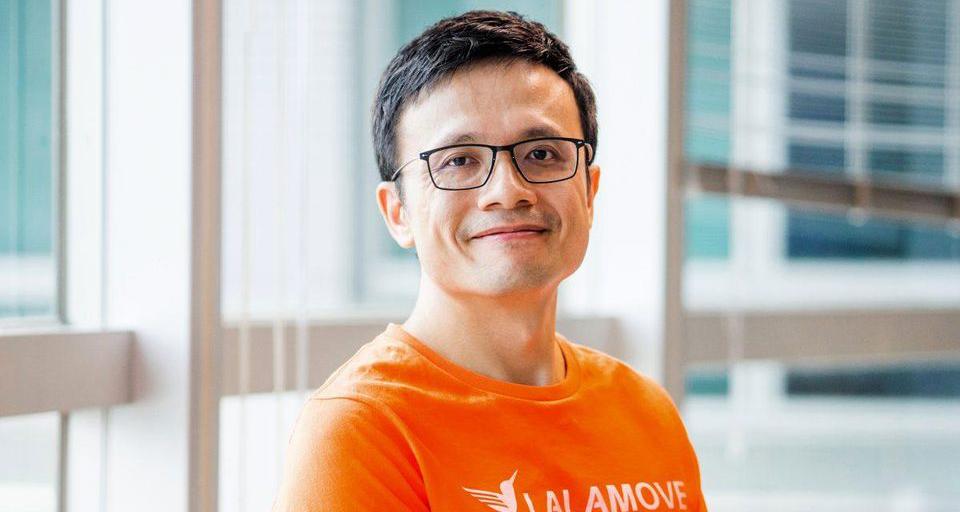
Lalamove CEO Shing Chow started Lalamove in late 2013, his past roles have included time with Bain & Company, a number of startup ventures — including a Hong Kong-based skin center — and a stint as a professional poker player

Overall, the business claims to have registered 3 million drivers to date and served more than 28 million users across all cities. With its headquarters in Hong Kong, it employs some 4,000 people across its business.

Rival GoGoVan exited through a merger with China-based 58 Suyun in 2017, at a claimed valuation of $1 billion, but Lalamove has remained independent and stuck to its guns. Larson said that already it is profitable in “a significant amount” of cities and typically, he said, the blueprint is to reach profitability within two years of opening a new location.

“The focus has always been on sustainable growth and we’re very strong on the cash flow front,” the former Rocket Internet executive added.

Larson and Lalamove have been very forthcoming in their desire to go public in Hong Kong, noting so publicly as early as 2017 at a TechCrunch China event in Shenzhen. That desire is still evident — “we’re very proud to be from Hong Kong and Hong Kong would be a good place for an IPO,” Larson said this week — but still the company said that it has no particular plan on the cards, despite its consumer-focused peers Uber and Lyft lining up IPOs in the U.S. this year.

“We don’t spend maybe even five minutes a year talking about it,” Larsen told TechCrunch. “The discussion is really ‘Let’s make sure we’re IPO ready’ because sometimes there are macroeconomic conditions you can’t control.”

Clearly, investors are bullish and it is notable that Lalamove’s new round comes at a time when many Chinese companies are downsizing their staff, with the likes of Didi, Meituan and JD.com announcing cuts and refocusing strategies in recent weeks.

“[Lalamove CEO and founder] Shing is a role model for Hong Kong’s new generation of innovative entrepreneurs,” said Sequoia China founder and managing partner Neil Shen. “Raised in Hong Kong and educated at Stanford University, Shing returned and plunged himself in the entrepreneurial wave of ‘Internet Plus,’ becoming a figure of entrepreneurial success.”

21 Feb 2019

This robotics museum in Korea will construct itself (in theory)

The planned Robot Science Museum in Seoul will have a humdinger of a first exhibition: its own robotic construction. It’s very much a publicity stunt, though a fun one — but who knows? Perhaps robots putting buildings together won’t be so uncommon in the next few years, in which case Korea will just be an early adopter.

The idea for robotic construction comes from Melike Altinisik Architects, the Turkish firm that won a competition to design the museum. Their proposal took the form of an egg-like shape covered in panels that can be lifted into place by robotic arms.

“From design, manufacturing to construction and services robots will be in charge,” wrote the firm in the announcement that they had won the competition. Now, let’s be honest: this is obviously an exaggeration. The building has clearly been designed by the talented humans at MAA, albeit with a great deal of help from computers. But it has been designed with robots in mind, and they will be integral to its creation.The parts will all be designed digitally, and robots will “mold, assemble, weld and polish” the plates for the outside, according to World Architecture, after which of course they will also be put in place by robots. The base and surrounds will be produced by an immense 3D printer laying down concrete.

So while much of the project will unfortunately have to be done by people, it will certainly serve as a demonstration of those processes that can be accomplished by robots and computers.

Construction is set to begin in 2020, with the building opening its (likely human-installed) doors in 2022 as a branch of the Seoul Metropolitan Museum. Though my instincts tell me that this kind of unprecedented combination of processes is more likely than not to produce significant delays. Here’s hoping the robots cooperate.

21 Feb 2019

Security token offerings aren’t looking much better in 2019

Pressed to explain who is using them, and why, 99 percent of cryptocurrencies let out all their air, go flying around the room making a raspberry sound, hit the wall and fall behind the couch forever.

The party is over. A few, however, can present a credible use case. “Tokenized securities” could be one of them: a more open and efficient way to transact shares and notes as well as distribute cash flows.

Proponents of “security token offerings” (STOs) have been telling that story now for a little more than a year. This data report canvases the market, finds few are buying it, interviews market participants for perspective and reveals gaps in the use case at the ground level that explain its failure to thrive.

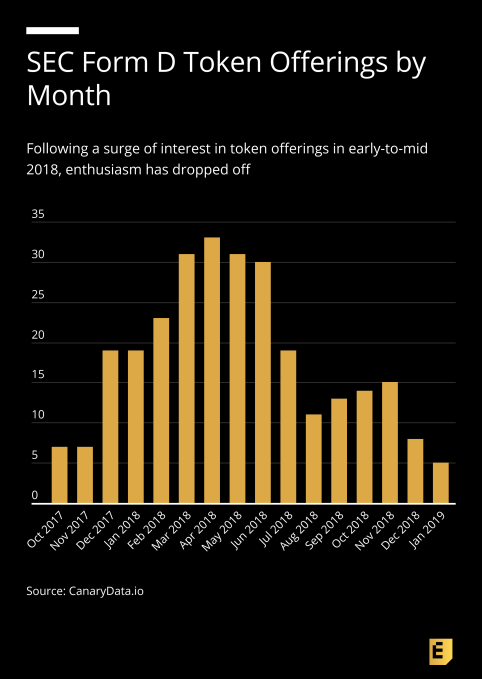
In October 2017, the market for “initial coin offerings,” or ICOs, reached a peak, with more than 100 capital raises closing through the sale of crypto tokens, according to market data provider Token Data. Proponents thought these tokens were an innovation on par with the joint stock corporation: not a claim on cash flows, but a vessel to participate in and directly capture the value latent in network effects. “Tokenized” networks raising money that month ranged from the prosaic, like a no-fee crypto exchange called Cobinhood ($13.2 million), to the ludicrous, like Dentacoin, “the blockchain solution for the global dental industry” ($1.1 million).

At the time, it was nearly unheard-of for such a project to acknowledge its token might be a security like the mundane stock certificate. In the following months, the US Securities and Exchange Commission (SEC) sent dozens of subpoenas to token issuers, indicating that they disagreed. By the following March, the number of SEC registrations for new token offerings equaled more than half the total ICO deal activity for the month.

As SEC moved in and ICOs cooled, a new enthusiasm for paperwork


The sudden popularity in 2018 of the so-called “security token” was undoubtedly a scramble to paper over cash grabs. However, there is a use case for “tokenized securities” that is worth considering. Bitcoin showed how ownership could be digitally secured and transferred without intermediaries. A tokenized security could do the same for investment contracts. “Smart contracts” are a value proposition that has been discussed in cryptocurrency since long before Bitcoin.

There is reason to be optimistic that this form of programmable ownership can bring efficiency, transparency, liquidity and access to the $1.7 trillion annual US private placement market. The value proposition is that smart contracts will reduce the cost of compliance in primary issuance and secondary trading. Issuers benefit by reduced liquidity premiums and more buyers to compete for their offering. Investors benefit by gaining more access to opportunities for growth-stage investment. This is a compelling story in US capital markets that have, for nearly two decades, starved retail investors of exposure to growth-stage investments.

Decline of the small-cap IPO reduced retail opportunities for risk & return

This value proposition, and a narrative of regulatory chill in the markets, have led some to believe that tokenized securities would bring back a bull market in crypto. The Wall Street hype machine has moved on from crypto; security tokens are one of the few areas in which the avid listener can detect faint echoes of its passing.

Media hype

  • “If it works you’re going to see tremors across Wall Street.” -CNBC commentator
  • “Apple and Tesla shares on the blockchain could be the next big thing” -CNBC headline
  • “2019: The Year Digital Securities Offerings Become the New ICOs” -CoinDesk
  • “Why security token offerings are replacing initial coin offerings” -Silicon Valley Business Journal

From 30,000 feet up, the use case for tokenized securities looks compelling. As with many blockchain-based projects, zoom down to the user level and misaligned incentives appear for key market participants.

  • Investors: Digital tokens carry technological risk, regulatory risk and market risk. Without a liquid market ready and waiting, private placement investors have little incentive to layer risk on top of the risk-return they already understand.
  • Brokers: Effective bankers and broker-dealers charge a premium for primary issuance; the more effective they are, the less incentive they have to adopt, especially given their investors are not clamoring for this product.
  • Issuers: With markets awash in private capital, there are very few quality issuers that cannot raise funds. The better the investment opportunity, the likelier its access to funds and investment banks in the top quartile, where investment decisions have kingmaker effects in the market. Interest in innovation that disrupts these relationships is therefore inversely related to suitability for capital, a repeat of the pattern in US issuers accessing new equity crowdfunding options under the JOBS Act of 2012.

If you build it, will they come?

To determine whether new tokenized security issuance is finding a fit in the market, Canary Data, an open crypto research initiative, undertook an exhaustive search of news wires and the SEC’s EDGAR database, beginning in 2017 and ending mid-January, looking for public statements and filings related to security token offerings. It’s an imperfect method; our database of offerings is constantly evolving as new information becomes available. But in an emerging segment of the financial markets it reflects the level of credible, mainstream activity.

We filtered out tokens that are in the mold of the ICO “utility token,” offering a financial instrument as a form of access to a valuable network effect. Many of these have registered as securities, but it is the value proposition of a tokenized tradtional security — a claim on cash flow, represented as a token — that we are interested in.

21 Feb 2019

Can you guess which face is real, and which is computer generated?

Computers have recently gotten much, much better at a somewhat unsettling skill: generating fake human faces. As in, creating an image of a human who has never existed before.

We saw the concept go a bit viral this week with ThisPersonDoesNotExist, a website hooked to a machine that generates a new face every few seconds. Or the feline version that dreams up (sometimes nightmare-inducing) cats, ThisCatDoesNotExist.

Now it has been turned into a game. Think you can tell which human is… well, human? (Spoiler: All of the images used as examples above are, according to the game, computer generated.)

Aptly called WhichFaceIsReal, the site throws two images side-by-side: one real, and one generated by a computer. It was put together by two professors at the University of Washington, building upon the same work as the sites mentioned above: StyleGAN, an algorithm recently open-sourced by a team at Nvidia. This algorithm pits two neural networks against each other — one attempting to generate fake face images, while another network attempts to flag the fake.

It’s not impossible to tell which is real, at this point. After you’ve been playing for a while, you might start to notice things the computer tends to get wrong. The authors of the site even outline some of the common issues here — things like weird water-splotch-like graphical artifacts, or smiling mouths featuring too many front teeth.

But even if you’re getting 90 percent of them right off the bat, you’ve gotta wonder: would you notice the fake if it weren’t so deliberately contrasted with a real one? If any of the fakes were just a random photo on a profile on the internet, would you even take a second look?

20 Feb 2019

On-demand shuttle startup Via enters South American market

Via, the on-demand shuttle startup backed by Daimler, has expanded into South America.

The company launched a service in Goiânia, Brazil with HP Transportes Coletivos, one of the country’s largest public transportation operators. Via says the service called CityBus 2.0 is the first on-demand shuttle system operated by a public transit operator to launch in Latin America.

Users are able to use an app to request a ride in 11 districts around the city. Base fares are R$2.50, or $0.68. Via’s service is features a fleet of 14-seater Mercedes-Benz vans that are capable of handling up to 3,500 trips per day. The service is employs 30 drivers. 

So far, it appears there’s demand for this on-demand shuttle service. More than 15,000 people downloaded the CityBus 2.0 app in the first week of service, Via said.

When a rider places the request, the app calculates the distance and shows the fare. Payment can be made by credit card or cash. While on-demand ride-hailing services typically only process payments through an app, Via does allow cash transactions with some transit agency partners. Cash payments are also available in cities like Orange County where we launched OC Flex.

Via has 50 deployments in 15 countries. The company has consumer-facing shuttles in Chicago, Washington, D.C. and New York. The company also partners with cities and transportation authorities — like this latest one in Brazil — giving clients access to their platform to deploy their own shuttles.

Last month, Via announced it was partnering with Los Angeles as part of a pilot program that will give people rides to three busy public transit stations. The pilot program aims to solve the first- and last-mile problem that makes it challenging for people to get to and from public transit stations.

20 Feb 2019

Trustpilot is revealing more data about how businesses flag reviews

Review site Trustpilot says it’s creating more transparency around how businesses respond to consumer reviews.

Founder and CEO Peter Mühlmann told me that while “the vast majority of companies” are using their ability to flag questionable reviews in “exactly the right way,” there’s a small minority who are potentially “ruining it for everyone” by aggressively flagging bad reviews.

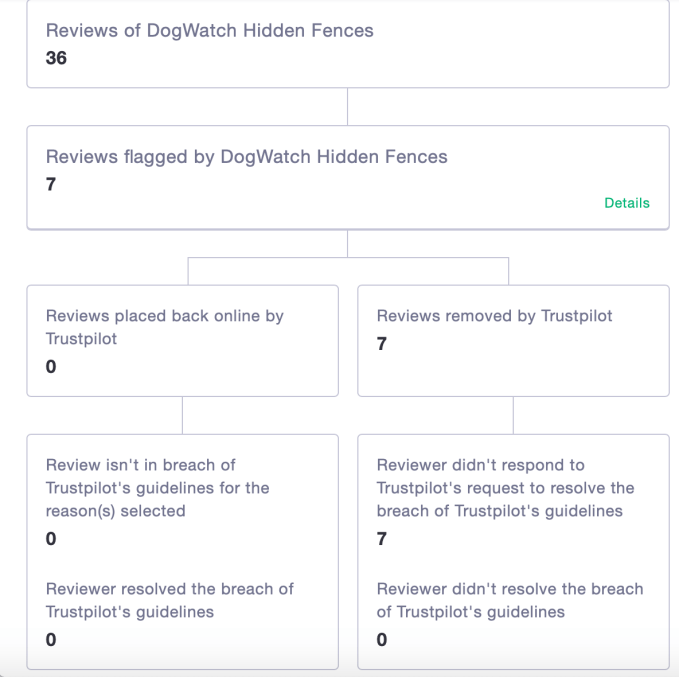
So with the new Transparent Flagging feature, Trustpilot visitors can actually see how many reviews a company flagged (starting on January 1st of this year), and what the ultimate outcome was. That way, if you’re wondering if you’re only seeing positive reviews because a business challenged all the negative ones, you can find out for yourself by clicking on the “activities” button in a business profile.

Trustpilot screen shot


That will reveal how many reviews were taken down because they represented a real breach of Trustpilot’s policies, versus reviews where the poster simply didn’t respond to questions, versus legitimate reviews that were ultimately reinstated.

Mühlmann suggested that this is part of a broader effort to make sure consumers can actually trust the reviews they see online, and to fight back against what he described (in a follow-up email) as “an arms race to five stars.”

“If marketers are motivated to cheat on our platform, consumers are going to see them do it,” he said. “At that point, the benefits simply don’t outweigh the risks. I wish them good luck – they’re going to need it.”