Author: azeeadmin

20 Feb 2019

Facebook adds new background location privacy controls to its Android app

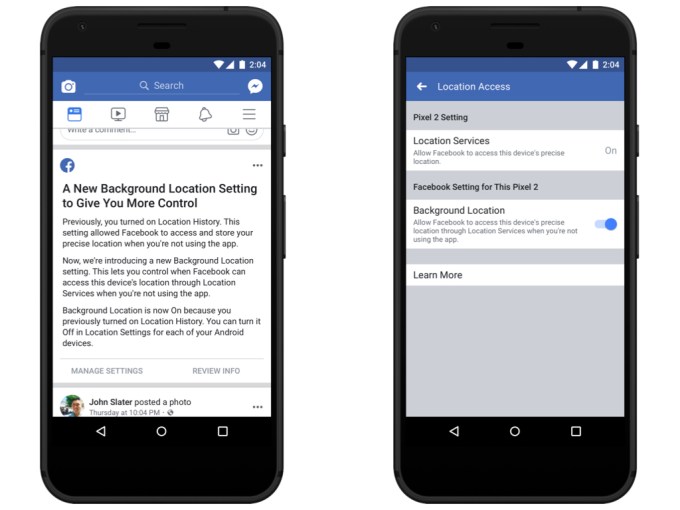
Facebook is updating its privacy settings on Android to make it easier for users to control what location data is sent to and stored by the company.

In its announcement, Facebook acknowledged that Android users have expressed concern over the app’s ability to continuously log location data in the background. Due to Android’s all-or-nothing system of location permissions relative to iOS, the Facebook app has historically had the green light for collecting location data whether a user is actively in the app or not.

While the company stopped short of admitting the practice, Facebook for Android users who previously had location services enabled can probably assume that Facebook was extensively tracking their location even when they weren’t actively using the app. Facebook describes the choice to toggle location history on as “[allowing] Facebook to build a history of precise locations received through Location Services on your devices.”

Android users who previously allowed Facebook access to their location data will retain those settings, though they’ll receive an alert about the new location controls. For users who kept the location settings for Facebook disabled, those permissions will remain toggled off. While these changes apply only to Android users, Facebook also noted that it would send out an alert to iOS users to remind them to reevaluate their location history settings.

If your location history isn’t something you’ve thought much about before, it’s worth spending a minute to consider how comfortable you are with that depth of personal data being transmitted continuously to a company with Facebook’s privacy track record. Remember: Once that information is out of your hands, you have little to no control over what happens with it.

20 Feb 2019

Samsung’s Galaxy S10 has a built-in Instagram mode

After weeks of leaks, Samsung still managed to save some surprises for today’s event. One of the most interesting among them is a partnership with Instagram that brings Stories directly to the camera app.

It’s an interesting partnership and mutually beneficial for both parties. For some, it could signal a kind of return to pre-loaded bloatware, but at least in the case of Instagram, the app is virtually ubiquitous for most users at this point anyway.

The mode got a brief demo on stage today — it’s pretty much what you’d expect out of the thing, bringing filters directly to the camera software and letting you upload straight to service without leaving Samsung’s default camera software.

Smartphone makers have had increasing difficult distinguishing their camera offerings in recent years. The last several generations of products like the Galaxy line, iPhone and Pixel have increasingly relied on AI/ML/software updates to set themselves apart, so these kinds of partnerships could certainly play a role in that going forward.

20 Feb 2019

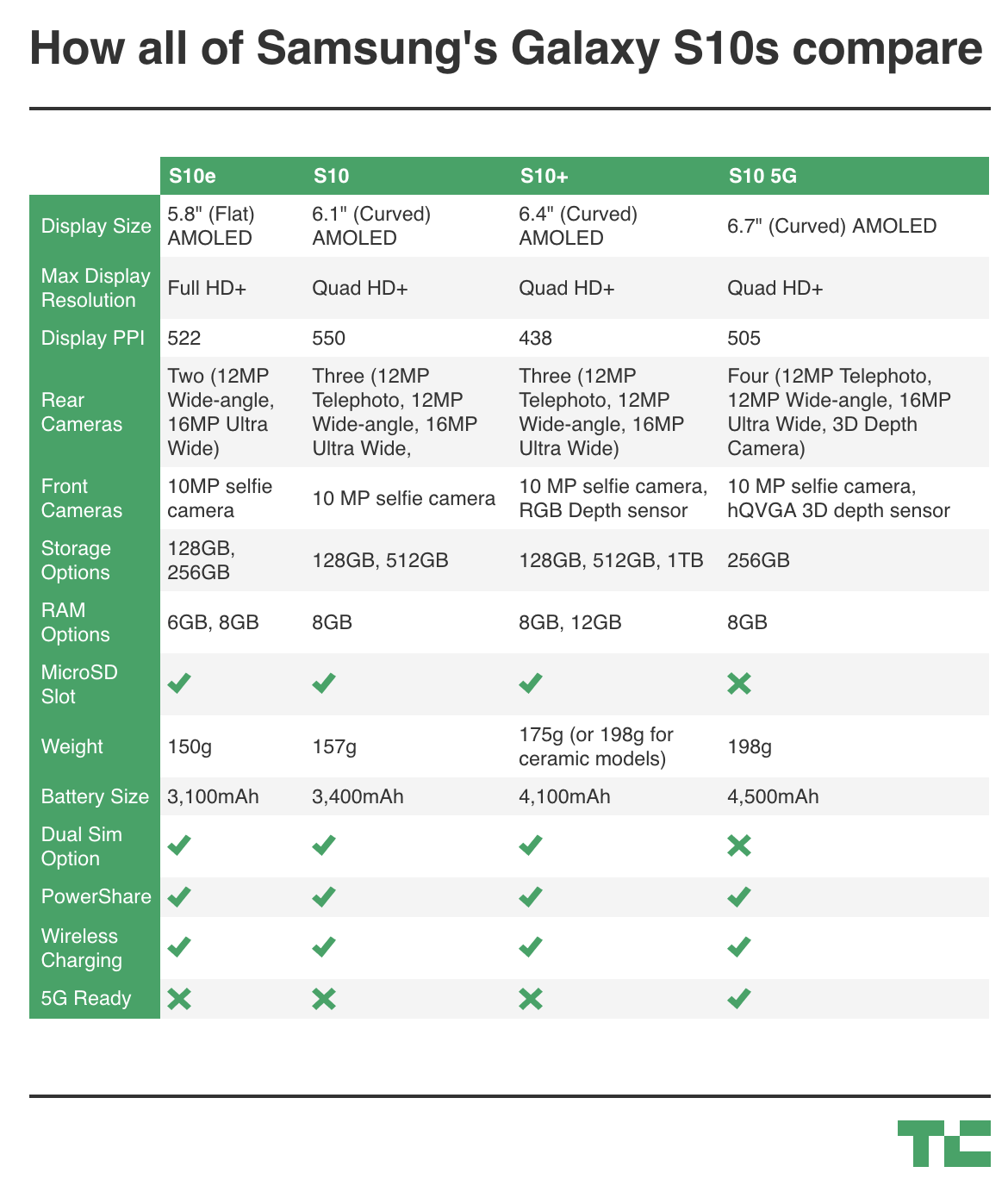
Here’s how all of Samsung’s new Galaxy S10’s compare

Samsung just announced not one, not two, but four new additions to its flagship Galaxy line: the S10e, S10, S10+, and S10 5G. Want a quick at-a-glance breakdown of how they all compare? We’ve got you covered.

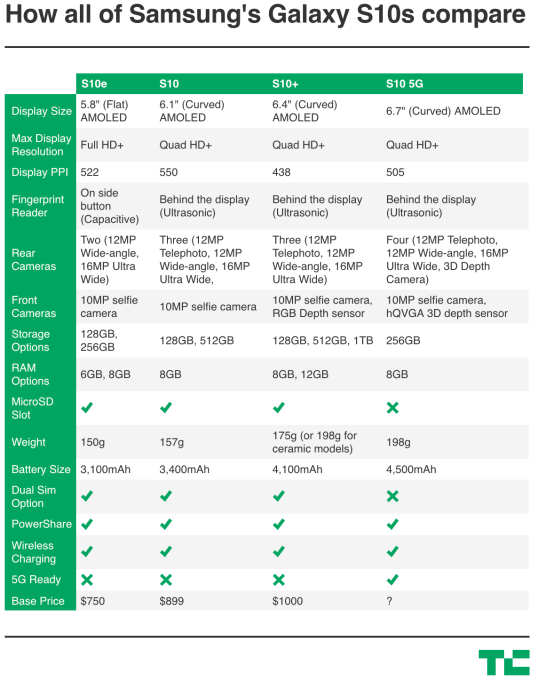
Brian’s got a deeper look at the different S10 models here — but if you’d rather see the key specs side-by-side, here’s a handy chart:

Most of it is self explanatory, barring perhaps “PowerShare” — a new feature Samsung added across the S10 lineup. Whereas wireless charging lets you charge any of the phones on a compatible charging pad, PowerShare lets you use the phone as a wireless charging pad for other devices — be it another phone or, say, Samsung’s just announced Galaxy Bud headphones.

You can find all of our coverage from Samsung’s Unpacked event here.

20 Feb 2019

Lyft launches surge-free, shared rides

Somewhat similar to Uber’s Express Pool option, Lyft just launched Shared Saver to help people spend less money for shared rides. But what makes Lyft’s option more attractive is that riders will never experience surge pricing.

“You’ll lock in the lowest prices, always — even when it’s busy,” Lyft wrote in a blog post today.

Shared Saver rides require customers to walk to a designated pickup location, which will be a maximum of a few blocks away, to meet your driver and co-riders. Same goes for your dropoff location.

Lyft’s long-term plan entails encouraging more people to take shared rides. Last June, Lyft updated its app to make shared rides much more visible. As of June 2018, 35 percent of Lyft rides were shared. Lyft’s goal is to hit 50 percent shared rides by 2020, Lyft VP of Government Relations Joseph Okpaku told TechCrunch at the time.

20 Feb 2019

These are Samsung’s new Galaxy Buds

After a seemingly endless stream of leaks over the past few weeks, there was essentially zero doubt that Samsung was announcing — amongst a bunch of other things — a new pair of wireless earbuds called the “Galaxy Buds” today.

Here they are.

Samsung says the Galaxy Buds should be able to pull around 5 hours of talk time, or 6 hours of music listening time. As with most of the other headliner devices Samsung has launched in recent years, sound tuning is handled by AKG (the acoustics brand Samsung bought alongside Harman in 2017.)

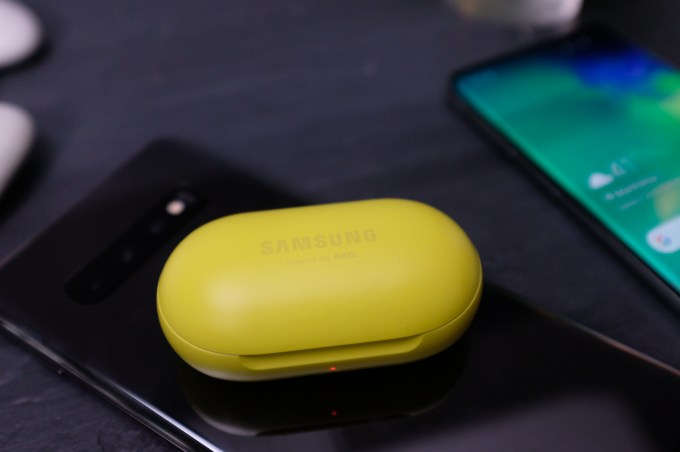
The feature they’ll probably market the hardest, though, is the companion charging case. It plays friendly with the new PowerShare feature built into the just-announced Galaxy S10 line, allowing you to charge the case wirelessly by sitting it on the rear side of the phone. It looks like this:

Samsung says that case should hold around 7 additional hours of charge time, and can give the Buds about 1.5 hours worth of juice in roughly 15 minutes.

Samsung says the Galaxy Buds should cost $129.99, and should ship starting March 8th.

Story developing…

20 Feb 2019

Samsung has sold 2 billion Galaxy phones

Samsung announced its most expensive phone today, but it also shared the progress it’s made so far in selling a whole lot of Galaxy smartphones.

Onstage, Samsung Electronics President DJ Koh announced that over the past decade, the company had sold more than 2 billion Galaxy devices.

The company has more than just smartphones falling beneath the galaxy brand, but this vanity stat is all about what they’ve been able to accomplish with their handset brand. The company didn’t break down the active install base of its Galaxy devices or detail a full break down of its smartphone sales.

The company shared info on a whole lot of devices today, including the Galaxy S10 and Galaxy Fold.

20 Feb 2019

Samsung just announced a phone with 1TB of built-in storage

Word around the rumor mill suggested Samsung was about to announce a phone with a ridiculous one terabyte of storage built right in, and sure enough: it did.

Samsung announced four different variations of the Galaxy S10 today — the S10e, the S10, the S10+, and the S10 5G. That third one, the S10+, is the one that can come with 1TB of internal storage.

I say “can”, here, because even after you choose between the four aforementioned S10 variations, you’ve got choices. The S10+ comes with three different storage options: 128GB (with 8GB of RAM), 512GB (also with 8GB of RAM), or one terabyte (with a sufficiently wild 12GB of RAM).

Oh, and it has a microSD slot that supports up to 512GB of additional space if carrying around 1TB of data in your pocket isn’t (stressful) enough.

Here’s the rest of the specs:

  • 6.4″ Quad HD Curved AMOLED display
  • Ultrasonic, in-display fingerprint sensor
  • Three cameras on the rear: a 12MP Telephoto lens, a 12MP dual pixel lens, and a 16MP ultra wide lens
  • Two cameras on the front: one 10MP dual pixel lens, and one 8MP RGB depth lens
  • Dimensions: 74.1 x 157.6 x 7.8mm
  • Weight: 175g for the standard model, or 198g for the ceramic models
  • 4,100mAh battery
  • Runs Android 9.0 (aka Android Pie)
  • WiFi 802.11 a/b/g/n/ac/ax

Samsung hasn’t yet mentioned how much the 1TB S10+ might cost, but it’s probably safe to say the answer is “lots”. We’ll update this page when we hear something more specific than that.

You can find all of our coverage from Samsung’s Unpacked event here.

20 Feb 2019

The Samsung S10’s cameras get ultra-wide-angle lenses and more AI smarts

Samsung’s S10 lineup features a whopping four models, the S10e, the S10, the S10+ and the S10 5G. Unsurprisingly, one of the features that differentiates these models is the camera system. Gone are the days, after all, where one camera would suffice. Now, all the S10 models, except for the budget S10e, feature at least three rear cameras and the high-end 5G model even goes for four — and all of them promise more AI smarts and better video stabilization.

All models get at least a standard 12MP read wide-angle camera with a 77-degree field of view, a 16MP ultra-wide-angle camera for 123-degree shots, and a 10MP selfie camera. The standard S10 then adds a 12MP telephoto lens to the rear camera setup and then S10+ gets an 8MP RGB depth camera. The high-end S10 5G adds a hQVGA 3D depth camera to both the front and rear setup.

The ultra-wide lens is a first for Samsung’s flagship S10 series, though it’s a bit late to the game here given that others have already offered these kind of lenses on their phones before. Still, if you are planning on getting an S10, this new lens will come in handy for large group shots and landscape photos.

On the video front, Samsung promises better stabilization, UHD quality for both the rear and front cameras and HDR10+ support for the rear camera.

These days, though, it’s all about computational photography and like its competitors, Samsung promises that its new cameras are also significantly smarter than its predecessors. Specifically, the company is pointing to its new scene optimizer for the S10 line which uses the phone’s neural processing unit to recognize and process up to 30 different scenes and also offer shot suggestions to help you better frame the scene. Since we haven’t actually used the phones yet, though, it’s hard to say how much a difference those AI smarts really make in day-to-day use.

20 Feb 2019

Samsung’s Galaxy S10 lineup arrives with four new models

In what may well be the most Samsung move in Samsung history, Samsung just introduced four new Samsung S10 models. For the 10th anniversary of the flagship line, Samsung is going all in on this thing. And with more information expected on Samsung’s upcoming foldable, well, that’s a lot of Samsungs, Samsung.
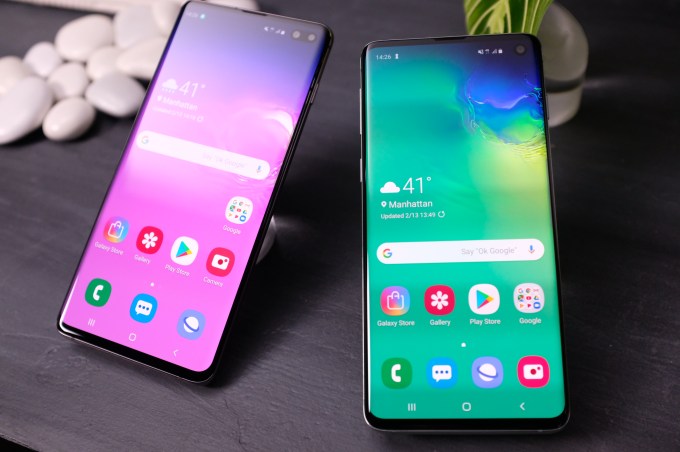
Before we dive in to what’s bound to be a lot of words about a lot of phones, here’s the basic breakdown of the line:

S10: The flagship. 6.1 inch. Starts at $900.

S10+: A little bigger, a little better. 6.4 inch. Starts at $1,000.

S10e: The [E]ntry level or [E]conomy or [E]gads that’s a lot of new phones. The Galaxy’s take on the iPhone XR. 5.8 inch. Starts at $750.

S10 5G: All the bells, all the whistles and whistles with bells on them. 6.7 inch. Starts at $?!?!?!?!?

And hey, look, Greg made a handy chart of all of the specs:
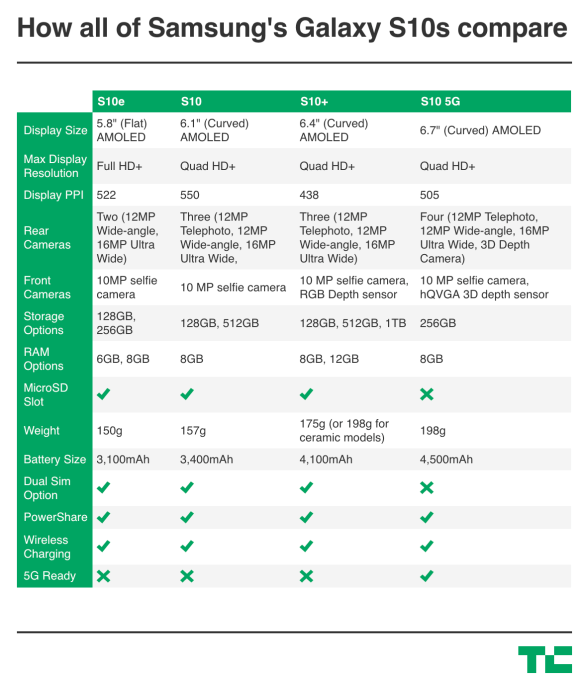
As for what’s new beyond the sheer number of devices, the top-line features are as follows: edge-to-edge display with pinhole cutout, three rear-facing cameras and Wireless Powershare, which uses the phone to wirelessly charge other handsets and the company’s new Galaxy Buds. Of course, some of those features vary by SKU.

Unlike the 10th anniversary iPhone a couple of years back, the S10 isn’t an attempt to rethink the product on the occasion of the line’s own first decade. Instead, the device finds Samsung adding more flagship features atop of what is already a pretty massive pile.

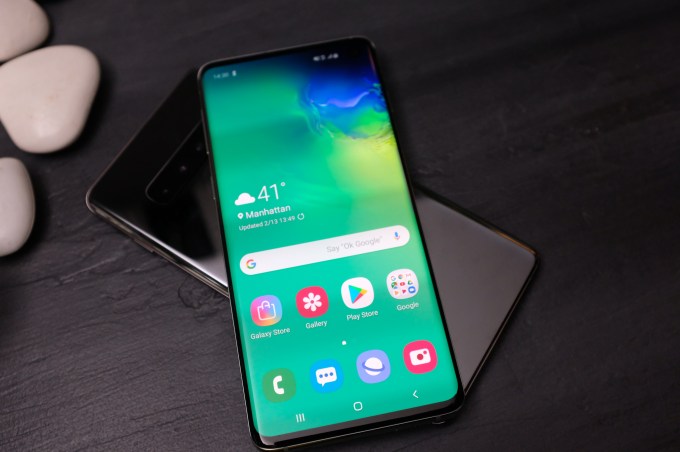
Those who’ve followed the Galaxy line with even passing interest will find that the S10 looks pretty familiar.  The most distinguishing bit of design language this time out is, naturally, the “Infinity-O” display. One of several screen technologies the company highlighted at last year’s developer conference, the “O” is exactly what it sounds like — a hole punch up top for the camera to peek through.
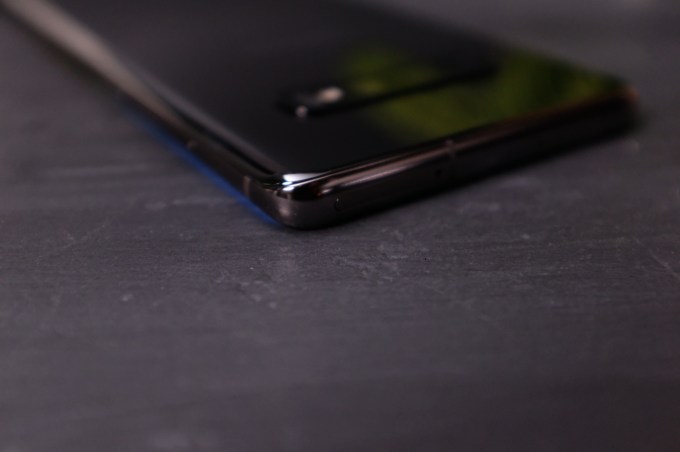
Unlike most of the rest of the industry, Samsung just skipped over that whole notch business, in favor of even more screen. Of course, the S10’s not the first handset with a pinhole — hell, it’s not even the first Samsung with one. That designation, interestingly enough, belongs to the A8, a mid-range handset introduced late last year for the China market — surely an indication of a company dealing with increased pressure from companies like Huawei and Xiaomi. 

The company says the feature was designed with a “precision laser,” leaving the phone with an impressive screen-to-body ratio of 93.1 percent. This is helped along with the addition of an under-display fingerprint reader. Again, the S10 isn’t the first handset with an in-screen fingerprint sensor (OnePlus, among others, brought one to market last year), but the company is among the first to use Qualcomm’s new technology.
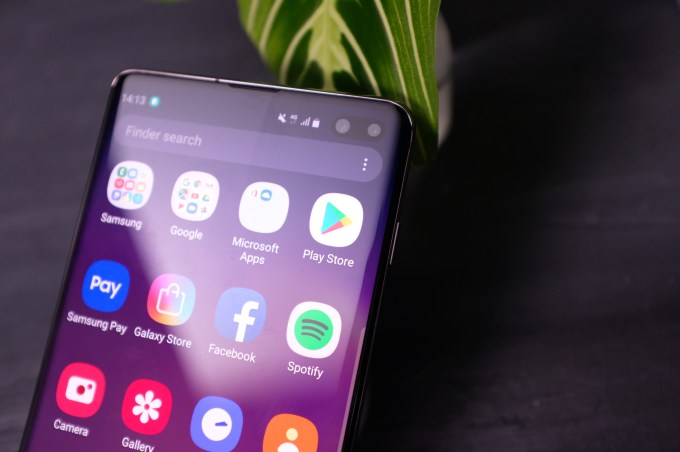
Announced in December at the Snapdragon summit, the reader adds an extra level of security beyond some of the already available options. The ultrasonic technology gives the system a fuller, more three-dimensional look at the fingerprint, making it more difficult for would-be thieves to spoof. Fingerprint info is stored on-device in a secure Knox folder.

It can be activated without turning the screen on, for quicker access, though, notably, may have some difficulty with thicker screen protectors. Samsung — and, likely, everyone else who utilizes Qualcomm’s new tech — will be working with accessory makers to market ones that play nicely with the tech.

The most fun feature here is, no doubt, Wireless Powershare. It’s another spot where Huawei beat the company to the punch, but it’s a compelling feature nonetheless  — and hey, it definitely beat Apple to the feature. Closest you get for iOS devices is the new iPad Pro’s ability to charge handsets via USB-C.
Here, all of the charging is done on contact — which means, granted, that you won’t be getting much use out of the phone while using the feature. It’s still handy, particularly when traveling. Plug in the S10. Plop it down and charge up another handset while you charge it up. The tech is compatible with Qi, so it will play nicely with third-party charging pads. It also, naturally, works with the Galaxy Buds, Samsung’s newly announced Bluetooth earbuds that beat Apple to the punch with a wireless charging case.

All of this is powered by some pretty beefy batteries, at 3,100 mAh for the S10e, 3,400 for the S10 and 4,100 for the S10+. Samsung notably began loosening up a bit on battery size last year, with its Note 7 woes now safely in the rear-view. As a matter of fact, the 5G packs a whopping 4,500 mAh battery to help offset drain from cellular usage and that massive display.

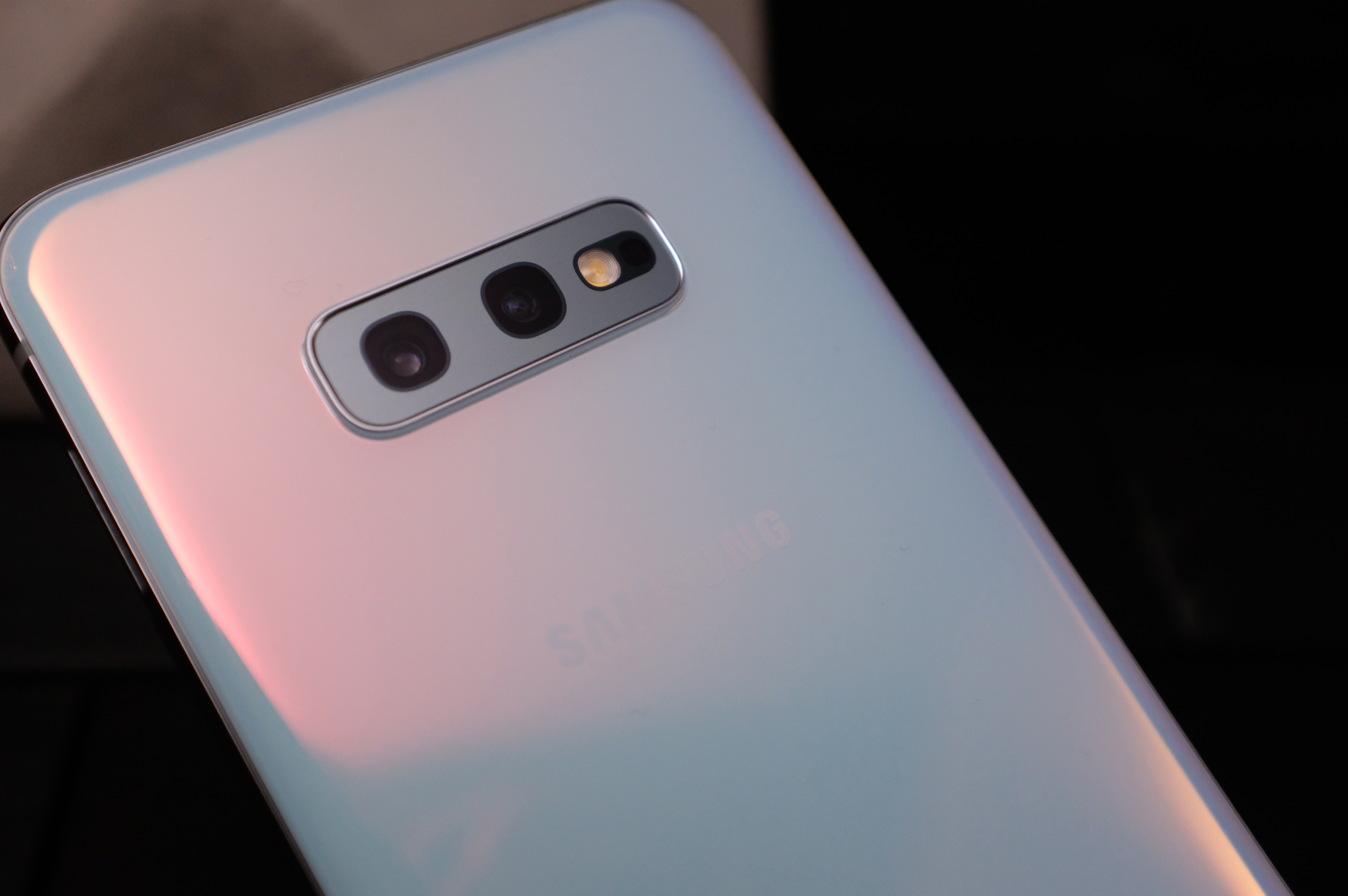
Of course, it wouldn’t be a new Galaxy without some camera news. Once again, the leaks were true. The base-line sports three cameras, configured horizontally, along with a flash. Honestly, the cutout looks a bit like a Microsoft Kinect camera configuration. What, precisely, the three lenses do wasn’t clear until now, however. After all, handset makers are using multiple camera setups for all manner of different reasons.

Here, the different cameras are being put to use to offer different focal points. There’s an ultra-wide lens offering 123-degree shots (16 megapixel), a standard wide lens with 77-degree shots and a third that does 2x optical zoom  (both 12 megapixel). Rear-facing video gets improved digital image stabilization, while the  front-facing can now do 4K, for ultra-high-res selfies, I suppose.

Of course, most of the camera upgrades we’ll be seeing in the foreseeable future will be powered by software, and as such, there are a number of improvements on that side, as well. Most notably is the use of neural processing to identify up to 30 different scenes and offer shot suggestions accordingly. Again, similar to much of the AI applications currently in use with various different Android handsets — as ever, I’m excited to get my hands on the damn thing to take it through its paces.

All of the above are, naturally, 1P68 — and yes, the headphone jack is still on-board. Samsung has done a good job turning that one-time ubiquitous port into a feature and differentiator from an increasing number of competitors. All sport the latest Snapdragon 855, and the S10 offers up to 1TB of storage.

Pre-orders for the S10e, S10 and S10+ start February 21. The handsets go on sale March 8. The 5G, meanwhile, is set to arrive at some point in Q2, as a Verizon exclusive. Sprint and T-Mobile versions will follow later.


20 Feb 2019

Samsung’s ‘budget flagship’ the Galaxy S10e starts at $750

Samsung just announced a lot of phones — four major variants of the Galaxy S10, as a matter of fact. The S10e is the most interesting of the bunch — or at least the most interesting one that doesn’t sport 5G.

The handset is the budget variant of the flagship. In other words, it’s sort of like Samsung’s take on the iPhone XR. At $750, it’s not cheap, cheap. The company’s got plenty of phones that fit that bill, if you’re on a budget. Instead, it’s a reasonably affordable alternative to the ever escalating price of flagships — and a way to get a version of the S10, without breaking the bank.

Like the iPhone XR, the S10e is a tacit acknowledgement that flagship phones have been priced out of the reach of many users. It’s also an attempt to appeal to developing markets, while reacting to slowed upgrade cycles and increased pricing competitions from companies like Huawei, who have demonstrated that flagships don’t need to cost an arm and a leg.

The handset sports a 5.8 inch display and a 3,100mAh battery. It’s up for pre-order February 21 and goes on sale March 8.