
Author: azeeadmin

19 Feb 2019

IFTTT co-founder Linden Tibbets steps down as CEO, replaced by turnaround specialist Chris Kibarian

After raising $24 million in funding led by Salesforce in April 2018, the startup IFTTT — which provides an API platform so that people can create short scripts for apps to work together — has announced that its co-founder Linden Tibbets has stepped down as CEO after 10 years leading the company. Chris Kibarian, who most recently was the CEO of Monster.com owner Randstad Digital Ventures, has taken on the role, and joined the board in the process. Tibbets, meanwhile, is staying on as IFTTT’s chief design officer.

Kibarian is a self-described turnaround specialist who has worked across a diverse set of businesses. In addition to restructuring Monster — a legacy from the first dot-com boom that was acquired for $429 million in 2016 — it got causes-based crowdfunding platform YouCaring into fighting form under its private equity owner. (YouCaring eventually bought Generosity.com from Indiegogo and then itself got acquired by GoFundMe.)

At IFTTT, his task will be to “realize IFTTT’s full potential and become the connectivity platform trusted by every person and business in the world,” Tibbets notes in a Medium post.

It’s notable that when IFTTT announced $24 million in funding last year, it was the first infusion of money to come to the company in four years — a relatively long time in the world of Silicon Valley startups. In the interim the company had made a few moves to launch new products, including those generating revenue, but had largely operated without much fanfare or attention (a little like the functional premise of IFTTT itself, to be honest).

On the other hand, the startup has some strong investors who appear to be rooting for it. In addition to Salesforce, its backers include IBM and the Chamberlain Group (best known for a variety of brands for automatic entry gates and garage door openers), Fenox Venture Capital, Andreessen Horowitz, Betaworks, Greylock, NEA, Norwest, SV Angels and more.

And in another, if modest, sign of optimism, between 2014 and 2018 IFTTT’s valuation went up. Its current valuation, according to PitchBook, is $249 million, compared to its post-money valuation of just under $210 million in 2014.

However, looking at the wider industry, you can see where IFTTT may have stalled in its growth, or at least in realising its full potential, as Tibbets puts it.

Tibbets writes that 2018 was “the best year in our company’s history” — noting record usage and over 700 services available for linking on its platform across verticals like retail, banking, food, automotive, government, health, education, and entertainment — but he doesn’t break out any specific usage numbers.

Last year, when it announced funding, the company said it had 14 million registered consumers (it did not disclose how many were active), 75 million Applets since launch, more than 5,000 active developers building services and more than 140,000 building Applets on the IFTTT Platform. Products from Google, Microsoft, Amazon, Twitter, BMW, Samsung, IBM, MyQ, and Verizon are among those touched by IFTTT scripts.

However, the wider landscape for connecting different apps together (IFTTT stands for “if this then that”) has been a tricky one to develop as a business.

Ordinary consumers — beyond early-adopting power users — may not be as likely to want to build such scripts (or “recipes” as IFTTT once called them before rebranding to “Applets”), and the most obvious integrations now often come as standard features in products or apps themselves.

Developers, meanwhile, may want to write their own scripts or use more sophisticated platforms that can provide deeper analytics or functionality around an integration. (For example, there are competing services like Microsoft’s Flow, and products that provide their own integration functionality that replace the need for using IFTTT, such as Alexa from Amazon, even while there are also ways to write integration scripts for Amazon products via IFTTT.)

“The biggest development in 2018 wasn’t growth in usage or our ecosystem, but growth for our business,” Tibbets writes tellingly. “We found concrete validation that connectivity is a real challenge for any brand looking to grow and retain their customers.”

I had thought that was actually IFTTT’s mission from the start. More to the point, if Kibarian can best figure out how to fit IFTTT into the current market, then that might turn out to be the most lucrative Applet of all.
19 Feb 2019

Movable Ink adds augmented reality to email marketing arsenal

Movable Ink has always helped marketers create highly customizable, visually interesting emails. Today, the company announced a new capability for marketers who want to introduce light-weight augmented reality (AR) to their campaigns.

Moveable Ink co-founder and CTO Michael Nutt says the company was looking for a way to provide customers with AR experiences with less fuss than most current methods. “Marketers were looking for something interesting in AR, but they wanted to do it themselves without expensive consultants. We had this powerful visual channel already. We combined that with web technologies and put together an offering for our clients,” he explained.

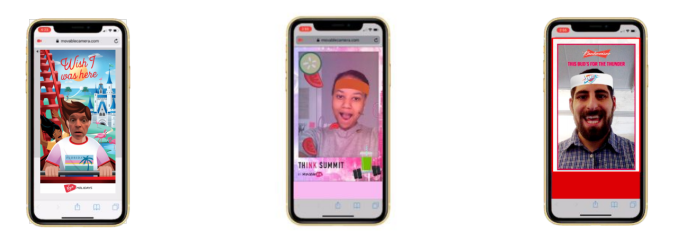
This isn’t highly sophisticated AR, but it does provide a starting point for marketers who want to get involved with it. The idea involves creating branded selfies. Say you are using a vacation company to take a cruise. The company could send you an email a couple of days prior to the trip. Clicking the email takes you to a site where you can take a picture of yourself, superimposed over a relevant background. Users can share these images on social media, thereby acting as brand ambassadors for these companies.

Photo: Movable Ink


Movable Ink’s mission involves making marketing emails more interesting so people open them. The AR component is really about increasing engagement, and Movable Ink says that in early Betas, it has been seeing a 40 percent increase in open rates and 50 percent of participants who do open the email, spending more than a minute engaging with the AR experience.

The flavor of AR the company is offering doesn’t require the end user have any special equipment and it doesn’t require the marketers to have coding skills. It’s all designed using tools that work inside any browser with graphical overlays and face filters to provide this customized selfie experience.

Once marketers create these experiences, they can measure and report on them like any marketing email, looking at opens, engagement time, the number of times the camera has been activated and how many pictures have been taken.

The company began working on this capability about a year ago and launched in Beta in October. The product is available for Movable Ink customers starting today.

19 Feb 2019

Thumbtack now offers benefits to independent contractors

The gig economy has been under much scrutiny as of late due to the way it pays — or, skirts around paying — its independent contractors. Thumbtack, a platform for finding professionals to do anything from home maintenance do DJing a party, is now offering benefits to some of its independent contractors.

“In a time where it feels like all the stories are about some tug of war between labor and a platform, I hope what this highlights is that there are opportunities for working together and to find solutions that are in service of the broad set of pros and their needs,” Thumbtack CEO Marco Zappacosta told TechCrunch ”

This is thanks to Thumbtack’s new pilot partnership with Alia, a portable benefits platform. Alia, which is a project of the National Domestic Workers Alliances Lab, works by enabling customers to contribute to their cleaner’s benefits. These benefits entail paid time off, life insurance and coverage for disabilities, accidents and critical illnesses.

“There’s been a lot of talk about portable benefits,” Thumbtack CEO Marco Zappacosta told TechCrunch. “Really, what we need to do is start experimenting, start learning, start trying and start doing. We found this is a great way to start and improve our relationships with pros.”

Initially, Thumbtack will only offer benefits to its housecleaners in California and New York. Through the partnership, Thumbtack customers will be able to contribute any amount of money to go toward the professionals’ benefits, though, the suggested donation is $5. For the first six months, Thumbtack will also contribute $25 to each pro (up to $20K in total) who joins Alia.

The relationship between a housecleaner and resident can be very personal and intimate, Zappacosta said. That’s why he believes there is an opportunity to leverage that relationship. Still, customers might not be as willing to contribute as Thumbtack hopes they’ll be, and Zappacosta understands that other approaches may be necessary.

“This is one shot on a goal,” Zappacosta said. “The only way we’re going to learn exactly what works best is by trying. The private sector alone won’t be able to solve this problem. It will require a government solution to make it easier for folks to access benefits who are out of traditional employment structures. This is the start of a long road.”

19 Feb 2019

Kairos gets a $4 million lifeline for its facial recognition software

Kairos, the facial recognition startup that found itself in turmoil following the ouster of founder and then-CEO Brian Brackeen last October, has raised $4 million in funding from E. Jay Saunders, CEO of Domus Semo Sancus. This brings Kairos’s total funding to $17 million.

As of November, Kairos had just enough money to get through Q1 of this year. At the time, Brackeen was looking to raise $5 million for the company and had already secured $3.5 million from Beyond Capital Markets, contingent upon Brackeen rejoining the company. Fast forward to today, and Brackeen is still out of the company and the interim CEO, Melissa Doval, has been appointed to permanent CEO.

The drama started back in October when New World Angels president and Kairos board chairperson Steve O’Hara sent a letter to Kairos founder Brian Brackeen notifying him of his termination from the role of chief executive officer. The termination letter cited willful misconduct as the cause for Brackeen’s termination. Specifically, O’Hara said Brackeen misled shareholders and potential investors, misappropriated corporate funds, did not report to the board of directors and created a divisive atmosphere.

Kairos sued Brackeen who then countersued the company in November, seeking to hold Kairos and Kairos CEO Melissa Doval, then interim-CEO, accountable “for intentionally destroying his reputation and livelihood through fraudulent conduct, the publication of malicious falsehoods, and the commission of illegal corporate acts.”

The suits are still in litigation.

Kairos is trying to tackle the society-wide problem of discrimination in artificial intelligence. While that’s not the company’s explicit mission — it’s to provide authentication tools to businesses — algorithmic bias has long been a topic the company, especially Brackeen, has addressed.

“I have always admired Kairos and its visionary work in pushing face-recognition technology beyond law-enforcement uses, while also ensuring its applications fall under self-imposed, ethical standards,” Doval said in a press release. “I’m especially proud to be leading our company’s dynamic team in my beloved hometown, as well as our innovative R&D team in Singapore, and look forward to making this inspiring brand even stronger.”

With Doval officially at the helm, Kairos says it stands by Brackeen’s earlier intent to not sell to law enforcement. Moving forward, Doval says Kairos has “great opportunities in the online dating and online gambling verticals to pursue.”

“We want to find ways and solutions for our product to protect people, not persecute them,” she said in a statement to TechCrunch. “Age and identity verification in these two verticals are very important and it is dire for these industries to ensure the safety of minors and we would like to be an integral part of that.”

Through investment and partnership with DSS, Kairos will also create a solution for banks for identity verification.

“I could not be happier about his investment and to see him at the helm of the board as executive chairman,” Brackeen said in a statement to TechCrunch. “The resignations of the former chairman as well as the other board member, who caused so much angst for the company and its shareholders, are concrete signs of progress. E. Jay has been instrumental in this progress and healing.”

For Brackeen, his plan is to launch a venture fund that uses AI to reduce bias in investment decisions. Called Lightship Capital, the fund will “also license out our AI to other venture capital firms, so they too can eliminate bias from their investment funnel. We look forward to seeing which firms take us up on that offer.”

19 Feb 2019

Twitter names first international markets to get checks on political advertisers

Twitter has announced it’s expanding checks on political advertisers outside the U.S. to also cover Australia, India and all the member states of the European Union.

This means anyone wanting to run political ads on its platform in those regions will first need to go through its certification process to prove their identity and certify a local location via a verification letter process.

Enforcement of the policies will kick in in the three regions on March 11, Twitter said today in a blog post. “Political advertisers must apply now for certification and go through the every step of the process,” it warns.

The company’s ad guidelines, which were updated last year, are intended to make it harder for foreign entities to target elections by adding a requirement that political advertisers self-identify and certify they’re locally based.

A Twitter spokeswoman told us that advertiser identity requirements include providing a copy of a national ID, and for candidates and political parties specifically it requires an official copy of their registration and national election authority.

The company’s blog post does not explain why it’s selected the three international regions it has named for its first expansion of political checks outside the U.S. But they do all have elections upcoming in the next months.

Elections to the EU parliament take play in May, while India’s general elections are expected to take place in April and May. Australia is also due to hold a federal election by May 2019.

Twitter has been working on ad transparency since 2017, announcing the launch of a self-styled Advertising Transparency Center back in fall that year, following political scrutiny over the role social media platforms in spreading Kremlin-backed disinformation during the 2016 US presidential election. It went on to launch the center in June 2018.

It also announced updated guidelines for political advertisers in May 2018 which also came into effect last summer, ahead of the U.S. midterms.

The ad transparency hub lets anyone (not just Twitter users) see all ads running on its platform, including the content/creative; how long ads have been running; and any ads specifically targeted at them if they are a user. Ads can also be reported to Twitter as inappropriate via the Center.

Political/electioneering ads get a special section that also includes information on who’s paying for the ad, how much they’ve spent, impressions per tweet and demographic targeting.

Though initially the political transparency layer only covered U.S. ads.

Now, more than half a year on, Twitter is preparing to expand the same system of checks to its first international regions.

In countries where it has implemented the checks, organizations buying political ads on its platform are also required to comply with a stricter set of rules for how they present their profiles to enforce a consistent look vis-a-vis how they present themselves online elsewhere — to try to avoid political advertisers trying to pass themselves off as something they’re not.

These consistency rules will apply to those wanting to run political ads in Europe, India and Australia from March. Twitter will also require political advertisers in the regions include a link to a website with valid contact info in their Twitter bio.

While those political advertisers with Twitter handles not related to their certified entity must also include a disclaimer in their bio stating the handle is “owned by”  the certified entity name.

The company’s move to expand political ad checks outside the U.S. is certainly welcome but it does highlight how piecemeal such policies remain with many more international regions with upcoming elections still lacking such checks — nor even a timeline to get them.

Including countries with very fragile democracies where political disinformation could be a hugely potent weapon.

Indonesia, which is a major market for Twitter, is due to hold a general election in April, for instance. The Philippines is also due to hold a general election in May. While Thailand has an election next month.

We asked Twitter whether it has any plans to roll out political ad checks in these three markets ahead of their key votes but the company declined to make a statement on why it had focused on the EU, Australia and India first.

A spokeswoman did tell us that it will be expanding the policy and enforcement globally in the future, though she would not provide a timeline for any further international expansion. 

19 Feb 2019

GN acquires Altia Systems for $125M to add video to its advanced audio solutions

Some interesting M&A is afoot in the world of hardware and software that’s aiming to improve the quality of audio and video communications over digital networks.

GN Group — the Danish company that broke new ground in mobile when it inked deals first with Apple and then Google to stream audio from their phones directly to smart, connected hearing aids — is expanding from audio to video, and from Europe to Silicon Valley.

Today, the company announced that it would acquire Altia Systems, a startup out of Cupertino that makes a “surround” videoconferencing device and software called the PanaCast (we reviewed it oncedesigned to replicate the panoramic, immersive experience of vision that we have as humans

GN is paying $125 million for the startup. For some context, this price represents a decent return: according to PitchBook, Altia was last valued at around $78 million with investors including Intel Capital and others.

Intel’s investment was one of several strategic partnerships that Altia had inked over the years. (Another was with Zoom to provide a new video solution for Uber.)

The Intel partnership, for one, will continue post-acquisition. “Intel invested in Altia Systems to bring an industry leading immersive, Panoramic-4K camera experience to business video collaboration,” said Dave Flanagan, Vice President of Intel Corporation and Senior Managing Director of Intel Capital, in a statement. “Over the past few years, Altia Systems has collaborated with Intel to use AI and to deliver more intelligent conference rooms and business meetings. This helps customers make better decisions, automate workflows and improve business efficiency. We are excited to work with GN to further scale this technology on a global basis.”

We have seen a lot of applications of AI in just about every area of technology, but one of the less talked about, but very interesting, areas has been in how it’s being used to enhance audio in digital network. Pindrop, as one example, is creating and tracking “audio fingerprints” for security applications, specifically fraud prevention (to authenticate users and to help weed out imposters based not just on the actual voice but on all the other aural cues we may not pick up as humans but can help build a picture of a caller’s location and so on).

GN, meanwhile, has been building AI-based algorithms to help those who cannot hear as well, or who simply needs to hear better, be able to listen to calls on digital networks and make out what’s being said. This not only requires technology to optimise the audio quality, but also algorithms that can help tailor that quality to the specific person’s own unique hearing needs.

One of the more obvious applications of services like these are for those who are hard of hearing and use hearing aids (which can be awful or impossible to use with mobile phones), another is in call centers, and this appears to be the area where GN is hoping to address with the Altia acquisition.

GN already offers two products for call centre workers, Jabra and BlueParrot — headsets and speakerphones with their own proprietary software that it claims makes workers more efficient and productive just by making it easier to understand what callers are saying.

Altia will be integrated into that solution to expand it to include videoconferencing around unified communications solutions, creating more natural experiences for those who are not actually in physical rooms together.

“Combining GN Audio’s sound expertise, partner eco-system and global channel access with the video technology from Altia Systems, we will take the experience of conference calls to a completely new level,” said René Svendsen-Tune, President and CEO of GN Audio, in a statement.

What’s notable is that GN is a vertically-integrated company, building not just hardware but software to run on it. The AI engine underpinning some of its software development will be getting a vast new trove of data fed into it now by way of the PanaCast solution: not jut in terms of video, but the large amount of audio that will naturally come along with it.

“Combining PanaCast’s immersive, intelligent video with GN Audio’s intelligent audio solutions will enable us to deliver a whole new class of collaboration products for our customers,” said Aurangzeb Khan, President and CEO of Altia Systems, in a statement. “PanaCast’s solutions enable companies to improve meeting participants’ experience, automate workflows, and enhance business efficiency and real estate utilization with data lakes of valid information.”

Given GN’s work with Android and iOS devices, it will be interesting to see how and if these video solutions make their way to those platforms as well, either by way of solutions that work on their phones or perhaps more native integrations down the line.

Regardless of how that develops, what’s clear is that there remains a market not just for basic tools to get work done, but technology to improve the quality of those tools, and that’s where GN hopes it will resonate with this deal.

19 Feb 2019

SendBird snags $52M Series B to expand messaging API tool

SendBird, a San Francisco area startup, helps developers add messaging to their apps with a couple of lines of code. It’s an idea similar to Stripe for payments or Twilio for communications. Today, the company announced a $52 million Series B investment.

The round was led by Iconiq Capital. Existing investors Shasta Ventures, August Capital, Y Combinator, and Funders Club also participated. Today’s investment brings the total raised to over $70 million, according to Crunchbase. Y Combinator is contributing to this round and SendBird was actually a member of the 2016 winter class.

The company gives developers the ability to add messaging to their apps without a fuss.”We are a very flexible, fully customizable, white label messaging capability. We come with a fully managed infrastructure. So basically, you can log into any mobile applications or websites out there, and use our messaging capability,” company founder and CEO John Kim explained.

Kim says it is applicable in any application that requires communication. That could be online gaming, dating apps or an on-demand delivery service — any case where two people need to communicate quickly. It provides the value prop of any API-driven service in that it enables developers to add messaging capability to an application with a couple of lines of code, saving them from having to create a service like this themselves from scratch.

They offer tiered pricing based on number of users using an application with SendBird messaging capability along with premium features for additional cost such as chat moderation tools or automated translation .

In addition to the API, the company also offers SDKs for iOS and Android along with Javascript, React Native, .NET and Unity.

The process is simple enough that the company has attracted 50,000 developers, running on almost 12,000 applications, and accounting for over a billion messages every month. Customers include the NBA, Yahoo! Sports and Glu Mobile.

The company has been growing quickly. In 2017 it had just 25 employees. Today, Kim reports that they have 74 and are adding additional people at a rapid clip. He said he will use the money to continue expanding to meet growing market demand, to publicize the company and grow a team of marketing and sales people to sell the tool directly to developers.

So far its success has been mainly driven by word of mouth, but part of what they want to do with the new funds is to get the word out and increase their market presence.

19 Feb 2019

Redis Labs raises a $60M Series E round

Redis Labs, a startup that offers commercial services around the Redis in-memory data store (and which counts Redis creator and lead developer Salvatore Sanfilippo among its employees), today announced that it has raised a $60 million Series E funding round led by private equity firm Francisco Partners.

The firm didn’t participate in any of Redis Labs’ previous rounds, but existing investors Goldman Sachs Private Capital Investing, Bain Capital Ventures, Viola Ventures and Dell Technologies Capital all participated in this round.

In total, Redis Labs has now raised $146 million and the company plans to use the new funding to accelerate its go-to-market strategy and continue to invest in the Redis community and product development.

Current Redis Labs users include the likes of American Express, Staples, Microsoft, Mastercard and Atlassian . In total, the company now has over 8,500 customers. Because it’s pretty flexible, these customers use the service as a database, cache and message broker, depending on their needs. The company’s flagship product is Redis Enterprise, which extends the open-source Redis platform with additional tools and services for enterprises. The company offers managed cloud services, which give businesses the choice between hosting on public clouds like AWS, GCP and Azure, as well as their private clouds, in addition to traditional software downloads and licenses for self-managed installs.

Redis Labs CEO Ofer Bengal told me that the company’s isn’t cash positive yet. He also noted that the company didn’t need to raise this round but that he decided to do so in order to accelerate growth. “In this competitive environment, you have to spend a lot and push hard on product development,” he said.

It’s worth noting that he stressed that Francisco Partners has a reputation for taking companies forward and the logical next step for Redis Labs would be an IPO. “We think that we have a very unique opportunity to build a very large company that deserves an IPO,” he said.

Part of this new competitive environment also involves competitors that use other company’s open source projects to build their own products without contributing back. Redis Labs was one of the first of a number of open source companies that decided to offer its newest releases under a new license that still allows developers to modify the code but that forces competitors that want to essentially resell it to buy a commercial license. Ofer specifically notes AWS in this context. It’s worth noting that this isn’t about the Redis database itself but about the additional modules that Redis Labs built. Redis Enterprise itself is closed-source.

“When we came out with this new license, there were many different views,” he acknowledged. “Some people condemned that. But after the initial noise calmed down — and especially after some other companies came out with a similar concept — the community now understands that the original concept of open source has to be fixed because it isn’t suitable anymore to the modern era where cloud companies use their monopoly power to adopt any successful open source project without contributing anything to it.”

19 Feb 2019

Sphero hits Kickstarter with new RVR robotics platform

Last year, Sphero stepped away from the flashiness of Disney IP, opting instead to focus on education. It was a pragmatic business decision, above all. The draw of licensing brands like Star Wars, Marvel and Pixar was clear, but the grind ultimately proved too much for the Colorado startup.

Besides, products like the Bolt and SPRK have provided low key hits for the company, as it’s made serious in-roads into the education market. The newly announced RVR marks a continuation along that path, while helping the company offer a stepping stone  to those users looking to graduate to something a bit more serious. 

Launched today via Sphero’s first-ever Kickstarter campaign, RVR bucks the company’s long-standing ball design for a more traditional four-wheel robot. As it notes in the accompanying press material, the ‘bot is “drivable  right out of the box”  using an iOS or Android app. Like the company’s ball robots,  navigation is a bit tricky at first, using the same kind of orientation method.

But that’s not really the point. RVR’s more than just a phone controlled car, thankfully. There are plenty enough of those already. The device is intended to be an early step into the world of robotics coding and development. In a meeting with TechCrunch ahead of launch,  cofounder Adam Wilson positioned the product as kind of a middle point between Sphero’s current educational tools and more advanced products like the kind being. produced by spinoff,  Misty Robotics. 

In other words, the robot can be used to teach coding in languages like Python and Javascript  and to iterative simple consumer robotic development. As for the move from ball to four wheels, that can be simply explained way to create what is quite literally a development platform.  The top of the robot is designed for familiar dev boards like Raspberry Pi and Arduino, along with plug  and play components from fellow Boulder startup Sparkfun.

RVR retails for $249, but early bird pledgers can pick one up now for $199. The product will start shipping to backers in September.

19 Feb 2019

Qualcomm launches its next-gen 5G modem and mmWave antenna

There can be little doubt that 5G is going to take center stage at this year’s Mobile World Congress in Barcelona. After years of hype without any real products, this is finally going to be the year that 5G — and especially 5G phones — will become available. 5G phones obviously need 5G modems, so maybe it’s no surprise that Qualcomm decided to get ahead of the MWC news cycle by launching its next-gen 5G modem and new mmWave antenna today.

As the company stressed throughout its press conference ahead of today’s announcement, it believes that the 5G rollout will be quite different from what we saw with 4G a few years ago. That launch, the company argues, was comparably slow, with only a few operators launching on a single band in a few select cities and with only a handful of available phones. The 5G rollout, however, is going to be global and will feature devices from plenty of OEMs and with support from more than 20 global operators.

Qualcomm announced its first 5G modem, the X50, in 2016. Today, it is launching the second generation of this technology, the X55.

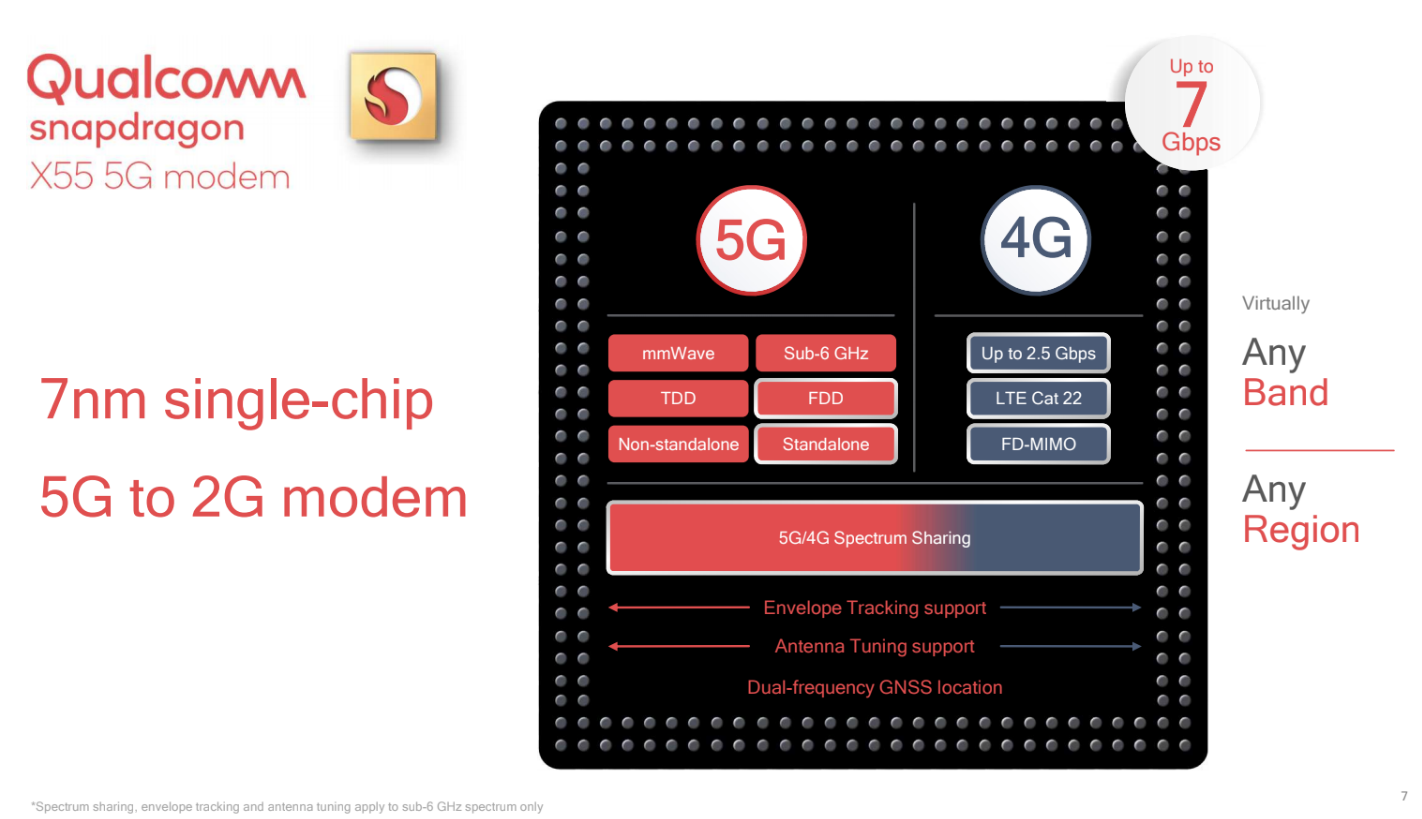
The X55 is the world’s first announced 7 Gbps 5G modem, but what’s maybe more important for your day-to-day usage (once you get a device that uses it), is that it supports every recent technology from 2G to 5G and every spectrum band in any region. It’s a 7nm chip and it has one more important trick up its sleeve: 5g/4G spectrum sharing, which allows operators to support 5G and LTE on the same spectrum.

The company expects that OEMs will use the X55 for everything from standard smartphones to fixed wireless receivers, laptops and cars.

A modem doesn’t do you much good without an antenna to receive those signals, so Qualcomm also today announced a new mmWave antenna module. Nothing too exciting there (unless you really like antennas), but the antenna completes Qualcomm’s mmWave 5G lineup in addition to its existing sub-6 GHz antenna and other modules.
