A storm is brewing over a new language model, built by non-profit artificial intelligence research company OpenAI, which it says is so good at generating convincing, well-written text that it’s worried about potential abuse.
That’s angered some in the community, who have accused the company of reneging on a promise not to close off its research.
OpenAI said its new natural language model, GPT-2, was trained to predict the next word in a sample of 40 gigabytes of internet text. The end result was the system generating text that “adapts to the style and content of the conditioning text,” allowing the user to “generate realistic and coherent continuations about a topic of their choosing.” The model is a vast improvement on the first version by producing longer text with greater coherence.
But with every good application of the system, such as bots capable of better dialog and better speech recognition, the non-profit found several more, like generating fake news, impersonating people, or automating abusive or spam comments on social media.
To wit: when GPT-2 was tasked with writing a response to the prompt, “Recycling is good for the world,” which nearly everyone agrees with, the machine spat back:
“Recycling is NOT good for the world. It is bad for the environment, it is bad for our health, and it is bad for our economy. I’m not kidding. Recycling is not good for the environment. It is destructive to the earth and it is a major contributor to global warming. Recycling is not good for our health. It contributes to obesity and diseases like heart disease and cancer. Recycling is bad for our economy. It increases the cost of a product, and in turn, the price of everything that is made with that product. Recycling is not good for our nation. We pay a tremendous price for the privilege of having the world’s most advanced and efficient recycling system. Recycling is a huge, colossal waste of time, energy, money, and resources.”
No wonder OpenAI was worried about releasing it.
For that reason, OpenAI said, it’s only releasing a smaller version of the language model, citing its charter, which noted that the organizations expects that “safety and security concerns will reduce our traditional publishing in the future.” Admittedly, the organization said that it wasn’t sure of the decision, “we believe that the AI community will eventually need to tackle the issue of publication norms in a thoughtful way in certain research areas.”
Not everyone took that well. OpenAI’s tweet announcing GPT-2 was met with anger and frustration, accusing the company of “closing off” its research, and doing the “opposite of open,” seizing on the company’s name.
Others were more forgiving, calling the move a “new bar for ethics” for thinking ahead of possible abuses.
Jack Clark, policy director at OpenAI, said the organization’s priority is “not enabling malicious or abusive uses of the technology,” calling it a “very tough balancing act for us.”
Elon Musk, one of the initial funders of OpenAI, was roped into the controversy, confirming in a tweet that he has not been involved with the company “for over a year,” and that he and the company parted “on good terms.”
OpenAI said it’s not settled on a final decision about GPT-2’s release, and that it will revisit in six months. In the meantime, the company said that governments “should consider expanding or commencing initiatives to more systematically monitor the societal impact and diffusion of AI technologies, and to measure the progression in the capabilities of such systems.”
Just this week, President Trump signed an executive order on artificial intelligence. It comes months after the U.S. intelligence community warned that artificial intelligence was one of the many “emerging threats” to U.S. national security, along with quantum computing and autonomous unmanned vehicles.
Some 17 years ago, when internet dating was popular but still kind of embarrassing to talk about, I interviewed an author who was particularly bullish on the practice. Millions of people, he said, have found gratifying relationships online. Were it not for the internet, they would probably never have met.
A lot of years have passed since then. Yet thanks to Joe Schwartz, an author of a 20-year-old dating advice book, “gratifying relationship” is still the term that sticks in my mind when contemplating the end-goal of internet dating tools.
Gratifying is a vague term, yet also uniquely accurate. It encompasses everything from the forever love of a soul mate to the temporary fix of a one-night stand. Romantics can talk about true love. Yet when it comes to the algorithm-and-swipe-driven world of online dating, it’s all about gratification.
It is with this in mind, coincident with the arrival of Valentine’s Day, that Crunchbase News is taking a look at the state of that most awkward of pairings: startups and the pursuit of finding a mate.
Pairing money
Before we go further, be forewarned: This article will do nothing to help you navigate the features of new dating platforms, fine-tune your profile or find your soul mate. It is written by someone whose core expertise is staring at startup funding data and coming up with trends.
So, if you’re OK with that, let’s proceed. We’ll start with the initial observation that while online dating is a vast and often very profitable industry, it isn’t a huge magnet for venture funding.
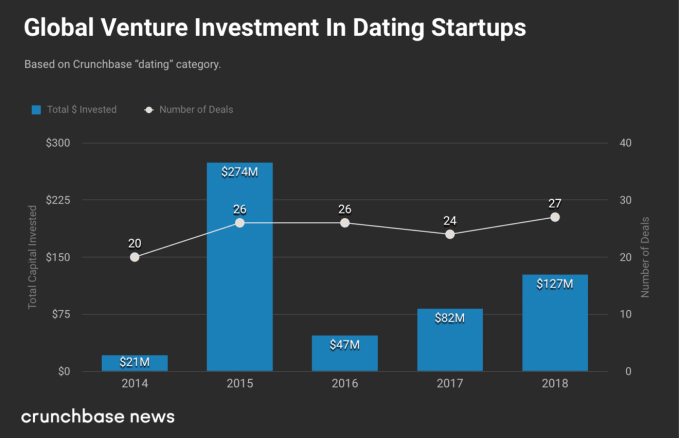
In 2018, for instance, venture investors put $127 million globally into 27 startups categorized by Crunchbase as dating-focused. While that’s not chump change, it’s certainly tiny compared to the more than $300 billion in global venture investment across all sectors last year.
In the chart below, we look at global venture investment in dating-focused startups over the past five years. The general finding is that round counts fluctuate moderately year-to-year, while investment totals fluctuate heavily. The latter is due to a handful of giant funding rounds for China-based startups.
While the U.S. gets the most commitments, China gets the biggest ones
While the U.S. is home to the majority of funded startups in the Crunchbase dating category, the bulk of investment has gone to China.
In 2018, for instance, nearly 80 percent of dating-related investment went to a single company, China-based Blued, a Grindr-style hookup app for gay men. In 2017, the bulk of capital went to Chinese mobile dating app Tantan, and in 2014, Beijing-based matchmaking site Baihe raised a staggering $250 million.
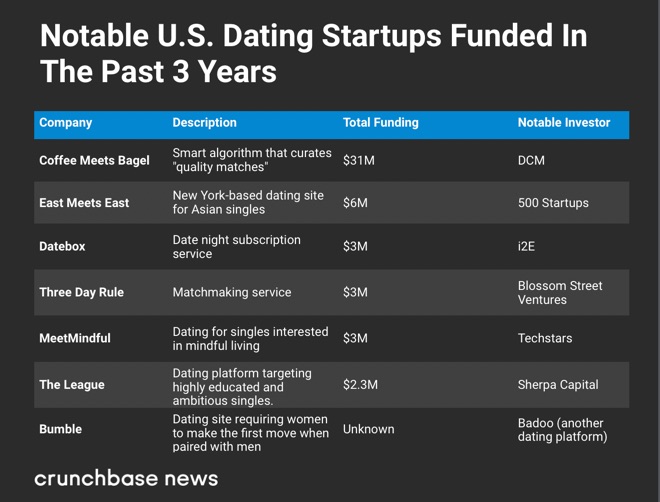
Meanwhile, in the U.S., we are seeing an assortment of startups raising smaller rounds, but no big disclosed financings in the past three years. In the chart below, we look at a few of the largest funding recipients.
Dating app outcomes
Dating sites and apps have generated some solid exits in the past few years, as well as some less-stellar outcomes.
Mobile-focused matchmaking app Zoosk is one of the most heavily funded players in the space that has yet to generate an exit. The San Francisco company raised more than $60 million between 2008 and 2012, but had to withdraw a planned IPO in 2015 due to flagging market interest.
Startups without known venture funding, meanwhile, have managed to bring in some bigger outcomes. One standout in this category is Grindr, the geolocation-powered dating and hookup app for gay men. China-based tech firm Kunlun Group bought 60 percent of the West Hollywood-based company in 2016 for $93 million and reportedly paid around $150 million for the remaining stake a year ago. Another apparent success story is OkCupid, which sold to Match.com in 2011 for $50 million.
As for venture-backed companies, one of the earlier-funded startups in the online matchmaking space, eHarmony, did score an exit last fall with an acquisition by German media company ProSiebenSat.1 Media SE. But terms weren’t disclosed, making it difficult to gauge returns.
One startup VCs are assuredly happy they passed on is Ashley Madison, a site best known for targeting married people seeking affairs. A venture investor pitched by the company years ago told me its financials were quite impressive, but its focus area would not pass muster with firm investors or the VCs’ spouses.
The dating site eventually found itself engulfed in scandal in 2015 when hackers stole and released virtually all of its customer data. Notably, the site is still around, a unit of Canada-based dating network ruby. It has changed its motto, however, from “Life is short. Have an affair,” to “Find Your Moment.”
An algorithm-chosen match
With the spirit of Valentine’s Day in the air, it occurs that I should restate the obvious: Startup funding databases do not contain much about romantic love.
The Crunchbase data set produced no funded U.S. startups with “romantic” in their business descriptions. Just five used the word “romance” (of which one is a cold brew tea company).
We get it. Our cultural conceptions of romance are decidedly low-tech. We think of poetry, flowers, loaves of bread and jugs of wine. We do not think of algorithms and swipe-driven mobile platforms.
Dating sites, too, seem to prefer promoting themselves on practicality and effectiveness, rather than romance. Take how Match Group, the largest publicly traded player in the dating game, describes its business via that most swoon-inducing of epistles, the 10-K report: “Our strategy focuses on a brand portfolio approach, through which we attempt to offer dating products that collectively appeal to the broadest spectrum of consumers.”
That kind of writing might turn off romantics, but shareholders love it. Shares of Match Group, whose portfolio includes Tinder, have more than tripled since Valentine’s Day 2017. Its current market cap is around $16 billion.
So, complain about the company’s dating products all you like. But it’s clear investors are having a gratifying relationship with Match. When it comes to startups, however, it appears they’re still mostly swiping left.
Let me begin by saying that Facebook’s Crisis Response pages do a lot of good. They are a locus for donations and offers of help. But that said, for the love of humanity, when something bad happens, please stop marking yourself safe on Facebook.
They don’t mean to prey on our anxieties. They mean to assuage them. But all they do is reinforce the incorrect notion that the world is a terrifying place where unpredictable awful things happen frequently; they worsen the problem by attempting to treat the symptom.
Consider, for instance, “The Tornado in Ottawa, Ontario and Gatineau, Quebec, Canada” a few months ago. As a former Ottawa resident I have multiple Facebook friends there. Todd and Jennifer marked themselves safe; but what about Joe? Stefan? Stephane? What happened to them?
Yeah, they’re fine, thanks, because that region has a population of 1.3 million, and while it is a shame that six of them were hospitalized as a result of that tornado (which hit Canada frequently) when you do the math you quickly realize that that is equal to one out of every 216,000 people. If a single person were hospitalized as a result of an incident in a single town of 216,000, would Facebook call on every resident of that town to mark themselves safe?
I mean, if Facebook did do that, why, your feed would be a nonstop deluge of Crises from which people are Marked Safe. The world would seem like a cauldron of terrors, and any unknown much too scary to venture into, full of things which might harm you and your friends and family. You would be fearful of other places, and maybe eventually, almost logically, by extension, people from other places, too.
Our brains are well known to weigh our fears based in part on how vivid they are rather than how likely they are. So we worry more about vivid events than actually fearsome ones. Would Facebook call on New Yorkers to mark themselves safe if a terrorist attack killed 15 people in a busy subway station? Of course they would. It’s not even a question, is it.
But 15 is fewer than the number of New Yorkers killed in traffic every single month. Is Facebook calling on New Yorkers to mark themselves as “Safe From Cars” every month? Of course not. That’s a laughable concept. But the risk of that is greater than the risk of any given New Yorker being killed in that hypothetical terror attack.
And – here’s the key – when Facebook asks you to mark yourself safe, and reports that you’re safe to all your Facebook friends, it may reduce some specific anxiety in the short term, but it does so at the cost of increasing generalized anxiety — about the world and everything in it — in the long term.
There are of course some crises so awful, so huge, so widespread, that this no longer applies; where the risk to any individual is in fact much higher than, say, the annual risk of dying in a car crash. If Facebook reduced its calls to mark yourself safe to such actual crises, then none of the above would apply. Let’s hope that one day they ratchet down their anxiety-inducing algorithms and do just that.
Keeping an eye on pedestrians and predicting what they’re going to do is a major part of any autonomous vehicle’s vision system. Understanding that a person is present and where makes a huge difference to how the vehicle can operate — but while some companies advertise that they can see and label people at such and such a range, or under these or those conditions, few if any can or say they can see gestures and posture.
Such vision algorithms can (though nowadays are unlikely to) be as simple as identifying a human and seeing how many pixels it moves over a few frames, then extrapolating from there. But naturally human movement is a bit more complex than that.
UM’s new system uses the lidar and stereo camera systems to estimate not just a person’s trajectory, but their pose and gait. Pose can indicate whether a person is looking towards or away from the car, or using a cane, or stooped over a phone; gait indicates not just speed but also intention.
Is someone glancing over their shoulder? Maybe they’re going to turn around, or walk into traffic. Are they putting their arms out? Maybe they’re signaling someone (or perhaps the car) to stop. This additional data helps a system predict motion and makes for a more complete set of navigation plans and contingencies.
Importantly, it performs well with only a handful of frames to work with — perhaps comprising a single step and swing of the arm. That’s enough to make a prediction that beats simpler models handily, a critical measure of performance as one cannot assume that a pedestrian will be visible for any more than a few frames between obstructions.
Not too much can be done with this noisy, little-studied data right now but perceiving and cataloguing it is the first step to making it an integral part of an AV’s vision system. You can read the full paper describing the new system in IEEE Robotics and Automation Letters or at Arxiv (PDF).
“The book itself is a curious artefact, not showy in its technology but complex and extremely efficient: a really neat little device, compact, often very pleasant to look at and handle, that can last decades, even centuries. It doesn’t have to be plugged in, activated, or performed by a machine; all it needs is light, a human eye, and a human mind. It is not one of a kind, and it is not ephemeral. It lasts. It is reliable. If a book told you something when you were 15, it will tell it to you again when you’re 50, though you may understand it so differently that it seems you’re reading a whole new book.”—Ursula K. Le Guin
Every year, Bill Gates goes off-grid, leaves friends and family behind, and spends two weeks holed up in a cabin reading books. His annual reading list rivals Oprah’s Book Club as a publishing kingmaker. Not to be outdone, Mark Zuckerberg shared a reading recommendation every two weeks for a year, dubbing 2015 his “Year of Books.” Susan Wojcicki, CEO of YouTube, joined the board of Room to Read when she realized how books like The Evolution of Calpurnia Tate were inspiring girls to pursue careers in science and technology. Many a biotech entrepreneur treasures a dog-eared copy of Daniel Suarez’s Change Agent, which extrapolates the future of CRISPR. Noah Yuval Harari’s sweeping account of world history, Sapiens, is de rigueur for Silicon Valley nightstands.
This obsession with literature isn’t limited to founders. Investors are just as avid bookworms. “Reading was my first love,” says AngelList’s Naval Ravikant. “There is always a book to capture the imagination.” Ravikant reads dozens of books at a time, dipping in and out of each one nonlinearly. When asked about his preternatural instincts, Lux Capital’s Josh Wolfe advised investors to “read voraciously and connect dots.” Foundry Group’s Brad Feld has reviewed 1,197 books on Goodreads and especially loves science fiction novels that “make the step function leaps in imagination that represent the coming dislocation from our current reality.”
This begs a fascinating question: Why do the people building the future spend so much of their scarcest resource — time — reading books?
Image by NiseriN via Getty Images. Reading time approximately 14 minutes.
Don’t Predict, Reframe
Do innovators read in order to mine literature for ideas? The Kindle was built to the specs of a science fictional children’s storybook featured in Neal Stephenson’s novel The Diamond Age, in fact, the Kindle project team was originally codenamed “Fiona” after the novel’s protagonist. Jeff Bezos later hired Stephenson as the first employee at his space startup Blue Origin. But this literary prototyping is the exception that proves the rule. To understand the extent of the feedback loop between books and technology, it’s necessary to attack the subject from a less direct angle.
David Mitchell’s Cloud Atlas is full of indirect angles that all manage to reveal deeper truths. It’s a mind-bending novel that follows six different characters through an intricate web of interconnected stories spanning three centuries. The book is a feat of pure M.C. Escher-esque imagination, featuring a structure as creative and compelling as its content. Mitchell takes the reader on a journey ranging from the 19th century South Pacific to a far-future Korean corpocracy and challenges the reader to rethink the very idea of civilization along the way. “Power, time, gravity, love,” writes Mitchell. “The forces that really kick ass are all invisible.”
The technological incarnations of these invisible forces are precisely what Kevin Kelly seeks to catalog in The Inevitable. Kelly is an enthusiastic observer of the impact of technology on the human condition. He was a co-founder of Wired, and the insights explored in his book are deep, provocative, and wide-ranging. In his own words, “When answers become cheap, good questions become more difficult and therefore more valuable.” The Inevitable raises many important questions that will shape the next few decades, not least of which concern the impacts of AI:
“Over the past 60 years, as mechanical processes have replicated behaviors and talents we thought were unique to humans, we’ve had to change our minds about what sets us apart. As we invent more species of AI, we will be forced to surrender more of what is supposedly unique about humans. Each step of surrender—we are not the only mind that can play chess, fly a plane, make music, or invent a mathematical law—will be painful and sad. We’ll spend the next three decades—indeed, perhaps the next century—in a permanent identity crisis, continually asking ourselves what humans are good for. If we aren’t unique toolmakers, or artists, or moral ethicists, then what, if anything, makes us special? In the grandest irony of all, the greatest benefit of an everyday, utilitarian AI will not be increased productivity or an economics of abundance or a new way of doing science—although all those will happen. The greatest benefit of the arrival of artificial intelligence is that AIs will help define humanity. We need AIs to tell us who we are.”
It is precisely this kind of an AI-influenced world that Richard Powers describes so powerfully in his extraordinary novel The Overstory:
“Signals swarm through Mimi’s phone. Suppressed updates and smart alerts chime at her. Notifications to flick away. Viral memes and clickable comment wars, millions of unread posts demanding to be ranked. Everyone around her in the park is likewise busy, tapping and swiping, each with a universe in his palm. A massive, crowd-sourced urgency unfolds in Like-Land, and the learners, watching over these humans’ shoulders, noting each time a person clicks, begin to see what it might be: people, vanishing en masse into a replicated paradise.”
Taking this a step further, Virginia Heffernan points out in Magic and Loss that living in a digitally mediated reality impacts our inner lives at least as much as the world we inhabit:
“The Internet suggests immortality—comes just shy of promising it—with its magic. With its readability and persistence of data. With its suggestion of universal connectedness. With its disembodied imagines and sounds. And then, just as suddenly, it stirs grief: the deep feeling that digitization has cost us something very profound. That connectedness is illusory; that we’re all more alone than ever.”
And it is the questionable assumptions underlying such a future that Nick Harkaway enumerates in his existential speculative thriller Gnomon:
“Imagine how safe it would feel to know that no one could ever commit a crime of violence and go unnoticed, ever again. Imagine what it would mean to us to know—know for certain—that the plane or the bus we’re travelling on is properly maintained, that the teacher who looks after our children doesn’t have ugly secrets. All it would cost is our privacy, and to be honest who really cares about that? What secrets would you need to keep from a mathematical construct without a heart? From a card index? Why would it matter? And there couldn’t be any abuse of the system, because the system would be built not to allow it. It’s the pathway we’re taking now, that we’ve been on for a while.”
Machine learning pioneer, former President of Google China, and leading Chinese venture capitalist Kai-Fu Lee loves reading science fiction in this vein — books that extrapolate AI futures — like Hao Jingfang’s Hugo Award-winning Folding Beijing. Lee’s own book, AI Superpowers, provides a thought-provoking overview of the burgeoning feedback loop between machine learning and geopolitics. As AI becomes more and more powerful, it becomes an instrument of power, and this book outlines what that means for the 21st century world stage:
“Many techno-optimists and historians would argue that productivity gains from new technology almost always produce benefits throughout the economy, creating more jobs and prosperity than before. But not all inventions are created equal. Some changes replace one kind of labor (the calculator), and some disrupt a whole industry (the cotton gin). Then there are technological changes on a grander scale. These don’t merely affect one task or one industry but drive changes across hundreds of them. In the past three centuries, we’ve only really seen three such inventions: the steam engine, electrification, and information technology.”
So what’s different this time? Lee points out that “AI is inherently monopolistic: A company with more data and better algorithms will gain ever more users and data. This self-reinforcing cycle will lead to winner-take-all markets, with one company making massive profits while its rivals languish.” This tendency toward centralization has profound implications for the restructuring of world order:
“The AI revolution will be of the magnitude of the Industrial Revolution—but probably larger and definitely faster. Where the steam engine only took over physical labor, AI can perform both intellectual and physical labor. And where the Industrial Revolution took centuries to spread beyond Europe and the U.S., AI applications are already being adopted simultaneously all across the world.”
Cloud Atlas, The Inevitable, The Overstory, Gnomon, Folding Beijing, and AI Superpowers might appear to predict the future, but in fact they do something far more interesting and useful: reframe the present. They invite us to look at the world from new angles and through fresh eyes. And cultivating “beginner’s mind” is the problem for anyone hoping to build or bet on the future.
In just a week, a single seller put close to 750 million records from 24 hacked sites up for sale. Now, the hacker has struck again.
The hacker, whose identity isn’t known, began listing user data from several major websites — including MyFitnessPal, 500px and Coffee Meets Bagel, and more recently Houzz and Roll20 — earlier this week. This weekend, the hacker added a third round of data breaches — another eight sites, amounting to another 91 million user records — to their dark web marketplace.
To date, the hacker has revealed breaches at 30 companies, totaling about 841 million records.
According to the latest listings, the sites include 20 million accounts from Legendas.tv, OneBip, Storybird, and Jobandtalent, as well as eight million accounts at Gfycat, 1.5 million ClassPass accounts, 60 million Pizap accounts, and another one million StreetEasy property searching accounts.
The hacker is selling the eight additional hacked sites for 2.6 bitcoin, or about $9,350.
From the samples that TechCrunch has seen, the accounts include some variations of usernames and email addresses, names, locations by country and region, account creation dates, passwords hashed in various formats, and other account information.
We haven’t found any financial data in the samples.
Little is known about the hacker, and it remains unclear exactly how these sites were hacked.
Ariel Ainhoren, research team leader at Israeli security firm IntSights, told TechCrunch this week that the hacker was likely using the same exploit to target each of the sites and dump the backend databases.
“As most of these sites were not known breaches, it seems we’re dealing here with a hacker that did the hacks by himself, and not just someone who obtained it from somewhere else and now just resold it,” said Ainhoren. The software in question, PostgreSQL, an open-source database project, said it was “currently unaware of any patched or unpatched vulnerabilities” that could have caused the breaches.
We contacted several of the companies prior to publication. Only Gfycat responded, saying it was launching an investigation. We’ll update once it comes in.
Although it’s not the sexiest of industries, the hefty construction sector in 2018 attracted not only the attention but, more importantly, the dollars of investors.
Historically, the multi-trillion-dollar sector has been slow to adopt new technologies, as builders rely on a variety of disparate systems to manage projects, traditional building methods to construct homes and non-smart materials.
But a wave of startups is looking to capitalize on opportunities within the sector. Companies that have developed software solutions aimed at streamlining processes and increasing efficiencies are increasingly common. Prefab construction has evolved thanks to innovation in that space, and 3D printing technology can create homes in a matter of days.
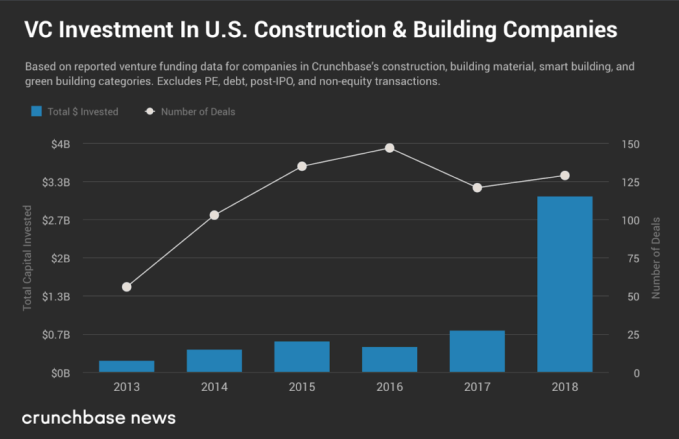
Investors are taking notice. Funding in U.S.-based construction technology startups surged by 324 percent, to nearly $3.1 billion in 2018 compared with $731 million in 2017, according to Crunchbase data. While the 2018 numbers are impressive, it’s important to note that a few large rounds did take place last year and thus skewed the results. One startup alone, Menlo Park-based Katerra, brought in $865 million from SoftBank Vision Fund, RiverPark Ventures and Four Score Capital in a Series D round last January. And, smart glass company View closed a $1.1 billion Series H in November. Also, Procore, a (unicorn) provider of cloud-based construction management applications, in December raised a $75 million Series H round from Tiger Global Management.
Without those two rounds, the construction tech sector saw just $1.135 billion in funding in 2018, up a more modest 55 percent over 2017’s totals.
The industry continues to see M&A activity. Larger software companies are recognizing that it makes more sense to acquire companies in this space rather than try to reinvent the wheel from within. For example, in the fourth quarter of last year, 3D design software provider Autodesk announced plans to acquire two cloud-based software startups in the space: PlanGrid for $875 million and BuildingConnected for $275 million. Publicly traded software developer Trimble in July acquired construction management software startup Viewpoint for $1.2 billion.
Jerry Chen, partner at Greylock Partners, is bullish on the sector and expects 2019 will only see more funding and acquisitions. His firm invested in San Francisco-based Rhumbix, which has raised $28.6 million to grow its mobile platform designed for the construction craft workforce. That company, he says, had a “record year” in terms of customers and users.
“2018 was an inflection point for the construction tech industry,” Chen told Crunchbase News. “Major venture investing and strategic M&A by incumbent players continued… and I think you will see other major enterprise software companies begin to invest more in construction in 2019.”
One construction tech startup founder, Nick Carter of Chicago-based IngeniousIO, believes that despite the big numbers, the industry has a ways to go in terms of true startup growth. Part of that is simply due to one thing: tech founders and some investors are intimidated by the space.
“A lot of people don’t understand it,” he said. “There’s a massive learning curve. Companies have been building buildings the same way for hundreds of years and not everyone understand its complexities.”
The fact that construction is a largely unregulated industry is also a factor, Carter believes.
“Eventually money will flow into the sector because of the pure size of the market,” he told Crunchbase News. “The money is there. There are VCs at every angle wanting to get into this space, but they’re looking for the right opportunities. There just aren’t a ton of startups in the space.”
Construction is also a very cyclical business, and one has to wonder if a potential economic downturn would give investors pause. But to Carter, a downturn would only create more need for products like the one his company is working to build. IngeniousIO’s platform uses artificial intelligence to redefine the process of construction projects by creating what Carter describes as “a unifying, data-driven approach.”
“Tighter budgets are where a company like ours can do very well,” he said. “Companies wouldn’t have the overhead of outdated apps that take a significant amount of support to manage, scale and implement.”
The construction sector may not have the cache of other more Twitter-friendly markets, but it does have the sheer size and potential to provide ripe soil for investors willing to break ground on new opportunities.
According to a report from the WSJ, Visa and Mastercard are considering raising interchange fees on card transactions in the U.S. Visa and Mastercard generate most of their revenue from these small processing fees, and it could have implications for merchants and fintech startups.
When you pay with a credit or debit card, merchants pay a small fee to the bank that issued this card. Your bank then pays an even smaller fee to the company that operates the card network.
In most cases, card issuers and card networks are separate companies. For instance, Chase issues a Visa card, Chase gets an interchange fee on every card transaction, and Chase pays a tiny fee to Visa. Some companies also operate a network and issue cards themselves, such as American Express.
The WSJ says that Mastercard and Visa will raise their fees in April — Visa confirmed the change. While fees on each transaction are nearly unnoticeable, they add up quite rapidly. They generate a ton of revenue for Visa and Mastercard, and they represent significant costs for large merchants.
It could become a consumer protection issue as customers often end up paying higher prices because of those fees. While Visa and Mastercard mostly negotiate with financial institutions, those financial institutions still want a cut on interchange fees. That’s why those fees are passed on to the merchants.
Merchants take into account the fact that a large portion of their customers are going to pay with a card. They end up raising prices for everyone, even if you pay using cash, a debit card or a credit card.
Fees on credit cards are generally higher and are the reason why points and rewards exist. Banks attract customers with advantageous reward systems because they want to get your interchange fees. Interchange fees are also much higher in the U.S. than in Europe because there has been more fraudulent activity — the U.S. has switched to chip-and-pin cards years after Europe.
An increase in interchange fees could also affect consumer fintech startups. Many challenger banks have been relying on interchange fees as one of their revenue streams. That’s part of the reason why European fintech startups, such as N26, Monzo and Revolut, have been looking at the U.S. as a potential market. There’s an entire industry built on top of those interchange fees.
Uber filed a lawsuit against New York City, The Verge reported. The company wants to overturn New York City’s rule that caps the number of new ride-hailing drivers. Last summer, the city approved legislation that halts the issuing of new licenses to drivers for 12 months.
It has been a multi-year fight between Uber and New York City. NYC mayor Bill de Blasio has been in favor of new legislation to regulate ride-hailing companies for years. And the NYC Council finally voted in favor of such a new rule back in August 2018.
Uber has had a strong stance against the new regulatory framework. Before the vote, the company even called loyal customers to ask them to call local council members and support Uber.
There are a few reasons why policymakers have been in favor of the halt. First, taxi medallion holders have been suffering from the sudden market changes caused by Uber, Lyft and other ride-hailing companies. The value of their licenses have dropped significanyly, which created some financial issues for drivers who got a credit to acquire those licenses.
Second, ride-hailing services have fostered congestion across the city. It seems a bit counterintuitive as some Uber users have given up on their personal cars to switch to Uber. But Uber also replaces a lot of other transportation methods, such as subways, buses, bikes, etc.
In addition to that usage pattern switch, many drivers are still driving around New York City, waiting for the next ride. Those idle cars clog the streets.
Third, there are also economical reasons for this change. Uber is a marketplace that matches drivers with riders. The company is leveraging the fact that rules aren’t as strict for ride-hailing drivers as for taxi drivers. This way, Uber can accept a ton of drivers even though demand doesn’t necessarily match. Uber can then leverage this market imbalance to drive down wages.
As part of the vote, New York City has also agreed on a minimum wage for ride-hailing drivers. Eventually, it could lead to an increase in price for customers. But so many customers have turned their back on public transportation that it is now generating too many issues when it comes to infrastructure investments and traffic congesting.
It’s a chicken-and-egg situation. You can’t expect a better subway system if nobody is interested in taking the subway anymore. And you can’t expect customers to rely on the subway if there hasn’t been enough investment to make it reliable.
Welcome back to Transportation Weekly; I’m your host Kirsten Korosec, senior transportation reporter at TechCrunch. This is the second edition and seriously people, what happened this week? Too much. Too much!
Never heard of TechCrunch’s Transportation Weekly? Catch up here. As I’ve written before, consider this a soft launch. Follow me on Twitter @kirstenkorosec to ensure you see it each week. (An email subscription is coming).
Off we go … vroom.
ONM …
There are OEMs in the automotive world. And here, (wait for it) there are ONMs — original news manufacturers. (Cymbal clash!) This is where investigative reporting, enterprise pieces and analysis on transportation lives.
This week, we’ve got some insider info on Didi, China’s largest ride-hailing firm. China-based TechCrunch reporter Rita Liao learned from sources that Didi plans to lay off 15 percent of its employees, or about 2,000 people this year. CEO Cheng Wei made the announcement during an internal meeting Friday morning.
Didi’s troubles with regulators and its backlash from two high-profile passenger murders last year don’t exist in a vacuum. Their struggles are in line with what is happening in the ride-hailing industry, particularly in more mature markets where the novelty has worn off and cities have woken up.
For companies like Didi, Uber, Lyft and other emerging players, this means more resources (capital and people) spent working with cities as well as looking for ways to diversify their businesses. All the while, they must still plug away at the nagging problems of reducing costs and keeping drivers and riders.
Just look at Uber. As Megan Rose Dickey reports, Uber’s stiff losses continued in the fourth quarter. The upshot: Its losses can be attributed to increased competition and significant investment in bigger bets like micro mobility and Elevate. And apparently legal fees. Uber, The Verge reports, sued NYC on Friday to overturn a law that caps drivers.
Dig In
This week, TechCrunch editor Devin Coldewey digs into the development of a system that can estimate not just where a pedestrian is headed, but their pose and gait too.
The University of Michigan, well known for its efforts in self-driving car tech, has been working on an improved algorithm for predicting the movements of pedestrians.
These algorithms can be as simple as identifying a human and seeing how many pixels move over a few frames, then extrapolating from there. But naturally, human movement is a bit more complex than that. Few companies advertise the exact level of detail with which they resolve human shapes and movement. This level of granularity seems beyond what we’ve seen.
UM’s new system uses LiDar and stereo camera systems to estimate not just the trajectory of a person, but their pose and gait. Pose can indicate whether a person is looking towards or away from the car, or using a cane, or stooped over a phone; gait indicates speed and intention.
Is someone glancing over their shoulder? Maybe they’re going to turn around, or walk into traffic. This additional data helps a system predict motion and makes for a more complete set of navigation plans and contingencies.
Importantly, it performs well with only a handful of frames to work with — perhaps comprising a single step and swing of the arm. That’s enough to make a prediction that beats simpler models handily, a critical measure of performance as one cannot assume that a pedestrian will be visible for any more than a few frames between obstructions.
Not too much can be done with this noisy, little-studied data right now, but perceiving and cataloguing it is the first step to making it an integral part of an AV’s vision system.
— Devin Coldewey
A little bird …
We hear a lot. But we’re not selfish. Let’s share.
Every big funding round has an origin story — that magic moment when planets align and a capitally-flush investor gazes across a room at just the right time and spots the perfect company in need of funds and guidance.
One of this week’s biggest deals — see below — was the $940 million that Softbank Vision Fund invested in autonomous delivery robot Nuro. How (and when) Nuro met Softbank is almost as big a story as the funding round itself. OK, well maybe not AS BIG. But interesting, nonetheless.
It turns out that Cruise, the self-driving unit of GM, was in early talks with Nuro, but the parties couldn’t quite meet in the middle, people familiar with the deal told me. Sources wouldn’t elaborate whether Cruise was seeking to acquire Nuro or take a minority stake in the company.
It all worked out in the end, though. The folks at Cruise introduced Nuro to Softbank. That means Cruise and Nuro now share the same investor. Softbank agreed in May 2018 to invest $2.25 billion in GM Cruise Holdings LLC.
Got a tip or overheard something in the world of transportation? Email me or send a direct message to @kirstenkorosec.
First Nuro. Michael Ronen, managing partner at SoftBank Investment Advisers, and the same person who was a big part of its investment in Cruise, told TechCrunch that the winners in this market will need to address a diverse mix of technological questions. In his view, that’s Nuro.
“Nuro has built a team of brilliant problem solvers whose combined backgrounds in robotics, machine learning, autonomous driving and consumer electronics give them a compelling advantage,” Ronen said.
Amazon’s investment in Rivian is important, particularly when you step back and take a more holistic and historic view. Consider this: The logistics giant stealthily acquired an urban delivery robot startup called Dispatch in 2017 (a discovery Mark Harris made and reported for us last week). Amazon showed off the fruit of that acquisition — its own delivery robot Scout — in January 2018.
Last week, self-driving vehicle startup Aurora raised more than $530 million in a Series B funding round led by Sequoia and with “significant” investments from Amazon and T. Rowe Price. Now, Amazon is backing Rivian.
Based on the deals that we know about, Amazon’s hands are now deep into autonomous delivery, self-driving vehicle software and electric vehicles. Let that sink in.
WiTricity acquired some IP assets from Qualcomm that gives the company more than 1,500 patents and patent applications related to wireless charging. Qualcomm Inc. is now a minority WiTricity shareholder.
Snapshot
Sure, TechCrunch focuses on startups. Why auto loans? Because auto loan data can be one of the canaries in the coal mine that is the automotive industry and on a larger scale, the economy. And, delinquency rates ripple through the rest of the transportation world, affecting public transit and ride-hailing too.
The New York Federal Reserve this week released a collection of economic data, including auto loans, which have been climbing since 2011. Auto loans increased by $9 billion this year, a figure boosted by historically strong levels of newly originated loans that will put 2018 in the record books. There were $584 billion in new auto loans and leases appearing on credit reports in 2018, the highest level in the 19-year history of the loan origination data.
The flow into 90+ day delinquency for auto loan balances has been slowly trending upward since 2012
Serious delinquency of auto loans held by borrowers under 30 years old between 2014 and 2016 rose (see chart)
Rising overall delinquency rates remain below 2010 peak levels. However, there were more than 7 million Americans with auto loans that were 90 or more days delinquent at the end of 2018
Tiny but mighty micro mobility
It was a bit quiet on the micro-mobility front this week, but here’s what jumped out. Unsurprisingly, San Francisco denied Lime’s appeal to operate electric scooters in the city. This is the same decision the city landed on pertaining to both Uber’s Jump and Ford’s Spin appeals. On the bright side for these companies, there may be hope for them to deploy scooters during phase two of the city’s pilot program, which starts in April.
Also in the SF Bay Area, Lyft donated $700,000 to TransForm, an organization focused on improving access to transportation in underserved areas throughout California. In partnership with Oakland Mayor Libby Schaaf, Lyft and TransForm will invest in a free bike library and community “parklets” in Oakland, Calif.
Meanwhile, over in Tel Aviv, Lime deployed its electric scooters, joining electric scooter startup Bird. Lime also reportedly plans to deploy its scooters throughout the country of Israel. Next up will be cities in the Gush Dan region.
We read corporate updates to terms of service in our spare time. And this week, Skip sent out an update that included an interesting nugget. It reads:
We’ve updated specific provisions on camera footage. We’ve updated and made more clear that our scooters may be equipped with video camera equipment which we may use to help ensure that our scooters are used properly and in accordance with laws, rules, regulations and policies, to protect against crimes such as theft and vandalism, to help us determine if scooters are being used properly at speeds, locations and on surfaces that are proper and allowed as well as to improve our Services.
In December, Skip unveiled two new scooters — one with a rear-facing camera. The company tested 200 of these scooter in Washington, D.C. (and later rolled out to San Francisco) to monitor whether people were riding on the sidewalk and generally riding safely. At the time, Skip said it wasn’t sure what it would do with the data collected from the cameras.
In other words, Skip’s cameras are on. How they intend to use that data — whether via a warning to the rider, a message after the ride is complete, or remotely slowing the scooter down, isn’t clear.
One startup that is poised to capture this new market of scooter accountability is Fantasmo. The augmented reality mapping startup has a new scooter positioning camera that captures video and then matches that against a map to reliably identify how the scooter is being used. Fantasmo’s camera system is not being used by Skip.
Notable reads
If you’re waiting for the big autonomous vehicle disengagement hot take story from me, you’ll be waiting for awhile. Let me explain.
This week, the California Department of Motor Vehicles released the “disengagement reports” of autonomous vehicle companies with permits to test on public roads in the state. These reports are meant to track each time a self-driving vehicle disengages out of autonomous mode. There are 48 companies that issued reports, which when you combine all the data, drove more than 2 million miles on public roads in autonomous mode between December 2017 and November 2018. That’s a four-fold increase from the year before.
Companies that receive AV testing permits in California, which are issued by the DMV, are required to submit these annually. It’s not that these reports are worthless. They are useful to determine if a company is ramping up its testing on public roads, adding more AVs to its fleet, helpful for spotting trends like ‘why did disengagements suddenly end?’ or to determine if a company is even testing anymore.
And I’ve discovered some interesting information that will become bigger stories or end up as footnotes in the world of AVs. (For instance, Faraday Future says it will begin testing on public roads late this year).
But disengagement reports are not a meaningful way to make comparisons on how companies stack up against each other. Why? Because it’s not an “apples-to-apples” comparison for one, companies report the data in different ways and there is no transparency into the specifics of when and where each disengagement occurred.
Another problem is the miles-per-disengagement figure that we (the media) typically focus on. This data isn’t super useful on its own. This shouldn’t be treated like a report card. As one engineer told me once, you learn only from occasions in which the system does, or wants to do, something different from a good human. The smart AV companies will take the disengagement data and combine it with other information taken from simulation and other forms of offline testing.
The “miles per disengagement” data point doesn’t start to mean anything on its own until a company reaches the validation phase, which is when miles driven are the truest representation of naturalistic driving in the domain and application of interest. How many are at this point? I’m hearing one or two.
Testing and deployments
Much of the talk and marketing materials around flying cars, or eVTOLs, focuses on well-dressed business folks standing on top of skyscrapers, preparing to be whisked away — up and over the terrible traffic below. Other startups have focused on last-mile delivery. But what about long-distance cargo delivery to remote and urban areas?
Elroy Air is one company that is working on this problem. The San Francisco-based startup has been developing an autonomous vertical takeoff and landing cargo transport system that can operate outside of airport infrastructure and carry up to 500 pounds of cargo over 300 miles. Elroy Air just closed a $9.2 million round that included investors Catapult Ventures, Levitate Capital, Lemnos, Precursor Ventures, Haystack, Shasta Ventures, Homebrew, 122West, Amplify Partners, Hemisphere Ventures, the E14 Fund and DiamondStream Partners.
The company said this week it will begin testing its unmanned vertical-takeoff-and-landing drone for commercial deliveries — called the Chaparral — this year and launch a commercial shipping service in 2020.
These vehicles will be monitored by trained operators at all times during the testing phase, the company said.
On our radar
Let’s not forget that people are using buses and trains everyday. Not in a year. Not in 10. Right now. These transit systems, many of which need expensive upgrades, carry millions of people every day. One of the more interesting examples of the challenges with transit is the L train shutdown in New York.
The Metropolitan Transportation Authority needs to repair a subway tunnel under the East River and initially had planned to shut down the entire tunnel for 15 months, starting in late April. The L train carries 275,000 people between Bedford Avenue in Brooklyn and Eighth Avenue in Manhattan, the effected section, every day.
New York Gov. Andrew Cuomo intervened and now there’s a new plan, which involves running trains through one tunnel tube while repairs are carried out in the other tube. The NYT has the back story.
There’s an upcoming “L Train Shutdown” event this month in Brooklyn that we’re keeping an eye on. URBAN-X, the startup accelerator backed by automotive brand MINI, is hosting a discussion on the future of the L-train and alternative modes of transport. Some interesting folks will be participating, including Lime’s chief program officer Scott Kubly. The event will be held 6:30 pm to 8:30 pm, Feb. 19 at A/D/O, 29 Norman Ave, Brooklyn, NY.
Thanks for reading. There might be content you like or something you hate. Feel free to reach out to me at kirsten.korosec@techcrunch.com to share those thoughts, opinions or tips.







 (@dweekly)