Author: azeeadmin

15 Feb 2019

Citizen expands its crime-tracking alert app to Baltimore

Depending on who you ask, Citizen is either a useful urban safety tool or a menacing glimpse into a self-surveilled police state, but either way, the app is coming to Baltimore. Citizen, formerly known as Vigilante, is a crime tracking app that offers geo-targeted alerts that notify users of dangers lurking nearby, from carjackings to kidnappings and every mundane horror in between.

Citizen launched first in New York City before expanding to San Francisco in 2017. The app pulls in public safety data, sifts it through its own editorial team and dispenses it out to relevant users based on their location. Citizen’s founder and CEO Andrew Frame told the Baltimore Sun that Citizen is expanding to the city both because its team has connections there and due to Baltimore’s reputation for crime. The city’s reputation for a deeply corrupt police department with sometimes fatal results was not part of that calculation.

“Given the escalating crime and lack of public safety resources, Baltimore was a great place to try something new,” Frame said of the new market. “Citizen can now help Baltimore residents in the way it has helped New York and San Francisco, with real-time notifications that let a user escape a burning building or rescue a four-year old from an abductor. Citizen, with its real-time information, may be just what Baltimore needs.”

Considering the popularity of services like Nextdoor, it’s hard to argue that people don’t want to know what’s going on around them just for the sake of knowing. The problem is that there’s no evidence this state of hyper-awareness does any quantifiable good and at least some evidence that it can actually put people, specifically people of color, at more risk due to implicit bias and racial profiling. For better or worse, that fact paired with the collective lack of concern over the demonstrable ills of asking untrained individuals to assess and report threats explains Citizen’s apparent popularity. “How to Record Great Live Video on Citizen: By broadcasting live, you can help Protect the World,” the company implored in a blog post for users last October.

Still, given that its first iteration got banned from the app store for actually encouraging regular people to intervene in crimes in progress, the company could be said to have matured, if by no choice of its own.

As we wrote when Citizen expanded to San Francisco, “People who get off on local crime updates on the evening news with probably love Citizen. So will catastrophists, or anyone else rapt by what feels like a hastening pace of global disaster. Nextdoor-lovers who thrive in a state of hypervigilance will feel right at home.”

The net effect of all of that crime-watching is basically impossible to measure, but Citizen nonetheless revels in tackily taking credit for anecdotal success stories that mean little without proper outcome tracking or data sets to back them up. The whole thing is sort of the inverse of something like RideAlong, a software suite designed to help law enforcement and emergency workers provide more compassionate, longitudinal care for the individuals being policed instead of showcasing those incidents as faceless red crime dots on a map.

Unfortunately, contextual data isn’t quite as sexy as realtime threats unfolding all around us in every direction. People want the red dots. And investors are happy to throw money at the red dots. So, for Baltimore, red dots it is.

15 Feb 2019

A ridiculously rare copy of Super Mario for NES just sold for over $100,000

An extra special copy of Super Mario for NES just sold for a mind-boggling $100,150.

Before you go digging through the attic to find your old copy to throw up for auction, you should know: the version in question here is super, super rare.

So what makes it special?

Super Mario has been released and re-released dozens of times in the past three decades. Even if we’re just talking about the original NES cartridge that came in a black box, there were eleven ever-so-slightly-different versions of the box shipped between 1985 and 1994. Some had tabs for hanging them from store shelves; some lacked a trademark symbol or two in the right spots; others had slightly tweaked graphics for the Nintendo “Seal of Quality” on the face.

The very first few runs, though, had a particularly obvious quirk: rather than being shrink-wrapped, they were sealed with just a little black “Nintendo” sticker at the top of the box. These early versions hit just a handful of test markets. Remember, Mario wasn’t a thing at this point — no one really had any idea what this game was about, much less the worldwide icon that Mario would become. So even amongst the super small number of copies that were distributed prior to the game’s wider launch in 1986, most people who got their hands on it wouldn’t think to keep it in pristine condition.

Wata Games, which certified this copy, pins the condition at around 9.4 out of 10. It also says that this copy is the only known “sticker sealed” one still in existence, and that even the sticker itself is somehow in tip-top shape. Wata has a breakdown of the many variations of Super Mario prints and reprints here.

$100,000 is a hefty chunk of change to drop on a game, and a press release from Heritage Auction house says the purchase was actually a joint effort between multiple buyers, including a coin dealer, multiple video game collectors and the founder of the auction house itself.

14 Feb 2019

StayTuned Digital helps video creators publish and measure everywhere

If you’re a video creator in 2019, you’re probably thinking about a long list of publishing destinations: YouTube, of course, but also Facebook, Instagram, Twitter, Snapchat and more.

StayTuned Digital is a new startup trying to help video creators and publishers push their content to multiple platforms. The company, which bills itself as “content’s best friend,” is officially unveiling its product today and announcing that it’s raised $2.5 million in funding.

StayTuned was founded by CEO Serge Kassardjian (previously the global head of media app business development for Google Play) and Randy Jimenez (previously CTO at SinglePlatform). Kassardjian told me he saw the need for a product like this during his time at Google, when he would talk to content creators becoming “overwhelmed” by the fragmentation across all the different devices and platforms available to them.

“What’s happened is every single one of the platforms is releasing new formats, new ways to optimize, it’s constantly changing every couple of months,” Kassardjian said.

So with StayTuned, publishers shouldn’t have to worry about all that. Kassardjian said the product does three big things: optimizes the video so that it looks good and can perform well on each platform, pushes the video to each platform and then measures the results, which feeds back into the optimization.

Kassardjian acknowledged that getting into the media business, even as a technology provider, might seem like a bad idea right now, but he said, “There’s a misconception that what’s happening in the world is that media and content is dead, but there’s more media and content ever before.”

Nor does Kassardjian believe that publishers can stop relying on Facebook and other platforms. Sure, they may want to drive more traffic to their own properties or launch their own subscription services, but unless they’re Netflix-sized, they can’t ignore the big platforms entirely.

“We provide ubiquity to where the audience is,” he said.

And when he talks about video publishers, he isn’t just thinking about traditional media companies (although he’s looking to work with them too). He also said StayTuned could work with newer digital companies, ecommerce retailers and other brands that are created content — and eventually, small businesses.

As for the funding, it was led by Bowery Capital, with participation CourtsideVC, Quaker Health, Social Leverage, Liquid 2 Ventures, The Fund, Hive Ventures, Grape Arbor and a number of angel investors. StayTuned is also part the current GCT Startup-in-Residence program.

14 Feb 2019

Postscript wants to be the Mailchimp for SMS

Email is certainly not dead, despite many such exclamations, but there’s no question that it’s a bloated, seeping hog of a platform on which it’s incredibly difficult for businesses to develop meaningful relationships with customers.

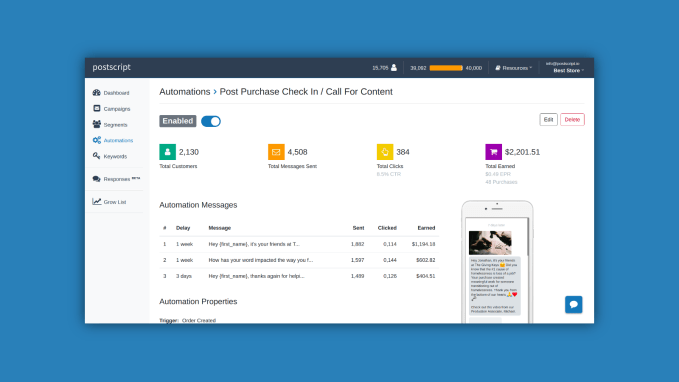
Postscript, a startup launching out of Y Combinator’s latest class, wants to learn from what email marketing got right and translate that to the next frontier of B2C communications: SMS. It basically wants to be the Mailchimp for texts.

“We are witnessing the decay of email,” Postscript president Alex Beller tells TechCrunch. “User behavior is all SMS now and e-commerce traffic and web traffic, in general, are so heavily mobile.”

The startup specifically wants to focus on shaping how consumers and businesses engage in the relationship around online commerce. Do you have a subscription to some cook-at-home meal startup? Then maybe they’ll shoot you a message asking if you want to add a new dessert option to your meal this week. Reply “YES” to add. That’s it.

The startup handles ensuring that businesses have proper consent from users to get text messages sent to them. From there businesses are able to segment users, plan SMS campaigns with text and media and have everything backed up by a decent analytics suite so that customers can see what happens on the other end of the texts. Beyond campaigns, communications can be automated based on customer actions so they get some feedback after they make a purchase or other action.

Being at the forefront of a new frontier for communicating with customers seems to have its advantages. Postscript claims a 95+ percent open rate and 35 percent click-through rate, numbers that are pretty wild for marketers that have dealt with the stats on email campaigns.

Given that people are used to SMS as a means of conversation, people are also a lot more likely to respond and ask questions inside the chain, something the Postscript founders were a bit surprised by but soon built into their feature set alongside integrations with customer support platforms.

“We rushed out this inbound feature when we realized how much [communication] we had coming in from users,” Postscript CEO Adam Turner told TechCrunch. “It’s all about engagement, not just clicks… and a one-way communication channel.”

As a consumer, the idea that my text messages are soon going to be inundated by #brands elicits a gut reaction to burn it all down, but there’s an air of inevitability that SMS will become the next place that businesses want to infiltrate. We’re already getting updates from food delivery services and UPS; Postscript wants their platform to let people expand and manage these relationships.

There are a few reasons why you don’t have to gravely fear your texting app turning into a corporate dump. The opt-in process for phone communications is already a bit more codified in the U.S., and as companies attempt to stay in the good graces of GDPR for fear of the EU god, it might be more likely they tread carefully. Additionally, while SMS fees aren’t substantial, there’s certainly a more baked-in cost than with forwarding an offer to a huge bank of emails. Lastly, users just have to punch out a quick “UNSUBSCRIBE” to get out of messages from which they’ve gotten their fill, a standard across carriers.

Right now the company is closely integrated with Shopify so users can add this to their storefronts. Pricing varies based on the amount of messages you’re sending. There’s a free tier for sending 100 messages per month, $50/month for sending 1,000 and a few more tiers topping out at a 40,000 SMS per month/$1,500 tier.

14 Feb 2019

Everything you need to know about GM’s new electric bikes

General Motors announced last year it was getting into the electric bike business. But besides a crowdsourcing name competition and a few teasers, details were scant.

Now, GM has given this new brand a name — ARĪV — as well as names for its two electric bikes, and some information about its go-to-market plan. The name ARĪV was selected as part of a global crowdsourcing campaign announced in November 2018.

The bikes

GM is bringing two new electric “connected” bikes to market this year — one folding and one compact — as it makes a broader push into electrification and experiments with how to diversify its business of making and selling vehicles.

The compact electric bike is called Meld and the folding one is called Merge.

GM says it brought “automotive-grade capabilities” to its bikes. The company’s experience with EV motor software and controls greatly influenced the proprietary GM motor that was built for the electric bikes, GM said.

The motor enables speeds up to 25 kph with four levels of pedal-assisted power. The battery allows users to travel 64 km, about 40 miles, on a single charge. The battery charges in about 3.5 hours.

Both bikes, which were engineered and designed in GM facilities in Michigan and Oshawa, Ontario, come standard with safety components such as integrated, rechargeable front and rear LED safety lights and oversized brake rotors to increase stopping power.

Where to find and buy them

GM plans to launch first in Germany, Belgium and the Netherlands because of “popularity of lithium-ion battery-powered ebikes in those markets.” GM has opened up a website www.BikeExchange.com where customers can pre-order.

The Meld will be cheaper than the Merge, and prices depend on the country.

In Belgium and the Netherlands, the ARĪV Meld is €2.800, or about $3,100, and the Merge is €3.400 ($3,800). In Germany, the ARĪV Meld is €2.750 and the Merge is €3.350.

ARĪV e-bikes are scheduled to begin shipping to customers in the second quarter of 2019.

The connected bits

GM calls these connected bikes and that can mean a lot of different things. In this case, it means the bikes can connect with an app via Bluetooth.

The app gives riders all kinds of metrics such as speed, distance, remaining battery level, motor assist level and distance traveled. The company plans to add more features, including a mode that will use a proprietary algorithm to help riders arrive at their destination sweat-free.

These bikes also come with what it calls a “Quad Lock mount,” a system to securely attach a smartphone to the bike. An integrated USB port allows riders to maintain their phone’s charge while on the go.

14 Feb 2019

Zendesk just hired three former Microsoft, Salesforce and Adobe execs

Today, Zendesk announced it had hired three new executives — Elisabeth Zornes, former general manager of global support for Microsoft Office, as Zendesk’s first chief customer officer; former Adobe executive Colleen Berube as chief information officer and former Salesforce executive Shawna Wolverton as senior vice president, product.

The company emphasized that the hirings were about expanding the executive suite and bringing in top people to help the company grow and move into larger enterprise organizations.

From left to right: Shawna Wolverton, Colleen Berube and Elizabeth Zornes

Zornes comes to Zendesk with 20 years of experience at Microsoft working in a variety of roles around Microsoft Office. She says that what attracted her to Zendesk was its focus on the customer.

“When I look at businesses today, no matter what size, what type or what geography, they can agree on one thing: customer experience is the rocket fuel to drive success. Zendesk has positioned itself as a technology company that empowers companies of all kinds to drive a new level of success by focusing on their customer experience, and helping them to be at the forefront of that was a very intriguing opportunity for me,” Zornes told TechCrunch.

New CIO Berube, who comes with two decades of experience, also sees her new job as a chance to have an impact on customer experience and help companies who are trying to transform into digital organizations. “Customer experience is the linchpin for all organizations to succeed in the digital age. My background is broad, having shepherded many different types of companies through digital transformations, and developing and running modern IT organizations,” she said.

Her boss, CEO and co-founder Mikkel Svane sees someone who can help continue to grow the company and develop the product. “We looked specifically for a CIO with a modern mindset who understands the challenges of large organizations trying to keep up with customer expectations today,” Svane told TechCrunch

As for senior VP of product Wolverton, she comes with 15 years of experience including a stint as head of product at Salesforce. She said that coming to Zendesk was about having an impact on a modern SaaS product. “The opportunity to build a modern, public, cloud-native CRM platform with Sunshine was a large part of my decision to join,” she said.

The three leaders have already joined the organization — Wolverton and Berube joined last month and Zornes started just this week.

14 Feb 2019

New York politicians slam Amazon as it drops HQ2 plan

Like the initial HQ2 plan, today’s news that Amazon will no longer be setting up shop in Queens has been met with a flood of mixed reactions. Business advocacy and real estate are decrying the retail giant’s decision to pack up and leave. I know I’ve been flooded with responses from various corners all afternoon.

Local politicians, on the other hand, appear to be placing the news squarely at the feet of Amazon .

In a statement provided to TechCrunch, Mayor Bill de Blasio took Amazon to task for the move in a customary bit of New York saltiness.

“You have to be tough to make it in New York City. We gave Amazon the opportunity to be a good neighbor and do business in the greatest city in the world,” the Mayor stated. “Instead of working with the community, Amazon threw away that opportunity. We have the best talent in the world and every day we are growing a stronger and fairer economy for everyone. If Amazon can’t recognize what that’s worth, its competitors will.”

Of course, de Blasio was key in Amazon’s initial decision. The mayor was condemned by many quarters for what was regarded by many as closed door dealings involving, among other things, massive tax breaks for the company. A mere three days ago, he called the plan “mission critical.”

The Mayor’s current take appears to be something more along the lines of, yeah, well, we didn’t really want you here anyway.

Speaker Corey Johnson, on the other hand, was one of the deal’s most vocal opponents from the outset, happily grilling Amazon reps at City Council meetings overs concerns around tax breaks, infrastructure and the company’s longstanding opposition to employee unions.

“I look forward to working with companies that understand that if you’re willing to engage with New Yorkers and work through challenging issues New York City is the world’s best place to do business,” he said in a statement provided to I hope this is the start of a conversation about vulture capitalism and where our tax dollars are best spent. I know I’d choose mass transit over helipads any day.”

Predictable, the city’s wing of the DSA was similarly in a celebratory mood. “”The impending Amazon deal was far from the only way capitalism is oppressing working class Queens residents and New Yorkers,” it said in a statement. “Millions of New Yorkers still lack any basic tenants’ rights and live with the threat of rent hikes, displacement, and evictions every day.”

14 Feb 2019

Facebook may face a record-setting multi-billion-dollar fine from the FTC

The Washington Post is reporting that Facebook’s row with the FTC could result in fines an order of magnitude larger than any levied against a tech company by the regulatory body before. While the talks appear to be ongoing, The Washington Post spoke with two people familiar with the situation who said the FTC is negotiating with Facebook over a possible “multi-billion dollar fine” — an amount more in line with the FTC’s massive $14.7 billion settlement with Volkswagen over emissions cheating in 2016.

In 2012, Google paid a record-setting $22.5 million to settle with the FTC over its own privacy infractions, an amount that is hardly a drop in the bucket by today’s terms. As we’ve previously reported, an FTC fine around that range — or even a multiple of that amount — would be easily shrugged off by the company, which brought in more than $13 billion in revenues in just one quarter of last year. Hitting Facebook with fines well beyond the millions is one of the only ways to punish a company so wealthy that paying out millions would be little more than a passing annoyance.

Assuming the FTC holds its ground in negotiations over a record-blowing fine against Facebook, the company is likely to push back hard in court, putting its vast financial resources to the work of insulating it from meaningful penalties both in the present and future. Whether the multi-billion-dollar fine materializes or not, the hefty sum would be a major symbol of Facebook’s recent privacy transgressions and the process would likely hold Facebook to account with some transparency and reporting measures that could be bruising, even if it didn’t pay up.

14 Feb 2019

TikTok spotted testing native video ads

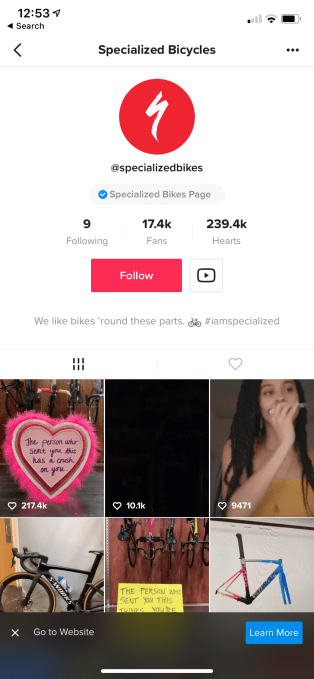
TikTok is testing a new ad product: a sponsored video ad that directs users to the advertiser’s website. The test was spotted in the beta version of the U.S. TikTok app, where a video labeled “Sponsored” from the bike retailer Specialized is showing up in the main feed, along with a blue “Lean More” button that directs users to tap to get more information.

Presumably, this button could be customized to send users to the advertiser’s website or any other web address, but for the time being it only opened the Specialized Bikes (@specializedbikes) profile page within the TikTok app.

However, the profile page itself also sported a few new features, including what appeared to be a tweaked version of the verified account badge.

Below the @specializedbikes username was “Specialized Bikes Page” and a blue checkmark (see below). On other social networks, checkmarks like this usually indicate a user whose account has gone through a verification process of some kind.

Typical TikTok user profiles don’t look like this — they generally only include the username. In some cases, we’ve seen them sport other labels like “popular creator” or “Official Account” — but these have been tagged with a yellowish-orange checkmark, not a blue one.

In addition, a pop-up banner overlay appeared at the bottom of the profile page, which directed users to “Go to Website” followed by another blue “Learn More” button.

Oddly, this pop-up banner didn’t show up all the time, and the “Learn More” button didn’t work — it only re-opened the retailer’s profile page.

As for the video itself, it features a Valentine’s Day heart that you can send to a crush, and, of course, some bikes.

The music backing the clip is Breakbot’s “By Your Side,” but is labeled “Promoted Music.” Weirdly, when you tap on the “Promoted Music” you’re not taken to the soundbite on TikTok like usual, but instead get an error message saying “Ad videos currently do not support this feature.”

The glitches indicate this video ad unit is still very much in the process of being tested, and not a publicly available ad product at this time.

TikTok parent ByteDance only just began to experiment with advertising in the U.S. and U.K. in January.

So far, public tests have only included an app launch pre-roll ad. But according to a leaked pitch deck published by Digiday, there are four TikTok ad products in the works: a brand takeover, an in-feed native video ad, a hashtag challenge and a Snapchat-style 2D lens filter for photos; 3D and AR lens were listed as “coming soon.”

TikTok previously worked with GUESS on a hashtag challenge last year, and has more recently been running app launch pre-roll ads for companies like GrubHub, Disney’s Kingdom Hearts and others. However, a native video ad hadn’t yet been spotted in the wild until now.

According to estimates from Sensor Tower, TikTok has grown to nearly 800 million lifetime installs, not counting Android in China. Factoring that in, it’s fair to say the app has topped 1 billion downloads. As of last July, TikTok claimed to have more than 500 million monthly active users worldwide, excluding the 100 million users it gained from acquiring Musical.ly.

That’s a massive user base, and attractive to advertisers. Plus, native video ads like the one seen in testing would allow brands to participate in the community, instead of interrupting the experience the way video pre-rolls do.

TikTok has been reached for comment, but was not able to provide one at this time. We’ll update if that changes. Specialized declined to comment.

14 Feb 2019

When do you go native?

So you’re a startup founder. Or you’re in charge of a new project at a big company. (Or maybe you just imagine being either of these things.) And you suddenly realize: you have to make a whole slew of massive decisions right now, based on imperfect information, which will reverberate for months or years, and may spell the difference between success or failure.

Among the most dreaded and dangerous decisions are the technical ones. Your web stack. Your cloud provider. Your datastore. But it’s fair to say that the most contentious, lately, is for projects which involve a smartphone app. There, the biggest question of all, the one which must be answered before any work is done, and the one which will probably hang over you for years, is: do you go native?

What that means is: do you build separate native Android and iOS apps, each from scratch in a native language, almost certainly meaning two development teams? Or do you use one of the many tools which promise you two apps for the price of one?

You can of course just build one app at at time. That makes sense if iterating swiftly to product-market fit is more important than doubling your initial addressable market. But if you do so with a native app, be aware you’re implicitly deciding to have two development teams, and two separate and out-of-sync codebases to maintain, somewhere down the road.

Choose your technologies (and your developers) wisely, and you will be able to move deftly, hire (relatively) easily, iterate quickly, and pivot gracefully. Choose poorly, and you’ll be burdened with technical debt that weighs you down until you’re barely able to fix bugs, much less roll out new features.

Speed matters. Cost matters. The long-term benefits of a single codebase are obvious — as are the costs of subpar apps which wind up costing far more than your initial gains. You could conceivably be betting your whole company on this decision. So what’s the right answer?

This is a decision I see a lot. For context, I’m the CTO of HappyFunCorp, and we wrestle with this decision multiple times a year, as we design and architect new apps for clients, or do major overhauls or existing ones. So I can tell you with great confidence that the answer is: “It depends.”