Author: azeeadmin

04 Feb 2019

Chicago RPA startup Catalytic hauls in $30M Series B

Robotics Process Automation (RPA) is as hot as any enterprise technology at the moment, as companies look for ways to marry their legacy systems with a more modern flavor of automation. Catalytic, a startup from the midwest is putting its own flavor on RPA, aiming at more unstructured data. Today it was rewarded with a $30 million Series B investment.

The investment was led by Intel Capital with participation from Redline Capital and existing investors NEA, Boldstart and Hyde Park Angel. Today’s round brings the total raised to almost $42 million, according to the company.

RPA helps automate highly mundane processes. Sean Chou, Catalytic co-founder and CEO says there are a couple of ways his company’s solution diverts from his competition, which includes companies like Blue Prism, Automation Anywhere and UIPath.

For starters, Chou says, his company’s solution concentrates on unstructured data like pulling information from documents or emails using a variety of techniques, depending on requirements. It could be old-fashioned scanning and OCR or more modern natural language process (NLP) to “read” the document, depending on requirements.

It is designed like all RPA tools to take humans out of the loop when it comes to the most mundane business processes, but as Chou says, his company wants human employees in the loop whenever needed, whether that’s exception processing or tasks that are simply too challenging to program at the moment.

The company launched in 2015 using money Chou had earned from the sale of his previous company Fieldglass, which he had sold the previous year to SAP for more than $1 billion dollars. Fieldglass helped with outsourcing, and as Chou developed that company, he saw a growing problem around automating certain tedious business processes, especially when they touched legacy systems inside an organization. He raised $3.1 million in seed money from Boldstart Ventures in NYC in 2016 and began building out the product in earnest.

Today, Catalytic has a dozen customers, including Bosch, the German manufacturing conglomerate. It employs 60 people in its Chicago headquarters. While its investors come from the coasts, Catalytic is building a company in the heart of the midwest, a part of the country that has often been left out of the startup economy.

With $30 million Catalytic can begin expanding the number of employees, including helping service its large customers, building out it partner network with other software companies and systems integrators, and bringing in more engineering talent to continue building out the product.

The product is offered on a subscription basis as a cloud service.

04 Feb 2019

Online platforms still not clear enough about hate speech takedowns: EC

In its latest monitoring report of a voluntary Code of Conduct on illegal hate speech, which platforms including Facebook, Twitter and YouTube signed up to in Europe back in 2016, the European Commission has said progress is being made on speeding up takedowns but tech firms are still lagging when it comes to providing feedback and transparency around their decisions.

Tech companies are now assessing 89% of flagged content within 24 hours, with 72% of content deemed to be illegal hate speech being removed, according to the Commission — compared to just 40% and 28% respectively when the Code was first launched more than two years ago.

However it said today that platforms still aren’t giving users enough feedback vis-a-vis reports, and has urged more transparency from platforms — pressing for progress “in the coming months”, warning it could still legislate for a pan-EU regulation if it believes it’s necessary.

Giving her assessment of how the (still) voluntary code on hate speech takedowns is operating at a press briefing today, commissioner Vera Jourova said: “The only real gap that remains is transparency and the feedback to users who sent notifications [of hate speech].

“On average about a third of the notifications do not receive a feedback detailing the decision taken. Only Facebook has a very high standard, sending feedback systematically to all users. So we would like to see progress on this in the coming months. Likewise the companies should be more transparent towards the general public about what is happening in their platforms. We would like to see them make more data available about the notices and removals.”
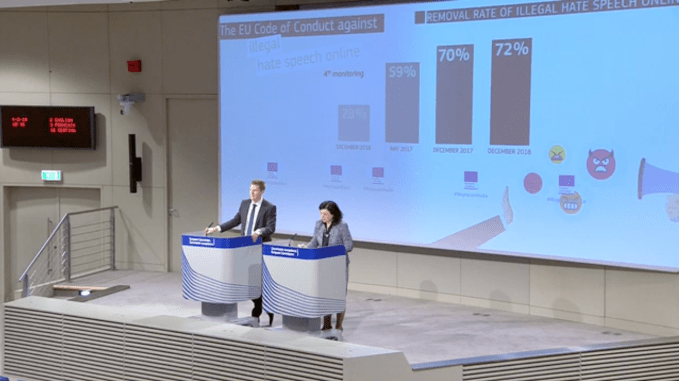
“The fight against illegal hate speech online is not over. And we have no signs that such content has decreased on social media platforms,” she added. “Let me be very clear: The good results of this monitoring exercise don’t mean the companies are off the hook. We will continue to monitor this very closely and we can always consider additional measures if efforts slow down.”

Jourova flagged additional steps taken by the Commission to support the overarching goal of clearing what she dubbed a “sewage of words” off of online platforms, such as facilitating data-sharing between tech companies and police forces to help investigations and prosecutions of hate speech purveyors move forward.

She also noted it continues to provide Member States’ justice ministers with briefings on how the voluntary code is operating, warning again: “We always discuss that we will continue but if it slows down or it stops delivering the results we will consider some kind of regulation.”

Germany passed its own social media hate speech takedown law back in 2016, with the so-called ‘NetzDG’ law coming into force in early 2017. The law provides for fines as high as €50M for companies that fail to remove illegal hate speech within 24 hours and has led to social media platforms like Facebook to plough greater resource into locally sited moderation teams.

While, in the UK, the government announced a plan to legislate around safety and social media last year. Although it has yet to publish a White Paper setting out the detail of its policy plan.

Last week a UK parliamentary committee which has been investigating the impacts of social media and screen use among children recommended the government legislate to place a legal ‘duty of care’ on platforms to protect minors.

The committee also called for platforms to be more transparent, urging them to provide bona fide researchers with access to high quality anonymized data to allow for robust interrogation of social media’s effects on children and other vulnerable users.

Debate about the risks and impacts of social media platforms for children has intensified in the UK in recent weeks, following reports of the suicide of a 14 year old schoolgirl — whose father blamed Instagram for exposing her to posts encouraging self harm, saying he had no doubt content she’d been exposed to on the platform had helped kill her.

During today’s press conference, Jourova was asked whether the Commission intends to extend the Code of Conduct on illegal hate speech to other types of content that’s attracting concern, such as bullying and suicide. But she said the executive body is not intending to expand into such areas.

She said the Commission’s focus remains on addressing content that’s judged illegal under existing European legislation on racism and xenophobia — saying it’s a matter for individual Member States to choose to legislate in additional areas if they feel a need.

“We are following what the Member States are doing because we see… to some extent a fragmented picture of different problems in different countries,” she noted. “We are focusing on what is our obligation to promote the compliance with the European law. Which is the framework decision against racism and xenophobia.

“But we have the group of experts from the Member States, in the so-called Internet forum, where we speak about other crimes or sources of hatred online. And we see the determination on the side of the Member States to take proactive measures against these matters. So we expect that if there is such a worrying trend in some Member State that will address it by means of their national legislation.”

“I will always tell you I don’t like the fragmentation of the legal framework, especially when it comes to digital because we are faced with, more or less, the same problems in all the Member States,” she added. “But it’s true that when you [take a closer look] you see there are specific issues in the Member States, also maybe related with their history or culture, which at some moment the national authorities find necessary to react on by regulation. And the Commission is not hindering this process.

“This is the sovereign decision of the Member States.”

Four more tech platforms joined the voluntary code of conduct on illegal hate speech last year: — namely Google+, Instagram, Snapchat, Dailymotion. While French gaming platform Webedia (jeuxvideo.com) also announced their participation today.

Drilling down into the performance of specific platforms, the Commission’s monitoring exercise found that Facebook assessed hate speech reports in less than 24 hours in 92.6% of the cases and 5.1% in less than 48 hours. The corresponding performance figures for YouTube were 83.8 % and 7.9%; and for Twitter 88.3% and 7.3%, respectively.

While Instagram managed 77.4 % of notifications assessed in less than 24 hours. And Google+, which will in any case closes to consumers this April, managed to assess just 60%.

In terms of removals, the Commission found YouTube removed 85.4% of reported content, Facebook 82.4% and Twitter 43.5% (the latter constituting a slight decrease in performance vs last year). While Google+ removed 80.0% of the content and Instagram 70.6%.

It argues that despite social media platforms removing illegal content “more and more rapidly”, as a result of the code, this has not led to an “over-removal” of content — pointing to variable removal rates as an indication that “the review made by the companies continues to respect freedom of expression”.

“Removal rates varied depending on the severity of hateful content,” the Commission writes. “On average, 85.5% of content calling for murder or violence against specific groups was removed, while content using defamatory words or pictures to name certain groups was removed in 58.5 % of the cases.”

“This suggest that the reviewers assess the content scrupulously and with full regard to protected speech,” it adds.

It is also crediting the code with helping foster partnerships between civil society organisations, national authorities and tech platforms — on key issues such as awareness raising and education activities.


04 Feb 2019

Lime beefs up its executive team with a CTO and CMO

Micromobility startup Lime, the company that operates shared electric scooters and bikes, has brought on its first chief marketing officer and appointed its first chief technology officer. Duke Stump, now CMO at Lime, is joining the company from Lululemon, where he served as EVP of Brand and Community.

Li Fan, who served as Lime’s head of engineering, is now assuming the role of CTO. During her short time (seven months), Fan has tripled the size of the engineering team. Before joining Lime, Fan was SVP of Engineering at Pinterest, and also previously served as a senior director of engineering at Google.

“Duke and Li will be tremendous assets to Lime’s executive leadership team. Duke’s global marketing expertise and experience growing some of the most iconic consumer brands will be instrumental to further Lime’s mission of micro-mobility,” Lime CEO and co-founder Toby Sun said in a statement. “Lime is constantly working to improve rider experience and Li’s dedication to this goal is unparalleled. Her successful track record and leadership skills are widely respected throughout the company and she is the perfect fit for this role.”

Lime, which got its beginnings as a bike-share company, has deployed its scooters in over 100 cities in the U.S. and 27 international cities. Since June, Lime has more than doubled the number of cities where it operates in the U.S. Lime has also partnered with Uber to offer Lime scooters within the Uber app.

04 Feb 2019

Chat app Line injects $182M into its mobile payment business

Japanese messaging app company Line is pumping 20 billion JPY ($182 million) into its mobile payment business as it tries to turn things around following a challenging year in 2018.

The company announced the infusion into Line Pay, a subsidiary that it fully owns, in a filing which stated that the new capital is “necessary funds for its future business operation.” No further details were provided.

The investment comes on the heels of Line’s latest financial report which saw it post a 5.79 billion JPY loss as revenue grew by 24 percent to reach 207.18 billion JPY in 2018. Line has long been a top money maker in the App Store, but its efforts to build out content around its messaging platform and games division have turned out to be expensive, with a job service, manga platform and e-commerce business among its ventures.

In addition to additional content, payments are also seen as ‘glue’ that can increase engagement within the Line ecosystem and its main messaging app.

The company is going after the cashless opportunity in Japan, where it is the dominant chat app with an estimated 50 million registered users. The country is notable for its continued use of cash, but the government is using the upcoming 2020 Olympic Games as an opportunity to move towards a digital future. Aside from its core Line Pay service, which sits inside the Line chat app, Line is introducing its own credit card with Visa and it has gone after Chinese tourists through a tie-in with Tencent, the internet giant behind China’s top messaging app WeChat.

Outside of Japan, Line Pay is also available in Thailand (where it works with the Bangkok metro provider), Taiwan (where it counts two banks as partners) and Indonesia, which Line says are its next three largest markets in terms of user numbers. Together, across those four countries, Line claims it has 165 million monthly active users and 40 million registered Line Pay users. Line said GMV reached 55 billion JPY ($482 million) per month back in November 2017, there’s been no update since.

The service was launched more widely but it has shuttered in other markets, including Singapore where it was ended in February 2018.

Beyond payment, Line is also moving into banking and financial services. It is working to launch a digital bank in Japan and last year it announced plans to investigate the potential to roll out loans, insurance and other services backed by its own cryptocurrency. While it didn’t hold an ICO — its ‘Link’ token is earned or can be bought on exchanges — Line did dive into crypto in a major way, opening its own exchange and starting a crypto investment fund, too. With the bear market in full effect, and token valuations dropping by 90 percent across the board, we haven’t heard too much more from Line on its crypto plans.

04 Feb 2019

WhatsApp adds support for Face ID/Touch ID biometric lock on iOS

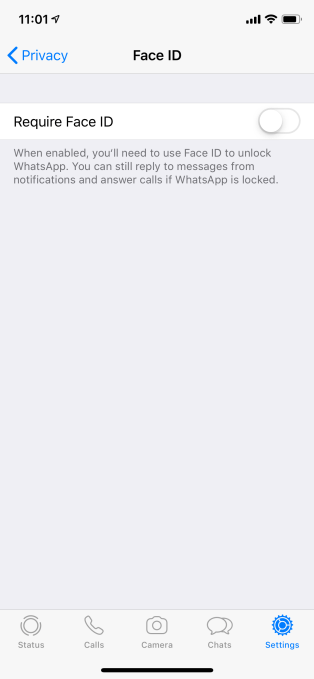
WhatsApp users updating to the latest version of the messaging app on iOS will find a new setting lurking at the bottom of the ‘Privacy’ menu that adds support for Apple’s biometric authentication technologies.

WhatsApp users on iOS can now tap into Apple’s biometrics for an extra layer of security

Under the new setting, called ‘Screen Lock’, users of WhatsApp on iOS can tap through to another menu to add an additional layer of security by requiring either their facial biometric or a fingerprint to unlock the messaging app.

iPhone users are either offered the ability to ‘require Face ID’ or ‘require Touch ID’ depending on their handset hardware.

The change, in version 2.19.20 of the WhatsApp iOS app, is listed as: 

• You can now require Face ID or Touch ID to unlock WhatsApp. Tap “Settings” > “Account” > “Privacy” and enable Screen Lock.

While WhatsApp makes use of the respected Signal Protocol to protect users’ comms via end-to-end encryption, the best encryption in the world can’t offer any protection if a person gains possession of your unlocked device as they can just open the app and read everything in plain text.

So the lack of a native lock option in WhatsApp has been a rather big security oversight. But one the messaging giant has at least now rectified on iOS.

Albeit the setting is not enabled by default — and is a bit buried in the menus — so less security savvy users are unlikely to realize it’s there.

There’s also still no native option in WhatsApp to add any kind of passcode to the app. Which would offer a universal ‘extra security’ option that could work across Android and iOS. (Presumably WhatsApp’s parent Facebook isn’t a fan of the added ‘friction’ such a setting could bring.)

Although various third party apps can be downloaded and used to require a passcode before other apps can be opened, a native passcode option would increase accessibility and shrink potential security concerns about using third party downloads for what should really be a core function.

04 Feb 2019

Aire raises $11M Series B to give credit scoring an ‘upgrade’

Aire, the U.K. startup that wants to give the credit scoring system a 21st century “upgrade,” has raised $11 million in Series B funding. The round is backed by European enterprise VC Crane Venture Partners, with strategic investments from Experian Ventures and Orange Digital Ventures.

Existing investors WhiteStar Capital and Sunstone Capital also followed on, while the company says it will use the additional capital to support “rapid growth,” including U.S. expansion. Aire also plans to further invest in the technology powering its credit insights engine, which aims to make credit checking fairer for consumers who may have a thin credit file, and therefore more valuable to lenders.

“How does a new borrower bypass the catch-22 problem of credit where it takes a while to get a history, but you need credit to start a history…,” says Aire co-founder and CEO Aneesh Varma, when asked the describe the problem the startup set out to solve.

“The system today doesn’t seem to serve everyone, even if they are deserving. Our solution focuses on an approach: The consumer is the best and deepest source of real data about themselves. This first-party data is the only way… [to] deliver win-win outcomes for both the consumer and the lender”.

To solve this conundrum, Varma says Aire can be likened to the role of a “manual underwriter” who tries to better understand a credit applicant’s life and financial situation, but delivered via technology in an automated and scalable way.

“Our main product today steps in to engage with an applicant on a lender’s website when the existing decision engine is unable to reach a full decision,” he explains. “We enable the consumer to supply relevant financial data to us about their circumstances. This is beyond just transactional banking data, and therefore gives us a full picture… looking forward, not just the historical snapshot”

On the backend, Aire’s platform accesses that data to provide ready-to-use outputs for its lending partners to use in real-time. The system is designed to get smarter over time, too, as more performance data of outstanding loans becomes available.

“[This is] where machine learning is very relevant). We also keep researching other methods and data streams that consumers can bring to us, while being on the right side of the privacy concerns,” says Varma.

One of the challenges faced by any company wishing to upgrade credit scoring by employing new data points and machine-learning is not to replicate the existing biases that are arguably ripe within the current system. This is something Varma says he and Aire take very seriously, having experienced some of those prejudices first hand himself.

“We are very insistent on a strong model governance process to ensure we are not biasing against certain individuals or protected traits. This is welded into our culture at Aire,” he says.

“First you have to know what are the biases that exist in the current system that you need to tackle. And then it requires doing the grunt work to involve real human checking and cross-calibrating the models… The challenges we are seeing with algorithms with big tech today are often because some of these companies taking the easy road out. They need to walk in that uncomfortable forest. It’s essential”.

To date, Aire says its algorithmic model has scored over $10 billion of credit across various consumer credit categories, which it reckons gives the startup a competitive advantage as the model improves with both data quantity and quality. The company claims to help lenders access more customers without increasing risk appetite, and says it has seen credit approvals increase by up to 19 percent.

On the lender side, Aire’s customers are credit card companies and retail finance (ie checkout financing), although Varma says longer term finance is also on the roadmap as the company’s models mature. On the consumer side, Aire typically serves working professionals who are earlier in the financial journey. These include various types of self-employment, such as contractors, freelancers, and those operating within the so-called gig economy.

04 Feb 2019

Healthcare wearables level up with new moves from Apple and Alphabet

Announcements that Apple has partnered with Aetna health insurance on a new app leveraging data from its Apple Watch and reports that Verily — one of the health-focused subsidiaries of Google‘s parent company — Alphabet, is developing a shoe that can detect weight and movement, indicate increasing momentum around using data from wearables for clinical health applications and treatments.

For venture capital investors, the movea from Apple and Alphabet to show new applications for wearable devices is a step in the right direction — and something that’s been long overdue.

“As a healthcare provider, we talk a lot about the important of preventative medicine, but the US healthcare system doesn’t have the right incentives in place to pay for it,” writes Cameron Sepah, an entrepreneur in residence at Trinity Ventures. “Since large employers largely pay for health care (outside of Medicaid and Medicare), they usually aren’t incentivized to pay for prevention, since employees don’t stay long enough for them to incur the long-term costs of health behaviors. So most startups in this space end up becoming an expendable wellness perk for companies. However, if an insurer like Aetna keeps its members long enough, there’s better alignment for disseminating this app.”

Sepah sees broader implications for the tie ups between health insurers and the tech companies making all sorts of devices to detect and diagnose conditions.

“Most patients relationship with their insurer is just getting paper bills/notifications in the mail, with terrible customer satisfaction (NPS) across the board,” Sepah wrote in an email. “But when there’s a way to build a closer relationship through a device that sits on your wrist, it opens possibilities to partner with other health tech startups that can notify patients when they are having mental health issues before they even recognize it (e.g. Mindstrong); or when they should get treatment for hypertension or sleep apnea (e.g. Cardiogram); or leverage their data into a digital chronic disease treatment program (e.g. Omada Health).”

Aetna isn’t the first insurer to tie Apple Watch data to their policies. In September 2018, John Hancock launched the Vitality program, which also gave users discounts on the latest Apple Watch if they linked it with John Hancock’s app. The company also gave out rewards if users changed their behavior around diet and exercise.

In a study conducted by Rand Europe of 400,000 people in the U.S., the U.K., and South Africa, research showed that users who wore an Apple Watch and participated in the Vitality benefits program averaged a 34 percent increase in physical activity compared to patients without the Apple Watch. It equated to roughly 5 extra days of working out per month.

“[It will] be interesting to see how CVS/Apple deal unfolds. Personalized health guidance based on a combination of individual medical records and real time wearable data is a huge and worthy goal,” wrote Greg Yap, a partner at the venture capital firm, Menlo Ventures . But, Yap wrote,I’m skeptical their first generation app will have enough data or training to deliver value to a broad population, but we’re likely to see some anecdotal benefits, and I find that worthwhile.”

Meanwhile the types of devices that record consumer health information are proliferating — thanks in no small part to Verily.

With the company reportedly working to co-develop shoes with sensors that monitor users’ movement and weight, according to CNBC, Verily is expanding its portfolio of connected devices for health monitoring and management. The company already has a watch that monitors certain patient data — including an FDA approved electrocardiogram — and is developing technologies to track diabetes-related eye disease in patients alongside smart lenses for cataract recovery.

It’s part of a broader push from technology companies to tie themselves closer to consumer health as they look to seize a part of the nearly $3 trillion healthcare industry.

If more data can be collected from wearable devices (or consumer behavior) and then monitored in a consistent fashion, tech companies ideally could suggest interventions faster and provide lower cost treatments to help avoid the need for urgent or emergency care.

These “top of the funnel” communications and monitoring services from tech companies could conceivably divert users and future healthcare patients into an alternative system that is potentially lower-cost with more of a focus on outcomes than on the volume of care and number of treatments prescribed.

Not all physicians are convinced that the use of persistent monitoring will result in better care. Dr. John Ioannidis, a celebrated professor from Stanford University, is skeptical about the utility of monitoring without a better understanding of what the data actually reveals.

“Information is good for you provided you know what it means. For much of that information we have no clue what it means. We have absolutely no idea what to do with it other than creating more anxiety,” Dr. Ioannidis said

The goal is to provide personalized guidance where machine learning can be used to identify problems and come up in concert with established therapeutic practices, according to investors who back life sciences starups.

“I think startups like Omada, Livongo, Lark, Vida, Virta, and others, can work and are already working on this overall vision of combining real time and personal historical data to deliver personalized guidance. But to be successful, startups need to be more narrowly focused and deliver improved outcomes and financial benefits right away,” according to Yap.


04 Feb 2019

Hulu teams up with that world record Instagram egg to raise awareness of mental health

Remember that egg that became Instagram’s most-liked post? It used its recently-acquired fame to shed light on mental health and the pressures of social media.

The account now has 10 million followers — its record photo has over 52 million likes — and it put that audience to use with a 30-second video that aired on Hulu around the Super Bowl. The account had teased a major revealed in recent weeks, and it proved to be the short spot with Hulu that promotes mental health awareness, particularly around the context of using social media.

“Recently I’ve started to crack… the pressure of social media is getting to me,” the video reads as the egg’s shell begins to crack before breaking into pieces.

“If you’re struggling too, talk to someone,” the egg says before it is resurrected with a full shell once again.

The video closes with a link to the Mental Health America website.

The video received praise from Mental Health America and many others on Twitter, but plenty of its Instagram followers expected more or don’t have a Hulu account, according to comments.

At the same time, the creators of the account — three advertising executives in South London — revealed background on the project, the egg is called “Eugene,” in an interview with the New York Times.

The trio — Chris Godfrey, Alissa Khan-Whelan and C.J. Brown — explained that they had been approached by Hulu, which had paid to develop the video which aims to take advantage of the hype and online chatter around the Super Bowl to raise its message. Given that the account is followed by a large number of children, as its creators acknowledged in the interview, a positive message like this rather than a commercial sell-out is a pleasant surprise, particularly when it is estimated that brand deals could fetch $10 million.

Hulu is the first to get a crack at the egg, but it remains to be seen if its appeal to brands will endure and whether its future messaging and partners will also be health-related.

04 Feb 2019

Spotify, eBay set standard for fertility benefits, study finds

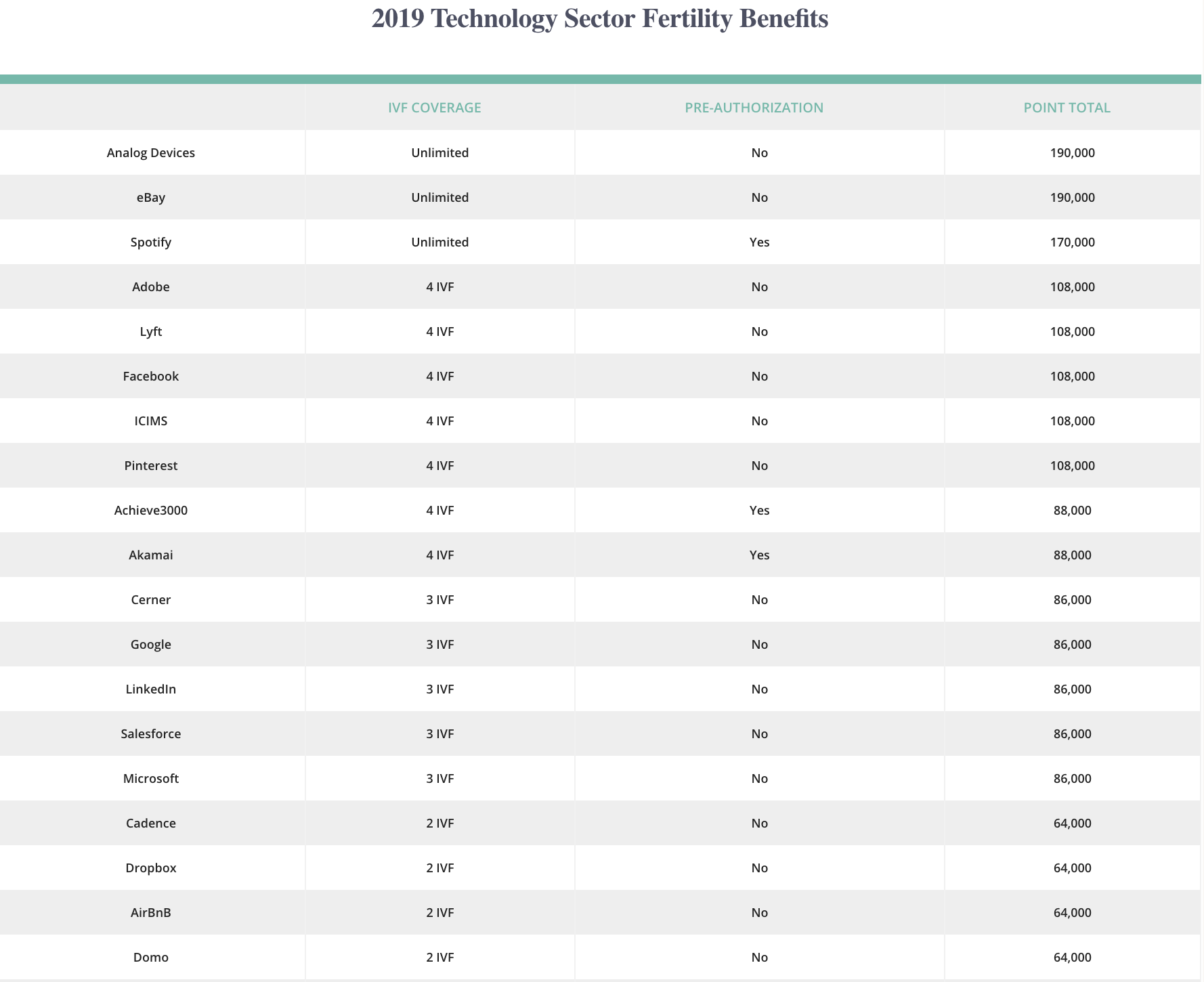
The technology sector awards women and same-sex couples the most comprehensive fertility benefit packages, according to a survey by FertilityIQ, an online platform for fertility patients to review doctors and research treatments.

The company asked 30,000 in vitro fertilisation (IVF) patients across industries about their employers’ — or their spouse’s employer’s’ — 2019 fertility treatment policy, and allocated points based on their support for IVF procedures and egg freezing, among other services.

Silicon Valley semiconductor business Analog Devices and eBay led the ranking. The two companies offer employees unlimited IVF cycles with no pre-authorization requirement, meaning employees do not need permission from insurance providers before seeking certain medical services. Pre-authorization has historically impacted lesbian, gay or unpartnered employees from accessing care quickly or at all, FertilityIQ co-founder Jake Anderson explained

Spotify, Adobe, Lyft, Facebook and Pinterest were amongst the highest-ranked technology businesses, too.

“I think a lot of people see the tech sector as being unenlightened when it comes to family values but it’s still the sector that makes the fertility benefits the most widely acceptable,” Anderson, a former consumer internet investor at Sequoia Capital, told TechCrunch.

FertilityIQ’s fertility benefits survey results.

Despite an initial outpouring of skepticism, Facebook and Apple became leaders in the fertility benefit category when they began paying for their female employees to freeze their eggs in 2014. Since then, smaller firms have opted to beef up those benefits to stay competitive with their much larger and richer counterparts.

“The Lyfts, the Airbnbs and the Ubers of the world, who clearly need to compete for those companies for talent, have effectively matched those companies dollar-for-dollar despite a much smaller war-chest,” Anderson said. “These companies that are worth 1/1000th of these bigger companies are effectively going toe-to-toe to offer whatever women need.”

Anderson and his wife, FertilityIQ co-founder Deborah Anderson, noticed improved benefits in 2018 from companies implicated by the #MeToo movement, such as Vice Media, Under Armour and Uber.

“Silicon Valley is notorious for talent moving around on you but it’s probably not coincidental that some of the companies that were in the spotlight in the #MeToo movement have added really generous benefits,” Deborah Anderson told TechCrunch.

Uber, for example, now pays for its employees to complete two IVF cycles but still requires pre-authorization.

One in 7 Americans struggle with infertility and the rate of IVF procedures only continues to increase, with the latest data indicating a 15 percent year-over-year growth rate. IVF costs roughly $22,000 per cycle, per FertilityIQ’s survey, a cost which has similarly increased 15 percent since 2015.

That’s a whole lot of cash for a fertility patient to dole out. If companies foot the bill, they’ll have a better shot at retaining talent.

“Best we can tell, there is no question that employees that get this benefit and use it are more loyal and more likely to stick around,” Jake Anderson said. “The company that helps you build your family is the company that you remain committed to.”

04 Feb 2019

Bud raises $20M to connect banks to fintechs and other financial service providers

Bud, the U.K. fintech that helps banks connect their apps and data to other fintech companies and financial service providers, has closed over $20 million in further funding.

The Series A round sees the company pick up backing from a number of banks: HSBC (which, via First Direct, it also counts as a customer), Goldman Sachs, ANZ, Investec’s INVC fund, and InnoCells (the corporate venture arm of Banco Sabadell).

Others participating include Lord Fink (the former chief executive of hedge fund Man Group), and 9Yards Capital (the VC firm to which George Osborne is an advisor).

Originally launched back in 2016 as a consumer app that wanted to make various financial services accessible from a single aggregated interface, the London-based startup has since pivoted to a tech platform it offers to banks to help them remain more competitive in the Open Banking/PSD2 era. Its tech lets banks create new apps and services that enable customers to manage all of their financial products within a single app.

Essentially, Bud acts as the tech layer that intelligently connects bank account data to third-party financial services, including those provided by fintechs and more traditional financial providers, as well as doing a lot of the other heavy-lifting required to create new consumer experiences from bank data.

“The work we have done with First Direct… is a showcase of features and functionalities made possible by new regulation, data science and relevant connections to fintech and banking services,” Bud CTO and co-founder George Dunning tells me.

“We have built a number of data enrichment features using transactional data to make people’s lives that little bit easier. Connection and aggregation of people’s accounts is the standard now, so we focussed on things like increasing financial literacy. ‘Smart Balance’ is a feature that shows users what they can safely spend and ‘Goals’ help them plan ahead. Our advanced regular payment finder filters and tracks bill payments and if you can save money Bud connects you to a service that will make it happen”.

Many of these features are powered by Bud’s ability to use data to detect patterns and behaviours. “Something as simple as detecting if someone is going abroad and helping them get insurance for their trip using one of our partners from within the app is much better than if you do it the traditional way,” says Dunning.

Other than HSBC-owned First Direct, the Bud co-founder isn’t able to disclose any of the company’s other bank customers. “We are working with a handful of banks across the industry, using open banking and our marketplace of services to solve problems for their customers which couldn’t be solved before now,” he says.

On the fintech and financial services side, Bud currently works with 85 different companies. These include fintechs Wealthify and PensionBee to more established companies like Hiscox and AJ Bell.

One other partner Dunning can talk about is the U.K. government, which Bud is working with as part of the Rent Recognition Challenge to create new solutions for people wishing to get on the housing ladder. “First-time buyers have it harder now than ever before. Work we are just finalising with The Treasury uses rent payments to help people grow their credit history to buy a home,” he says.

Meanwhile, Bud says the new capital will support the expansion of the Bud team, as the company moves to double its headcount creating what it claims will be the “largest team dedicated to Open Banking in the world”. Its current headcount is 62.

Cue statement from Raman Bhatia, Head of digital bank at HSBC Retail Banking and Wealth Management: “Since the start of our partnership with Bud back in 2017, we’ve been impressed with the team’s approach to innovation. They have helped to shape our approach to open banking, working with us to deliver services that makes banking easier for our customers. They stand out as motivated by their mission to help people have a better relationship with financial services”.