Author: azeeadmin

01 Feb 2019

Juul Labs hires former Apple employee to lead the fight against counterfeits

Juul Labs, the e-cig company under fire for its product’s popularity with young people, has brought on a new VP of Intellectual Property Protection with Adrian Punderson, formerly of PwC and Apple.

Punderson’s job is all about working alongside government agencies, as well as Juul Labs Intellectual Property VP Wayne Sobon, to combat the sale of counterfeit and infringing products. These can range from copycat vapes and pods that are actually marketed as Juul products all the way to products that are designed specifically to be Juul compatible without using the trademark.

These counterfeit and infringing products pose a serious threat to the company. Of course, no business wants its products infringed or its marketshare stolen.

With Juul, however, it’s far more complicated. Juul Labs is currently under heavy FDA scrutiny over the popularity of its products with minors.

“As you start to enforce generally on the sale of these types of products to youth, oftentimes they are going to look for another seller or distribution point of this product,” said Punderson. “The challenge is that oftentimes they’re going to platforms or places for this and you have no idea what the origin of the product is. A lot of it is counterfeit. So they get something they believe is Juul only to find out they have a counterfeit device or pod.”

He went on to say that, for Juul, a top priority is identifying counterfeit sellers and quickly putting that information into the hands of law enforcement. To the extent that they can’t take action, said Punderson, Juul will take civil action.

Part of the concern is that there is zero transparency into what ingredients are being used in infringing products, whereas Juul’s recipe at least meets the legal requirements for disclosure as it seeks full FDA approval.

Juul doesn’t currently have data around the scale of infringing products on the market, but counterfeit Juul products may inaccurately increase sales figures, intensifying scrutiny from the FDA.

Juul has already taken legal action against many infringing manufacturers and distributors, but Punderson aims to take Juul’s efforts against infringing products to a new level.

He sees the issue as threefold: Juul Labs must work to stop these products from being manufactured in the first place, ensure they aren’t allowed across borders into the country, and take action against retailers who sell infringing products and remove them from the market.

“This isn’t a problem where there is only a production problem but there isn’t really a distribution or consumption problem,” said Punderson. “We don’t have the luxury of looking at the problem singly-faceted. From a global perspective, we want to stop the production and distribution of infringing products around the world, and we’ll work closely with government agencies attempting to stop illicit distribution of goods.”

Punderson previously served as Managing Director of IP Protection at PriceWaterhouse Coopers, VP of Global Anti-Counterfeiting/Anti-Diversion at Oakley, and worked at Apple on the Intellectual Property Enforcement team.

Juul is currently viewed by many as a Facebook-ified, 2018 version of Marlboro. Notably, Juul Labs recently closed a $12.8 billion investment from Altria Group, the makers of Marlboro cigarettes. When asked why he chose to work for Juul, Punderson said his initial reaction was no. But that after he did some research around the mission of the company, and thought of his own personal experience losing his father to emphysema, he came around quickly.

“I would do anything to get two or three more years with my dad, who was a lifelong smoker,” said Punderson. “[…] We’re trying to do good things here, move people away from tobacco and give them an alternative. To me, it’s a valuable, noble cause that’s worth being involved in and I’m proud to be here.”

It remains to be seen just how big of an issue infringing products are for Juul and other above-board e-cig makers, but Juul is ramping up its efforts to combat copycats from getting into the hands of consumers.

01 Feb 2019

Twilio closes acquisition of email specialist SendGrid in all-stock deal now worth $3B

Twilio’s bid to become the go-to platform for all of a business’s external communication needs took a big step ahead today. The company said that it has closed its acquisition of email specialist SendGrid. First announced four months ago, Twilio today said the all-stock deal is valued at $3 billion — up from a $2 billion price tag when it was initially announced.

Specifically, this is because the prices of both company’s stocks have been on a roll. Based on the closing price of Twilio Class A common stock on Jan. 31, 2019 and an exchange ratio of 0.485 shares of Twilio Class A common stock per share of SendGrid common stock, Twilio said SendGrid stockholders received $53.99 of aggregate value per share of SendGrid common stock. (SendGrid has now ceased trading and has been removed from the NYSE, as it becomes a full subsidiary of Twilio led by its CEO Sameer Dholakia.)

The name of the game these days when it comes to communications with customers is omnichannel, and this acquisition aims to address that.

The deal brings together Twilio, a powerhouse in messaging and voice communications — by way of a set of APIs, Twilio allows developers of apps, web sites and other digitial properties easily to integrate custom phone numbers and to manage messaging communications with customers covering not just voice and SMS but also custom messaging channels like Facebook Messenger and WhatsApp, as well as video — with SendGrid, a company that has made similar innovations in email, which had been a gap in Twilio’s range of services.

Together the companies will be managing 140,000 active customer accounts covering some 600 billion interactions on an annualized basis.

“Effective customer engagement is a strategic imperative for every company. With SendGrid now a part of Twilio, our goal is to provide a complete platform for every form of customer engagement,” said Jeff Lawson, Twilio co-founder and CEO, in a statement. “Through our mutual developer-first approach, we empower the builders of the world to create magical customer experiences unique to every interaction.”

“Together, we serve more than 140,000 active customer accounts and power more than 600 billion annualized interactions each year. We have a shared vision, a shared model and shared values that will set us up for success,” said . “As we join forces today, I’m more confident than ever that we can accelerate our vision of creating one unquestioned platform of choice for developers and companies around the world and help them transform the way they engage with their customers,” added Dholakia in a statement.

01 Feb 2019

H1-B changes will simplify application process

The federal government yesterday published the final rule for changes to the H1-B visa program, which is one of the primary conduits for technical talent to come and work in the United States.

There are two key changes coming with the rule. First, the government will require applicants for an H1-B visa to electronically register with the immigration office for the H1-B lottery before they submit their applications or documentation.

Due to hard caps imposed by Congress on the number of workers who can be admitted under the program, tens of thousands of people apply for a visa who ultimately do not attain it. Under the current process, applicants must submit their entire applications including supporting documentation in order to apply for a lottery run by USCIS, the immigration authority.

Last year, roughly 190,000 applicants applied for 85,000 total slots. That means 105,000 people put together complete applications but lost out on the lottery.

Under the new rule that will be in force for this year’s H1-B process, applicants will first register with USCIS electronically, which will process the lottery. If selected in the lottery, an applicant would then be invited to submit their application and supporting materials. The idea is that you only have to do all the work of applying when there is an actual slot available.

The change is likely to cut into the revenue of immigration attorneys, who today prepare full applications for all applicants. A typical H1-B visa application retainer for an attorney today in Silicon Valley runs in the low thousands of dollars each, with companies picking up the tab. I am sure attorneys will still recommend doing some prep work, but the new rules should cut costs for employers.

The second change of the final rule has to do with how the lottery is conducted. Be very careful here, as the changes are somewhat subtle and there is a lot of malarkey being written across the internet about it.

Under the H1-B program, there are two pools of applicants: let’s call them the regular pool and the advanced degree holders pool. There is a cap of 65,000 for the regular pool, and 20,000 for the advanced degree pool, which is limited to applicants holding a master’s degree or better.

In today’s process, advanced degree applicants first go through the lottery of the advanced degree pool, and if they fail, they get added to the regular pool for the second lottery. In the new process just confirmed by USCIS, that process is inverted: the regular pool lottery will be run first with all applicants, and then the advanced degree pool will happen second with advanced degree applicants who failed in the first lottery.

What does that mean for applicants? Well, we have to do a bit of table napkin probability math to understand* (feel free to skip ahead if you just want the answer).

Using last year’s numbers there were 95,885 advanced degree applicants for 20,000 spots, so a roughly 20.85% chance of receiving a visa. That means 75,885 advanced degree applicants who lost out were then added to the regular pool of 94,213 applicants. That’s 170,098 applicants for 65,000 visas, or roughly a 38.21% chance of getting a visa. Across the two lotteries then, advanced degree holders statistically would have gotten 20,000 visas from the first lottery, and then 38.21% of 75,885 or 28,998 visas from the regular pool lottery. So an advanced degree holder had a 51.1% of getting an H1-B visa, compared to 38.21% for regular pool applicants.

That’s the old probabilities, so let’s see how reversing the sequence of lotteries change the probabilities. Now, 95,885 advanced degree holders join 94,213 regular applicants for 65,000 spots, for a success rate of 34.19%. That means 32,786 advanced degree holders will be successful in the regular pool. From there, the 63,099 advanced degree applicants who were not successful would get to go through the advanced degree lottery of 20,000 spots, a probability rate of 31.70%. Combined then, you have 20,000 + 32,786 = 52,786 successful advanced degree holders out of 95,885, for a combined statistical success rate of 55.05%.

Net-net, the changes in the lottery sequence mean that advanced degree holders would have been successful 55.05% of the time last year, compared with 51.1% under the previous system. For regular applicants, the success rate declines from 38.21% to 31.70%.

So to be accurate in language, I would say that USCIS is (from a statistical point of view) “placing an additional emphasis” on advanced degree holders. It’s a meaningful adjustment if you are applying of course, but ultimately nothing has changed since immigration priorities are written into the law and the executive branch doesn’t have much flexibility to change these systems.

(*One side note: that probability math is “rough” because the H1-B program has a variety of small preferences and set asides that make the probability math unique for each person. Citizens of Chile and Singapore get special treatment, and if you apply to work in Guam and a few other territories, you also have your own special process).

Talking about borders: Huawei and smartphone privacy

The Huawei logo is seen in the center of Warsaw, Poland

(Photo by Jaap Arriens/NurPhoto via Getty Images)

The U.S., like many countries around the world, doesn’t provide a lot of privacy rights at the border. The country can scan the electronic devices of any traveler, and save files and other data in those sweeps, and such tactics are increasingly common much to the chagrin of privacy advocates like the ACLU.

But there is a benefit of these sweeps when it comes to closing in on an international investigation. The U.S. Department of Justice charged Huawei’s CFO Meng Wanzhou with a variety of crimes including bank fraud and wire fraud this week in connection with Huawei’s alleged breach of U.S. sanctions on Iran.

From the indictment, some of the key evidence for the case comes from a sweep of Meng’s smartphone while she passed through JFK Airport, where border officials captured Huawei’s talking points about the Iran / Skycom situation. From the indictment, “When she entered the United States, MENG was carrying an electronic device that contained a file in unallocated space—indicating that the file may have been deleted […]”

As with debates over end-to-end encryption, there are complexities to the level of privacy that should be offered at national borders. While the general right to privacy should be protected, law enforcement should also have the tools it needs to stop crimes within a proper due process system.

Talking about borders: Brexit and manufacturing scale

(Photo by Dan Kitwood/Getty Images)

I talked about manufacturing scale yesterday in the context of Foxconn’s multiple shutdowns of its factories in Wisconsin and Guangzhou this week. Apple isn’t the only one failing to find a screw these days — now the entirety of Britain’s industrial base is worried about finding components.

Bloomberg noted that British “Companies’ inventory holdings grew in January at the quickest rate in the 27-year history of IHS Markit’s survey, the group said in a report Friday.” Companies are stockpiling everything from screws and parts to medications as the risk of a no-deal Brexit increases after Parliament has repeatedly struck down plans for Britain’s withdrawal from the European Union.

Stockpile as much as you want, but China’s success over the past three decades since reform and opening up has been making its borders, customs, and ports some of the most efficient in the world. If Britain wants to compete, it needs to do the same.

TechCrunch is experimenting with new content forms. This is a rough draft of something new – provide your feedback directly to the author (Danny at danny@techcrunch.com) if you like or hate something here.

Share your feedback on your startup’s attorney

My colleague Eric Eldon and I are reaching out to startup founders and execs about their experiences with their attorneys. Our goal is to identify the leading lights of the industry and help spark discussions around best practices. If you have an attorney you thought did a fantastic job for your startup, let us know using this short Google Forms survey and also spread the word. We will share the results and more in the coming weeks.

What’s Next

  • More work on societal resilience
  • I’m reading a Korean novel called The Human Jungle by Cho Chongnae that places a multi-national cast of characters in China’s economy. It’s been a great read a quarter of the way in.

This newsletter is written with the assistance of Arman Tabatabai from New York

01 Feb 2019

Carbon is 3D printing custom football helmet liners for Riddell

Just in time to ride the last of the pre-Super Bowl buzz, Carbon today announced that it’s teaming up with sports equipment giant Riddell to 3D print customized football helmet padding.

Referred to as “Diamond technology,” the collaboration creates lattice design pads of resin that are custom built to a player’s dimensions and position. Carbon says the pads were created by analyzing data from more than five million on-field collisions collected by Riddell smart helmets.

“We scan heads, and then you’ve got the shell of the helmet,” Carbon co-founder and CEO Joseph DeSimone told TechCrunch. “The gap between the head and the shell is now customized. That space is now custom to everybody, and we fill that space with a lattice that controls the impact of the sport. It allows you to get really great performance as you control the impact that the players see.”

The technology arrives as the health impacts of football are receiving stronger scrutiny. The repetitive nature of football hits has been tied to a number of unfortunate side effects, including, notably, CTE. A recent study found that the dementia-causing condition was found in 110 out of 111 brains of autopsied football players. 

“As someone who’s spent thousands of hours watching film, I know that no two players play the same way,” quarterback and Riddell spokesperson Peyton Manning said in a release tied to the news. “They all have different styles and tendencies on the field, which is another key benefit to Riddell’s Diamond technology. With the SpeedFlex Precision Diamond, players are not only experiencing the latest in head protection, they can also dictate where the helmet is positioned to improve sight lines and maximize field vision.”

The customized helmets will be made available for pro and college level athletes later this year. They’ll be printed using the L1, a newly announced printer designed for manufacturing that brings the company’s Digital Light Synthesis technology to a larger scale. The L1 has 10 times the build area as its predecessor, the M1 and five times the M2 (that’s “M” for “Medium” and “L” for “Large, by the way).

The advent of the new printer could go a ways toward helping Carbon realize its goal of bringing this technology to a manufacturing-level scale. Of course, the company’s already got a decent head start on that front, having produced 100,000 pairs of mid-soles through its ongoing partnership with Adidas.

01 Feb 2019

How to recover quickly if you get locked out of Google

I know first-hand how frustrating it is to get locked out of your Google account and to lose access to much of your online life. I’m hoping this simple work-around will help get you get through the account recovery process much faster than the manual method, which takes a minimum of 3-5 days (and in my case ended up taking weeks).

This week, a colleague who remembered my article on my lock-out experience, asked me for advice after she was locked out of her account. And a solution occurred to me, one that I had actually discovered last year, but had never put to use myself. It worked for her, and I hope it works for you too. It’s actually pretty simple.

If you have paid storage on Google, follow these steps:

  1. Go to Google One.
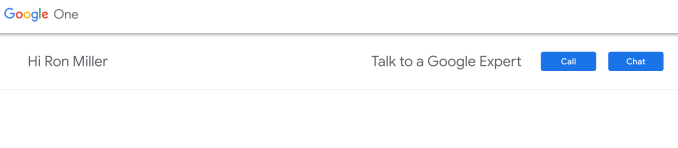
  2. Click the Call button at the top of the screen.
  3. Tell the person who answers that you’re locked out. They should be able to you.

Click the Call button at the top of the screen.

If you don’t have a Google One account, follow these steps:

  1. Go to Google One.
  2. Choose a monthly storage option. You can get started with a 100 gigs of storage for just $1.99 a month.
  3. After you set up your storage, click the Call button and tell them you’re locked out.

While I can’t absolutely guarantee this will help you get your Google account back in short order, I can tell you it worked flawlessly for my colleague and she got back into hers shortly after opening a Google One account. While some may object to paying, if you can afford to spend $23.88 a year for 100 gigs of storage and access to human tech support (for this or any problem you have), it could be well worth it if it solves your issue quickly and gives you overall peace of mind.

01 Feb 2019

Apple fixes FaceTime eavesdrop bug, with software update incoming

Three days after Apple pulled its new Group FaceTime feature offline after users found they could eavesdrop on people before accepting a call, the company says it’s fixed the bug on its end.

“We have fixed the Group FaceTime security bug on Apple’s servers and we will issue a software update to re-enable the feature for users next week,” said Apple in a statement. “We sincerely apologize to our customers who were affected and all who were concerned about this security issue. We appreciate everyone’s patience as we complete this process.”

The bug allowed anyone to swipe up and add themselves to a Group FaceTime call, a new group video feature that Apple introduced last year. TechCrunch verified the bug after it began making the rounds on social media.

To prevent misuse, Apple pulled the plug on Group FaceTime on its servers.

Apple continued: “We want to assure our customers that as soon as our engineering team became aware of the details necessary to reproduce the bug, they quickly disabled Group FaceTime and began work on the fix.”

But the privacy issue came after reports that a 14-year-old from Arizona and his mother tried to report the bug to Apple days before to no avail, citing difficulties in contacting the company.

In Friday’s statement, Apple thanked the Thompson family for reporting the bug,

“We are committed to improving the process by which we receive and escalate these reports, in order to get them to the right people as fast as possible. We take the security of our products extremely seriously and we are committed to continuing to earn the trust Apple customers place in us,” the statement added.

New York’s attorney general Letitia James and governor Andrew Cuomo said they would investigate the incident.

01 Feb 2019

Brexit backer’s insurance firm and leave campaign fined £120k by data watchdog

The UK’s data protection watchdog has issued fines against a pro-Brexit campaign, Leave.EU, and an insurance company owned by the largest individual donor to the leave cause, Arron Banks’ Eldon Insurance.

The penalties have been handed down for what the Information Commissioner’s Office (ICO) dubs “serious breaches of electronic marketing laws” during the 2016 referendum on the UK’s European Union membership. 

The fines — served under the Privacy and Electronic Communications Regulations 2003, which governs electronic marketing — total £120,000 (~$157k); with Leave.EU fined a total of £60k (covering two incidents) and Eldon Insurance £60k.

The ICO’s investigation found the two entities were closely linked and it says systems for segregating the personal data of insurance customers’ from that of political subscribers’ were “ineffective”.

Leave.EU used Eldon Insurance customers’ details unlawfully to send almost 300,000 political marketing messages, according to the ICO’s probe.

Eldon Insurance was also found to have carried out two unlawful direct marketing campaigns which involved the sending of more than a million emails to Leave.EU subscribers without “sufficient consent”.

The ICO says it will now review how both entities are complying with data protection laws by carrying out audits — to observe how personal data is processed; what policies and procedures are in place; and look at the types of training made available for staff.

Key employees across both organisations will also be interviewed, including directors, staff and their data protection officers.

The ICO adds that it will publish its findings when it concludes the audits.

Commenting in a statement, information commissioner Elizabeth Denham, said: “It is deeply concerning that sensitive personal data gathered for political purposes was later used for insurance purposes; and vice versa. It should never have happened. We have been told both organisations have made improvements and learned from these events. But the ICO will now audit the organisations to determine how they are using customers’ personal information.”

The ICO issued a preliminary enforcement notice and three notices of intent to fine Leave.EU and Eldon Insurance trading as Go Skippy Insurance, last November, as part of a wide-ranging investigation into data analytics for political purposes.

“After considering the companies’ representations, the ICO has issued the fines, confirming a change to one amount, with the other two remaining unchanged,” it writes today. “The regulator has also issued two assessment notices to Leave.EU and Eldon Insurance to inform both organisations that they will be audited.”

Banks and associates connected to his unofficial leave campaign remain under investigation by the UK’s National Crime Agency. Last November the NCA announced an investigation into the source of £8M in funding Banks provided to the Leave.EU campaign — after an Electoral Commission investigation found there were reasonable grounds to suspect he was “not the true source” of the money.

The UK introduced legislation back in the year 2000 to outlaw foreign donations, with donors of even a few thousand pounds needing to be both British citizens and on the UK electoral roll for the donations to be legal.

However since then the rise of social media platforms has provided an unregulated workaround for election spending rules by offering a free-for-all conduit for political ads by the backdoor.

And it’s only since major scandals over election interference, such as Kremlin propaganda targeting the 2016 US presidential election, that tech giants have started to pay attention to the problem and introduce some checks on who can run political ads.

Facebook, for example, recently announced it will set up human-staffed operations centers to monitor political news.

In a few markets it’s also launched tools that offer a degree of transparency around who is buying certain types of political ads. But such measures clearly come far too late for Brexit.

A UK parliamentary committee which spend months investigating the issue of online political disinformation — and slammed Facebook for dodging its questions — came out with a laundry list of recommendations for changes to the law in a preliminary report last year, including calling for a levy on social media firms to defend democracy from disinformation.

Although the government rejected the levy, and most of the committee’s recommendations — preferring a ‘wait and see’ approach. (It has previously committed to legislate around social media and safety, though.)

Last year the UK’s election oversight body issued a series of fines for other leave-backed Brexit referendum campaigns — after finding the official Vote Leave campaign had breached election campaign spending limits by undeclared joint working with a youth-focused Brexit campaign, BeLeave.

Almost half a million pounds in illegal overspending was channeled via a Canadian data firm, AggregateIQ, to use for targeting political advertising pushing pro-Brexit ads on Facebook’s platform.

Facebook later released some of the ads that had been used by Brexit campaigns, which included fake claims and dogwhistle racism being used by leave campaigns to stir up fear among voters about foreigners coming to the UK.

The Facebook Cambridge Analytica data misuse scandal which snowballed into a major global scandal last year, also triggered a major ICO investigation into the use of personal data for political campaigning, parts of which remain ongoing.

The watchdog issued a £500,000 fine on Facebook last year, as part of that probe — saying the company had “failed to sufficiently protect the privacy of its users before, during and after the unlawful processing” by Cambridge Analytica.

Though Facebook has filed an appeal, arguing the ICO did not find evidence that any UK users’ data was processed by CA.

Last year information commissioner Elizabeth Denham also called for an “ethical pause” around the use of microtargeting ad tools for political campaigning — saying there was “a risk of developing a system of voter surveillance by default”.

In the case of Facebook, the platform has generally preferred to continue accepting money for political ads, while it works on expanding self-styled “election security” measures.

Although it did temporarily suspend foreign-funded ads during a referendum in Ireland last year on whether to repeal or retain a constitutional ban on abortion — acting after concerns had been raised. It also fast tracked the launch of an ad transparency tool in the market ahead of the vote.

01 Feb 2019

Everyone Raises $100M, Pinterest And Zoom Want To Go Public, And HelloSign

Hello and welcome back to Equity, TechCrunch’s venture capital-focused podcast, where we unpack the numbers behind the headlines.

This week we recorded as a trio: Connie Loizos holding down the studio with our guest, the ever-present Jeff Clavier of Uncork Capital. I dialed in from the what was the East Coast, back before it froze over.

But while the temperature is low over here, the world’s tech news was anything but slow. Indeed, we had to cram a lot into a little bit of time, so here’s the quick overview to follow as you listen:

  • Acorns raised a $105 million Series E. The company, best known for its savings product, does a bit more than just that. With its new capital, the service should have more than enough dosh to work to its own betterment, building a wealthfront for its investors and founders alike. A real square deal, if you will. 
  • Stripe also raised another $100 million, but at its $22.5 billion valuation how much money is that really? Not much!
  • Moving along, it being 2019, we couldn’t avoid chatting about the IPO market. First up was news that Pinterest has bankers. That Big Pint is going public is not a surprise. That this may finally be the year somewhat is; Pinterest has been a perennial IPO possible. We’re excited to see its margins so that we can better grok what it’s worth.
  • And on the IPO front, Zoom is said to be making progress as well. Connie pointed out that 2018 was the year of the enterprise IPO, and that 2019 is looking more consumer-oriented. But that won’t stop Zoom if its S-1 comes in as healthy as we expect it.
  • We ran a bit long (woo!) hitting on the SEC, Barrett Daniels, Uber, and more, but we did wrap talking about the Dropbox-HelloSign deal. More of those please, they’re fun to write about.

A big thanks to Jeff for joining us. Today we had two people on the show who are part of the first name club on Twitter. That was fun.

Hang tight, we’re back in a week!

Equity drops every Friday at 6:00 am PT, so subscribe to us on Apple PodcastsOvercast, Pocket Casts, Downcast and all the casts.

01 Feb 2019

Amazon and Flipkart pull 100,000s of products to comply with new Indian law

Amazon has been forced to pull an estimated 400,000 products in India after new regulation limiting e-commerce businesses went into force in the country today.

First announced at the end of 2018, the new regulation imposes a ban on exclusive sales, prevents retailers from selling products on platforms they count as investors, and it applies restrictions on discounts and cashback promotions.

That’s hugely problematic for Amazon and Flipkart, its rival that’s owned by Walmart following a $16 billion investment last year. After a 2016 ruling prevented it from owning inventory, Amazon restricted its system so that its own products were offered by entities that it jointly owned with local partners. However, the newest regulation forbids it from working with organizations that it has ownership of, hence it is estimated to have pulled as many as 400,000 products from sale in India, according to a New York Times report.

The same report suggests that Flipkart could pull as many as one-quarter of its products in order to comply with the rule, according to analysis from consulting firm Technopak.

Flipkart and Amazon have been unsuccessful with efforts to get a three-month extension to the rules, Bloomberg reported, hence their respective catalogs look very much more sparse today.

Online commerce in the country is tipped to surpass $100 billion per year by 2022, up from $35 billion today, as increasing numbers of Indian citizens come online, according to a report co-authored by PwC. But it looks like 2019 could deliver a major curveball.

01 Feb 2019

A government propaganda app is going viral in China

Besides binge-watching TikTok videos and battling enemies in the magical land of mobile games, many Chinese people may also pass time during the upcoming Lunar New Year on Xuexi Qiangguo, a news and chat app developed by the country’s top ideology officials.

The app managed to top the Chinese App Store between January 22 and 25 before two ByteDance apps pushed it down to the third place this week, download statistics from App Annie shows. At a glance, the news section is almost exclusively about the Communist Party and president Xi Jinping.

xuexi qiangguo

The app is almost exclusively about the Communist Party and president Xi Jinping.

It doubles as an instant messenger, with development support provided by Alibaba’s Dingtalk enterprise communications tool. That means users can log in via their Dingtalk account and chat with their Dingtalk contacts directly over Xuexi Qiangguo.

xuexi qiangguo

The app doubles as a messenger with technical support provided by Alibaba’s Dingtalk.

Directly translated as “studying strengthens the nation,” Xuexi Qiangguo is the product of a research center under China’s Publicity Department, an important organ in charge of how information disseminates in the country. The digital weapon underscores the Communist Party’s growing efforts in recent years to appeal to phone-savvy generations, though the app seems to have peaked.

As of February 1, the iOS version of Xuexi Qiangguo is rated 2.4 out of 5 from 6,810 reviews. Its impressive download number, as it turns out, is in part a result of top-down order. Many early users are Party members or work in China’s giant state apparatus, who were told to install the app. Several users TechCrunch spoke to, including a public school principal, a director of a district party committee and a municipal government official, confirmed that everyone in their organizations must download the app and every now and then, users may get quizzed on relevant content.

Newspapers and social media posts also suggest local governments have mandated downloads among Party members and encouraged the general public to give it a try. Some take a step further to organize offline study sessions for the app. For some context, China had nearly 90 million Communist Party members by the end of 2017.

xuexi qiangguo

A city in Hunan Province has ordered all Party members to install Xuexi Qiangguo, a local newspaper reported. The photo shows a study session held for the app. Source: 衡阳晚报 via Weibo 

“I believe that most of the downloads were incentivized, probably only a very small portion was initiated by a real interest,” says Kristin Shi-Kupfer, director at MERICS, a German think tank specializing in China. “This app will probably drop out of the rankings of any app store soon.”

To engage the younger crowd, the app takes cues from new media forms in China’s flourishing online world. The news section, for instance, appears to be modelled on ByteDance’s popular news app Jinri Toutiao . While Toutiao uses algorithms to understand user preferences and delivers content from a wide array of third-party publications, Xuexi Qiangguo curates from an army of 18 state-controlled outlets.

The app also has a gamified loyalty program, which rewards users virtual points when they complete a task, such as daily sign-in. Since registrations are on a real-name basis, supervisors can check who in their organizations haven’t installed the app, ushering in a new kind of digital monitoring.

“The timing of the publishing of this app might be linked to the upcoming Chinese New Year Festival, which the Chinese Communist Party sees as an opportunity and a necessity to spread their ideology,” notes Shi-Kupfer.” [It] may be hoping that people would use the holiday season to take a closer look, but probably also knowing that most people would rather choose other sources to relax, consume and travel.”