Author: azeeadmin

31 Jan 2019

Facebook users who quit the social network for a month feel happier

New research out of Stanford and New York University took a look at what happens when people step back from Facebook for a month.

Through Facebook, the research team recruited 2,488 people who averaged an hour of Facebook use each day. After assessing their “willingness to accept” the idea of deactivating their account for a month, the study assigned eligible participants to an experimental category that would deactivate their accounts or a control group that would not.

Over the course of the month-long experiment, researchers monitored compliance by checking participants’ profiles. The participants self-reported a rotating set of well being measures in real time, including happiness, what emotion a participant felt over the last 10 minutes and a measure of loneliness.

As the researchers report, leaving Facebook correlated with improvements on well being measures. They found that the group tasked with quitting Facebook ended up spending less time on other social networks too, instead spending more time to offline activities like spending time with friends and family (good) and watching television (maybe not so good). Overall the group reported that it spent less time consuming news in general.

The group that Facebook also reported less time spent on the social network after the study-imposed hiatus was up, suggesting that the break might have given them new insight into their own habits.

“Reduced post-experiment use aligns with our finding that deactivation improved subjective well-being, and it is also consistent with the hypotheses that Facebook is habit forming… or that people learned that they enjoy life without Facebook more than they had anticipated,” the paper’s authors wrote.

There are a few things to be aware of with the research. The paper notes that subjects were told they would “keep [their] access to Facebook Messenger.” Though the potential impact of letting participants remain on Messenger isn’t mentioned again, it sounds like they were still freely using one of the platform’s main functions though perhaps one with fewer potential negative effects on mood and behavior.

Unlike some recent research, this study was conducted by economics researchers. That’s not unusual for social psych-esque stuff like this but does inform aspects of the method, measured used and perspective.

Most important for a bit more context, the research was conducted in the run-up to the 2016 U.S. presidential election. That fact that is likely to have informed participants’ attitudes around social media, both before and after the election.

While the participants reported that they were less informed about current events, they also showed evidence of being less politically polarized, “consistent with the concern that social media have played some role in the recent rise of polarization in the US.”

In an era of ubiquitous threats to quit the world’s biggest social network, the fact remains that we mostly have no idea what our online habits are doing to our brains and behavior. Given that, we also don’t know what happens when we step back from social media environments like Facebook and give our brains a reprieve. With its robust sample size and fairly thorough methodology, this study provides us a useful glimpse into those effects. For more insight into the research, you can read the full paper here.


31 Jan 2019

Don’t worry, this rocket-launching Chinese robo-boat is strictly for science

It seems inevitable that the high seas will eventually play host to a sort of proxy war as automated vessels clash over territory for the algae farms we’ll soon need to feed the growing population. But this rocket-launching robo-boat is a peacetime vessel concerned only with global weather patterns.

The craft is what’s called an unmanned semi-submersible vehicle, or USSV, and it functions as a mobile science base — and now, a rocket launch platform. For meteorological sounding rockets, of course, nothing scary.

It solves a problem we’ve seen addressed by other seagoing robots like the Saildrone: that the ocean is very big, and very dangerous — so monitoring it properly is equally big and dangerous. You can’t have a crew out in the middle of nowhere all the time, even if it would be critical to understanding the formation of a typhoon or the like. But you can have a fleet of robotic ships systematically moving around the ocean.

In fact this is already done in a variety of ways and by numerous countries and organizations, but much of the data collection is both passive and limited in range. A solar-powered buoy drifting on the currents is a great resource, but you can’t exactly steer it, and it’s limited to sampling the water around it. And weather balloons are nice, too, if you don’t mind flying it out to where it needs to be first.

A robotic boat, on the other hand, can go where you need it do and deploy instruments in a variety of ways, dropping or projecting them deep into the water or, in the case of China’s new USSV, firing them 20,000 feet into the air.

“Launched from a long-duration unmanned semi-submersible vehicle, with strong mobility and large coverage of the sea area, rocketsonde can be used under severe sea conditions and will be more economical and applicable in the future,” said Jun Li, a researcher at the Chinese Academy of Sciences, in a news release.

The 24-foot craft, which has completed a handful of near-land cruises in Bohai Bay, was announced in the paper. You may wonder what “semi-submersible” means. Essentially they put as much of the craft as possible under the water, with only instruments, hatches, and other necessary items aboveboard. That minimizes the effect of rough weather on the craft — but it is still self-righting in case it capsizes in major wave action.

The USSV’s early travels.

It runs on a diesel engine, so it’s not exactly the latest tech there, but for a large craft going long distances solar is still a bit difficult to manage. The diesel on board will last it about 10 days and take it around 3,000 km, or 1,800 miles.

The rocketsondes are essentially small rockets that shoot up to a set altitude and then drop a “driftsonde,” a sensor package attached to a balloon, parachute, or some other descent-slowing method. The craft can carry up to 48 of these, meaning it could launch one every few hours for its entire 10-day cruise duration.

The researchers’ findings were published in the journal Advances in Atmospheric Sciences. This is just a prototype, but its success suggests we can expect a few more at the very least to be built and deployed. I’ve asked Li a few questions about the craft and will update this post if I hear back.

31 Jan 2019

Pandora-powered channels will come to SiriusXM’s app this year

SiriusXM this week offered a few more details on how it plans to leverage its newest asset, Pandora, following its $3.5 billion acquisition of the streaming music service last year, which officially closes on Friday. At the time of the deal, the company spoke about the potential for cross-promotion opportunities between the services and new subscription packages. Now, those efforts are getting off the ground — starting with a promotion within the Pandora app for SiriusXM subscriptions, followed by the launch of Pandora channels within the SiriusXM app.

Currently, SiriusXM offers a variety of programming packages, ranging from a cheaper ($11/mo) “Mostly Music” sampling of channels all the way up to a premium “All Access” ($21/mo) subscription. It also runs various time-limited promotions that offer its service for as little as $5 per month for a set period, like six months.

According to Sirius XM CEO James Meyer — speaking to investors on the Q4 earnings call on Wednesday — the company will now start promoting special SiriusXM packages to Pandora listeners.

The company, he said, intends “to capitalize on cross-promotion opportunities between SiriusXM’s more than 36 million subscribers across North America and Pandora’s approximately 70 million monthly active users. In early February, we will begin a targeted promotion to SiriusXM subscribers and Pandora listeners,” he noted. “Select Pandora listeners will receive an offer to obtain a unique $5 a month ‘Mostly News,’ ‘Mostly Music’ or ‘News Talk’ [SiriusXM subscription] package in their satellite-equipped vehicle.”

In other words, SiriusXM will be pushing low-cost $5 per month streaming plans within the Pandora app itself.

The company believes the cross-promotions will be successful because of the overlap in the two services’ customer bases. It found that approximately half of the owners of the SiriusXM-enabled vehicle fleet of 100 million cars have used Pandora in the past two years, for example. SiriusXM aims to leverage those Pandora listeners’ data in order to convert, retain or bring them back to SiriusXM.

In addition, the exec said that existing SiriusXM subscribers would receive extended 14-day trials to Pandora’s Premium service.

By mid-2019, the company plans to launch a new Pandora-powered channel within its own SiriusXM app, based on their favorite artist. It will also add a new radio channel to the SiriusXM app that’s driven by the latest trends from Pandora’s “billions of thumbs” — meaning the “thumbs up” (likes), songs receive within the streaming app.

Meyer spoke briefly about the challenges facing Pandora — specifically a decline in listening hours, which SiriusXM believes can be fixed by improving Pandora’s in-car listening statistics, making the Pandora app more compelling, and adding more content.

“This is just the beginning. We expect, over time, to create new, unique audio packages that will bring together the best of both services, creating a powerful platform for artists to reach their fans and to create new audiences,” said Meyer.

The merger of the two companies has not been without upheaval, though.

This week, the company announced that Pandora CEO Roger Lynch and other executives would be stepping down, including general counsel Steve Bene, CFO Naveen Chopra and chief human resources officer Kristen Robinson. Meyer will instead lead the combined company, he said, in order to streamline decision-making and increase the speed of the integrations.

SiriusXM reported record revenues for the fourth quarter and year, at $1.5 billion and $5.8 billion, respectively. Net income was $251 million for the quarter, up from a loss of $37 million in the year-ago period. Full-year 2018 net income grew 81 percent to a record $1.2 billion.

The newly combined company will have more than 100 million listeners in North America, with nearly 40 million self-paying subscribers and more than 75 million on trials or using ad-based products.

31 Jan 2019

Sources: Clutter is raising $200-250M led by SoftBank for on-demand storage and moving

Marie Kondo’s rise as a cultural icon shows there’s big business to be had in sorting out a mess. And startups are also hoping to get in on the action.

TechCrunch has learned that Clutter, a storage-on-demand service that packs up, takes away, stores and returns your possessions at the click of an app, is raising between $200 million and $250 million in funding.

Sources tell us that term sheets are out but have yet to be finalised while investors go through due diligence, and that currently the plan is for the round to be led by SoftBank.

Clutter’s CEO and co-founder Ari Mir declined to comment for this story, as did SoftBank. Other investors contacted for the story did not respond.

Clutter last raised money in 2017, when it picked up $64 million from backers that included Atomico, GV, Sequoia and Fifth Wall. Pitchbook notes that the round was done at a $240 million post-money valuation. That could give Clutter a valuation of between $400 million and $500 million in this latest round — a figure our sources also mentioned.

Clutter currently operates in the Bay Area, Southern California, Seattle, New York and Chicago, and it’s likely that this funding could be used to help it expand to more regions.

For it and a number of its competitors, the target users are consumers based in urban areas who live in smaller spaces with less storage options; have the disposable income not only to buy stuff but to pay to keep it somewhere else; and likely already use of other app-based on-demand services for food, transport, work-space and so on, making them familiar and ready to work with startups offering the same services to manage their material possessions.

But the business of storage on demand is nothing short of, well, cluttered.

For starters, there are a lot of startups in the space angling to take on a wide array of incumbents like Public Storage, U-Haul and others that offer services to clear away your possessions and store them in lockers. In a market estimated to be worth some $40 billion annually, other hopefuls include MakeSpace, OmniTrove, Livible, and Closetbox.

As with other on-demand e-commerce services like transportation, accommodation and food delivery, there is a race for economy of scale and market penetration. In the case of storage, that race includes working with or building facilities where space can be filled out in the most optimised way, as well as building the most efficient tech platform to manage the safe collection, storage and retrieval of people’s items. That’s before the human aspect of the service is considered. As with other on-demand collaborative economy startups, Clutter and its competitors rely on being able to hire the right people to get the job done well.

Clutter will be hoping that a big cash infusion will help it come out ahead in all of these areas: when and if this round closes, it will have raised more funding than the rest of its (many) startup competitors combined.

But the business of moving things is also tricky for an other reason: companies are dealing in people’s personal possessions, and so when something doesn’t go right — an item is lost or broken in the process, for example — the bad experience takes on an especially emotional angle.

Clutter may be the biggest in its category, but it has had its share of negative feedback on platforms like Yelp, Trustpilot and Twitter. It can be hard to vet the truth of all public comments, but it will be interesting to see how and if customer feedback plays a role in the company closing this round and its bigger efforts to scale.

As with other on-demand startups, there is also the fact that it can be a capital-intensive business. From what we understand, Clutter has been working on this round for a while and had to downsize last year to cut down on its burn rate.

Others in the space have been tackling liquidity in other ways that also speak to some of the shifting and experimental nature of this still-young market. Omni — a storage company that also lets people rent out their possessions while they are not using them — last year took an investment from executives at Ripple and struck a partnership with the XRP company. Now it’s offering users an option to get paid in XRP instead of cash when they rent out their items.

The fact that SoftBank is the investor name that has come up to lead this round for Clutter underscores characteristics in common with other recent SoftBank investments.

Armed with hundreds of millions of dollars to invest across the tech industry, SoftBank has developed a reputation for wading into areas of e-commerce and other tech fields crowded with competition that will likely see inevitable consolidation — and it invests in the startup that it believes will be the winner, a pattern we’ve seen at Uber, WeWork, Fair, DoorDash, Compass and many more.

If all goes to plan, SoftBank’s investment, in turn, becomes something of a self-fulfilling prophecy. It’s not just a financial boost to help the startup grow, but also — given that it’s SoftBank — a mark of confidence to other investors that the business is solid and supported for the longer haul.


31 Jan 2019

Rana el Kaliouby and Alexei Efroswill be speaking at TC Sessions: Robotics + AI April 18 at UC Berkeley

TechCrunch’s third robotics event is just over two and a half months away, and it’s already shaping up to be a doozy. We’ve already announced Anca Dragan, Hany Farid, Melonee Wise and Peter Barrett for our event and have an exciting pair of new names to share with you.

UC Berkeley’s Alexei Efros and Affectiva CEO Rana el Kaliouby will be joining us at Zellerbach Hall on April 18 for TC Sessions: Robotics+AI.

Alexei Efros is a professor at UC Berkeley’s Electrical Engineering and Computer Sciences and a member of the school’s Artificial Intelligence Research Lab. His work focuses on computer vision, graphics and computational photography, utilizing visual data to help better understand the world. Efros also researches robotics, machine learning and the use of computer vision in the humanities. Prior to joining UC Berkeley, he was member of CMU’s Robotics Institute.

Rana el Kaliouby is the cofounder and CEO of Affectiva, an MIT Media Lab spinoff that creates softs signed designed to recognize human emotions. el Kaliouby designed the startup’s underlying technology, which helps bring more depth and understanding to facial recognition. Prior to cofounding the company, she worked as an MIT research scientist, cofounding the school’s Autism & Communication Technology Initiative.

Early-Bird tickets are on sale now for just $249 – that’s $100 off full-priced tickets. Buy yours today here. Students can book a deeply discounted ticket for just $45 here.

31 Jan 2019

Digital influencers and the dollars that follow them

Animated characters are as old as human storytelling itself, dating back thousands of years to cave drawings that depict animals in motion. It was really in the last century, however—a period bookended by the first animated short film in 1908 and Pixar’s success with computer animation with Toy Story from 1995 onwards—that animation leapt forward. Fundamentally, this period of great innovation sought to make it easier to create an animated story for an audience to passively consume in a curated medium, such as a feature-length film.

Our current century could be set for even greater advances in the art and science of bringing characters to life. Digital influencers—virtual or animated humans that live natively on social media—will be central to that undertaking. Digital influencers don’t merely represent the penetration of cartoon characters into yet another medium, much as they sprang from newspaper strips to TV and the multiplex. Rather, digital humans on social media represent the first instance in which fictional entities act in the same plane of communication as you and I—regular people—do. Imagine if stories about Mickey Mouse were told over a telephone or in personalized letters to fans. That’s the kind of jump we’re talking about.

Social media is a new storytelling medium, much as film was a century ago. As with film then, we have yet to transmit virtual characters to this new medium in a sticky way.

Which isn’t to say that there aren’t digital characters living their lives on social channels right now. The pioneers have arrived: Lil’ Miquela, Astro, Bermuda, and Shudu are prominent examples. But they have are still only notable for their novelty, not yet their ubiquity. They represent the output of old animation techniques applied to a new medium. This Techcrunch article did a great job describing the current digital influencer landscape.

So why haven’t animated characters taken off on social media platforms?  It’s largely an issue of scale—it’s expensive and time-consuming to create animated characters and to depict their adventures.  One 2017 estimate stated that a 60-90 second animation took about 6 weeks.  An episode of animated TV takes between 13 months to produce, typically with large teams in South Korea doing much of the animation legwork. That pace simply doesn’t work in a medium that calls for new original content multiple times a day.

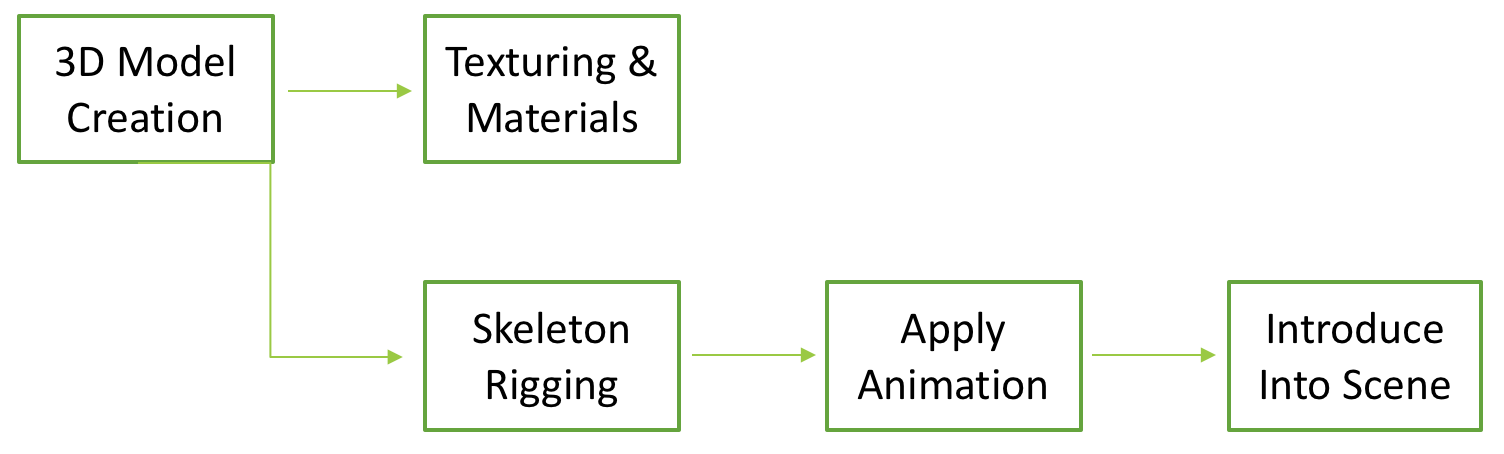
Yet the technical piece of the puzzle is falling into place, which is primarily what I want to talk about today. Traditionally, virtual characters were created by a team of experts—not scalable—in the following way:

  • Create a 3D model
  • Texture the model and add additional materials
  • Rig the 3D model skeleton
  • Animate the 3D model
  • Introduce character into desired scene


Today, there are generally three different types of virtual avatar:  realistic high-resolution CGI avatars, stylized CGI avatars, and manipulated video avatars. Each has its strengths and pitfalls, and the fast-approaching world of scaled digital influencers will likely incorporate aspects of all three.

The digital influencers mentioned above are all high-resolution CGI avatars. It’s unsurprising that this tech has breathed life into the most prominent digital influencers so far—this type of avatar offers the most creative latitude and photorealism. You can create an original character and have her carry out varied activities.

The process for their creation borrows most from the old-school CGI pipeline described above, though accelerated through the use of tools like Daz3D for animation, Moka Studio for rigging, and Rokoko for motion capture. It’s old wine in new bottles. Naturally, it shares the same bottlenecks as the old-school CGI pipeline: creating characters in this way consumes a lot of time and expertise.

Though researchers like Ari Shapiro at the University of Southern California Institute for Creative Technologies are currently working on ways to automate the creation of high-resolution CGI avatars, that bottleneck remains for obstacle for digital influencers entering the mainstream.

Stylized CGI avatars, on the other hand, have entered the mainstream. If you have an iPhone or use Snapchat, chances are you have one. Apple, Samsung, Pinscreen, Loom.ai, Embody Digital, Genies, and Expressive.ai are just some of the companies playing in this space. These avatars, while likely to spread ubiquitously a la Bitmoji before them, are limited in scope.

While they extend the ability to create an animated character to anyone who uses an associated app, that creation and personalization is circumscribed: the avatar’s range is limited for the purposes of what we’re discussing in this article. It’s not so much a technology for creating new digital humans as it is a tool for injecting a visual shorthand for someone into the digital world. You’ll use it to embellish your Snapchat game, but storytellers will be unlikely to use these avatars to create a spiritual successor to Mickey Mouse and Buzz Lightyear (though they will be a big advertising / brand partnership opportunity nonetheless).

Video manipulation—you probably know it as deepfakes—is another piece of tech that is speeding virtual or fictional characters into the mainstream. As the name implies, however, it’s more about warping reality to create something new. Anyone who has seen Nicolas Cage’s striking features dropped onto Amy Adams’ body in a Superman film will understand what I’m talking about.

Open source packages like this one allow almost anyone to create a deepfake (with some technical knowhow—your grandma probably hasn’t replaced her time-honored Bingo sessions with some casual deepfaking). It’s principally used by hobbyists, though recently we’ve seen startups like Synthesia crop up with business use cases. You can use deepfake tech for mimicry, but we haven’t yet seen it used for creating original characters. It shares some of the democratizing aspects of stylized CGI avatars, and there are likely many creative applications for the tech that simply haven’t been realized yet.

While none of these technology stacks on their own currently enable digital humans at scale, when combined they may make up the wardrobe that takes us into Narnia. Video manipulation, for example, could be used to scale realistic high-res characters like Lil’ Miquela through accelerating the creation of new stories and tableaux for her to inhabit. Nearly all of the most famous animated characters have been stylized, and I wouldn’t bet against social media’s Snow White being stylized too. What is clear is that the technology to create digital influencers at scale is nearing a tipping point. When we hit that tipping point, these creations will transform entertainment and storytelling.

31 Jan 2019

Daily Crunch: Facebook beats Wall Street estimates

The Daily Crunch is TechCrunch’s roundup of our biggest and most important stories. If you’d like to get this delivered to your inbox every day at around 9am Pacific, you can subscribe here:

1. Facebook shares shoot up after strong Q4 earnings despite data breach

Facebook managed to beat Wall Street’s estimates in its Q4 earnings despite a seemingly constant beatdown in the press.

The company said it hit 2.32 billion monthly users, up 2.2 percent from 2.27 billion last quarter, speeding up its growth rate. And it earned $16.91 billion off all those users, with $2.38 in GAAP earnings per share.

2. Robert Swan named Intel CEO

Half a year after being named interim CEO, Bob Swan is taking the job full-time. He stepped into the interim role as word emerged of then-CEO Brian Krzanich’s “past consensual relationship” with an employee.

3. New York cracks down on companies that sell fake followers

The office of New York Attorney General Letitia James has reached a settlement with Devumi, a company that made millions selling fake followers to unsuspecting customers. The state of New York found that Devumi had engaged in illegal deception and illegal impersonation in the course of fluffing up social media profiles with its automated accounts.

google paying users

Image: Bryce Durbin/TechCrunch

4. Google will stop peddling a data collector through Apple’s back door

It looks like Facebook wasn’t the only one abusing Apple’s system for distributing employee-only apps to sidestep the App Store and collect extensive data on users.

5. Google+ for consumers will shut down on April 2nd

Speaking of Google: It’s no secret that the company planned to pull life support from the consumer version of Google+ in April. Until now, though, we didn’t know the exact date.

6. Cheap Internet of Things gadgets betray you even after you toss them in the trash

It’s not just while they’re plugged in that these slapdash gadgets are a security risk — even from the garbage can, they can still compromise your network.

7. Hulu announces a new ad unit that appears when you pause

Yes, Hulu is introducing an ad unit that will show up when you pause a video. But no, the ad won’t be a video.

31 Jan 2019

WashU announces donation from Square co-founder to grow engineering school

Washington University in St. Louis (WashU) announced today that its engineering school received its largest single donation in history. The donation was offered by Square co-founder and WashU alumni Jim McKelvey, for whom the school will be renamed, from the School of Engineering & Applied Science to The James McKelvey School of Engineering.

WashU did not disclose the donated amount and historically does not disclose financial information.

McKelvey has deep ties to his alma mater. McKelvey’s father, Jim McKelvey Sr., was a professor at the WashU School of Engineering for 23 years, before serving as its dean for an additional 27 years. In 2017, McKelvey donated $15 million for a new engineering building that will bear his father’s name. The serial entrepreneur is determined to improve the reach of the school to which he attributes much of his success – since it was there where he first fell in love with computer science.

“This is such a fantastic place to study,” McKelvey told TechCrunch regarding his time as an undergraduate. “At the time, I had no plans to be an engineer. I came in as an economics major and then discovered the engineering school.”

WashU is already one of the top private research universities in the country and its engineering school – which provides 40 different degree programs led by roughly 230 professors — represents the university’s second largest concentration of undergraduate enrollment. STEM majors and careers have continued to grow more popular – yet the supply of education and talent hasn’t kept up. The fight for talent in the Valley remains harder than ever and by 2020, the number of unfilled computing jobs is expected to reach one million. With the incremental capital and its connection to major McKelvey leaders like McKelvey, WashU hopes the donation can help the school satisfy the demand for high-quality technical education and seriously enhance its position as an elite engineering university.

Though the funds are not tied to any particular spending requirements and can be used flexibly, the school plans to use the money primarily to fund scholarships and faculty recruitment, retention and research. Additionally, McKelvey’s donation will be key to WashU’s initiative of expanding opportunities for interdisciplinary study between the engineering school and other departments.

In a conversation with TechCrunch, the engineering school’s dean, Aaron Bobick, highlighted his hope for inter-department concentrations involving Economics and Computing, Finance and Systems Engineering and various other combinations. “Engineering is a way of thinking and we need to produce folks that sit at the intersection of all these disciplines,” said Bobick.

WashU also hopes to allocate a portion of the donation towards increasing community engagement and establishing partnership programs with the growing tech ecosystem in St. Louis. “We need to be a place where the quality of both our impact and the people we produce is clear to everyone. We want to do more and do it at a higher level.” 

In the school’s release, Bobick outlined his large ambitions for the McKelvey School of Engineering:

“We are extraordinarily grateful to Jim Jr. and his family for their incredible history of generosity to the engineering school. Particularly now, while we stand poised to truly transform our approach to research, innovation and learning, this new commitment will allow us to advance the McKelvey School of Engineering into the next tier of top engineering programs in this country and the world. This tremendous gift creates new opportunities for our students and faculty to tackle the world’s greatest engineering challenges, and to dramatically expand computing throughout the university. At the same time, it helps ensure that a diverse population of students will have access to a world-class engineering education, and enable the school to be a catalyst for economic development for the St. Louis region and beyond.”

The donation represents the latest in a series of large gifts to universities with a focus on enhancing resources in STEM fields. WashU has also been pushing the expansion of its engineering school through a number of other avenues, having invested over $250 million since 2000, which includes 700,000 square feet in new engineering facilities, with two new academic buildings set to open in 2019 and 2020.

31 Jan 2019

Uber’s transit offering just went live in Denver

Uber, after announcing its intentions to get into public transit last April, is ready to launch in Denver. In partnership with the Regional Transportation District and transit data provider Moovit, residents of Denver will now be able to navigate public transportation within the Uber app.

For transit, Uber is serving two sets of customers: agencies and riders. For both sets, Uber is aiming to increase efficiency, enhance the experience, and increase equity and accessibility, Uber Head of Transit David Reich told TechCrunch over the phone.

Initially, the ability to purchase tickets via the Uber app won’t be available, but it’s on the horizon. The in-app ticketing portion, in partnership with Masabi, will be available in the coming weeks, Reich said.

“You’ll have that full end-to-end experience,” Reich said. “We’re trying to take the stress out of traveling so you don’t have to worry about waiting in line [for a ticket] and missing the train.”

While Uber is only launching this in Denver today, Masabi handles ticketing for 30 transportation agencies worldwide, including Los Angeles’ Metrolink, New York’s MTA, London’s Thames Clippers and Boston’s MBTA. Uber also has relationships with a number of cities already, Reich said.

“We’ve been speaking with dozens of transit agencies around the world,” he said. “Denver was super innovative, very future-thinking and was a great city to partner with.”

Moving forward, Reich says to expect to see Transit launch in more cities in the coming months. This is all part of Uber’s new efforts, under the leadership of CEO Dara Khosrowshahi, to become a mulit-modal transportation provider. In April, when Khosrowshahi first announced Transit, he said,

“Whether you’re using mass transit for your morning commute, taking an e-bike for a mid-day meeting, using Pool to take a ride home or renting a car for the weekend,” Khosrowshahi said at the press event in D.C. today, “we want Uber to be there with you and we want to partner with cities to be part of our solution moving forward.”

31 Jan 2019

Google’s Cloud Firestore NoSQL database hits general availability

Google today announced that Cloud Firestore, its serverless NoSQL document database for mobile, web and IoT apps, is now generally available. In addition, Google is also introducing a few new features and bringing the service to ten new regions.

With this launch, Google is giving developers the option to run their databases in a single region. During the beta, developers had to use multi-region instances and while that obviously has some advantages with regard to resilience, it’s also more expensive and not every app needs to run in multiple regions.

“Some people don’t need the added reliability and durability of a multi-region application,” Google product manager Dan McGrath told me. “So for them, having a more cost-effective regional instance is very attractive, as well as data locality and being able to place a Cloud Firestore database as close as possible to their user base.”

The new regional instance pricing is up to 50 percent cheaper than the current multi-cloud instance prices. Which solution you pick does influence the SLA guarantee Google gives you, though. While the regional instances are still replicated within multiple zones inside the region, all of the data is still within a limited geographic area. Hence, Google promises 99.999 percent availability for multi-region instances and 99.99 percent availability for regional instances.

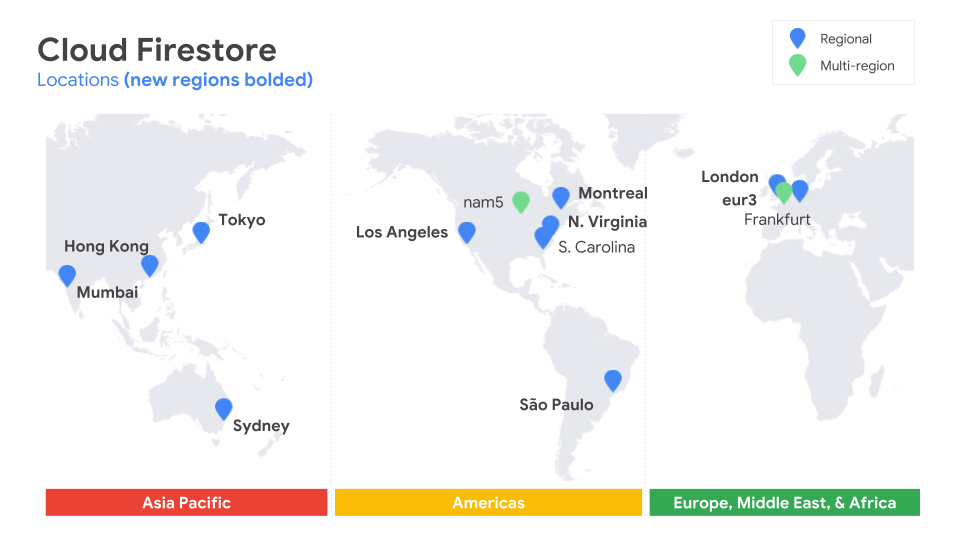
And talking about regions, Cloud Firestore is now available in ten new regions around the world. Firestore launched with a single location when it launched and added two more during the beta. With this, Firestore is now available in 13 locations (including the North America and Europe multi-region offerings). McGrath tells me Google is still in the planning phase for deciding the next phase of locations but he stressed that the current set provides pretty good coverage across the globe.

Also new in this release is deeper integration with Stackdriver, the Google Cloud monitoring service, which can now monitor read, write and delete operations in near-real time. McGrath also noted that Google plans to add the ability to query documents across collections and to increment database values without needing a transaction soon.

It’s worth noting that while Cloud Firestore falls under the Googe Firebase brand, which typically focuses on mobile developers, Firestore offers all of the usual client-side libraries for Compute Engine or Kubernetes Engine applications, too.

“If you’re looking for a more traditional NoSQL document database, then Cloud Firestore gives you a great solution that has all the benefits of not needing to manage the database at all,” McGrath said. “And then, through the Firebase SDK, you can use it as a more comprehensive back-end as a service that takes care of things like authentication for you.”

One of the advantages of Firestore is that it has extensive offline support, which makes it ideal for mobile developers but also IoT solutions. Maybe it’s no surprise then that Google is positioning it as a tool for both Google Cloud and Firebase users.