Author: azeeadmin

31 Jan 2019

Binance now lets users buy crypto with a credit card

Binance, the world’s largest crypto exchange based on trading volume, will now let you spend money you don’t have after it added support for credit cards from Visa and Mastercard.

Credit card usage in crypto is controversial. Aside from the risk — ask anyone who bought crypto last year… — top exchanges have gone back and forth on support. Coinbase, for example, stopped allowing credit card purchases a year ago but, when it still allowed them, customers were found to have incurred additional charges.

With many crypto owners getting “rekt” by a slump that has seen the market crash by around 90 percent, with some tokens now effectively worthless, the winds of change in the bear market are interesting to observe.

Coinbase is abandoning its conservative approach to the coins that it lists, while Binance — which operates on the opposite scale with support for a glut of tokens — has moved from being crypto-only to offer fiat currency options to customers. Support for credit cards is a major part of that and it brings Coinbase and Binance into direct competition for the first time.

The company, which is officially based in Malta, has opened fiat currency trading outposts in Uganda and Jersey, and it has plans to add similar ramps in Liechtenstein, Singapore and other places.

CEO Changpeng Zhao told TechCrunch last year that Binance plans to grow to 10 fiat exchanges in 2019, with “ideally two per continent.” Part of the strategy is to help larger, institutional investors bring money into the crypto ecosystem, a move that he believes will boost Binance and the crypto industry generally.

The credit card support has come via a partnership with crypto-focused payment company Simplex, but there are caveats.

Credit cards can only be used to purchase a limited set of tokens, those are Bitcoin, Ethereum, Litecoin and Ripple’s XRP.

There are also geographical limitations. The Simplex service isn’t supported in some countries, while, in the U.S., it doesn’t cover the following states: New York, Georgia, Connecticut, New Mexico, Hawaii, and Washington.

Finally, support for banks is not universal, too, which means that some users will not be able to buy on Binance using their credit card.

Those that can are charged a 3.5 percent fee and must wait 10-30 minutes for their tokens, a Binance spokesperson confirmed to TechCrunch. Once purchased, those tokens can be freely traded on Binance, which claims to list over 150 cryptocurrencies.

Still, the move may bolster the exchange’s trading volume which, while still the highest in the industry, has dropped below $1 billion per day in recent times.

At the time of writing, the exchange had traded some $666 million worth of crypto in the last 24 hours, according to data from CoinMarketCap. A lot of that depression is down to the market plummet, which has seen the overall value of that trading volumes fall and reduced consumer interest in trading, but giving more people the tools to buy might offset that somewhat.

“The crypto industry is still in its early stages and most of the world’s money is still in fiat. Building fiat gateways is what we need now to grow the ecosystem, increase adoption and introduce crypto to more users,” Zhao said in a canned statement.

Note: The author owns a small amount of cryptocurrency. Enough to gain an understanding, not enough to change a life.

31 Jan 2019

Social media should have “duty of care” towards kids, UK MPs urge

Social media platforms are being urged to be far more transparent about how their services operate and to make “anonymised high-level data” available to researchers so the technology’s effects on users — and especially on children and teens — can be better understood.

The calls have been made in a report by the UK parliament’s Science and Technology Committee which has been looking into the impacts of social media and screen use among children — to consider whether such tech is “healthy or harmful”.

“Social media companies must also be far more open and transparent regarding how they operate and particularly how they moderate, review and prioritise content,” it writes.

Concerns have been growing about children’s use of social media and mobile technology for some years now, with plenty of anecdotal evidence and also some studies linking tech use to developmental problems, as well as distressing stories connecting depression and even suicide to social media use.

Although the committee writes that its dive into the topic was hindered by “the limited quantity and quality of academic evidence available”. But it also asserts: “The absence of good academic evidence is not, in itself, evidence that social media and screens have no effect on young people.”

“We found that the majority of published research did not provide a clear indication of causation, but instead indicated a possible correlation between social media/screens and a particular health effect,” it continues. “There was even less focus in published research on exactly who was at risk and if some groups were potentially more vulnerable than others when using screens and social media.”

The UK government expressed its intention to legislate in this area, announcing a plan last May to “make social media safer” — promising new online safety laws to tackle concerns.

The committee writes that it’s therefore surprised the government has not commissioned “any new, substantive research to help inform its proposals”, and suggests it get on and do so “as a matter of urgency” — with a focus on identifying people at risk of experiencing harm online and on social media; the reasons for the risk factors; and the longer-term consequences of the tech’s exposure on children.

It further suggests the government should consider what legislation is required to improve researchers’ access to this type of data, given platforms have failed to provide enough access for researchers of their own accord.

The committee says it heard evidence of a variety of instances where social media could be “a force for good” but also received testimonies about some of the potential negative impacts of social media on the health and emotional wellbeing of children.

“These ranged from detrimental effects on sleep patterns and body image through to cyberbullying, grooming and ‘sexting’,” it notes. “Generally, social media was not the root cause of the risk but helped to facilitate it, while also providing the opportunity for a large degree of amplification. This was particularly apparent in the case of the abuse of children online, via social media.

“It is imperative that the government leads the way in ensuring that an effective partnership is in place, across civil society, technology companies, law enforcement agencies, the government and non-governmental organisations, aimed at ending child sexual exploitation (CSE) and abuse online.”

The committee suggests the government commission specific research to establish the scale and prevalence of online CSE — pushing it to set an “ambitious target” to halve reported online CSE in two years and “all but eliminate it in four”.

A duty of care

A further recommendation will likely send a shiver down tech giants’ spines, with the committee urging a duty of care principle be enshrined in law for social media users under 18 years of age to protect them from harm when on social media sites.

Such a duty would up the legal risk stakes considerably for user generated content platforms which don’t bar children from accessing their services.

The committee suggests the government could achieve that by introducing a statutory code of practice for social media firms, via new primary legislation, to provide “consistency on content reporting practices and moderation mechanisms”.

It also recommends a requirement in law for social media companies to publish detailed Transparency Reports every six months.

It is also for a 24 hour takedown law for illegal content, saying that platforms should have to review reports of potentially illegal content and take a decision on whether to remove, block or flag it — and reply the decision to the individual/organisation who reported it — within 24 hours.

Germany already legislated for such a law, back in 2017 — though in that case the focus is on speeding up hate speech takedowns.

In Germany social media platforms can be fined up to €50 million if they fail to comply with the NetzDG law, as its truncated German name is known. (The EU executive has also been pushing platforms to remove terrorist related material within an hour of a report, suggesting it too could legislate on this front if they fail to moderate content fast enough.)

The committee suggests the UK’s media and telecoms regulator, Ofcom would be well-placed to oversee how illegal content is handled under any new law.

It also recommends that social media companies use AI to identify and flag to users (or remove as appropriate) content that “may be fake” — pointing to the risk posed by new technologies such as “deep fake videos”.

More robust systems for age verification are also needed, in the committee’s view. It writes that these must go beyond “a simple ‘tick box’ or entering a date of birth”.

Looking beyond platforms, the committee presses the government to take steps to improve children’s digital literacy and resilience, suggesting PSHE (personal, social and health) education should be made mandatory for primary and secondary school pupils — delivering “an age-appropriate understanding of, and resilience towards, the harms and benefits of the digital world”.

Teachers and parents should also not be overlooked, with the committee suggesting training and resources for teachers and awareness and engagement campaigns for parents.

31 Jan 2019

Poor smartphones sales drag LG to first quarterly loss in 2 years

We’ve written extensively about LG’s struggling mobile business, which has suffered at the hands of aggressive Chinese Android makers, and now that unit has dragged its parent company into posting its first quarterly loss for two years.

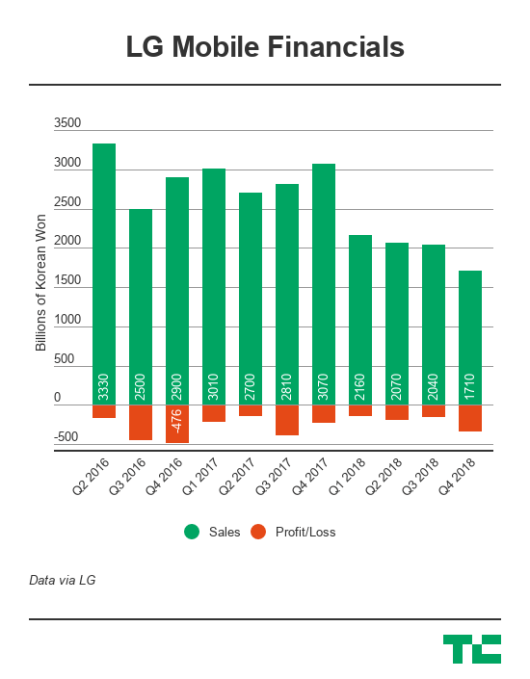
The Korean electronics giant is generally in good health — it posted a $2.4 billion profit for 2018 — but its smartphone business’s failings saw it post a loss in Q4 2018, its first quarterly negative since Q4 2016.

Overall, the company posted a KRW 75.7 billion ($67.1 million) operating loss as revenue slid seven percent year-on-year to KRW 15.77 trillion ($13.99 billion). LG said the change was “primarily due to lower sales of mobile products.”

We’ve known for some time that LG’s mobile business is strugglingthe division got another new head last November — but things went from bad to worse in Q4. LG Mobile saw revenue fall by 42 percent to reach KRW 1.71 trillion, $1.51 billion. The operating loss for the period grew to KRW 322.3 billion, or $289.8 million, from KRW 216.3 billion, $194 million, one year previous.

Over the full year, LG Mobile posted a $700 million loss (KRW 790.1 billion) but the company claimed things are improving thanks to “better material cost controls and overhead efficiencies based on the company’s platform modularization strategy.”

LG used CES to showcase a range of home entertainment products — that division is doing far better than mobile, with a record annual profit of $1.35 billion in 2018 — so we’ll have to wait until Mobile World Congress in February to see exactly what LG has in mind. Already, though, we have a suggestion and it isn’t exactly set-the-world-on-fire stuff.

“LG’s mobile division will push 5G products and smartphones featuring different form factors while focusing on key markets where the LG brand remains strong,” the company said in a statement.

It will certainly take something very special to turn things around. It seems more likely that LG Mobile head Brian Kwon — who also heads up that hugely-profitable home entertainment business — will focus on cutting costs and squeezing out the few sweet spots left. Continued losses, particularly against success from other units, might eventually see LG shutter its mobile business.

Still, things could be worse for LG, it could be HTC.

31 Jan 2019

Dadi brings in $2M to democratize sperm storage

The founders of Dadi — pronounced daddy — think men are in need of a wake-up call.

“Men [have] a biological clock just like women, which is something that people don’t talk about,” Dadi co-founder and chief executive officer Tom Smith told TechCrunch. “Infertility isn’t a women’s issue; It’s both a men’s and women’s issue.”

Smith believes Dadi, the provider of a temperature-controlled at-home fertility test and sperm collection kit, will encourage men to contribute to family planning conversations and become more aware of their reproductive health. The startup is officially launching its kit and long-term sperm storage service today with nearly $2 million in venture capital funding from London-based seed fund firstminute capital and New York-based Third Kind Venture Capital.

“Our mission is to normalize the conversation around male fertility and reproductive health, and empower men with knowledge of fertility so they can have that conversation with their family,” Smith said.

Here’s how it works: Dadi customers order a kit online, masturbate and collect their sperm within the comfort of their own homes, drop it off with FedEx and wait for a full fertility report, which comes with a microscopic video of the each man’s actual sperm. To survive the trip to the startup’s laboratory — the New England Cryogenic Center — the Dadi-designed container injects preservatives, which are nested in the lid of the cup, into the sperm sample.

Headquartered in Brooklyn, Dadi’s service is FDA-licensed in all 50 states and costs a total of $198, including a test and one-year of sperm storage.

Dadi’s co-founding team includes Mackey Saturday, a graphic designer who created Instagram’s logo, and Gordon von Steiner, a former creative director in the fashion industry. The team has prioritized design and messaging of the product, in addition to security, privacy and high medical standards.

“We aren’t trying to sell hair pills, we are actually interacting with customers at a very vulnerable part of their life,” Smith said. “We feel like our value set, approach and thoughtfulness really differentiate us from anyone else in the space.”

One in 6 U.S. couples struggles with fertility, with male factor infertility a cause of 30 percent of those cases, per ReproductiveFacts.org. Startups want to improve these statistics, targeting an industry that’s trapped in the 1980s.

“We are in the direct-to-consumer era,” Smith said. “We reached peak app a couple years ago and I think a lot of the innovation that’s happening in the space comes down to individualized services.”

Dadi joins a cadre of privately-funded male fertility or men’s health businesses. Hims, the provider of direct-to-consumer erectile dysfunction (ED) and hair loss medication, leads the pact. The 2-year-old business entered the unicorn club last week with a $100 million investment. Ro, formerly known only as Roman, sells ED medication online, too, and has raised a total of $91 million. Legacy, which freezes men’s sperm, recently won TechCrunch’s very own Startup Battlefield competition in Berlin. And Manual, an educational portal and treatment platform for men’s issues, raised a £5 million seed round earlier this month from Felix Capital, Cherry Ventures and Cassius Capital.

It’s clear that VCs have woken up to the opportunity to disrupt fertility with tech-enabled solutions to age-old issues and now, entrepreneurs passionate about helping men broach sensitive topics, from infertility to erectile dysfunction to hair loss and more, are able to gain ground.

Here’s to more funding for women’s health businesses, which are in dire need of innovation, too.

31 Jan 2019

Uber driven out of Barcelona again

Uber is suspending its professional taxi service in Barcelona from tomorrow almost a year after it re-entered the Catalan capital.

The move follows the regional government agreeing new regulations for the vehicle for hire (VTC) sector aimed at making sure they do not compete directly with taxis.

“The new restrictions approved by the Catalan Government leave us with no choice but to suspend UberX while we assess our future in Barcelona. We are committed to being a long term partner to Spanish cities and hope to work with the Catalan Government and the City Council on fair regulation for all,” an Uber spokesman told us.

We’ve reached out to Cabify to ask whether it will also be suspending service in the city tomorrow.

The ride-hailing company also said previously that it would have no choice but to leave if the decree was approved. And local press is reporting it will also suspend services across the region tomorrow.

The new regional VTC rules, which also come into force across Catalonia from tomorrow, require a minimum 15 minute wait between a booking being made and a passenger being picked up.

The decree also bans VTCs from circulating in the streets between jobs, requiring they go back to a base such as a parking lot or garage to wait for the next pick up.

VTC companies using apps for ride bookings are also prohibited from displaying the real-time location of bookable vehicles prior to a reservation being made.

Achieving compliance would clearly require major changes to how ride-hailing companies like Uber and Cabify operate. The decree also provides for fines of up to €1,400 (~$1,600) for any VTC drivers caught infringing the provisions. So Uber’s announcement of a service suspension is not a surprise.

Nor does the company appear prepared to return unless the decree is reversed, saying it needs a “fair” regulation — echoing its messaging when it pulled out of Denmark back in 2017.

“The obligation to wait 15 minutes to travel in a VTC does not exist anywhere in Europe and is totally incompatible with the immediacy of on-demand services, such as UberX,” it writes now in a blog post entitled ‘see you later, Barcelona’.

“Barcelona, we hope to see you soon,” it adds, claiming the relaunched service was used by more than half a million people over its run, relying on “thousands” of drivers to deliver it.

Uber’s original p2p service was also forced out of Barcelona, back in 2014, following legal challenges from the taxi sector that eventually went all the way up to Europe’s top court.

At the end of 2017 the court judged Uber to be a transport company, not a neutral platform — enforcing compliance with local VTC rules and rendering the Uber’s early regulation-dodging playbook a dud in Europe.

Since then, taxi associations in Barcelona and other major Spanish cities have been keeping up the pressure for regulation on the VTC sector by holding a series of strikes — including one earlier this month in which some strikers were caught on camera attacking a Cabify driver’s car.

The driver was reported to have suffered a panic attack during the attack.

An ‘indefinite strike’ was also called last summer and only ended after the Spanish government agreed to devolve regulatory power to autonomous regions and local authorities.

Uber and Cabify temporarily paused services in Barcelona during that strike after reports of violence, including attacks on drivers. Although taxi associations organizing the protests were quick to distance themselves from any violent acts, urging their members to protest peacefully.

The most recent strike in Barcelona also saw some VTC drivers take to the streets to try to apply the brake to regulation, parking their vehicles along a major road and demonstrating outside parliament.

There’s still a chance that the Catalan parliament could refuse to back the decree. Though the current regional government is committed to a full restructuring of the law to ensure VTCs and taxis do not compete for the same work.

31 Jan 2019

Nintendo posts $958M profit but cuts Switch target despite strong Christmas sales

Nintendo has cut its ambitious annual Switch sales forecast despite enjoying a strong Christmas Q3 quarter.

The Japanese games giant recorded a 104.21 billion JPY ($958 million) net profit on revenue of 608.39 billion JPY ($5.59 billion) between October and December 2018. Revenue was up 26 percent year-on-year, which is an impressive feature given that quarter was a successful one for Nintendo, yielding its biggest operating profit in a Q3 for eight years.

The Nintendo Switch is now closing down on lifetime sales of the N64. Nintendo shifted a record 9.41 million consoles during the three-month period, up 30 percent annually, to take it to 14.49 million this financial year, which began in April 2018. However, despite a success last quarter, likely helped in no small amount by Christmas, Nintendo has trimmed its ambitious goal to sell 20 million Switch units this financial year. Instead, the target is 17 million, which means it is estimating around 2.5 million sales during January, February and March.

In terms of games, a bunch of new releases performed well in the last quarter. Pokémon: Let’s Go sold million titles since its November release, Super Smash Bros. Ultimate sold 12.08 million since its December launch and Super Mario Party, released in October, reached 5.3 million sales. Total game sales jumped by 101 percent to reach 94.64 million sales during the period.

Nintendo’s retro consoles — the NES Classic and Super NES Classic — sold 5.83 million. But there is bad news for Nintendo loyalists, the upcoming Mario Kart Tour mobile game won’t ship in March — its revised launch date is this summer.

31 Jan 2019

Sencrop is a data platform to help farmers manage their lands

Meet Sencrop a French startup that wants to empower farmers using sensors, a data platform and a service marketplace. The company recently raised a $10 million funding round.

The Series A round was led by Bpifrance with NCI Waterstart, Nord Capital and The Yield Lab also participating. Existing investors Demeter and Breega Capital also reinvested.

If you’re a farmer and are getting started when it comes to leveraging data, Sencrop wants to be a one-stop shop for all your digital needs. The company sells connected stations that can measure temperature, humidity, rainfall, windspeed, etc.

Each station costs between $340 and $570 (between €300 and €500) and you can have as many as you want. You can install the station yourself — it’s as easy as planting a post.

After that, you pay a subscription to access the platform. It costs around $170 to $340 per year (€150 to €300). In addition to live readings of your sensors, Sencrop can help you predict the next steps.

“On the other side of the platform, there are people broadcasting services to farmers,” co-founder and CEO Michael Bruniaux told me. “For instance, we can predict a disease and the farmer knows whether they need a product or not to prevent the disease.”

You can imagine a full-fledged marketplace in the future. For instance, it could be a good way to subscribe to an insurance product, order seeds or contact companies and cooperatives corporations willing to buy your output.

5,000 farmers, winemakers and arborists are already using the platform to monitor their farms. Most of them are currently based in Europe.

Sencrop is slowly building a community of farmers by combining all data points together. For instance, if other people living not far from you are also using Sencrop, you’ll get better forecasts and insights on what to expect.

The company first started with potato crops, vineyards and cereals. But now, you can find all kinds of profiles on Sencrop. Some farmers have a tiny piece of land of less than 100 acres while others have gigantic farms.

With today’s funding round, Sencrop wants to scale the community and expand to new markets.

31 Jan 2019

Nintendo’s Mario Kart mobile game won’t launch until the summer

It’s been a long year for Nintendo fans waiting on Mario Kart to come to mobile and, unfortunately, more patience is required after the game’s launch was moved back to this summer.

Nintendo announced plans to bring the much-loved franchise to smartphones one year ago. It was originally slated to launch by the end of March 2019, but the Japanese games giant said today it is pushing that date back to summer 2019.

The key passage sits within Nintendo’s latest earnings report, released today, which explains that additional time is needed “to improve [the] quality of the application and expand the content offerings after launch.”

It’s frustrating but, as The Verge points out, you can refer to a famous Nintendo phrase if you are seeking comfort.

Shigeru Miyamoto, who created the Mario and Zelda franchises, once remarked that “a delayed game is eventually good, but a rushed game is forever bad.”

There’s plenty riding on the title — excuse the pun. Super Mario Run, the company’s first major game for the iPhone, showed its most popular IP has the potential to be a success on mobile, even though Mario required a $9.99 payment to go beyond the limited demo version. Mario Kart is the most successful Switch title to date, so it figures that it can be a huge smash on mobile if delivered in the right way.

31 Jan 2019

Partech is doubling the size of its African venture fund to $143 million

Partech has doubled its Africa VC fund to $143 million and opened a Nairobi office to complement its Dakar practice.

The Partech Africa Fund plans to make 20 to 25 investments across roughly 10 countries over the next several years, according to General Partner Tidjane Deme. The fund has added Ceasar Nyagha as Investment Officer for the Kenya office to expand its East Africa reach.

Partech Africa will primarily target Series A and B investments and some pre-series rounds at higher dollar amounts. “We will consider seed-funding—what we call seed-plus—tickets in the $500,000 range,” Deme told TechCrunch on a call from Dakar.

“In terms of sectors, we’re agnostic. We’ve been looking at all…sectors. We’re open to all plays; we have a strong appetite for people who are tapping into Africa’s informal economies,” he said.

African startups who want to pitch to the new fund should seek a referral. “My usual recommendation is to find someone who can introduce you to any member of the team. We receive a lot of requests…but an intro and recommendation…shortcuts one through all that,” Deme said.

Headquartered in Paris, Partech has offices in Berlin, San Francisco, Dakar, and now Nairobi. To bring the Arica fund to $143 million the VC firm tapped a number of other funds, several undisclosed corporate venture arms, and development finance institutions.

They include Averroes Finance III, the IFC, the EBRD, and African Development Bank. Deme would not list figures, but confirmed “the IFC and European Bank for Reconstruction committed the largest amounts.”

On why players like the IFC, which has its own VC shop for African startups, would place capital with Partech, Deme explained, “many have existing mandates to co-invest…others may not know this territory as well and would rather invest in another fund” with regional experience.

Partech used that experience in 2018 to make 4 investments in African startups (2 undisclosed). They led the $16 million round in South African fintech firm Yoco (covered here at TechCrunch) and a $3 million round in Nigerian B2B e-commerce platform TradeDepot.

Partech Africa joined several Africa focused funds over the last few years to mark a surge in VC for the continent’s startups. Partech announced its first raise of $70 million in early 2018 next to TLcom Capital’s $40 million, and TPG Growth’s $2 billion.

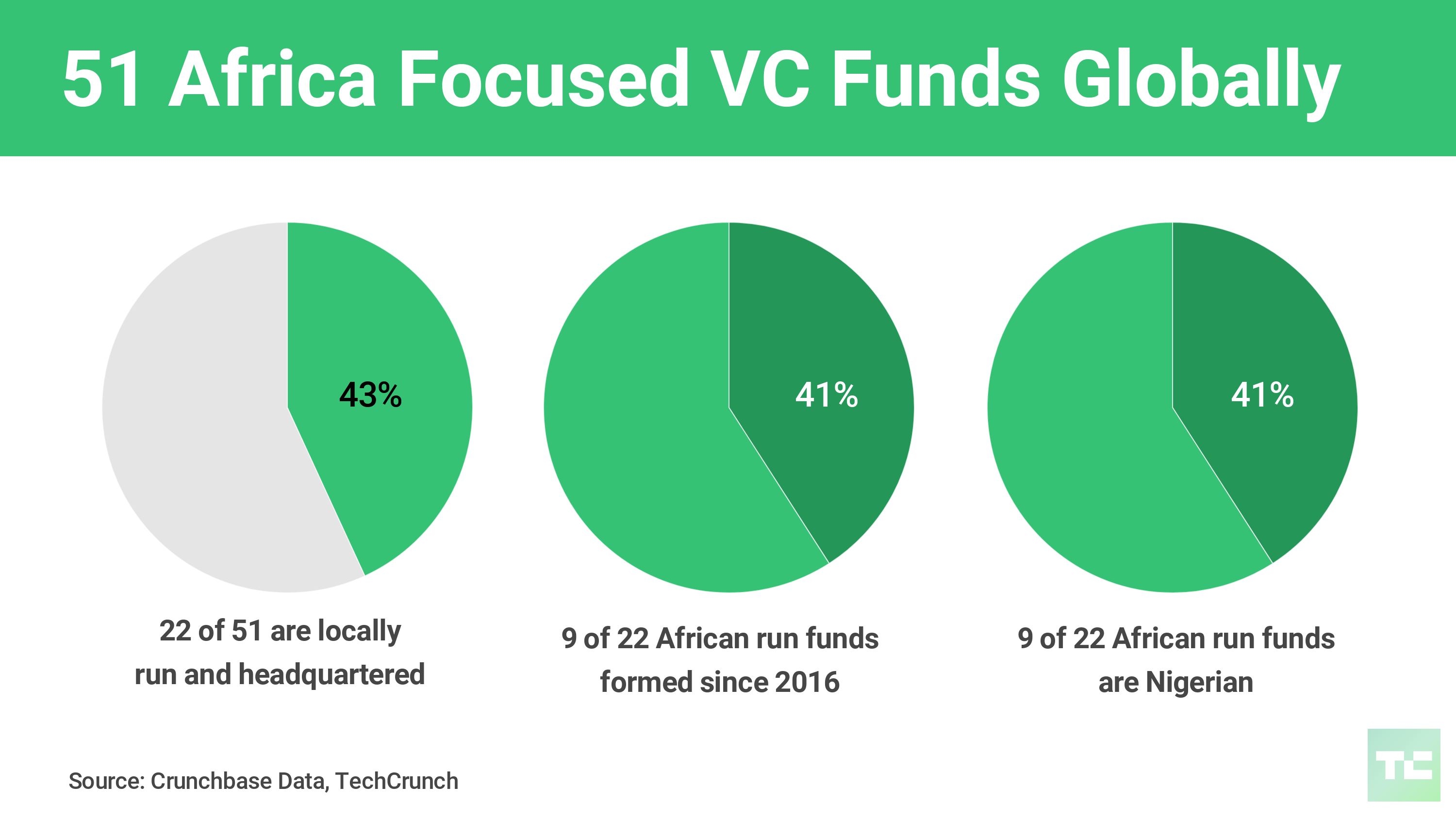
Africa focused VC firms, including those locally run and managed, have grown to 51 globally, according to recent Crunchbase research.

As for a bead on total VC spending for African tech, figures can vary widely.

By Partech’s numbers, compiled from an annual survey it does on Africa, 2017 funding for African startups reached $560 million.

Partech hasn’t released its 2018 Africa VC estimate but it will now be up  some $70 million more from its own recent raise.

31 Jan 2019

Samsung posts fourth-quarter profit drop, warns of weak demand until the second half of 2019

Samsung Electronics reported its largest quarterly profit decline in two years during its earnings report today. As the Galaxy maker warned in its earnings guidance earlier this month, its results were hurt by slower-than-expected demand for semiconductors, which had bolstered its earnings in previous quarters even when smartphone sales were slow.

Samsung’s forecast was also dour, at least for the first half of the year. It said annual earnings will decline thanks to continuing weak demand for chips, but expects demand for memory products and OLED panels to improve during the second half.

The company’s fourth-quarter operating profit was 10.8 trillion won (about $9.7 billion), a 28.7 percent decrease from the 15.15 trillion won it recorded in the same period one year ago. Revenue was 59.27 trillion won, a 10.2 percent drop year over year.

Broken out by business, Samsung’s semiconductor unit recorded quarterly operating profit of 7.8 trillion won, down from 10.8 trillion won a year ago. Its mobile unit’s operating profit was 1.5 trillion won, compared to 2.4 trillion won a year ago.

Smartphone makers, including Samsung rival Apple, have been hit hard by slowing smartphone sales around the world, especially in China. Upgrade cycles are also becoming longer as customers wait to buy newer models.

This hurt both Samsung’s smartphone and chip sales, as “overall market demand for NAND and DRAM drop[ped] due to macroeconomic uncertainties and adjustments in inventory levels by customers including datacenter companies and smartphone makers,” said the company’s earnings report.

Samsung expects chip sales to be sluggish during the first quarter because of weak seasonality and inventory adjustments by its biggest customers. The company was optimistic about the last two quarters of 2019, when it expects demand for chips and OLED panels to pick up thanks seasonal demand and customers finishing their inventory adjustments.