Author: azeeadmin

01 Oct 2018

Tesla shares rebound, erasing losses from SEC-Elon Musk showdown

Tesla shares popped more than 17% on Monday, erasing losses from last week’s tussle between CEO Elon Musk and the U.S. Securities and Exchange Commission.

That “tussle” might have cost Musk $20 million (ands Tesla another $20 million) and his chairman of the board seat. But after an initial shock, investors have apparently recovered. Perhaps it was Musk’s leaked internal email (later filed as an 8k with the SEC) that stated Tesla is “close to achieving profitability.”

Or maybe investors believe the SEC settlement won’t fundamentally change the company. Musk’s tweets might have more lawyerly oversight and he may no longer be chairman, but he’ll remain CEO, is still the largest shareholder and has a board seat.

Even the late-night tweets (yup, there already was one at 1 a.m. PT Monday) haven’t gone away.

In other words, “plus ça change, plus c’est la même chose.”

Either way, some including Barclays analyst Brian A. Johnson, saw the Monday’s rebound coming.

“With 90 days to comply with the settlement, Tesla is likely in our view to strike a typically bullish tone on the 3Q sales release, shareholder letter and conference call,” Johnson wrote in a research note published Monday. “As a result, we would not be surprised to see the stock rebound over the next few weeks. Nevertheless, we reiterate our UW and $210 price target.”

tesla shares october 1 2018

Tesla shares recover Monday, October 1, 2018.

There are other material items that are right around the corner. Tesla and Musk pulled out all the stops (even tapping Tesla owners to volunteer) to close out September with a record number of produced and delivered vehicles.

The company’s third-quarter production numbers will show whether Tesla was able to maintain the previous quarter’s goal of 5,000 Model 3 vehicles per week.

01 Oct 2018

A former U.S. President walks into a blockchain conference…

In a sign of the major cryptocurrency players’ continued influence and ability to pay premium speaking fees, the keynote speaker for Ripple’s two-day Swell conference was none other than former President Bill Clinton.

In what felt like a very odd cameo for Clinton, the former President largely meandered through an hour-long conversation about his new James Patterson book, gun regulation, backroom stories regarding the Oslo Treaty, and a couple loosely-connected points about the cryptocurrency space tossed in there for the audience.

Clinton expectedly did not dive into the regulatory intricacies facing multi-billion dollar enterprises like Ripple (the company), but he did offer a bit of caution to those responsible for where the industry moves next through the lens of what he experienced in the late 90’s dealing with internet companies.

“I think it’s very important that people like you who live on the edge of this will not get so carried away with the immediate financial rewards and sense of empowerment that you forget that one rule nobody’s repealed is that if things sound too good to be true they probably are,” Clinton said. “In a modern world you need a way of determining that and hedging against it without killing the goose that laid the golden egg. That means you have to be clever about what regulatory or other structures that you set up.”

While Clinton certainly did not appear to be a Shingy-esque blockchain evangelist onstage, he delivered a targeted amount of enthusiasm about new technologies like blockchain and artificial intelligence in enhancing accessibility and shaping the country’s economic future.

“This whole blockchain deal has the potential it does only because it is applicable across national borders and income groups, the permutations and possibilities are staggeringly great,” Clinton said.

XRP year-over-year via CoinMarketCap

It’s an understatement that Ripple (the company) has had a staggeringly great calendar year since its last Swell conference as Ripple (the currency) has come to rest 3x where it was a year ago, though, in the meantime it surged astronomic multiples beyond the growth seen by other volatile cryptocurrencies like Bitcoin and dove downward nearly as quickly.

Though Clinton was verbose on plenty of topics unrelated to the conference’s topic at hand, his  few words regarding “not killing the golden goose” with premature or overreaching legislation seemed to be a popular point with investors and entrepreneurs in the crowd who have bought into the concept that XRP is perhaps the “safer” choice for betting on a future financial structure shaped by cryptocurrencies.

01 Oct 2018

Assassin’s Creed Odyssey falls far short of its own wondrous sandbox

It’s hard to imagine a better demonstration of the state of AAA gaming today than Assassin’s Creed Odyssey, a game where the whole of the wine-dark Classical Aegean is available for you to ply with your oars — but which operates according to a risible, cartoonish video game logic that seems, if possible even more anachronistic. Should you play it? Absolutely.

(Very minor spoilers ahead.)

In case you haven’t been following the Assassin’s Creed… well, odyssey, the last few years, the game took some time off following the lavishly produced but ambivalently received Unity and Syndicate games, set in revolutionary Paris and Victorian London respectively. The series, critics said, was wearing itself a bit thin despite the fabulous set dressing.

You can imagine everyone’s surprise when AC returned in Origins, set in an enormous swathe of ancient Egypt. New systems nudged the game from the stealth action of its roots towards the expansive, open-world RPG currently in vogue. It was a little rough around the edges but the scale was welcome, as was the shift away from the increasingly turgid Assassins vs Templars secret society scramble.

The news that the next game would take place in Ancient Greece at the time of the Peloponnesian War thrilled me to no end. I’ve always been a fan of the Classical era, Homer and Herodotus and Periclean Athens and all that. I’ll also admit to an unironic love of 300 and the story of Leonidas’s last stand — the graphic novel, not the movie, which was awful.

Are you kidding me? Look at this.

Here, then was that world brought to life with all the fidelity that Ubisofts hundreds of artists and modelers could bring, with a narrative combining secret societies with classical warfare, historical figures, and high-seas adventure (I loved the pirate-themed AC Black Flag). On paper this is the greatest game ever to grace the screen.

And in a way, it is. Ubisoft’s rendering of the Classical world is so beautiful, so massive, so obviously a labor of love and skill and intensive research that I have spent much of my time in the game simply gawking.

The costumes! The statues! The landscapes! The light! It’s a feast of details at every location, from the idyllic backwater of Kephallonia, where your hero begins their story to the sprawling, bustling Athens just approaching the zenith of its glory. I (that is to say, my character) walked past the Theatre of Dionysus in its construction, which I have visited in person (now ruined and restored, of course), and on up to the Acropolis, where I scaled the Parthenon and looked out over the tiled roofs under one of which, for all I know, I may find Plato sitting and writing the Symposium.
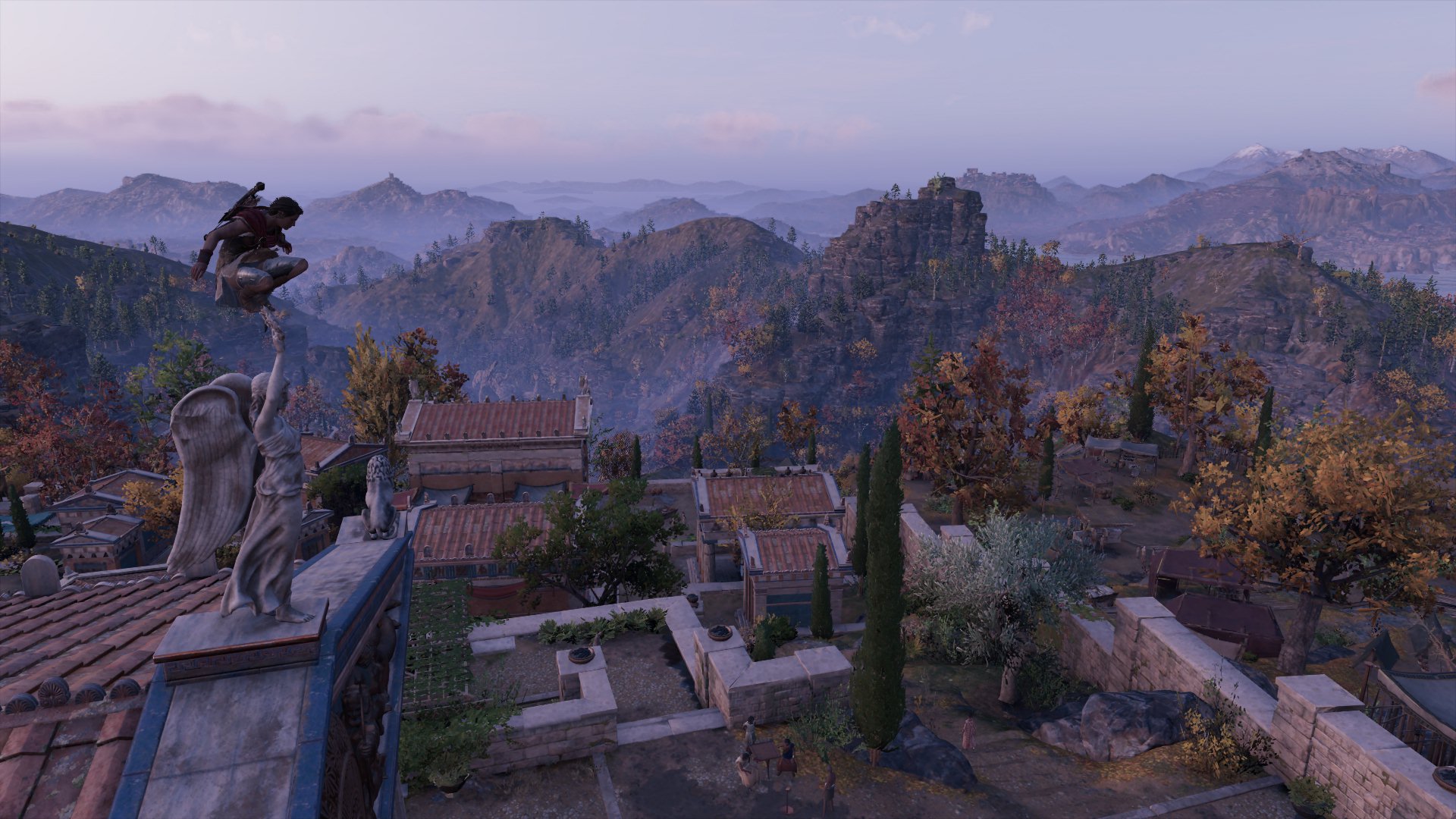
Seriously.

Then I meander to the harbor, board my black ship, and split the seas to explore any of the islands in the entire Aegean — any of them. The whole Aegean! Well, most of it, anyway. Enough that you won’t ask for more. Here be mythical creatures, political machinations, stormy seas and sunny shanties.

The world that Assassin’s Creed: Odyssey in habits, I feel confident in saying, is the largest and most impressive that I have encountered, with special credit given for having to reflect reality to a certain extent, which is not a limitation shared by its eminent competition in the open-world genre, like Horizon: Zero Dawn and Breath of the Wild.

In my opinion, both as a gamer and a lover of antiquity, it is worth the price of admission to experience this world, to see and hear Ancient Greece in a way that was heretofore impossible, and simply to revel in the almost inconceivable level craft that was so obviously put into this mind-boggling world.

And now, having made that judgment, I will proceed to trash the game I just recommended for about two thousand words.

The game itself

Assassin’s Creed: Odyssey, the game itself, is embarrassing to play. The characters you interact with and the minute-by-minute gameplay are so uneven that I truly believe that Ubisoft simply didn’t have time to adequately play-test it. It feels like the game was just too big to run through once they’d made it so they just shipped. If someone from Ubisoft were sitting next to me as I played, I would expect them to be cringing constantly.

It’s an incredibly lopsided collection of old and new ideas, balanced and unbalanced systems, good and bad UI, intuitive and baffling combat, beautiful and repulsive graphics, and excellent and laughable voice acting. I haven’t finished the game, let alone all the side quests, but although I expect to encounter more good things as I go, the bad things were apparently pretty much from the first few minutes and haven’t abated.

The AI of the people in this game seems to have regressed ten years to a simpler age. They are truly idiots all, from people on the street to elite soldiers.
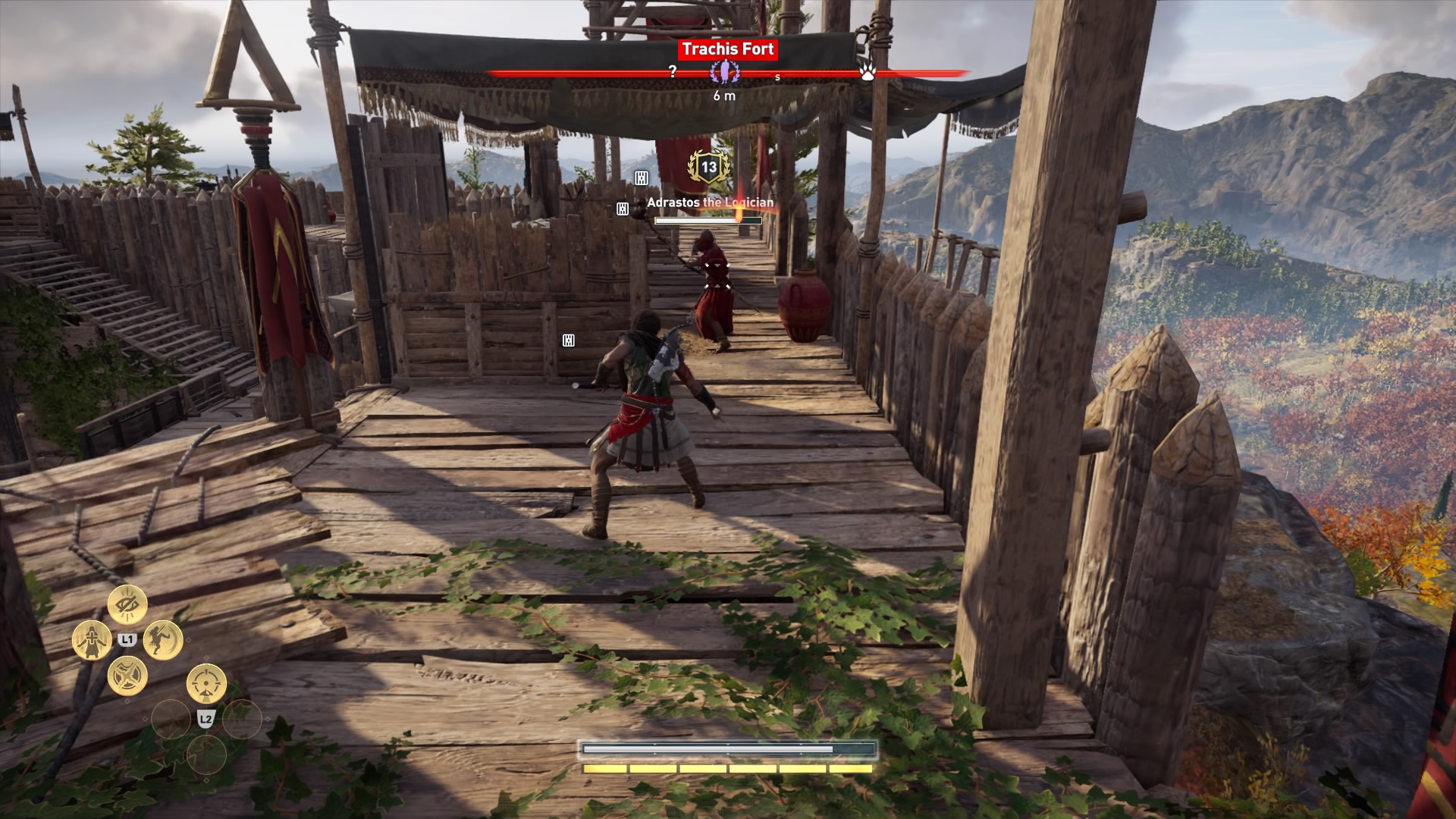
Good old Adrastos the Logician, engaging in hand to hand combat.

One of the first things that happened when I got my horse and learned to have it follow a road was that it mowed down a few laborers. This, I found, would happen everywhere I went: every character in the game walks right in the center of the road and dives madly out of your way as you canter down it, screaming and cursing. Wild animals cluttered the road, and reacting confusedly as I approached and throwing themselves under the hooves of my steed, Phobos.

This was my first taste of what would become a theme. Why, I asked myself, wouldn’t these people just walk on the side of the road? The developers clearly accounted for horses riding down it, and have behaviors and barks for when that happens. But it’s so weird, so unrealistic, so video gamey. Surely in this lovingly rendered world it is not unusual for a horse to run down a mountain road? Why then do they behave in this way? Because the people were not created intelligently — it’s as simple as that. None of them.

I once emptied a military camp of guards and then set about looting the place. A woman was being held captive in a cage — not an uncommon thing to find — so I let her out. As she escaped, thanking me, I turned to take the items out of a nearby chest. The woman, mid-escape, screamed with rage at me for this theft, snatching a nearby spear and rushing me in righteous anger. What?

Perhaps I can’t expect every peasant to be a genius, but guards too (of all ranks) are unbelievably dense. They will step over the corpses of their fellow men to get to their post and not say a word. They will fail to hear the clashing of swords, or not notice a guy being violently flipped over and disemboweled, a matter of feet away. They will follow you one by one around corners where you can dispatch them individually and fail to see or care about the ever-widening pool of blood. They are as dumb as the dumbest guards from games that came out 10 years ago.

“Mother of Spiders”

Not much better are the much-ballyhooed mercenaries, who come after you if you do too many bad things. It’s not really clear what the bad things are, but eventually you’ll see a red helmet icon on your map and know you’ve been naughty. They’re basically guards with special weapons and a few characteristics like “weak to fire” or “takes 20 percent less ranged damage.” Technically they have backstories but you have to drill down to their description to find them, and by the time you’re doing that you’ve probably already killed them. You can recruit them for your ship, like you can recruit anyone, but they generally amount to stat bonuses with funny names like Demos the Drunk. He didn’t act drunk — just had a spear I wanted, so I took him out. I mean, the variation is welcome, but it’s nothing like, for example, the nemesis system in the Mordor series.

Combat is a real mix. You are no longer a fragile assassin who can be killed from a few good hits, but a powerful warrior with supernatural skills like instant mid-battle heals and teleportation. This is combat between equals, but your equals are generally stiff types with two or three attacks they repeat over and over, glowing a bright red or gold before doing so.

A slippery-feeling dodge system zips you through these attacks, or you can parry some of them, then slash away at your attacker. Some guards or targets, especially if they’re a level or two above you, will take minutes of patient slashing before they drop. I was sent on a hunt to kill a legendary boar that I gave up on after a couple minutes because I had only taken its health down by a quarter while not being hit myself.

Compared with other action RPGs it’s pretty listless stuff. More appealing is the stealth, which the fools of guards are obviously there to encourage, since you can empty a camp or fort of its occupants systematically and it can be quite satisfying. But with the perfect knowledge effected by scouting such a place with your eagle’s x-ray vision, it feels more like bullying than anything.

The Peloponnesian War is going on around you, though you’d be hard-pressed to notice most of the time. You don’t exactly take sides, since whatever area you’re in, your enemies are the ones in control. You can weaken the faction in power by various means and force a battle (a melee in which the combat, now against dozens, feels frustratingly sloppy), but ultimately the guards and camps feel much the same as one another — Spartans have different helmets from Athenians.

I thought at first this would be deeper than it is. I had looted a variety of armor pieces, several of which suggested I could use them to blend in among the Athenians whom I was at that moment working to undermine. So I donned them and headed to the nearest camp, hoping to walk about unsuspected, Hitman-style, sowing chaos by releasing caged animals and setting fire to supplies. Nope: I was immediately attacked on approaching the gate, before I’d even come in or done anything suspicious. The guard that had never seen me before apparently recognized me as the bloodthirsty mercenary who’d wiped out a camp a mile or so away, minutes earlier. No espionage for me.

It’s never really clear who you’re fighting or why, because the locations and people are just names. It doesn’t matter if they’re Athenian or Spartan, just that they’re the ones between you and the treasure chest. I guess that’s the life of a mercenary, but it doesn’t make you care a lot.

That was a quest?

The RPG elements, from gear to abilities, have almost no integration with the game itself. From the very beginning you can see your whole skill tree, including things involving the magic spear that you don’t yet know is magic. You gain new abilities and upgrade your ship not through interesting quests or meeting interesting people, but simply by spending points and resources.

When your ship’s captain says the hull ought to be upgraded, it’s not the start of a quest to find some cool big trees or visit his hometown where he left his ship-building tools and pals. It’s literally just a reminder to stock up on wood and iron and press the button to upgrade in the pause screen.

When you meet a talented carpenter whose brother is being held by bandits, it isn’t a quest to reunite these guys for a power team that enables a ship repair superpower. He just turns out to be a regular guy who increases your hull strength by a couple percentage points.
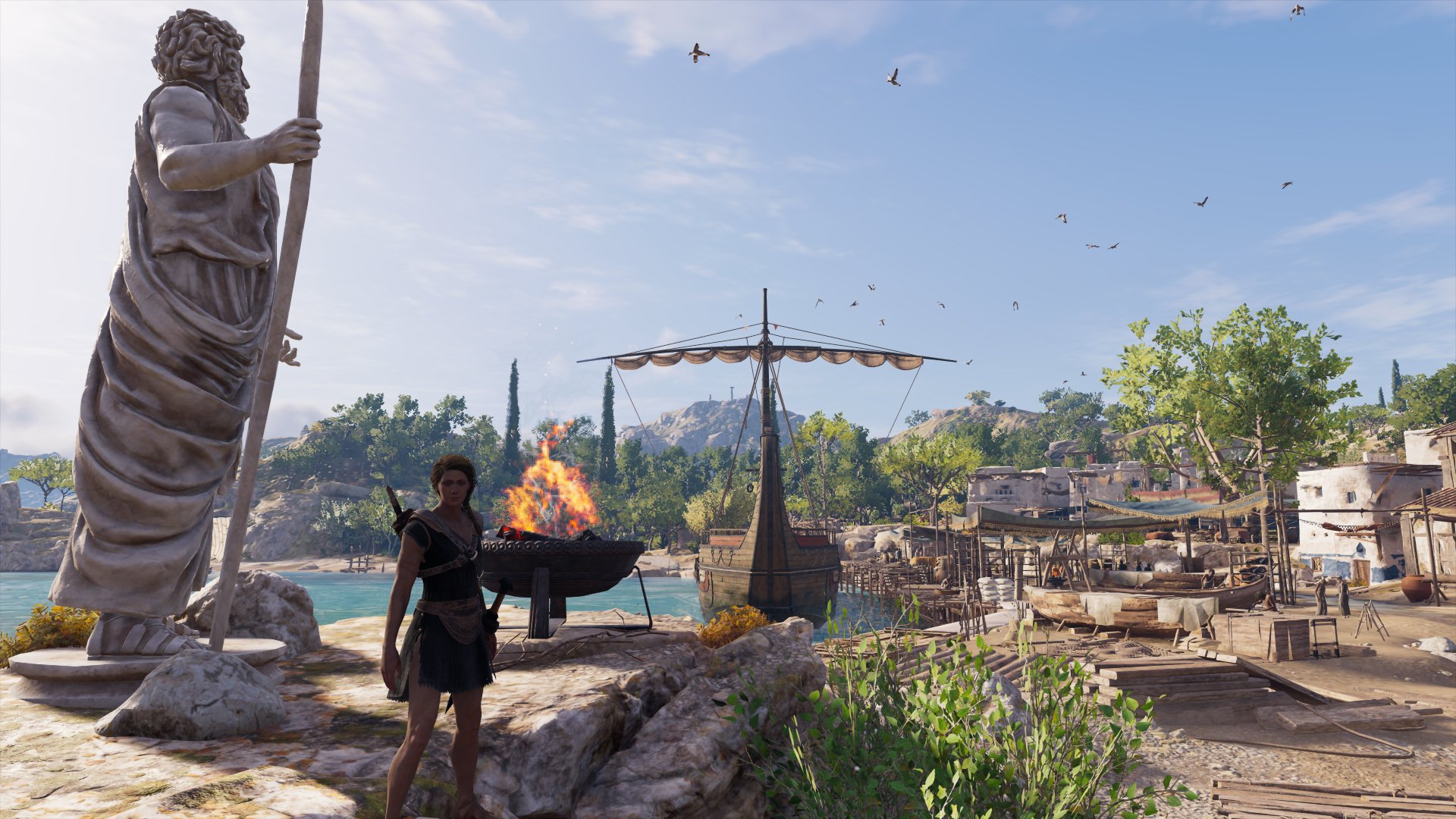
Quests, talked up ahead of release as being fully voiced and emergent, as though you’re receiving a request from help from a needy merchant or the like, are nothing of the sort. Every one I’ve encountered so far has been a variant of: Kill these five wolves specifically. Kill these three Spartan elite guards specifically. Kill these bandits. Sink these ships.

Each has a flimsy justification (they’re blocking the road; they stole money from me) and are often atrociously acted. In one I found the quest giver asleep; he obligingly woke me up to say he wanted to take the fight to some bandits who had been demanding money from him. As soon as I agreed, those very bandits appeared not ten feet away and instantly ran him through. Quest failed.

There are deeper side quests, to be sure. But the hundreds of quests you’ll see on quest boards or appearing randomly in the wild are like this, and rarely give more than a spritz of XP and gold. Sometimes you can recruit the quest-giver, though they might or might not be helpful on your crew.

I wish that they had taken the time and effort that went into creating 20 or 30 of these quests and made one single side quest with multiple steps, characters that mattered a bit, and provided substantial rewards like a new ability for your ship.

Even main story quests, such as the targets you’ll be taking on, can be disappointingly shallow. You’re supposed to be following threads and clues, but several are just handed to you: Here’s some lady. Here’s her exact location. Go kill her. No dialogue, no footwork, no alternatives. Stab this person and take their shiny thing. Shouldn’t I at least try to get some information out of her? Why isn’t there even a death cutscene like in so many of the other games?

The writing is hit and miss. The main story and its immediate side quests are fine — I’m perhaps 25 hours in and I’m interested to see where it’s going, even if it’s not particularly surprising. And it helps that the writing and voices for the main characters are leaps and bounds above the rest.

I chose to play as Kassandra, as opposed to Alexios, for a lot of reasons. And I love her. She’s well-acted, her writing is funny and occasionally realistic, and I like that she is indistinguishable from her male alternative in every way. Your companions, especially Herodotos and your exuberant captain Barnabas, are great.

Yet other characters are ridiculous: badly written, worse acted. Even major ones. I remember one exchange with a soon-to-be-target who was pressuring me to torture some poor sap. His voice acting was so bad, especially compared to his interlocutor Kassandra’s, that I was laughing out loud. He was far from the only example of this.

Games like The Witcher 3 have spoiled us on the quality of the writing and quests, but that should be a new bar to meet, not a high-water point. It’s sad that Ubisoft hasn’t upped its game here, so to speak; it feels like 90 percent of the game I’ve played so far is purely mechanical, and even at its best it sits like a layer of butter spread thinly across an enormous Greek piece of toast. But what toast!

It’s tantalizing to see how good a game like this could be, only to be let down again and again with elements that would feel out of date ten years ago. I’m having a great time when I’m not shaking my head at it, and enjoying the scenery when I’m not being attacked by one of the evidently 50,000 bears out for my blood in the Classical world.

As I wrote earlier, to me it is worth buying just for the good parts. But as someone who cares about games and loves the idea of this one, I can’t help but observe how dated and baffling it is at the same time. It doesn’t live up to the world it was created to inhabit, but that world is practically a complete game in itself, and one that I immediately loved.


01 Oct 2018

After much drama, LendingClub founder Renaud Laplanche get a slap on the wrist by the SEC

In May of 2016, LendingClub CEO Renaud Laplanche faced the most embarrassing outcome imaginable for a founder. He was forced to resign from the peer-to-peer lending company he had created, just 18 months after taking it public in a splashy debut that saw its shares soar 56 percent, and its market cap hit an a stunning $8.5 billion.

Laplanche, said LendingClub’s board at the time, had taken out loans on the platform for himself and family members without being transparent about them. Laplanche reportedly also did not disclose a personal stake in an investment firm in which LendingClub had considered making an investment.

It was a stunning turn of events as they unfolded. Today, however, it looks like the biggest victim was not Laplanche but 12-year-old LendingClub, whose market cap now hovers around $1.6 billion. Not only has Laplanche moved on to a new funding startup called Upgrade that he founded soon after leaving LendingClub and for which he has already raised $142 million from investors, but a two-year-long SEC investigation concluded Friday with a settlement that saw Laplanche neither admit nor deny wrongdoing. Instead, he agreed to pay a $200,000 fine and to be barred from the securities industry for three years.

The last will not, as you might imagine, impact his role as CEO of Upgrade. Though, Jina Choi, the longtime head of the SEC’s San Francisco unit, has called “barring people from their industries” one of the SEC’s “most impactful remedies,” in Laplanche’s case, the ban seems mostly for show as it bars him from very specific securities activities in which he is not currently involved. To wit, he can’t serve as registered investment advisor or a broker dealer or as municipal bond trader, but he isn’t doing any of these things anyway at Upgrade, which purely manages institutional capital.

The SEC wrung a tougher settlement out of LendingClub Asset Management, an investment management unit of LendingClub and a registered investment advisor, which must pay a $4 million fine.

Carrie Dolan, LendingClub’s former chief financial officer, will separately pay $65,000.

According to the SEC, a division of LendingClub under Mr. Laplanche’s direction had adjusted how the funds were managed without telling investors. A source familiar with the situation says there was an imbalance between three-year and five-year loans in a since-shuttered fund that was among several dedicated to investing in notes originated by the platform.

Laplanche declined to talk with us today about the settlement, instead emailing a statement that reads:

I am pleased to have worked out a settlement with the SEC to put to rest any issues related to compliance lapses that might have occurred under my watch at Lending Club. Consistent with SEC policy, I have agreed not to admit nor deny the specific narrative of the events contained in the settlement order.

I am glad that we can now put these issues behind us and focus on the important goals of making credit more affordable to consumers and delivering attractive returns to investors through disciplined underwriting and exciting product innovation. With the benefit of my prior experience, I feel better equipped to establish a strong culture of compliance and effective internal controls under the supervision of capable professionals.

Laplanche did comment on the settlement that Tesla CEO Elon Musk reached with the SEC this past weekend, in which Musk agreed to step down as Tesla’s chairman and pay a $20 million fine after being charged with making “false and misleading statements” to investors on his Twitter account when he said he had secured funding to take the company private.

Musk, too, settled without admitting or denying the allegations of the complaint.

“I understand his decision of just taking the settlement and putting the issue behind him as opposed to going through a lengthy court process,” said Laplanche. Seeming to draw a comparison between himself and Musk, Laplanche added: “He might have prevailed. But it would have taken another two to three years. Sometimes it’s better to settle, to admit no wrongdoing, and move on.”

01 Oct 2018

Benchmark is staying focused, targeting $425M for ninth fund

VC powerhouse Benchmark has filed to raise $425 million for its ninth flagship fund.

While other firms close billion-dollar venture funds despite a history of smaller fundraises, Benchmark is sticking to its guns. The firm, known for its early bets on Twitter, Uber, Snap and WeWork, hasn’t fallen victim to the SoftBank effect.

Longtime Benchmark general partners Bill Gurley and Peter Fenton are listed on the filing alongside three newer members of the partnership. Benchmark staples Mitch Lasky and Matt Cohler, who joined the firm in 2007 and 2008, respectively, are noticeably absent.

Lasky’s departure doesn’t come as a shock. He stepped down from Snap’s board of directors in June just after Recode reported that he was “widely expected to not sign up for another round of deals.”

Cohler, for his part, joined Benchmark a decade ago from Facebook where he was a vice president. At Benchmark, he was responsible for investments in Dropbox, Domo, Duo Security and others.

In June 2017, he replaced Gurley on Uber’s board of directors. Gurley stepped down from the ride-hailing giant’s board following a well-publicized fight to remove founder Travis Kalanick from the c-suite.

Cohler and Lasky are expected to keep their board seats, according to Axios.

Sarah Tavel, Chetan Puttagunta and Eric Vishria will replace the pair in fund nine. Puttagunta joined the storied VC firm from NEA in July. Tavel, Benchmark’s first-ever female partner, was hired about a year ago from Greylock Partners and Vishria, the co-founder of social browsing startup Rockmelt, joined in 2014 as the fifth member of the firm’s partnership.

Despite the personnel shake-ups, Benchmark is shaping up to having a pretty stellar 2018. Two of its portfolio companies, Upwork and Elastic, submitted their S-1 registration statements to the SEC in September. Benchmark is the largest shareholder in both companies.

01 Oct 2018

Facebook breach hit up to 5M EU users, and it faces up to $1.63B in fines

Less than 10 percent of the 50 million users attacked in Facebook’s recent breach lived in the European Union, tweeted the Irish Data Protection Commission which oversees privacy in the region. However, Facebook still could be liable for up to $1.63 billion in fines, or 4 percent of its $40.7 billion in annual global revenue for the prior financial year, if the EU determines it didn’t do enough to protect the security of its users.

Facebook wrote in response to the IDPC’s tweet that “We’re working with regulators including the Irish Data Protection Commission to share preliminary data about Friday’s security issue. As we work to confirm the location of those potentially affected, we plan to release further info soon.”

Facebook alerted regulators and the public to the breach Friday morning after discovering it Tuesday afternoon. That’s important because it came under the 72-hour deadline for announcing hacks that can trigger an additional fine of up to 2 percent of a company’s global revenue if not met.

That hack saw sophisticated attackers combine three bugs in Facebook’s profile, privacy, and video uploading features to steal the access token of 50 million users. These access tokens could allow the attackers to take over user accounts and act as them on Facebook, Instagram, Oculus, and other sites that rely on Facebook’s login system. The EU’s GDPR laws threaten heavy fines for improper security practices and are seen as stricter than those in the US, so its findings during this investigation carry weight.

The big question remains what data was stolen and how it could potentially be misused. Unless investigators or journalists discover a nefarious application for that data, such as how Cambridge Analytica’s illgotten data was used to inform Donald Trump’s campaign strategy, it’s unlikely for the public to see this as more than just another of Facebook’s constant privacy scandals. It could still trigger regulation, or push partners away from using Facebook’s login system, but the world seems to be growing numb to the daily cybersecurity breaches that plague the internet.

01 Oct 2018

Why Blissfully decided to go all in on serverless

Serverless has become a big buzzword of late, and with good reason. It has the potential to completely alter how developers write code. They can simply write a series of event triggers, while letting the cloud vendor worry about providing whatever amount of compute resources are required to complete the job. It represents a huge shift in how programs are developed, but it’s been difficult to find companies who were built from the ground up using this methodology because it’s fairly new.

Blissfully, a startup that helps customers manage their Software as a Service usage inside their companies, is one company that decided to do just that. Aaron White, co-founder and CTO, says that when he was building early versions of Blissfully, he found he needed quick bursts of compute power to deliver a list of all the SaaS products an organization is using.

He figured he could set aside a bunch of servers to provide that burst of power as needed, but that would have required a ton of overhead on his part to manage. At this point, he was a lone programmer trying to prove his SaaS management idea was even possible. As he looked at the pros and cons of serverless versus traditional virtual machines, he began to see serverless as a viable approach.

What he learned along the way was that serverless offers many advantages to a company with a bursty approach like Blissfully, scaling up and down as needed. But it isn’t perfect and there are issues around management and tooling and handling the pros and cons of that scaling ability that he had to learn about on the fly, especially coming in as early as he did with this approach.

Serverless makes sense

Blissfully is a service where serverless made a lot of sense. It wouldn’t have to manage or pay for servers it wasn’t using. Nor would it have to worry about the underlying infrastructure at all. That would be up to the cloud provider, and it would only pay for the bursts as they happened.

Serverless is actually a misnomer in that it doesn’t mean that there are no servers. It actually means that you don’t have to set up a servers in order to run your program, which is a pretty mind-blowing transformation. In traditional programming you have to write your code and set up all the underlying hardware ahead of time, whether it’s in your data center or in the cloud. With serverless, you just write the code and the cloud provider handles all of that for you.

The way it works in practice is that programmers set up a series of event triggers, so when a certain thing happens, the cloud provider sees this and provides the necessary resources on demand. Most of the cloud vendors are offering this type of service, whether AWS Lambda, Azure Functions or Google Functions.

At this point, White began to think about serverless as a way of freeing him from thinking about managing and maintaining infrastructure and all that entailed. “I started thinking, let’s see how far we can take this. Can we really we do absolutely everything serverless, and if so that reduces a ton of traditional DevOps-style work you have to do in practice. There’s still plenty, but that was the thinking at the beginning,” he said.

Overcoming obstacles

But there were issues, especially getting into serverless as early as he did. For starters, White needed to find developers who could work in this fashion, and in 2016 when it launched there weren’t a large number of people out there with  serverless skills. White said he wasn’t looking for direct experience so much as people who were curious to learn and were flexible enough to deal with new technology, regardless of how Blissfully implemented that.

Once he figured out the basics, he needed to think about how this would work structurally. “Part of the challenge is figuring out where do you draw the boundaries between different serverless functions? How do you think about how much you want to overload the capability of one function versus another? How do you want to split it up? You could go way too specific, and you can of course, go way too broad. So there’s a lot of judgement calls to be made in terms of how you want to split your code base to work in this way,” he said.

The other challenge he faced going with a serverless approach so early was a dearth of tooling around it. White found Serverless, Inc right way, which helped him with a basic framework for developing, but he lacked good logging tools and says that the company still struggles with this even now. “DevOps doesn’t go away. This is still running on a server somewhere (even if you don’t control that) and you will run into issues.” One such issue he calls a “cold start issue.”

Getting the resources right

Blissfully uses AWS Lambda, and as their customers require resources, it isn’t as though Amazon has a set of dedicated resources set aside waiting for such an event. If it needs to start servers cold, that could result in latency. To compensate for that, Blissfully runs a job that pings Lambda continually, so that it’s always ready to run the actual application, and there isn’t a lag time related to starting from scratch.

The other issue could be the opposite problem. You can scale much faster than you’re ready to deal with and that can be a problem for a small team. He says in that case, you want to put a limiter on the speed of the calls so you don’t end up spending more than you can afford, and it doesn’t scale beyond your team’s ability to manage it, “I think, in some ways, this actually accelerates you running into problems where you would normally be larger scale before you really had to think about them,” White said.

The other piece is that once Lambda gets everything going, it can move data faster than your external APIs can handle, and that could require limiters to actually slow things down. “I never had that problem in the past where I was provisioning so many computational resources that Google was yelling at me for being too fast. Being too fast for Google takes a lot of effort, but it doesn’t take a lot of effort with Lambda. When it does decide to spool up whatever resources, you can do some serious outbound damaged to other APIs.” That meant he and his team actually had to think very early on about building sophisticated rate limiting schemes.

As for costs, White estimates that his costs are much lower now that he has the service built and in place. “Our costs are so low right now, and far lower than if we had server-based infrastructure. Our computational pattern is very bursty.” That’s because it re-parses the SaaS database once a day or when the customer first signs up, and in between, usage is fairly low beyond interacting with the data.

“So for us that was perfect for serverless because I don’t really need to keep capacity around that would be pure waste.”

01 Oct 2018

Uber’s JUMP bike fleet may soon double in size in SF

If you live in San Francisco, expect to see more of those bright orange electric bikes on the road in the coming weeks. JUMP, the Uber-owned electric bike-share service that is about halfway through its 18-month bike-share pilot in San Francisco, may deploy an additional 250 bikes in the city. The pilot initially enabled JUMP to deploy 250 bikes with the potential to deploy an additional 250, if the first nine months went well.

Next week, the San Francisco Municipal Transportation Agency Director of Transportation is expected to make a formal decision around the expansion. Though, the SFMTA staff is recommending the city allow JUMP to deploy another 250 bikes.

Since deploying the bikes in January, JUMP has clocked more than 326,000 total trips across 38,000 unique riders, with about 2,250 trips taken each week day. Meanwhile, the average JUMP bike gets used between eight to ten times a day, with an average trip length of 2.6 miles.

JUMP bikes operate in tandem with Motivate’s Ford GoBike system, which includes both regular pedal and pedal-assist bikes. Based on the SFMTA’s preliminary conclusions, there is high demand for shared, electric bikes. Also, they seem to serve different trip lengths, origins and destinations, according to the SFMTA.

In San Francisco, there 1,200 Ford GoBikes with about 5,500 active riders. Per weekday, there are about 6,000 trips taken. While each JUMP bike makes about eight to 10 trips a day, a single Ford GoBike makes about one or two. Below, you can see just how much more popular JUMP’s shared, dockless electric bikes are than the shared, station-based bikes from Ford GoBike.

From the beginning, meaning prior to the Uber acquisition, JUMP has been focused on serving traditionally underserved communities. Although 55 percent of JUMP trips start or end in those areas, which the SFMTA identifies as “the most disadvantaged communities in the city,” there are still some communities that have reported a lack of service. Moving forward, the SFMTA says it will work with JUMP to “improve geographic equity and distribution.

01 Oct 2018

What to expect from tomorrow’s Microsoft Surface event

It’s fall. That means every big to mid-sized tech company is holding an event to debut its latest offerings in time for the holidays. Even if said offering is just a laptop made out of leather. Not to be left out, Microsoft’s got an event planned for tomorrow afternoon in New York.

As we noted early last month, we know a few thing for sure. First, it’s a hardware event. Second, it’s focused on Surface products. Third, there’s not going to be a Surface Phone this time.

The invite itself doesn’t offer a lot of information. It’s plain and white, bearing the words “a moment of your time.” Could there be a Surface Watch? I mean, I guess, but I wouldn’t bet on it. We have, however, seen enough credible rumors and leaks that we’ve got a pretty decent handle on what to expect tomorrow.

The Surface Pro 6 is the clear frontrunner here. It’s the product that’s been leaked the most ahead of the event — and honestly, it’s the member of the Surface family most overdue for a refresh. From what we’ve seen so far, I wouldn’t anticipate anything major on the design front. In fact, the product looks nearly identical to its predecessor.

In fact, the company’s apparently staying with the full-size USB ports found on the earlier units, rather than embracing USB-C. Seems like an odd choice for what’s traditionally been a forward-thinking line, though Microsoft appears to prize backward compatibility above all else here.

The internals fare a bit better here. The processors are being upgraded to 8th-gen Intel Cores with between 128GB and 1TB of storage, coupled with 4, 8 or 16GB of RAM.

The same appears to go for the Surface Laptop. I liked the original quite a bit, so I wouldn’t be entirely disappointed if they company doesn’t tweak the design language, as expected — though the supposed lack of USB-C ports is an odd one. As with the Pro, there’s expected to be a black version for the models with higher-end specs.

The Laptop is said to ship in both Core i5 and i7 configurations, coupled with storage starting at 128GB (up to 1TB) and 8 or 16GB of RAM.

Other potential additions include a refreshed Surface Studio and updates to the HoloLens line. The event kicks off tomorrow at 4PM ET.

01 Oct 2018

Sales engagement startup Apollo says its massive contacts database was stolen in a data breach

Apollo, a sales engagement startup boasting a database of more than 200 million contact records, has been hacked.

The YC Combinator-backed company, formerly known as ZenProspect, helps salespeople connect with prospective customers. Using its massive prospect database of 200 million contacts at 10 million companies, Apollo matches sellers with potential buyers.

Apollo said that the bulk of the stolen data was from its prospect database.

Bjoern Zinssmeister, co-founder of Templarbit, which posts details of data breaches on its Breachroom page, obtained a copy of the email sent to affected customers and forwarded it to TechCrunch.

The email said that company said the breach was discovered weeks after system upgrades in July.

“We have confirmed that the majority of exposed information came from our publicly gathered prospect database, which could include name, email address, company names, and other business contact information,” said the email to customers. “Some client-imported data was also accessed without authorization,” the company said, but did not say what kind of data that included.

Apollo’s database contains publicly available data, including names, job titles, employers, social media handles, phone numbers and email addresses. It doesn’t include Social Security numbers, financial data or email addresses and passwords, Apollo said.

Although the company’s chief executive Tim Zheng said that the company had contacted customers in line with its “values of transparency,” Zheng declined to answer TechCrunch’s questions — including what data was taken and how many customers were affected.

“The investigation is still ongoing,” said Zheng in an email. He added that the “only statement that we’re making to press at this time is the customer communication” sent to affected users.

Zheng also refused to say if the company has informed state authorities of the breach. A spokesperson for the California attorney general did not immediately comment on whether Apollo has notified the state about the breach.

Apollo may also face action from European authorities under GDPR.

The data breach may not pose an immediate security risk to users such as if usernames and passwords are stolen, but exposed contact information can have a long-term effect on user security, such as making it easier for attackers to send targeted phishing emails.

Even if the stolen data isn’t considered that sensitive, the breach adds to a growing pile of companies hoarding vast amounts of data but failing to keep it safe.